welcome
Toyota Motor Manufacturing; USA Inc.
12/11/2015 prepared by group 2 1
Group 2
• Dipawita Dey 120305
• Priyanka Hui Chowdhury 120316
• Nusrat Jahan 120329
12/11/2015 prepared by group 2 2
Content
• Company Overview
• Case summary
• Identified problem
• Consequence of problem
• Causes of the problem
• Solution of the problem
• Alternative recommendations
12/11/2015 prepared by group 2 3
Company overview
 A Japanese automobiles manufacturer which
was founded by Kiichiro Toyoda in 1937.
 Produces about 200-millionth vehicles
under 5 brands:
 Toyota
 Hino
 Lexus
 Ranz
 Scion
 The largest listed company in Japan by
market capitalization
 The eleventh largest company in the world
by revenue.
12/11/2015 prepared by group 2 4
Case summary
 Toyota’s Georgetown, Kentucky, plant was established with the aim of providing
flawless & high quality at low cost in 1985.
 Toyota Production system (TPS) aimed at cost reduction by thoroughly
eliminating waste.
 TPS maintained two principles for facilitating the critical process:
 The principle of Just-In-Time (JIT) production.
 The principle of jidoka.
 They followed Kaizen (continuous improvement) in pursuing production system’s
goals continuously
 In Georgetown, assembly operation were performed along 353 stations consisting
of several connected line segments.
 Every station on the assembly line embodied jidoka & kaizen tools.
12/11/2015 prepared by group 2 5
Case summary
• A standardized work chart was posted to Show -
• The cycle time of each work station
• The sequence of work tasks
• The timing to perform them within one cycle
• The mission of the production control (PC) department to feed
necessary parts into TMM operation just-in-time.
• The planning process of PC reflected JIT in two ways:
• The practice of hejinuka (balancing the total order).
• The use of kanban card (related with part production).
12/11/2015 prepared by group 2 6
Case summary
• TMM’s quality control (QC) department pursued a mandatory routine of
tough quality standard.
• QC served two major functions :
• Providing instant feedback to direct operations.
• Preventing problems from occurring in the first place.
• TMM’s purchasing departments concentrated on managing cost over the
long haul.
• In the Georgetown’s plant TMM found some severe problems which they
wanted to work out:
• Less productivity.
• Low line utilization rate than projected target.
• The seat problem.
12/11/2015 prepared by group 2 7
Identified problem
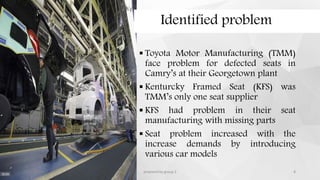
 Toyota Motor Manufacturing (TMM)
face problem for defected seats in
Camry’s at their Georgetown plant
 Kenturcky Framed Seat (KFS) was
TMM’s only one seat supplier
 KFS had problem in their seat
manufacturing with missing parts
 Seat problem increased with the
increase demands by introducing
various car models
12/11/2015 prepared by group 2 8
Consequences of the problem
• Defective product with defective seats
• Production plan failed to meet target
• Run ratio dropped 95% to 85% (45 less cars in per shift)
• Offline production increased
• Production cost increased
12/11/2015 prepared by group 2 9
Causes of the problem
• TMM did not followed TPS philosophy but only matched their tools
• KFS seats matched the TMM capacity but did not implemented TPS
philosophy in production
• TMM identified problems and tagged them in storage for rework
• TMM did not provide real time solution rather increased work load
for rework
12/11/2015 prepared by group 2 10
Solutions of the problem
• TMM need to participate the KFS QC department
• Placing own personnel
• Providing production guideline
• Defective items need to resolve at real time in assembly line
• Review the seat designs for new models
12/11/2015 prepared by group 2 11
Alternative Recommendations
• Close relation should be maintained between KFS, TMM and
TMC
• TMM should be inspected all seats properly in KSP before
they are shipped
 It will encourage them --------
To improve quality
To remove problematic seats before they are shipped
12/11/2015 prepared by group 2 12
Alternative Recommendations
• TMM should share quality review report with KSF
It will make the firm able to analyze areas with fundamental
defect problems
• TPS integration will benefit the Toyota supplier network
• TMM should recommend a reduction in the variety of seats
with TMC
12/11/2015 prepared by group 2 13
Questions ???
12/11/2015 prepared by group 2 14

Toyota- HBS case

  • 1.
    welcome Toyota Motor Manufacturing;USA Inc. 12/11/2015 prepared by group 2 1
  • 2.
    Group 2 • DipawitaDey 120305 • Priyanka Hui Chowdhury 120316 • Nusrat Jahan 120329 12/11/2015 prepared by group 2 2
  • 3.
    Content • Company Overview •Case summary • Identified problem • Consequence of problem • Causes of the problem • Solution of the problem • Alternative recommendations 12/11/2015 prepared by group 2 3
  • 4.
    Company overview  AJapanese automobiles manufacturer which was founded by Kiichiro Toyoda in 1937.  Produces about 200-millionth vehicles under 5 brands:  Toyota  Hino  Lexus  Ranz  Scion  The largest listed company in Japan by market capitalization  The eleventh largest company in the world by revenue. 12/11/2015 prepared by group 2 4
  • 5.
    Case summary  Toyota’sGeorgetown, Kentucky, plant was established with the aim of providing flawless & high quality at low cost in 1985.  Toyota Production system (TPS) aimed at cost reduction by thoroughly eliminating waste.  TPS maintained two principles for facilitating the critical process:  The principle of Just-In-Time (JIT) production.  The principle of jidoka.  They followed Kaizen (continuous improvement) in pursuing production system’s goals continuously  In Georgetown, assembly operation were performed along 353 stations consisting of several connected line segments.  Every station on the assembly line embodied jidoka & kaizen tools. 12/11/2015 prepared by group 2 5
  • 6.
    Case summary • Astandardized work chart was posted to Show - • The cycle time of each work station • The sequence of work tasks • The timing to perform them within one cycle • The mission of the production control (PC) department to feed necessary parts into TMM operation just-in-time. • The planning process of PC reflected JIT in two ways: • The practice of hejinuka (balancing the total order). • The use of kanban card (related with part production). 12/11/2015 prepared by group 2 6
  • 7.
    Case summary • TMM’squality control (QC) department pursued a mandatory routine of tough quality standard. • QC served two major functions : • Providing instant feedback to direct operations. • Preventing problems from occurring in the first place. • TMM’s purchasing departments concentrated on managing cost over the long haul. • In the Georgetown’s plant TMM found some severe problems which they wanted to work out: • Less productivity. • Low line utilization rate than projected target. • The seat problem. 12/11/2015 prepared by group 2 7
  • 8.
    Identified problem  ToyotaMotor Manufacturing (TMM) face problem for defected seats in Camry’s at their Georgetown plant  Kenturcky Framed Seat (KFS) was TMM’s only one seat supplier  KFS had problem in their seat manufacturing with missing parts  Seat problem increased with the increase demands by introducing various car models 12/11/2015 prepared by group 2 8
  • 9.
    Consequences of theproblem • Defective product with defective seats • Production plan failed to meet target • Run ratio dropped 95% to 85% (45 less cars in per shift) • Offline production increased • Production cost increased 12/11/2015 prepared by group 2 9
  • 10.
    Causes of theproblem • TMM did not followed TPS philosophy but only matched their tools • KFS seats matched the TMM capacity but did not implemented TPS philosophy in production • TMM identified problems and tagged them in storage for rework • TMM did not provide real time solution rather increased work load for rework 12/11/2015 prepared by group 2 10
  • 11.
    Solutions of theproblem • TMM need to participate the KFS QC department • Placing own personnel • Providing production guideline • Defective items need to resolve at real time in assembly line • Review the seat designs for new models 12/11/2015 prepared by group 2 11
  • 12.
    Alternative Recommendations • Closerelation should be maintained between KFS, TMM and TMC • TMM should be inspected all seats properly in KSP before they are shipped  It will encourage them -------- To improve quality To remove problematic seats before they are shipped 12/11/2015 prepared by group 2 12
  • 13.
    Alternative Recommendations • TMMshould share quality review report with KSF It will make the firm able to analyze areas with fundamental defect problems • TPS integration will benefit the Toyota supplier network • TMM should recommend a reduction in the variety of seats with TMC 12/11/2015 prepared by group 2 13
  • 14.