[Business Communication]
[Company Name]
Performance Appraisal
Question 3
Performance appraisal can have many positive effects if the
employee views the appraisal as valuable and valid.
Scenario: A group of registered nurses (RN), with five to ten
years of work experience in your department had verbalised that
the appraisal they received from another Nurse Manager was
unfair. You are tasked to re-appraise these RNs. Describe the
strategies that you would undertake to ensure a fair assessment
process.
Objectives
• Discuss the types of Performance Appraisal
• Highlight the benefits of Performance Appraisal
• Elaborate on disadvantage of Performance Appraisal
• Underline the Performance Appraisal system in hospital
• Compare the Performance Appraisal forms of four hospitals
• Explore strategies taken to deal with the situation in the
scenario
Types of appraisal
Management By Objectives (MBO)
• A method in which managers or employers set a list of objectives and
make assessments on their performance on a regular basis, and finally
make rewards based on the results achieved (Nandy, 2011)
• This method mostly cares about the results achieved (goals) but not to the
way how employees can fulfill them.
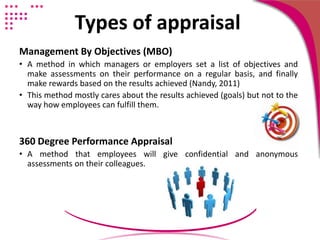
360 Degree Performance Appraisal
• A method that employees will give confidential and anonymous
assessments on their colleagues.
Types of appraisal
Performance Ranking Method
• Used to assess the working performance of employees from the highest to lowest
levels
• Managers will make comparisons of an employee with the others, instead of making
comparison of each employee with some certain standards (Dhami, 2010)
Peer Review Appraisal
• A way to more effectively gauge the performance of employees by establishing
relevant evaluation criteria, using those best equipped to speak about individual’s
work to grade him / her accordingly
• Peer review can take the form of disciplinary panels or ongoing feedback between
co-workers (Lovering, 2006)
• This method helps to enhance employee trust and communication
Benefits of Performance Appraisal
Organization
• Recognize and manage staff performance
• Planning and decision making
• Improve staff retention
Appraiser
• Framework for sharing feedback
• Promote career planning for staff (Chandra & Frank, 2004)
• Feedback on own management style and leadership skills (Parkin &
McKimm, 2009)
Benefits of Performance Appraisal
Appraisee
• Reflection on areas of weakness and strengths (Finlay &
Mclaren, 2009)
• Opportunity to raise issues / obstacles
• Focus on developing individual performance
• Better understanding of goals and requirements
• Identify action plan for future development
• Indication for Salary increment / incentives (Parkin &
McKimm, 2009)
Disadvantages of Performance Appraisal
• If not done right, they can create a NEGATIVE EXPERIENCE.
• Performance appraisals are very time consuming and can be
overwhelming to managers with many employees.
• They are based on human assessment and are subject to rater
errors and biases.
• They can create a very stressful environment for everyone
involved.
Performance Appraisal system in hospital
• Performance Appraisal are usually done annually (interim is done 6
months after appraisal is given)
• Open appraisal system as a measure of employee’s performance
(individual competency and development)
• An employee who is served with a Written Warning during the
appraisal period shall immediately receive a performance rating of
“4”. He / She will be subject to a second performance review in 6
months.
• Both the appraisee and the appraiser will sign the Performance
Appraisal Form and the employee can request a copy of the
completed appraisal form (SGH Performance Appraisal, 2011).
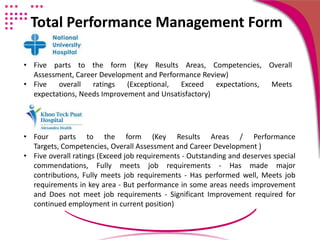
• Five parts to the form (Key Results Areas, Competencies, Overall
Assessment, Career Development and Performance Review)
• Five overall ratings (Exceptional, Exceed expectations, Meets
expectations, Needs Improvement and Unsatisfactory)
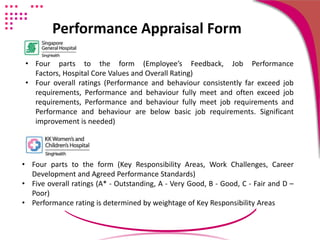
• Four parts to the form (Key Results Areas / Performance
Targets, Competencies, Overall Assessment and Career Development )
• Five overall ratings (Exceed job requirements - Outstanding and deserves special
commendations, Fully meets job requirements - Has made major
contributions, Fully meets job requirements - Has performed well, Meets job
requirements in key area - But performance in some areas needs improvement
and Does not meet job requirements - Significant Improvement required for
continued employment in current position)
Total Performance Management Form
• Four parts to the form (Employee’s Feedback, Job Performance
Factors, Hospital Core Values and Overall Rating)
• Four overall ratings (Performance and behaviour consistently far exceed job
requirements, Performance and behaviour fully meet and often exceed job
requirements, Performance and behaviour fully meet job requirements and
Performance and behaviour are below basic job requirements. Significant
improvement is needed)
• Four parts to the form (Key Responsibility Areas, Work Challenges, Career
Development and Agreed Performance Standards)
• Five overall ratings (A* - Outstanding, A - Very Good, B - Good, C - Fair and D –
Poor)
• Performance rating is determined by weightage of Key Responsibility Areas
Performance Appraisal Form
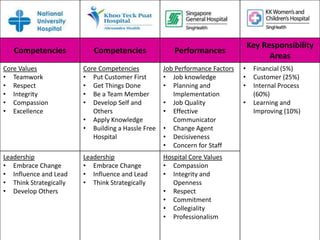
Competencies Competencies Performances
Key Responsibility
Areas
Core Values
• Teamwork
• Respect
• Integrity
• Compassion
• Excellence
Core Competencies
• Put Customer First
• Get Things Done
• Be a Team Member
• Develop Self and
Others
• Apply Knowledge
• Building a Hassle Free
Hospital
Job Performance Factors
• Job knowledge
• Planning and
Implementation
• Job Quality
• Effective
Communicator
• Change Agent
• Decisiveness
• Concern for Staff
• Financial (5%)
• Customer (25%)
• Internal Process
(60%)
• Learning and
Improving (10%)
Leadership
• Embrace Change
• Influence and Lead
• Think Strategically
• Develop Others
Leadership
• Embrace Change
• Influence and Lead
• Think Strategically
Hospital Core Values
• Compassion
• Integrity and
Openness
• Respect
• Commitment
• Collegiality
• Professionalism
Process of Employee Appeal
Singapore General Hospital Policy
• Every employee has a RIGHT TO APPEAL against management’s decision
affecting them
• The Hospital shall resolve all employees grievances fairly as soon as they
surface so as not to allow them to grow in magnitude.
• Where the grievance cannot be resolved at the immediate Supervisor's
level, the employee may bring it to the next supervisory level.
• Management must ensure that the employee’s grievance is responded in a
timely manner (usually within 7 working days)
Process of Employee Appeal
Singapore General Hospital Policy
• The employee has the right to appeal until his grievance is resolved or
reaches the level of the CEO whose decision shall be final.
• There will be no reprisal against any party concerned. The employee in
particular will not suffer victimization from anyone as a result of seeking
resolution of a grievance through this procedure.
• The employee may request to be accompanied by a fellow employee as
spokesman at any time. Where additional time is required in making a
determination, the employee will be informed of the expected period of
extension and the reasons (SGH Employee Appeal Procedure, 2011)
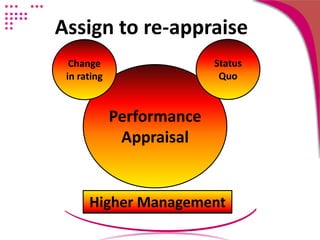
Assign to re-appraise
Higher Management
Performance
Appraisal
Change
in rating
Status
Quo
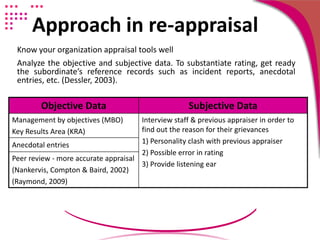
Approach in re-appraisal
Know your organization appraisal tools well
Analyze the objective and subjective data. To substantiate rating, get ready
the subordinate’s reference records such as incident reports, anecdotal
entries, etc. (Dessler, 2003).
Objective Data Subjective Data
Management by objectives (MBO)
Key Results Area (KRA)
Interview staff & previous appraiser in order to
find out the reason for their grievances
1) Personality clash with previous appraiser
2) Possible error in rating
3) Provide listening ear
Anecdotal entries
Peer review - more accurate appraisal
(Nankervis, Compton & Baird, 2002)
(Raymond, 2009)
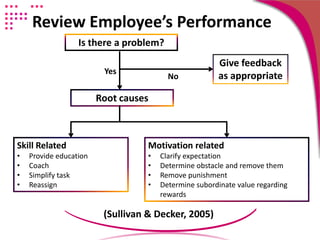
Review Employee’s Performance
Is there a problem?
No
Give feedback
as appropriateYes
Root causes
Skill Related
• Provide education
• Coach
• Simplify task
• Reassign
Motivation related
• Clarify expectation
• Determine obstacle and remove them
• Remove punishment
• Determine subordinate value regarding
rewards
(Sullivan & Decker, 2005)
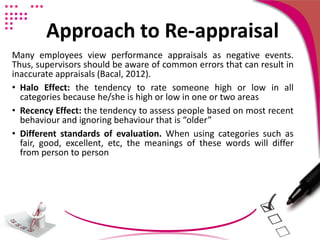
Approach to Re-appraisal
Many employees view performance appraisals as negative events.
Thus, supervisors should be aware of common errors that can result in
inaccurate appraisals (Bacal, 2012).
• Halo Effect: the tendency to rate someone high or low in all
categories because he/she is high or low in one or two areas
• Recency Effect: the tendency to assess people based on most recent
behaviour and ignoring behaviour that is “older”
• Different standards of evaluation. When using categories such as
fair, good, excellent, etc, the meanings of these words will differ
from person to person
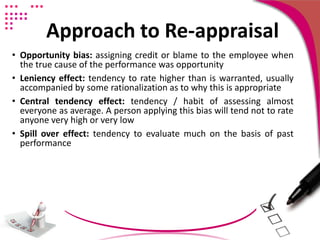
Approach to Re-appraisal
• Opportunity bias: assigning credit or blame to the employee when
the true cause of the performance was opportunity
• Leniency effect: tendency to rate higher than is warranted, usually
accompanied by some rationalization as to why this is appropriate
• Central tendency effect: tendency / habit of assessing almost
everyone as average. A person applying this bias will tend not to rate
anyone very high or very low
• Spill over effect: tendency to evaluate much on the basis of past
performance
Approach to Re-appraisal
• Exhibits effective communication skills with the ability to listen
(Vasset, 2010)
• Direct subordinate to focus on organizational objectives in PPA
discussion (Dessler, 2003)
• Understand the subordinate‘s root causes for under performance
(Ellis, 2008)
• Supervisor should not put personal spins on the PPA but must
project to staff how she could improve herself. (Ellis, 2008)
• Supervisor should not view subordinate with under performance as
punitive (Vasset, 2010)
Change in Rating
• Higher management (SNM / ADN) to approve for re-appraisal
by another appraiser
• Collate and present facts to higher management who will act
as a mediator
• Final decision lies with higher management
• Regardless of outcome, previous appraiser to conduct the re-
appraisal session
– Save face (previous appraiser)
– Maintain trust (appraisee)
Status Quo
• Focus on their actions, not on the person
• Be specific and timely
• Be calm
• Reaffirm your faith in the person
• Define positive steps
• Get over it
Status Quo
How to handle defensive employee
• Recognize denial is the first reaction of a subordinate with poor
performance
• Others react with anger and aggression
• Never attack a person’s defenses
― Concentrate on the act itself rather than on the person (Dessler, 2003)
― Direct subordinate to focus on organizational performance standards
(Ellis, 2008)
• Maintain subordinate dignity (Rayner & Smith, 2009)
― Interview session to be done in private
― Provide constructive feedback
Status Quo
How to handle defensive employee
• Postponed interview when subordinate is not ready
― Allow subordinate to let off the steam when confronting (Dessler,
2003)
― Allow subordinate to reflect on what has transpired (Sullivan & Decker,
2005)
• Recognize your own limitation
― Seek help and do not expect to solve every problem by yourself
(Dessler, 2003)
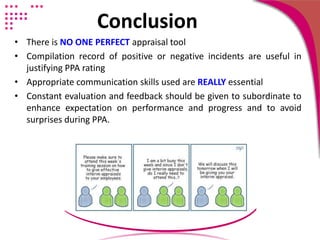
Conclusion
• There is NO ONE PERFECT appraisal tool
• Compilation record of positive or negative incidents are useful in
justifying PPA rating
• Appropriate communication skills used are REALLY essential
• Constant evaluation and feedback should be given to subordinate to
enhance expectation on performance and progress and to avoid
surprises during PPA.
References
Bacal, R. (2012). A Performance Management Bias and Error Glossary. Retrieved from
http://performance-appraisals.org/Bacalsappraisalarticles/articles/bias.htm)
Chandran, A., & Frank, D. Z. (2004). Utilization of Performance Appraisal Systems in
Health Care Organizations and Improvement Strategies for Supervisors. The Health
Care Manager, 23(1), 25-30.
Dessler, G. (2003). Human Resource Management (9th ed.). New Jersey: Prentice Hall.
Dhami, R. 2010. Performance appraisal methods. Retrieved from
http://www.humanresources.hrvinet.com/performance-appraisal-methods/
Ellis, J. (2008). Managing Performance. Nursing Management, 1(15), 28-33
Finlay, K., & McLaren, S. (2009). Does appraisal enhance learning, improve practice and
encourage continuing professional development? A survey of general practitioner’s
experiences of appraisal. Quality in Primary Care, (17), 387-395.
References
Kandang Kerbau Women's and Children's Hospital. (2010). Performance Appraisal Form
(10A1-0001).
Khoo Teck Puat Hospital. (2011). Total Performance Management Form.
Lovering, C. (2006). The advantages of the peer review appraisal method. Retrieved
from http://smallbusiness.chron.com/advantages-peer-review-appraisal-method-
34573.html
Nandy, R. (2011). Why Do We Need Performance Appraisal? Retrieved from
http://www.chillibreeze.com/articles_various/performance-appraisal.asp
National University Hospital. (2010). Total Performance Management Form (R1-03-09).
Parkin, D., & McKimm, J. (2009). Managing the Appraisal. British Journal of Hospital
Medicine, 70 (9), 528-531.
Rayner, C., & Smith, D.A. (2009). Managing and Leading People. London: Chartered
Institute of Personnel & Development.
References
Reh, F.J. (2012). How To Give Negative Feedback Properly. Retrieved from
http://management.about.com/cs/peoplemanagement/ht/negativefb.htm
Singapore General Hospital. (2011). Employee Appeal Procedure (HR-PP-073).
Singapore General Hospital. (2011). Performance Appraisal Form - Exempt Employee
(91200-FM-010).
Singapore General Hospital. (2011). Performance Feedback (HR-PP-020).
Sullivan, E. J., & Decker, P. J. (2005). Effective leadership and management in nursing
(6th ed.). New Jersey: Prentice Hall.
Vasset, F. (2010). Employee s’ perception of justice in performance appraisals. Nursing
Management, 2(17), 30-34.

Performance appraisal

  • 1.
  • 2.
    Question 3 Performance appraisalcan have many positive effects if the employee views the appraisal as valuable and valid. Scenario: A group of registered nurses (RN), with five to ten years of work experience in your department had verbalised that the appraisal they received from another Nurse Manager was unfair. You are tasked to re-appraise these RNs. Describe the strategies that you would undertake to ensure a fair assessment process.
  • 3.
    Objectives • Discuss thetypes of Performance Appraisal • Highlight the benefits of Performance Appraisal • Elaborate on disadvantage of Performance Appraisal • Underline the Performance Appraisal system in hospital • Compare the Performance Appraisal forms of four hospitals • Explore strategies taken to deal with the situation in the scenario
  • 4.
    Types of appraisal ManagementBy Objectives (MBO) • A method in which managers or employers set a list of objectives and make assessments on their performance on a regular basis, and finally make rewards based on the results achieved (Nandy, 2011) • This method mostly cares about the results achieved (goals) but not to the way how employees can fulfill them. 360 Degree Performance Appraisal • A method that employees will give confidential and anonymous assessments on their colleagues.
  • 5.
    Types of appraisal PerformanceRanking Method • Used to assess the working performance of employees from the highest to lowest levels • Managers will make comparisons of an employee with the others, instead of making comparison of each employee with some certain standards (Dhami, 2010) Peer Review Appraisal • A way to more effectively gauge the performance of employees by establishing relevant evaluation criteria, using those best equipped to speak about individual’s work to grade him / her accordingly • Peer review can take the form of disciplinary panels or ongoing feedback between co-workers (Lovering, 2006) • This method helps to enhance employee trust and communication
  • 6.
    Benefits of PerformanceAppraisal Organization • Recognize and manage staff performance • Planning and decision making • Improve staff retention Appraiser • Framework for sharing feedback • Promote career planning for staff (Chandra & Frank, 2004) • Feedback on own management style and leadership skills (Parkin & McKimm, 2009)
  • 7.
    Benefits of PerformanceAppraisal Appraisee • Reflection on areas of weakness and strengths (Finlay & Mclaren, 2009) • Opportunity to raise issues / obstacles • Focus on developing individual performance • Better understanding of goals and requirements • Identify action plan for future development • Indication for Salary increment / incentives (Parkin & McKimm, 2009)
  • 8.
    Disadvantages of PerformanceAppraisal • If not done right, they can create a NEGATIVE EXPERIENCE. • Performance appraisals are very time consuming and can be overwhelming to managers with many employees. • They are based on human assessment and are subject to rater errors and biases. • They can create a very stressful environment for everyone involved.
  • 9.
    Performance Appraisal systemin hospital • Performance Appraisal are usually done annually (interim is done 6 months after appraisal is given) • Open appraisal system as a measure of employee’s performance (individual competency and development) • An employee who is served with a Written Warning during the appraisal period shall immediately receive a performance rating of “4”. He / She will be subject to a second performance review in 6 months. • Both the appraisee and the appraiser will sign the Performance Appraisal Form and the employee can request a copy of the completed appraisal form (SGH Performance Appraisal, 2011).
  • 11.
    • Five partsto the form (Key Results Areas, Competencies, Overall Assessment, Career Development and Performance Review) • Five overall ratings (Exceptional, Exceed expectations, Meets expectations, Needs Improvement and Unsatisfactory) • Four parts to the form (Key Results Areas / Performance Targets, Competencies, Overall Assessment and Career Development ) • Five overall ratings (Exceed job requirements - Outstanding and deserves special commendations, Fully meets job requirements - Has made major contributions, Fully meets job requirements - Has performed well, Meets job requirements in key area - But performance in some areas needs improvement and Does not meet job requirements - Significant Improvement required for continued employment in current position) Total Performance Management Form
  • 12.
    • Four partsto the form (Employee’s Feedback, Job Performance Factors, Hospital Core Values and Overall Rating) • Four overall ratings (Performance and behaviour consistently far exceed job requirements, Performance and behaviour fully meet and often exceed job requirements, Performance and behaviour fully meet job requirements and Performance and behaviour are below basic job requirements. Significant improvement is needed) • Four parts to the form (Key Responsibility Areas, Work Challenges, Career Development and Agreed Performance Standards) • Five overall ratings (A* - Outstanding, A - Very Good, B - Good, C - Fair and D – Poor) • Performance rating is determined by weightage of Key Responsibility Areas Performance Appraisal Form
  • 13.
    Competencies Competencies Performances KeyResponsibility Areas Core Values • Teamwork • Respect • Integrity • Compassion • Excellence Core Competencies • Put Customer First • Get Things Done • Be a Team Member • Develop Self and Others • Apply Knowledge • Building a Hassle Free Hospital Job Performance Factors • Job knowledge • Planning and Implementation • Job Quality • Effective Communicator • Change Agent • Decisiveness • Concern for Staff • Financial (5%) • Customer (25%) • Internal Process (60%) • Learning and Improving (10%) Leadership • Embrace Change • Influence and Lead • Think Strategically • Develop Others Leadership • Embrace Change • Influence and Lead • Think Strategically Hospital Core Values • Compassion • Integrity and Openness • Respect • Commitment • Collegiality • Professionalism
  • 15.
    Process of EmployeeAppeal Singapore General Hospital Policy • Every employee has a RIGHT TO APPEAL against management’s decision affecting them • The Hospital shall resolve all employees grievances fairly as soon as they surface so as not to allow them to grow in magnitude. • Where the grievance cannot be resolved at the immediate Supervisor's level, the employee may bring it to the next supervisory level. • Management must ensure that the employee’s grievance is responded in a timely manner (usually within 7 working days)
  • 16.
    Process of EmployeeAppeal Singapore General Hospital Policy • The employee has the right to appeal until his grievance is resolved or reaches the level of the CEO whose decision shall be final. • There will be no reprisal against any party concerned. The employee in particular will not suffer victimization from anyone as a result of seeking resolution of a grievance through this procedure. • The employee may request to be accompanied by a fellow employee as spokesman at any time. Where additional time is required in making a determination, the employee will be informed of the expected period of extension and the reasons (SGH Employee Appeal Procedure, 2011)
  • 17.
    Assign to re-appraise HigherManagement Performance Appraisal Change in rating Status Quo
  • 18.
    Approach in re-appraisal Knowyour organization appraisal tools well Analyze the objective and subjective data. To substantiate rating, get ready the subordinate’s reference records such as incident reports, anecdotal entries, etc. (Dessler, 2003). Objective Data Subjective Data Management by objectives (MBO) Key Results Area (KRA) Interview staff & previous appraiser in order to find out the reason for their grievances 1) Personality clash with previous appraiser 2) Possible error in rating 3) Provide listening ear Anecdotal entries Peer review - more accurate appraisal (Nankervis, Compton & Baird, 2002) (Raymond, 2009)
  • 19.
    Review Employee’s Performance Isthere a problem? No Give feedback as appropriateYes Root causes Skill Related • Provide education • Coach • Simplify task • Reassign Motivation related • Clarify expectation • Determine obstacle and remove them • Remove punishment • Determine subordinate value regarding rewards (Sullivan & Decker, 2005)
  • 20.
    Approach to Re-appraisal Manyemployees view performance appraisals as negative events. Thus, supervisors should be aware of common errors that can result in inaccurate appraisals (Bacal, 2012). • Halo Effect: the tendency to rate someone high or low in all categories because he/she is high or low in one or two areas • Recency Effect: the tendency to assess people based on most recent behaviour and ignoring behaviour that is “older” • Different standards of evaluation. When using categories such as fair, good, excellent, etc, the meanings of these words will differ from person to person
  • 21.
    Approach to Re-appraisal •Opportunity bias: assigning credit or blame to the employee when the true cause of the performance was opportunity • Leniency effect: tendency to rate higher than is warranted, usually accompanied by some rationalization as to why this is appropriate • Central tendency effect: tendency / habit of assessing almost everyone as average. A person applying this bias will tend not to rate anyone very high or very low • Spill over effect: tendency to evaluate much on the basis of past performance
  • 22.
    Approach to Re-appraisal •Exhibits effective communication skills with the ability to listen (Vasset, 2010) • Direct subordinate to focus on organizational objectives in PPA discussion (Dessler, 2003) • Understand the subordinate‘s root causes for under performance (Ellis, 2008) • Supervisor should not put personal spins on the PPA but must project to staff how she could improve herself. (Ellis, 2008) • Supervisor should not view subordinate with under performance as punitive (Vasset, 2010)
  • 23.
    Change in Rating •Higher management (SNM / ADN) to approve for re-appraisal by another appraiser • Collate and present facts to higher management who will act as a mediator • Final decision lies with higher management • Regardless of outcome, previous appraiser to conduct the re- appraisal session – Save face (previous appraiser) – Maintain trust (appraisee)
  • 24.
    Status Quo • Focuson their actions, not on the person • Be specific and timely • Be calm • Reaffirm your faith in the person • Define positive steps • Get over it
  • 25.
    Status Quo How tohandle defensive employee • Recognize denial is the first reaction of a subordinate with poor performance • Others react with anger and aggression • Never attack a person’s defenses ― Concentrate on the act itself rather than on the person (Dessler, 2003) ― Direct subordinate to focus on organizational performance standards (Ellis, 2008) • Maintain subordinate dignity (Rayner & Smith, 2009) ― Interview session to be done in private ― Provide constructive feedback
  • 26.
    Status Quo How tohandle defensive employee • Postponed interview when subordinate is not ready ― Allow subordinate to let off the steam when confronting (Dessler, 2003) ― Allow subordinate to reflect on what has transpired (Sullivan & Decker, 2005) • Recognize your own limitation ― Seek help and do not expect to solve every problem by yourself (Dessler, 2003)
  • 27.
    Conclusion • There isNO ONE PERFECT appraisal tool • Compilation record of positive or negative incidents are useful in justifying PPA rating • Appropriate communication skills used are REALLY essential • Constant evaluation and feedback should be given to subordinate to enhance expectation on performance and progress and to avoid surprises during PPA.
  • 28.
    References Bacal, R. (2012).A Performance Management Bias and Error Glossary. Retrieved from http://performance-appraisals.org/Bacalsappraisalarticles/articles/bias.htm) Chandran, A., & Frank, D. Z. (2004). Utilization of Performance Appraisal Systems in Health Care Organizations and Improvement Strategies for Supervisors. The Health Care Manager, 23(1), 25-30. Dessler, G. (2003). Human Resource Management (9th ed.). New Jersey: Prentice Hall. Dhami, R. 2010. Performance appraisal methods. Retrieved from http://www.humanresources.hrvinet.com/performance-appraisal-methods/ Ellis, J. (2008). Managing Performance. Nursing Management, 1(15), 28-33 Finlay, K., & McLaren, S. (2009). Does appraisal enhance learning, improve practice and encourage continuing professional development? A survey of general practitioner’s experiences of appraisal. Quality in Primary Care, (17), 387-395.
  • 29.
    References Kandang Kerbau Women'sand Children's Hospital. (2010). Performance Appraisal Form (10A1-0001). Khoo Teck Puat Hospital. (2011). Total Performance Management Form. Lovering, C. (2006). The advantages of the peer review appraisal method. Retrieved from http://smallbusiness.chron.com/advantages-peer-review-appraisal-method- 34573.html Nandy, R. (2011). Why Do We Need Performance Appraisal? Retrieved from http://www.chillibreeze.com/articles_various/performance-appraisal.asp National University Hospital. (2010). Total Performance Management Form (R1-03-09). Parkin, D., & McKimm, J. (2009). Managing the Appraisal. British Journal of Hospital Medicine, 70 (9), 528-531. Rayner, C., & Smith, D.A. (2009). Managing and Leading People. London: Chartered Institute of Personnel & Development.
  • 30.
    References Reh, F.J. (2012).How To Give Negative Feedback Properly. Retrieved from http://management.about.com/cs/peoplemanagement/ht/negativefb.htm Singapore General Hospital. (2011). Employee Appeal Procedure (HR-PP-073). Singapore General Hospital. (2011). Performance Appraisal Form - Exempt Employee (91200-FM-010). Singapore General Hospital. (2011). Performance Feedback (HR-PP-020). Sullivan, E. J., & Decker, P. J. (2005). Effective leadership and management in nursing (6th ed.). New Jersey: Prentice Hall. Vasset, F. (2010). Employee s’ perception of justice in performance appraisals. Nursing Management, 2(17), 30-34.

Editor's Notes

  • #7 Organization: The performance appraisal assist the employees to reach to his/her full potential. Discussion on the employee’s career advancement will also takes place. An organization will likely to retain its employee if a clear career path is identified- Appraiser: PA allow sharing of feedback work performance and how the staff can do better. It allows the supervisor to discuss and plan future performance through the use of learning objectives. Since it is a 2 way communication, PA allow feedback on appraiser own management and leadership skills.
  • #8 Organization: The performance appraisal assist the employees to reach to his/her full potential. Discussion on the employee’s career advancement will also takes place. An organization will likely to retain its employee if a clear career path is identified- Appraiser: PA allow sharing of feedback work performance and how the staff can do better. It allows the supervisor to discuss and plan future performance through the use of learning objectives. Since it is a 2 way communication, PA allow feedback on appraiser own management and leadership skills.
  • #9 Organization: The performance appraisal assist the employees to reach to his/her full potential. Discussion on the employee’s career advancement will also takes place. An organization will likely to retain its employee if a clear career path is identified- Appraiser: PA allow sharing of feedback work performance and how the staff can do better. It allows the supervisor to discuss and plan future performance through the use of learning objectives. Since it is a 2 way communication, PA allow feedback on appraiser own management and leadership skills.