PERFORMANCE
APPRAISAL
Ms.Sadhana Banerji
Assistant Professor-NDIM
MEANING OF PERFORMANCE APPRAISAL
PERFORMANCE- It refers to the degree of accomplishment
of the tasks that make up an individuals job. it indicates how
well an individual is fulfilling the job requirement.
APPRAISAL- assessment, evaluation, judgment, review,
consideration
Act of evaluation of performance
???????????IS PERFORMANCE APPRAISAL.
Basically it is systematic process involving 3
steps:
 Setting work standards
 Assessing employees actual performance
relative to these standards
 Offering feedback to the employee so that he
can eliminate deficiencies and improve
performance in the course of time.
Definition of performance appraisal
 Written assessments of employees carries out in a
systematic way at regular intervals.
 It is a process of evaluating an employee’s
performance and the qualifications of the employee
in terms of the requirements of the job for which
he/she is employed.
Features of Performance appraisal
It tries to find out how well the employee
is performing the job and tries to
establish a plan for further improvement.
It is carried out periodically. It is not one
shot deal.
It is not past oriented activity.
Performance appraisal is not job
evaluation.
OBJECTIVES OF PA
1.
1. To improve the performance of the
To improve the performance of the organisation
organisation
2.
2. To assess actual against expected performance
To assess actual against expected performance
3.
3. To assist subordinate to improve own performance.
To assist subordinate to improve own performance.
4.
4. To contribute to determining fair rewards
To contribute to determining fair rewards
5.
5. To identify employees suitable for promotion
To identify employees suitable for promotion
6.
6. To contribute to development of individuals
To contribute to development of individuals
BENEFITS OF PERFORMANCE
APPRAISAL
 It provides a scientific basis for judging the
merits or worth of employees who will try to
improve their performance.
 It provides a sound basis for promotion ,
demotion, transfer or termination.
 It helps in distinguishing between efficient and
in efficient workers. In this way it actually
reveals the defects in the selection procedure.
BENEFITS OF PERFORMANCE
APPRAISAL TO THE MANAGER
 It helps the supervisors to evaluate the
performance and to know the potentials of their
subordinates systematically.
 It also help to assign work to individual for
which they are best suited.
 If the performance appraisal is done
scientifically and systematically ,it will prevent
employee grievance.
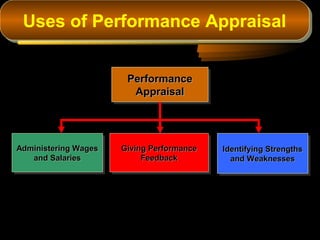
Uses of Performance Appraisal
Performance
Performance
Appraisal
Appraisal
Performance
Performance
Appraisal
Appraisal
Giving Performance
Giving Performance
Feedback
Feedback
Giving Performance
Giving Performance
Feedback
Feedback
Administering Wages
Administering Wages
and Salaries
and Salaries
Administering Wages
Administering Wages
and Salaries
and Salaries
Identifying Strengths
and Weaknesses
and Weaknesses
Identifying Strengths
and Weaknesses
and Weaknesses
What to Evaluate?
Traits Measures
Are an assessment of what the employee is,
not what the employee actually does.
Behavior-based measures
Focus on what an employee does and what the
employee should do differently.
Results-based measures
Focus is on accomplishments or outcomes that
can be measured objectively.
How to Evaluate?
 Relative Assessment
 Employees are measured against other
employees and ranked on their distance
from the next higher to the next lower
performing employee.
 Absolute Measurement
 Employees are all measured strictly by
absolute performance requirements or
standards of their jobs.
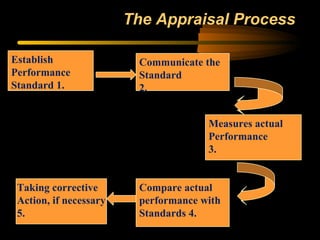
The Appraisal Process
Establish
Performance
Standard 1.
Communicate the
Standard
2.
Measures actual
Performance
3.
Compare actual
performance with
Standards 4.
Taking corrective
Action, if necessary
5.
Performance appraisal methods
Appraisal
Methods
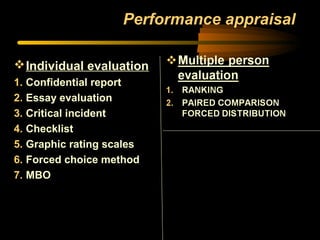
Performance appraisal
Individual evaluation
1. Confidential report
2. Essay evaluation
3. Critical incident
4. Checklist
5. Graphic rating scales
6. Forced choice method
7. MBO
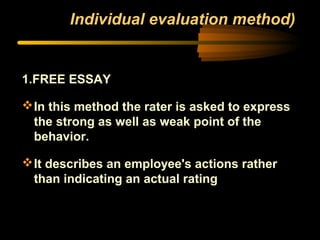
Individual evaluation method)
1.FREE ESSAY
In this method the rater is asked to express
the strong as well as weak point of the
behavior.
It describes an employee's actions rather
than indicating an actual rating
Essay contd…
While preparing the essay on the employee
the rater considers the following factors:
a)Job knowledge
b)Employees understanding of the company’s
programmes, policies.
c)Employee relations with co –workers and
superiors.
d)The attitudes and the perceptions of the
employee.
2.CRITICAL INCIDENT METHOD
 Critical incidents are behaviors that result in
good or poor job performance.
 Such incidents are recorded by the superiors.
 The rater plays the role of ‘Observer’ rather
than ‘Judge’.
 For e.g.
“I saw Mishra closing the steam line valve
at the instant the pipeline burst. We could
save a lot of lives due to the above factor.”
CHECKLIST
A check list represents in its simplest form ,a
set of objectives or descriptive statements
about the employee and his behavior.
 Checklists consist of groups of statements
that pertain to a given job.
For e.g.
I. is the employee really interested in the task?
Yes/No
II.Does he respects his superior? Yes/No
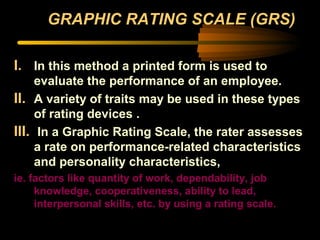
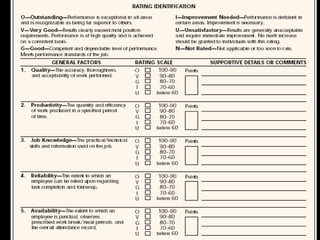
GRAPHIC RATING SCALE (GRS)
I. In this method a printed form is used to
evaluate the performance of an employee.
II. A variety of traits may be used in these types
of rating devices .
III. In a Graphic Rating Scale, the rater assesses
a rate on performance-related characteristics
and personality characteristics,
ie. factors like quantity of work, dependability, job
knowledge, cooperativeness, ability to lead,
interpersonal skills, etc. by using a rating scale.
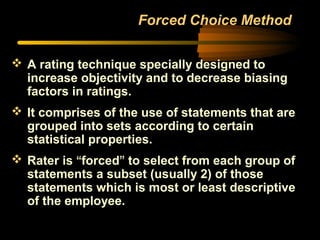
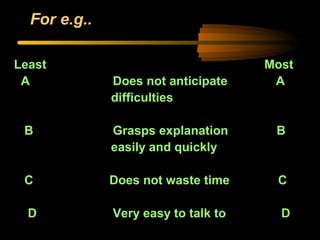
Forced Choice Method
 A rating technique specially designed to
increase objectivity and to decrease biasing
factors in ratings.
 It comprises of the use of statements that are
grouped into sets according to certain
statistical properties.
 Rater is “forced” to select from each group of
statements a subset (usually 2) of those
statements which is most or least descriptive
of the employee.
For e.g..
Least Most
A Does not anticipate A
difficulties
B Grasps explanation B
easily and quickly
C Does not waste time C
D Very easy to talk to D
Multiple –person evaluation methods
1. Ranking
2. Paired Comparison
3. Forced Distribution
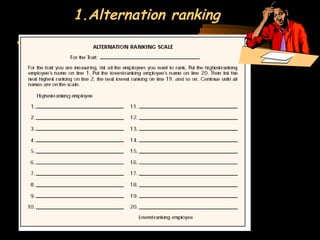
1.Alternation ranking
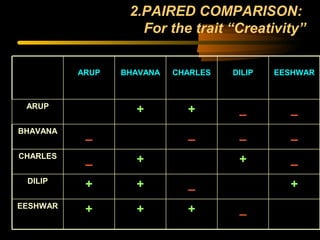
2.PAIRED COMPARISON:
For the trait “Creativity”
_
+
+
+
EESHWAR
+
_
+
+
DILIP
_
+
+
_
CHARLES
_
_
_
_
BHAVANA
_
_
+
+
ARUP
EESHWAR
DILIP
CHARLES
BHAVANA
ARUP
Forced distribution
One of the errors in rating is leniency i.e.
Clustering a large number of employees
around a high point on a rating scale.
This method compel the rater to
distribute the rates on all points on the
rating.
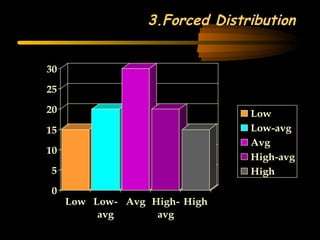
For e.g. the following distribution might be
assumed to exist – excellent 10%,good
20%,average 40%,below average 20%.
3.Forced Distribution
0
5
10
15
20
25
30
Low Low-
avg
Avg High-
avg
High
Low
Low-avg
Avg
High-avg
High
MANAGEMENT BY OBJECTIVES
 The use of Management By Objectives was
first widely advocated in the 1950s by the
noted management theorist Peter Drucker.
 MBO requires the management to set specific
measurable goals with each employee.
 This technique emphasis anticipatively set
goals(that are agreed upon by the superior and
the employee).
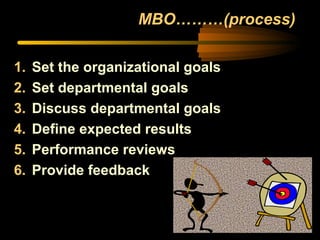
MBO………(process)
1. Set the organizational goals
2. Set departmental goals
3. Discuss departmental goals
4. Define expected results
5. Performance reviews
6. Provide feedback
360 Degree Appraisal
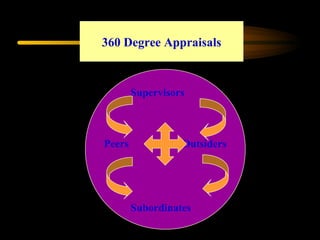
A 360 degree appraisal system collects
performance information from multiple
parties, that interact with the employee
on a routine basis.
Generate more accurate feedback by
gathering information from people about
an individual’s performance .
It was originally developed by TV Rao in
mid eighties at IIM ,A.
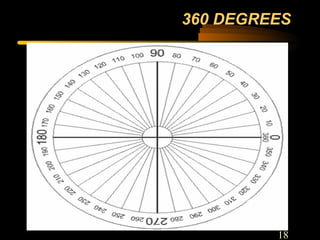
18
360 DEGREES
Parties involved
1. Supervisors
2. Peers
3. Subordinates
4. customer
360 Degree Appraisals
Supervisors
Peers Outsiders
Subordinates
Parties involved……
1. Supervisor –It includes supervisor of the
employee having knowledge about the work of
the employee. General practice is that
immediate superiors.
2. Peers-Peer rating may reliable in rating
behavior and manner of performance.
3. Subordinates-the concept of having superiors
rated by subordinated .
4. Customers- employee performance in terms of
behavior ,promptness ,speed in doing the job
can be better judged by customers.
Contd……..
Corporation like
GE, Reliance, Wipro,Infosys,SBI,Aditya Birla
Group are all using this tool to discover home
truth about their managers.
For e.g. If manager has 6 subordinates ,the
manager does not know which subordinates
said what ,the result are summarized and
averaged.
It may be possible one may criticize the boss for
standing too close to people ,another may
comment on boss’s aggressive tone.
Factors that can Distort Appraisals
1. First Impression
The appraisers first impression of a candidate
may color his evaluation of all subsequent
behavior.
2. Personal prejudice
if the rater dislikes any employee or any
group ,he may rate them at the lower end .
3. Halo effect: when one aspect of the
subordinate's performance affects the rater’s
evaluation of the other performance.
Factors that can Distort Appraisals
4. Central tendency:
Play safe policy in rating by rating all the
employees around the middle point of the
rating scale and they avoid rating the people
at both the extremes of the scale.
5 .The Leniency and Strictness:
6. The Recency effect:
The raters generally remember the recent
actions of the employee at the time of rating
and rate on the basis of these recent action.

pamethods2-170410104816 (1).pdf

  • 1.
  • 2.
    MEANING OF PERFORMANCEAPPRAISAL PERFORMANCE- It refers to the degree of accomplishment of the tasks that make up an individuals job. it indicates how well an individual is fulfilling the job requirement. APPRAISAL- assessment, evaluation, judgment, review, consideration Act of evaluation of performance
  • 3.
    ???????????IS PERFORMANCE APPRAISAL. Basicallyit is systematic process involving 3 steps:  Setting work standards  Assessing employees actual performance relative to these standards  Offering feedback to the employee so that he can eliminate deficiencies and improve performance in the course of time.
  • 4.
    Definition of performanceappraisal  Written assessments of employees carries out in a systematic way at regular intervals.  It is a process of evaluating an employee’s performance and the qualifications of the employee in terms of the requirements of the job for which he/she is employed.
  • 5.
    Features of Performanceappraisal It tries to find out how well the employee is performing the job and tries to establish a plan for further improvement. It is carried out periodically. It is not one shot deal. It is not past oriented activity. Performance appraisal is not job evaluation.
  • 6.
    OBJECTIVES OF PA 1. 1.To improve the performance of the To improve the performance of the organisation organisation 2. 2. To assess actual against expected performance To assess actual against expected performance 3. 3. To assist subordinate to improve own performance. To assist subordinate to improve own performance. 4. 4. To contribute to determining fair rewards To contribute to determining fair rewards 5. 5. To identify employees suitable for promotion To identify employees suitable for promotion 6. 6. To contribute to development of individuals To contribute to development of individuals
  • 7.
    BENEFITS OF PERFORMANCE APPRAISAL It provides a scientific basis for judging the merits or worth of employees who will try to improve their performance.  It provides a sound basis for promotion , demotion, transfer or termination.  It helps in distinguishing between efficient and in efficient workers. In this way it actually reveals the defects in the selection procedure.
  • 8.
    BENEFITS OF PERFORMANCE APPRAISALTO THE MANAGER  It helps the supervisors to evaluate the performance and to know the potentials of their subordinates systematically.  It also help to assign work to individual for which they are best suited.  If the performance appraisal is done scientifically and systematically ,it will prevent employee grievance.
  • 9.
    Uses of PerformanceAppraisal Uses of Performance Appraisal Performance Performance Appraisal Appraisal Performance Performance Appraisal Appraisal Giving Performance Giving Performance Feedback Feedback Giving Performance Giving Performance Feedback Feedback Administering Wages Administering Wages and Salaries and Salaries Administering Wages Administering Wages and Salaries and Salaries Identifying Strengths Identifying Strengths and Weaknesses and Weaknesses Identifying Strengths Identifying Strengths and Weaknesses and Weaknesses
  • 10.
    What to Evaluate? TraitsMeasures Are an assessment of what the employee is, not what the employee actually does. Behavior-based measures Focus on what an employee does and what the employee should do differently. Results-based measures Focus is on accomplishments or outcomes that can be measured objectively.
  • 11.
    How to Evaluate? Relative Assessment  Employees are measured against other employees and ranked on their distance from the next higher to the next lower performing employee.  Absolute Measurement  Employees are all measured strictly by absolute performance requirements or standards of their jobs.
  • 12.
    The Appraisal Process Establish Performance Standard1. Communicate the Standard 2. Measures actual Performance 3. Compare actual performance with Standards 4. Taking corrective Action, if necessary 5.
  • 13.
  • 14.
    Performance appraisal Individual evaluation 1.Confidential report 2. Essay evaluation 3. Critical incident 4. Checklist 5. Graphic rating scales 6. Forced choice method 7. MBO
  • 15.
    Individual evaluation method) 1.FREEESSAY In this method the rater is asked to express the strong as well as weak point of the behavior. It describes an employee's actions rather than indicating an actual rating
  • 16.
    Essay contd… While preparingthe essay on the employee the rater considers the following factors: a)Job knowledge b)Employees understanding of the company’s programmes, policies. c)Employee relations with co –workers and superiors. d)The attitudes and the perceptions of the employee.
  • 18.
    2.CRITICAL INCIDENT METHOD Critical incidents are behaviors that result in good or poor job performance.  Such incidents are recorded by the superiors.  The rater plays the role of ‘Observer’ rather than ‘Judge’.  For e.g. “I saw Mishra closing the steam line valve at the instant the pipeline burst. We could save a lot of lives due to the above factor.”
  • 19.
    CHECKLIST A check listrepresents in its simplest form ,a set of objectives or descriptive statements about the employee and his behavior.  Checklists consist of groups of statements that pertain to a given job. For e.g. I. is the employee really interested in the task? Yes/No II.Does he respects his superior? Yes/No
  • 20.
    GRAPHIC RATING SCALE(GRS) I. In this method a printed form is used to evaluate the performance of an employee. II. A variety of traits may be used in these types of rating devices . III. In a Graphic Rating Scale, the rater assesses a rate on performance-related characteristics and personality characteristics, ie. factors like quantity of work, dependability, job knowledge, cooperativeness, ability to lead, interpersonal skills, etc. by using a rating scale.
  • 23.
    Forced Choice Method A rating technique specially designed to increase objectivity and to decrease biasing factors in ratings.  It comprises of the use of statements that are grouped into sets according to certain statistical properties.  Rater is “forced” to select from each group of statements a subset (usually 2) of those statements which is most or least descriptive of the employee.
  • 24.
    For e.g.. Least Most ADoes not anticipate A difficulties B Grasps explanation B easily and quickly C Does not waste time C D Very easy to talk to D
  • 25.
    Multiple –person evaluationmethods 1. Ranking 2. Paired Comparison 3. Forced Distribution
  • 26.
  • 27.
    2.PAIRED COMPARISON: For thetrait “Creativity” _ + + + EESHWAR + _ + + DILIP _ + + _ CHARLES _ _ _ _ BHAVANA _ _ + + ARUP EESHWAR DILIP CHARLES BHAVANA ARUP
  • 28.
    Forced distribution One ofthe errors in rating is leniency i.e. Clustering a large number of employees around a high point on a rating scale. This method compel the rater to distribute the rates on all points on the rating. For e.g. the following distribution might be assumed to exist – excellent 10%,good 20%,average 40%,below average 20%.
  • 29.
    3.Forced Distribution 0 5 10 15 20 25 30 Low Low- avg AvgHigh- avg High Low Low-avg Avg High-avg High
  • 31.
    MANAGEMENT BY OBJECTIVES The use of Management By Objectives was first widely advocated in the 1950s by the noted management theorist Peter Drucker.  MBO requires the management to set specific measurable goals with each employee.  This technique emphasis anticipatively set goals(that are agreed upon by the superior and the employee).
  • 32.
    MBO………(process) 1. Set theorganizational goals 2. Set departmental goals 3. Discuss departmental goals 4. Define expected results 5. Performance reviews 6. Provide feedback
  • 34.
    360 Degree Appraisal A360 degree appraisal system collects performance information from multiple parties, that interact with the employee on a routine basis. Generate more accurate feedback by gathering information from people about an individual’s performance . It was originally developed by TV Rao in mid eighties at IIM ,A.
  • 35.
  • 36.
    Parties involved 1. Supervisors 2.Peers 3. Subordinates 4. customer
  • 37.
  • 38.
    Parties involved…… 1. Supervisor–It includes supervisor of the employee having knowledge about the work of the employee. General practice is that immediate superiors. 2. Peers-Peer rating may reliable in rating behavior and manner of performance. 3. Subordinates-the concept of having superiors rated by subordinated . 4. Customers- employee performance in terms of behavior ,promptness ,speed in doing the job can be better judged by customers.
  • 39.
    Contd…….. Corporation like GE, Reliance,Wipro,Infosys,SBI,Aditya Birla Group are all using this tool to discover home truth about their managers. For e.g. If manager has 6 subordinates ,the manager does not know which subordinates said what ,the result are summarized and averaged. It may be possible one may criticize the boss for standing too close to people ,another may comment on boss’s aggressive tone.
  • 40.
    Factors that canDistort Appraisals 1. First Impression The appraisers first impression of a candidate may color his evaluation of all subsequent behavior. 2. Personal prejudice if the rater dislikes any employee or any group ,he may rate them at the lower end . 3. Halo effect: when one aspect of the subordinate's performance affects the rater’s evaluation of the other performance.
  • 41.
    Factors that canDistort Appraisals 4. Central tendency: Play safe policy in rating by rating all the employees around the middle point of the rating scale and they avoid rating the people at both the extremes of the scale. 5 .The Leniency and Strictness: 6. The Recency effect: The raters generally remember the recent actions of the employee at the time of rating and rate on the basis of these recent action.