index Introduction History Objectives What is Performance Appraisal? Performance Appraisal Process. Methods of Performance Appraisal Conclusion.
History Roots in the early 20th century  The world's second oldest profession PA recognized by US government in 1950 This became evident in the late 1980s. The UK (consistent with Europe) Employment Equality (Age) Regulations 2006,
Definition “ Any system of determining how well an individual employee has performed during a period of time, frequently used as a basis for determining merit increases.” “ OBSERVE   and  EVALUATE   an employee’s in relation to  PRE-SET   performance standards.”
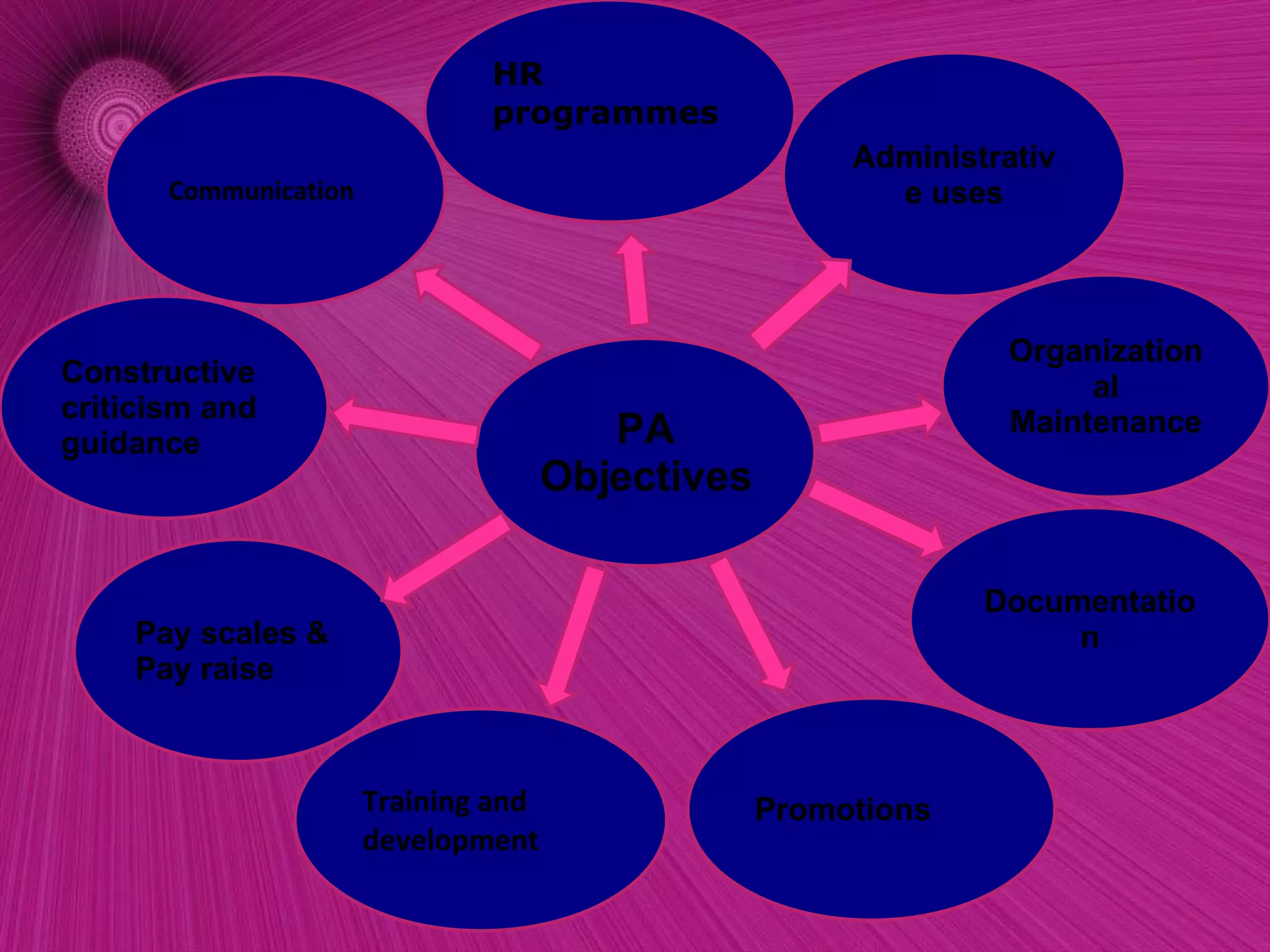
PA Objectives Documentation Organizational Maintenance Promotions Training and development Pay scales & Pay raise Constructive criticism and guidance Administrative uses HR programmes Communication
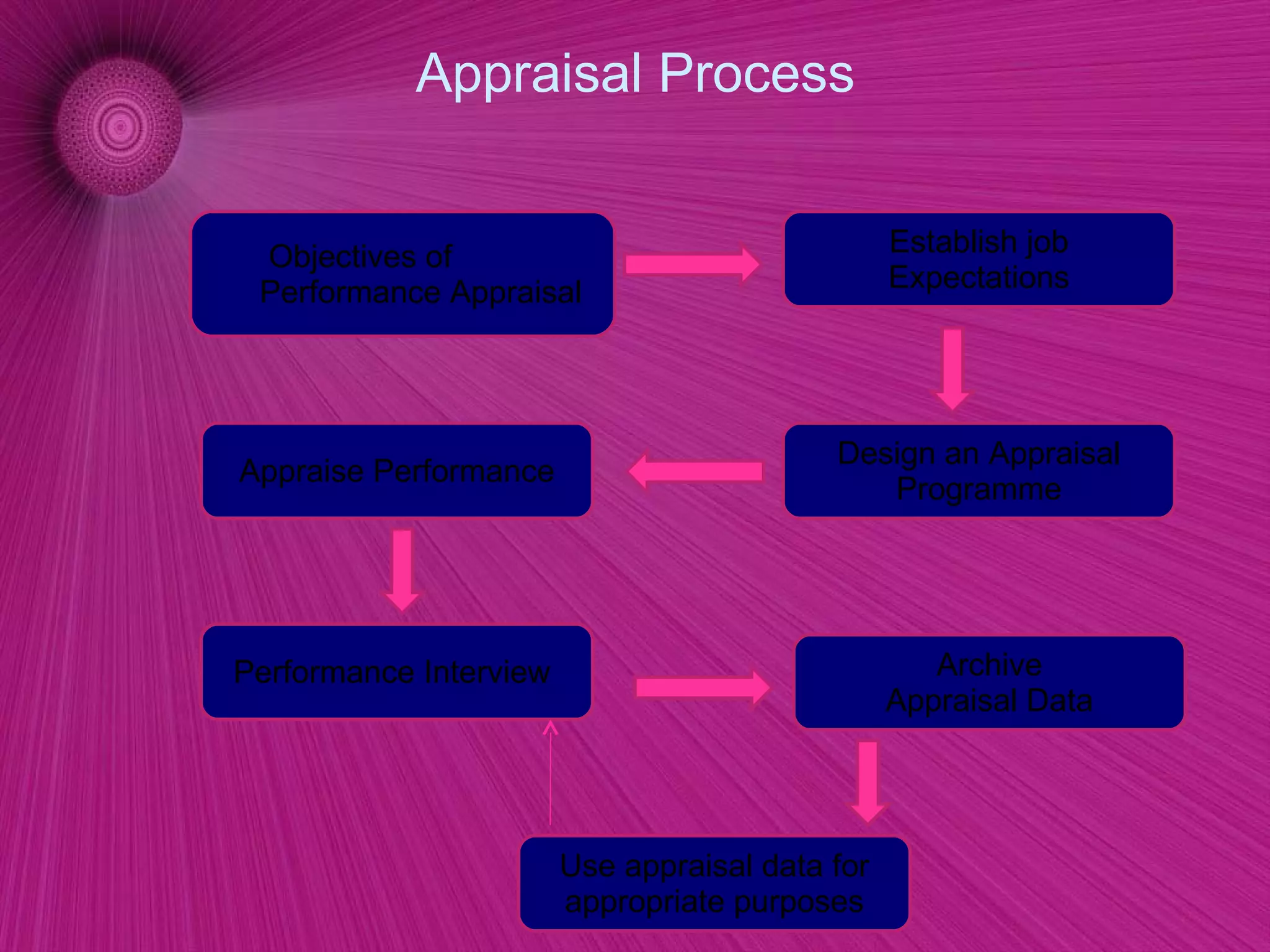
Appraisal Process Establish job Expectations Design an Appraisal Programme Appraise Performance Performance Interview Objectives of Performance Appraisal Archive Appraisal Data Use appraisal data for appropriate purposes
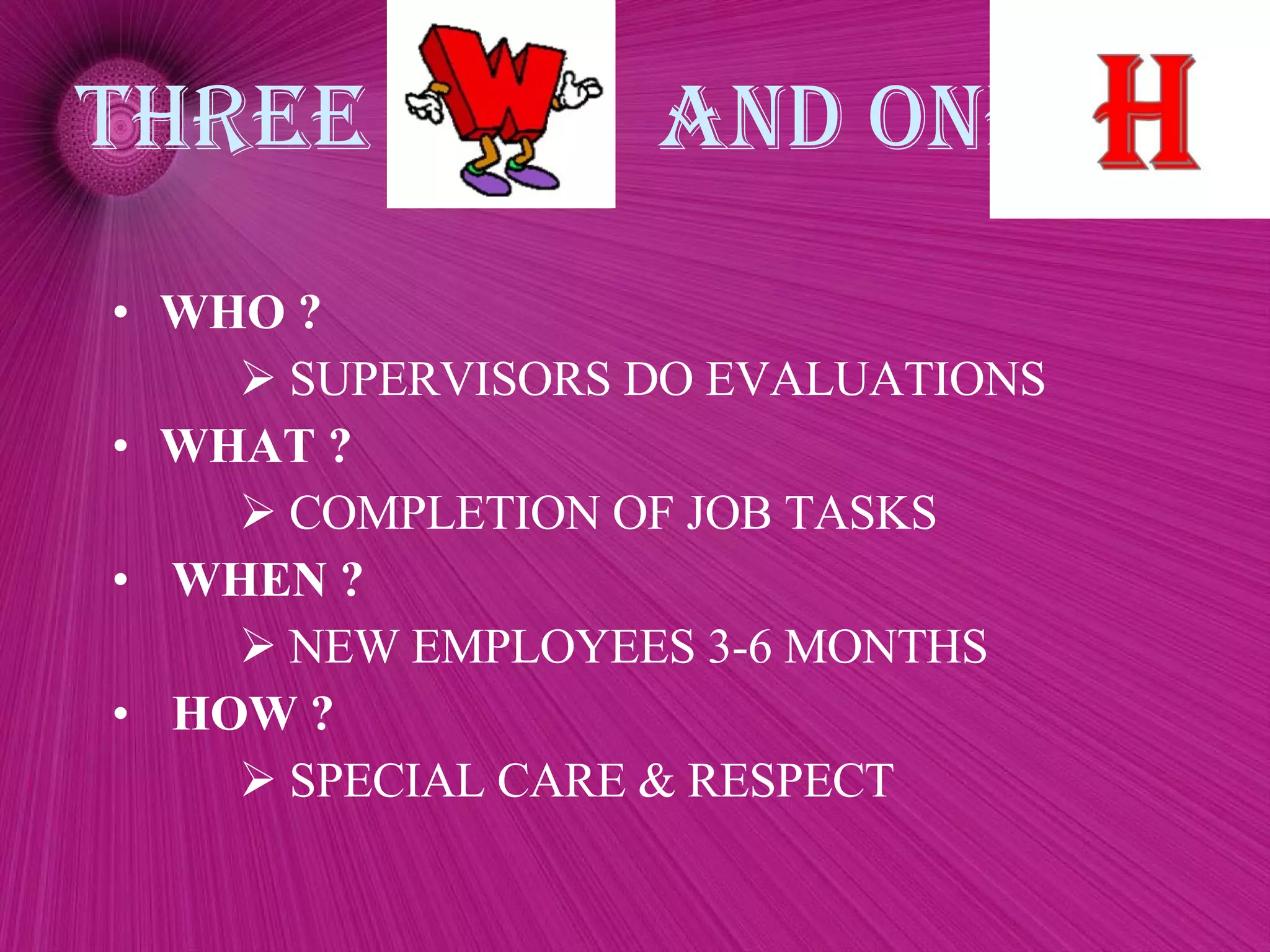
THREE  AND ONE  WHO ? SUPERVISORS DO EVALUATIONS WHAT ? COMPLETION OF JOB TASKS WHEN ? NEW EMPLOYEES 3-6 MONTHS HOW ? SPECIAL CARE & RESPECT
Sources of Information 1)   Supervisors  (most common) Role Conflict (e.g., judge and trainer/teacher) Motivation Time availability Friendship   2)   Co-Workers  (Peers) Friendship bias Leniency  High level of accuracy Best used as a source of feedback
Sources of Information (cont) 3)   Self Lots of knowledge Leniency effect Good preparation for performance appraisal meeting (conducive for dialog)  4)   Subordinates  Biases (e.g., # of subordinates, type of job, expected evaluation from supervisor)  5)   Client Good source of feedback Negativity bias
Methods of pa Confidential Report Graphic Rating Scale Ranking Method Forced Choice Method Critical Incidents Method MBO 7.  Checklist Forced Choice Method Critical Incidence Method Performance Tests and Observations Field Review Rating Scale s  Forced Distribution Method 14  Behaviorally Anchored Rating Scales
confidential report Evaluation of Characteristics e.g. Loyalty, attendance Traditional Method Workshop on Performance Appraisal in 1983 Objectives of Category “C” & “D” Characteristics should be easily understandable . Rating scale of report should be introduce as Qualitative Reporting.
Graphic rating scale Measure the degree of characteristics required for adequate performance of the job. Sawlapurkar(1967), Dayal(1969), Bolar(1978), Dwivedi Poor Average Good Excellent Quantity of Work 1 2 3 4 Quality of Work 1 2 3 4 Job knowledge 1 2 3 4 Dependability 1 2 3 4 Attitude 1 2 3 4
Ranking method Employee is evaluated by different Supervisors with ranks and then these ranks are grouped to see which employee is rated “BEST”. E.g. Subordinates A B C Mean Rank Mohan 2 4 3 3.0 Kumar 1 2 1 1.3 Sunil 3 1 2 2.0 Bharat 5 3  4 4.0 Ravi 4 5 5 4.6
Forced Choice method Supervisor asked to indicate one least & one most descriptive statement for particular subordinate. Each statement carries some weight which is not known to the supervisor. Statistical tools having numerical score provides merit of employee .
Critical incidents method Any critical incidents or Outstanding examples of success or failure of subordinates is recorded by supervisor. It improve the supervisor ability as an observer Identifies Areas where counseling may be useful.  It is less Reliable and valid for many organizations.
Management By objectives “ Management by Objectives (MBO) is a process of agreeing upon objectives within an organization so that management and employees agree to the objectives and understand what they are.” Largest user of MBO in India is public sector but failure of it is lack of performance appraisal system. Setting goal is difficult in MBO.
Five step mbo process
Explanation of MBO in more detail as its an important topic
MBO HAS A METHOD OF PERFORMANCE APPRASIAL.USES AND LIMITATIONS
DEFINITION A GOAL –DIRECTED  APPROACH  TO PERFORMANCE APPRAISAL IN WHICH WORKERS AND THEIR SUPERVISORS SET GOALS TOGETHER FOR THE UPCOMING  EVALUATION PERIOD
USES  THE OUTCOME  APPROACH PROVIDES CLEAR AND AMBIGUOUS CRITERIA BY WHICH WORKER PERFORMANCE CAN BE JUDGED. IT ALSO ELIMINATES SUBJECTIVITY AND POTENTIAL FOR ERROR AND BIAS THEN ALONG WITH IT. PROVIDES FLEXIBILTY
EXAMPLE A CHANGE IN THE PRODUCTION SYSTEM MAY LEAD TO A NEW SET OF  OUTCOME  APPROACHES  AND MEASURES  AND PERHAPS A SET OF PERFORMANCE  STANDARDS .
USES THIS HAPPENED BECAUSE  OF MBO A WORKERS OBJECTIVES WERE BETTER UNDERSTOOD  AT THE BEGINNING OF A NEW EVALUATION PERIOD IF THE ORGANISATION  CALLS FOR  EMPHASES
LIMITATIONS SUPPOSE  THE EQUIPMENT OR THE MACHINERY IS WORKING  FINE  THEN ANY INEXPERIENCED  LABOUR CAN DO THE JOB BUT WHAT IF THE MACHINERY IS NOT WORKING PROPERLY THEN WILL THE INEXPERIENCED PERSON WOULD BE ABLE TO RESOLVE THE PROBLEM
LIMITATIONS(CONTD) IF YOU WERE THE MANGER WHAT WOULD YOU DO ? GET THE BEST WORKER ON TO THE JOB DEPENDING ON HIS PERFORMANCE  RECORDS BUT YOUR WORKER WOULD ACTUALLY END UP  LOOKING LIKE THE WORST  WORKERS IN THE TERMS OF THE AMOUT OF PRODUCT PRODUCED
LIMITATIONS (CONTD) POTENTIAL DIFFICULTY WITH OUTCOME BASED- PERFORMANCE  MEASURES  IS THE DEVELOPMENT  OF A”RESULTS AT ANY COST” MENTALITY. FOR EXAMPLE , AN ORGANISATION MAY USE THE NUMBER OF UNITS PRODUCED AS PERFORMANCE  MEASURE BECAUSE IT IS FAIRLY EASY TO QUANTIFY.WORKERS CONCENTRATING ON QUANITITY MAY NEGLECT QUALITY AND FOLLOW UP SERVICE  TO THE LONG –TERM DTERIMENT OF THE ORGANISATION
DEFINITION OF OUTCOME  MEASURE  “ THE NUMBER OF UNITS  PRODUCED  THAT ARE  WITHIN  ACCEPTABLE  QUALITY  LIMITS”
Checklist Statement on the traits of employee and his job When points are allotted it becomes –  weighted checklist Advantage – standardisation, economy, ease of use Disadvantage – relative rating is not possible
Field Review A senior member of the HR department or a training officer discusses and interviews the supervisors to evaluate and rate  The assessor does not belong to the ratee’s department.
Essay Method Employee is described in a number of broad categories like Overall impression Strengths and weakness The strength of this method is the writing skills and analytical skills of the rater.
Comparative Evaluation Approaches Conducted by supervisors. These appraisals result in ranking from  best to worst –  helpful in deciding  merit pay, promotions and organisational rewards.
Paired-Comparison Method The appraiser compares each employee with every other employee PROCESS First:  A and B are compared Second:  Then A is compared with C, D,E….
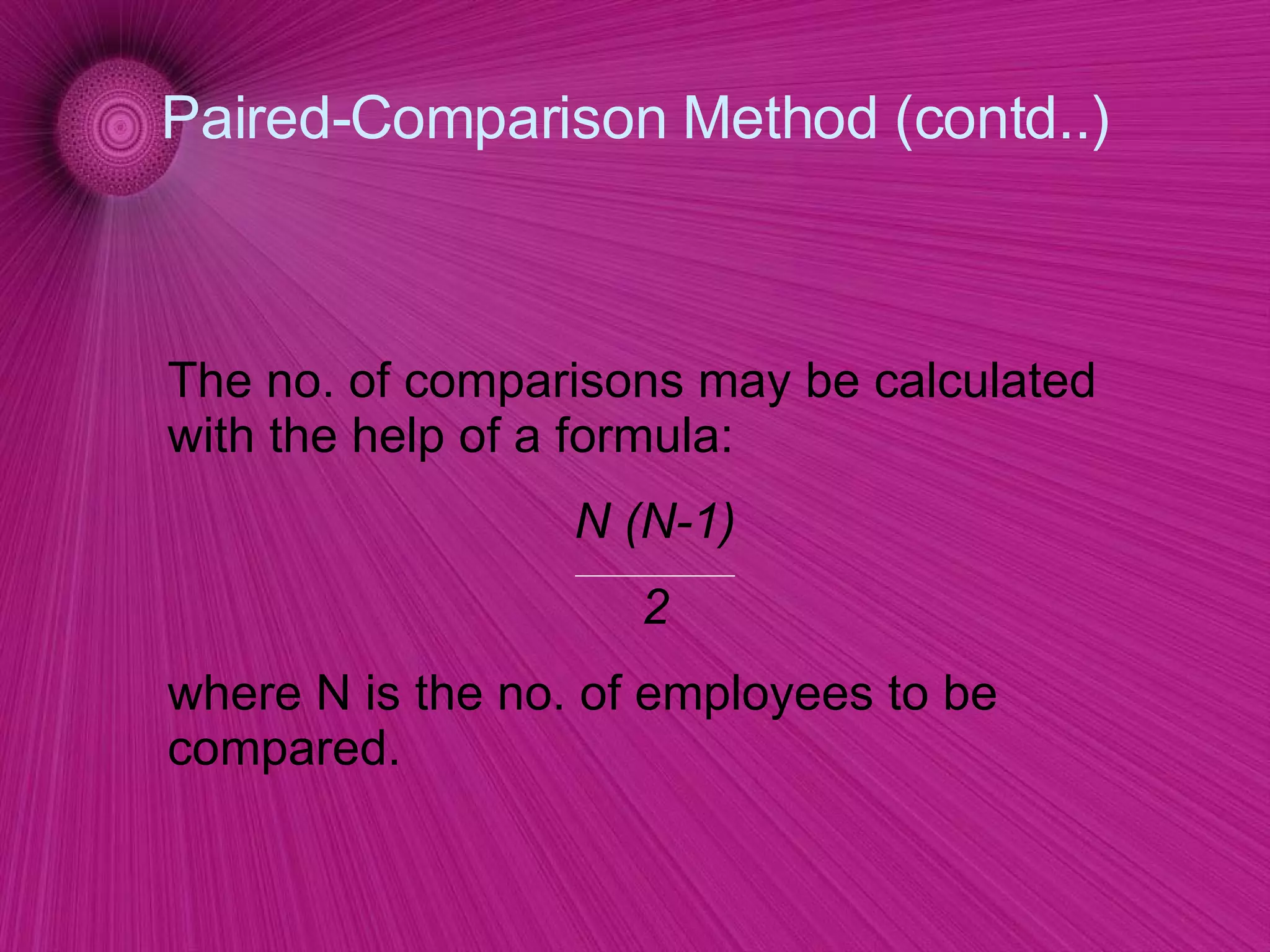
Paired-Comparison Method (contd..) The no. of comparisons may be calculated with the help of a formula: N (N-1) 2 where N is the no. of employees to be compared.
PA in Government Organisations Most commonly used method is  Confidential Reports Discrepancies Lack of accountability Laid back attitude due to high level of job security Unrealistic objectives Team appraisal is often not possible
Compensation and Performance Merit Pay Profit Sharing Incentives and Performance Bonus Gain Sharing
Current Global Trends in PA Trend towards a 360-Degree feedback system Problems in implementation are anticipated and efforts are being made to overcome them Team Performance Appraisal  Rank and Yank Strategy TQM an Performance Appraisal
Challenges Determining the evaluation criteria Lack of competence  Errors in rating and evaluation  Resistance
360º PERFORMANCE APPRAISAL
CONTENTS INTRODUCTION TO  360º  PA WHO DOSE  360º   PA?  WHY TO USE  360º   PA? HOW TO IMPLEMENT  360º  PA?  TIMING OF  360º  PA USES OF  360º  PA   ADVANTAGES OF  360º  PA DISADVANTAGES OF  360º   PA COMPANIES USING  360º   PA SAMPLE QUESTIONNARIE
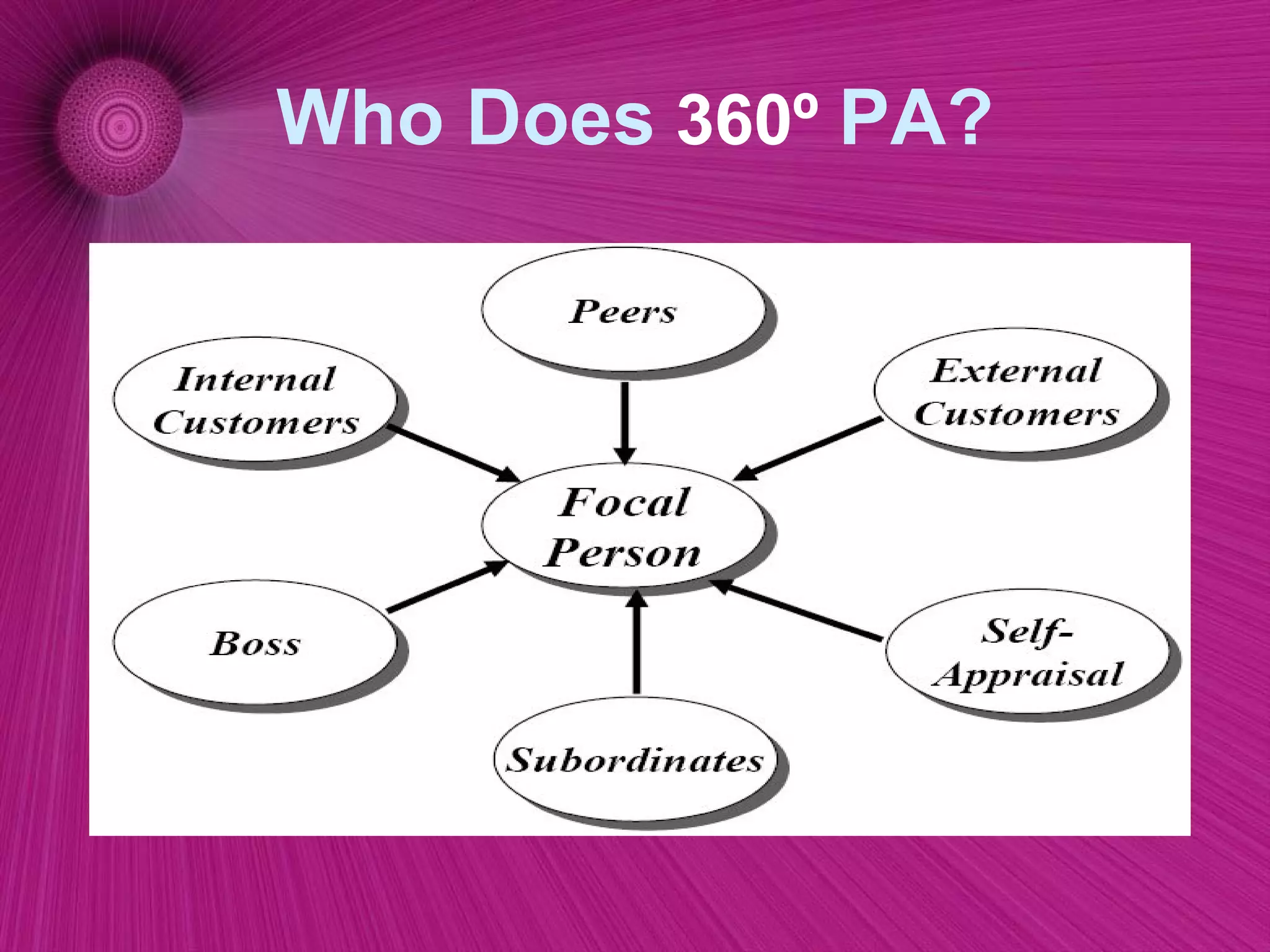
INTRODUCTI0N A developmental and/or performance appraisal tool which utilizes multiple-source feedback from people who work most closely with the employee. It is also known as multirate feedback,multisource feedback & multisource assessment. It is done either by interview method or questionnaire
Who Does  360º  PA?
Why to use  360º  PA? It provides the individual with an opportunity to learn how different colleagues perceive them, leading to increase self-awareness.  It encourages self-development.  It increases understanding of the behaviours required to improve personal and organisational effectiveness.
Contd… It promotes a more open culture where giving and receiving feedback is an accepted norm.  It increases communication within the organisation.  It can be a powerful trigger for change.
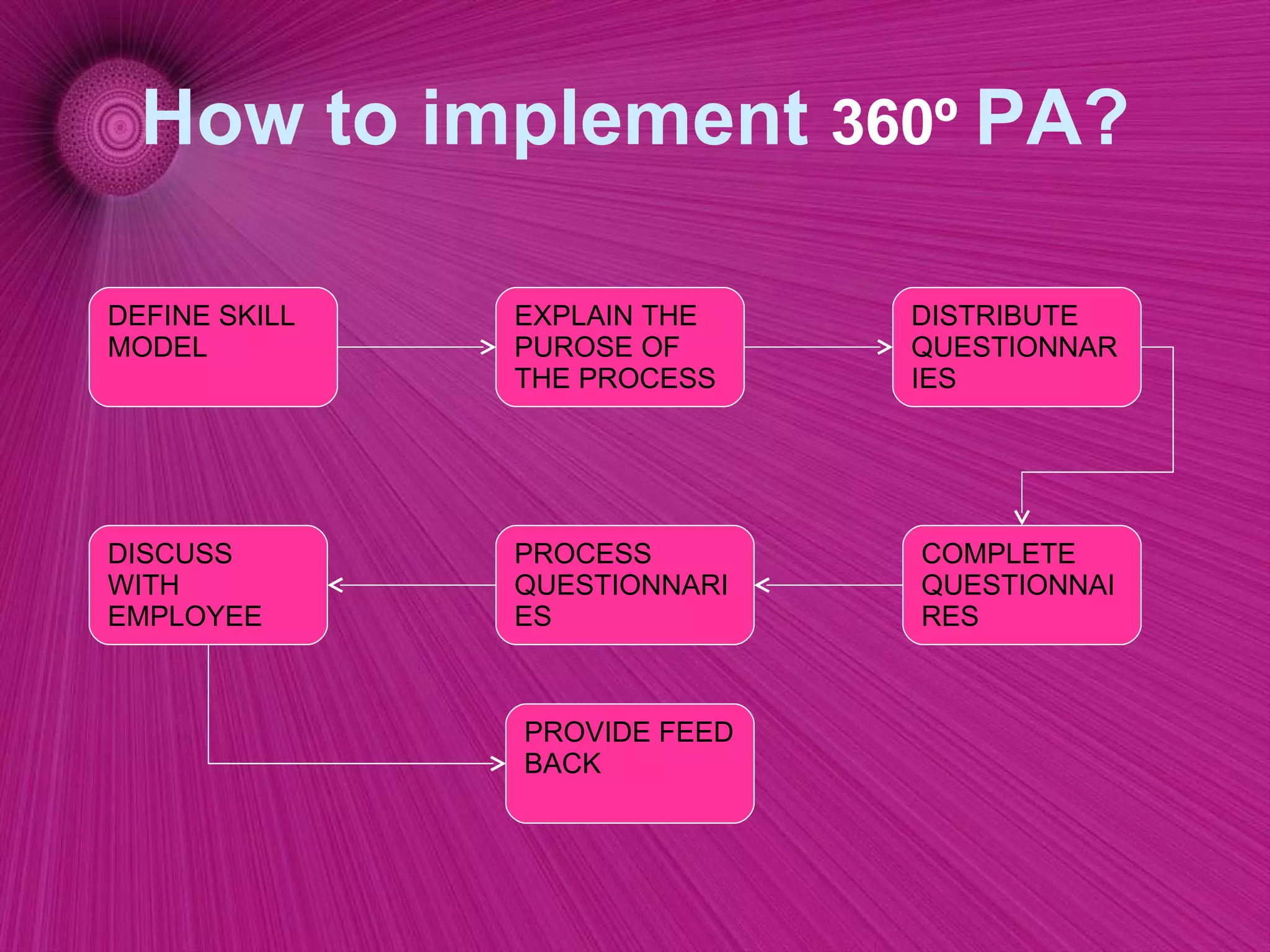
How to implement  360º  PA? EXPLAIN THE PUROSE OF THE PROCESS DEFINE SKILL MODEL DISCUSS WITH EMPLOYEE PROVIDE FEED BACK PROCESS QUESTIONNARIES COMPLETE QUESTIONNAIRES DISTRIBUTE QUESTIONNARIES
Timing of  360º  PA It is not appropriate to introduce it during periods of downturn or when  re-organisations have been announced.
Uses of  360º   PA Validating selection processes and development programmes  Identifying training and development needs  Pinpointing skills and competencies  Making personnel decisions such as promotions, terminations, salary hike and probationary status  Career development
Contd…. Employee coaching  Supervisory training  Management development
Advantages Increase awareness of senior management that they too have development needs. More reliable feed back to senior manager about their performance. Encouraging more open feed back. Identifing key development areas for the individual, a department and organization as whole.
Contd… Identifying strength that can be used to the best advantages of business. Provide clear picture to senior management about individual’s real worth. Raising self awareness of employee & managers about how they personally affect others positively& negatively.
Disadvantages People not giving frank or honest feed back. People being put under stress in receiving or giving feed back. Lack of action following feed back. Too much bureaucracy.
MNC’sUsing 360º PA American Airlines AT&T American Express Boeing Compaq General Electric Glaxo General Mills Hewlett-Packard Intel Herman Miller J.P. Morgan Morgan Stanley Motorola Procter & Gamble Levi Strauss 3M FedEx
Indian companies using  360º PA   Reliance Industries Crompton Greaves Godrej Shops Wipro Infosys Thermax GE(India)
ERRORS IN PERFORMANCE APPRAISAL, WAYS & MEANS TO REDUCE IT
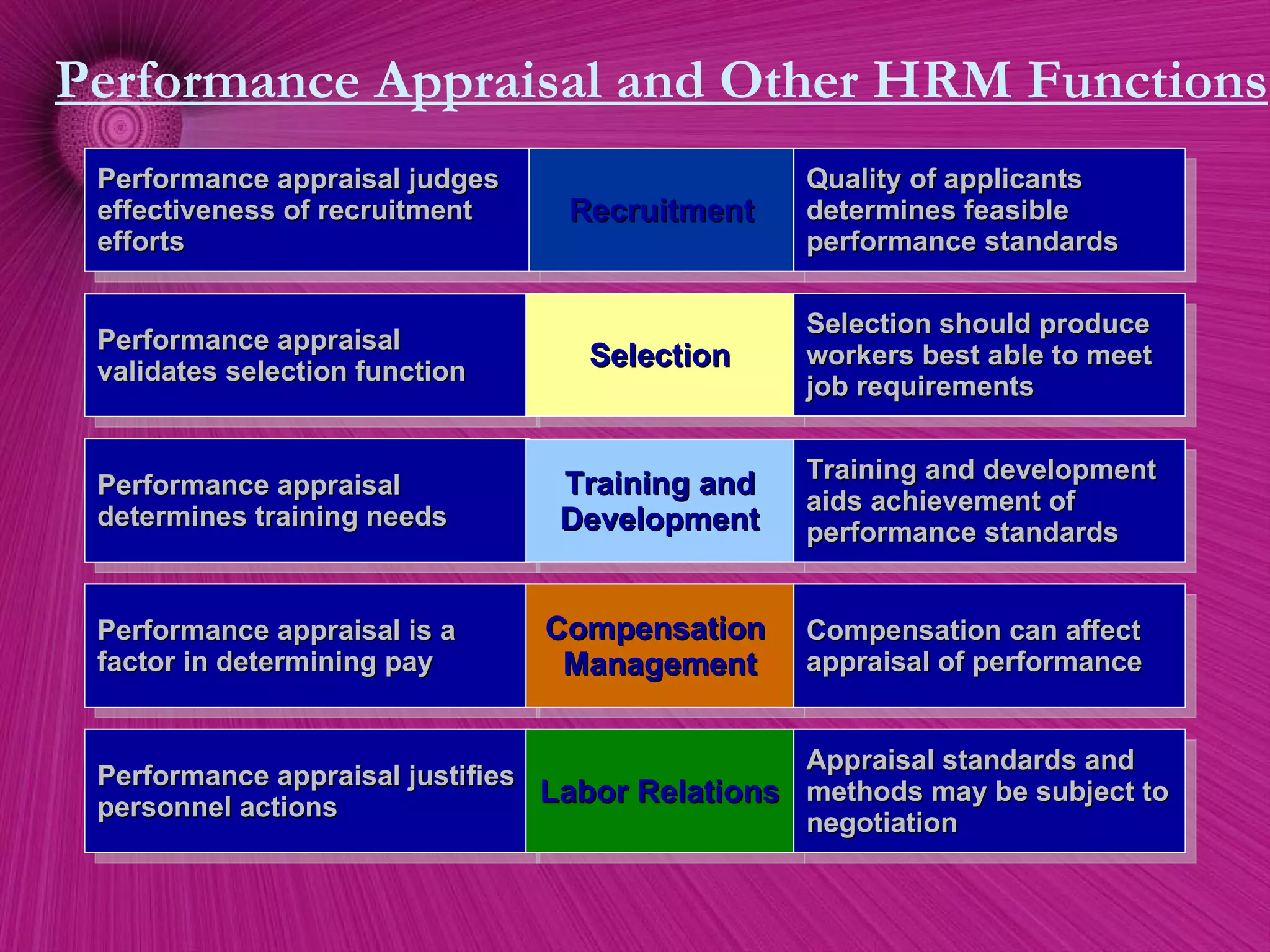
Performance Appraisal and Other HRM Functions Performance appraisal validates selection function Selection Selection should produce workers best able to meet job requirements Performance appraisal determines training needs Training and Development Training and development aids achievement of performance standards Performance appraisal is a factor in determining pay Compensation  Management Compensation can affect appraisal of performance Performance appraisal judges effectiveness of recruitment efforts Recruitment Quality of applicants determines feasible performance standards Performance appraisal justifies personnel actions Labor Relations Appraisal standards and methods may be subject to negotiation
Reasons Appraisal Programs Sometimes Fail Lack of top-management information and support Unclear performance standards Rater bias Too many forms to complete Inadequate preparation on the part of the manager. Employee is not given clear objectives at the beginning of performance period.  Overemphasis on uncharacteristic performance. Organizational politics or personal relationships judgments . Manager may not be trained at evaluation or giving feedback. No follow-up and coaching after the evaluation
Common Errors in the Appraisal Process Halo Error/ Horn Error First Impression Error Recency Error Leniency Error Severity Error Central Tendency Error Stereotyping Attribtion bias
Responsibility Commitment Initiative Sensitivity Judgment Communication Observation of specific behavior (s) (e.g., volunteers to work overtime) Halo Error/Horn Error :   rating a single individual based on the interviewer’s general feeling toward the individual so that employee receives nearly identical ratings (usually high) on all performance areas High ratings on other performance dimensions
First Impression Error Tendency of a rater to make an initial positive or negative judgement of an employee and allow that first impression to color or distort later information Leniency Error give more positive ratings to employees than they deserve Severity Error   evaluate employees more unfavorably than they deserve Central Tendency Error rating all employees near the mid-point of the performance scale
Recency Error The tendency of minor events that have happened recently to have more influence on the rating than major events of many months ago. Stereotyping The tendency to generalize across groups and ignore individual differences.
Strategies to Better Understand and Measure Job Performance Improve Appraisal Formats Select the Right Raters Understand Why Raters Make Mistakes
Training Raters to Rate More Accurately Rater-error training to reduce psychometric errors Performance dimension training Performance-standard training
Ensure that procedures for personnel decisions do not differ as a function of the race, sex, national origin, religion, or age of those affected by such decisions. 2)  Use objective and uncontaminated data whenever they are available. 3)  Provide a formal system of review or appeal to resolve disagreements regarding appraisals. 4)  Use more than one independent evaluator of performance. 5)  Use a formal, standardized system for personnel decisions. 6)  Ensure that evaluators have ample opportunity to observe and rate performance if ratings must be made. 7)  Avoid ratings on traits such as dependability, drive, aptitude, or attitude. 8)  Provide documented performance counseling prior to performance,-based termination decisions. Prescriptions for Legally Defensible Appraisal Systems
Assessment Centres - Process & Methods
Presentation Outline :- What is meant by a Assessment Centre? When are they conducted? Dimensions of Assessment Centre. The Assessment Process How Effective are Assessment Centres Current Trend in Assessment Centres Questions
Assessment Centre It’s a process not a Place or a Location.   It’s a process which is being increasingly used by middle to large organizations  In Recruitment. In Promotions to identify staff who possess strong potential for higher level positions. In training and development. Etc..
Assessment Centre It’s a process where a group of participants undertake a  series  of job-related exercises  under observation , so that  Skills Competencies and Character traits of an individual can be assessed. Specially trained assessors evaluate each participant against predetermined criteria.
When are they conducted? Assessment Centres are used after the initial stages of the selection process. Other measurements such as psychological tests may complement the selection process.  Other recruitment activities, which are currently gaining favour, such as an expected attendance with other hopeful recruits at a company social function, are not part of Assessment Centres.
What do assessors look for in a candidate –  the dimensions Adaptability:   Ability to react to changing situations or information in a timely manner. Decisiveness:   Readiness to make decisions, render judgments, take action, or commit one-self to a course of action. Delegation :  Ability to use subordinates effectively. Development of Subordinates :  Ability to maximize human potential of subordinates through training and developmental activities.  Independence:   Ability to act based on own convictions rather than through a desire to please others.  Initiative:   Desire to actively influence events rather than passively accepting them; self-starting; takes action beyond what is necessarily called for. Interpersonal Relations:   Ability to perceive and react to the needs of others, paying attention to others' feelings and ideas, accepting what others have to say, and perceiving the impact of self on others.
What do assessors look for in a candidate –  the dimensions Judgment:   Ability to evaluate courses of action, develop alternative courses of action, and to reach logical decisions based on the information at hand.  Listening :    Ability to extract important information in oral communications and to convey the impression that one is interested in what others have to say.  Organizational Sensitivity:   Ability to perceive the impact of a decision on the rest of the organization, awareness of the impact of outside pressures on the organization. Persuasiveness:   Ability to organize and present material in a convincing manner to gain agreement or acceptance.  Planning and Organization:   Ability to efficiently establish an appropriate course of action for self and/or others, to accomplish a specific goal, make proper assignments of personnel, and appropriate use of resources. 
Assessment Process :- Some of the Common Exercises done are :- Exercises to measure a particular set of job skills. Case Studies In Tray exercises Group exercises Role plays
Exercises to measure a particular set of job skills. For Example :-  Recruits for a car production line were tested on physical strength, coordination and aptitude for production line work, by repeatedly fitting tyres onto wheel rims. Accounts Clerk recruits were asked to complete tests measuring accuracy against speed.  Tests may involve calculating hotel accounts, goods invoices, and vehicle mileage examples
Case Studies Project Managers may be asked to plan for the release of a new product, which incorporates scheduling, budgeting and resourcing.  This type of exercise may measure the ability to: analyse complex data and issues; seek solutions; project plan; and present findings, using a mixture of presentation skills.
In Tray exercises In In Tray exercise, you may be asked to assume a particular role as an employee of a fictitious company and work through a pile of correspondence in your In Tray.  These tests commonly measure Job Skills such as: ability to organise and prioritise work; analytical skills; communication with team members and customers; written communication skills; and delegation (if a higher level position).  This type of exercise may take from several hours to a day.
Group Exercises Group exercises involve candidates working together as a team, to resolve a presented issue.  These exercises commonly measure interpersonal skills such as group leadership, teamwork, negotiation, and group problem solving skills.
Role plays If you are asked to do a role play, you will be asked to assume a fictitious role and handle a particular work situation. Customer Service Officers may be asked to respond to a number of phone inquiries, including customer queries and complaints.  This type of exercise may measure: oral communication, customer service orientation, and problem solving. Managers may be asked to provide feedback to a sales representative staff member, after viewing a videotape of the sales representative's call with a client.
How effective are Assessment Centres? Assessment Centres have provided higher validity levels for test outcomes than other selection methods.(Landy 1989). Due to  the wider range of skill measurements used, which other tests may lack.  Effectiveness of each Assessment Centre will depend on the strength of its component exercises.  Work simulation tests may closely match the expectations of the employer organisation. The assessors may be senior company employees who have an ongoing involvement with and interest in the successful candidate, whom they helped select (Landy 1989, Robertson, 1987).  Lastly, Assessment Centres, by nature of their work simulation design, 'appear' to more closely evaluate the demands and requirements of the advertised position, compared to interviews and psychological tests.
Current Trends in Assessment Centre. There has been a trend towards using the term “Development Centre”, in place of “Assessment Centre”.  Helped in Gain in reduced anxiety. Participants find the term “development” more friendly and less threatening than “assessment”.
Example of In Tray exercise A common example of an in tray exercise at first level management may involve: placing you in a particular role within a work setting, where a crisis situation is developing. The situation requires you to take responsibility for the situation. During the exercise, mail is delivered and collected each half hour. The exercise will describe what resources are available to you: e.g. a list of internal phone contacts and who's who, a telephone, fax, personal computer, information such as a product reference chart, data showing the work area's performance, a calendar which notes key dates and relevant deadlines,
a highlighter, pen, pencil, eraser, ruler, internal memo pad, letterhead stationery, writing pad, envelopes, out tray, and an in tray containing particular items. Intray items may range from requests to return calls to customers with specific complaints and queries, comments to be provided to your manager, reports to be completed, requests from your staff, and office social club notices. Some of this correspondence may be past the action date, other notes may be vague in meaning.
Example of Group Exercises One example of a problem solving scenario includes a Tower Building exercise, using play building blocks.  In this exercise, a group may be competing with other groups to design and build a tower in accordance with a construction brief which may stipulate minimum height, time period the completed tower has to stand 'unsupported', colour, cost of block shapes, a time limit, and a budget.  There may be monetary penalties for failing to reach particular aspects of the brief. Each group has access to a limited number of blocks.

Performance Appraisal 03(2)

  • 1.
  • 2.
    index Introduction HistoryObjectives What is Performance Appraisal? Performance Appraisal Process. Methods of Performance Appraisal Conclusion.
  • 3.
    History Roots inthe early 20th century The world's second oldest profession PA recognized by US government in 1950 This became evident in the late 1980s. The UK (consistent with Europe) Employment Equality (Age) Regulations 2006,
  • 4.
    Definition “ Anysystem of determining how well an individual employee has performed during a period of time, frequently used as a basis for determining merit increases.” “ OBSERVE and EVALUATE an employee’s in relation to PRE-SET performance standards.”
  • 5.
    PA Objectives DocumentationOrganizational Maintenance Promotions Training and development Pay scales & Pay raise Constructive criticism and guidance Administrative uses HR programmes Communication
  • 6.
    Appraisal Process Establishjob Expectations Design an Appraisal Programme Appraise Performance Performance Interview Objectives of Performance Appraisal Archive Appraisal Data Use appraisal data for appropriate purposes
  • 7.
    THREE ANDONE WHO ? SUPERVISORS DO EVALUATIONS WHAT ? COMPLETION OF JOB TASKS WHEN ? NEW EMPLOYEES 3-6 MONTHS HOW ? SPECIAL CARE & RESPECT
  • 8.
    Sources of Information1) Supervisors (most common) Role Conflict (e.g., judge and trainer/teacher) Motivation Time availability Friendship 2) Co-Workers (Peers) Friendship bias Leniency High level of accuracy Best used as a source of feedback
  • 9.
    Sources of Information(cont) 3) Self Lots of knowledge Leniency effect Good preparation for performance appraisal meeting (conducive for dialog) 4) Subordinates Biases (e.g., # of subordinates, type of job, expected evaluation from supervisor) 5) Client Good source of feedback Negativity bias
  • 10.
    Methods of paConfidential Report Graphic Rating Scale Ranking Method Forced Choice Method Critical Incidents Method MBO 7. Checklist Forced Choice Method Critical Incidence Method Performance Tests and Observations Field Review Rating Scale s Forced Distribution Method 14 Behaviorally Anchored Rating Scales
  • 11.
    confidential report Evaluationof Characteristics e.g. Loyalty, attendance Traditional Method Workshop on Performance Appraisal in 1983 Objectives of Category “C” & “D” Characteristics should be easily understandable . Rating scale of report should be introduce as Qualitative Reporting.
  • 12.
    Graphic rating scaleMeasure the degree of characteristics required for adequate performance of the job. Sawlapurkar(1967), Dayal(1969), Bolar(1978), Dwivedi Poor Average Good Excellent Quantity of Work 1 2 3 4 Quality of Work 1 2 3 4 Job knowledge 1 2 3 4 Dependability 1 2 3 4 Attitude 1 2 3 4
  • 13.
    Ranking method Employeeis evaluated by different Supervisors with ranks and then these ranks are grouped to see which employee is rated “BEST”. E.g. Subordinates A B C Mean Rank Mohan 2 4 3 3.0 Kumar 1 2 1 1.3 Sunil 3 1 2 2.0 Bharat 5 3 4 4.0 Ravi 4 5 5 4.6
  • 14.
    Forced Choice methodSupervisor asked to indicate one least & one most descriptive statement for particular subordinate. Each statement carries some weight which is not known to the supervisor. Statistical tools having numerical score provides merit of employee .
  • 15.
    Critical incidents methodAny critical incidents or Outstanding examples of success or failure of subordinates is recorded by supervisor. It improve the supervisor ability as an observer Identifies Areas where counseling may be useful. It is less Reliable and valid for many organizations.
  • 16.
    Management By objectives“ Management by Objectives (MBO) is a process of agreeing upon objectives within an organization so that management and employees agree to the objectives and understand what they are.” Largest user of MBO in India is public sector but failure of it is lack of performance appraisal system. Setting goal is difficult in MBO.
  • 17.
  • 18.
    Explanation of MBOin more detail as its an important topic
  • 19.
    MBO HAS AMETHOD OF PERFORMANCE APPRASIAL.USES AND LIMITATIONS
  • 20.
    DEFINITION A GOAL–DIRECTED APPROACH TO PERFORMANCE APPRAISAL IN WHICH WORKERS AND THEIR SUPERVISORS SET GOALS TOGETHER FOR THE UPCOMING EVALUATION PERIOD
  • 21.
    USES THEOUTCOME APPROACH PROVIDES CLEAR AND AMBIGUOUS CRITERIA BY WHICH WORKER PERFORMANCE CAN BE JUDGED. IT ALSO ELIMINATES SUBJECTIVITY AND POTENTIAL FOR ERROR AND BIAS THEN ALONG WITH IT. PROVIDES FLEXIBILTY
  • 22.
    EXAMPLE A CHANGEIN THE PRODUCTION SYSTEM MAY LEAD TO A NEW SET OF OUTCOME APPROACHES AND MEASURES AND PERHAPS A SET OF PERFORMANCE STANDARDS .
  • 23.
    USES THIS HAPPENEDBECAUSE OF MBO A WORKERS OBJECTIVES WERE BETTER UNDERSTOOD AT THE BEGINNING OF A NEW EVALUATION PERIOD IF THE ORGANISATION CALLS FOR EMPHASES
  • 24.
    LIMITATIONS SUPPOSE THE EQUIPMENT OR THE MACHINERY IS WORKING FINE THEN ANY INEXPERIENCED LABOUR CAN DO THE JOB BUT WHAT IF THE MACHINERY IS NOT WORKING PROPERLY THEN WILL THE INEXPERIENCED PERSON WOULD BE ABLE TO RESOLVE THE PROBLEM
  • 25.
    LIMITATIONS(CONTD) IF YOUWERE THE MANGER WHAT WOULD YOU DO ? GET THE BEST WORKER ON TO THE JOB DEPENDING ON HIS PERFORMANCE RECORDS BUT YOUR WORKER WOULD ACTUALLY END UP LOOKING LIKE THE WORST WORKERS IN THE TERMS OF THE AMOUT OF PRODUCT PRODUCED
  • 26.
    LIMITATIONS (CONTD) POTENTIALDIFFICULTY WITH OUTCOME BASED- PERFORMANCE MEASURES IS THE DEVELOPMENT OF A”RESULTS AT ANY COST” MENTALITY. FOR EXAMPLE , AN ORGANISATION MAY USE THE NUMBER OF UNITS PRODUCED AS PERFORMANCE MEASURE BECAUSE IT IS FAIRLY EASY TO QUANTIFY.WORKERS CONCENTRATING ON QUANITITY MAY NEGLECT QUALITY AND FOLLOW UP SERVICE TO THE LONG –TERM DTERIMENT OF THE ORGANISATION
  • 27.
    DEFINITION OF OUTCOME MEASURE “ THE NUMBER OF UNITS PRODUCED THAT ARE WITHIN ACCEPTABLE QUALITY LIMITS”
  • 28.
    Checklist Statement onthe traits of employee and his job When points are allotted it becomes – weighted checklist Advantage – standardisation, economy, ease of use Disadvantage – relative rating is not possible
  • 29.
    Field Review Asenior member of the HR department or a training officer discusses and interviews the supervisors to evaluate and rate The assessor does not belong to the ratee’s department.
  • 30.
    Essay Method Employeeis described in a number of broad categories like Overall impression Strengths and weakness The strength of this method is the writing skills and analytical skills of the rater.
  • 31.
    Comparative Evaluation ApproachesConducted by supervisors. These appraisals result in ranking from best to worst – helpful in deciding merit pay, promotions and organisational rewards.
  • 32.
    Paired-Comparison Method Theappraiser compares each employee with every other employee PROCESS First: A and B are compared Second: Then A is compared with C, D,E….
  • 33.
    Paired-Comparison Method (contd..)The no. of comparisons may be calculated with the help of a formula: N (N-1) 2 where N is the no. of employees to be compared.
  • 34.
    PA in GovernmentOrganisations Most commonly used method is Confidential Reports Discrepancies Lack of accountability Laid back attitude due to high level of job security Unrealistic objectives Team appraisal is often not possible
  • 35.
    Compensation and PerformanceMerit Pay Profit Sharing Incentives and Performance Bonus Gain Sharing
  • 36.
    Current Global Trendsin PA Trend towards a 360-Degree feedback system Problems in implementation are anticipated and efforts are being made to overcome them Team Performance Appraisal Rank and Yank Strategy TQM an Performance Appraisal
  • 37.
    Challenges Determining theevaluation criteria Lack of competence Errors in rating and evaluation Resistance
  • 38.
  • 39.
    CONTENTS INTRODUCTION TO 360º PA WHO DOSE 360º PA? WHY TO USE 360º PA? HOW TO IMPLEMENT 360º PA? TIMING OF 360º PA USES OF 360º PA ADVANTAGES OF 360º PA DISADVANTAGES OF 360º PA COMPANIES USING 360º PA SAMPLE QUESTIONNARIE
  • 40.
    INTRODUCTI0N A developmentaland/or performance appraisal tool which utilizes multiple-source feedback from people who work most closely with the employee. It is also known as multirate feedback,multisource feedback & multisource assessment. It is done either by interview method or questionnaire
  • 41.
    Who Does 360º PA?
  • 42.
    Why to use 360º PA? It provides the individual with an opportunity to learn how different colleagues perceive them, leading to increase self-awareness. It encourages self-development. It increases understanding of the behaviours required to improve personal and organisational effectiveness.
  • 43.
    Contd… It promotesa more open culture where giving and receiving feedback is an accepted norm. It increases communication within the organisation. It can be a powerful trigger for change.
  • 44.
    How to implement 360º PA? EXPLAIN THE PUROSE OF THE PROCESS DEFINE SKILL MODEL DISCUSS WITH EMPLOYEE PROVIDE FEED BACK PROCESS QUESTIONNARIES COMPLETE QUESTIONNAIRES DISTRIBUTE QUESTIONNARIES
  • 45.
    Timing of 360º PA It is not appropriate to introduce it during periods of downturn or when re-organisations have been announced.
  • 46.
    Uses of 360º PA Validating selection processes and development programmes Identifying training and development needs Pinpointing skills and competencies Making personnel decisions such as promotions, terminations, salary hike and probationary status Career development
  • 47.
    Contd…. Employee coaching Supervisory training Management development
  • 48.
    Advantages Increase awarenessof senior management that they too have development needs. More reliable feed back to senior manager about their performance. Encouraging more open feed back. Identifing key development areas for the individual, a department and organization as whole.
  • 49.
    Contd… Identifying strengththat can be used to the best advantages of business. Provide clear picture to senior management about individual’s real worth. Raising self awareness of employee & managers about how they personally affect others positively& negatively.
  • 50.
    Disadvantages People notgiving frank or honest feed back. People being put under stress in receiving or giving feed back. Lack of action following feed back. Too much bureaucracy.
  • 51.
    MNC’sUsing 360º PAAmerican Airlines AT&T American Express Boeing Compaq General Electric Glaxo General Mills Hewlett-Packard Intel Herman Miller J.P. Morgan Morgan Stanley Motorola Procter & Gamble Levi Strauss 3M FedEx
  • 52.
    Indian companies using 360º PA Reliance Industries Crompton Greaves Godrej Shops Wipro Infosys Thermax GE(India)
  • 53.
    ERRORS IN PERFORMANCEAPPRAISAL, WAYS & MEANS TO REDUCE IT
  • 54.
    Performance Appraisal andOther HRM Functions Performance appraisal validates selection function Selection Selection should produce workers best able to meet job requirements Performance appraisal determines training needs Training and Development Training and development aids achievement of performance standards Performance appraisal is a factor in determining pay Compensation Management Compensation can affect appraisal of performance Performance appraisal judges effectiveness of recruitment efforts Recruitment Quality of applicants determines feasible performance standards Performance appraisal justifies personnel actions Labor Relations Appraisal standards and methods may be subject to negotiation
  • 55.
    Reasons Appraisal ProgramsSometimes Fail Lack of top-management information and support Unclear performance standards Rater bias Too many forms to complete Inadequate preparation on the part of the manager. Employee is not given clear objectives at the beginning of performance period. Overemphasis on uncharacteristic performance. Organizational politics or personal relationships judgments . Manager may not be trained at evaluation or giving feedback. No follow-up and coaching after the evaluation
  • 56.
    Common Errors inthe Appraisal Process Halo Error/ Horn Error First Impression Error Recency Error Leniency Error Severity Error Central Tendency Error Stereotyping Attribtion bias
  • 57.
    Responsibility Commitment InitiativeSensitivity Judgment Communication Observation of specific behavior (s) (e.g., volunteers to work overtime) Halo Error/Horn Error : rating a single individual based on the interviewer’s general feeling toward the individual so that employee receives nearly identical ratings (usually high) on all performance areas High ratings on other performance dimensions
  • 58.
    First Impression ErrorTendency of a rater to make an initial positive or negative judgement of an employee and allow that first impression to color or distort later information Leniency Error give more positive ratings to employees than they deserve Severity Error evaluate employees more unfavorably than they deserve Central Tendency Error rating all employees near the mid-point of the performance scale
  • 59.
    Recency Error Thetendency of minor events that have happened recently to have more influence on the rating than major events of many months ago. Stereotyping The tendency to generalize across groups and ignore individual differences.
  • 60.
    Strategies to BetterUnderstand and Measure Job Performance Improve Appraisal Formats Select the Right Raters Understand Why Raters Make Mistakes
  • 61.
    Training Raters toRate More Accurately Rater-error training to reduce psychometric errors Performance dimension training Performance-standard training
  • 62.
    Ensure that proceduresfor personnel decisions do not differ as a function of the race, sex, national origin, religion, or age of those affected by such decisions. 2) Use objective and uncontaminated data whenever they are available. 3) Provide a formal system of review or appeal to resolve disagreements regarding appraisals. 4) Use more than one independent evaluator of performance. 5) Use a formal, standardized system for personnel decisions. 6) Ensure that evaluators have ample opportunity to observe and rate performance if ratings must be made. 7) Avoid ratings on traits such as dependability, drive, aptitude, or attitude. 8) Provide documented performance counseling prior to performance,-based termination decisions. Prescriptions for Legally Defensible Appraisal Systems
  • 63.
    Assessment Centres -Process & Methods
  • 64.
    Presentation Outline :-What is meant by a Assessment Centre? When are they conducted? Dimensions of Assessment Centre. The Assessment Process How Effective are Assessment Centres Current Trend in Assessment Centres Questions
  • 65.
    Assessment Centre It’sa process not a Place or a Location. It’s a process which is being increasingly used by middle to large organizations In Recruitment. In Promotions to identify staff who possess strong potential for higher level positions. In training and development. Etc..
  • 66.
    Assessment Centre It’sa process where a group of participants undertake a series of job-related exercises under observation , so that Skills Competencies and Character traits of an individual can be assessed. Specially trained assessors evaluate each participant against predetermined criteria.
  • 67.
    When are theyconducted? Assessment Centres are used after the initial stages of the selection process. Other measurements such as psychological tests may complement the selection process. Other recruitment activities, which are currently gaining favour, such as an expected attendance with other hopeful recruits at a company social function, are not part of Assessment Centres.
  • 68.
    What do assessorslook for in a candidate – the dimensions Adaptability: Ability to react to changing situations or information in a timely manner. Decisiveness: Readiness to make decisions, render judgments, take action, or commit one-self to a course of action. Delegation : Ability to use subordinates effectively. Development of Subordinates : Ability to maximize human potential of subordinates through training and developmental activities. Independence: Ability to act based on own convictions rather than through a desire to please others. Initiative: Desire to actively influence events rather than passively accepting them; self-starting; takes action beyond what is necessarily called for. Interpersonal Relations: Ability to perceive and react to the needs of others, paying attention to others' feelings and ideas, accepting what others have to say, and perceiving the impact of self on others.
  • 69.
    What do assessorslook for in a candidate – the dimensions Judgment: Ability to evaluate courses of action, develop alternative courses of action, and to reach logical decisions based on the information at hand. Listening :   Ability to extract important information in oral communications and to convey the impression that one is interested in what others have to say. Organizational Sensitivity: Ability to perceive the impact of a decision on the rest of the organization, awareness of the impact of outside pressures on the organization. Persuasiveness: Ability to organize and present material in a convincing manner to gain agreement or acceptance. Planning and Organization: Ability to efficiently establish an appropriate course of action for self and/or others, to accomplish a specific goal, make proper assignments of personnel, and appropriate use of resources. 
  • 70.
    Assessment Process :-Some of the Common Exercises done are :- Exercises to measure a particular set of job skills. Case Studies In Tray exercises Group exercises Role plays
  • 71.
    Exercises to measurea particular set of job skills. For Example :- Recruits for a car production line were tested on physical strength, coordination and aptitude for production line work, by repeatedly fitting tyres onto wheel rims. Accounts Clerk recruits were asked to complete tests measuring accuracy against speed. Tests may involve calculating hotel accounts, goods invoices, and vehicle mileage examples
  • 72.
    Case Studies ProjectManagers may be asked to plan for the release of a new product, which incorporates scheduling, budgeting and resourcing. This type of exercise may measure the ability to: analyse complex data and issues; seek solutions; project plan; and present findings, using a mixture of presentation skills.
  • 73.
    In Tray exercisesIn In Tray exercise, you may be asked to assume a particular role as an employee of a fictitious company and work through a pile of correspondence in your In Tray. These tests commonly measure Job Skills such as: ability to organise and prioritise work; analytical skills; communication with team members and customers; written communication skills; and delegation (if a higher level position). This type of exercise may take from several hours to a day.
  • 74.
    Group Exercises Groupexercises involve candidates working together as a team, to resolve a presented issue. These exercises commonly measure interpersonal skills such as group leadership, teamwork, negotiation, and group problem solving skills.
  • 75.
    Role plays Ifyou are asked to do a role play, you will be asked to assume a fictitious role and handle a particular work situation. Customer Service Officers may be asked to respond to a number of phone inquiries, including customer queries and complaints. This type of exercise may measure: oral communication, customer service orientation, and problem solving. Managers may be asked to provide feedback to a sales representative staff member, after viewing a videotape of the sales representative's call with a client.
  • 76.
    How effective areAssessment Centres? Assessment Centres have provided higher validity levels for test outcomes than other selection methods.(Landy 1989). Due to the wider range of skill measurements used, which other tests may lack. Effectiveness of each Assessment Centre will depend on the strength of its component exercises. Work simulation tests may closely match the expectations of the employer organisation. The assessors may be senior company employees who have an ongoing involvement with and interest in the successful candidate, whom they helped select (Landy 1989, Robertson, 1987). Lastly, Assessment Centres, by nature of their work simulation design, 'appear' to more closely evaluate the demands and requirements of the advertised position, compared to interviews and psychological tests.
  • 77.
    Current Trends inAssessment Centre. There has been a trend towards using the term “Development Centre”, in place of “Assessment Centre”. Helped in Gain in reduced anxiety. Participants find the term “development” more friendly and less threatening than “assessment”.
  • 78.
    Example of InTray exercise A common example of an in tray exercise at first level management may involve: placing you in a particular role within a work setting, where a crisis situation is developing. The situation requires you to take responsibility for the situation. During the exercise, mail is delivered and collected each half hour. The exercise will describe what resources are available to you: e.g. a list of internal phone contacts and who's who, a telephone, fax, personal computer, information such as a product reference chart, data showing the work area's performance, a calendar which notes key dates and relevant deadlines,
  • 79.
    a highlighter, pen,pencil, eraser, ruler, internal memo pad, letterhead stationery, writing pad, envelopes, out tray, and an in tray containing particular items. Intray items may range from requests to return calls to customers with specific complaints and queries, comments to be provided to your manager, reports to be completed, requests from your staff, and office social club notices. Some of this correspondence may be past the action date, other notes may be vague in meaning.
  • 80.
    Example of GroupExercises One example of a problem solving scenario includes a Tower Building exercise, using play building blocks. In this exercise, a group may be competing with other groups to design and build a tower in accordance with a construction brief which may stipulate minimum height, time period the completed tower has to stand 'unsupported', colour, cost of block shapes, a time limit, and a budget. There may be monetary penalties for failing to reach particular aspects of the brief. Each group has access to a limited number of blocks.