Employee Compensation and Benefits
@UNIVERSITY OF KARACHI by Adeem S. Syed
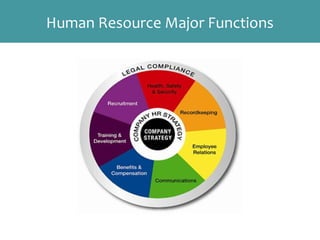
Human Resource Major Functions
Employee Compensation and Benefits
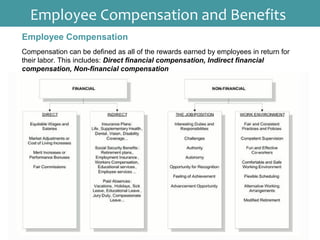
Employee Compensation
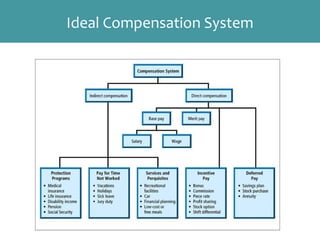
Compensation can be defined as all of the rewards earned by employees in return for
their labor. This includes: Direct financial compensation, Indirect financial
compensation, Non-financial compensation
Employee Compensation and Benefits
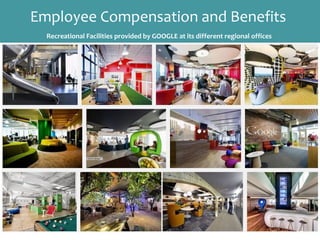
Recreational Facilities provided by GOOGLE at its different regional offices
Employee Benefits
Employee benefits typically refers to retirement plans,
health life insurance, life insurance, disability insurance,
vacation, employee stock ownership plans, etc. Benefits are
increasingly expensive for businesses to provide to
employees, so the range and options of benefits are
changing rapidly to include, for example, flexible benefit
plans.
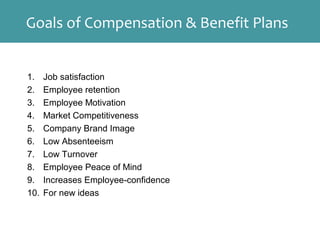
1. Job satisfaction
2. Employee retention
3. Employee Motivation
4. Market Competitiveness
5. Company Brand Image
6. Low Absenteeism
7. Low Turnover
8. Employee Peace of Mind
9. Increases Employee-confidence
10. For new ideas
Goals of Compensation & Benefit Plans
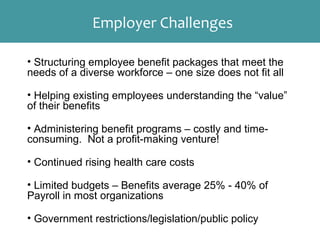
• Structuring employee benefit packages that meet the
needs of a diverse workforce – one size does not fit all
• Helping existing employees understanding the “value”
of their benefits
• Administering benefit programs – costly and time-
consuming. Not a profit-making venture!
• Continued rising health care costs
• Limited budgets – Benefits average 25% - 40% of
Payroll in most organizations
• Government restrictions/legislation/public policy
Employer Challenges
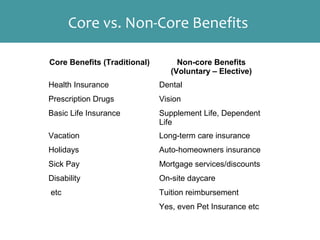
Core Benefits (Traditional) Non-core Benefits
(Voluntary – Elective)
Health Insurance Dental
Prescription Drugs Vision
Basic Life Insurance Supplement Life, Dependent
Life
Vacation Long-term care insurance
Holidays Auto-homeowners insurance
Sick Pay Mortgage services/discounts
Disability On-site daycare
etc Tuition reimbursement
Yes, even Pet Insurance etc
Core vs. Non-Core Benefits
Ideal Compensation System
• Employee benefits have huge budget impacts to employers
• Benefits are the “hidden paycheck” for employees
• Employees need to understand the “total compensation” an employer
provides – not just the “salary.” Employers need to sell Total
Compensation – not just salary
• Employees need to be “educated consumers” of benefit programs –
especially health care and retirement programs
• Compensation motivates employees while benefits provides a sense of
security to the employees, both favorable for employer.
*****
CONCLUSION
• Employee benefits have huge budget impacts to employers
• Benefits are the “hidden paycheck” for employees
• Employees need to understand the “total compensation” an employer
provides – not just the “salary.” Employers need to sell Total
Compensation – not just salary
• Employees need to be “educated consumers” of benefit programs –
especially health care and retirement programs
• Compensation motivates employees while benefits provides a sense of
security to the employees, both favorable for employer.
*****
CONCLUSION

Compensation And Benefits

  • 1.
    Employee Compensation andBenefits @UNIVERSITY OF KARACHI by Adeem S. Syed
  • 2.
  • 3.
    Employee Compensation andBenefits Employee Compensation Compensation can be defined as all of the rewards earned by employees in return for their labor. This includes: Direct financial compensation, Indirect financial compensation, Non-financial compensation
  • 4.
    Employee Compensation andBenefits Recreational Facilities provided by GOOGLE at its different regional offices Employee Benefits Employee benefits typically refers to retirement plans, health life insurance, life insurance, disability insurance, vacation, employee stock ownership plans, etc. Benefits are increasingly expensive for businesses to provide to employees, so the range and options of benefits are changing rapidly to include, for example, flexible benefit plans.
  • 5.
    1. Job satisfaction 2.Employee retention 3. Employee Motivation 4. Market Competitiveness 5. Company Brand Image 6. Low Absenteeism 7. Low Turnover 8. Employee Peace of Mind 9. Increases Employee-confidence 10. For new ideas Goals of Compensation & Benefit Plans
  • 6.
    • Structuring employeebenefit packages that meet the needs of a diverse workforce – one size does not fit all • Helping existing employees understanding the “value” of their benefits • Administering benefit programs – costly and time- consuming. Not a profit-making venture! • Continued rising health care costs • Limited budgets – Benefits average 25% - 40% of Payroll in most organizations • Government restrictions/legislation/public policy Employer Challenges
  • 7.
    Core Benefits (Traditional)Non-core Benefits (Voluntary – Elective) Health Insurance Dental Prescription Drugs Vision Basic Life Insurance Supplement Life, Dependent Life Vacation Long-term care insurance Holidays Auto-homeowners insurance Sick Pay Mortgage services/discounts Disability On-site daycare etc Tuition reimbursement Yes, even Pet Insurance etc Core vs. Non-Core Benefits
  • 8.
  • 9.
    • Employee benefitshave huge budget impacts to employers • Benefits are the “hidden paycheck” for employees • Employees need to understand the “total compensation” an employer provides – not just the “salary.” Employers need to sell Total Compensation – not just salary • Employees need to be “educated consumers” of benefit programs – especially health care and retirement programs • Compensation motivates employees while benefits provides a sense of security to the employees, both favorable for employer. ***** CONCLUSION
  • 10.
    • Employee benefitshave huge budget impacts to employers • Benefits are the “hidden paycheck” for employees • Employees need to understand the “total compensation” an employer provides – not just the “salary.” Employers need to sell Total Compensation – not just salary • Employees need to be “educated consumers” of benefit programs – especially health care and retirement programs • Compensation motivates employees while benefits provides a sense of security to the employees, both favorable for employer. ***** CONCLUSION

Editor's Notes

  • #2 Title Page
  • #3 Background / Preface
  • #4 Slide # 01 - Definition
  • #5 Slide # 02 – Recreational Facilities provided by GOOGLE at its different regional offices
  • #6 Slide # 02 – Goals / Objectives / Purpose
  • #7 Slide # 03 – Employer’s Challenges
  • #8 Slide # 04 – Comparison Between Core & Extra Benefits
  • #9 Slide # 05 – Ideal Compensation Structure System
  • #10 Conclusion