Performance Evaluation

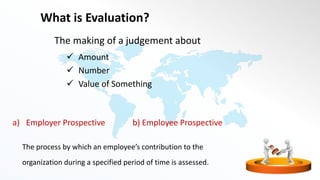
What is Evaluation?
The making of a judgement about
 Amount
 Number
 Value of Something
a) Employer Prospective b) Employee Prospective
The process by which an employee’s contribution to the
organization during a specified period of time is assessed.
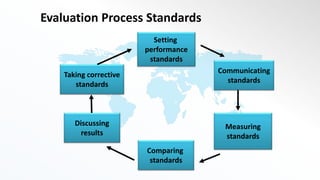
Evaluation Process Standards
Setting
performance
standards
Taking corrective
standards
Discussing
results
Comparing
standards
Measuring
standards
Communicating
standards
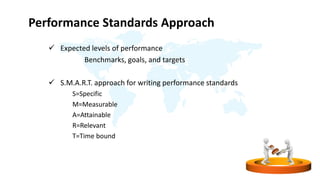
Performance Standards Approach
 Expected levels of performance
Benchmarks, goals, and targets
 S.M.A.R.T. approach for writing performance standards
S=Specific
M=Measurable
A=Attainable
R=Relevant
T=Time bound
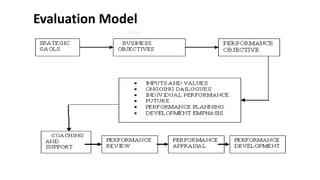
Evaluation Model
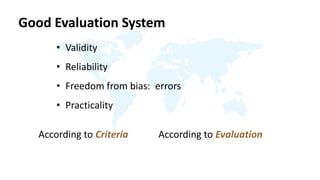
Good Evaluation System
• Validity
• Reliability
• Freedom from bias: errors
• Practicality
According to Criteria According to Evaluation
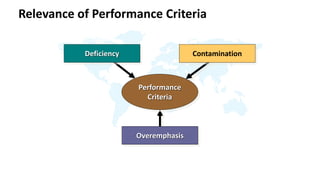
Relevance of Performance Criteria
Overemphasis
Deficiency Contamination
Performance
Criteria
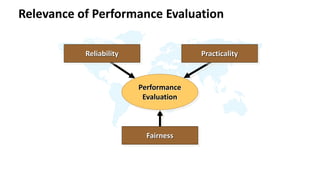
Relevance of Performance Evaluation
Fairness
Reliability Practicality
Performance
Evaluation
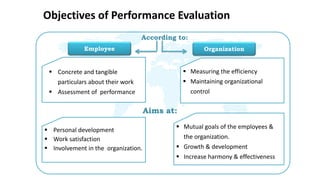
Objectives of Performance Evaluation
 Measuring the efficiency
 Maintaining organizational
control
 Concrete and tangible
particulars about their work
 Assessment of performance
 Mutual goals of the employees &
the organization.
 Growth & development
 Increase harmony & effectiveness
 Personal development
 Work satisfaction
 Involvement in the organization.
Employee Organization
According to:
Aims at:
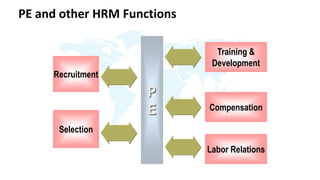
PE and other HRM Functions
Recruitment
Selection
Training &
Development
Compensation
Labor Relations
P
E
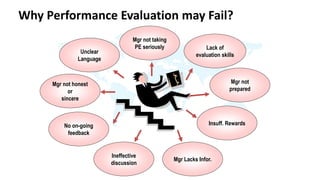
Why Performance Evaluation may Fail?
Unclear
Language
Mgr not taking
PE seriously
Mgr not
prepared
No on-going
feedback
Mgr not honest
or
sincere
Ineffective
discussion
Lack of
evaluation skills
Mgr Lacks Infor.
Insuff. Rewards
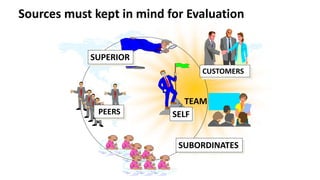
SUPERIOR
CUSTOMERS
TEAM
SUBORDINATES
PEERS SELF
Sources must kept in mind for Evaluation
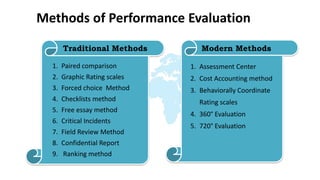
Methods of Performance Evaluation
1. Paired comparison
2. Graphic Rating scales
3. Forced choice Method
4. Checklists method
5. Free essay method
6. Critical Incidents
7. Field Review Method
8. Confidential Report
9. Ranking method
1. Assessment Center
2. Cost Accounting method
3. Behaviorally Coordinate
Rating scales
4. 360° Evaluation
5. 720° Evaluation
Traditional Methods Modern Methods
Traditional Methods

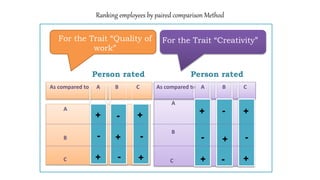
Paired Comparison Method
• Ranking employees by making a chart of all possible pairs of the
employees for each trait and indicating which is the better Employee of
the pair.
• It is useful where priorities are not clear
• This method is not appropriate if a large number of employee are
required to be evaluated.
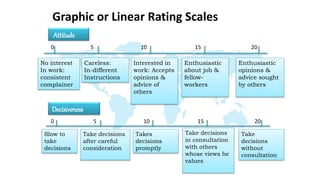
Graphic or Linear Rating Scales
Attitude
No interest
In work:
consistent
complainer
Careless:
In-different
Instructions
Interested in
work: Accepts
opinions &
advice of
others
Enthusiastic
about job &
fellow-
workers
Enthusiastic
opinions &
advice sought
by others
Decisiveness
Take decisions
in consultation
with others
whose views he
values
Slow to
take
decisions
Take decisions
after careful
consideration
Takes
decisions
promptly
Take
decisions
without
consultation
0 5 10 15 20
0 5 10 15 20
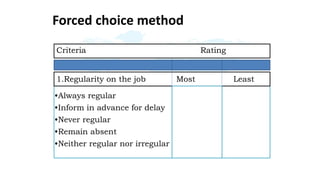
Criteria Rating
1.Regularity on the job Most Least
Forced choice method
•Always regular
•Inform in advance for delay
•Never regular
•Remain absent
•Neither regular nor irregular
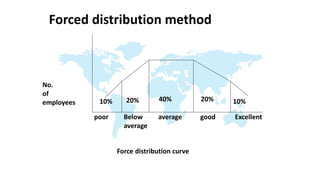
No.
of
employees 10% 20% 40% 20% 10%
poor Below
average
average good Excellent
Force distribution curve
Forced distribution method
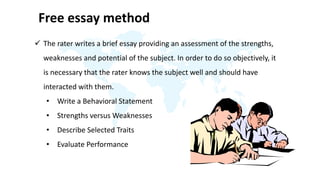
Free essay method
 The rater writes a brief essay providing an assessment of the strengths,
weaknesses and potential of the subject. In order to do so objectively, it
is necessary that the rater knows the subject well and should have
interacted with them.
• Write a Behavioral Statement
• Strengths versus Weaknesses
• Describe Selected Traits
• Evaluate Performance
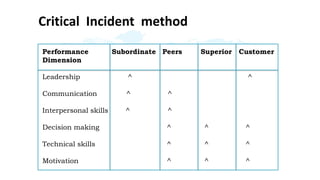
Critical Incident method
Performance Subordinate Peers Superior Customer
Dimension
Leadership ^ ^
Communication ^ ^
Interpersonal skills ^ ^
Decision making ^ ^ ^
Technical skills ^ ^ ^
Motivation ^ ^ ^
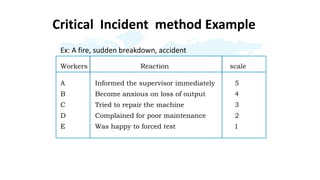
Ex: A fire, sudden breakdown, accident
Workers Reaction scale
A Informed the supervisor immediately 5
B Become anxious on loss of output 4
C Tried to repair the machine 3
D Complained for poor maintenance 2
E Was happy to forced test 1
Critical Incident method Example
Confidential report
 It is mostly used in government organizations. A descriptive
report prepared by the employee’s immediate superior. The
report highlights the strengths and weaknesses of the
subordinate. The impressions of the superior about the
subordinate are merely recorded and kept confidential without
revealing the facts.
As compared to A B C
A + - +
B - + -
C + - +
For the Trait “Quality of
work”
A - + +
B + - +
C + + -
As compared to A B C
For the Trait “Creativity”
+
+
++
+
+
+
+ +-
-
-
--
- +
- -
Person rated Person rated
Ranking employees by paired comparison Method
Modern Methods

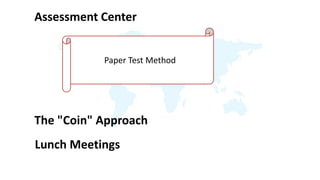
Assessment Center
Paper Test Method
Lunch Meetings
The "Coin" Approach
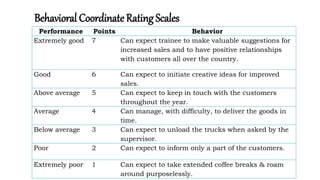
Behavioral Coordinate Rating Scales
Performance Points Behavior
Extremely good 7 Can expect trainee to make valuable suggestions for
increased sales and to have positive relationships
with customers all over the country.
Good 6 Can expect to initiate creative ideas for improved
sales.
Above average 5 Can expect to keep in touch with the customers
throughout the year.
Average 4 Can manage, with difficulty, to deliver the goods in
time.
Below average 3 Can expect to unload the trucks when asked by the
supervisor.
Poor 2 Can expect to inform only a part of the customers.
Extremely poor 1 Can expect to take extended coffee breaks & roam
around purposelessly.
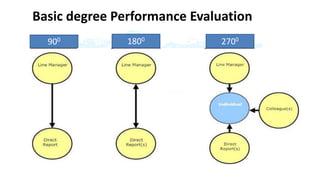
180 Appraisal
0
900 1800 2700
Basic degree Performance Evaluation
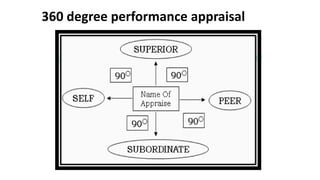
360 degree performance appraisal
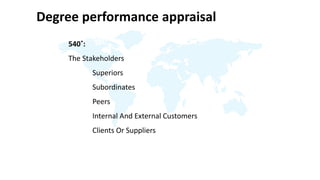
540˚:
The Stakeholders
Superiors
Subordinates
Peers
Internal And External Customers
Clients Or Suppliers
Degree performance appraisal
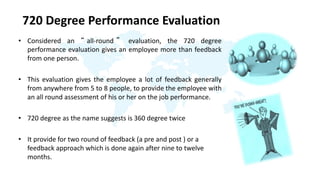
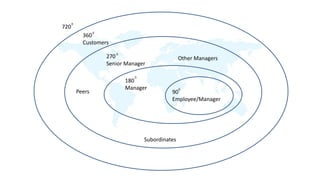
720 Degree Performance Evaluation
• Considered an “ all-round ” evaluation, the 720 degree
performance evaluation gives an employee more than feedback
from one person.
• This evaluation gives the employee a lot of feedback generally
from anywhere from 5 to 8 people, to provide the employee with
an all round assessment of his or her on the job performance.
• 720 degree as the name suggests is 360 degree twice
• It provide for two round of feedback (a pre and post ) or a
feedback approach which is done again after nine to twelve
months.
90
Employee/Manager
180
Manager
270
Senior Manager
Other Managers
Peers
Subordinates
360
Customers
720
0
0
0
0
0
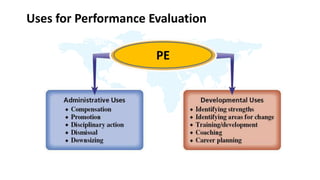
Uses for Performance Evaluation
PE
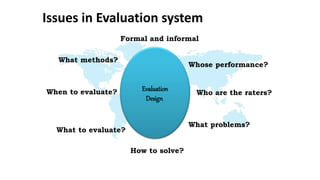
Issues in Evaluation system
Evaluation
Design
Formal and informal
Whose performance?
Who are the raters?
What problems?
How to solve?
What to evaluate?
When to evaluate?
What methods?
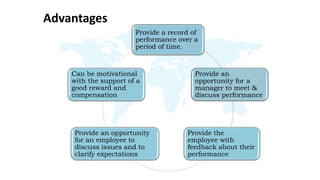
Advantages
Provide a record of
performance over a
period of time.
Provide an
opportunity for a
manager to meet &
discuss performance
Provide the
employee with
feedback about their
performance
Provide an opportunity
for an employee to
discuss issues and to
clarify expectations
Can be motivational
with the support of a
good reward and
compensation
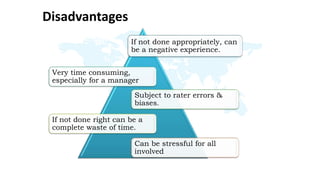
If not done appropriately, can
be a negative experience.
Very time consuming,
especially for a manager
Subject to rater errors &
biases.
If not done right can be a
complete waste of time.
Can be stressful for all
involved
Disadvantages
Performace evaluation

Performace evaluation

  • 1.
  • 2.
    What is Evaluation? Themaking of a judgement about  Amount  Number  Value of Something a) Employer Prospective b) Employee Prospective The process by which an employee’s contribution to the organization during a specified period of time is assessed.
  • 3.
    Evaluation Process Standards Setting performance standards Takingcorrective standards Discussing results Comparing standards Measuring standards Communicating standards
  • 4.
    Performance Standards Approach Expected levels of performance Benchmarks, goals, and targets  S.M.A.R.T. approach for writing performance standards S=Specific M=Measurable A=Attainable R=Relevant T=Time bound
  • 5.
  • 6.
    Good Evaluation System •Validity • Reliability • Freedom from bias: errors • Practicality According to Criteria According to Evaluation
  • 7.
    Relevance of PerformanceCriteria Overemphasis Deficiency Contamination Performance Criteria
  • 8.
    Relevance of PerformanceEvaluation Fairness Reliability Practicality Performance Evaluation
  • 9.
    Objectives of PerformanceEvaluation  Measuring the efficiency  Maintaining organizational control  Concrete and tangible particulars about their work  Assessment of performance  Mutual goals of the employees & the organization.  Growth & development  Increase harmony & effectiveness  Personal development  Work satisfaction  Involvement in the organization. Employee Organization According to: Aims at:
  • 10.
    PE and otherHRM Functions Recruitment Selection Training & Development Compensation Labor Relations P E
  • 11.
    Why Performance Evaluationmay Fail? Unclear Language Mgr not taking PE seriously Mgr not prepared No on-going feedback Mgr not honest or sincere Ineffective discussion Lack of evaluation skills Mgr Lacks Infor. Insuff. Rewards
  • 12.
  • 13.
    Methods of PerformanceEvaluation 1. Paired comparison 2. Graphic Rating scales 3. Forced choice Method 4. Checklists method 5. Free essay method 6. Critical Incidents 7. Field Review Method 8. Confidential Report 9. Ranking method 1. Assessment Center 2. Cost Accounting method 3. Behaviorally Coordinate Rating scales 4. 360° Evaluation 5. 720° Evaluation Traditional Methods Modern Methods
  • 14.
  • 15.
    Paired Comparison Method •Ranking employees by making a chart of all possible pairs of the employees for each trait and indicating which is the better Employee of the pair. • It is useful where priorities are not clear • This method is not appropriate if a large number of employee are required to be evaluated.
  • 16.
    Graphic or LinearRating Scales Attitude No interest In work: consistent complainer Careless: In-different Instructions Interested in work: Accepts opinions & advice of others Enthusiastic about job & fellow- workers Enthusiastic opinions & advice sought by others Decisiveness Take decisions in consultation with others whose views he values Slow to take decisions Take decisions after careful consideration Takes decisions promptly Take decisions without consultation 0 5 10 15 20 0 5 10 15 20
  • 17.
    Criteria Rating 1.Regularity onthe job Most Least Forced choice method •Always regular •Inform in advance for delay •Never regular •Remain absent •Neither regular nor irregular
  • 18.
    No. of employees 10% 20%40% 20% 10% poor Below average average good Excellent Force distribution curve Forced distribution method
  • 19.
    Free essay method The rater writes a brief essay providing an assessment of the strengths, weaknesses and potential of the subject. In order to do so objectively, it is necessary that the rater knows the subject well and should have interacted with them. • Write a Behavioral Statement • Strengths versus Weaknesses • Describe Selected Traits • Evaluate Performance
  • 20.
    Critical Incident method PerformanceSubordinate Peers Superior Customer Dimension Leadership ^ ^ Communication ^ ^ Interpersonal skills ^ ^ Decision making ^ ^ ^ Technical skills ^ ^ ^ Motivation ^ ^ ^
  • 21.
    Ex: A fire,sudden breakdown, accident Workers Reaction scale A Informed the supervisor immediately 5 B Become anxious on loss of output 4 C Tried to repair the machine 3 D Complained for poor maintenance 2 E Was happy to forced test 1 Critical Incident method Example
  • 22.
    Confidential report  Itis mostly used in government organizations. A descriptive report prepared by the employee’s immediate superior. The report highlights the strengths and weaknesses of the subordinate. The impressions of the superior about the subordinate are merely recorded and kept confidential without revealing the facts.
  • 23.
    As compared toA B C A + - + B - + - C + - + For the Trait “Quality of work” A - + + B + - + C + + - As compared to A B C For the Trait “Creativity” + + ++ + + + + +- - - -- - + - - Person rated Person rated Ranking employees by paired comparison Method
  • 24.
  • 25.
    Assessment Center Paper TestMethod Lunch Meetings The "Coin" Approach
  • 26.
    Behavioral Coordinate RatingScales Performance Points Behavior Extremely good 7 Can expect trainee to make valuable suggestions for increased sales and to have positive relationships with customers all over the country. Good 6 Can expect to initiate creative ideas for improved sales. Above average 5 Can expect to keep in touch with the customers throughout the year. Average 4 Can manage, with difficulty, to deliver the goods in time. Below average 3 Can expect to unload the trucks when asked by the supervisor. Poor 2 Can expect to inform only a part of the customers. Extremely poor 1 Can expect to take extended coffee breaks & roam around purposelessly.
  • 27.
    180 Appraisal 0 900 18002700 Basic degree Performance Evaluation
  • 28.
  • 29.
    540˚: The Stakeholders Superiors Subordinates Peers Internal AndExternal Customers Clients Or Suppliers Degree performance appraisal
  • 30.
    720 Degree PerformanceEvaluation • Considered an “ all-round ” evaluation, the 720 degree performance evaluation gives an employee more than feedback from one person. • This evaluation gives the employee a lot of feedback generally from anywhere from 5 to 8 people, to provide the employee with an all round assessment of his or her on the job performance. • 720 degree as the name suggests is 360 degree twice • It provide for two round of feedback (a pre and post ) or a feedback approach which is done again after nine to twelve months.
  • 31.
  • 32.
    Uses for PerformanceEvaluation PE
  • 33.
    Issues in Evaluationsystem Evaluation Design Formal and informal Whose performance? Who are the raters? What problems? How to solve? What to evaluate? When to evaluate? What methods?
  • 34.
    Advantages Provide a recordof performance over a period of time. Provide an opportunity for a manager to meet & discuss performance Provide the employee with feedback about their performance Provide an opportunity for an employee to discuss issues and to clarify expectations Can be motivational with the support of a good reward and compensation
  • 35.
    If not doneappropriately, can be a negative experience. Very time consuming, especially for a manager Subject to rater errors & biases. If not done right can be a complete waste of time. Can be stressful for all involved Disadvantages