Evaluation Methods

What is Evaluation?
The making of a judgement about
 Amount
 Number
 Value of Something
a) Employer Prospective b) Employee Prospective
EVALUATION STRUCTURE
JOB BASED
JOB ANALYSIS
JOB DESCRIPTION
JOB SPECIFICATION
PERSON BASED
SKILL
SKILL ANALYSIS
SKILL BLOCKS
CERTIFICATION PROCESS
COMPETENCIES
CORE COMPETENCIES
COMPETENCY SETS
BEHAVIORAL DESCRIPTORS
PERSON BASED STRUCTURE
JOB EVALUATION
JOB SPECIFICATIONSJOB DESCRIPTIONJOB ANALYSIS
• Duties
• Skill Requirements
• Knowledge
• Skills
• Education
• Experience
• Abilities
• Identify, define, & describe
• Responsibilities
• Reporting relationships
• Working conditions
JOB ANALYSIS

JOB ANALYSIS
WHY performing JA?
WHO should be involved?
HOW should we collect it?
WHAT information do we need?
WHAT is job analysis?
• WHY performing Job Analysis?
Two critical uses of JOB ANALYSIS:
1. It establishes similarities and differences in the work
contents of the job
2. It helps establish an internally fair and aligned job
structure
• WHAT is job analysis?
– Process of defining a job in terms of its component
tasks or duties and the knowledge or skills required
to perform them
WHAT & WHY
WHAT information do we need?
JOB IDENTIFICATION JOB CONTENT
 Title  Tasks, Activities
 Department in which job is located  Working conditions, Performance criteria
 Number of people who hold job  Critical incidents, Conflicting demands
EMPLOYEE CHARACTERISTICS INTERNAL RELATIONSHIPS EXTERNAL RELATIONSHIPS
 Professional knowledge  Boss and other  Suppliers
 Written skills  Superiors  Customers
 Verbal skills  Peers  Regulatory
 Leadership skills  Subordinates  Professional industry
HOW should we collect the information?
QUANTITATIVE METHODS
• Questionnaire via web-site
CONVENTIONAL METHODS
• Interview
• Questionnaire
WHO should be involved?
JOBHOLDERS SUPERVISORS ANALYSTS
JOB DESCRIPTIONS

JOB DESCRIPTION
General Guidelines
Basic Considerations
WHAT is job description?
Job description means the basis of job specification
it generally includes
Duties
Purpose
Responsibilities
Scope
Working conditions
WHAT is job description?
General guidelines
Basic Considerations
Independence
JOB DESCRIPTIONS & JOB SPECIFICATIONS
JOB ANALYSIS
RECRUITMENT SELECTION
PERFORMANCE
APPRAISAL
TRAINING &
CAREER
DEVELOPMENT
USES OF JOB ANALYSIS INFORMATION
JOB EVALUATION

JOB EVALUATION
What is Job evaluation?
Objectives Job Evaluation
Some Major Decisions
Job Evaluation Process
Benefit Job Evaluation
Job Evaluation Methods
Job evaluation is a systematic way of determining the
value/worth of a job in relation to other jobs in organization.
What is job evaluation?
EvaluationDescriptionAnalysis
 Tries to assess jobs ,not people
 The basic information is obtained from job analysis
 Carried out by groups, not by individuals
 Establish the purpose of evaluation
 Decide whether to use single or multiple plans
 Choose among alternative approaches
 Obtain involvement of relevant stakeholders
 Evaluate plan’s usefulness
Some Major Decisions
SELECT
TECHNIQUE
CHOOSE
COMMITTEE
TRAIN MEMBERS
TO EVALUATE
DOCUMENT PLAN
COMMUNICATE
WITH EMPLOYEES
SET-UP APPEALS
PROCESS
Job Evaluation Process Steps
Work
Relationship
Job
Analysis
Job
Description
Job
Evaluation
Job
Structure
Critical Steps
Job Evaluation Flows
JOB EVALUATION METHODS

JOB EVALUATION METHODS
The techniques of job evaluation
1. Qualitative Method
a) Simple ranking method
b) Grading method
2. Quantitative Method
a) Point method
b) Factor comparison method
Simple Ranking Method1.a
 As per this method, jobs are arranged form highest to lowest, in
order of their values or merit to the organization
 Jobs can also be arranged according to the relative difficulty in
performing them.
 The job at the top has the highest value and job at the lowest has
the lowest value.
 Jobs are arranged in each department and then department
ranking are combined to develop an organization ranking
Grading Method
CLASS RANK EMPLOYEES
Class 1 Executives Office manager, Deputy Office manager,
Office Superintendent, etc.
Class 2 Skilled workers Purchasing Assistant, Cashier, Receipts
Clerk, etc.
Class 3 Semi-skilled workers Steno typists, Machine-operators, etc.
Class 4 Less-skilled workers File Clerks, Office boys, etc.
Major job classes are established. Various jobs are assigned by ranking to
these grades based on their personal interpretations of relative difficulty
of tasks, responsibility involved, knowledge and experience required,
authority level etc.
1.b
POINT METHOD2.a
Education
Degrees
Levels
Decision
Making
Degrees
Levels
Job factors
Skill
Responsibility
& Effort
Dexterity
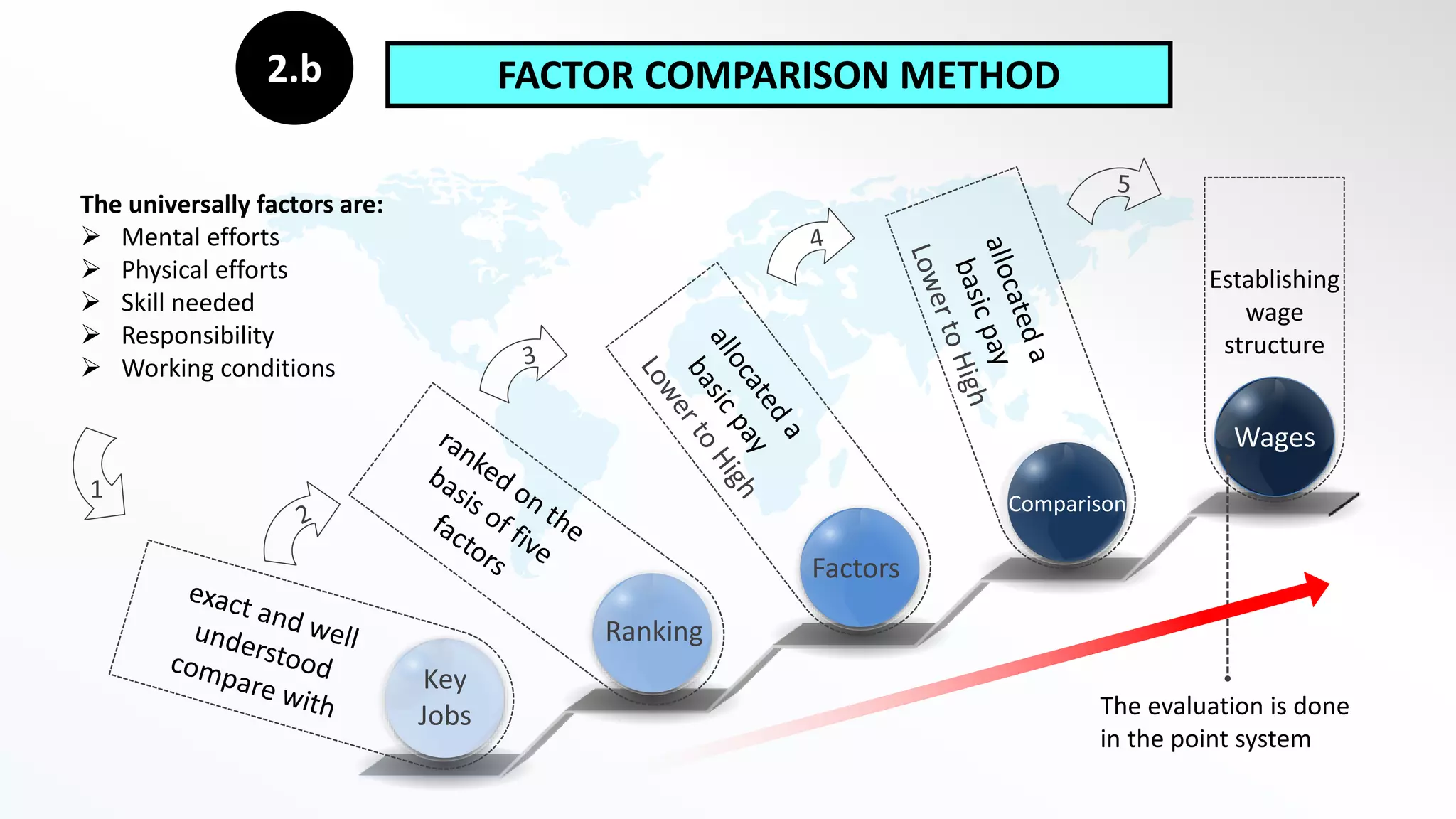
FACTOR COMPARISON METHOD
Wages
Key
Jobs
Ranking
Factors
Comparison
The universally factors are:
 Mental efforts
 Physical efforts
 Skill needed
 Responsibility
 Working conditions
Establishing
wage
structure
The evaluation is done
in the point system
2.b
1
Advantages:
 This system is systematic where every job factor is quantified
 It can easily be explained to workers
 The relative value of each job is determined by comparison with some key job.
 The number of factors used being limited, it helps in avoiding overlapping.
 It can be used for evaluation of unlike jobs.
FACTOR COMPARISON METHOD
Limitations:
 It is difficult to operate as selection of unfairly paid jobs as key jobs can result in
considerable error.
 There may be frequent changes in wage levels requiring adjustment in key jobs.
 The system is complex and cannot be easily understood by unskilled staff.
 This method is expensive and small units cannot afford to use it
Further Employees` Evaluation

30
Reliability
Relevance
Sensitivity
Practicality
Why Performance Evaluation
31
 Immediate supervisor only (typical)
 Committee of several supervisors
 Employees’ peers (coworkers)
 Employees’ subordinates
 Someone outside the immediate work situation
 Self-evaluation
Who Should Evaluate the Employee?
 Opposition to evaluation
 System design and operating problems
 Rater problems include
Potential Evaluation Problems
• Rater errors and bias
• The influence of liking
• Organizational politics
• Whether to focus on the
individual or the group
• Legal issues
 Reduction in inequalities in salary structure specialization
 Helps in selection of employees
 Harmonious relationship between employees and manager standardization
 Relevance of new jobs
Benefits of Job Evaluation
Evaluation methods

Evaluation methods

  • 1.
  • 2.
    What is Evaluation? Themaking of a judgement about  Amount  Number  Value of Something a) Employer Prospective b) Employee Prospective
  • 3.
    EVALUATION STRUCTURE JOB BASED JOBANALYSIS JOB DESCRIPTION JOB SPECIFICATION PERSON BASED SKILL SKILL ANALYSIS SKILL BLOCKS CERTIFICATION PROCESS COMPETENCIES CORE COMPETENCIES COMPETENCY SETS BEHAVIORAL DESCRIPTORS PERSON BASED STRUCTURE
  • 4.
    JOB EVALUATION JOB SPECIFICATIONSJOBDESCRIPTIONJOB ANALYSIS • Duties • Skill Requirements • Knowledge • Skills • Education • Experience • Abilities • Identify, define, & describe • Responsibilities • Reporting relationships • Working conditions
  • 5.
  • 6.
    JOB ANALYSIS WHY performingJA? WHO should be involved? HOW should we collect it? WHAT information do we need? WHAT is job analysis?
  • 7.
    • WHY performingJob Analysis? Two critical uses of JOB ANALYSIS: 1. It establishes similarities and differences in the work contents of the job 2. It helps establish an internally fair and aligned job structure • WHAT is job analysis? – Process of defining a job in terms of its component tasks or duties and the knowledge or skills required to perform them WHAT & WHY
  • 8.
    WHAT information dowe need? JOB IDENTIFICATION JOB CONTENT  Title  Tasks, Activities  Department in which job is located  Working conditions, Performance criteria  Number of people who hold job  Critical incidents, Conflicting demands EMPLOYEE CHARACTERISTICS INTERNAL RELATIONSHIPS EXTERNAL RELATIONSHIPS  Professional knowledge  Boss and other  Suppliers  Written skills  Superiors  Customers  Verbal skills  Peers  Regulatory  Leadership skills  Subordinates  Professional industry
  • 9.
    HOW should wecollect the information? QUANTITATIVE METHODS • Questionnaire via web-site CONVENTIONAL METHODS • Interview • Questionnaire WHO should be involved? JOBHOLDERS SUPERVISORS ANALYSTS
  • 10.
  • 11.
    JOB DESCRIPTION General Guidelines BasicConsiderations WHAT is job description?
  • 12.
    Job description meansthe basis of job specification it generally includes Duties Purpose Responsibilities Scope Working conditions WHAT is job description?
  • 13.
  • 14.
  • 15.
    JOB DESCRIPTIONS &JOB SPECIFICATIONS JOB ANALYSIS RECRUITMENT SELECTION PERFORMANCE APPRAISAL TRAINING & CAREER DEVELOPMENT USES OF JOB ANALYSIS INFORMATION
  • 16.
  • 17.
    JOB EVALUATION What isJob evaluation? Objectives Job Evaluation Some Major Decisions Job Evaluation Process Benefit Job Evaluation Job Evaluation Methods
  • 18.
    Job evaluation isa systematic way of determining the value/worth of a job in relation to other jobs in organization. What is job evaluation? EvaluationDescriptionAnalysis
  • 19.
     Tries toassess jobs ,not people  The basic information is obtained from job analysis  Carried out by groups, not by individuals  Establish the purpose of evaluation  Decide whether to use single or multiple plans  Choose among alternative approaches  Obtain involvement of relevant stakeholders  Evaluate plan’s usefulness Some Major Decisions
  • 20.
    SELECT TECHNIQUE CHOOSE COMMITTEE TRAIN MEMBERS TO EVALUATE DOCUMENTPLAN COMMUNICATE WITH EMPLOYEES SET-UP APPEALS PROCESS Job Evaluation Process Steps
  • 21.
  • 22.
  • 23.
    JOB EVALUATION METHODS Thetechniques of job evaluation 1. Qualitative Method a) Simple ranking method b) Grading method 2. Quantitative Method a) Point method b) Factor comparison method
  • 24.
    Simple Ranking Method1.a As per this method, jobs are arranged form highest to lowest, in order of their values or merit to the organization  Jobs can also be arranged according to the relative difficulty in performing them.  The job at the top has the highest value and job at the lowest has the lowest value.  Jobs are arranged in each department and then department ranking are combined to develop an organization ranking
  • 25.
    Grading Method CLASS RANKEMPLOYEES Class 1 Executives Office manager, Deputy Office manager, Office Superintendent, etc. Class 2 Skilled workers Purchasing Assistant, Cashier, Receipts Clerk, etc. Class 3 Semi-skilled workers Steno typists, Machine-operators, etc. Class 4 Less-skilled workers File Clerks, Office boys, etc. Major job classes are established. Various jobs are assigned by ranking to these grades based on their personal interpretations of relative difficulty of tasks, responsibility involved, knowledge and experience required, authority level etc. 1.b
  • 26.
  • 27.
    FACTOR COMPARISON METHOD Wages Key Jobs Ranking Factors Comparison Theuniversally factors are:  Mental efforts  Physical efforts  Skill needed  Responsibility  Working conditions Establishing wage structure The evaluation is done in the point system 2.b 1
  • 28.
    Advantages:  This systemis systematic where every job factor is quantified  It can easily be explained to workers  The relative value of each job is determined by comparison with some key job.  The number of factors used being limited, it helps in avoiding overlapping.  It can be used for evaluation of unlike jobs. FACTOR COMPARISON METHOD Limitations:  It is difficult to operate as selection of unfairly paid jobs as key jobs can result in considerable error.  There may be frequent changes in wage levels requiring adjustment in key jobs.  The system is complex and cannot be easily understood by unskilled staff.  This method is expensive and small units cannot afford to use it
  • 29.
  • 30.
  • 31.
    31  Immediate supervisoronly (typical)  Committee of several supervisors  Employees’ peers (coworkers)  Employees’ subordinates  Someone outside the immediate work situation  Self-evaluation Who Should Evaluate the Employee?
  • 32.
     Opposition toevaluation  System design and operating problems  Rater problems include Potential Evaluation Problems • Rater errors and bias • The influence of liking • Organizational politics • Whether to focus on the individual or the group • Legal issues
  • 33.
     Reduction ininequalities in salary structure specialization  Helps in selection of employees  Harmonious relationship between employees and manager standardization  Relevance of new jobs Benefits of Job Evaluation