PRESENTATION
ON
PERFORMANCE APPRAISAL
PA is the method of evaluating the
behaviour of the employees in the
workplace, normally including
both quantitative and qualitative
aspect of the job.
 How the employee is performing
 How the employee can develop
 What the superior can do to make it
happen
 How the job is going
What is Performance Appraisal
• Provide information about the performance ranks.
Decision regarding salary revision, confirmation,
promotion and demotions.
• Provide feedback about level of achievement and
behaviour of the subordinate.
• Provide information which helps to counsel the
employees.
• Provide information to diagnose the deficiency of
the employees.
• Provide training and development needs of the
employees.
WHY conduct a Performance
Appraisal
• The performance review must occur atleast
once in a year. Some companies review twice in
a year.
• However, as a part of Performance
Management, the performance review is a
continuing, ongoing activity.
WHEN to conduct a Performance
Appraisal
• Establish a more effective two way communication
• Set performance objectives
• Help improve current performance
• Assess past performance
• Provide feedback on performance
• Identify training & development needs
• Allocate rewards
• Identify staff with promotional possibilities
• Assist in career planning decisions
OBJECTIVES of Performance
Appraisal
• The Appraisee
• The Appraiser
• HR Department
WHO are involved in Performance
Appraisal
• Regularity of the
Attendance.
• Ability to work
individually or in group.
• Leadership skills.
• Initiative, Technical skills.
• Ability to grasp new things.
• Area of interest.
• Attitude.
• Job Knowledge.
Content of Performance Management
• Judgmental Skills.
• Area of improvement.
• Past Achievement.
• Honesty and sincerity.
• Innovativeness
• Cost & Time consciousness
• Communication
Traditional Methods of
Performance Appraisal.
• Graphic Rating Scales: This is the oldest and
most widely method used for performance
appraisal. The scales may specify five points, so
a factor such as job knowledge might be rated 1
(poorly informed about work duties) to 5 (has
complete mastery of all phases of the job).
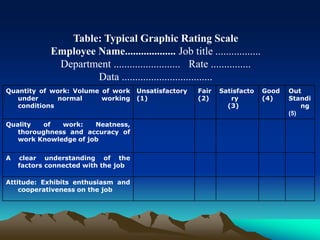
Quantity of work: Volume of work
under normal working
conditions
Unsatisfactory
(1)
Fair
(2)
Satisfacto
ry
(3)
Good
(4)
Out
Standi
ng
(5)
Quality of work: Neatness,
thoroughness and accuracy of
work Knowledge of job
A clear understanding of the
factors connected with the job
Attitude: Exhibits enthusiasm and
cooperativeness on the job
Table: Typical Graphic Rating Scale
Employee Name................... Job title .................
Department ......................... Rate ...............
Data ..................................
Ranking Method
• This is one of the oldest and simplest
techniques of performance appraisal. In
this method, the appraiser ranks the
employees from the best to the poorest on
the basis of their overall performance. It is
quite useful for a comparative evaluation.
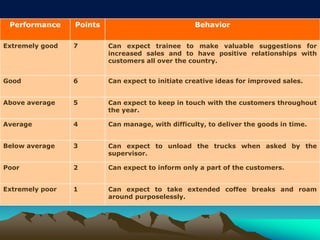
Performance Points Behavior
Extremely good 7 Can expect trainee to make valuable suggestions for
increased sales and to have positive relationships with
customers all over the country.
Good 6 Can expect to initiate creative ideas for improved sales.
Above average 5 Can expect to keep in touch with the customers throughout
the year.
Average 4 Can manage, with difficulty, to deliver the goods in time.
Below average 3 Can expect to unload the trucks when asked by the
supervisor.
Poor 2 Can expect to inform only a part of the customers.
Extremely poor 1 Can expect to take extended coffee breaks and roam
around purposelessly.
Paired Comparison Method
• A better technique of comparison than the
straight ranking method, this method compares
each employee with all others in the group, one
at a time. After all the comparisons on the basis
of the overall comparisons, the employees are
given the final rankings.
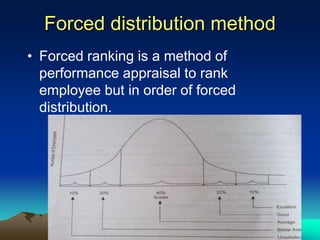
Forced distribution method
• Forced ranking is a method of
performance appraisal to rank
employee but in order of forced
distribution.
Checklist Method
• Another simple type
of individual
evaluation method is
the checklist.
Is the employee really interested in the task assigned? Yes/No
Is he respected by his colleagues (co-workers) Yes/No
Does he give respect to his superiors? Yes/No
Does he follow instructions properly? Yes/No
Does he make mistakes frequently? Yes/No
Critical Incidence Method
• Under this method, the manager prepares lists of
statements of very effective and ineffective behavior of an
employee. These critical incidents or events represent the
outstanding or poor behavior of employees on the job .
• July 20 – Mr. Paul patiently attended to the major
customers complaint. He is polite, prompt, enthusiastic in
solving the customers’ problem.
On the other hand the bad critical incident may appear as
under:
• September 28– Mr. Paul stayed 45 minutes over on his
break during the busiest part of the day. He failed to
answer the store manager’s call thrice.
Essay Method
• This method asked managers /
supervisors to describe strengths and
weaknesses of an employee’s behavior.
Confidential Report
It is mostly used in government organizations. It
is a descriptive report prepared, generally at the
end of every year, by the employee’s immediate
superior. The report highlights the strengths and
weaknesses of the subordinate.
Modern Methods
MBO
A process whereby the superior and
subordinates of the organization jointly
identify its common objectives, define
each individual’s major areas of
responsibility.
1. Establishment of Goals
2. Setting the performance standard
3. Actual level of job attainment is
compared with the goals agreed upon.
4. Establishing new goals and new
strategies for goals not previously
attained.
PSYCHOLOGICAL APPRAISALS:
When psychologists are used for evaluations, they
asses an individual’s potential. The appraisal consists
of in-depth interviews, psychological tests,
discussions with supervisors and a review of other
evaluations.
Assessment Centre
• This not a technique of performance appraisal
by itself. In fact, this is a system or organization
where assessment of several individual is done
by experts by using various techniques. These
techniques used role playing, case studies etc.
360 DEGREE
FEEDBACK
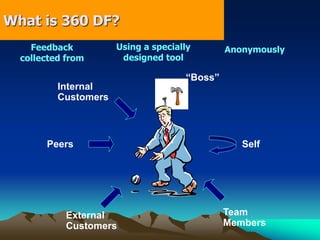
What is 360 DF?
360 Degree Feedback is a multi - rater
feedback system where an individual is
assessed by a number of assessors including
his boss, direct reports, colleagues, internal
customers and external customers
Internal
Customers
“Boss”
Peers
External
Customers
Team
Members
Self
Feedback
collected from
Using a specially
designed tool
Anonymously
What is 360 DF?
1. Halo/horn effect – employee’s
extreme competence in one
area “shines” over all others.
Conversely, employee does
poorly in one area and this
overshadows all areas.
2. Bias – own prejudices {race,
national origin, gender,
appearance, etc.} influence the
appraisal
3. Comparison Rating –
contrasting one employee with
another
Common Problems Associated with Conducting
the Appraisal
3. Central Tendency – rate everyone as average
4. Recency Effect – focusing on recent
performance instead of entire year
5. Personal Prejudice – If the rater dislikes one
group or employees, he may rate them at the
lower end.
6. Favoritism – evaluating friends or those who
don’t make waves, etc. more favorably than
others
Common Problems Associated with Conducting the
Appraisal
Performance Appraisal System introduction

Performance Appraisal System introduction

  • 1.
  • 2.
    PA is themethod of evaluating the behaviour of the employees in the workplace, normally including both quantitative and qualitative aspect of the job.  How the employee is performing  How the employee can develop  What the superior can do to make it happen  How the job is going What is Performance Appraisal
  • 3.
    • Provide informationabout the performance ranks. Decision regarding salary revision, confirmation, promotion and demotions. • Provide feedback about level of achievement and behaviour of the subordinate. • Provide information which helps to counsel the employees. • Provide information to diagnose the deficiency of the employees. • Provide training and development needs of the employees. WHY conduct a Performance Appraisal
  • 4.
    • The performancereview must occur atleast once in a year. Some companies review twice in a year. • However, as a part of Performance Management, the performance review is a continuing, ongoing activity. WHEN to conduct a Performance Appraisal
  • 5.
    • Establish amore effective two way communication • Set performance objectives • Help improve current performance • Assess past performance • Provide feedback on performance • Identify training & development needs • Allocate rewards • Identify staff with promotional possibilities • Assist in career planning decisions OBJECTIVES of Performance Appraisal
  • 6.
    • The Appraisee •The Appraiser • HR Department WHO are involved in Performance Appraisal
  • 7.
    • Regularity ofthe Attendance. • Ability to work individually or in group. • Leadership skills. • Initiative, Technical skills. • Ability to grasp new things. • Area of interest. • Attitude. • Job Knowledge. Content of Performance Management • Judgmental Skills. • Area of improvement. • Past Achievement. • Honesty and sincerity. • Innovativeness • Cost & Time consciousness • Communication
  • 8.
    Traditional Methods of PerformanceAppraisal. • Graphic Rating Scales: This is the oldest and most widely method used for performance appraisal. The scales may specify five points, so a factor such as job knowledge might be rated 1 (poorly informed about work duties) to 5 (has complete mastery of all phases of the job).
  • 9.
    Quantity of work:Volume of work under normal working conditions Unsatisfactory (1) Fair (2) Satisfacto ry (3) Good (4) Out Standi ng (5) Quality of work: Neatness, thoroughness and accuracy of work Knowledge of job A clear understanding of the factors connected with the job Attitude: Exhibits enthusiasm and cooperativeness on the job Table: Typical Graphic Rating Scale Employee Name................... Job title ................. Department ......................... Rate ............... Data ..................................
  • 10.
    Ranking Method • Thisis one of the oldest and simplest techniques of performance appraisal. In this method, the appraiser ranks the employees from the best to the poorest on the basis of their overall performance. It is quite useful for a comparative evaluation.
  • 11.
    Performance Points Behavior Extremelygood 7 Can expect trainee to make valuable suggestions for increased sales and to have positive relationships with customers all over the country. Good 6 Can expect to initiate creative ideas for improved sales. Above average 5 Can expect to keep in touch with the customers throughout the year. Average 4 Can manage, with difficulty, to deliver the goods in time. Below average 3 Can expect to unload the trucks when asked by the supervisor. Poor 2 Can expect to inform only a part of the customers. Extremely poor 1 Can expect to take extended coffee breaks and roam around purposelessly.
  • 12.
    Paired Comparison Method •A better technique of comparison than the straight ranking method, this method compares each employee with all others in the group, one at a time. After all the comparisons on the basis of the overall comparisons, the employees are given the final rankings.
  • 13.
    Forced distribution method •Forced ranking is a method of performance appraisal to rank employee but in order of forced distribution.
  • 14.
    Checklist Method • Anothersimple type of individual evaluation method is the checklist. Is the employee really interested in the task assigned? Yes/No Is he respected by his colleagues (co-workers) Yes/No Does he give respect to his superiors? Yes/No Does he follow instructions properly? Yes/No Does he make mistakes frequently? Yes/No
  • 15.
    Critical Incidence Method •Under this method, the manager prepares lists of statements of very effective and ineffective behavior of an employee. These critical incidents or events represent the outstanding or poor behavior of employees on the job . • July 20 – Mr. Paul patiently attended to the major customers complaint. He is polite, prompt, enthusiastic in solving the customers’ problem. On the other hand the bad critical incident may appear as under: • September 28– Mr. Paul stayed 45 minutes over on his break during the busiest part of the day. He failed to answer the store manager’s call thrice.
  • 16.
    Essay Method • Thismethod asked managers / supervisors to describe strengths and weaknesses of an employee’s behavior.
  • 17.
    Confidential Report It ismostly used in government organizations. It is a descriptive report prepared, generally at the end of every year, by the employee’s immediate superior. The report highlights the strengths and weaknesses of the subordinate.
  • 18.
  • 19.
    MBO A process wherebythe superior and subordinates of the organization jointly identify its common objectives, define each individual’s major areas of responsibility. 1. Establishment of Goals 2. Setting the performance standard 3. Actual level of job attainment is compared with the goals agreed upon. 4. Establishing new goals and new strategies for goals not previously attained.
  • 20.
    PSYCHOLOGICAL APPRAISALS: When psychologistsare used for evaluations, they asses an individual’s potential. The appraisal consists of in-depth interviews, psychological tests, discussions with supervisors and a review of other evaluations.
  • 21.
    Assessment Centre • Thisnot a technique of performance appraisal by itself. In fact, this is a system or organization where assessment of several individual is done by experts by using various techniques. These techniques used role playing, case studies etc.
  • 22.
  • 23.
    What is 360DF? 360 Degree Feedback is a multi - rater feedback system where an individual is assessed by a number of assessors including his boss, direct reports, colleagues, internal customers and external customers
  • 24.
  • 25.
    1. Halo/horn effect– employee’s extreme competence in one area “shines” over all others. Conversely, employee does poorly in one area and this overshadows all areas. 2. Bias – own prejudices {race, national origin, gender, appearance, etc.} influence the appraisal 3. Comparison Rating – contrasting one employee with another Common Problems Associated with Conducting the Appraisal
  • 26.
    3. Central Tendency– rate everyone as average 4. Recency Effect – focusing on recent performance instead of entire year 5. Personal Prejudice – If the rater dislikes one group or employees, he may rate them at the lower end. 6. Favoritism – evaluating friends or those who don’t make waves, etc. more favorably than others Common Problems Associated with Conducting the Appraisal