Performance Appraisal

   Performance Appraisal (PA) refers to all those procedures that are used to evaluate
    the

   personality
   performance
   potential of its group members
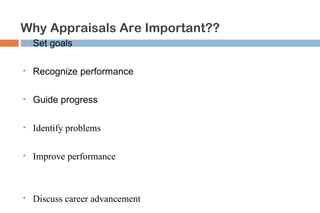
Why Appraisals Are Important??
   Set goals
        Set goals
   Recognize performance
        Recognize performance

       Guide progress
   Guide progress
        Identify problems
   Identify problems
        Improve performance

   Improve performance
        Discuss career advancement


   Discuss career advancement
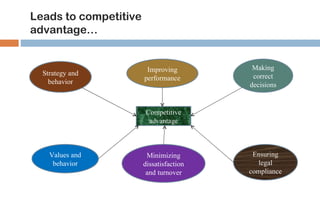
Leads to competitive
advantage…


                        Improving         Making
  Strategy and                            correct
                       performance
    behavior                             decisions


                        Competitive
                         advantage


    Values and          Minimizing        Ensuring
     behavior          dissatisfaction      legal
                        and turnover     compliance
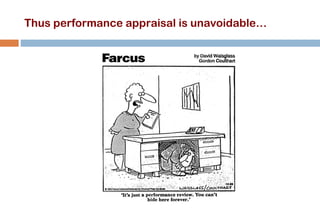
Thus performance appraisal is unavoidable…
Performance Appraisal : past-oriented methods


       Rating scale
       Confidential report
       Essay evaluation
       Critical incident method
       Checklists
       Forced choice method
       Behaviorally anchored rating scale
       Ranking
Past-oriented Methods Contd.


        Paired comparison method

        Forced distribution method

        Field review technique
Future-oriented Methods

   Management by objective

   360o Feedback Method

   Psychological Appraisals

   Assessment Centre
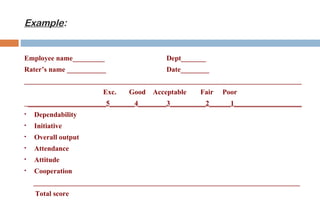
Rating scale

   The rating scale consist of several numerical scales, each representing a job
    related performance criterion such as dependability, initiative, output,
    attendance, attitude, co-operation and the like
Example:


Employee name_________                     Dept_______
Rater’s name ___________                   Date________
______________________________________________________________________________
                         Exc.   Good   Acceptable   Fair   Poor
    ______________________5_______4________3__________2______1___________________
    Dependability
    Initiative
    Overall output
    Attendance
    Attitude
    Cooperation
     ___________________________________________________________________________
      Total score
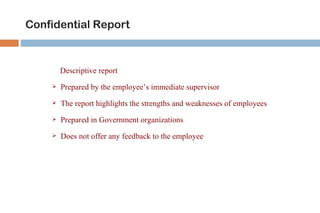
Confidential Report


        Descriptive report
       Prepared by the employee’s immediate supervisor
       The report highlights the strengths and weaknesses of employees
       Prepared in Government organizations
       Does not offer any feedback to the employee
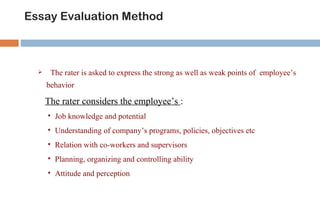
Essay Evaluation Method


      The rater is asked to express the strong as well as weak points of employee’s
      behavior

      The rater considers the employee’s :
         Job knowledge and potential
         Understanding of company’s programs, policies, objectives etc
         Relation with co-workers and supervisors
         Planning, organizing and controlling ability
         Attitude and perception
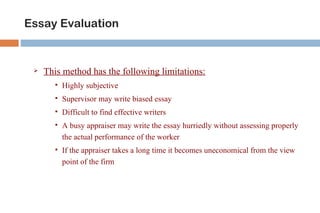
Essay Evaluation


    This method has the following limitations:
          Highly subjective
          Supervisor may write biased essay
          Difficult to find effective writers
          A busy appraiser may write the essay hurriedly without assessing properly
           the actual performance of the worker
          If the appraiser takes a long time it becomes uneconomical from the view
           point of the firm
Critical Incident Technique


         Manager prepares lists of statements of very effective and ineffective

          behavior of an employee

         These critical incidents represent the outstanding or poor behavior of the

          employees

         The manager periodically records critical incidents of employee’s behavior
Critical Incident Technique


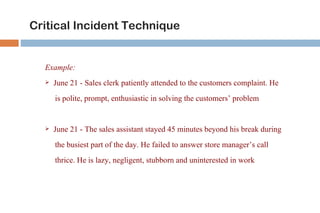
  Example:
     June 21 - Sales clerk patiently attended to the customers complaint. He
      is polite, prompt, enthusiastic in solving the customers’ problem


     June 21 - The sales assistant stayed 45 minutes beyond his break during
      the busiest part of the day. He failed to answer store manager’s call
      thrice. He is lazy, negligent, stubborn and uninterested in work
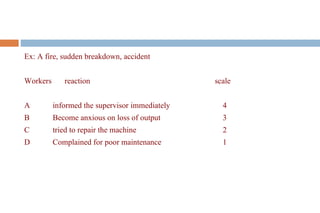
Ex: A fire, sudden breakdown, accident


Workers      reaction                           scale


A         informed the supervisor immediately     4
B         Become anxious on loss of output        3
C         tried to repair the machine             2
D         Complained for poor maintenance         1
Critical Incident Technique


       Limitation of this technique are:
       Negative incidents may be more noticeable than positive incidents.

       Results in very close supervision which may not be liked by the employee.

       The recording of incidents is a chore for the supervisor concerned who may be
        too busy or forget to do it.
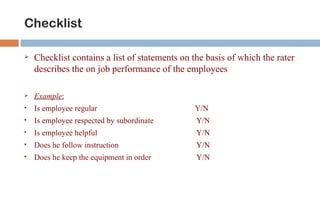
Checklist

   Checklist contains a list of statements on the basis of which the rater
    describes the on job performance of the employees

   Example:
   Is employee regular                        Y/N
   Is employee respected by subordinate        Y/N
   Is employee helpful                         Y/N
   Does he follow instruction                  Y/N
   Does he keep the equipment in order         Y/N
Behaviorally Anchored Rating Scale

   BARS represent a range of descriptive statements of behavior varying from the least
    to the most effective

   In this a rater is expected to indicate which behavior on each scale best describes an
    employee’s performance
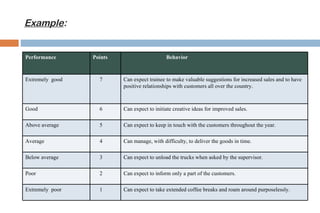
Example:


Performance      Points                      Behavior


Extremely good     7      Can expect trainee to make valuable suggestions for increased sales and to have
                          positive relationships with customers all over the country.


Good               6      Can expect to initiate creative ideas for improved sales.

Above average      5      Can expect to keep in touch with the customers throughout the year.

Average            4      Can manage, with difficulty, to deliver the goods in time.

Below average      3      Can expect to unload the trucks when asked by the supervisor.

Poor               2      Can expect to inform only a part of the customers.

Extremely poor     1      Can expect to take extended coffee breaks and roam around purposelessly.
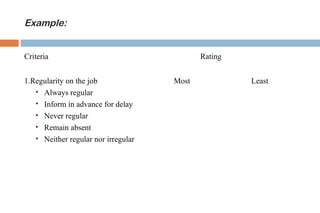
Forced Choice Method


     In the forced choice method the rater is forced to select statements which are

      readymade

     The rater is asked to indicate which of the phrases is the most and least

      descriptive of a particular worker

     Favorable qualities earn plus credit and unfavorable ones earn the reverse
Example:


Criteria                                    Rating


1.Regularity on the job              Most            Least
    Always regular

    Inform in advance for delay

    Never regular

    Remain absent

    Neither regular nor irregular
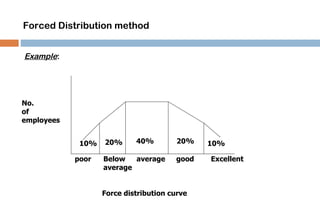
Forced Distribution method


Example:


No.
of
employees


             10%   20%      40%         20%   10%

            poor   Below   average     good   Excellent
                   average


                   Force distribution curve
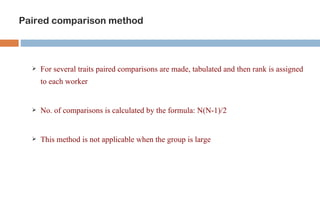
Paired comparison method


     For several traits paired comparisons are made, tabulated and then rank is assigned
      to each worker


     No. of comparisons is calculated by the formula: N(N-1)/2


     This method is not applicable when the group is large
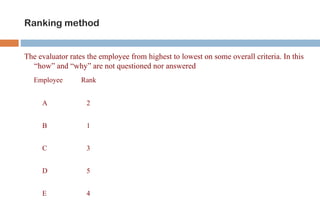
Ranking method


The evaluator rates the employee from highest to lowest on some overall criteria. In this
  “how” and “why” are not questioned nor answered
   Employee       Rank


     A             2


     B             1


     C             3


     D             5


     E             4
Field Review Method


    The appraiser goes to the field and obtains the information about work

     performance of the employee by way of questioning the said individual, his peer

     group, and his superiors
Future-oriented appraisals
Management by Objectives (MBO)


    First step: MBO emphasizes collectively set goals that are tangible, verifiable,

     and measurable

    Second step: setting the performance standard for the subordinates

    Third step: the actual level of goal attainment is compared with the goals agreed

     upon

    Final step: involves establishing new goals and possibly new strategies for goals

     not previously achieved
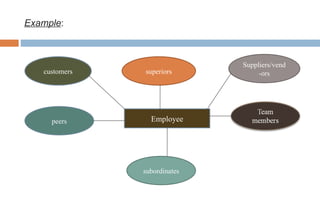
360o Feedback Method


   It is a systematic collection and feedback of performance data on an individual or

    group, derived from a number of stakeholders

   Data is gathered and fed back to the individual participant in a clear way designed to

    promote understanding, acceptance and ultimately behavior

   It makes the employee feel much more accountable
Example:


                              Suppliers/vend
   customers   superiors           -ors


     peers       Employee


               subordinates
Psychological Appraisals

   It focuses on the future potential of an employee

   past performance or the actual performance is not taken into consideration

   Evaluation is based on employee’s intellectual, emotional, motivational and other
    related characteristics
Assessment Centres


   An assessment centre is a central location where managers may come
    together to have their participation in job-related exercises evaluated by
    trained observers
THANK   YOU
References:
                   Human Resource Management
                  By: K Aswathappa
 www.google.com
 www.scribd.com

Performance appraisal concepts and method

  • 2.
    Performance Appraisal  Performance Appraisal (PA) refers to all those procedures that are used to evaluate the  personality  performance  potential of its group members
  • 3.
    Why Appraisals AreImportant??  Set goals Set goals  Recognize performance Recognize performance Guide progress  Guide progress Identify problems  Identify problems Improve performance  Improve performance Discuss career advancement  Discuss career advancement
  • 4.
    Leads to competitive advantage… Improving Making Strategy and correct performance behavior decisions Competitive advantage Values and Minimizing Ensuring behavior dissatisfaction legal and turnover compliance
  • 5.
    Thus performance appraisalis unavoidable…
  • 6.
    Performance Appraisal :past-oriented methods  Rating scale  Confidential report  Essay evaluation  Critical incident method  Checklists  Forced choice method  Behaviorally anchored rating scale  Ranking
  • 7.
    Past-oriented Methods Contd.  Paired comparison method  Forced distribution method  Field review technique
  • 8.
    Future-oriented Methods  Management by objective  360o Feedback Method  Psychological Appraisals  Assessment Centre
  • 9.
    Rating scale  The rating scale consist of several numerical scales, each representing a job related performance criterion such as dependability, initiative, output, attendance, attitude, co-operation and the like
  • 10.
    Example: Employee name_________ Dept_______ Rater’s name ___________ Date________ ______________________________________________________________________________ Exc. Good Acceptable Fair Poor ______________________5_______4________3__________2______1___________________  Dependability  Initiative  Overall output  Attendance  Attitude  Cooperation ___________________________________________________________________________ Total score
  • 11.
    Confidential Report Descriptive report  Prepared by the employee’s immediate supervisor  The report highlights the strengths and weaknesses of employees  Prepared in Government organizations  Does not offer any feedback to the employee
  • 12.
    Essay Evaluation Method  The rater is asked to express the strong as well as weak points of employee’s behavior The rater considers the employee’s :  Job knowledge and potential  Understanding of company’s programs, policies, objectives etc  Relation with co-workers and supervisors  Planning, organizing and controlling ability  Attitude and perception
  • 13.
    Essay Evaluation  This method has the following limitations:  Highly subjective  Supervisor may write biased essay  Difficult to find effective writers  A busy appraiser may write the essay hurriedly without assessing properly the actual performance of the worker  If the appraiser takes a long time it becomes uneconomical from the view point of the firm
  • 14.
    Critical Incident Technique  Manager prepares lists of statements of very effective and ineffective behavior of an employee  These critical incidents represent the outstanding or poor behavior of the employees  The manager periodically records critical incidents of employee’s behavior
  • 15.
    Critical Incident Technique Example:  June 21 - Sales clerk patiently attended to the customers complaint. He is polite, prompt, enthusiastic in solving the customers’ problem  June 21 - The sales assistant stayed 45 minutes beyond his break during the busiest part of the day. He failed to answer store manager’s call thrice. He is lazy, negligent, stubborn and uninterested in work
  • 16.
    Ex: A fire,sudden breakdown, accident Workers reaction scale A informed the supervisor immediately 4 B Become anxious on loss of output 3 C tried to repair the machine 2 D Complained for poor maintenance 1
  • 17.
    Critical Incident Technique Limitation of this technique are:  Negative incidents may be more noticeable than positive incidents.  Results in very close supervision which may not be liked by the employee.  The recording of incidents is a chore for the supervisor concerned who may be too busy or forget to do it.
  • 18.
    Checklist  Checklist contains a list of statements on the basis of which the rater describes the on job performance of the employees  Example:  Is employee regular Y/N  Is employee respected by subordinate Y/N  Is employee helpful Y/N  Does he follow instruction Y/N  Does he keep the equipment in order Y/N
  • 19.
    Behaviorally Anchored RatingScale  BARS represent a range of descriptive statements of behavior varying from the least to the most effective  In this a rater is expected to indicate which behavior on each scale best describes an employee’s performance
  • 20.
    Example: Performance Points Behavior Extremely good 7 Can expect trainee to make valuable suggestions for increased sales and to have positive relationships with customers all over the country. Good 6 Can expect to initiate creative ideas for improved sales. Above average 5 Can expect to keep in touch with the customers throughout the year. Average 4 Can manage, with difficulty, to deliver the goods in time. Below average 3 Can expect to unload the trucks when asked by the supervisor. Poor 2 Can expect to inform only a part of the customers. Extremely poor 1 Can expect to take extended coffee breaks and roam around purposelessly.
  • 21.
    Forced Choice Method  In the forced choice method the rater is forced to select statements which are readymade  The rater is asked to indicate which of the phrases is the most and least descriptive of a particular worker  Favorable qualities earn plus credit and unfavorable ones earn the reverse
  • 22.
    Example: Criteria Rating 1.Regularity on the job Most Least  Always regular  Inform in advance for delay  Never regular  Remain absent  Neither regular nor irregular
  • 23.
    Forced Distribution method Example: No. of employees 10% 20% 40% 20% 10% poor Below average good Excellent average Force distribution curve
  • 24.
    Paired comparison method  For several traits paired comparisons are made, tabulated and then rank is assigned to each worker  No. of comparisons is calculated by the formula: N(N-1)/2  This method is not applicable when the group is large
  • 25.
    Ranking method The evaluatorrates the employee from highest to lowest on some overall criteria. In this “how” and “why” are not questioned nor answered Employee Rank A 2 B 1 C 3 D 5 E 4
  • 26.
    Field Review Method  The appraiser goes to the field and obtains the information about work performance of the employee by way of questioning the said individual, his peer group, and his superiors
  • 27.
  • 28.
    Management by Objectives(MBO)  First step: MBO emphasizes collectively set goals that are tangible, verifiable, and measurable  Second step: setting the performance standard for the subordinates  Third step: the actual level of goal attainment is compared with the goals agreed upon  Final step: involves establishing new goals and possibly new strategies for goals not previously achieved
  • 29.
    360o Feedback Method  It is a systematic collection and feedback of performance data on an individual or group, derived from a number of stakeholders  Data is gathered and fed back to the individual participant in a clear way designed to promote understanding, acceptance and ultimately behavior  It makes the employee feel much more accountable
  • 30.
    Example: Suppliers/vend customers superiors -ors peers Employee subordinates
  • 31.
    Psychological Appraisals  It focuses on the future potential of an employee  past performance or the actual performance is not taken into consideration  Evaluation is based on employee’s intellectual, emotional, motivational and other related characteristics
  • 32.
    Assessment Centres  An assessment centre is a central location where managers may come together to have their participation in job-related exercises evaluated by trained observers
  • 33.
    THANK YOU
  • 34.
    References: Human Resource Management By: K Aswathappa www.google.com www.scribd.com