

RELATIONSHIP BETWEEN TEACHER
BELIEFS AND IMPLEMENTATION
L E C T U R E R : Y E E B E E
C H O O
I P G K T H O
Topic 5b TSL 3143
TEACHER AND CURRICULUM IMPLEMENTATION
• With their knowledge, experiences and
competencies, teachers are central to any
curriculum improvement effort.
• Better teachers foster better learning.
• The key to getting teachers committed to a
curriculum is to enhance their knowledge of the
curriculum. This means teachers need to be
trained and workshops have to be organised for
professional development.
• The extrinsic factors that may impede
curriculum change are inadequacy of
resources, time, school ethos and professional
support.
• The intrinsic factors are: lack of professional
knowledge, professional adequacy and
professional interest and motivation.
TEACHER AND CURRICULUM IMPLEMENTATION
RESEARCH IN IMPLEMENTATION
Fullan, M.G., & Pomfret, A. (1977). Research on curriculum and instruction
implementation. Review of Educational Research, 47(2), 335-397
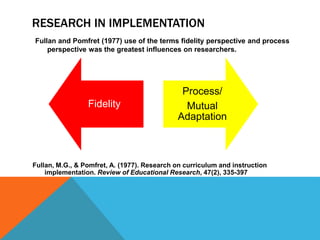
Fidelity
Process/
Mutual
Adaptation
Fullan and Pomfret (1977) use of the terms fidelity perspective and process
perspective was the greatest influences on researchers.
TEACHER AND CURRICULUM IMPLEMENTATION
• Ariav (1988) used the phrase curriculum literacy
to suggest that many teachers lack
understanding of what the curriculum should be
and lack skill in how best to teach it.
• The fidelity perspective assumes that because
teachers have a low level of curriculum literacy,
the planned curriculum must be highly
structured and teachers must be given explicit
instructions about how to teach it.
Fidelity of Use: Staying very close to the
prescribed written document.
• The ‘fidelity’ approach suggests curriculum as
‘a course of study, a textbook series, a guide, a
set of teacher plans’ (Snyder et al. 1992: 427),
where experts define curriculum knowledge for
teachers.
• This means that curriculum change occurs
through a central model in systematic stages,
which confines the teacher’s role to delivering
curriculum materials.
TEACHER AND CURRICULUM IMPLEMENTATION
Fidelity of Use
• Shawer (2003) indicated that the fidelity
approach leads teachers to become curriculum
transmitters who use the student’s book as the
only source of instructional content.
• They transmit textbook content as its structure
dictates by means of linear unit-by-unit, lesson-
by-lesson and page-by-page strategies.
• Moreover, these teachers rarely supplement the
missing elements and focus solely on covering
content without responding to classroom
dynamics.
TEACHER AND CURRICULUM IMPLEMENTATION
Mutual-Adaptation: Individual, creative versions of
the written curriculum.
• The ‘adaptation’ approach is a ‘process
whereby adjustments in a curriculum are made
by curriculum developers and those who use it
in the school’ (Snyder et al. 1992:410).
• This involves conversations between teachers
and external developers to adapt curriculum for
local needs.
TEACHER AND CURRICULUM IMPLEMENTATION
Mutual-Adaptation
• The teacher’s role has also become more active
through teachers’ curriculum adjustments.
• Through curriculum adjustments, teachers
become curriculum-developers who use various
sources in addition to curriculum materials.
• They adapt existing materials and topics, add
new topics, leave out irrelevant elements, use
flexible lesson plans, respond to student
differences and use various teaching
techniques.
TEACHER AND CURRICULUM IMPLEMENTATION
TUTORIAL 5B
• List your teacher beliefs and do a Think-
Pair-Share
• Based on curriculum specifications /
curriculum standards, plan and provide
suitable ways of assessing, learning,
providing feedback and reviewing
instructions.
Think-Pair-Share
(1)think individually about a topic or answer to a
question;
(2)pair with a partner and discuss the topic or
question; and
(3)share ideas with the rest of the class.

TSL3143 Topic 5b Relationship Between Teacher Belief and Implementation

  • 1.
    RELATIONSHIP BETWEEN TEACHER BELIEFSAND IMPLEMENTATION L E C T U R E R : Y E E B E E C H O O I P G K T H O Topic 5b TSL 3143
  • 2.
    TEACHER AND CURRICULUMIMPLEMENTATION • With their knowledge, experiences and competencies, teachers are central to any curriculum improvement effort. • Better teachers foster better learning. • The key to getting teachers committed to a curriculum is to enhance their knowledge of the curriculum. This means teachers need to be trained and workshops have to be organised for professional development.
  • 3.
    • The extrinsicfactors that may impede curriculum change are inadequacy of resources, time, school ethos and professional support. • The intrinsic factors are: lack of professional knowledge, professional adequacy and professional interest and motivation. TEACHER AND CURRICULUM IMPLEMENTATION
  • 4.
    RESEARCH IN IMPLEMENTATION Fullan,M.G., & Pomfret, A. (1977). Research on curriculum and instruction implementation. Review of Educational Research, 47(2), 335-397 Fidelity Process/ Mutual Adaptation Fullan and Pomfret (1977) use of the terms fidelity perspective and process perspective was the greatest influences on researchers.
  • 5.
    TEACHER AND CURRICULUMIMPLEMENTATION • Ariav (1988) used the phrase curriculum literacy to suggest that many teachers lack understanding of what the curriculum should be and lack skill in how best to teach it. • The fidelity perspective assumes that because teachers have a low level of curriculum literacy, the planned curriculum must be highly structured and teachers must be given explicit instructions about how to teach it.
  • 6.
    Fidelity of Use:Staying very close to the prescribed written document. • The ‘fidelity’ approach suggests curriculum as ‘a course of study, a textbook series, a guide, a set of teacher plans’ (Snyder et al. 1992: 427), where experts define curriculum knowledge for teachers. • This means that curriculum change occurs through a central model in systematic stages, which confines the teacher’s role to delivering curriculum materials. TEACHER AND CURRICULUM IMPLEMENTATION
  • 7.
    Fidelity of Use •Shawer (2003) indicated that the fidelity approach leads teachers to become curriculum transmitters who use the student’s book as the only source of instructional content. • They transmit textbook content as its structure dictates by means of linear unit-by-unit, lesson- by-lesson and page-by-page strategies. • Moreover, these teachers rarely supplement the missing elements and focus solely on covering content without responding to classroom dynamics. TEACHER AND CURRICULUM IMPLEMENTATION
  • 8.
    Mutual-Adaptation: Individual, creativeversions of the written curriculum. • The ‘adaptation’ approach is a ‘process whereby adjustments in a curriculum are made by curriculum developers and those who use it in the school’ (Snyder et al. 1992:410). • This involves conversations between teachers and external developers to adapt curriculum for local needs. TEACHER AND CURRICULUM IMPLEMENTATION
  • 9.
    Mutual-Adaptation • The teacher’srole has also become more active through teachers’ curriculum adjustments. • Through curriculum adjustments, teachers become curriculum-developers who use various sources in addition to curriculum materials. • They adapt existing materials and topics, add new topics, leave out irrelevant elements, use flexible lesson plans, respond to student differences and use various teaching techniques. TEACHER AND CURRICULUM IMPLEMENTATION
  • 10.
    TUTORIAL 5B • Listyour teacher beliefs and do a Think- Pair-Share • Based on curriculum specifications / curriculum standards, plan and provide suitable ways of assessing, learning, providing feedback and reviewing instructions.
  • 11.
    Think-Pair-Share (1)think individually abouta topic or answer to a question; (2)pair with a partner and discuss the topic or question; and (3)share ideas with the rest of the class.