PROFESSIONAL DEVELOPMENT
&
ACCOUNTABILITY
ASOKAN.R
ASSO. PROFESSOR
KALINGA INSTITUTE OF NURSING SCIENCES
KIIT (DU)
BHUBANESWAR
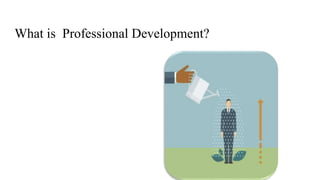
What is Professional Development?
Those processes and activities designed to enhance the
professional knowledge, skills, and attitudes, so that they can improve
student learning.
Professional development can no longer just be about
exposing teachers to a concept or providing basic knowledge
about a teaching methodology.
Instead, professional development in an era of
accountability requires a change in a teacher’s practice that
leads to increases in student learning.
Professional development should focus on
deepening teachers’ content knowledge,
knowledge of how students learn particular content,
providing opportunities for active learning,
&
encouraging the teachers’ professional
development experiences.
Professional learning
Aim,
To provide focused professional development to
support teachers, to ensure their success, and student
achievement.
Why professional development for teachers is important?
prepare the teachers for the changing classroom, and
provides rich opportunities for teachers to continue
to develop their teaching skills and subject matter
knowledge.
Why Evaluation of professional development is important?
The first reason is accountability
• Services to the consumer. This includes accountability of how we
gain new knowledge.
&
• how that knowledge is used in practice.
• Offering consumers the newest & most informative knowledge
• Not providing short-term ability, but the application of that
knowledge over time and setting.
• We must document the validity of knowledge, transfer and use
of knowledge
• & systemic integration of knowledge in a way that is credible to
consumers.
A second reason is need for accountability to our
• Funders —organizations is support our professional development.
• As fiscal resources become more limited and the need for services
grows
• There is an increasing need to support of professional development.
What is Good Professional Development?
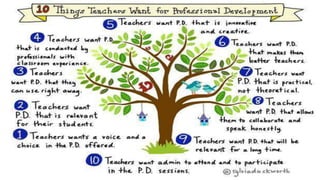
Good professional development should be:
• Long term
• Focused equally on content, academic discipline, and new skills
• Continued collaboratively and in the classroom
• Transformative,
• Giving teachers new ideas and ways to change their classroom practice.
Steps to Good Professional Development
• Know Your Audience. (consider who your audience and any special
needs specific to the group)
• Set Goals (SMART goal)
• Choose Your Focus
• Choose Your Presentation Style
• Pace Your Time
• Plan Ahead
• Connect to Standards
• Evaluate the programme
Five Models of Teacher-Centered Professional Development
1. Observation/Assessment
Master teacher in a school / specialist / very experienced teacher –
observes teachers in their classrooms, assessing their instructional practices and
providing structured feedback.
2. Open Classrooms
Teachers want to see other teachers in action. In an open classroom
model, teachers create lessons and invite colleagues to observe the lesson and
provide feedback in a post-observation session.
The focus of open classroom is on teacher behavior.
3. Lesson Study
Lesson study is a well-studied and highly successful form of
professional development—if teachers are provided the time, support,
resources and skilled facilitation needed.
In lesson study, teachers collaboratively plan, develop or improve
a lesson; field test the lesson in a classroom; observe it; make changes;
and collect data to see the impact of the lesson on student learning.
This usually occurs over a period of months.
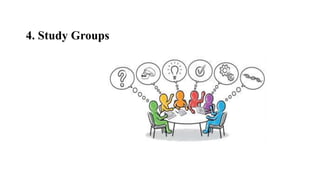
4. Study Groups
Teachers benefit from formal discussions and interactions with peers
around critical issues.
In study groups teachers collaborate, as a single large group or in
smaller teams, to study a particular issue with the goal of solving a common
problem or creating and implementing a plan to attain a common goal.
The study—the reading, discussion, writing and reflection, led by a skilled
facilitator—is the key component of a study group.
During the study process they may use print-based resources, classroom
materials and their experiences as part of their approach to the problem.
5. Looking at Student Work
“Looking at Student Work” (LASW) is a model of teacher
collaborative self-study and formative assessment that focuses on
examining student work and assessing the way the teacher designed the
particular activity being reviewed.
The power of teachers collaboratively examining student’s
work. Linking it back to how students learn, and how the lesson was
designed, and then restructuring lessons based on this information is a
key component.
This type of professional development uses highly structured
protocols that make the examination of student work non-
threatening and keep the focus off what the teacher did or did not do
and instead on evidence of student learning.
Effective Professional Development
Effective professional development is a structured professional
learning that results in changes in teacher practices and
improvements in student learning outcomes.
• Content focused
• Incorporates active learning
• Supports collaboration.
• Uses models of effective practice
• Provides coaching and expert support
• Offers feedback and reflection
• Sustained duration
Principles of Effective Professional Development
• Controlled vision of the classroom
• Helps teachers develop the knowledge and skills to create vision
• Mirrors methods to be used by students
• Builds a learning community
• Develops teacher leadership
• Links to the system
• Continuously assessed
Principles for the Design of PD Experiences for Teachers
1. Make sure that PD focuses on the subject matter teachers will be
teaching
2. Should be driven by analysis of gap between student goals and
performance
3. Involve teachers in decisions about their PD
4. PD should be “job-embedded”
5. Should relate to individual needs but involve collaboration with
other teachers
6. PD should be continuous and ongoing
7. PD should be evaluated.
Responsibilities of Beginning Teacher Assistance
1. Professional Development/Growth Plan
2. Mentor Teachers
3. Higher Education Assistance
Professional Development Educator’s Responsibility
• Provide an atmosphere within the classroom.
• Provide time on a weekly basis for two-way conferences.
• Model effective classroom management techniques for the teacher
candidate.
• Help the student teacher implement efficient daily routines and
procedures.
• Demonstrate best practices methods.
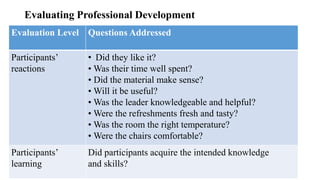
Evaluating Professional Development
Evaluation Level Questions Addressed
Participants’
reactions
• Did they like it?
• Was their time well spent?
• Did the material make sense?
• Will it be useful?
• Was the leader knowledgeable and helpful?
• Were the refreshments fresh and tasty?
• Was the room the right temperature?
• Were the chairs comfortable?
Participants’
learning
Did participants acquire the intended knowledge
and skills?
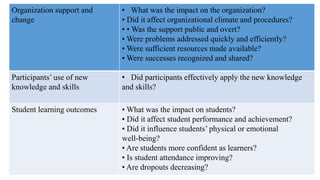
Organization support and
change
• What was the impact on the organization?
• Did it affect organizational climate and procedures?
• • Was the support public and overt?
• Were problems addressed quickly and efficiently?
• Were sufficient resources made available?
• Were successes recognized and shared?
Participants’ use of new
knowledge and skills
• Did participants effectively apply the new knowledge
and skills?
Student learning outcomes • What was the impact on students?
• Did it affect student performance and achievement?
• Did it influence students’ physical or emotional
well-being?
• Are students more confident as learners?
• Is student attendance improving?
• Are dropouts decreasing?
Designing effective professional development
 Participation
 Content focus
Active learning
 Research base for specific type of activities
 Involvement with curriculum
 Workshops/Seminars
 Active research
Case discussions
 study groups
 lesson study
 Examining student work
 Coaching
Mentoring
 Collaborative work
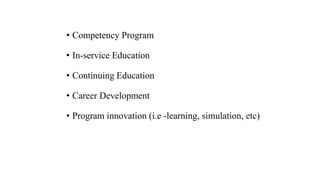
• Competency Program
• In-service Education
• Continuing Education
• Career Development
• Program innovation (i.e -learning, simulation, etc)
• Orientation
• Preceptor/co-worker support
• In-house educational programs
• Advanced certification
• Research evidence based practice
• Teamwork (interdisciplinary team work)
• HEALnet is a unique online continuing professional
development(CPD) website for Nurses and Health
Professionals.
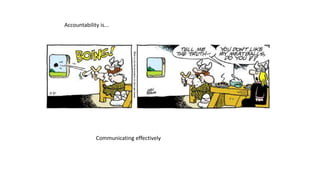
Accountability is...
Accountability at work
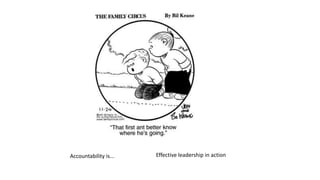
Accountability is... Effective leadership in action
Accountability is...
Knowing who, what, when, why, and how
Accountability is...
Communicating effectively
What is accountability?
Accountability means individuals are responsible for their actions
and maybe asked to justify them.
Professional development systems differ in the way they
respond to four central questions:
• Who is accountable?
• To whom are they accountable?
• For what are they accountable?
• And with what consequences?
ACCOUNTABILITY
One focus of the accountability and professional development
department is to provide timely and accurate information to the schools
for informed decision-making.
Aim to provide information that supports continuous improvement
of our academic and operational services.
There are multiple accountability measure that the responsible for,
it is our responsibility to guide, inform, and support in these areas.
Nurses cannot blame anyone else for mistakes – they are
accountable, answerable, and liable for their own actions, the completion
of the assigned task, and acts of delegation.
Accountability cannot be delegated.
Professional Responsibility and Accountability
• Accountable and takes responsibility for own nursing actions and
professional conduct.
• Functions within own level of competence, within the legally recognized
scope of practice and within all relevant legislation.
• Assesses own practice and undertakes activities to improve practice and
meet identified learning goals on an ongoing basis.
• Takes action to promote the provision of safe, appropriate and ethical care
to clients.
• Advocates or helps to develop policies and practices consistent with
the standards of the profession.
• Maintains own physical, psychological and emotional fitness to
practice.
• Maintains current registration.
• Understands the role of the regulatory body and the relationship of
the regulatory body to one’s own practice.
Teachers in Opportunity
✱Lead other teachers
✱ Specialize in their best roles and subjects
✱ Receive on-the-job development routinely
✱ Manage advanced professionals
✱ Typically work in collaborative teams
✱ Advance in their careers through new roles, without leaving teaching
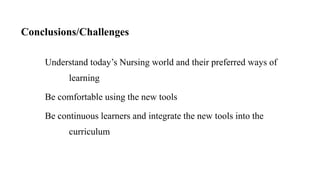
Conclusions/Challenges
Understand today’s Nursing world and their preferred ways of
learning
Be comfortable using the new tools
Be continuous learners and integrate the new tools into the
curriculum
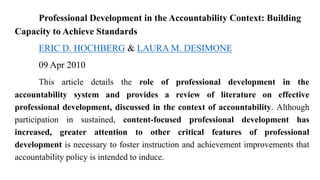
Professional Development in the Accountability Context: Building
Capacity to Achieve Standards
ERIC D. HOCHBERG & LAURA M. DESIMONE
09 Apr 2010
This article details the role of professional development in the
accountability system and provides a review of literature on effective
professional development, discussed in the context of accountability. Although
participation in sustained, content-focused professional development has
increased, greater attention to other critical features of professional
development is necessary to foster instruction and achievement improvements that
accountability policy is intended to induce.
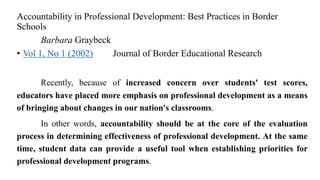
Accountability in Professional Development: Best Practices in Border
Schools
Barbara Graybeck
• Vol 1, No 1 (2002) Journal of Border Educational Research
Recently, because of increased concern over students' test scores,
educators have placed more emphasis on professional development as a means
of bringing about changes in our nation's classrooms.
In other words, accountability should be at the core of the evaluation
process in determining effectiveness of professional development. At the same
time, student data can provide a useful tool when establishing priorities for
professional development programs.
THANK YOU

Professional Development & Accountability in Nursing

  • 2.
    PROFESSIONAL DEVELOPMENT & ACCOUNTABILITY ASOKAN.R ASSO. PROFESSOR KALINGAINSTITUTE OF NURSING SCIENCES KIIT (DU) BHUBANESWAR
  • 3.
  • 4.
    Those processes andactivities designed to enhance the professional knowledge, skills, and attitudes, so that they can improve student learning.
  • 5.
    Professional development canno longer just be about exposing teachers to a concept or providing basic knowledge about a teaching methodology. Instead, professional development in an era of accountability requires a change in a teacher’s practice that leads to increases in student learning.
  • 6.
    Professional development shouldfocus on deepening teachers’ content knowledge, knowledge of how students learn particular content, providing opportunities for active learning, & encouraging the teachers’ professional development experiences.
  • 7.
    Professional learning Aim, To providefocused professional development to support teachers, to ensure their success, and student achievement.
  • 8.
    Why professional developmentfor teachers is important? prepare the teachers for the changing classroom, and provides rich opportunities for teachers to continue to develop their teaching skills and subject matter knowledge.
  • 9.
    Why Evaluation ofprofessional development is important?
  • 10.
    The first reasonis accountability • Services to the consumer. This includes accountability of how we gain new knowledge. & • how that knowledge is used in practice.
  • 11.
    • Offering consumersthe newest & most informative knowledge • Not providing short-term ability, but the application of that knowledge over time and setting. • We must document the validity of knowledge, transfer and use of knowledge • & systemic integration of knowledge in a way that is credible to consumers.
  • 12.
    A second reasonis need for accountability to our • Funders —organizations is support our professional development. • As fiscal resources become more limited and the need for services grows • There is an increasing need to support of professional development.
  • 13.
    What is GoodProfessional Development?
  • 14.
    Good professional developmentshould be: • Long term • Focused equally on content, academic discipline, and new skills • Continued collaboratively and in the classroom • Transformative, • Giving teachers new ideas and ways to change their classroom practice.
  • 16.
    Steps to GoodProfessional Development • Know Your Audience. (consider who your audience and any special needs specific to the group) • Set Goals (SMART goal) • Choose Your Focus • Choose Your Presentation Style • Pace Your Time • Plan Ahead • Connect to Standards • Evaluate the programme
  • 17.
    Five Models ofTeacher-Centered Professional Development 1. Observation/Assessment Master teacher in a school / specialist / very experienced teacher – observes teachers in their classrooms, assessing their instructional practices and providing structured feedback. 2. Open Classrooms Teachers want to see other teachers in action. In an open classroom model, teachers create lessons and invite colleagues to observe the lesson and provide feedback in a post-observation session. The focus of open classroom is on teacher behavior.
  • 18.
    3. Lesson Study Lessonstudy is a well-studied and highly successful form of professional development—if teachers are provided the time, support, resources and skilled facilitation needed. In lesson study, teachers collaboratively plan, develop or improve a lesson; field test the lesson in a classroom; observe it; make changes; and collect data to see the impact of the lesson on student learning. This usually occurs over a period of months.
  • 19.
  • 20.
    Teachers benefit fromformal discussions and interactions with peers around critical issues. In study groups teachers collaborate, as a single large group or in smaller teams, to study a particular issue with the goal of solving a common problem or creating and implementing a plan to attain a common goal. The study—the reading, discussion, writing and reflection, led by a skilled facilitator—is the key component of a study group. During the study process they may use print-based resources, classroom materials and their experiences as part of their approach to the problem.
  • 21.
    5. Looking atStudent Work
  • 22.
    “Looking at StudentWork” (LASW) is a model of teacher collaborative self-study and formative assessment that focuses on examining student work and assessing the way the teacher designed the particular activity being reviewed. The power of teachers collaboratively examining student’s work. Linking it back to how students learn, and how the lesson was designed, and then restructuring lessons based on this information is a key component.
  • 23.
    This type ofprofessional development uses highly structured protocols that make the examination of student work non- threatening and keep the focus off what the teacher did or did not do and instead on evidence of student learning.
  • 24.
    Effective Professional Development Effectiveprofessional development is a structured professional learning that results in changes in teacher practices and improvements in student learning outcomes.
  • 25.
    • Content focused •Incorporates active learning • Supports collaboration. • Uses models of effective practice • Provides coaching and expert support • Offers feedback and reflection • Sustained duration
  • 26.
    Principles of EffectiveProfessional Development • Controlled vision of the classroom • Helps teachers develop the knowledge and skills to create vision • Mirrors methods to be used by students • Builds a learning community • Develops teacher leadership • Links to the system • Continuously assessed
  • 27.
    Principles for theDesign of PD Experiences for Teachers 1. Make sure that PD focuses on the subject matter teachers will be teaching 2. Should be driven by analysis of gap between student goals and performance 3. Involve teachers in decisions about their PD 4. PD should be “job-embedded”
  • 28.
    5. Should relateto individual needs but involve collaboration with other teachers 6. PD should be continuous and ongoing 7. PD should be evaluated.
  • 29.
    Responsibilities of BeginningTeacher Assistance 1. Professional Development/Growth Plan 2. Mentor Teachers 3. Higher Education Assistance
  • 30.
    Professional Development Educator’sResponsibility • Provide an atmosphere within the classroom. • Provide time on a weekly basis for two-way conferences. • Model effective classroom management techniques for the teacher candidate. • Help the student teacher implement efficient daily routines and procedures. • Demonstrate best practices methods.
  • 31.
    Evaluating Professional Development EvaluationLevel Questions Addressed Participants’ reactions • Did they like it? • Was their time well spent? • Did the material make sense? • Will it be useful? • Was the leader knowledgeable and helpful? • Were the refreshments fresh and tasty? • Was the room the right temperature? • Were the chairs comfortable? Participants’ learning Did participants acquire the intended knowledge and skills?
  • 32.
    Organization support and change •What was the impact on the organization? • Did it affect organizational climate and procedures? • • Was the support public and overt? • Were problems addressed quickly and efficiently? • Were sufficient resources made available? • Were successes recognized and shared? Participants’ use of new knowledge and skills • Did participants effectively apply the new knowledge and skills? Student learning outcomes • What was the impact on students? • Did it affect student performance and achievement? • Did it influence students’ physical or emotional well-being? • Are students more confident as learners? • Is student attendance improving? • Are dropouts decreasing?
  • 33.
    Designing effective professionaldevelopment  Participation  Content focus Active learning  Research base for specific type of activities  Involvement with curriculum  Workshops/Seminars  Active research Case discussions
  • 34.
     study groups lesson study  Examining student work  Coaching Mentoring  Collaborative work
  • 35.
    • Competency Program •In-service Education • Continuing Education • Career Development • Program innovation (i.e -learning, simulation, etc)
  • 36.
    • Orientation • Preceptor/co-workersupport • In-house educational programs • Advanced certification • Research evidence based practice • Teamwork (interdisciplinary team work) • HEALnet is a unique online continuing professional development(CPD) website for Nurses and Health Professionals.
  • 37.
  • 38.
    Accountability is... Effectiveleadership in action
  • 39.
    Accountability is... Knowing who,what, when, why, and how
  • 40.
  • 41.
    What is accountability? Accountabilitymeans individuals are responsible for their actions and maybe asked to justify them.
  • 42.
    Professional development systemsdiffer in the way they respond to four central questions: • Who is accountable? • To whom are they accountable? • For what are they accountable? • And with what consequences?
  • 43.
    ACCOUNTABILITY One focus ofthe accountability and professional development department is to provide timely and accurate information to the schools for informed decision-making. Aim to provide information that supports continuous improvement of our academic and operational services. There are multiple accountability measure that the responsible for, it is our responsibility to guide, inform, and support in these areas.
  • 44.
    Nurses cannot blameanyone else for mistakes – they are accountable, answerable, and liable for their own actions, the completion of the assigned task, and acts of delegation. Accountability cannot be delegated.
  • 45.
    Professional Responsibility andAccountability • Accountable and takes responsibility for own nursing actions and professional conduct. • Functions within own level of competence, within the legally recognized scope of practice and within all relevant legislation. • Assesses own practice and undertakes activities to improve practice and meet identified learning goals on an ongoing basis. • Takes action to promote the provision of safe, appropriate and ethical care to clients.
  • 46.
    • Advocates orhelps to develop policies and practices consistent with the standards of the profession. • Maintains own physical, psychological and emotional fitness to practice. • Maintains current registration. • Understands the role of the regulatory body and the relationship of the regulatory body to one’s own practice.
  • 47.
    Teachers in Opportunity ✱Leadother teachers ✱ Specialize in their best roles and subjects ✱ Receive on-the-job development routinely ✱ Manage advanced professionals ✱ Typically work in collaborative teams ✱ Advance in their careers through new roles, without leaving teaching
  • 48.
    Conclusions/Challenges Understand today’s Nursingworld and their preferred ways of learning Be comfortable using the new tools Be continuous learners and integrate the new tools into the curriculum
  • 49.
    Professional Development inthe Accountability Context: Building Capacity to Achieve Standards ERIC D. HOCHBERG & LAURA M. DESIMONE 09 Apr 2010 This article details the role of professional development in the accountability system and provides a review of literature on effective professional development, discussed in the context of accountability. Although participation in sustained, content-focused professional development has increased, greater attention to other critical features of professional development is necessary to foster instruction and achievement improvements that accountability policy is intended to induce.
  • 50.
    Accountability in ProfessionalDevelopment: Best Practices in Border Schools Barbara Graybeck • Vol 1, No 1 (2002) Journal of Border Educational Research Recently, because of increased concern over students' test scores, educators have placed more emphasis on professional development as a means of bringing about changes in our nation's classrooms. In other words, accountability should be at the core of the evaluation process in determining effectiveness of professional development. At the same time, student data can provide a useful tool when establishing priorities for professional development programs.
  • 51.