KNOWLEDGE AND CURRICULUM
UNIT 7
PRINCIPLES OF CURRICULUM
DEVELOPMENT
UNIT 7
PRINCIPLES OF CURRICULUM
DEVELOPMENT
Need for curriculum development-Principles and stages of
curriculum development- Types of curriculum : Subject
centered curriculum, Student centered curriculum, Society
centered curriculum and Life centered curriculum – Models of
curriculum development : Tyler’s Model and Hilda Tabal’s
model
CURRICULUM DEVELOPMENT
Curriculum Development
- used first by Saylor and Alexandar in their work ‘Planning
Curriculum for schools’
-involves the techniques and methods for developing,
designing,implenting,evaluating and improving the curriculum
- Curriculum development is a continuous process.
• It has a broad scope because it is not only about the school, the
learners and teachers, but it is also about the development of society.
CURRICULUM DEVELOPMENT
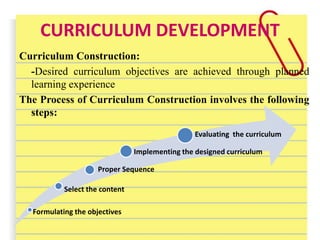
Curriculum Construction:
-Desired curriculum objectives are achieved through planned
learning experience
The Process of Curriculum Construction involves the following
steps:
Formulating the objectives
Select the content
Proper Sequence
Implementing the designed curriculum
Evaluating the curriculum
CURRICULUM DEVELOPMENT
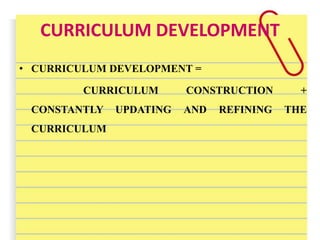
• CURRICULUM DEVELOPMENT =
CURRICULUM CONSTRUCTION +
CONSTANTLY UPDATING AND REFINING THE
CURRICULUM
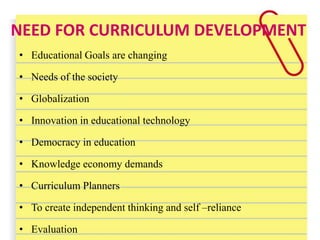
NEED FOR CURRICULUM DEVELOPMENT
• Educational Goals are changing
• Needs of the society
• Globalization
• Innovation in educational technology
• Democracy in education
• Knowledge economy demands
• Curriculum Planners
• To create independent thinking and self –reliance
• Evaluation
PRINCIPLES OF CURRICULUM
DEVELOPMENT
• Curriculum organization is a scientific process which
involves basic principles on which its credibility
exists.
• Not a collection of topics, it reflects ethos of the
society, themes of the subjects and learning
variability.
PRINCIPLES OF CURRICULUM
DEVELOPMENT
• Principle of Child-Centeredness
- the age, interest, capability, capacity, aspiration, needs and
psychology of the learner should be taken as consideration.
• Principle of Community -Centeredness
- the social needs and local needs of the learner should be taken
into account while we construct the curriculum.
PRINCIPLES OF CURRICULUM
DEVELOPMENT
• Principle of Balance/Integration
- related to the social environment of the students.
- balanced importance should be given to the needs of the child
The curriculum should integrate
1. Cognitive, affective and psychomotor objectives and
abilities
2. Knowledge and experience
3. Objectives and Content
4. Child’s activities and needs with the needs and activity
PRINCIPLES OF CURRICULUM
DEVELOPMENT
• Principle of need
- It helps in fulfilling the various needs of the learner
- Each learner has his needs which are generally related to
development.
• Principle of Utility
- Curriculum should provide rich experiences, both academic
and social to the students.
- activities of the curriculum should be useful to the learner for
the higher studies.
PRINCIPLES OF CURRICULUM
DEVELOPMENT
• Principle of Creativity
- It should place the pupil in the place o the discoverer and
provision should be made for creative type activities
• Principle of Preservation
- It should help in the preservation and transmission of the
knowledge, traditions, standards of conduct on which the culture
and civilization depend.
PRINCIPLES OF CURRICULUM
DEVELOPMENT
• Principle of Variety
- The curriculum should satisfy the students with the variety of
knowledge, the varying interests and needs.
• Principle of Flexibility
- It is an important part in the curriculum development.
- It should give enough time and sufficient chance to the
students.
PRINCIPLES OF CURRICULUM
DEVELOPMENT
• Principle of Contemporary Knowledge
- The curriculum should give the modern or current knowledge
and theories to the students.
• Principle of Sequencing
• Principle of Continuity
• Principle of Accuracy
• Principle of Interest
• Principle of Readiness
• Principle of Meaningfulness
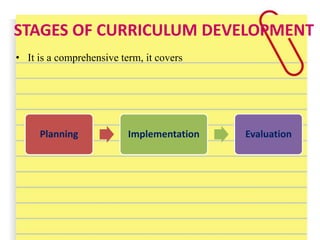
STAGES OF CURRICULUM DEVELOPMENT
• It is a comprehensive term, it covers
Planning Implementation Evaluation
STAGES OF CURRICULUM DEVELOPMENT
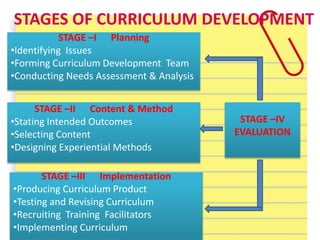
STAGE –I Planning
•Identifying Issues
•Forming Curriculum Development Team
•Conducting Needs Assessment & Analysis
STAGE –II Content & Method
•Stating Intended Outcomes
•Selecting Content
•Designing Experiential Methods
STAGE –III Implementation
•Producing Curriculum Product
•Testing and Revising Curriculum
•Recruiting Training Facilitators
•Implementing Curriculum
STAGE –IV
EVALUATION
TYPES OF CURRICULUM DEVELOPMENT
Klein (1985) has identified three basic curriculum
designs.They are
 Subject – Centered Curriculum
 Student – Centered Curriculum
 Life – Centered Curriculum
One more curriculum design has been added later.
 Society – Centered Curriculum
Subject – Centered Curriculum
• It gives more emphasis to subjects in comparison with
children.
• This also known as Book Centered Curriculum, because of
its emphasis on book knowledge and book learning.
Variation in Subject – Centered Curriculum
The subject matter can be designed in several ways.
1. Separate Subjects Curriculum
2. Correlated Curriculum
3. Integrated Curriculum
4. Core curriculum
Importance features
• Objective: ‘Learning outcomes’ expressed in behavioral terms
• Content : May be concepts,ideas,processes within the subject
area
• Instructional Materials : Text Book
• Activities : The traditional verbal activities (Listening,Writing,
Reading)
• Grouping : Large Group
• Time & Space : Time spent in the classroom and time is
divided into Block
• Teacher & Methodology : Teacher uses lecture, demo and
discussion methods to present the contents. The teacher is
expert in subject area.
• Evaluation : Periodic evaluation and marks or grades indigate
the degree of achievement.
Student – Centered Curriculum
• It is designed to develop the individual and social qualities of
a student
• It is based on the interests, needs and aspirations of the child
• According to Kelly(1977) a child centered curriculum puts
emphasis on:
1. Needs of the learner
2. Growth of the learner
3. Interests of the learner
Importance features
• Objective: It is not predetermined by the teacher instead The
students are used for learning process
• Content : It is selected in accordance with the needs,interest,
abilities and past experience of the students
• Instructional Materials : Students organize contents
themselves
• Activities : It selected by students .Teachers are just consulted
• Grouping : Formed on common interests or needs
• Time & Space : Time is not fixed, but flexible and space for
learning is unstructured
• Teacher & Methodology : Teacher is a co-learner
• Evaluation : Both teacher and students jointly evaluate the
learning outcome. Self –Evaluation is done by the Students.
Society – Centered Curriculum
• The students learn the fundamental skill required through
real life application of community
• This curriculum is meant to reach out beyond classroom and
into the community where the would can be changed by the
students and teachers
• This is very much an activist model, where students are
encouraged to be leading activists in their community where
life problems, community affairs, and real-world problems
exist
Importance features
• Instructional Materials : A great variety of materials and
resources in the community are used.
• Activities : It is planned by the teacher and students
• Grouping : Formed on the basis of student needs and desires
• Time & Space : Time depends on the nature if the project
undertaken by the students.
Space for learning includes all the resources of the school and
community
• Teacher & Methodology : Teacher is a facilitator and direct
observation,field study,direct experience are the methods used
by the teacher
• Evaluation : Evaluation is jointly done by the teacher and
students
Curriculum Model
A model is a format for
curriculum design developed to meet
unique needs, contexts and /or
purposes.
In order to address these goals,
curriculum developers design,
reconfigure, or rearrange one or more
key curriculum components
Models of curriculum development
There are two types of models in curriculum
development. They are,
 Tyler’s Model
 Hilda Taba’s Model
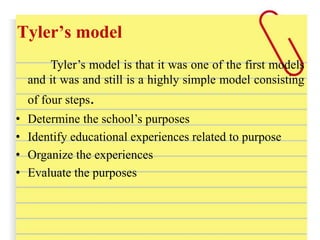
Tyler’s model
Tyler’s model is that it was one of the first models
and it was and still is a highly simple model consisting
of four steps.
• Determine the school’s purposes
• Identify educational experiences related to purpose
• Organize the experiences
• Evaluate the purposes
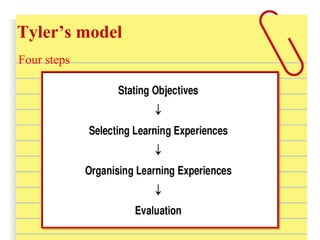
Tyler’s model
Four steps
Step One
Step one is determining the objectives of the school or
class. In other words, what do the students need to do in
order to be successful? Each subject has natural objectives
that are indicators of mastery. All objectives need to be
consistent with the philosophy of the school and this is often
neglected in curriculum development. For example, a school
that is developing an English curriculum my create an
objective that students will write essays. This would be one
of many objectives within the curriculum
Step Two
Step two is developing learning experiences that help the
students to achieve step one. For example, if students need to
meet the objective of writing an essay. The learning
experience might be a demonstration by the teacher of
writing an essay. The students then might practice writing
essays. The experience (essay demonstration and writing) is
consistent with the objective (Student will write an essay).
Step Three
Step three is organizing the experiences. Should the
teacher demonstrate first or should the students learn by
writing immediately? Either way could work and preference
is determined by the philosophy of the teacher and the needs
of the students. The point is that the teacher needs to
determine a logical order of experiences for the students.
Step Four
Step four is evaluation of the objectives. Now the
teacher assesses the students ability to write an essay. There
are many ways to do this. For example, the teacher could
have the students write an essay without assistance. If they
can do this, it is evidence that the students have achieve the
objective of the lesson
Tyler’s Possible Learning Experiences
Tyler outlines four general categories of possible
learning experiences.
• Development of thinking skills
• Acquisition of information
• Development of social attitudes and
• Development of student interests
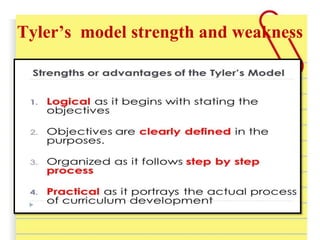
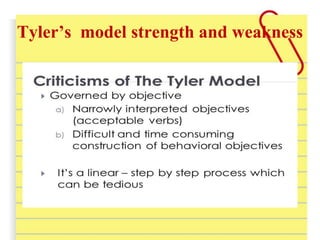
Tyler’s model strength and weakness
Hilda Taba’s model
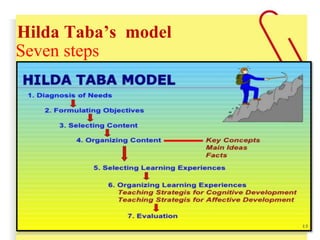
Seven steps
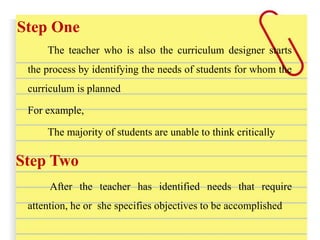
Step One
The teacher who is also the curriculum designer starts
the process by identifying the needs of students for whom the
curriculum is planned
For example,
The majority of students are unable to think critically
Step Two
After the teacher has identified needs that require
attention, he or she specifies objectives to be accomplished
Step Three
The objectives selected or created suggest the subject
matter or content of the curriculum. Not only should
objectives and content match, but also validity and
significance of the content chosen needs to be determined.
i.e., the relevancy and significance of content.
Step Four
A teacher cannot just select content, but must organise it
in some type of sequence, taking it to consideration the
maturity of learners, their academic achievement and their
interests.
Step Five
Content must be presented to students and students must be
engaged with the content. At this point, the teacher selects
instructional methods that will involve the students with the
content.
Step Six
Just as content must be sequenced and organized ,so must
the learning activities. Often, the sequence of the learning
activities is determined by the content. But the teacher needs to
keep in mind the particular students whom he or she will be
teaching.
Step Seven
The curriculum planner must determine just what
objectives have been accomplished. Evaluation procedures
need to be designed to evaluate learning outcomes.
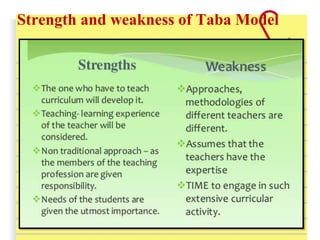
Strength and weakness of Taba Model
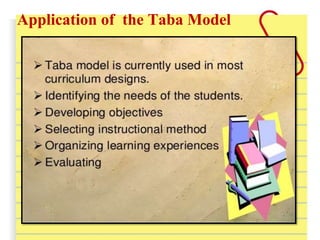
Application of the Taba Model
CONCLUSION

Knowledge and curriculum unit 7

  • 1.
    KNOWLEDGE AND CURRICULUM UNIT7 PRINCIPLES OF CURRICULUM DEVELOPMENT
  • 2.
    UNIT 7 PRINCIPLES OFCURRICULUM DEVELOPMENT Need for curriculum development-Principles and stages of curriculum development- Types of curriculum : Subject centered curriculum, Student centered curriculum, Society centered curriculum and Life centered curriculum – Models of curriculum development : Tyler’s Model and Hilda Tabal’s model
  • 3.
    CURRICULUM DEVELOPMENT Curriculum Development -used first by Saylor and Alexandar in their work ‘Planning Curriculum for schools’ -involves the techniques and methods for developing, designing,implenting,evaluating and improving the curriculum - Curriculum development is a continuous process. • It has a broad scope because it is not only about the school, the learners and teachers, but it is also about the development of society.
  • 4.
    CURRICULUM DEVELOPMENT Curriculum Construction: -Desiredcurriculum objectives are achieved through planned learning experience The Process of Curriculum Construction involves the following steps: Formulating the objectives Select the content Proper Sequence Implementing the designed curriculum Evaluating the curriculum
  • 5.
    CURRICULUM DEVELOPMENT • CURRICULUMDEVELOPMENT = CURRICULUM CONSTRUCTION + CONSTANTLY UPDATING AND REFINING THE CURRICULUM
  • 6.
    NEED FOR CURRICULUMDEVELOPMENT • Educational Goals are changing • Needs of the society • Globalization • Innovation in educational technology • Democracy in education • Knowledge economy demands • Curriculum Planners • To create independent thinking and self –reliance • Evaluation
  • 7.
    PRINCIPLES OF CURRICULUM DEVELOPMENT •Curriculum organization is a scientific process which involves basic principles on which its credibility exists. • Not a collection of topics, it reflects ethos of the society, themes of the subjects and learning variability.
  • 8.
    PRINCIPLES OF CURRICULUM DEVELOPMENT •Principle of Child-Centeredness - the age, interest, capability, capacity, aspiration, needs and psychology of the learner should be taken as consideration. • Principle of Community -Centeredness - the social needs and local needs of the learner should be taken into account while we construct the curriculum.
  • 9.
    PRINCIPLES OF CURRICULUM DEVELOPMENT •Principle of Balance/Integration - related to the social environment of the students. - balanced importance should be given to the needs of the child The curriculum should integrate 1. Cognitive, affective and psychomotor objectives and abilities 2. Knowledge and experience 3. Objectives and Content 4. Child’s activities and needs with the needs and activity
  • 10.
    PRINCIPLES OF CURRICULUM DEVELOPMENT •Principle of need - It helps in fulfilling the various needs of the learner - Each learner has his needs which are generally related to development. • Principle of Utility - Curriculum should provide rich experiences, both academic and social to the students. - activities of the curriculum should be useful to the learner for the higher studies.
  • 11.
    PRINCIPLES OF CURRICULUM DEVELOPMENT •Principle of Creativity - It should place the pupil in the place o the discoverer and provision should be made for creative type activities • Principle of Preservation - It should help in the preservation and transmission of the knowledge, traditions, standards of conduct on which the culture and civilization depend.
  • 12.
    PRINCIPLES OF CURRICULUM DEVELOPMENT •Principle of Variety - The curriculum should satisfy the students with the variety of knowledge, the varying interests and needs. • Principle of Flexibility - It is an important part in the curriculum development. - It should give enough time and sufficient chance to the students.
  • 13.
    PRINCIPLES OF CURRICULUM DEVELOPMENT •Principle of Contemporary Knowledge - The curriculum should give the modern or current knowledge and theories to the students. • Principle of Sequencing • Principle of Continuity • Principle of Accuracy • Principle of Interest • Principle of Readiness • Principle of Meaningfulness
  • 14.
    STAGES OF CURRICULUMDEVELOPMENT • It is a comprehensive term, it covers Planning Implementation Evaluation
  • 15.
    STAGES OF CURRICULUMDEVELOPMENT STAGE –I Planning •Identifying Issues •Forming Curriculum Development Team •Conducting Needs Assessment & Analysis STAGE –II Content & Method •Stating Intended Outcomes •Selecting Content •Designing Experiential Methods STAGE –III Implementation •Producing Curriculum Product •Testing and Revising Curriculum •Recruiting Training Facilitators •Implementing Curriculum STAGE –IV EVALUATION
  • 16.
    TYPES OF CURRICULUMDEVELOPMENT Klein (1985) has identified three basic curriculum designs.They are  Subject – Centered Curriculum  Student – Centered Curriculum  Life – Centered Curriculum One more curriculum design has been added later.  Society – Centered Curriculum
  • 17.
    Subject – CenteredCurriculum • It gives more emphasis to subjects in comparison with children. • This also known as Book Centered Curriculum, because of its emphasis on book knowledge and book learning. Variation in Subject – Centered Curriculum The subject matter can be designed in several ways. 1. Separate Subjects Curriculum 2. Correlated Curriculum 3. Integrated Curriculum 4. Core curriculum
  • 18.
    Importance features • Objective:‘Learning outcomes’ expressed in behavioral terms • Content : May be concepts,ideas,processes within the subject area • Instructional Materials : Text Book • Activities : The traditional verbal activities (Listening,Writing, Reading) • Grouping : Large Group • Time & Space : Time spent in the classroom and time is divided into Block • Teacher & Methodology : Teacher uses lecture, demo and discussion methods to present the contents. The teacher is expert in subject area. • Evaluation : Periodic evaluation and marks or grades indigate the degree of achievement.
  • 19.
    Student – CenteredCurriculum • It is designed to develop the individual and social qualities of a student • It is based on the interests, needs and aspirations of the child • According to Kelly(1977) a child centered curriculum puts emphasis on: 1. Needs of the learner 2. Growth of the learner 3. Interests of the learner
  • 20.
    Importance features • Objective:It is not predetermined by the teacher instead The students are used for learning process • Content : It is selected in accordance with the needs,interest, abilities and past experience of the students • Instructional Materials : Students organize contents themselves • Activities : It selected by students .Teachers are just consulted • Grouping : Formed on common interests or needs • Time & Space : Time is not fixed, but flexible and space for learning is unstructured • Teacher & Methodology : Teacher is a co-learner • Evaluation : Both teacher and students jointly evaluate the learning outcome. Self –Evaluation is done by the Students.
  • 21.
    Society – CenteredCurriculum • The students learn the fundamental skill required through real life application of community • This curriculum is meant to reach out beyond classroom and into the community where the would can be changed by the students and teachers • This is very much an activist model, where students are encouraged to be leading activists in their community where life problems, community affairs, and real-world problems exist
  • 22.
    Importance features • InstructionalMaterials : A great variety of materials and resources in the community are used. • Activities : It is planned by the teacher and students • Grouping : Formed on the basis of student needs and desires • Time & Space : Time depends on the nature if the project undertaken by the students. Space for learning includes all the resources of the school and community • Teacher & Methodology : Teacher is a facilitator and direct observation,field study,direct experience are the methods used by the teacher • Evaluation : Evaluation is jointly done by the teacher and students
  • 23.
    Curriculum Model A modelis a format for curriculum design developed to meet unique needs, contexts and /or purposes. In order to address these goals, curriculum developers design, reconfigure, or rearrange one or more key curriculum components
  • 24.
    Models of curriculumdevelopment There are two types of models in curriculum development. They are,  Tyler’s Model  Hilda Taba’s Model
  • 25.
    Tyler’s model Tyler’s modelis that it was one of the first models and it was and still is a highly simple model consisting of four steps. • Determine the school’s purposes • Identify educational experiences related to purpose • Organize the experiences • Evaluate the purposes
  • 26.
  • 27.
    Step One Step oneis determining the objectives of the school or class. In other words, what do the students need to do in order to be successful? Each subject has natural objectives that are indicators of mastery. All objectives need to be consistent with the philosophy of the school and this is often neglected in curriculum development. For example, a school that is developing an English curriculum my create an objective that students will write essays. This would be one of many objectives within the curriculum
  • 28.
    Step Two Step twois developing learning experiences that help the students to achieve step one. For example, if students need to meet the objective of writing an essay. The learning experience might be a demonstration by the teacher of writing an essay. The students then might practice writing essays. The experience (essay demonstration and writing) is consistent with the objective (Student will write an essay).
  • 29.
    Step Three Step threeis organizing the experiences. Should the teacher demonstrate first or should the students learn by writing immediately? Either way could work and preference is determined by the philosophy of the teacher and the needs of the students. The point is that the teacher needs to determine a logical order of experiences for the students.
  • 30.
    Step Four Step fouris evaluation of the objectives. Now the teacher assesses the students ability to write an essay. There are many ways to do this. For example, the teacher could have the students write an essay without assistance. If they can do this, it is evidence that the students have achieve the objective of the lesson
  • 31.
    Tyler’s Possible LearningExperiences Tyler outlines four general categories of possible learning experiences. • Development of thinking skills • Acquisition of information • Development of social attitudes and • Development of student interests
  • 32.
  • 33.
  • 34.
  • 35.
    Step One The teacherwho is also the curriculum designer starts the process by identifying the needs of students for whom the curriculum is planned For example, The majority of students are unable to think critically Step Two After the teacher has identified needs that require attention, he or she specifies objectives to be accomplished
  • 36.
    Step Three The objectivesselected or created suggest the subject matter or content of the curriculum. Not only should objectives and content match, but also validity and significance of the content chosen needs to be determined. i.e., the relevancy and significance of content. Step Four A teacher cannot just select content, but must organise it in some type of sequence, taking it to consideration the maturity of learners, their academic achievement and their interests.
  • 37.
    Step Five Content mustbe presented to students and students must be engaged with the content. At this point, the teacher selects instructional methods that will involve the students with the content. Step Six Just as content must be sequenced and organized ,so must the learning activities. Often, the sequence of the learning activities is determined by the content. But the teacher needs to keep in mind the particular students whom he or she will be teaching.
  • 38.
    Step Seven The curriculumplanner must determine just what objectives have been accomplished. Evaluation procedures need to be designed to evaluate learning outcomes.
  • 39.
    Strength and weaknessof Taba Model
  • 40.
  • 41.