Importance of Supervision
and Evaluation in
classroom instruction
Group 3 Members:
Lorena G. Lecita Thesa C. Madalag
Mayreyjen G. Diaz Kryss Gianne G. Pastores
Nilma C. Libron
Supervision of instruction
“Supervision is the guide that holds a successful
school together.. a process by which some person or
group of people is responsible for providing a link
between individual teacher needs and organizational
goals that individuals within the school can work in
harmony toward their vision of what the school should
be”- Glickman, 1990.
Supervision of instruction
Instructional Supervision is a professional continuous and
cooperative process for the improvement of instruction. It is
characterized by guidance, assistance, sharing of ideas,
facilitation, or creation to help teachers improve learning
situation and quality of learning in the schools. It is hand
holding for a professional colleague by a supervisor or
instructional leader who possesses superior knowledge and
skills and who work collaboratively in a school environment
that nurtures the development of professional learning
community.
Supervision of instruction
Instructional supervision is the work of
ensuring the implementation of the
educational mission of a school by
overseeing, equipping, and empowering
teachers to provide meaningful learning
experiences for students.
Supervision of instruction
Along the policy of DepEd conforms to conduct
of instructional supervision to guide its
instructional leaders, school principal, master
teachers, head teachers and teachers. It
undergoes proper procedures to prepare all
concerned with needed materials, tools and
forms to avoid conflict and misinterpretation in
the conduct of instructional supervision.
Supervision of instruction
Through effective supervision of instruction,
administrators can:
• reinforce and enhance teaching practices that will
contribute to improve student learning.
• Provide meaningful feedback and direction to
teachers.
•Hold teachers accountable for providing an
appropriate and well-planned program.
Approaches to Instructional
Supervision
1. Directive Supervision - whether intensive or
informational may lend very well for beginning
and inexperienced teachers, experienced teachers
who are having teaching difficulties, and teachers
who are performing well but need direct intensive
guidance on new innovations. Plan is either
supervisor assigned or suggested.
Approaches to Instructional
Supervision
2. Collaborative Supervision – is appropriate in
starting to create a professional learning
community, where individual teacher tries to be
responsible of each other’s professional growth. It
promotes cooperative and collegial learning,
where the teacher and the supervisor mutually
plan and work together as equal.
Approaches to Instructional
Supervision
3. Self-directive Supervision – most appropriate
for advanced and independent self-directed
teachers who clearly have greater knowledge and
understanding of what they want to do. The
supervisor’s role is to provide technical resources,
motivate and assist in the attainment of the plan.
Importance of supervision instruction
•To provide objective feedback to teachers.
•To diagnose and solve teaching problems.
•To help teachers develop their strategies and skills.
•To evaluate teachers maintain positive attitude.
EVALUATION OF CLASSROOM
INSTRUCTION
WHAT IS CLASSROOM EVALUATION?
- refers to student assessment that
teaches design and administer
themselves.
TYPES OF EVALUATION
Fomative Evaluation
Summative Evaluation
TYPES OF EVALUATION
Formative Evaluation
-Used to determine the effectiveness of the
delivery of instruction that will serve as the basis
for improvement.
Summative Evaluation
- Used for making administrative decisions
(promotion, hiring, merit pay, grant of tenure,
reassignment and even dismissal
Why do we need to evaluate Classroom
Instructions?
1. To help the instructional supervisor know how to
assist teachers in their work.
2. To assess the quality of instruction.
3. To monitor teacher’s progress in instruction.
4. To serve as a basis for the administrative
decision making.
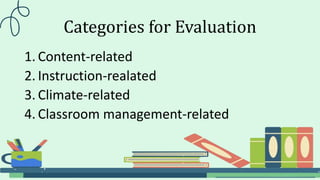
Categories for Evaluation
1. Content-related
2. Instruction-realated
3. Climate-related
4. Classroom management-related
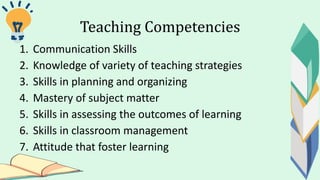
Teaching Competencies
1. Communication Skills
2. Knowledge of variety of teaching strategies
3. Skills in planning and organizing
4. Mastery of subject matter
5. Skills in assessing the outcomes of learning
6. Skills in classroom management
7. Attitude that foster learning
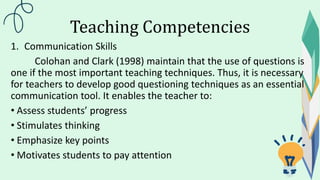
Teaching Competencies
1. Communication Skills
Colohan and Clark (1998) maintain that the use of questions is
one if the most important teaching techniques. Thus, it is necessary
for teachers to develop good questioning techniques as an essential
communication tool. It enables the teacher to:
• Assess students’ progress
• Stimulates thinking
• Emphasize key points
• Motivates students to pay attention
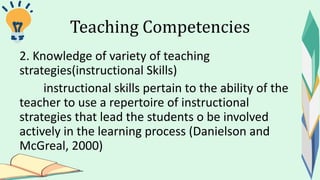
Teaching Competencies
2. Knowledge of variety of teaching
strategies(instructional Skills)
instructional skills pertain to the ability of the
teacher to use a repertoire of instructional
strategies that lead the students o be involved
actively in the learning process (Danielson and
McGreal, 2000)
Instructional Skills are demonstrated by
competent teachers through:
• The application of motivation and presentation
strategies suited to the topic and class level.
• Use of appropriate instructional materials.
• Selection of pacing of learning activities that sustain
students’ interest.
• Ease in explaining difficult concepts by using by using
simple terms.
• The art of questioning.
Teaching Competencies
3. Skills in planning and organizing
• The organization of content, materials, and method of
classroom instruction requires careful planning.
4. Mastery of Subject matter (content)
• Teachers are expected to be expert on the subject
matter being taught.
• Teachers should be well-versed about the topic under
discussion.
Teaching Competencies
5. Skills in assessing the outcomes of learning ( evaluation of
learning)
•The teacher can use the evaluation result to determine
wether the concepts and skills emphasized during
instruction were understood or not.
6. Skills in classroom management (Classroom Discipline)
•To foster student involvement and cooperation in all
classroom activities.
Teaching Competencies
1. Attitude that foster / promote learning (personality)
- suggested attitudes and behaviors of the teachers that promote
learning and create proper climate in the classroom:
• High Expectations
• Enthusiasm
• Concern for Children
• Openness to student inquiry
• Fairness
• Humor
• Sensitivity to the needs and concerns of students
• decisiveness
IMPORTANCE
OF
EVALUATION
1. Evaluation is important to the classroom
teachers, supervisors and administrators in
directing as well as guiding teaching and
learning.
2. Evaluation aids in devising more effective
instructional materials and procedures of
instruction.
3.Evaluation stimulates students to study.
4. Evaluation helps teachers to discover the
needs of the pupils.
5. Evaluation used to enforce external standards upon
the individual class or school.
6. Evaluation, likewise, helps to provide objective
evidences for effective cooperation between parents
and the teachers.
THANK YOU !
AND
GOD BLESS US ALL !!