P/B :- YASH N. ANGHAN
THE
VOJTA
TECHNIQUE
INTRODUCTION
❖ PRFESSOR VOJTA
VACLAV [ PEDIATRIC
NEUROLOGIST ]
DEVELOPED THE BASES
OF HIS DIAGNOSTICS
AND THERAPY, THE
VOJTA PRINCIPLE,
BETWEEN 1950 AND 1970.
P/B :- YASH N. ANGHAN
DEFINITON
Vojta-Therapy is a dynamic neuromuscular
treatment method based on the developmental
kinesiology and principles of reflex locomotion.
This method is supposed to treat patients with
disorders of central nervous system and
musculoskeletal system.
P/B :- YASH N. ANGHAN
WHAT IS REFLEX LOCOMOTION ?
• Reflex is an involuntary movement as a response
to external stimuli.
• Locomotion is defined as an ability to perform a
movement from one place to another.
• In reflex locomotion, there is a coordinated,
rhythmic activation of the total skeletal
musculature and a CNS response at various circuit
levels.
P/B :- YASH N. ANGHAN
INDICATION
• According to Vojta, This therapy can be
applicable to any age
• Infantile postural asymmetry,
• Congenital muscular torticollis (“wry neck”),
• Stroke
• Cerebral palsy
• Hemi plegia
• Spina bifida
• Congenital myopathies
• Hip Dysplasia
• Morbus – Down syndrome
P/B :- YASH N. ANGHAN
STIMULATING ZONES
• Vojta describes 10 different zones that are
available to stimulate the motor patterns of reflex
locomotion.
• A light pressure on certain stimulus zone (muscles
or bones) and resistance to the current movement
is applied to cause patient’s involuntary motor
response and performance of certain movement
patterns.
P/B :- YASH N. ANGHAN
STIMULATING ZONES
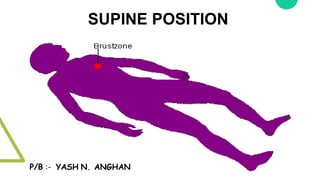
• Supine : 1 point – breast zone ( 7th – 8th intercostal
space, below the nipple.
• Prone : 7 points – 1) Trunk area
2) Acromion process of Scapula
3) Medial epicondyle of Humerus
4) Radial styloid process
5) Aponeurosis of Gluteus Medius
6) Medial epicondyle of femur
7) lateral process of Calcaneus
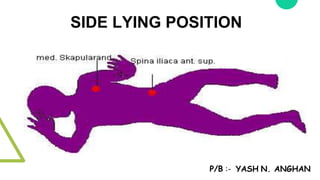
• Side lying : 2 points : 1) Ant. Sup. Iliac spine
2) Medial scapular area
P/B
:-
YASH
N.
ANGHAN
SUPINE POSITION
P/B :- YASH N. ANGHAN
PRONE POSITION
P/B :- YASH N. ANGHAN
SIDE LYING POSITION
P/B :- YASH N. ANGHAN
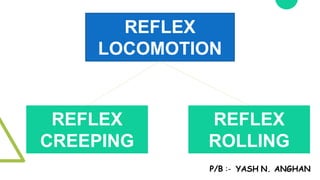
REFLEX
ROLLING
REFLEX
CREEPING
REFLEX
LOCOMOTION
P/B :- YASH N. ANGHAN
Reflex Rolling – PHASE – 1
Starting Position :- Supine lying with U.E. and L.E. are
extended.
Stimulating Point = breast zone ( 7th – 8th intercostal
space, below the nipple.
Ending Position :- Rolling is achieved, Resist the
Turning of the head
P/B :- YASH N. ANGHAN
The fundamental reactions - Phase 1 reflex rolling
• Extension of the spine
• Flexion of the legs in hip, knee, and ankle joints
• Maintenance of the legs in this position against gravity,
outside the support base of the back
• Preparation of the arms for the following support
function
• Lateral eye movements
• Initiation of swallowing
• Increase in the depth of breathing
• Coordinated, differentiated activation of the abdominal
muscles P/B :- YASH N. ANGHAN
• Starting position :- Side lying Position.
• Stimulating Points :- 1) Ant. Sup. Iliac spine
2) Medial scapular area
• Ending Position :- The rolling sequence is completed
in crawling.
Reflex Rolling – PHASE – 2
P/B :- YASH N. ANGHAN
P/B
:-
YASH
N.
ANGHAN
• Contrary flexion and extension movements of the
over- and underlying arms and legs with increase
in support function on the underlying shoulder
progressing to the hand, and on the underlying
pelvis progressing to the leg
• Extension of the spine during the entire rolling
sequence
• Maintenance of the head in side lying, against
gravity
The fundamental reactions - Phase 2 reflex rolling
P/B :- YASH N. ANGHAN
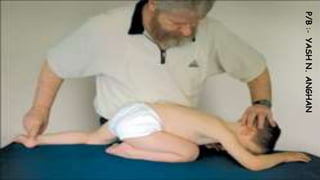
Reflex Creeping
• Starting Position :- prone lying with the head resting
on the bed rotated to one side.
• Stimulating Points :- 1) In Neonates :- can be fully
activated from one zone
2) in older patients :- combination
of several pressure points is
necessary
P/B :- YASH N. ANGHAN
The resulting sequence
• Movement predominantly ensues in the so-
called cross pattern, in which the right leg and
the left arm, or vice versa, move simultaneously.
A leg and its contralateral arm support the body
and move the trunk forwards.
P/B :- YASH N. ANGHAN
P/B
:-
YASH
N.
ANGHAN
• Activation of the muscular support and uprighting
mechanisms necessary for supporting and
grasping, rising and walking, as well as stepping
movements of the arms and legs
• Activation of the respiratory, abdominal, and
pelvic floor musculature, as well as the sphincters
of the bladder and bowel
• Swallowing (important for mastication)
• Eye movements
The fundamental reactions - reflex creeping
P/B :- YASH N. ANGHAN
Effects of Vojta technique
Skeletal Musculature
• The spine is segmentally extended, rotated and
is functionally more mobile.
• The head can be moved more freely.
• The joints centre themselves, especially at the
hip and shoulder. Incorrect postures decrease.
• The hands and feet can be used in a more
goal-directed and comprehensive fashion for
grasp and support functions.
P/B :- YASH N. ANGHAN
Face and Mouth Area:
• Sucking, swallowing and chewing movements are
facilitated.
• The eyes move themselves independently of the
head and more goal-directed.
• The voice becomes louder and stronger.
• Speech acquisition is facilitated and enunciation
becomes easier to understand.
P/B :- YASH N. ANGHAN
Respiratory Function:
• The rib cage widens.
• The breathing becomes deeper and more even.
The Autonomic (Involuntary) Nervous System:
• There is better blood circulation to the skin.
• The sleep-wake rhythm improves.
• The regulating functions of the bowel and the urinary
bladder are activated.
The Mind:
• The patient seems more balanced, happier and is
more emotionally resilient.
P/B :- YASH N. ANGHAN
Perception:
• Equilibrium reactions are improved.
• Orientation in space becomes better.
• The sensations – cold, warm, sharp or dull –
become stronger or more accurate.
• Own proprioception becomes more distinct.
• The recognition of forms and structures exclusively
through touch (stereognosis) becomes better.
• The ability to concentrate becomes more persistent
and more flexible.
P/B :- YASH N. ANGHAN
THANK YOU
P/B :- YASH N. ANGHAN

VOJTA APPROACH.pptx

  • 2.
    P/B :- YASHN. ANGHAN THE VOJTA TECHNIQUE
  • 3.
    INTRODUCTION ❖ PRFESSOR VOJTA VACLAV[ PEDIATRIC NEUROLOGIST ] DEVELOPED THE BASES OF HIS DIAGNOSTICS AND THERAPY, THE VOJTA PRINCIPLE, BETWEEN 1950 AND 1970. P/B :- YASH N. ANGHAN
  • 4.
    DEFINITON Vojta-Therapy is adynamic neuromuscular treatment method based on the developmental kinesiology and principles of reflex locomotion. This method is supposed to treat patients with disorders of central nervous system and musculoskeletal system. P/B :- YASH N. ANGHAN
  • 5.
    WHAT IS REFLEXLOCOMOTION ? • Reflex is an involuntary movement as a response to external stimuli. • Locomotion is defined as an ability to perform a movement from one place to another. • In reflex locomotion, there is a coordinated, rhythmic activation of the total skeletal musculature and a CNS response at various circuit levels. P/B :- YASH N. ANGHAN
  • 6.
    INDICATION • According toVojta, This therapy can be applicable to any age • Infantile postural asymmetry, • Congenital muscular torticollis (“wry neck”), • Stroke • Cerebral palsy • Hemi plegia • Spina bifida • Congenital myopathies • Hip Dysplasia • Morbus – Down syndrome P/B :- YASH N. ANGHAN
  • 7.
    STIMULATING ZONES • Vojtadescribes 10 different zones that are available to stimulate the motor patterns of reflex locomotion. • A light pressure on certain stimulus zone (muscles or bones) and resistance to the current movement is applied to cause patient’s involuntary motor response and performance of certain movement patterns. P/B :- YASH N. ANGHAN
  • 8.
    STIMULATING ZONES • Supine: 1 point – breast zone ( 7th – 8th intercostal space, below the nipple. • Prone : 7 points – 1) Trunk area 2) Acromion process of Scapula 3) Medial epicondyle of Humerus 4) Radial styloid process 5) Aponeurosis of Gluteus Medius 6) Medial epicondyle of femur 7) lateral process of Calcaneus • Side lying : 2 points : 1) Ant. Sup. Iliac spine 2) Medial scapular area P/B :- YASH N. ANGHAN
  • 9.
    SUPINE POSITION P/B :-YASH N. ANGHAN
  • 10.
    PRONE POSITION P/B :-YASH N. ANGHAN
  • 11.
    SIDE LYING POSITION P/B:- YASH N. ANGHAN
  • 12.
  • 13.
    Reflex Rolling –PHASE – 1 Starting Position :- Supine lying with U.E. and L.E. are extended. Stimulating Point = breast zone ( 7th – 8th intercostal space, below the nipple. Ending Position :- Rolling is achieved, Resist the Turning of the head P/B :- YASH N. ANGHAN
  • 14.
    P/B :- YASHN. ANGHAN
  • 15.
    The fundamental reactions- Phase 1 reflex rolling • Extension of the spine • Flexion of the legs in hip, knee, and ankle joints • Maintenance of the legs in this position against gravity, outside the support base of the back • Preparation of the arms for the following support function • Lateral eye movements • Initiation of swallowing • Increase in the depth of breathing • Coordinated, differentiated activation of the abdominal muscles P/B :- YASH N. ANGHAN
  • 16.
    • Starting position:- Side lying Position. • Stimulating Points :- 1) Ant. Sup. Iliac spine 2) Medial scapular area • Ending Position :- The rolling sequence is completed in crawling. Reflex Rolling – PHASE – 2 P/B :- YASH N. ANGHAN
  • 17.
  • 18.
    • Contrary flexionand extension movements of the over- and underlying arms and legs with increase in support function on the underlying shoulder progressing to the hand, and on the underlying pelvis progressing to the leg • Extension of the spine during the entire rolling sequence • Maintenance of the head in side lying, against gravity The fundamental reactions - Phase 2 reflex rolling P/B :- YASH N. ANGHAN
  • 19.
    Reflex Creeping • StartingPosition :- prone lying with the head resting on the bed rotated to one side. • Stimulating Points :- 1) In Neonates :- can be fully activated from one zone 2) in older patients :- combination of several pressure points is necessary P/B :- YASH N. ANGHAN
  • 20.
    The resulting sequence •Movement predominantly ensues in the so- called cross pattern, in which the right leg and the left arm, or vice versa, move simultaneously. A leg and its contralateral arm support the body and move the trunk forwards. P/B :- YASH N. ANGHAN
  • 21.
  • 22.
    • Activation ofthe muscular support and uprighting mechanisms necessary for supporting and grasping, rising and walking, as well as stepping movements of the arms and legs • Activation of the respiratory, abdominal, and pelvic floor musculature, as well as the sphincters of the bladder and bowel • Swallowing (important for mastication) • Eye movements The fundamental reactions - reflex creeping P/B :- YASH N. ANGHAN
  • 23.
    Effects of Vojtatechnique Skeletal Musculature • The spine is segmentally extended, rotated and is functionally more mobile. • The head can be moved more freely. • The joints centre themselves, especially at the hip and shoulder. Incorrect postures decrease. • The hands and feet can be used in a more goal-directed and comprehensive fashion for grasp and support functions. P/B :- YASH N. ANGHAN
  • 24.
    Face and MouthArea: • Sucking, swallowing and chewing movements are facilitated. • The eyes move themselves independently of the head and more goal-directed. • The voice becomes louder and stronger. • Speech acquisition is facilitated and enunciation becomes easier to understand. P/B :- YASH N. ANGHAN
  • 25.
    Respiratory Function: • Therib cage widens. • The breathing becomes deeper and more even. The Autonomic (Involuntary) Nervous System: • There is better blood circulation to the skin. • The sleep-wake rhythm improves. • The regulating functions of the bowel and the urinary bladder are activated. The Mind: • The patient seems more balanced, happier and is more emotionally resilient. P/B :- YASH N. ANGHAN
  • 26.
    Perception: • Equilibrium reactionsare improved. • Orientation in space becomes better. • The sensations – cold, warm, sharp or dull – become stronger or more accurate. • Own proprioception becomes more distinct. • The recognition of forms and structures exclusively through touch (stereognosis) becomes better. • The ability to concentrate becomes more persistent and more flexible. P/B :- YASH N. ANGHAN
  • 27.
    THANK YOU P/B :-YASH N. ANGHAN