Functional Assessment Scales
Darpan Vanvi
1st Year MPT
Contents
 Introduction
 Berg Balance scale
 Barthel Index
 Functional Independence Measure
 Action Research Arm Test
 Functional Reach Test & Multi-directional Reach
Test
 References
Introduction
 Functional assessment measures an individuals
level of function and ability to perform
functional task.
 Functional assessments evaluate specific things
such as grooming, bathing, dressing or more
general aspect such as quality of life.
 Assessments have to be valid, reliable and
reproducible.
 They can be self-administered questionnaires or
clinician administered.
Berg Balance Scale
• The berg balance scale is widely used clinical
test of person’s Static and Dynamic balance
abilities.
• Name after Katherine berg.
• Berg balance scale is generally considered to be
Gold Standard.
 Used to objectively determine a patient’s ability
to safely balance during a series of
predetermined tasks.
 14 items list
 Each item consisting of a five point 0 to 4
 0 indicating the lowest level of function and 4
the highest level of function
 It takes approximately 20 minutes to complete.
Interpretation
 Cut-off scores for the elderly were reported by
Berg et al 1992 as follows :
 A score of 56 indicates functional balance.
 A score of < 45 indicates individuals may be at
greater risk of falling.
(A) Parkinson’s disease
 Test/Retest reliability: Excellent(ICC=0.94)
 Interrater reliability: Excellent(ICC=0.95)
(B) Stroke
Test/retest reliability:
 (For acute stroke)
=Excellent (ICC=0.99)
 Interrater Reliability:
 For acute stroke)
=Excellent (ICC=0.95)
 For chronic stroke:
=Excellent(ICC=0.98)
 Concurrent( For acute stroke):
Excellent correlation with Postural
Assessment scale (r=0.92 to 0.95)
 Predictive ( For acute stroke)
Excellent correlation with Motor
assessment scale (r=0.82 to 0.84)
Barthel Index
 The Barthel Scale/Index (BI) is an ordinal
scale used to measure performance in activities
of daily living (ADL).
 The Barthel Index measures the degree of
assistance required by an individual on 10 items
of mobility and self care ADL
Area of assessment: Activities of daily living
functional mobility gait
Assessment type: Performance measure
ICF Domain: Activity
Measurement Domain: Activity of daily living
motor
 The Barthel includes 10 personal activities:
• Feeding,
• Personal Toileting,
• Bathing,
• Dressing And Undressing,
• Getting On And Off A Toilet,
• Controlling Bladder,
• Controlling Bowel,
• Moving From Wheelchair To Bed And
Returning,
• Walking On Level Surface (Or Propelling A
Wheelchair If Unable To Walk) And
• Ascending And Descending Stairs
 Proposed guidelines for interpreting Barthel
scores are that scores of
 0-20 indicate “total” dependency,
 21-60 indicate “severe” dependency,
 61-90 indicate “moderate” dependency
 91-99 indicates “slight” dependency.
 Note- the Barthel Index should not be used alone
for predicting outcomes.
 STROKE
 MCID : Acute stroke =1.85 points
 Interrater/Intrarater Reliability
 For acute stroke : Excellent (ICC=0.94)
 For Ischemic Stroke :
:Intrarater excellent (ICC=0.98
:Interrater excellent (ICC=0.90)
 Criterion validity(Predictive/Concurrent):
 Acute stroke : Excellent agreement between The
FIM motor & 10 items BI at both admission &
Discharge (ICC>0.83)
Functional Independence Measure
 Measure the level of patient’s disability &
Indicates how much assistance is required for
individual to carry out activities of daily living
 Area of Assessment : Activities of daily living
 Assessment type : Observer
 It is an 18-item measurement tool that grouped
into 2 sub-scales- Motor and Cognition.
 1)13 motor tasks
 2) 5 cognitive tasks(considered basic activities of
daily living)
 Motor subscales includes:
1)Eating
2)Grooming
3)Bathing
4)Dressing UL
5)Dressing LL
6)Toileting
7)Bladder management
8)Bowel management
9)Transfer-Bed/ Chair/ Wheelchair
10)Toilet transfer
11)Shower transfer
12)Walk/ Wheelchair
13)Stairs
Cognition subscales include:
1)Comprehension
2)Expression
3)Social interaction
4)Problem solving
5)Memory
 No Helper
7. Complete Independence (Timely, Safety)
6. Modified Independence (Device)
 Helper - Modified Dependence
5. Supervision (Subject = 100%)
4. Minimal Assistance (Subject = 75% or more)
3. Moderate Assistance (Subject = 50% or more)
 Helper - Complete Dependence
2. Maximal Assistance (Subject = 25% or more)
1. Total Assistance or not Testable (Subject less than 25%)
Interpretation
 Motor subscale(the sum of the individuals motor
subscale item) will be a value between 13 and
91.
 Cognition subscale(the sum of individual
cognition subscale items) will be a value
between 5 and 35.
 The total score for the FIM instrument(the sum
of motor and cognition subscale scores) will be a
value between 18 and 126.
 STROKE
 Criterion Validity(Predictive/Concurrent):
A) Predictive validity :FIM total score at admission
were found to be the most powerful prediction of
Montebello Rehabilitation factor score (beta
coefficient=0.42)
B) Concurrent :Excellent correlation between FIM
motor subscale & Barthel index
At admission (r=0.92)
At discharge (r=0.94)
Action Research Arm Test
 The Action Research Arm Test (ARAT) is a 19
item observational measure used by physical
therapists and other health care professionals to
assess upper extremity performance
(coordination, dexterity and functioning) in
stroke recovery, brain injury and multiple
sclerosis populations.
 Items comprising the ARAT are categorized into
four subscales (grasp, grip, pinch and gross
movement) and arranged in order of decreasing
difficulty, with the most difficult task examined
first, followed by the least difficult task.
 Area of assessment :Activities of daily living
:Co-ordination
:Dexterity
:UE Function
 Assessment type : Observer
 The 19 items comprising the ARAT are scored
using a 4 point ordinal scale, as follows:
0 = No movement
1 = Movement task is partially performed
2 = Movement task is completed but takes
abnormally long
3 = Movement is performed normally
Positioning
 Standard positioning for the ARAT has the
subject seated upright in a chair with a firm back
and no armrests.
 The head should be in a neutral position, with
feet in contact with the floor.
 This body posture must be maintained
throughout the testing period, with the trunk
contacting the back of the chair.
 Feedback is provided as required, to prevent the
subject from standing up, shifting laterally or
leaning forward.
Stroke
 MCID :Acute stroke =5.7
:Chronic stroke=12 to 17 points
 Interrater/Intrarater Reliability:
 Acute stroke- Excellent interrater (ICC=0.92)
 Chronic stroke-Excellent interrater (ICC=0.995)
-Excellent intrarater (ICC=0.989)
 Criterion Validity(Predictive/Concurrent):
 Chronic stroke-Excellent correlation between
ARAT & Arm motor score of Fugl meyer
(r=0.94<0.001)
Functional Reach Test
 FRT was developed by Pamela Duncan and co-
workers in 1990
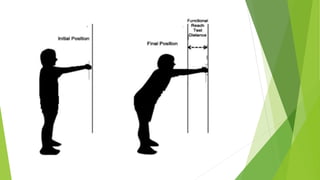
 Defined as “The maximal distance one can reach
forward beyond arm’s length, while maintaining
a fixed base of support in the standing position.”
 Used to assess dynamic balance in one simple
task.
 This test measures the distance between the
length of an outstretched arm in a maximal
forward reach from a standing position, while
maintaining a fixed base of support.
 It was developed to predict fall in elderly people;
being unable to reach more than 15 centimeters
(6 inches) depicts a high fall risk and frailty.
 Area of Assessment:
1)Balance : Vestibular
2)Balance : Non-Vestibular
3)Functional Mobility
4)Vestibular
 Assessment type : Performance measure
 Measurement Interpretation :
1) 10’’/25cm - Greater low risk of falls
2) 6’’/15cm to 10’’/25cm – Risk of falls is 2x
greater than normal
3) 6’’/15cm – Less risk of falling 4x greater than
normal
4) Unwilling to reach risk of falling 8x greater
than normal
Multi-directional reach test
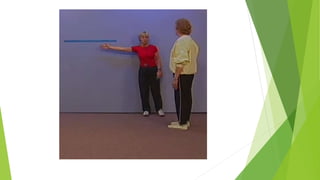
 Used to determine the limits of stability of
individual in 4 directions.
 It measures how far an individual can voluntarily
reach, thereby shifting the COG to the limits of
the BOS with the feet stationary.
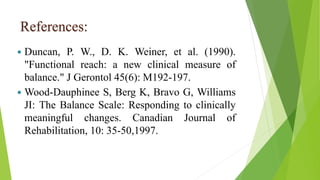
References:
 Duncan, P. W., D. K. Weiner, et al. (1990).
"Functional reach: a new clinical measure of
balance." J Gerontol 45(6): M192-197.
 Wood-Dauphinee S, Berg K, Bravo G, Williams
JI: The Balance Scale: Responding to clinically
meaningful changes. Canadian Journal of
Rehabilitation, 10: 35-50,1997.
 Susan B. O’Sullivan-Tomas J. Schmitz-George
D. Fulk : Sixth Edition
 Rehabmeasure.com

Functional assessment scale.pptx

  • 1.
  • 2.
    Contents  Introduction  BergBalance scale  Barthel Index  Functional Independence Measure  Action Research Arm Test  Functional Reach Test & Multi-directional Reach Test  References
  • 3.
    Introduction  Functional assessmentmeasures an individuals level of function and ability to perform functional task.  Functional assessments evaluate specific things such as grooming, bathing, dressing or more general aspect such as quality of life.
  • 4.
     Assessments haveto be valid, reliable and reproducible.  They can be self-administered questionnaires or clinician administered.
  • 5.
    Berg Balance Scale •The berg balance scale is widely used clinical test of person’s Static and Dynamic balance abilities. • Name after Katherine berg. • Berg balance scale is generally considered to be Gold Standard.
  • 6.
     Used toobjectively determine a patient’s ability to safely balance during a series of predetermined tasks.  14 items list  Each item consisting of a five point 0 to 4
  • 7.
     0 indicatingthe lowest level of function and 4 the highest level of function  It takes approximately 20 minutes to complete.
  • 9.
    Interpretation  Cut-off scoresfor the elderly were reported by Berg et al 1992 as follows :  A score of 56 indicates functional balance.  A score of < 45 indicates individuals may be at greater risk of falling.
  • 10.
    (A) Parkinson’s disease Test/Retest reliability: Excellent(ICC=0.94)  Interrater reliability: Excellent(ICC=0.95)
  • 11.
    (B) Stroke Test/retest reliability: (For acute stroke) =Excellent (ICC=0.99)
  • 12.
     Interrater Reliability: For acute stroke) =Excellent (ICC=0.95)  For chronic stroke: =Excellent(ICC=0.98)
  • 13.
     Concurrent( Foracute stroke): Excellent correlation with Postural Assessment scale (r=0.92 to 0.95)  Predictive ( For acute stroke) Excellent correlation with Motor assessment scale (r=0.82 to 0.84)
  • 14.
    Barthel Index  TheBarthel Scale/Index (BI) is an ordinal scale used to measure performance in activities of daily living (ADL).  The Barthel Index measures the degree of assistance required by an individual on 10 items of mobility and self care ADL
  • 15.
    Area of assessment:Activities of daily living functional mobility gait Assessment type: Performance measure ICF Domain: Activity Measurement Domain: Activity of daily living motor
  • 16.
     The Barthelincludes 10 personal activities: • Feeding, • Personal Toileting, • Bathing, • Dressing And Undressing, • Getting On And Off A Toilet,
  • 17.
    • Controlling Bladder, •Controlling Bowel, • Moving From Wheelchair To Bed And Returning, • Walking On Level Surface (Or Propelling A Wheelchair If Unable To Walk) And • Ascending And Descending Stairs
  • 18.
     Proposed guidelinesfor interpreting Barthel scores are that scores of  0-20 indicate “total” dependency,  21-60 indicate “severe” dependency,  61-90 indicate “moderate” dependency  91-99 indicates “slight” dependency.  Note- the Barthel Index should not be used alone for predicting outcomes.
  • 19.
     STROKE  MCID: Acute stroke =1.85 points
  • 20.
     Interrater/Intrarater Reliability For acute stroke : Excellent (ICC=0.94)  For Ischemic Stroke : :Intrarater excellent (ICC=0.98 :Interrater excellent (ICC=0.90)
  • 21.
     Criterion validity(Predictive/Concurrent): Acute stroke : Excellent agreement between The FIM motor & 10 items BI at both admission & Discharge (ICC>0.83)
  • 23.
    Functional Independence Measure Measure the level of patient’s disability & Indicates how much assistance is required for individual to carry out activities of daily living  Area of Assessment : Activities of daily living  Assessment type : Observer
  • 24.
     It isan 18-item measurement tool that grouped into 2 sub-scales- Motor and Cognition.  1)13 motor tasks  2) 5 cognitive tasks(considered basic activities of daily living)
  • 25.
     Motor subscalesincludes: 1)Eating 2)Grooming 3)Bathing 4)Dressing UL 5)Dressing LL 6)Toileting
  • 26.
    7)Bladder management 8)Bowel management 9)Transfer-Bed/Chair/ Wheelchair 10)Toilet transfer 11)Shower transfer 12)Walk/ Wheelchair 13)Stairs
  • 27.
  • 29.
     No Helper 7.Complete Independence (Timely, Safety) 6. Modified Independence (Device)  Helper - Modified Dependence 5. Supervision (Subject = 100%) 4. Minimal Assistance (Subject = 75% or more) 3. Moderate Assistance (Subject = 50% or more)  Helper - Complete Dependence 2. Maximal Assistance (Subject = 25% or more) 1. Total Assistance or not Testable (Subject less than 25%)
  • 30.
    Interpretation  Motor subscale(thesum of the individuals motor subscale item) will be a value between 13 and 91.  Cognition subscale(the sum of individual cognition subscale items) will be a value between 5 and 35.
  • 31.
     The totalscore for the FIM instrument(the sum of motor and cognition subscale scores) will be a value between 18 and 126.
  • 32.
     STROKE  CriterionValidity(Predictive/Concurrent): A) Predictive validity :FIM total score at admission were found to be the most powerful prediction of Montebello Rehabilitation factor score (beta coefficient=0.42)
  • 33.
    B) Concurrent :Excellentcorrelation between FIM motor subscale & Barthel index At admission (r=0.92) At discharge (r=0.94)
  • 34.
    Action Research ArmTest  The Action Research Arm Test (ARAT) is a 19 item observational measure used by physical therapists and other health care professionals to assess upper extremity performance (coordination, dexterity and functioning) in stroke recovery, brain injury and multiple sclerosis populations.
  • 35.
     Items comprisingthe ARAT are categorized into four subscales (grasp, grip, pinch and gross movement) and arranged in order of decreasing difficulty, with the most difficult task examined first, followed by the least difficult task.
  • 36.
     Area ofassessment :Activities of daily living :Co-ordination :Dexterity :UE Function  Assessment type : Observer
  • 37.
     The 19items comprising the ARAT are scored using a 4 point ordinal scale, as follows: 0 = No movement 1 = Movement task is partially performed
  • 38.
    2 = Movementtask is completed but takes abnormally long 3 = Movement is performed normally
  • 40.
    Positioning  Standard positioningfor the ARAT has the subject seated upright in a chair with a firm back and no armrests.  The head should be in a neutral position, with feet in contact with the floor.
  • 41.
     This bodyposture must be maintained throughout the testing period, with the trunk contacting the back of the chair.  Feedback is provided as required, to prevent the subject from standing up, shifting laterally or leaning forward.
  • 42.
    Stroke  MCID :Acutestroke =5.7 :Chronic stroke=12 to 17 points
  • 43.
     Interrater/Intrarater Reliability: Acute stroke- Excellent interrater (ICC=0.92)  Chronic stroke-Excellent interrater (ICC=0.995) -Excellent intrarater (ICC=0.989)
  • 44.
     Criterion Validity(Predictive/Concurrent): Chronic stroke-Excellent correlation between ARAT & Arm motor score of Fugl meyer (r=0.94<0.001)
  • 45.
    Functional Reach Test FRT was developed by Pamela Duncan and co- workers in 1990  Defined as “The maximal distance one can reach forward beyond arm’s length, while maintaining a fixed base of support in the standing position.”  Used to assess dynamic balance in one simple task.
  • 46.
     This testmeasures the distance between the length of an outstretched arm in a maximal forward reach from a standing position, while maintaining a fixed base of support.  It was developed to predict fall in elderly people; being unable to reach more than 15 centimeters (6 inches) depicts a high fall risk and frailty.
  • 47.
     Area ofAssessment: 1)Balance : Vestibular 2)Balance : Non-Vestibular 3)Functional Mobility 4)Vestibular  Assessment type : Performance measure
  • 49.
     Measurement Interpretation: 1) 10’’/25cm - Greater low risk of falls 2) 6’’/15cm to 10’’/25cm – Risk of falls is 2x greater than normal 3) 6’’/15cm – Less risk of falling 4x greater than normal 4) Unwilling to reach risk of falling 8x greater than normal
  • 50.
    Multi-directional reach test Used to determine the limits of stability of individual in 4 directions.  It measures how far an individual can voluntarily reach, thereby shifting the COG to the limits of the BOS with the feet stationary.
  • 52.
    References:  Duncan, P.W., D. K. Weiner, et al. (1990). "Functional reach: a new clinical measure of balance." J Gerontol 45(6): M192-197.  Wood-Dauphinee S, Berg K, Bravo G, Williams JI: The Balance Scale: Responding to clinically meaningful changes. Canadian Journal of Rehabilitation, 10: 35-50,1997.
  • 53.
     Susan B.O’Sullivan-Tomas J. Schmitz-George D. Fulk : Sixth Edition  Rehabmeasure.com