Prepared by:
Mrs. Akila. A, M.Sc (N); M.Sc (PSY)
Associate Professor
INTRODUCTION
Attitude is a specific mental state of an
individual towards something according to
which his behaviour towards it is moulded.
Attitude is a way we perceive, think, feel
and more or less permanently in relation to
something.
DEFINITION
Attitude can be defined, as an enduring
organization of motivational, emotional,
perceptual and cognitive processes with
respect to some aspect of the individual’s
world-
(Krech and Crutchfield-1948)
Attitude as an readiness to respond in
such a way, that behaviour is given a certain
direction- Travers 1973.
CHARACTERISTICS OF
ATTITUDE
Attitudes:
1. subject- object relationship
2. Learnt
3. Relatively enduring state of relationship
4. Has motivational & affective
characteristics.
5. Numerous & varied as the stimuli to
which they respond.
CHARACTERISTICS OF
ATTITUDE
6.Ranges from strongly positive to strongly
negative.
7.Consists of affective, behavioural &
cognitive components.
8. Explicit (consciously aware) or Implicit
(Unconscious)
9.Accompanied by tones of strong feeling
called sentiments.
10. Related to our needs & Problems
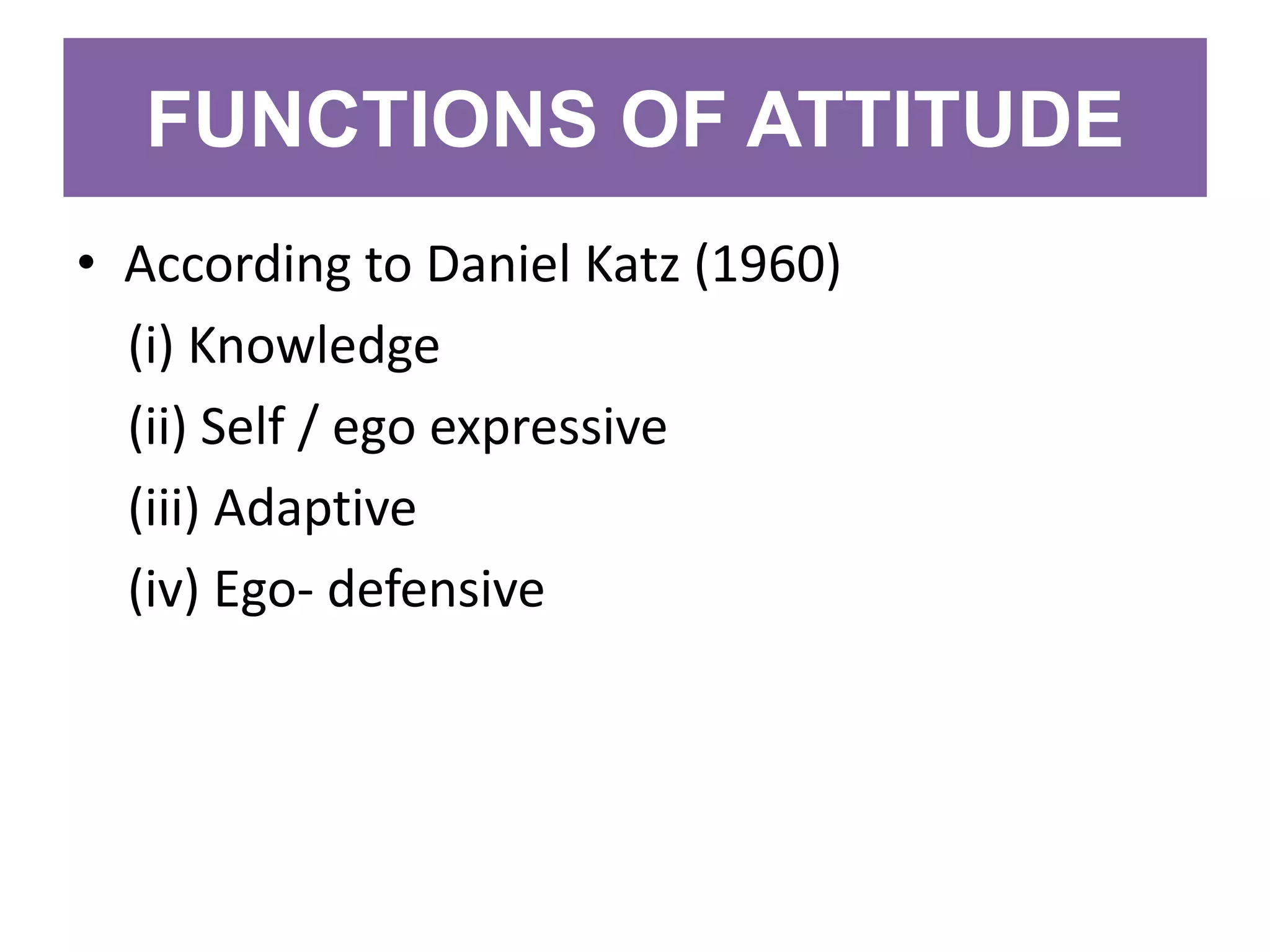
FUNCTIONS OF ATTITUDE
• According to Daniel Katz (1960)
(i) Knowledge
(ii) Self / ego expressive
(iii) Adaptive
(iv) Ego- defensive
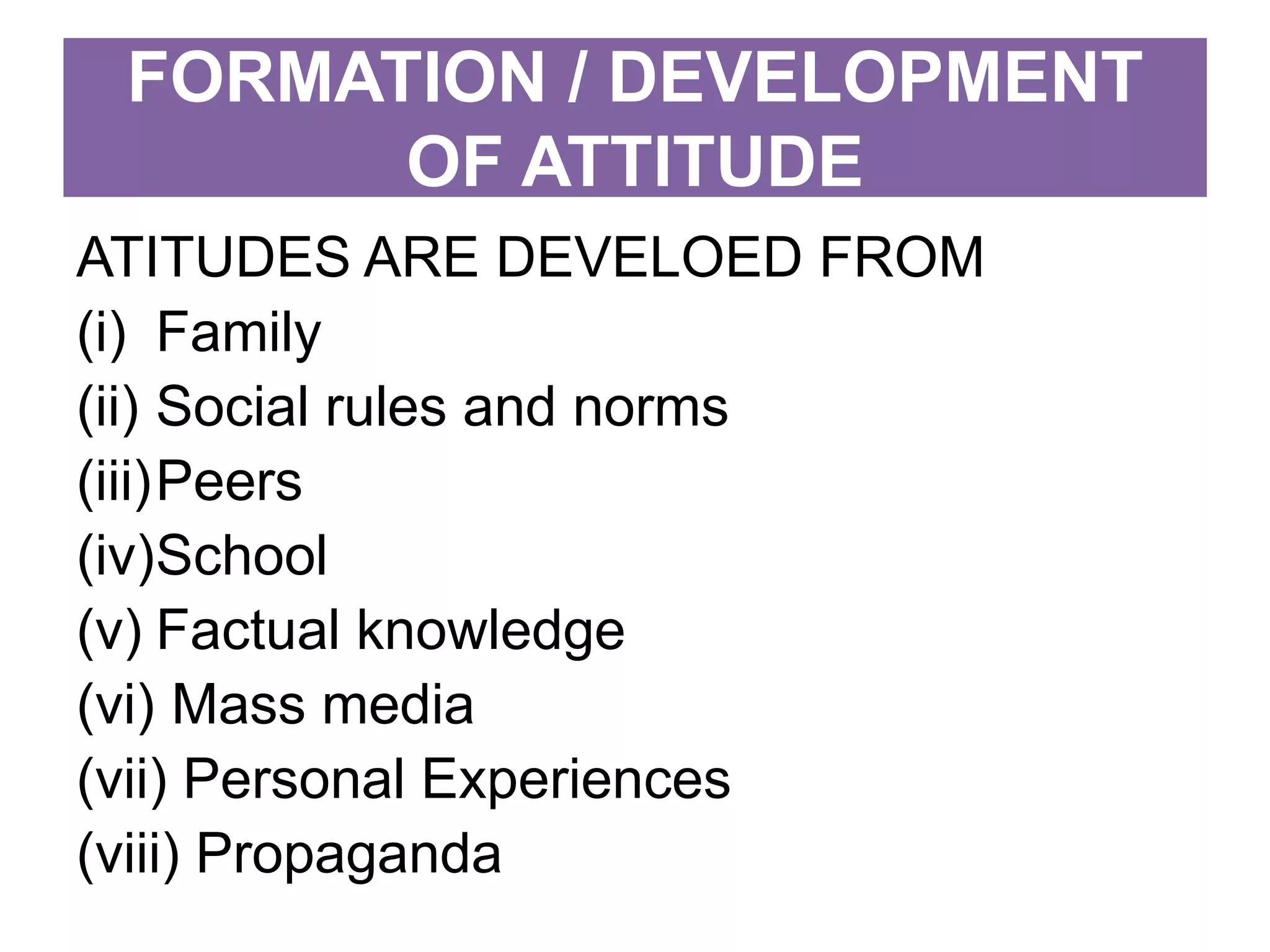
FORMATION / DEVELOPMENT
OF ATTITUDE
ATITUDES ARE DEVELOED FROM
(i) Family
(ii) Social rules and norms
(iii)Peers
(iv)School
(v) Factual knowledge
(vi) Mass media
(vii) Personal Experiences
(viii) Propaganda
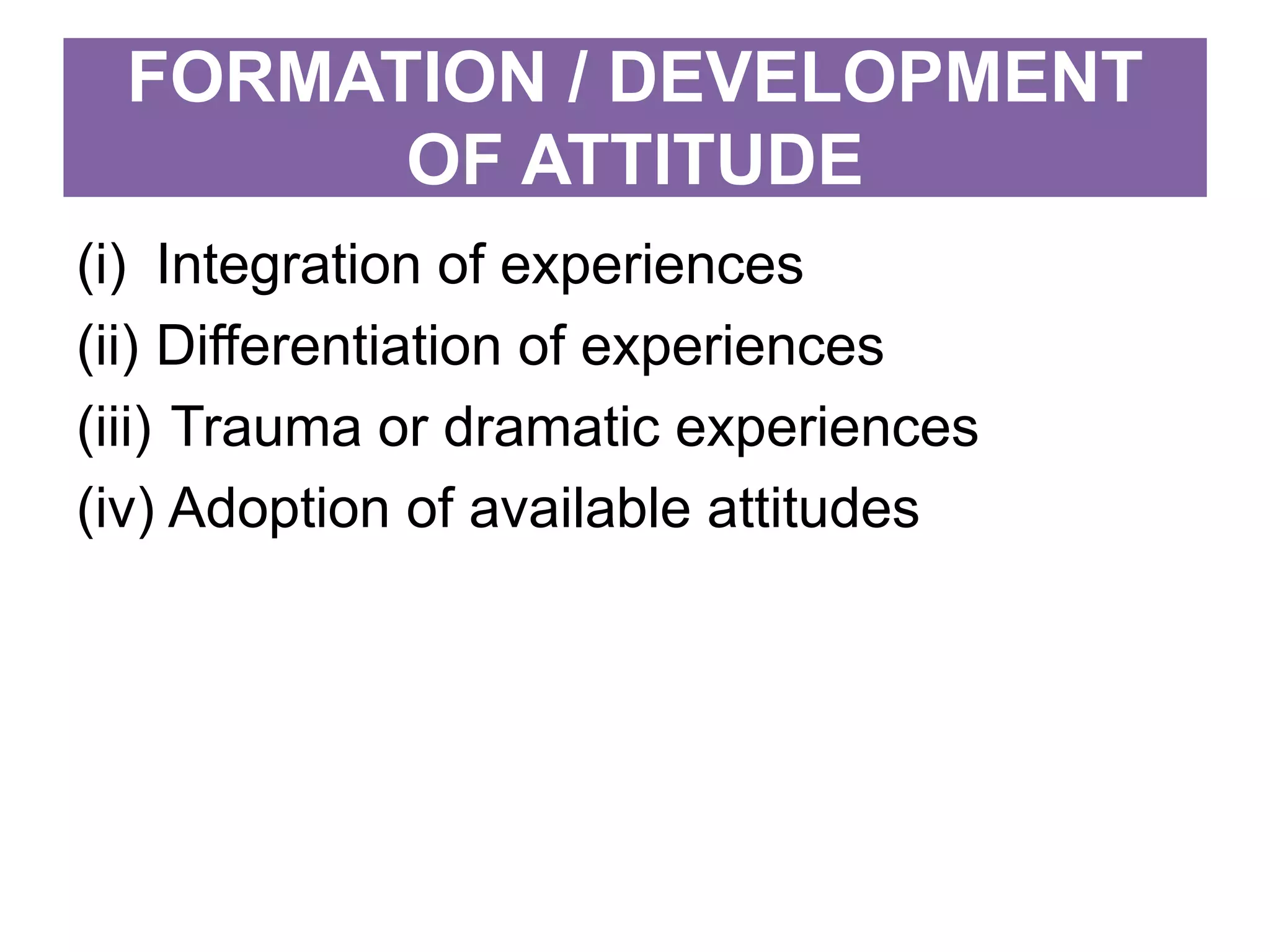
FORMATION / DEVELOPMENT
OF ATTITUDE
(i) Integration of experiences
(ii) Differentiation of experiences
(iii) Trauma or dramatic experiences
(iv) Adoption of available attitudes
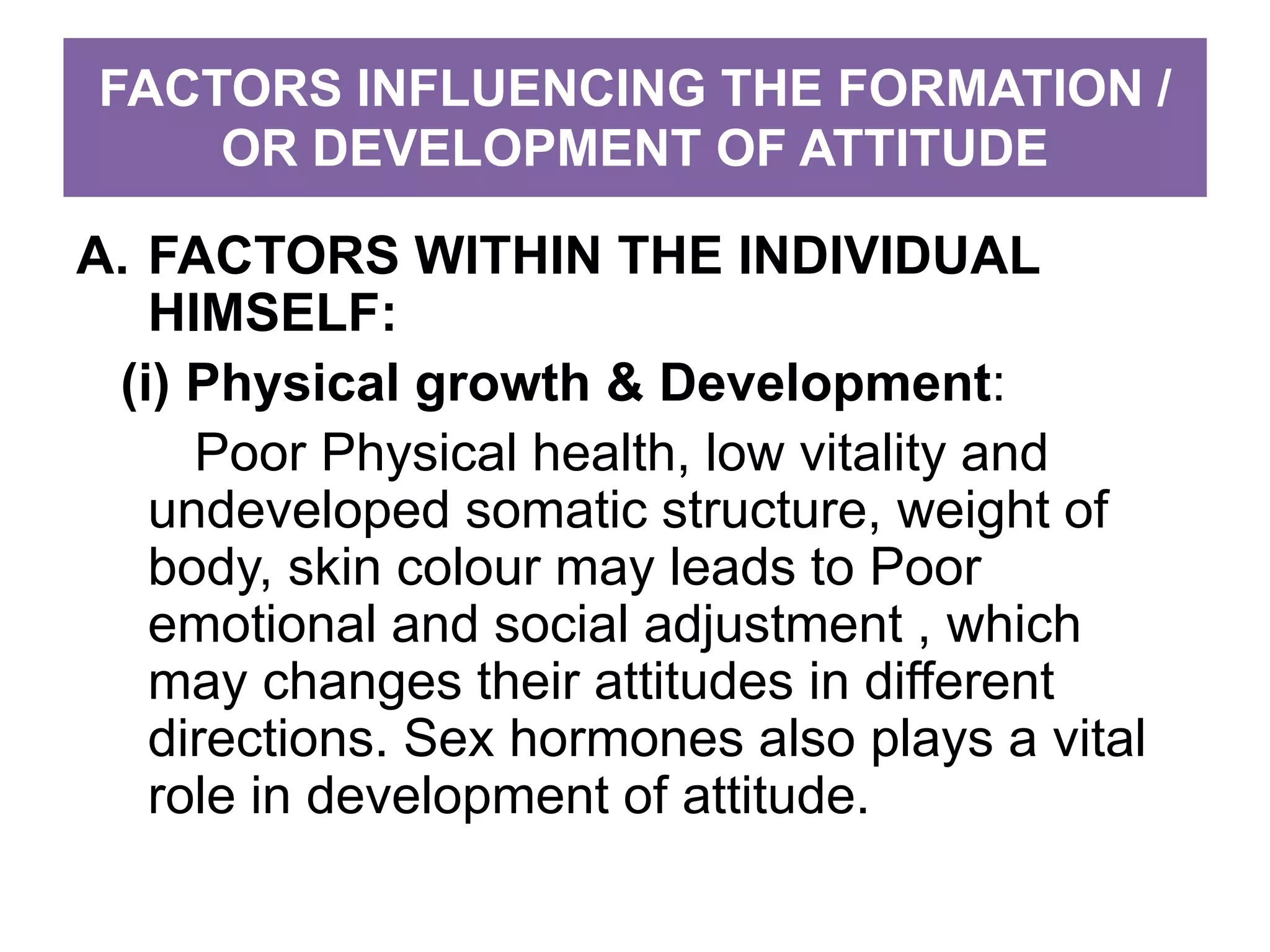
FACTORS INFLUENCING THE FORMATION /
OR DEVELOPMENT OF ATTITUDE
A. FACTORS WITHIN THE INDIVIDUAL
HIMSELF:
(i) Physical growth & Development:
Poor Physical health, low vitality and
undeveloped somatic structure, weight of
body, skin colour may leads to Poor
emotional and social adjustment , which
may changes their attitudes in different
directions. Sex hormones also plays a vital
role in development of attitude.
(ii) Intellectual Development:
-Attitude development is conditioned by
the growth of intelligence.
-Memory, thinking, reasoning Plays a
major role.
(iii) Emotional Development:
- Emotions plays a dominant role in overt
or covert behaviour manifestation &
behaviour is related to attitudes.
(iv) Social development:
- Social interaction and Group processes
are the key to attitude formation.
- Social Attitudes are formed from the
reciprocal groups.
(v) Ethical and moral Development:
-Every individual develops certain ideals,
values and concepts of the self in which
he takes Pride.
- Even in enhancing the feelings of self
esteem.
B. FACTORS WITHIN THE INDIVIDUAL’S
ENVIRONMENT:
(i) Home and Family:
Children are identify themselves from
their Parents and other family members.
Example: Negative Parental attitudes like
hostility, rejection may lead their children
to develop aggressive attitudes.
(ii) Social environment:
- Contact with the neighbourhood, school,
community, society norms, traditions of the
community to which one belongs, cast strong
influence in early attitudes.
- In schools, factors like teachers and their
behaviour , classmates and their behaviour,
their curriculum, general tone and discipline
of the institution may influence attitude.
- Religious groups, Social clubs or constitution,
where one learns or earns has a definite set of
emotional & intellectual environment.
BEHAVIOUR AND ATTITUDE
-Our attitudes, favourable or unfavourable,
represent our predispositions to react (or
respond to certain stimuli.
-In this sense, it becomes quite imperative
that our responses or reactions to the stimuli,
observable in one or more conative
behaviour are the product or outcome of our
attitude towards those objects, persons or
situations.
- Our observed behaviour in our day- day life
may provide sufficient testimony to establish
a direct relationship between one’s behaviour
and attitude towards a thing, person or
situation.
- Attitudes drive behaviour:
An individual has to change what he thinks
before he can change what he will do.
- Behaviour drives attitudes:
An individual must change what he does
before he changes what he thinks.
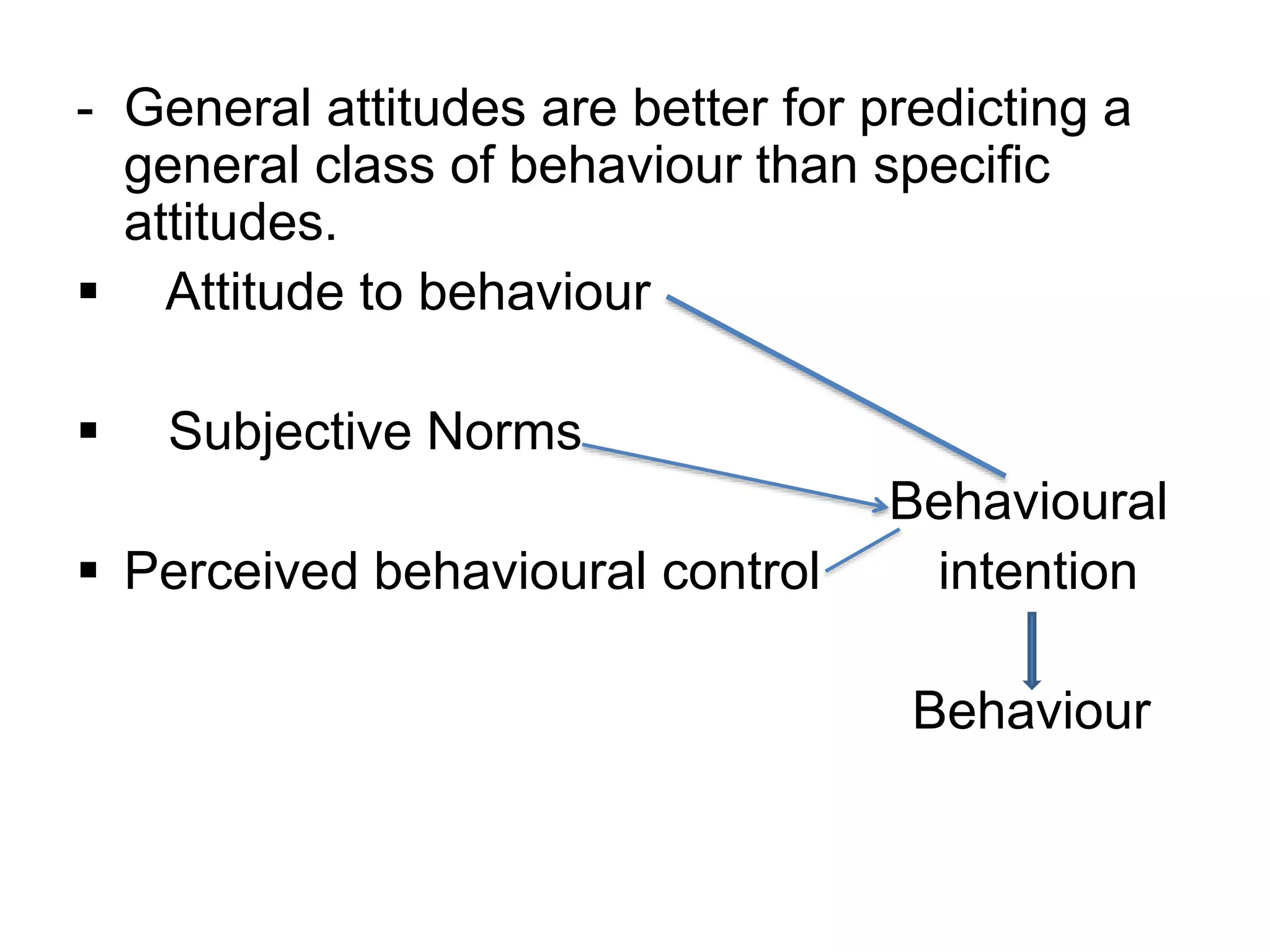
- General attitudes are better for predicting a
general class of behaviour than specific
attitudes.
 Attitude to behaviour
 Subjective Norms
Behavioural
 Perceived behavioural control intention
Behaviour
- In case if person has a negative attitude
towards a particular Political party, it will
colour his thinking, feeling and action towards
them.
- Same way, if a person has positive attitude
towards a political party will be appreciating
the functioning, ideology of that party.
- Not only in social life, but also in world of
work and profession, we may witness a close
link between one’s attitude and behaviour.
- - Behaviour can modify attitudes.
ATTITUDE CHANGES
Once attitudes and beliefs have been
formed, they have a tendency to persist or
continue. It is therefore, difficult to change the
attitudes that have been established. There
are many reasons for our inability to change
them easily.
Attitudes can be changed through:
- Providing Proper education:
Can be done through both the curricular and
co-curricular and formal and informal means.
- Making use of Propaganda machinery:
The most popular way utilized nowadays for
bringing attitudinal change among the
particular group of people or masses is to
make use of the propaganda mechanism.
- Using fear inducing Mechanism:
Threats, Punitive measures, strict
disciplinary rules and legal laws are many
times employed in bringing attitudinal
changes among individuals.
Examples: Dowry, killing of girl baby in womb
of mother.
- Use of modelling techniques:
People are easily attracted to the model
behaviour of their role models for bringing
changes in their own attitudes and behaviour.
- Direct Personal Experiences:
 The most enduring changes in the behaviour
of the people are introduces through their
own direct personal experiences.
 when person at this time of intense
communal riots, gets his survival through the
active help and generosity of the people
belonging to the community.
- Making use of the cognitive dissonance
mechanism:
In this mechanism, cognitive
dissonance , it may exist simultaneously 2
different cognitions of a particular thing,
event or phenomena in the minds of an
individual.
- Bringing desired changes in beliefs and
values:
For this, we have to rectify the erroneous
beliefs and replace the negative values
with the positive ones.
NURSING IMPLICATIONS OF
ATTITUDE
(i) Avoid negative attitude towards race,
community or a disease results in prejudiced
behaviour that affects the patient care.
(ii) The nurse should recognize her attitudes and
prevent them from interfering with nursing
care.
(iii)Nurse’s should understand patient’s
attitudes.
• Nurse’s should identify the patient’s
unfavourable attitudes and change them
into favourable ones.
• The nurse should need to cultivate
Professional attitude which will lead into
success in the work.
Psychology unit iv  attitude

Psychology unit iv attitude

  • 1.
    Prepared by: Mrs. Akila.A, M.Sc (N); M.Sc (PSY) Associate Professor
  • 2.
    INTRODUCTION Attitude is aspecific mental state of an individual towards something according to which his behaviour towards it is moulded. Attitude is a way we perceive, think, feel and more or less permanently in relation to something.
  • 3.
    DEFINITION Attitude can bedefined, as an enduring organization of motivational, emotional, perceptual and cognitive processes with respect to some aspect of the individual’s world- (Krech and Crutchfield-1948) Attitude as an readiness to respond in such a way, that behaviour is given a certain direction- Travers 1973.
  • 4.
    CHARACTERISTICS OF ATTITUDE Attitudes: 1. subject-object relationship 2. Learnt 3. Relatively enduring state of relationship 4. Has motivational & affective characteristics. 5. Numerous & varied as the stimuli to which they respond.
  • 5.
    CHARACTERISTICS OF ATTITUDE 6.Ranges fromstrongly positive to strongly negative. 7.Consists of affective, behavioural & cognitive components. 8. Explicit (consciously aware) or Implicit (Unconscious) 9.Accompanied by tones of strong feeling called sentiments. 10. Related to our needs & Problems
  • 6.
    FUNCTIONS OF ATTITUDE •According to Daniel Katz (1960) (i) Knowledge (ii) Self / ego expressive (iii) Adaptive (iv) Ego- defensive
  • 7.
    FORMATION / DEVELOPMENT OFATTITUDE ATITUDES ARE DEVELOED FROM (i) Family (ii) Social rules and norms (iii)Peers (iv)School (v) Factual knowledge (vi) Mass media (vii) Personal Experiences (viii) Propaganda
  • 8.
    FORMATION / DEVELOPMENT OFATTITUDE (i) Integration of experiences (ii) Differentiation of experiences (iii) Trauma or dramatic experiences (iv) Adoption of available attitudes
  • 9.
    FACTORS INFLUENCING THEFORMATION / OR DEVELOPMENT OF ATTITUDE A. FACTORS WITHIN THE INDIVIDUAL HIMSELF: (i) Physical growth & Development: Poor Physical health, low vitality and undeveloped somatic structure, weight of body, skin colour may leads to Poor emotional and social adjustment , which may changes their attitudes in different directions. Sex hormones also plays a vital role in development of attitude.
  • 10.
    (ii) Intellectual Development: -Attitudedevelopment is conditioned by the growth of intelligence. -Memory, thinking, reasoning Plays a major role. (iii) Emotional Development: - Emotions plays a dominant role in overt or covert behaviour manifestation & behaviour is related to attitudes.
  • 11.
    (iv) Social development: -Social interaction and Group processes are the key to attitude formation. - Social Attitudes are formed from the reciprocal groups. (v) Ethical and moral Development: -Every individual develops certain ideals, values and concepts of the self in which he takes Pride. - Even in enhancing the feelings of self esteem.
  • 12.
    B. FACTORS WITHINTHE INDIVIDUAL’S ENVIRONMENT: (i) Home and Family: Children are identify themselves from their Parents and other family members. Example: Negative Parental attitudes like hostility, rejection may lead their children to develop aggressive attitudes.
  • 13.
    (ii) Social environment: -Contact with the neighbourhood, school, community, society norms, traditions of the community to which one belongs, cast strong influence in early attitudes. - In schools, factors like teachers and their behaviour , classmates and their behaviour, their curriculum, general tone and discipline of the institution may influence attitude. - Religious groups, Social clubs or constitution, where one learns or earns has a definite set of emotional & intellectual environment.
  • 14.
    BEHAVIOUR AND ATTITUDE -Ourattitudes, favourable or unfavourable, represent our predispositions to react (or respond to certain stimuli. -In this sense, it becomes quite imperative that our responses or reactions to the stimuli, observable in one or more conative behaviour are the product or outcome of our attitude towards those objects, persons or situations.
  • 15.
    - Our observedbehaviour in our day- day life may provide sufficient testimony to establish a direct relationship between one’s behaviour and attitude towards a thing, person or situation. - Attitudes drive behaviour: An individual has to change what he thinks before he can change what he will do. - Behaviour drives attitudes: An individual must change what he does before he changes what he thinks.
  • 16.
    - General attitudesare better for predicting a general class of behaviour than specific attitudes.  Attitude to behaviour  Subjective Norms Behavioural  Perceived behavioural control intention Behaviour
  • 17.
    - In caseif person has a negative attitude towards a particular Political party, it will colour his thinking, feeling and action towards them. - Same way, if a person has positive attitude towards a political party will be appreciating the functioning, ideology of that party. - Not only in social life, but also in world of work and profession, we may witness a close link between one’s attitude and behaviour. - - Behaviour can modify attitudes.
  • 18.
    ATTITUDE CHANGES Once attitudesand beliefs have been formed, they have a tendency to persist or continue. It is therefore, difficult to change the attitudes that have been established. There are many reasons for our inability to change them easily. Attitudes can be changed through: - Providing Proper education: Can be done through both the curricular and co-curricular and formal and informal means.
  • 19.
    - Making useof Propaganda machinery: The most popular way utilized nowadays for bringing attitudinal change among the particular group of people or masses is to make use of the propaganda mechanism. - Using fear inducing Mechanism: Threats, Punitive measures, strict disciplinary rules and legal laws are many times employed in bringing attitudinal changes among individuals. Examples: Dowry, killing of girl baby in womb of mother.
  • 20.
    - Use ofmodelling techniques: People are easily attracted to the model behaviour of their role models for bringing changes in their own attitudes and behaviour. - Direct Personal Experiences:  The most enduring changes in the behaviour of the people are introduces through their own direct personal experiences.  when person at this time of intense communal riots, gets his survival through the active help and generosity of the people belonging to the community.
  • 21.
    - Making useof the cognitive dissonance mechanism: In this mechanism, cognitive dissonance , it may exist simultaneously 2 different cognitions of a particular thing, event or phenomena in the minds of an individual. - Bringing desired changes in beliefs and values: For this, we have to rectify the erroneous beliefs and replace the negative values with the positive ones.
  • 22.
    NURSING IMPLICATIONS OF ATTITUDE (i)Avoid negative attitude towards race, community or a disease results in prejudiced behaviour that affects the patient care. (ii) The nurse should recognize her attitudes and prevent them from interfering with nursing care. (iii)Nurse’s should understand patient’s attitudes.
  • 23.
    • Nurse’s shouldidentify the patient’s unfavourable attitudes and change them into favourable ones. • The nurse should need to cultivate Professional attitude which will lead into success in the work.