MS AGNES MAHIMA DAVID
M.Sc. Nursing
 DEFINITION
When more than one fetus simultaneously
develop in the uterus
Twin = 2 fetus
Triplets =3 fetus
Quadruplets =4 fetus
Quintuplets = 5 fetus
Sextuplets =6 fetus
Septuplets =7 fetus
Hellin’s Law:
Twins: 1:89
Triplets: 1:892
Quadruplets: 1:893
Quintuplets: 1:894
Conjoined twins: 1 : 60,000
Worldwide incidence of monozygotic - 1 in 250
Incidence of dizygotic varies & increasing
• Race: most common in Negroes
• Age: Increased maternal age
• Parity: more common in multipara
• Heredity - family history of multifetal
gestation
• Nutritional status – well nourished women
• ART - ovulation induction with clomiphene
citrate, gonadotropins and IVF
• Conception after stopping OCP
TWINS
Simultaneous development of two fetuses is
the commonest variety of multiple pregnancy
VARIETIES
1. Binovular twins :it is the commonest variety
of multiple pregnancy (two third) and
results from the fertilization of two ova
2. Uniovular twins : (one third ) results from
the fertilization of the single ovum
 GENESIS OF TWINS
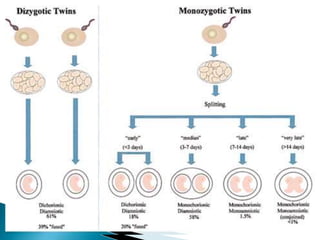
1. Binovular twins: (fraternal,dizygotic )results from
fertilization of two ova
 most likely ruptures from two distinct graffian follicles
usually of the same or one from each ovary by two
sperms during a single ovarian cycle
 Their subsequent implantation and development differ
little from those of a single fertilized ovum
 The babies bear only fraternal resemblance to each other
UNIOVULAR TWINS (identical ,monozygotic )
 They develop from the fusion of one oocyte and
one spermatozoon which after fertilization splits
into two
 These twins will be of the same sex and have the
same genes ,blood group and physical features
• Upto 3 days - diamniotic-dichorionic
• Between 4th & 7th day - diamniotic
monochorionic - most common type
• Between 8th & 12th day- monoamniotic-
monochorionic
• After 13th day - conjoined / Siamese twins.
CONJOINED TWINS
Ventral:
1) Omphalopagus(abdomen
2) Thoracopagus
3) Cephalopagus(head n chest
4) Caudal/ ischiopagus(pelvis
Lateral:
1) Parapagus(trunk)
Dorsal:
1)Craniopagus,(head)
2)Pyopagus(base of spine)
Superfecundation
Fertilization of two different ova released in the
same cycle
Superfetation
Fertilization of two ova released in different
cycles
Monozygotic twin Dizygotic twins
 2 ova + 2 sperm
 Same or opposite sex
 Fraternal resemblance
 Double or s/t fused
 Different genetic
features
 DNA microprobe -
different
 1 ova + 1 sperm
 Same sex
 Identical features
 Single or double
placenta
 Same genetic features
 DNA microprobe -
same
• HISTORY:
I. History of ovulation inducing drugs specially
gonadotropins
II. Family history of twinning (maternal side).
• SYMPTOMS:
i. Hyperemesis gravid rum
ii. Cardio-respiratory embarrassment - palpitation
or shortness of breath
iii. Tendency of swelling of the legs,
iv. Varicose veins
v. Hemorrhoids
vi. Excessive abdominal enlargement
vii. Excessive fetal movements
GENERAL EXAMINATION:
I. Prevalence of anaemia is more than in
singleton pregnancy
II. Unusual weight gain, not explained by pre-
eclampsia or obesity
III. Evidence of preeclampsia(25%)is a common
association.
ABDOMINALEXAMINATION:
Inspection:
• The elongated shape of a normal pregnant
uterus is changed to a more "barrel shape” and
the abdomen is unduly enlarged.
• Palpation:
 Fundal height more than the period of
amenorrhoea girth more than normal
 Palpation of too many fetal parts
 Palpation of two fetal heads
 Palpation of three fetal poles
• Auscultation:
Two distinct fetal heart sounds with
Zone of silence
10 beat difference
 Hydramnios
 Macrosomia
 Fibroid with pregnancy
 Ovarian tumor with pregnancy
 Adenexal mass with pregnancy
 Ascites with pregnancy
 Molar pregnancy
 Sonography: In multi fetal pregnancy it is done to
obtain the following information:
i. Suspecting twins – 2 sacs with fetal poles and cardiac
activity
ii. Confirmation of diagnosis
iii. Viability of fetuses, vanishing twin
iv. Chorionicity – 6 to 9 wks ( single or double placenta,
twin peak sign in d /d gestation or Tsign in m/d )
v. Pregnancy dating, Fetal anomalies
vi. Fetal growth monitoring (at every 3-4 weeks interval)
for IUGR
i. Presentation and lie of the fetuses
ii. Twin transfusion (Doppler studies)
iii. Placental localization
iv. Amniotic fluid volume
 Radiography
 Biochemical tests: raised but not diagnostic
Maternal serum chorionic
gonadotrophin,
Alpha fetoprotein
Unconjugated oestriol
 Maternal
Pre
eclampsia
During
Pregnancy
APH
mechanical
distress
pre term
labor
Hydraminos
Nausea &
vomiting
malpresentation
Anemia
During
labor
Bleeding
PPH Cord
prolapse
Early rupture
of
membranes
Increased
operative
interference
During
puerperium
Infection
Failing
lactation Sub-
involution
anemia
 Fetal
Miscarriage
rate is
increased
Fetal
anomalies
Discordant
twin
growth
Premature
StillbirthAsphyxia
Intrauterine
death
Antenatal
 Diet
 Increased rest
 Supplement therapy
 Interval of antenatal visit
 Fetal surveillance
Labor
Vaginal is allowed when both the twins are /or at
least the first twin is vertex presentation
1st stage
• A skilled obstetrician should be present
• Neonatologist (two)
• Presence of ultrasound in the labor room
• Patient should be in bed
• Use of analgesic drugs
• Careful fetal monitoring
• Internal examination should be done
• i/v line with ringer solution
Multiple Pregnancy

Multiple Pregnancy

  • 1.
    MS AGNES MAHIMADAVID M.Sc. Nursing
  • 2.
     DEFINITION When morethan one fetus simultaneously develop in the uterus Twin = 2 fetus Triplets =3 fetus Quadruplets =4 fetus Quintuplets = 5 fetus Sextuplets =6 fetus Septuplets =7 fetus
  • 3.
    Hellin’s Law: Twins: 1:89 Triplets:1:892 Quadruplets: 1:893 Quintuplets: 1:894 Conjoined twins: 1 : 60,000 Worldwide incidence of monozygotic - 1 in 250 Incidence of dizygotic varies & increasing
  • 4.
    • Race: mostcommon in Negroes • Age: Increased maternal age • Parity: more common in multipara • Heredity - family history of multifetal gestation • Nutritional status – well nourished women • ART - ovulation induction with clomiphene citrate, gonadotropins and IVF • Conception after stopping OCP
  • 5.
    TWINS Simultaneous development oftwo fetuses is the commonest variety of multiple pregnancy VARIETIES 1. Binovular twins :it is the commonest variety of multiple pregnancy (two third) and results from the fertilization of two ova 2. Uniovular twins : (one third ) results from the fertilization of the single ovum
  • 6.
     GENESIS OFTWINS 1. Binovular twins: (fraternal,dizygotic )results from fertilization of two ova  most likely ruptures from two distinct graffian follicles usually of the same or one from each ovary by two sperms during a single ovarian cycle  Their subsequent implantation and development differ little from those of a single fertilized ovum  The babies bear only fraternal resemblance to each other
  • 8.
    UNIOVULAR TWINS (identical,monozygotic )  They develop from the fusion of one oocyte and one spermatozoon which after fertilization splits into two  These twins will be of the same sex and have the same genes ,blood group and physical features • Upto 3 days - diamniotic-dichorionic • Between 4th & 7th day - diamniotic monochorionic - most common type • Between 8th & 12th day- monoamniotic- monochorionic • After 13th day - conjoined / Siamese twins.
  • 11.
    CONJOINED TWINS Ventral: 1) Omphalopagus(abdomen 2)Thoracopagus 3) Cephalopagus(head n chest 4) Caudal/ ischiopagus(pelvis Lateral: 1) Parapagus(trunk) Dorsal: 1)Craniopagus,(head) 2)Pyopagus(base of spine)
  • 12.
    Superfecundation Fertilization of twodifferent ova released in the same cycle Superfetation Fertilization of two ova released in different cycles
  • 13.
    Monozygotic twin Dizygotictwins  2 ova + 2 sperm  Same or opposite sex  Fraternal resemblance  Double or s/t fused  Different genetic features  DNA microprobe - different  1 ova + 1 sperm  Same sex  Identical features  Single or double placenta  Same genetic features  DNA microprobe - same
  • 14.
    • HISTORY: I. Historyof ovulation inducing drugs specially gonadotropins II. Family history of twinning (maternal side). • SYMPTOMS: i. Hyperemesis gravid rum ii. Cardio-respiratory embarrassment - palpitation or shortness of breath iii. Tendency of swelling of the legs, iv. Varicose veins v. Hemorrhoids vi. Excessive abdominal enlargement vii. Excessive fetal movements
  • 15.
    GENERAL EXAMINATION: I. Prevalenceof anaemia is more than in singleton pregnancy II. Unusual weight gain, not explained by pre- eclampsia or obesity III. Evidence of preeclampsia(25%)is a common association. ABDOMINALEXAMINATION: Inspection: • The elongated shape of a normal pregnant uterus is changed to a more "barrel shape” and the abdomen is unduly enlarged.
  • 16.
    • Palpation:  Fundalheight more than the period of amenorrhoea girth more than normal  Palpation of too many fetal parts  Palpation of two fetal heads  Palpation of three fetal poles • Auscultation: Two distinct fetal heart sounds with Zone of silence 10 beat difference
  • 17.
     Hydramnios  Macrosomia Fibroid with pregnancy  Ovarian tumor with pregnancy  Adenexal mass with pregnancy  Ascites with pregnancy  Molar pregnancy
  • 18.
     Sonography: Inmulti fetal pregnancy it is done to obtain the following information: i. Suspecting twins – 2 sacs with fetal poles and cardiac activity ii. Confirmation of diagnosis iii. Viability of fetuses, vanishing twin iv. Chorionicity – 6 to 9 wks ( single or double placenta, twin peak sign in d /d gestation or Tsign in m/d ) v. Pregnancy dating, Fetal anomalies vi. Fetal growth monitoring (at every 3-4 weeks interval) for IUGR
  • 19.
    i. Presentation andlie of the fetuses ii. Twin transfusion (Doppler studies) iii. Placental localization iv. Amniotic fluid volume  Radiography  Biochemical tests: raised but not diagnostic Maternal serum chorionic gonadotrophin, Alpha fetoprotein Unconjugated oestriol
  • 20.
  • 21.
  • 22.
  • 23.
  • 24.
    Antenatal  Diet  Increasedrest  Supplement therapy  Interval of antenatal visit  Fetal surveillance
  • 25.
    Labor Vaginal is allowedwhen both the twins are /or at least the first twin is vertex presentation 1st stage • A skilled obstetrician should be present • Neonatologist (two) • Presence of ultrasound in the labor room • Patient should be in bed • Use of analgesic drugs • Careful fetal monitoring • Internal examination should be done • i/v line with ringer solution