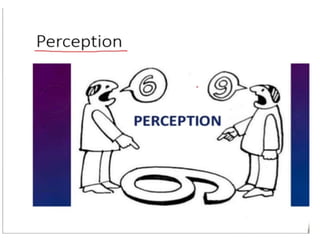
• Perception is a cognitive process that allows
people to use their five senses to interact with
the world around them and gain a better
understanding of their environment. Visual
perception is the form of perception that uses
a person's sight to see and absorb something
new, and then organizes what they see within
their brain to help them understand it.
•What is Sensation and Perception?
•The concept of sensation and perception explains how humans interact with the outside world.
But what is sensation and perception? Sensation and perception are two separate processes, but
they are two sides of the same coin. In sensation and perception, sensory stimuli are taken from
the environment and sent to the brain.
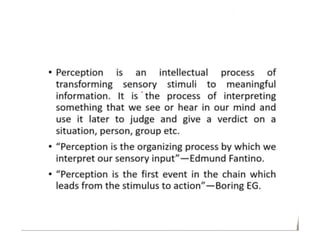
 Sensation is input about the physical world obtained by our sensory receptors.
 Perception is the process by which the brain selects, organizes, and interprets these
sensations.
•How is Sensation and Perception Related?
•Sensation is the first step to creating perceptions about the outside world. Through sensation,
humans can turn sensory inputs from the environment into signals understood by the brain. Once
the signals are in the brain, then perception can occur.
•Sensation
•What is sensation? Sensation is the introduction to sensation and perception. Humans use
sensory organs (eyes, nose, skin, ears, and tongue) to see, smell, feel, listen, and taste.
 Sensory organs detect external sensory stimuli, such as light, sound, and temperature.
 In every sensory organ is a sensory receptor that receives information from the stimuli.
• Sensation occurs when sensory receptors detect physical sensory stimuli from the
environment and encode the input into the nervous system. Within the main sensory organs
are smaller, specialized
Werror in
Perceptio
pn
Perception in error(distortion perception)
Errors in Perception
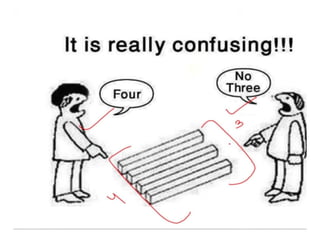
• Perception Error is when we get things wrong about
what we see or understand.
• Examples include guessing too quickly, thinking
everyone in a group is the same, or only noticing what
we like.
• Perceptual Errors can lead to confusion and poor
decisions.
• To avoid these mistakes, we should keep an open
mind, listen to others, and get all the facts before
deciding.
Types of Perceptual Errors
• There are various types of perceptual errors. For example
• 1. Bias Perception:
• Bias Perception occurs when individuals interpret information based on
their existing beliefs or attitudes, leading to distorted judgments. Biases
can be influenced by cultural background, personal experiences, and
social factors, shaping individuals’ perceptions of reality. Recognizing
bias perception is vital for critical thinking, enabling objective
assessment and consideration of alternative viewpoints. Strategies like
seeking diverse sources of information, questioning assumptions, and
acknowledging personal biases can help reduce the impact of bias
perception and encourage balanced interpretations.
• For example, consider meeting someone with a tattoo on their arm. One
might naturally link such body art to traits like rebelliousness or a
tendency for trouble. However, this individual may possess qualities that
contradict such assumptions, such as kindness and responsibility.
Therefore, the biased perception driven by their appearance leads to
baseless assumptions about their character, highlighting the constraints
of depending solely on outward signs to form judgments about others.
• 2. Role of Culture:
• The concept of culture as a factor in perception errors
highlights how our cultural backgrounds and beliefs shape
how we see and understand the world. Sometimes, our
upbringing and cultural values can cause us to misinterpret or
misunderstand information. Different cultural norms regarding
communication or social behavior can affect how one interpret
interactions with others. What seems normal or acceptable in
one culture might be seen differently in another.
• For example, suppose there is a meeting at 2 p.m. Some
people who come from a culture where they value punctuality
will arrive on time or even before 2 p.m. But, people who have
a relaxed attitude towards punctuality will never arrive on
time. So, in this example, we can see that culture influences
perceptions of time and punctuality
• 3. Stereotypes:
• Judging or perceiving on the basis of the characteristics of the group,
some one belongs
• Person is not perceived as individual
• Stereotypes represent a form of error in perception, where individuals
rely on oversimplified or generalized beliefs about a particular group of
people, often based on characteristics such as race, gender, or nationality.
These preconceived notions can lead to biased judgments and
discriminatory behavior toward individuals who are perceived to fit into
these categories.
• For example, if someone believes that teenagers are lazy and
unmotivated. They might assume that all teenagers are lazy and do not do
any work with full efficiency. This stereotype overlooks the fact that many
teenagers are dedicated, ambitious, and actively pursue their goals. So, if
someone applies this stereotype to a teenager they meet, they may
unfairly judge him without considering his individual characteristics or
accomplishments.
• Politician are corrupt, Police take bribes etc
• 4. Halo Effect:
• Perceiving total quality on the basis of perceiving few or one qualitt
• The halo effect occurs when we form judgments about individuals based on a
single prominent characteristic or behavior, often overlooking other important
factors. This tendency to focus narrowly can lead to significant consequences,
as it may result in inaccurate assessments of individuals’ overall qualities or
abilities. Consequently, our perceptions may be biased, leading to
misinterpretations and flawed conclusions about others. Recognizing the halo
effect as an error in perception is important because it can lead to biased
judgments and inaccurate assessments. By being aware of this bias, individuals
can strive to evaluate people and things based on their specific qualities rather
than being unduly influenced by their overall impression.
• For example, during a job interview, the interviewer notices that the candidate
has an impressive educational background from a prestigious university. Due to
this single positive attribute, the interviewer may unconsciously assume that
the candidate possesses other desirable qualities, such as intelligence,
diligence, and competence in the relevant field. As a result, the interviewer
might overlook potential weaknesses or inconsistencies in the candidate’s
experience or skills, leading to a biased evaluation and potentially influencing
the hiring decision.
• 5. First Impression:
• Judging the people on the basis of first few second encounter
• In this duration forms positive or negative opinion for others
• In the context of perception errors, an impression represents the initial
judgment or viewpoint individuals develop about something or someone
following their first encounter or interaction. It’s the initial gut feeling or
understanding one forms when meeting someone or encountering
something new. Yet, solely relying on these initial impressions can
occasionally result in misconceptions. This is because the first impressions
are often shaped by external factors like appearance, behavior, or the
circumstances of the interaction, which may not always provide a complete
or accurate picture of the person or situation.
• For example, when encountering someone new at a party, if they appear
reserved and quiet, it’s easy to assume they’re dull. However, upon further
interaction, it becomes evident that they may possess a vibrant and
engaging personality once they become more comfortable. The initial
impression of them being uninteresting stemmed from a perception error, as
they were not initially given the opportunity to showcase their true
character.
• 6. Status Effect:
• Perception is also influenced by status. The status effect is a
perceptional error where individuals attribute certain qualities
or traits to others based on their perceived social or
professional status. In simpler terms, it means that people
might assume someone has particular characteristics or abilities
simply because of their position or status in society or within an
organization. Recognizing the status effect as a perceptional
error is important because it reminds us to evaluate people
based on their individual merits and qualities rather than solely
on their position or status.
• For example, someone might automatically assume that a
person in a high-ranking position is more competent or
knowledgeable, regardless of their actual abilities. This can lead
to biased judgments and unfair treatment.
• 7. Self Serving Bias:
• The self-serving bias is a perceptional error where
individuals tend to attribute positive outcomes to their
own abilities or actions, while attributing negative
outcomes to external factors beyond their control. In
simpler terms, it means that people often take credit for
their successes but blame others or circumstances for
their failures.
• For example, when people play video games with friends,
if they win, they say that they’re good at the game. But if
they lose, they might say it’s because of luck or the game
being unfair. This helps them look good by focusing on
their strengths when they win and blaming outside things
when they lose.
• 8. Selective Perception:
• Selective Perception is the tendency of people to selectively
interpret what they see on the basis of their background,
interest, attitude and experience. In simple terms, selective
perception includes misinterpretation of sensory information or
deviation from objective reality. People having selective
perception will filter the information they receive, through their
personal lenses and will only focus on aspects that align with
their values, preferences, or beliefs, and will disregard the rest of
the information.
• For example, when shopping for a new phone and having a
specific brand in mind, people tend to focus only on the features
that the preferred brand offers. They might overlook the features
of other brands. This shows that perception can be influenced by
being choosy about a particular thing.
• 9. Jumping to Conclusions:
• Jumping to Conclusions is a perception error where
individuals make hasty judgments or decisions based on
limited or incomplete information, often without
considering alternative explanations or evidence. In
simpler terms, it means making assumptions without
taking the time to gather all the relevant facts. Recognising
jumping to conclusions as a perception error is important
because it can lead to misunderstandings, conflicts, and
unfair treatment of others.
• For example, when someone doesn’t respond to a
message, it’s common to assume they’re angry, but there
could be other reasons, such as being occupied with
something else or simply not having seen the message yet.
• 10. Projection:
• Projection is a perception error where individuals attribute their own
thoughts, feelings, or motives to others, assuming that others share the
same beliefs or intentions. In simpler terms, it means projecting our own
emotions or thoughts onto someone else, without considering their
perspective. Recognising projection as a perception error is important
because it can lead to misunderstandings and miscommunication.
• For example, imagine someone often feels anxious about being judged
by others because of how they look. As a result, they start thinking that
everyone else is always judging them too, even if others aren’t really
paying much attention to their appearance. Essentially, they’re assuming
that others feel the same way about their looks as they do, which might
not be true.
How to Overcome Errors in Perception?
• 1. Question your Assumptions: Questioning one’s
assumptions acts as a reality check for beliefs,
ensuring they rely on facts rather than personal
beliefs. This practice aids in avoiding misguided
decisions and biases such as confirmation bias or
stereotyping. Approaching situations with an open
mind allows for gathering accurate information and
making informed decisions, promoting objectivity,
fostering creativity, and enhancing understanding of
the world. Awareness of biases and assumptions is
vital for improving perception, as self-awareness
facilitates better understanding of others
• 2. Have Empathy: Empathy is a potent method for
rectifying errors in perception. It involves grasping
others’ thoughts and feelings by imagining
ourselves in their position. Through empathy, one
gains a deeper understanding of individuals,
transcending personal biases. This aids in
enhanced communication, fostering deeper
relationships, and establishing a nurturing and
inclusive atmosphere. Embracing empathy enables
the reduction of perceptual errors, facilitating
improved connections with others across various
aspects of life.
• 3. Take Positive Approach: Utilizing a positive approach is effective
in correcting perceptual errors. By embracing optimism and focusing
on positives, individuals overcome biases and misunderstandings.
Being open-minded and considering diverse perspectives helps
mitigate confirmation bias. Overall, maintaining a positive mindset
and seeking positives in people and situations helps address errors
in perception, fostering accurate judgments and deeper connections.
• 4. Be Collaborative: Collaboration offers an effective method for
correcting perceptual errors by engaging with others, appreciating
their perspectives, and working together for a shared understanding.
It encourages open communication and idea exchange, allowing
diverse viewpoints to surface and challenging preconceptions.
Additionally, collaboration promotes active listening and empathy,
enhancing understanding and reducing misinterpretation. Overall,
embracing collaboration harnesses collective intelligence, challenges
biases, and leads to informed decisions, fostering inclusivity and
cooperation within the organization.
• 5. Have Diverse Perspective: Examining situations from various
perspectives is crucial for rectifying errors in the understanding.
This involves actively seeking to comprehend different
viewpoints and experiences to gain a more comprehensive
understanding of a situation or issue. One approach is to engage
in discussions with individuals from diverse backgrounds who
hold differing opinions, such as friends, family members, or
colleagues. They can provide insights based on their unique
experiences. Additionally, diversifying our sources of information
is beneficial. This may involve reading materials authored by
various individuals or consuming news from a range of sources.
In today’s interconnected world, comprehending diverse
perspectives is essential for navigating the complexities of our
diverse society and ensuring equitable treatment for all
individuals.
• 6. Admit when you are Wrong: Acknowledging mistakes is crucial for
correcting errors in perception. It involves apologizing when judgments
or understandings are incorrect and being prepared to rectify them.
Essentially, it’s about humility and recognising mistakes. Admitting
mistakes facilitates learning and development. Officially, this readiness to
acknowledge mistakes fosters a culture of accountability and continuous
improvement. It promotes reflection and receptivity to feedback, aiding
in better understanding of the world. Ultimately, accepting fallibility and
embracing learning from errors allows for rectifying perception errors
and gaining wisdom.
• 7. Avoid Miscommunication: Misunderstandings often occur because
individuals have different perceptions, causing confusion and conflicts.
To address this, clarity and understanding must be prioritized. Firstly,
attentive listening is crucial, focusing on the speaker’s words and
emotions. Secondly, clear and simple communication is beneficial, using
straightforward language, providing examples as necessary, and avoiding
technical jargons. Overall, to prevent miscommunication, effective
listening and clear communication are essential, facilitating better
relationships and conflict avoidance.

Perception and error inn perception.pptx

  • 5.
    • Perception isa cognitive process that allows people to use their five senses to interact with the world around them and gain a better understanding of their environment. Visual perception is the form of perception that uses a person's sight to see and absorb something new, and then organizes what they see within their brain to help them understand it.
  • 6.
    •What is Sensationand Perception? •The concept of sensation and perception explains how humans interact with the outside world. But what is sensation and perception? Sensation and perception are two separate processes, but they are two sides of the same coin. In sensation and perception, sensory stimuli are taken from the environment and sent to the brain.  Sensation is input about the physical world obtained by our sensory receptors.  Perception is the process by which the brain selects, organizes, and interprets these sensations. •How is Sensation and Perception Related? •Sensation is the first step to creating perceptions about the outside world. Through sensation, humans can turn sensory inputs from the environment into signals understood by the brain. Once the signals are in the brain, then perception can occur. •Sensation •What is sensation? Sensation is the introduction to sensation and perception. Humans use sensory organs (eyes, nose, skin, ears, and tongue) to see, smell, feel, listen, and taste.  Sensory organs detect external sensory stimuli, such as light, sound, and temperature.  In every sensory organ is a sensory receptor that receives information from the stimuli. • Sensation occurs when sensory receptors detect physical sensory stimuli from the environment and encode the input into the nervous system. Within the main sensory organs are smaller, specialized
  • 11.
  • 12.
  • 13.
    Errors in Perception •Perception Error is when we get things wrong about what we see or understand. • Examples include guessing too quickly, thinking everyone in a group is the same, or only noticing what we like. • Perceptual Errors can lead to confusion and poor decisions. • To avoid these mistakes, we should keep an open mind, listen to others, and get all the facts before deciding.
  • 14.
    Types of PerceptualErrors • There are various types of perceptual errors. For example • 1. Bias Perception: • Bias Perception occurs when individuals interpret information based on their existing beliefs or attitudes, leading to distorted judgments. Biases can be influenced by cultural background, personal experiences, and social factors, shaping individuals’ perceptions of reality. Recognizing bias perception is vital for critical thinking, enabling objective assessment and consideration of alternative viewpoints. Strategies like seeking diverse sources of information, questioning assumptions, and acknowledging personal biases can help reduce the impact of bias perception and encourage balanced interpretations. • For example, consider meeting someone with a tattoo on their arm. One might naturally link such body art to traits like rebelliousness or a tendency for trouble. However, this individual may possess qualities that contradict such assumptions, such as kindness and responsibility. Therefore, the biased perception driven by their appearance leads to baseless assumptions about their character, highlighting the constraints of depending solely on outward signs to form judgments about others.
  • 15.
    • 2. Roleof Culture: • The concept of culture as a factor in perception errors highlights how our cultural backgrounds and beliefs shape how we see and understand the world. Sometimes, our upbringing and cultural values can cause us to misinterpret or misunderstand information. Different cultural norms regarding communication or social behavior can affect how one interpret interactions with others. What seems normal or acceptable in one culture might be seen differently in another. • For example, suppose there is a meeting at 2 p.m. Some people who come from a culture where they value punctuality will arrive on time or even before 2 p.m. But, people who have a relaxed attitude towards punctuality will never arrive on time. So, in this example, we can see that culture influences perceptions of time and punctuality
  • 16.
    • 3. Stereotypes: •Judging or perceiving on the basis of the characteristics of the group, some one belongs • Person is not perceived as individual • Stereotypes represent a form of error in perception, where individuals rely on oversimplified or generalized beliefs about a particular group of people, often based on characteristics such as race, gender, or nationality. These preconceived notions can lead to biased judgments and discriminatory behavior toward individuals who are perceived to fit into these categories. • For example, if someone believes that teenagers are lazy and unmotivated. They might assume that all teenagers are lazy and do not do any work with full efficiency. This stereotype overlooks the fact that many teenagers are dedicated, ambitious, and actively pursue their goals. So, if someone applies this stereotype to a teenager they meet, they may unfairly judge him without considering his individual characteristics or accomplishments. • Politician are corrupt, Police take bribes etc
  • 17.
    • 4. HaloEffect: • Perceiving total quality on the basis of perceiving few or one qualitt • The halo effect occurs when we form judgments about individuals based on a single prominent characteristic or behavior, often overlooking other important factors. This tendency to focus narrowly can lead to significant consequences, as it may result in inaccurate assessments of individuals’ overall qualities or abilities. Consequently, our perceptions may be biased, leading to misinterpretations and flawed conclusions about others. Recognizing the halo effect as an error in perception is important because it can lead to biased judgments and inaccurate assessments. By being aware of this bias, individuals can strive to evaluate people and things based on their specific qualities rather than being unduly influenced by their overall impression. • For example, during a job interview, the interviewer notices that the candidate has an impressive educational background from a prestigious university. Due to this single positive attribute, the interviewer may unconsciously assume that the candidate possesses other desirable qualities, such as intelligence, diligence, and competence in the relevant field. As a result, the interviewer might overlook potential weaknesses or inconsistencies in the candidate’s experience or skills, leading to a biased evaluation and potentially influencing the hiring decision.
  • 18.
    • 5. FirstImpression: • Judging the people on the basis of first few second encounter • In this duration forms positive or negative opinion for others • In the context of perception errors, an impression represents the initial judgment or viewpoint individuals develop about something or someone following their first encounter or interaction. It’s the initial gut feeling or understanding one forms when meeting someone or encountering something new. Yet, solely relying on these initial impressions can occasionally result in misconceptions. This is because the first impressions are often shaped by external factors like appearance, behavior, or the circumstances of the interaction, which may not always provide a complete or accurate picture of the person or situation. • For example, when encountering someone new at a party, if they appear reserved and quiet, it’s easy to assume they’re dull. However, upon further interaction, it becomes evident that they may possess a vibrant and engaging personality once they become more comfortable. The initial impression of them being uninteresting stemmed from a perception error, as they were not initially given the opportunity to showcase their true character.
  • 19.
    • 6. StatusEffect: • Perception is also influenced by status. The status effect is a perceptional error where individuals attribute certain qualities or traits to others based on their perceived social or professional status. In simpler terms, it means that people might assume someone has particular characteristics or abilities simply because of their position or status in society or within an organization. Recognizing the status effect as a perceptional error is important because it reminds us to evaluate people based on their individual merits and qualities rather than solely on their position or status. • For example, someone might automatically assume that a person in a high-ranking position is more competent or knowledgeable, regardless of their actual abilities. This can lead to biased judgments and unfair treatment.
  • 20.
    • 7. SelfServing Bias: • The self-serving bias is a perceptional error where individuals tend to attribute positive outcomes to their own abilities or actions, while attributing negative outcomes to external factors beyond their control. In simpler terms, it means that people often take credit for their successes but blame others or circumstances for their failures. • For example, when people play video games with friends, if they win, they say that they’re good at the game. But if they lose, they might say it’s because of luck or the game being unfair. This helps them look good by focusing on their strengths when they win and blaming outside things when they lose.
  • 21.
    • 8. SelectivePerception: • Selective Perception is the tendency of people to selectively interpret what they see on the basis of their background, interest, attitude and experience. In simple terms, selective perception includes misinterpretation of sensory information or deviation from objective reality. People having selective perception will filter the information they receive, through their personal lenses and will only focus on aspects that align with their values, preferences, or beliefs, and will disregard the rest of the information. • For example, when shopping for a new phone and having a specific brand in mind, people tend to focus only on the features that the preferred brand offers. They might overlook the features of other brands. This shows that perception can be influenced by being choosy about a particular thing.
  • 22.
    • 9. Jumpingto Conclusions: • Jumping to Conclusions is a perception error where individuals make hasty judgments or decisions based on limited or incomplete information, often without considering alternative explanations or evidence. In simpler terms, it means making assumptions without taking the time to gather all the relevant facts. Recognising jumping to conclusions as a perception error is important because it can lead to misunderstandings, conflicts, and unfair treatment of others. • For example, when someone doesn’t respond to a message, it’s common to assume they’re angry, but there could be other reasons, such as being occupied with something else or simply not having seen the message yet.
  • 23.
    • 10. Projection: •Projection is a perception error where individuals attribute their own thoughts, feelings, or motives to others, assuming that others share the same beliefs or intentions. In simpler terms, it means projecting our own emotions or thoughts onto someone else, without considering their perspective. Recognising projection as a perception error is important because it can lead to misunderstandings and miscommunication. • For example, imagine someone often feels anxious about being judged by others because of how they look. As a result, they start thinking that everyone else is always judging them too, even if others aren’t really paying much attention to their appearance. Essentially, they’re assuming that others feel the same way about their looks as they do, which might not be true.
  • 24.
    How to OvercomeErrors in Perception? • 1. Question your Assumptions: Questioning one’s assumptions acts as a reality check for beliefs, ensuring they rely on facts rather than personal beliefs. This practice aids in avoiding misguided decisions and biases such as confirmation bias or stereotyping. Approaching situations with an open mind allows for gathering accurate information and making informed decisions, promoting objectivity, fostering creativity, and enhancing understanding of the world. Awareness of biases and assumptions is vital for improving perception, as self-awareness facilitates better understanding of others
  • 25.
    • 2. HaveEmpathy: Empathy is a potent method for rectifying errors in perception. It involves grasping others’ thoughts and feelings by imagining ourselves in their position. Through empathy, one gains a deeper understanding of individuals, transcending personal biases. This aids in enhanced communication, fostering deeper relationships, and establishing a nurturing and inclusive atmosphere. Embracing empathy enables the reduction of perceptual errors, facilitating improved connections with others across various aspects of life.
  • 26.
    • 3. TakePositive Approach: Utilizing a positive approach is effective in correcting perceptual errors. By embracing optimism and focusing on positives, individuals overcome biases and misunderstandings. Being open-minded and considering diverse perspectives helps mitigate confirmation bias. Overall, maintaining a positive mindset and seeking positives in people and situations helps address errors in perception, fostering accurate judgments and deeper connections. • 4. Be Collaborative: Collaboration offers an effective method for correcting perceptual errors by engaging with others, appreciating their perspectives, and working together for a shared understanding. It encourages open communication and idea exchange, allowing diverse viewpoints to surface and challenging preconceptions. Additionally, collaboration promotes active listening and empathy, enhancing understanding and reducing misinterpretation. Overall, embracing collaboration harnesses collective intelligence, challenges biases, and leads to informed decisions, fostering inclusivity and cooperation within the organization.
  • 27.
    • 5. HaveDiverse Perspective: Examining situations from various perspectives is crucial for rectifying errors in the understanding. This involves actively seeking to comprehend different viewpoints and experiences to gain a more comprehensive understanding of a situation or issue. One approach is to engage in discussions with individuals from diverse backgrounds who hold differing opinions, such as friends, family members, or colleagues. They can provide insights based on their unique experiences. Additionally, diversifying our sources of information is beneficial. This may involve reading materials authored by various individuals or consuming news from a range of sources. In today’s interconnected world, comprehending diverse perspectives is essential for navigating the complexities of our diverse society and ensuring equitable treatment for all individuals.
  • 28.
    • 6. Admitwhen you are Wrong: Acknowledging mistakes is crucial for correcting errors in perception. It involves apologizing when judgments or understandings are incorrect and being prepared to rectify them. Essentially, it’s about humility and recognising mistakes. Admitting mistakes facilitates learning and development. Officially, this readiness to acknowledge mistakes fosters a culture of accountability and continuous improvement. It promotes reflection and receptivity to feedback, aiding in better understanding of the world. Ultimately, accepting fallibility and embracing learning from errors allows for rectifying perception errors and gaining wisdom. • 7. Avoid Miscommunication: Misunderstandings often occur because individuals have different perceptions, causing confusion and conflicts. To address this, clarity and understanding must be prioritized. Firstly, attentive listening is crucial, focusing on the speaker’s words and emotions. Secondly, clear and simple communication is beneficial, using straightforward language, providing examples as necessary, and avoiding technical jargons. Overall, to prevent miscommunication, effective listening and clear communication are essential, facilitating better relationships and conflict avoidance.