PROMOTING
PROMOTING
BREASTFEEDING
BREASTFEEDING
Caring for socioeconomically
deprived and vulnerable;
Breastfeeding is the
best gift a mother
best gift a mother
can give to her
can give to her
newborn
newborn
Introduction
Introduction
 In infancy, no gift is more precious than
In infancy, no gift is more precious than
breastfeeding.
breastfeeding.
 Infants are meant to breastfeed.
Infants are meant to breastfeed.
 Breastfeeding provides the best possible
Breastfeeding provides the best possible
start to life in all areas of development.
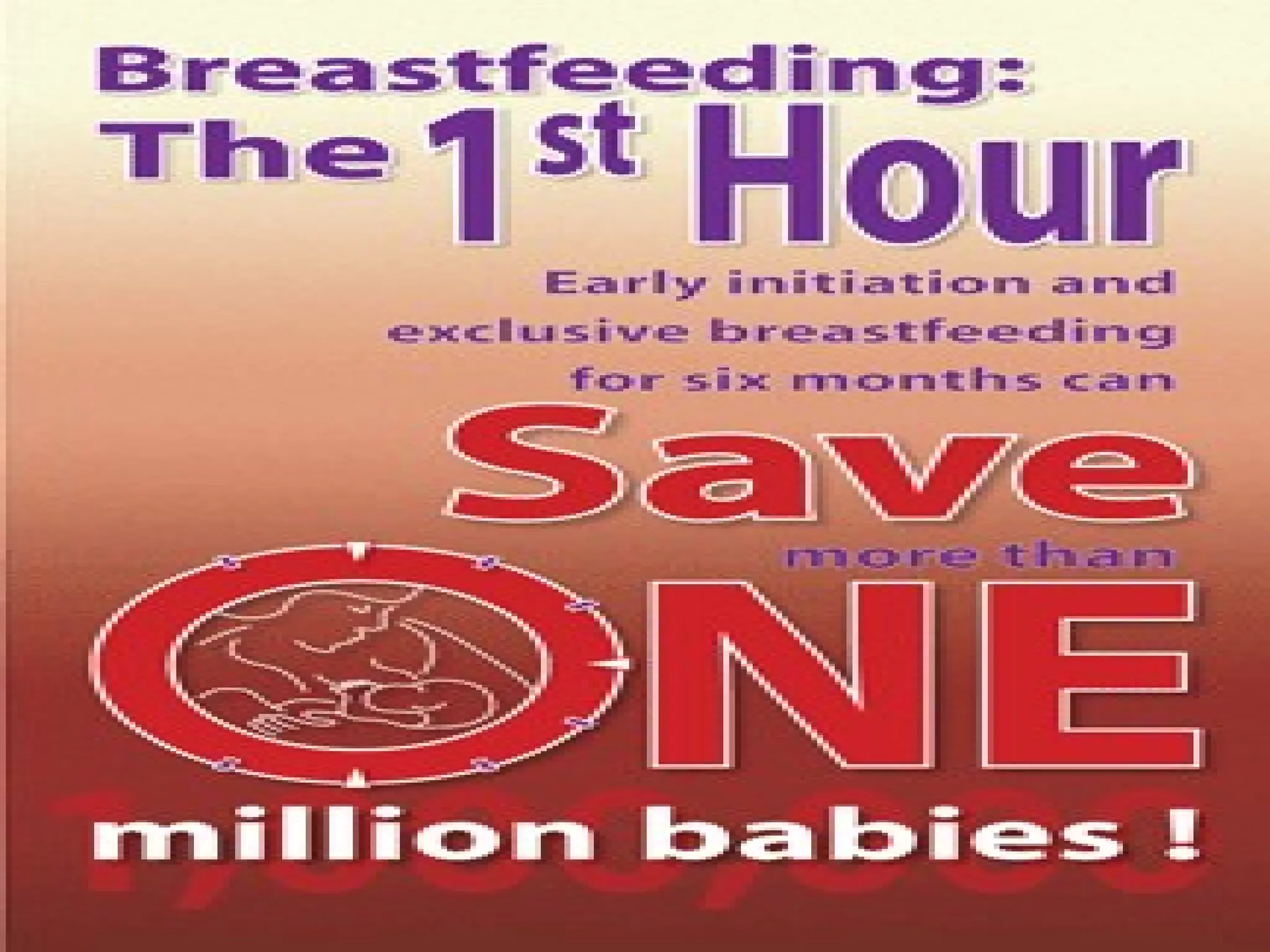
 Early initiation and exclusive breastfeeding
Early initiation and exclusive breastfeeding
for six months of life can save more than one
million babies.
million babies.
Breastfeeding
Breastfeeding
 Breastfeeding is the feeding of infant or
Breastfeeding is the feeding of infant or
young child with breast milk directly
from woman’s breasts, not from a baby
bottle/ other container.
 Babies have a suckling reflex that
Babies have a suckling reflex that
enables them to suck and swallow milk.
FACTS & FIGURES
FACTS & FIGURES
 Breast milk is the best source of nourishment for
Breast milk is the best source of nourishment for
human infants, preventing disease, promoting
health and reducing health care costs.
 Artificial feeding is associated with more
Artificial feeding is associated with more deaths
deaths
from
from diarrhoea/pneumonia
diarrhoea/pneumonia in infants.
in infants.
 A lack of exclusive breastfeeding during the first
A lack of exclusive breastfeeding during the first
six months of life contributes to over a million
avoidable child deaths each year.
FACTS & FIGURES – cont’d
 Unfortunately, “Breastfeeding practice”
Unfortunately, “Breastfeeding practice”
among mothers in Pakistan, is still
alarmingly low.
alarmingly low.
 Exclusive breastfeeding as well as the
Exclusive breastfeeding as well as the
duration for which a child is breastfed, is
lowest in Pakistan, compared for
neighbouring South Asian countries
including India, Bangladesh, Nepal and Sri
Lanka.
Lanka.
FACTS & FIGURES – cont’d
 Globally, less than 40% of infants under six
Globally, less than 40% of infants under six
months of age are exclusively breastfed
 In Pakistan, 37% of infants under six
In Pakistan, 37% of infants under six
months of age are exclusively breastfed
(
(Demographic & Health Survey of Pakistan, 2006-07).
Demographic & Health Survey of Pakistan, 2006-07).
 Highest bottle-feeding Rate
Highest bottle-feeding Rate:
: 32%
32%
FACTS & FIGURES – cont’d
 Exclusive Breastfeeding Rates in other
Exclusive Breastfeeding Rates in other
countries of the Region:
 Sri Lanka: 76%
Sri Lanka: 76%
 Nepal: 53%
Nepal: 53%
 India: 46%
India: 46%
 Bangladesh: 43%
Bangladesh: 43%
FACTS & FIGURES – cont’d
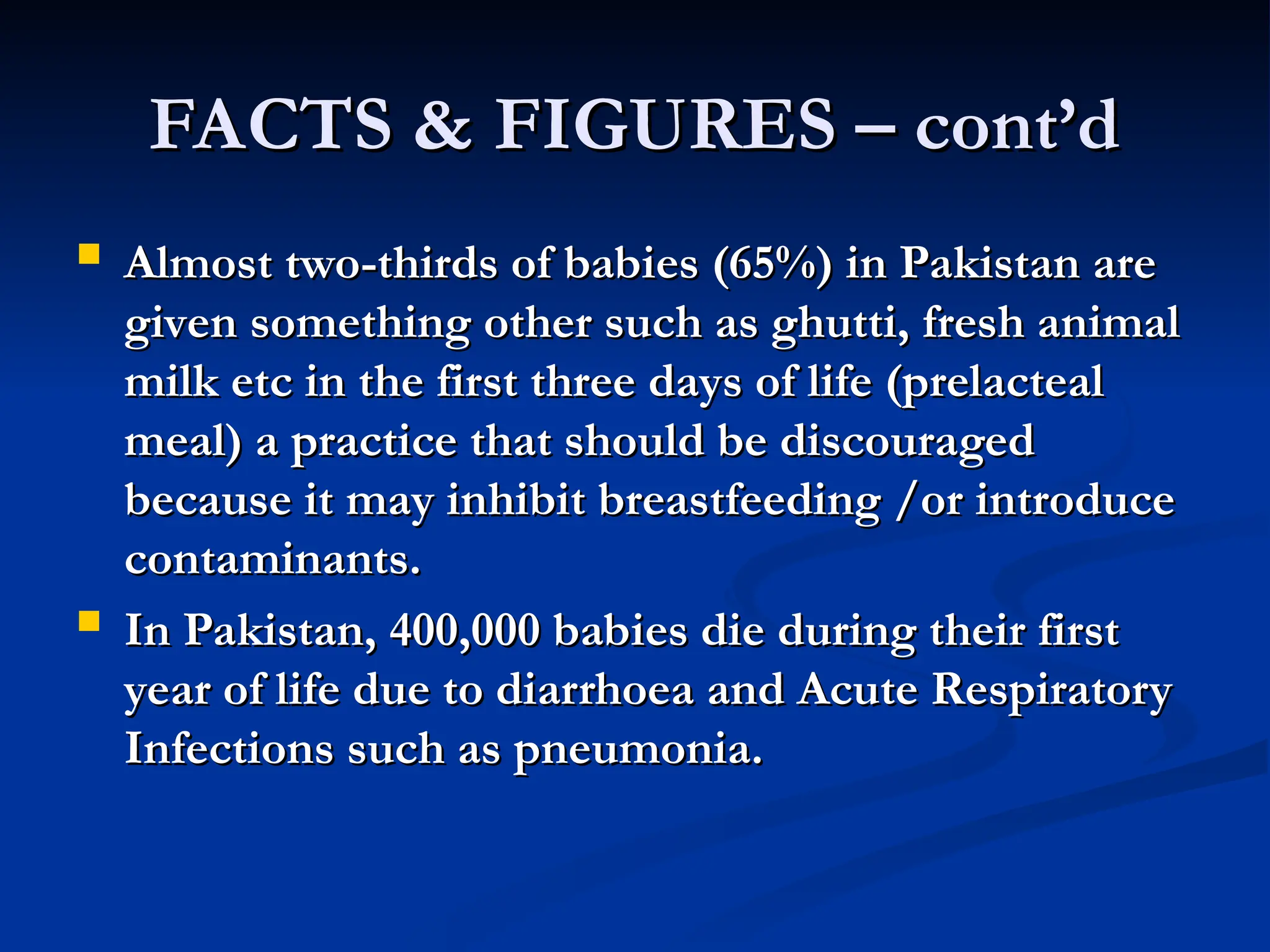
 Almost two-thirds of babies (65%) in Pakistan are
Almost two-thirds of babies (65%) in Pakistan are
given something other such as ghutti, fresh animal
milk etc in the first three days of life (prelacteal
meal) a practice that should be discouraged
because it may inhibit breastfeeding /or introduce
contaminants.
contaminants.
 In Pakistan, 400,000 babies die during their first
In Pakistan, 400,000 babies die during their first
year of life due to diarrhoea and Acute Respiratory
Infections such as pneumonia.
FACTS & FIGURES – cont’d
 Children who are not exclusively
Children who are not exclusively
breastfed 14 times higher risk of dying
as compared to those who are breastfed
 10% higher risk of getting diarrhoea
10% higher risk of getting diarrhoea
FACTS & FIGURES – cont’d
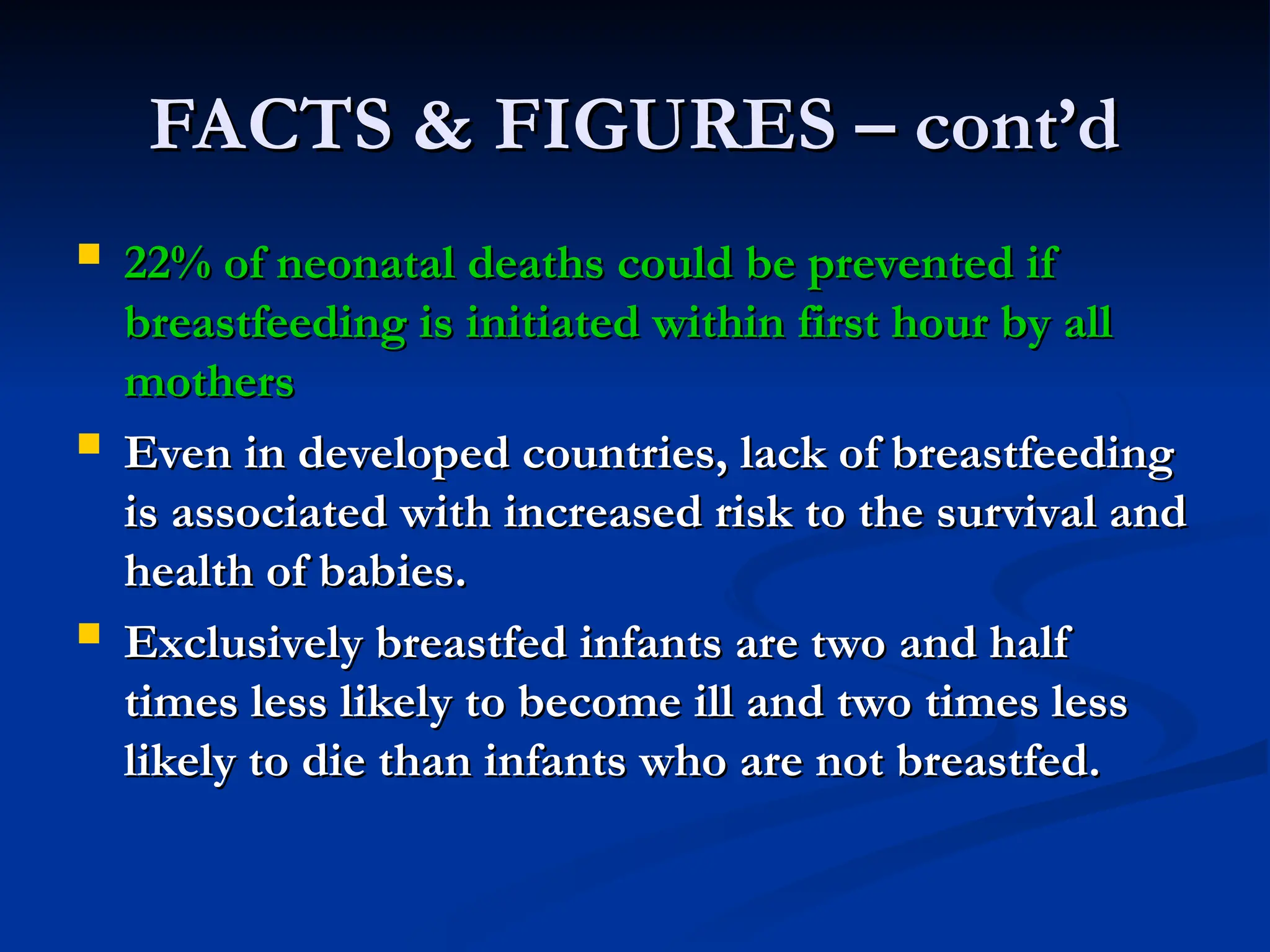
 22% of neonatal deaths could be prevented if
22% of neonatal deaths could be prevented if
breastfeeding is initiated within first hour by all
mothers
mothers
 Even in developed countries, lack of breastfeeding
Even in developed countries, lack of breastfeeding
is associated with increased risk to the survival and
health of babies.
health of babies.
 Exclusively breastfed infants are two and half
Exclusively breastfed infants are two and half
times less likely to become ill and two times less
likely to die than infants who are not breastfed.
FACTS & FIGURES – cont’d
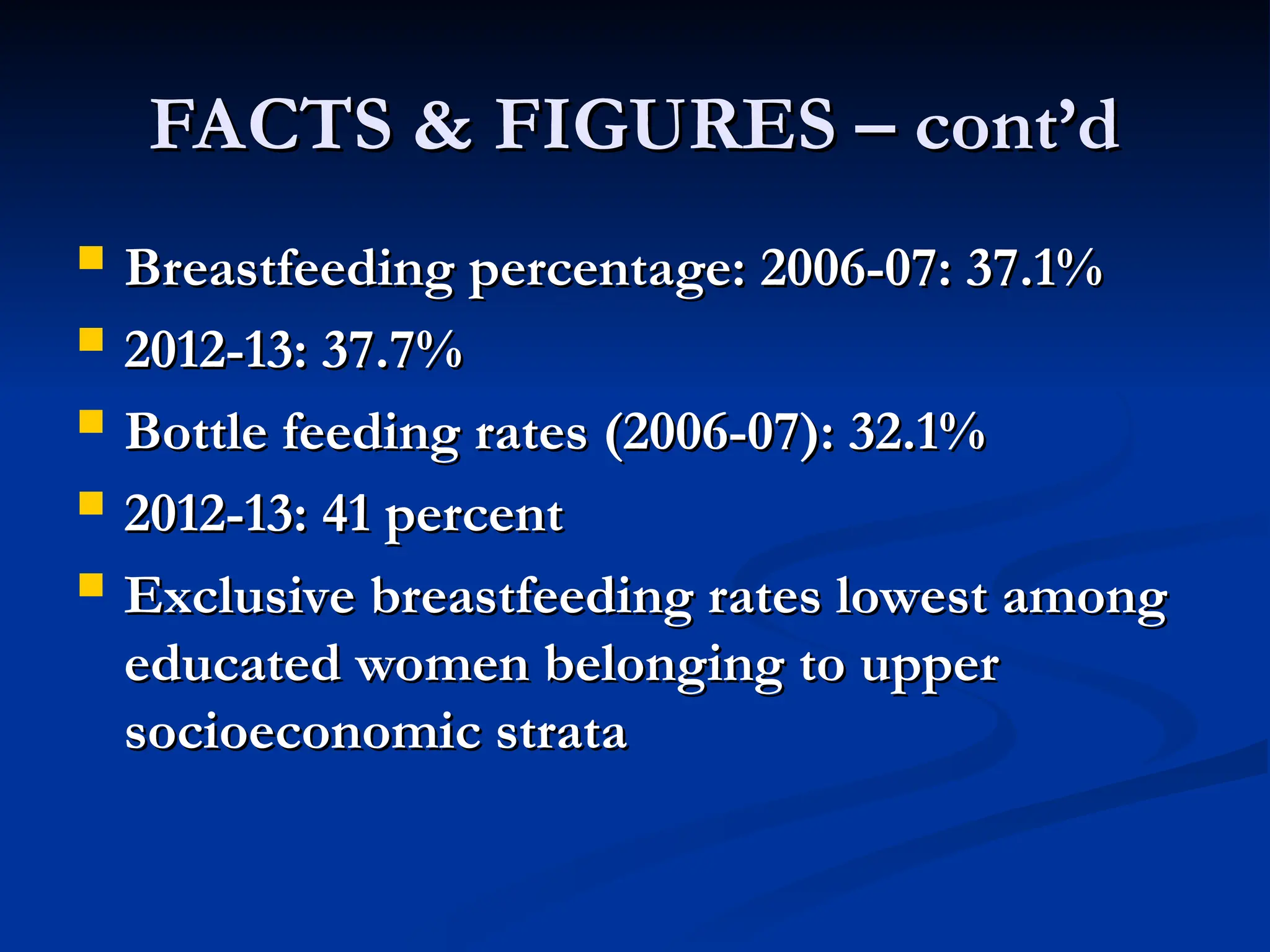
 Breastfeeding percentage: 2006-07: 37.1%
Breastfeeding percentage: 2006-07: 37.1%
 2012-13: 37.7%
2012-13: 37.7%
 Bottle feeding rates (2006-07): 32.1%
Bottle feeding rates (2006-07): 32.1%
 2012-13: 41 percent
2012-13: 41 percent
 Exclusive breastfeeding rates lowest among
Exclusive breastfeeding rates lowest among
educated women belonging to upper
socioeconomic strata
FACTS & FIGURES – cont’d
 Bottle feeding rates high among
Bottle feeding rates high among
working women, women belonging to
upper income class and those residing
among urban areas and those seeking
care from health professionals
 Pakistan has highest bottle feeding rates
Pakistan has highest bottle feeding rates
and lowest exclusive breastfeeding rates
in South Asia
in South Asia
Factors responsible for depriving
children from their right of breastfeeding
 Mother’s ignorance about its importance
Mother’s ignorance about its importance
 Newborns or mothers pathological factors
Newborns or mothers pathological factors
 Different taboos and myths
Different taboos and myths
 Lack of training by health workers for
Lack of training by health workers for
preparation of mother for breastfeeding after
delivery
delivery
 Awareness and effectiveness of law, its
Awareness and effectiveness of law, its
implementation and monitoring
Factors responsible for depriving
children from their right of breastfeeding
One of the reasons for
One of the reasons for
reduction in the rate of
breastfeeding is easy
availability of its supplements
Breastfeeding cannot be
Breastfeeding cannot be
promoted in the absence of
effective crackdown on the
unethical promotion of the
infant formula by the
industry.
industry.
ADVANTAGES OF MOTHER'S
MILK
MILK
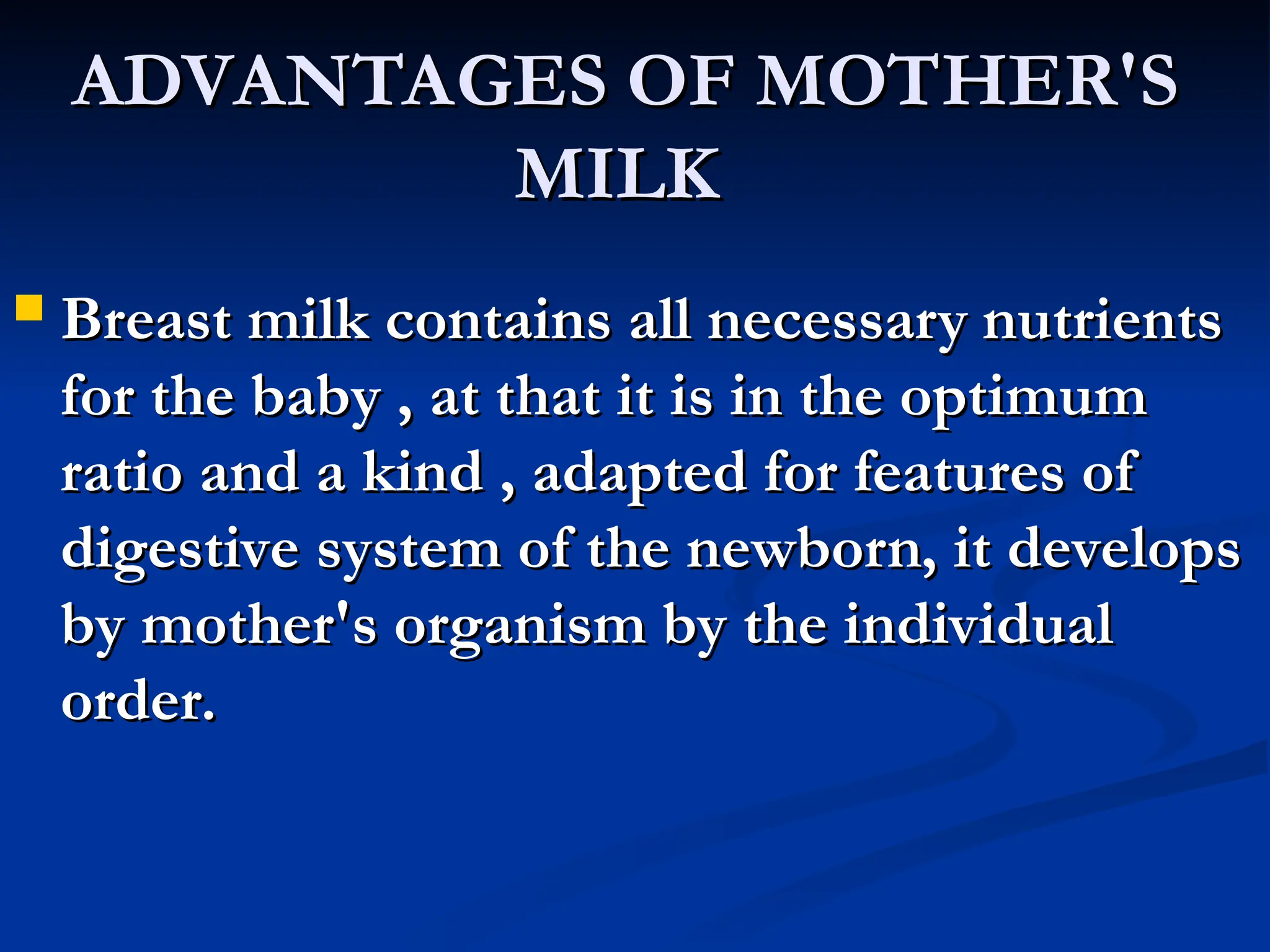
 Breast milk contains all necessary nutrients
Breast milk contains all necessary nutrients
for the baby , at that it is in the optimum
ratio and a kind , adapted for features of
digestive system of the newborn, it develops
by mother's organism by the individual
order.
order.
ADVANTAGES OF BREAST
FEEDING
FEEDING
 The structure of mother's milk
The structure of mother's milk
change in process of the baby's
growth , in accordance with his
needs. Colostrum is produced at
first time after childbirth , then
mammary gland produce
transitional milk and from
second-third week mother's
milk becomes mature.
Slide 2a
Benefits of breastfeeding for the
Infant
Infant
 Provides superior nutrition
Provides superior nutrition
for optimum growth.
for optimum growth.
 Complete food for babies up
Complete food for babies up
to six months of age
 Provides adequate water for
Provides adequate water for
hydration.
hydration.
Slide 2.1
Benefits of breastfeeding for the
Infant
Infant
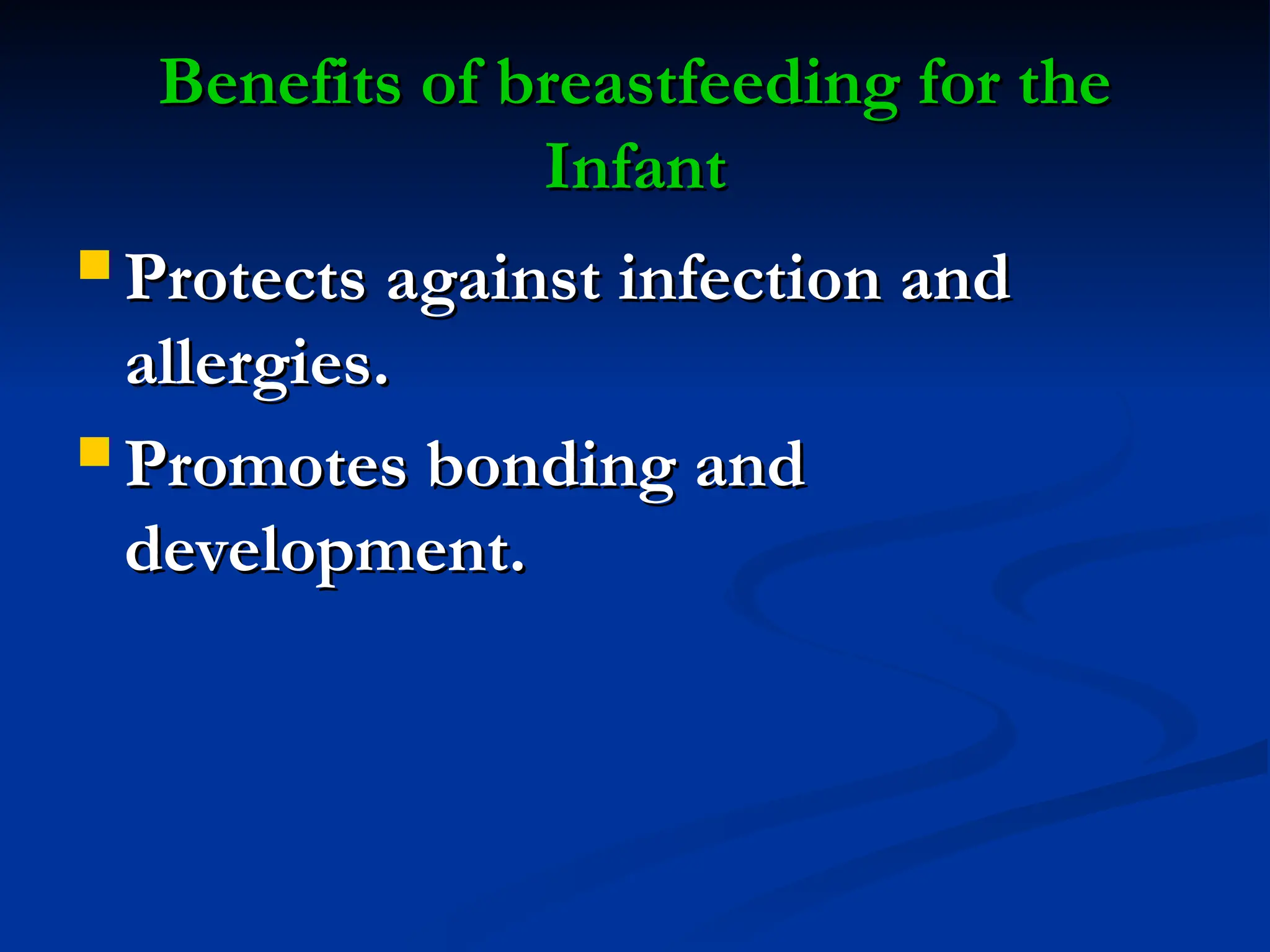
 Protects against infection and
Protects against infection and
allergies.
allergies.
 Promotes bonding and
Promotes bonding and
development.
development.
Advantages for the Baby
 Less illnesses, diseases (diarrhoea,
Less illnesses, diseases (diarrhoea,
pneumonia, ear infections etc) & disorders
 Antibodies in breast milk
Antibodies in breast milk
 Always the right temperature
Always the right temperature
 Nurturing benefits from skin to skin contact
Nurturing benefits from skin to skin contact
 Aids in development of baby’s brain and
Aids in development of baby’s brain and
nervous system
nervous system
Advantages for the Baby
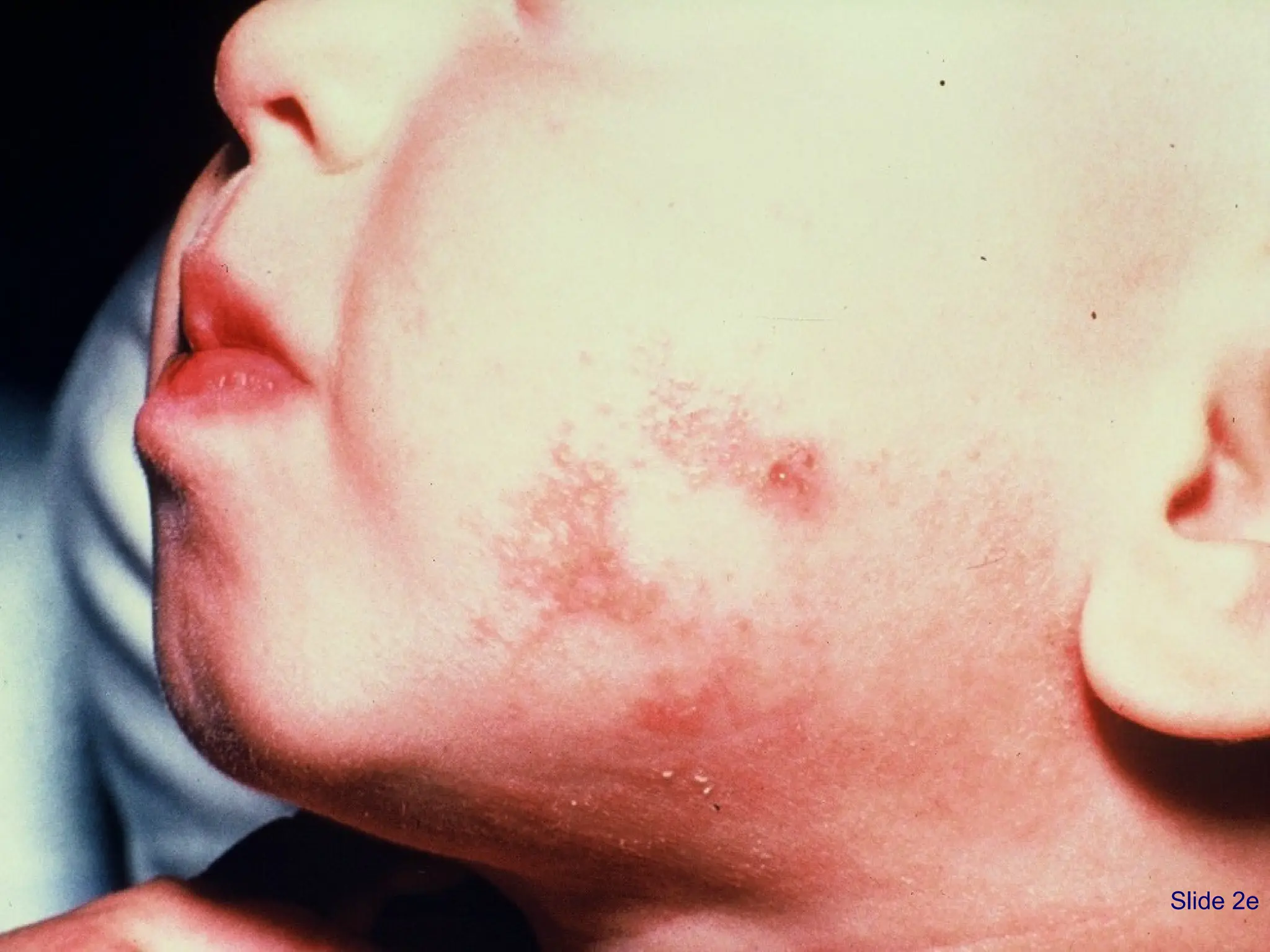
 Breastfeeding reduces the risk of
Breastfeeding reduces the risk of
hypertension, diabetes, asthma,
cancer and obesity in their future
life.
life.
Composition of Breast milk
 Proteins:
Proteins: less casein in human milk and it forms a softer
less casein in human milk and it forms a softer
curds which is easier to digest. Human milk also contains
antibodies (anti-infective proteins). Cow’s milk contains
too much of the protein casein which are difficult for a
baby’s immature kidneys to excrete.
 Fat content
Fat content: Human milk contains essential fatty acids
: Human milk contains essential fatty acids
which are needed for baby’s growing brain, eyes & blood
vessels. Enzyme lipase, in human milk helps to digest fat.
Cow’s milk does not contain enzyme lipase to digest the fat
and baby becomes constipated. Cow’s milk more saturated
fatty acids than breast milk which can cause obesity in
baby.
baby.
Composition of Breast milk – cont’d
 Lactose
Lactose:
: Breast milk contains more lactose
Breast milk contains more lactose
than others milk which an energy source for
brain development.
brain development.
 Vitamins and Iron
Vitamins and Iron:
: Human milk contains
Human milk contains
more of some important vitamins than cow’s
milk like Vitamin A & vitamin C. only about
10%of the iron in cow’s milk is absorbed
(iron deficiency anaemia) but about 50% of
the iron from breast milk is absorbed.
Composition of Breast milk – cont’d
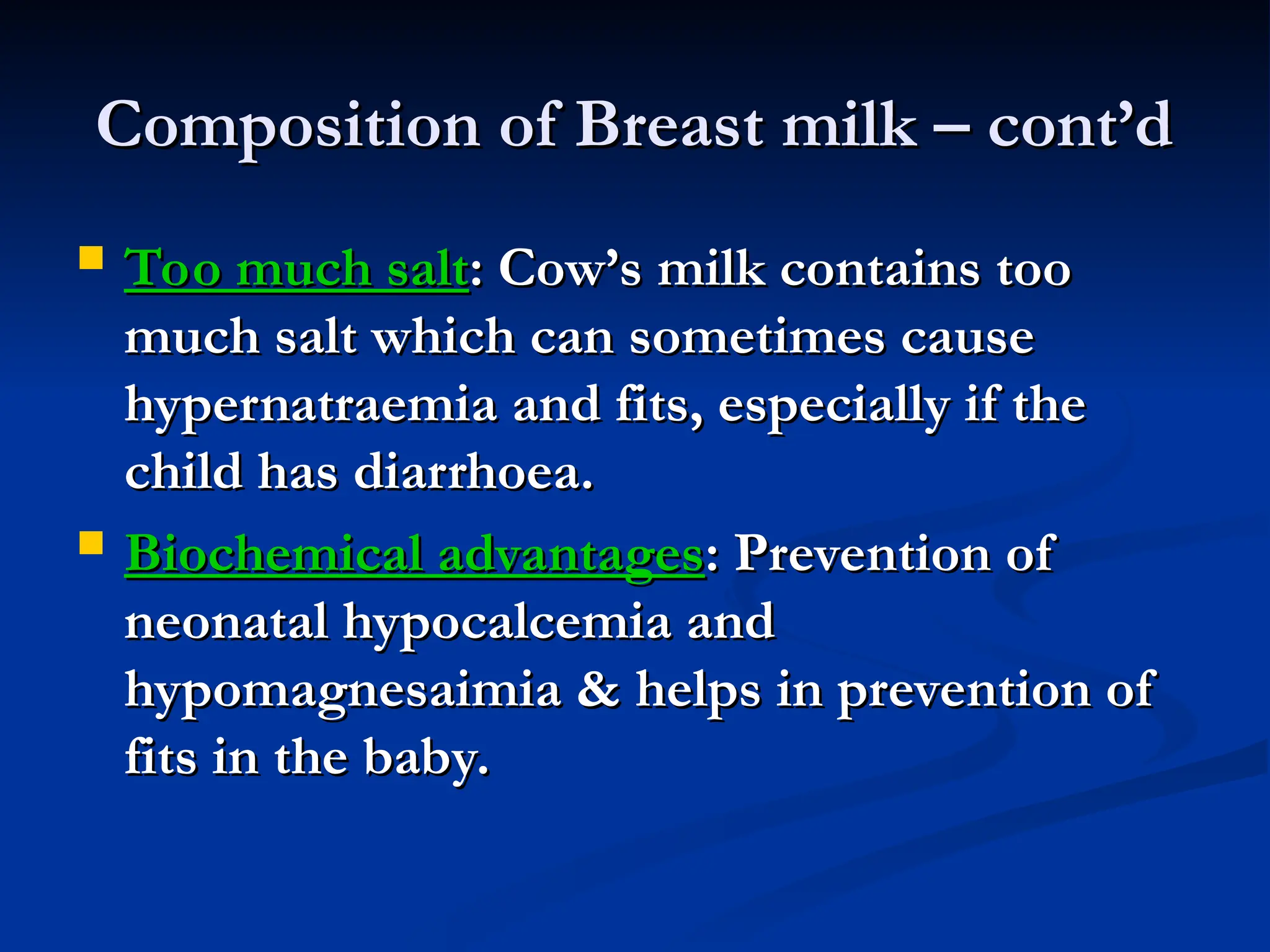
 Too much salt
Too much salt: Cow’s milk contains too
: Cow’s milk contains too
much salt which can sometimes cause
hypernatraemia and fits, especially if the
child has diarrhoea.
 Biochemical advantages
Biochemical advantages: Prevention of
: Prevention of
neonatal hypocalcemia and
hypomagnesaimia & helps in prevention of
fits in the baby.
fits in the baby.
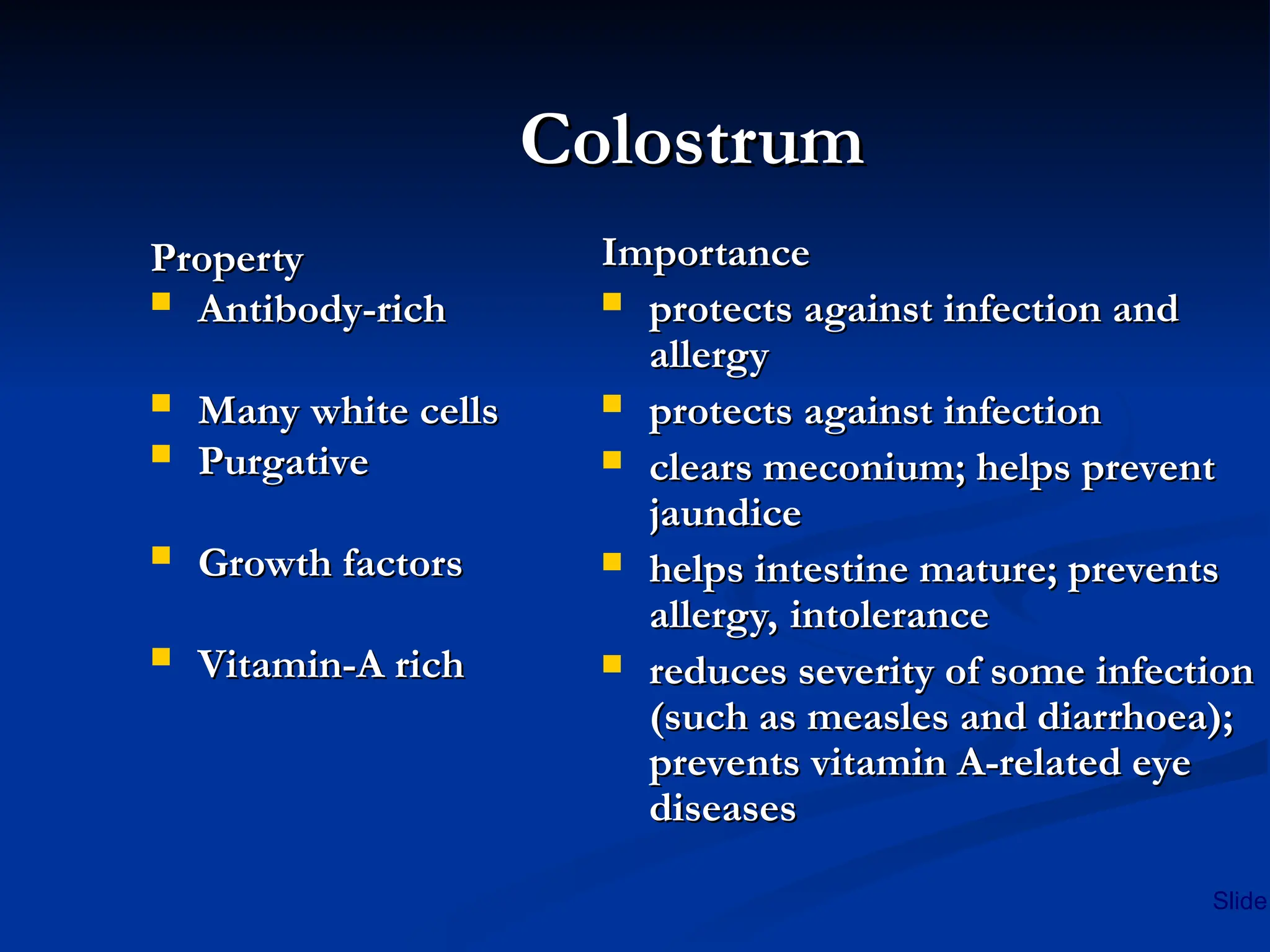
Colostrum
Colostrum
Property
Property
 Antibody-rich
Antibody-rich
 Many white cells
Many white cells
 Purgative
Purgative
 Growth factors
Growth factors
 Vitamin-A rich
Vitamin-A rich
Importance
Importance
 protects against infection and
protects against infection and
allergy
allergy
 protects against infection
protects against infection
 clears meconium; helps prevent
clears meconium; helps prevent
jaundice
jaundice
 helps intestine mature; prevents
helps intestine mature; prevents
allergy, intolerance
 reduces severity of some infection
reduces severity of some infection
(such as measles and diarrhoea);
prevents vitamin A-related eye
diseases
diseases
Slide
Protective effect of
breastfeeding
breastfeeding
on infant morbidity
on infant morbidity
Slide
Slide 2d
Protective Effect of
Breastfeeding
Breastfeeding
on Infant Mortality
on Infant Mortality
Slide 2
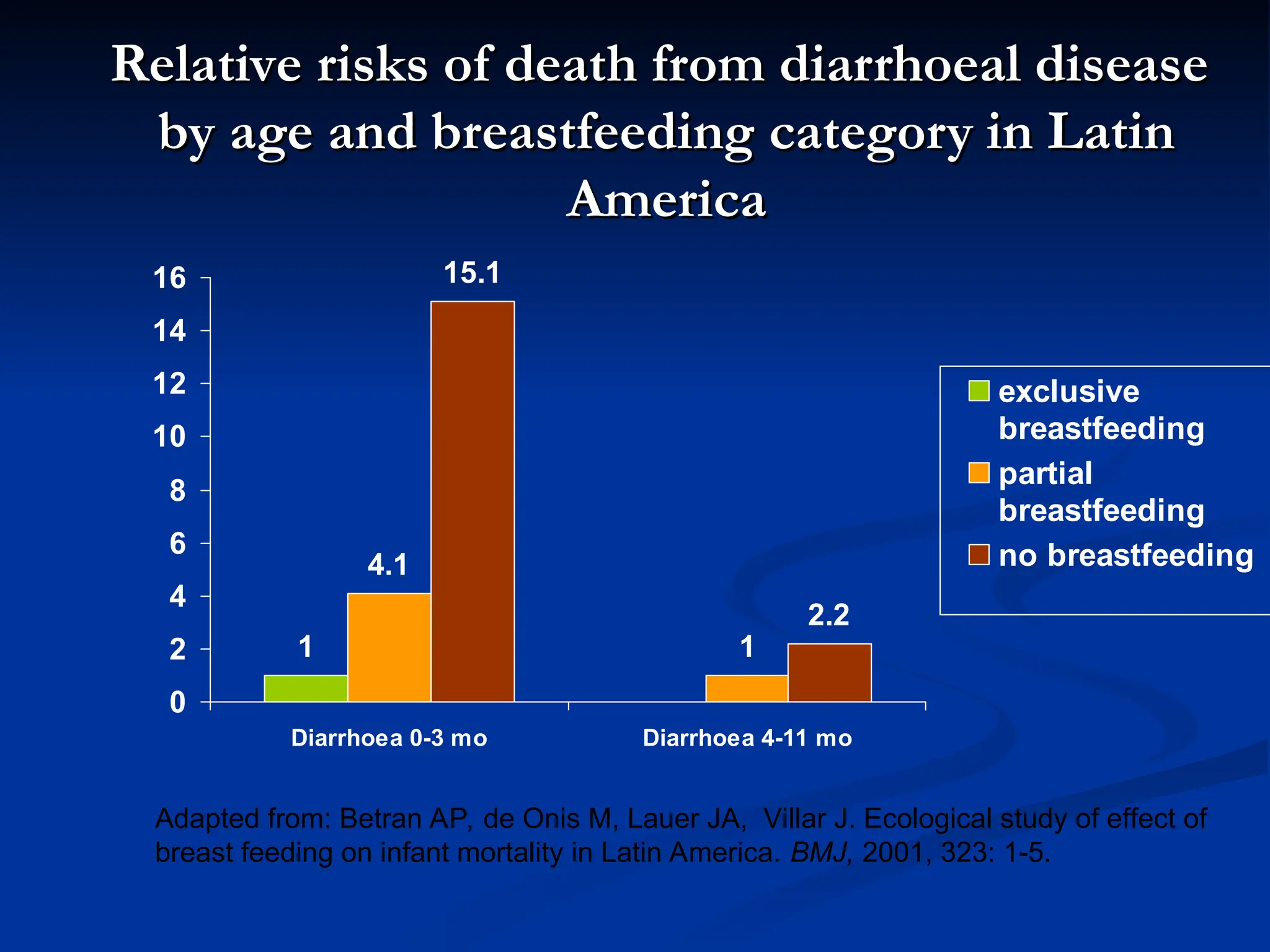
Relative risks of death from diarrhoeal disease
by age and breastfeeding category in Latin
America
America
1
4.1
1
15.1
2.2
0
2
4
6
8
10
12
14
16
Diarrhoea 0-3 mo Diarrhoea 4-11 mo
exclusive
breastfeeding
partial
breastfeeding
no breastfeeding
Adapted from: Betran AP, de Onis M, Lauer JA, Villar J. Ecological study of effect of
breast feeding on infant mortality in Latin America. BMJ, 2001, 323: 1-5.
Relative risks of death from acute
respiratory infections by age and
breastfeeding category
in Latin America
in Latin America
1
4
2.1
2.9
1
0
0.5
1
1.5
2
2.5
3
3.5
4
4.5
ARI 0-3 mo 4-11 mo
exclusive
breastfeeding
partial
breastfeeding
no breastfeeding
Adapted from: Betran AP, de Onis M, Lauer JA, Villar J. Ecological study of effect of
breast feeding on infant mortality in Latin America. BMJ, 2001, 323: 1-5.
Slide 2
Breastfeeding Reduces
the Risk of Chronic
the Risk of Chronic
Disease
Disease
Slide 2
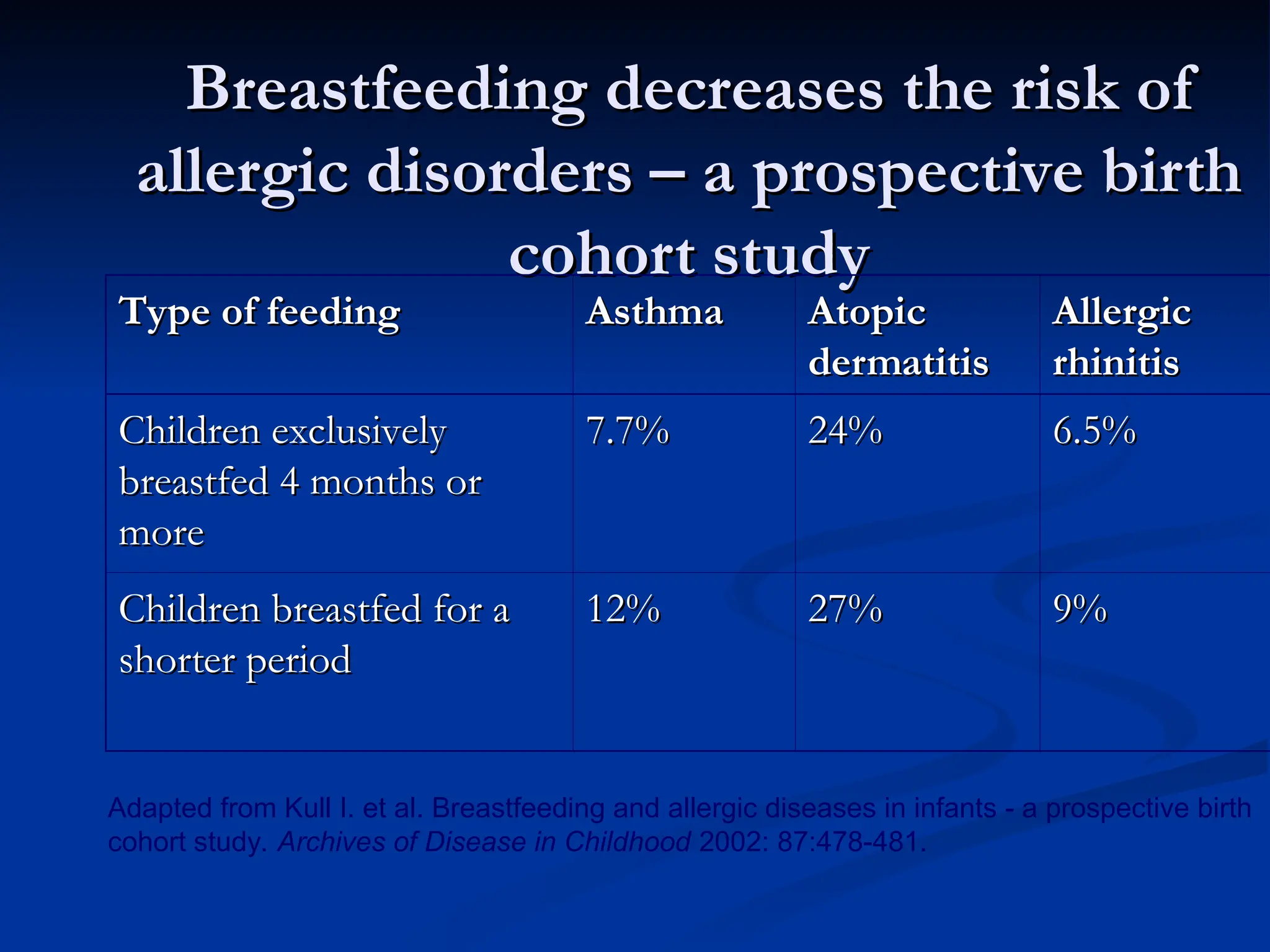
Breastfeeding decreases the risk of
allergic disorders – a prospective birth
cohort study
cohort study
Type of feeding
Type of feeding Asthma
Asthma Atopic
Atopic
dermatitis
dermatitis
Allergic
Allergic
rhinitis
rhinitis
Children exclusively
breastfed 4 months or
more
more
7.7%
7.7% 24%
24% 6.5%
6.5%
Children breastfed for a
shorter period
shorter period
12%
12% 27%
27% 9%
9%
Adapted from Kull I. et al. Breastfeeding and allergic diseases in infants - a prospective birth
cohort study. Archives of Disease in Childhood 2002: 87:478-481.
Slide 2e
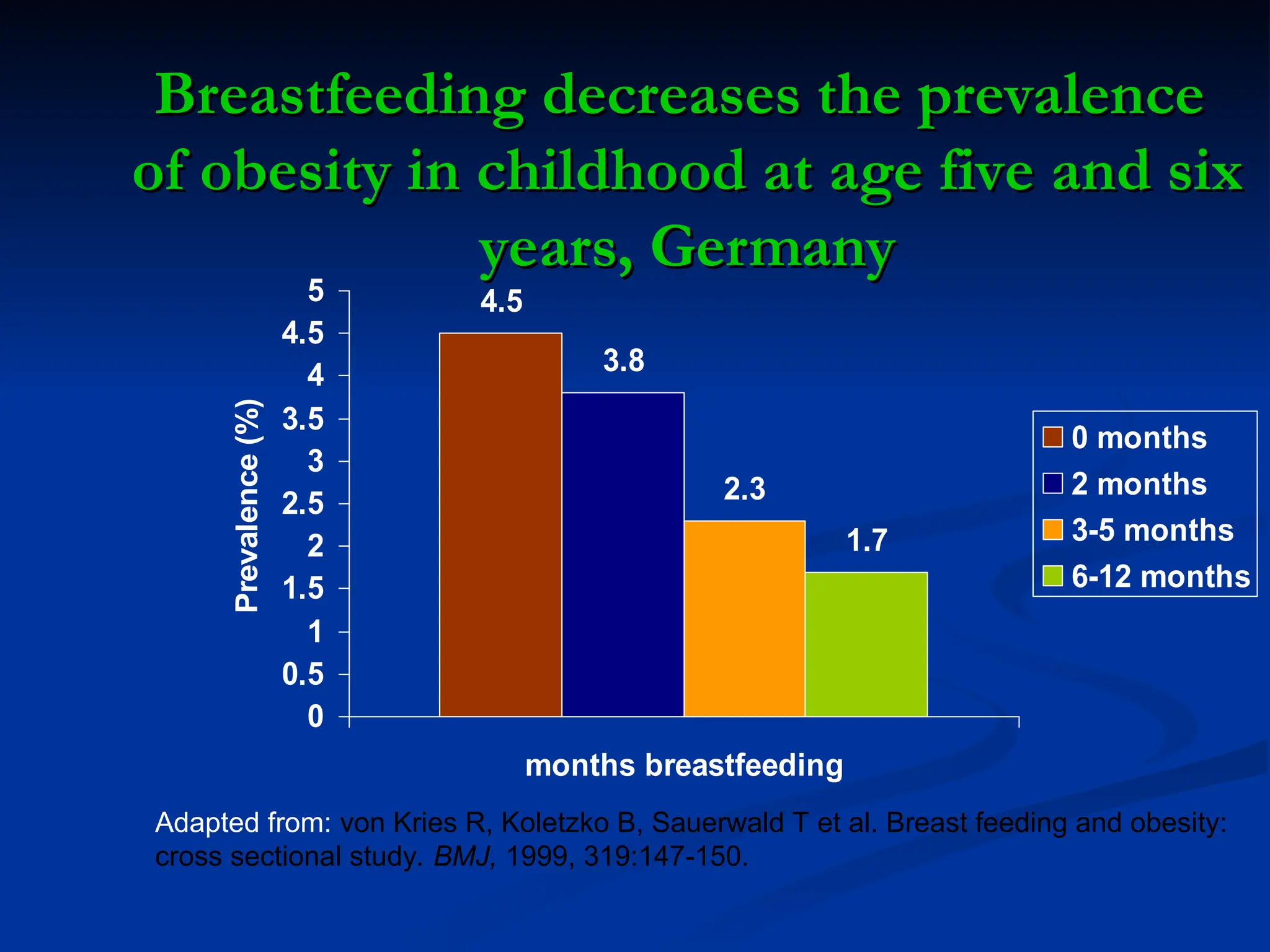
Breastfeeding decreases the prevalence
of obesity in childhood at age five and six
years, Germany
years, Germany
4.5
3.8
2.3
1.7
0
0.5
1
1.5
2
2.5
3
3.5
4
4.5
5
months breastfeeding
Prevalence
(%)
0 months
2 months
3-5 months
6-12 months
Adapted from: von Kries R, Koletzko B, Sauerwald T et al. Breast feeding and obesity:
cross sectional study. BMJ, 1999, 319:147-150.
Breastfeeding has
Breastfeeding has
psychosocial
psychosocial
and developmental
and developmental
benefits
benefits
Slide 2
Intelligence quotient by type of feeding
BF 2.1 points
higher than FF
Study in 6 months
to 2 year- olds
1988
BF 8.3 points
higher than FF
Study in 7.5-8
year-olds
1992
BF 2 points
higher than FF
Study in 3-7
year-olds
1982
BM 7.5 points
higher than no BM
Study in 7.5-8
year-olds
1992
BF 12.9 points
higher than FF
Study in 9.5
year-olds
1996
BF = breastfed
FF = formula fed
BM = breast milk
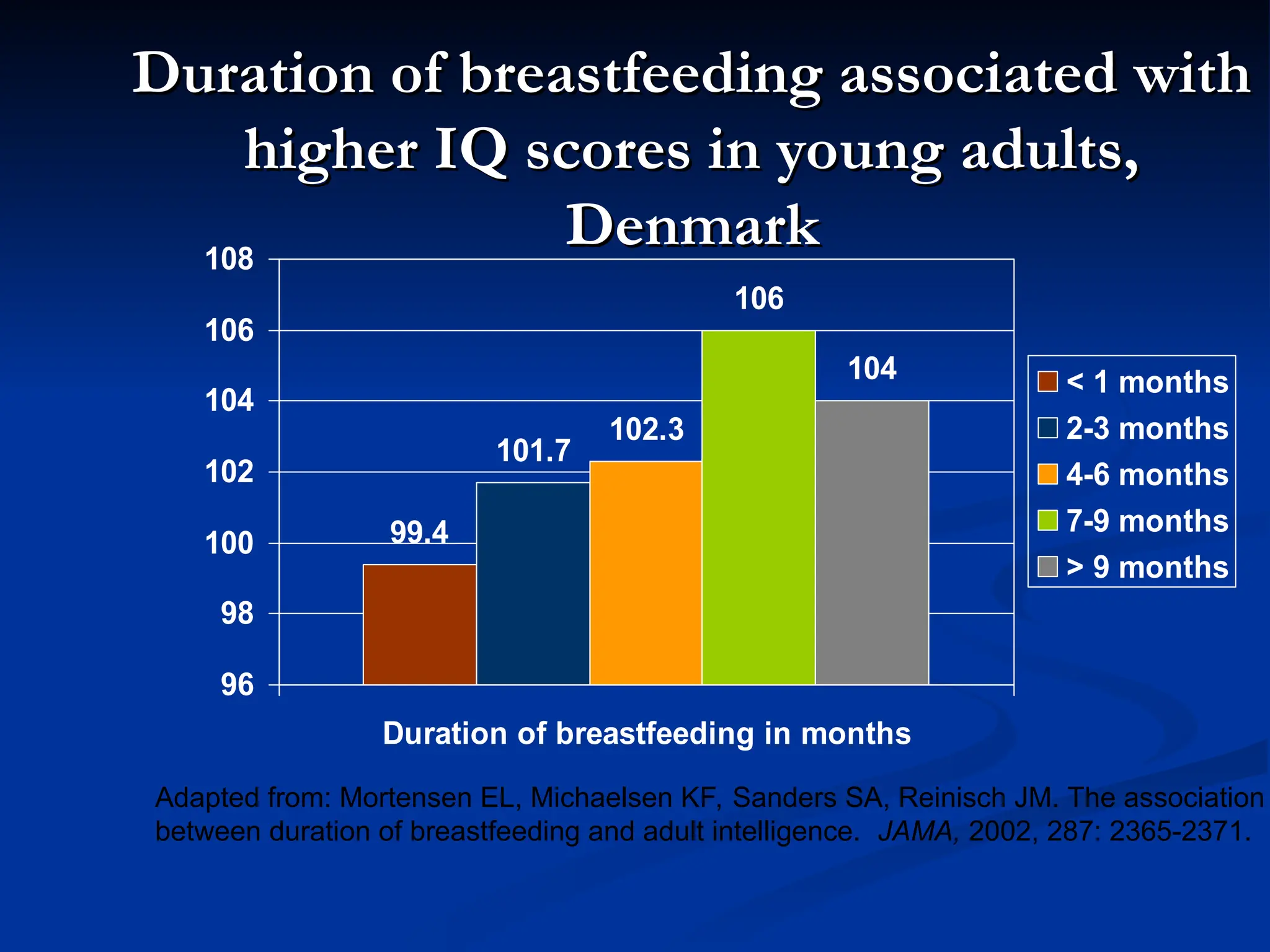
Duration of breastfeeding associated with
higher IQ scores in young adults,
Denmark
Denmark
99.4
102.3
106
101.7
104
96
98
100
102
104
106
108
Duration of breastfeeding in months
< 1 months
2-3 months
4-6 months
7-9 months
> 9 months
Adapted from: Mortensen EL, Michaelsen KF, Sanders SA, Reinisch JM. The association
between duration of breastfeeding and adult intelligence. JAMA, 2002, 287: 2365-2371.
Benefits of breastfeeding for the
mother
mother
 Protects mother’s health
Protects mother’s health
 helps reduces risk of uterine bleeding and helps
helps reduces risk of uterine bleeding and helps
the uterus to return to its previous size
 reduces risk of breast and
reduces risk of breast and
ovarian cancer
ovarian cancer
 Helps delay a new pregnancy
Helps delay a new pregnancy
 Helps a mother return to pre-pregnancy weight
Helps a mother return to pre-pregnancy weight
Slide 2
Advantages for Mother
 Decreased postpartum bleeding & depression
Decreased postpartum bleeding & depression
 Earlier return to pre-pregnancy weight
Earlier return to pre-pregnancy weight
 Delayed resumption of ovulation
Delayed resumption of ovulation
 Reduced risk of ovarian cancer
Reduced risk of ovarian cancer
 Reduced premenopausal breast cancer
Reduced premenopausal breast cancer
Advantages for Mother
 Promotes between mother and
Promotes between mother and
baby
baby
 Reduces risk of hip fracture,
Reduces risk of hip fracture,
osteoporosis after menopause.
 Prevents obesity
Prevents obesity
 Makes life easier
Makes life easier
Advantages for Mother
 It saves time and money
It saves time and money
 No bottles to warm in the middle of
No bottles to warm in the middle of
the night
the night
Benefits for Society
 Breastfeeding saves on health care costs.
Breastfeeding saves on health care costs.
 Total medical care costs for the nation are
Total medical care costs for the nation are
much lower for fully breastfed infants than
never breastfed infants since breastfed
infants typically need fewer sick care visits,
prescriptions and hospitalizations.
Benefits for Society
 Breastfeeding produces more productive
Breastfeeding produces more productive
workforce. BF mothers miss less work, as
their infants are sick less often
 BF is better for our environment because
BF is better for our environment because
there is less trash and plastic waste
compared to that produced by formula cans
and bottle supplies.
WHEN TO FEED?
WHEN TO FEED?
 You should feed your baby just after childbirth. It is desirable,
You should feed your baby just after childbirth. It is desirable,
that mom constantly was in contact with her baby also. You
should feed him by the first request. It may be tired for you to feed
every hour, but you can't make a schedule for the work of a little
stomach.
stomach.
 Hunger is new sensations for the baby, he hasn't felt it before. The
Hunger is new sensations for the baby, he hasn't felt it before. The
digestive system of the baby’s only starts to develop. When
intervals between feedings are greater, the baby sucks very
greedy, swallows the air, overeats .It's difficultly to digest a plenty
food at one sitting. And the baby get a problems with a tummy, he
becomes restless. Feed your child gradually, but more often.
 Mother's milk assimilates well, infants can't to overeat it. It's quite
Mother's milk assimilates well, infants can't to overeat it. It's quite
another matter the artificial feeding, there are more problem with
it , than you can imagine.
Baby Friendly Hospital Initiative
 BFHI was launched by WHO &
BFHI was launched by WHO &
UNICEF in 1991
UNICEF in 1991
 The initiative is a global effort for
The initiative is a global effort for
improving the role of maternity
services to breastfeed babies
Baby Friendly Hospital Initiative
 It aims at improving the care of pregnant
It aims at improving the care of pregnant
women , mothers and newborns at health
care facilities that provide maternity services
for protecting, promoting and supporting
breastfeeding.
breastfeeding.
 To become Baby Friendly Hospital,
To become Baby Friendly Hospital,
Hospitals & maternity centres must practice
of the
of the “Ten Steps to Successful
“Ten Steps to Successful
Breastfeeding”
Breastfeeding”
The Ten Steps
The Ten Steps
to Successful
to Successful
Breastfeeding
Breastfeeding
From:
From: A Joint WHO/UNICEF
A Joint WHO/UNICEF
Statement
Statement
Published by the World Health
Organization
Organization
MYTHS ABOUT
MYTHS ABOUT
BREASTFEEDING
BREASTFEEDING
 Breastfeeding ruins the shape of your breasts
Breastfeeding ruins the shape of your breasts
 Small breastfed women won’t have enough
Small breastfed women won’t have enough
milk
milk
 Artificial milk is as good as the real breast
Artificial milk is as good as the real breast
milk
milk
 Breastfeeding takes more time than bottle
Breastfeeding takes more time than bottle
feeding
feeding
 You must wean if you get pregnant
You must wean if you get pregnant
MYTHS ABOUT
MYTHS ABOUT
BREASTFEEDING – cont’d
 Mother’s milk is poisonous
Mother’s milk is poisonous
 You can’t breastfeed after a caesarean
You can’t breastfeed after a caesarean
section
section
 Breastfeeding is painful
Breastfeeding is painful
 You can’t breastfeed if you plan to go to
You can’t breastfeed if you plan to go to
work or school
work or school
 Night nursing disturbs sleep
Night nursing disturbs sleep
MYTHS ABOUT
MYTHS ABOUT
BREASTFEEDING – cont’d
 You will to have a good diet or your milk
You will to have a good diet or your milk
won’t nourish the baby properly.
 Breastfeeding make you fat or make you
Breastfeeding make you fat or make you
week
week
 Breastfed newborn need vitamins and
Breastfed newborn need vitamins and
supplements
supplements
 You can’t take medication while you are
You can’t take medication while you are
breastfeeding
breastfeeding
 Breast milk is not enough
Breast milk is not enough
MYTHS ABOUT
MYTHS ABOUT
BREASTFEEDING – cont’d
 You should give him water in
You should give him water in
hot weather
hot weather
 Stop breastfeeding when you are
Stop breastfeeding when you are
sick (having diarrhoea or
vomiting), it contaminates your
child
child
MYTHS ABOUT
MYTHS ABOUT
BREASTFEEDING – cont’d
 BF does not provide any protection
BF does not provide any protection
against becoming pregnant.
 BF women cannot take the birth
BF women cannot take the birth
control pill
control pill
 Babies who are breast-fed on demand
Babies who are breast-fed on demand
are more likely to be “colicky”.
MYTHS ABOUT
MYTHS ABOUT
BREASTFEEDING – cont’d
 The mother should not
The mother should not
breastfeed if she is taking
medicine.
medicine.
 If the baby is off the breast for few
If the baby is off the breast for few
days/weeks the mother should not
restart BF because the milk sours.
Common Misconceptions Affecting
BF in Emergencies
BF in Emergencies
 Malnourished mothers can not breastfeed.
Malnourished mothers can not breastfeed.
 Stress prevents mothers from producing
Stress prevents mothers from producing
milk.
milk.
 Once a mother stops BF, she cannot restart.
Once a mother stops BF, she cannot restart.
 When a woman has been raped, she cannot
When a woman has been raped, she cannot
breastfeed.
breastfeed.
 HIV positive mothers should never
HIV positive mothers should never
breastfeed.
breastfeed.
Causes of low Breastfeeding in our
Country
Country
 Social taboos
Social taboos –
– talking about
talking about
breastfeeding issue is social taboo
 Unethical promotion of formula
Unethical promotion of formula
milk
milk
 Lifestyle consciousness
Lifestyle consciousness
 Fashion
Fashion
Factors/barriers that cause
discontinuation of Breastfeeding
1.
1. Inadequate milk
Inadequate milk
2.
2. Exhaustion
Exhaustion
3.
3. Working women
Working women
4.
4. Lack of supporting environment for
Lack of supporting environment for
working mothers
working mothers
5.
5. Lack of counselling on part of health care
Lack of counselling on part of health care
providers
providers
6.
6. Promotion of breastfeeding substitutes by
Promotion of breastfeeding substitutes by
multinationals
multinationals
Factors/barriers that cause
discontinuation of Breastfeeding
 Women from higher socio-economic strata
Women from higher socio-economic strata
 Women who have a C-section
Women who have a C-section
 Lack of antenatal visits to healthcare
Lack of antenatal visits to healthcare
facilities
facilities
 If women in the upper strata will not
If women in the upper strata will not
breastfeed their children, the same trend will
trickle down to all levels of society
Breastfeeding Rules
Breastfeeding Rules
 “
“Protection of Breastfeeding and Young
Protection of Breastfeeding and Young
Child Nutrition Ordinance 2002”
 Government notified the Rules and
Government notified the Rules and
Regulations regarding breastfeeding
ordinance on Feb 9, 2009. “Protection of
Breastfeeding and Child Nutrition Rules”
Practices prohibited by Ordinance
 Creating impression that the Infant’s
Creating impression that the Infant’s
formula milk is better than mother’s milk
 Giving gift or benefit to health workers or
Giving gift or benefit to health workers or
his family.
his family.
 Distribution and donation of infant formula
Distribution and donation of infant formula
milk and products
milk and products
 Distribution of educational and information
Distribution of educational and information
material
material
Practices prohibited by Ordinance
 Distribution and acceptance of free
Distribution and acceptance of free
samples
samples
 Pictures, graphics or texts that
Pictures, graphics or texts that
encourage bottle-feeding or
discourage breast-feeding
Labeling
Labeling
 Contain a conspicuous notice in bold
Contain a conspicuous notice in bold
characters:
characters:
 “
“ MOTHER’ S MILK IS BEST FOOD FOR
MOTHER’ S MILK IS BEST FOOD FOR
YOUR BABY AND HELPS IN
PREVENTING DIARRHOEAL AND
OTHER ILLNESSES”
OTHER ILLNESSES”
Complaint Procedure
Complaint Procedure
 Under the section 15 of the Ordinance, any
Under the section 15 of the Ordinance, any
person may make an application in writing
to the Board or a Provincial Committee
concerning contravention of any of the
provisions of the Ordinance or the Rules
provisions of the Ordinance or the Rules.
.
National Infant Feeding Board
 Head: Minister of Health
Head: Minister of Health
 Secretary: Dy DG of Health
Secretary: Dy DG of Health
 Members:
Members:
 Provincial health secretaries
Provincial health secretaries
 Pediatricians
Pediatricians
 Gynecologists
Gynecologists
 Representatives of industry
Representatives of industry
 Consumer rights organizations
Consumer rights organizations
Powers of Board
Powers of Board
 Receive violations of the Ordinance and take
Receive violations of the Ordinance and take
action against violators
 Call for consultations with provincial
Call for consultations with provincial
governments and stakeholders in order to
ensure implementation and strict
compliance with the provision of Ordinance
and these Rules.
and these Rules.
 Provincial Breastfeeding Committees
Provincial Breastfeeding Committees
Recommendations to Promote
Breastfeeding
Breastfeeding
 Awareness campaign through media about
Awareness campaign through media about
benefits of BF & hazards of artificial feeding
 Regular lectures on breastfeeding in girls
Regular lectures on breastfeeding in girls
colleges
colleges
 Repeat video films at waiting rooms of air
Repeat video films at waiting rooms of air
ports, railway stations, bus stops etc
 Strict implementation of Protection of
Strict implementation of Protection of
Breastfeeding and Child Nutrition Rules
2009
2009
Recommendations to Promote
Breastfeeding
Breastfeeding
 Penalties for violators of BF Rules
Penalties for violators of BF Rules
 Targeting health providers, working women
Targeting health providers, working women
with urban residence and higher income
strata and marginalized women
 Role of Lady Health Workers
Role of Lady Health Workers
 Role of Ulemas
Role of Ulemas
 Inclusion of Breastfeeding subject in the
Inclusion of Breastfeeding subject in the
syllabus of schools and colleges
Recommendations to Promote
Breastfeeding
Breastfeeding
 Provision of 4 months maternity leave to
Provision of 4 months maternity leave to
pregnant working mothers & reduction of
working hours for lactating mothers
 Provision of separation room or nursery for
Provision of separation room or nursery for
working mothers where they can keep their
babies and can feed them after every two
hours
hours
 Antenatal breastfeeding counselling
Antenatal breastfeeding counselling
Recommendations to Promote
Breastfeeding
Breastfeeding
 Creation of mother-friendly
Creation of mother-friendly
workplaces
workplaces
 Motivation of gynecologists and
Motivation of gynecologists and
lady health workers to advocate in
favor of breastfeeding throughout
pregnancy term
pregnancy term
 http://www.who.int/maternal_child_adolescent/topics/child/imci/en/
 http://en.wikipedia.org/wiki/Integrated_Management_of_Childhood_Illness
 http://rho.emro.who.int/rhodata/?vid=2753#
 http://
www.emro.who.int/child-health/strategy-implementation/implementation-of-i
mci-in-pakistan.html
References
References
Thank you!
Thank you!

Promoting breastfeedinghhhhhhhhhhhhh.ppt

  • 1.
  • 2.
    Breastfeeding is the Breastfeedingis the best gift a mother best gift a mother can give to her can give to her newborn newborn
  • 3.
    Introduction Introduction  In infancy,no gift is more precious than In infancy, no gift is more precious than breastfeeding. breastfeeding.  Infants are meant to breastfeed. Infants are meant to breastfeed.  Breastfeeding provides the best possible Breastfeeding provides the best possible start to life in all areas of development. start to life in all areas of development.  Early initiation and exclusive breastfeeding Early initiation and exclusive breastfeeding for six months of life can save more than one for six months of life can save more than one million babies. million babies.
  • 4.
    Breastfeeding Breastfeeding  Breastfeeding isthe feeding of infant or Breastfeeding is the feeding of infant or young child with breast milk directly young child with breast milk directly from woman’s breasts, not from a baby from woman’s breasts, not from a baby bottle/ other container. bottle/ other container.  Babies have a suckling reflex that Babies have a suckling reflex that enables them to suck and swallow milk. enables them to suck and swallow milk.
  • 5.
    FACTS & FIGURES FACTS& FIGURES  Breast milk is the best source of nourishment for Breast milk is the best source of nourishment for human infants, preventing disease, promoting human infants, preventing disease, promoting health and reducing health care costs. health and reducing health care costs.  Artificial feeding is associated with more Artificial feeding is associated with more deaths deaths from from diarrhoea/pneumonia diarrhoea/pneumonia in infants. in infants.  A lack of exclusive breastfeeding during the first A lack of exclusive breastfeeding during the first six months of life contributes to over a million six months of life contributes to over a million avoidable child deaths each year. avoidable child deaths each year.
  • 7.
    FACTS & FIGURES– cont’d FACTS & FIGURES – cont’d  Unfortunately, “Breastfeeding practice” Unfortunately, “Breastfeeding practice” among mothers in Pakistan, is still among mothers in Pakistan, is still alarmingly low. alarmingly low.  Exclusive breastfeeding as well as the Exclusive breastfeeding as well as the duration for which a child is breastfed, is duration for which a child is breastfed, is lowest in Pakistan, compared for lowest in Pakistan, compared for neighbouring South Asian countries neighbouring South Asian countries including India, Bangladesh, Nepal and Sri including India, Bangladesh, Nepal and Sri Lanka. Lanka.
  • 8.
    FACTS & FIGURES– cont’d FACTS & FIGURES – cont’d  Globally, less than 40% of infants under six Globally, less than 40% of infants under six months of age are exclusively breastfed months of age are exclusively breastfed  In Pakistan, 37% of infants under six In Pakistan, 37% of infants under six months of age are exclusively breastfed months of age are exclusively breastfed ( (Demographic & Health Survey of Pakistan, 2006-07). Demographic & Health Survey of Pakistan, 2006-07).  Highest bottle-feeding Rate Highest bottle-feeding Rate: : 32% 32%
  • 9.
    FACTS & FIGURES– cont’d FACTS & FIGURES – cont’d  Exclusive Breastfeeding Rates in other Exclusive Breastfeeding Rates in other countries of the Region: countries of the Region:  Sri Lanka: 76% Sri Lanka: 76%  Nepal: 53% Nepal: 53%  India: 46% India: 46%  Bangladesh: 43% Bangladesh: 43%
  • 10.
    FACTS & FIGURES– cont’d FACTS & FIGURES – cont’d  Almost two-thirds of babies (65%) in Pakistan are Almost two-thirds of babies (65%) in Pakistan are given something other such as ghutti, fresh animal given something other such as ghutti, fresh animal milk etc in the first three days of life (prelacteal milk etc in the first three days of life (prelacteal meal) a practice that should be discouraged meal) a practice that should be discouraged because it may inhibit breastfeeding /or introduce because it may inhibit breastfeeding /or introduce contaminants. contaminants.  In Pakistan, 400,000 babies die during their first In Pakistan, 400,000 babies die during their first year of life due to diarrhoea and Acute Respiratory year of life due to diarrhoea and Acute Respiratory Infections such as pneumonia. Infections such as pneumonia.
  • 11.
    FACTS & FIGURES– cont’d FACTS & FIGURES – cont’d  Children who are not exclusively Children who are not exclusively breastfed 14 times higher risk of dying breastfed 14 times higher risk of dying as compared to those who are breastfed as compared to those who are breastfed  10% higher risk of getting diarrhoea 10% higher risk of getting diarrhoea
  • 12.
    FACTS & FIGURES– cont’d FACTS & FIGURES – cont’d  22% of neonatal deaths could be prevented if 22% of neonatal deaths could be prevented if breastfeeding is initiated within first hour by all breastfeeding is initiated within first hour by all mothers mothers  Even in developed countries, lack of breastfeeding Even in developed countries, lack of breastfeeding is associated with increased risk to the survival and is associated with increased risk to the survival and health of babies. health of babies.  Exclusively breastfed infants are two and half Exclusively breastfed infants are two and half times less likely to become ill and two times less times less likely to become ill and two times less likely to die than infants who are not breastfed. likely to die than infants who are not breastfed.
  • 13.
    FACTS & FIGURES– cont’d FACTS & FIGURES – cont’d  Breastfeeding percentage: 2006-07: 37.1% Breastfeeding percentage: 2006-07: 37.1%  2012-13: 37.7% 2012-13: 37.7%  Bottle feeding rates (2006-07): 32.1% Bottle feeding rates (2006-07): 32.1%  2012-13: 41 percent 2012-13: 41 percent  Exclusive breastfeeding rates lowest among Exclusive breastfeeding rates lowest among educated women belonging to upper educated women belonging to upper socioeconomic strata socioeconomic strata
  • 14.
    FACTS & FIGURES– cont’d FACTS & FIGURES – cont’d  Bottle feeding rates high among Bottle feeding rates high among working women, women belonging to working women, women belonging to upper income class and those residing upper income class and those residing among urban areas and those seeking among urban areas and those seeking care from health professionals care from health professionals  Pakistan has highest bottle feeding rates Pakistan has highest bottle feeding rates and lowest exclusive breastfeeding rates and lowest exclusive breastfeeding rates in South Asia in South Asia
  • 15.
    Factors responsible fordepriving Factors responsible for depriving children from their right of breastfeeding children from their right of breastfeeding  Mother’s ignorance about its importance Mother’s ignorance about its importance  Newborns or mothers pathological factors Newborns or mothers pathological factors  Different taboos and myths Different taboos and myths  Lack of training by health workers for Lack of training by health workers for preparation of mother for breastfeeding after preparation of mother for breastfeeding after delivery delivery  Awareness and effectiveness of law, its Awareness and effectiveness of law, its implementation and monitoring implementation and monitoring
  • 16.
    Factors responsible fordepriving Factors responsible for depriving children from their right of breastfeeding children from their right of breastfeeding One of the reasons for One of the reasons for reduction in the rate of reduction in the rate of breastfeeding is easy breastfeeding is easy availability of its supplements availability of its supplements
  • 17.
    Breastfeeding cannot be Breastfeedingcannot be promoted in the absence of promoted in the absence of effective crackdown on the effective crackdown on the unethical promotion of the unethical promotion of the infant formula by the infant formula by the industry. industry.
  • 18.
    ADVANTAGES OF MOTHER'S ADVANTAGESOF MOTHER'S MILK MILK  Breast milk contains all necessary nutrients Breast milk contains all necessary nutrients for the baby , at that it is in the optimum for the baby , at that it is in the optimum ratio and a kind , adapted for features of ratio and a kind , adapted for features of digestive system of the newborn, it develops digestive system of the newborn, it develops by mother's organism by the individual by mother's organism by the individual order. order.
  • 19.
    ADVANTAGES OF BREAST ADVANTAGESOF BREAST FEEDING FEEDING  The structure of mother's milk The structure of mother's milk change in process of the baby's change in process of the baby's growth , in accordance with his growth , in accordance with his needs. Colostrum is produced at needs. Colostrum is produced at first time after childbirth , then first time after childbirth , then mammary gland produce mammary gland produce transitional milk and from transitional milk and from second-third week mother's second-third week mother's milk becomes mature. milk becomes mature.
  • 20.
  • 21.
    Benefits of breastfeedingfor the Benefits of breastfeeding for the Infant Infant  Provides superior nutrition Provides superior nutrition for optimum growth. for optimum growth.  Complete food for babies up Complete food for babies up to six months of age to six months of age  Provides adequate water for Provides adequate water for hydration. hydration. Slide 2.1
  • 22.
    Benefits of breastfeedingfor the Benefits of breastfeeding for the Infant Infant  Protects against infection and Protects against infection and allergies. allergies.  Promotes bonding and Promotes bonding and development. development.
  • 23.
    Advantages for theBaby Advantages for the Baby  Less illnesses, diseases (diarrhoea, Less illnesses, diseases (diarrhoea, pneumonia, ear infections etc) & disorders pneumonia, ear infections etc) & disorders  Antibodies in breast milk Antibodies in breast milk  Always the right temperature Always the right temperature  Nurturing benefits from skin to skin contact Nurturing benefits from skin to skin contact  Aids in development of baby’s brain and Aids in development of baby’s brain and nervous system nervous system
  • 24.
    Advantages for theBaby Advantages for the Baby  Breastfeeding reduces the risk of Breastfeeding reduces the risk of hypertension, diabetes, asthma, hypertension, diabetes, asthma, cancer and obesity in their future cancer and obesity in their future life. life.
  • 25.
    Composition of Breastmilk Composition of Breast milk  Proteins: Proteins: less casein in human milk and it forms a softer less casein in human milk and it forms a softer curds which is easier to digest. Human milk also contains curds which is easier to digest. Human milk also contains antibodies (anti-infective proteins). Cow’s milk contains antibodies (anti-infective proteins). Cow’s milk contains too much of the protein casein which are difficult for a too much of the protein casein which are difficult for a baby’s immature kidneys to excrete. baby’s immature kidneys to excrete.  Fat content Fat content: Human milk contains essential fatty acids : Human milk contains essential fatty acids which are needed for baby’s growing brain, eyes & blood which are needed for baby’s growing brain, eyes & blood vessels. Enzyme lipase, in human milk helps to digest fat. vessels. Enzyme lipase, in human milk helps to digest fat. Cow’s milk does not contain enzyme lipase to digest the fat Cow’s milk does not contain enzyme lipase to digest the fat and baby becomes constipated. Cow’s milk more saturated and baby becomes constipated. Cow’s milk more saturated fatty acids than breast milk which can cause obesity in fatty acids than breast milk which can cause obesity in baby. baby.
  • 26.
    Composition of Breastmilk – cont’d Composition of Breast milk – cont’d  Lactose Lactose: : Breast milk contains more lactose Breast milk contains more lactose than others milk which an energy source for than others milk which an energy source for brain development. brain development.  Vitamins and Iron Vitamins and Iron: : Human milk contains Human milk contains more of some important vitamins than cow’s more of some important vitamins than cow’s milk like Vitamin A & vitamin C. only about milk like Vitamin A & vitamin C. only about 10%of the iron in cow’s milk is absorbed 10%of the iron in cow’s milk is absorbed (iron deficiency anaemia) but about 50% of (iron deficiency anaemia) but about 50% of the iron from breast milk is absorbed. the iron from breast milk is absorbed.
  • 27.
    Composition of Breastmilk – cont’d Composition of Breast milk – cont’d  Too much salt Too much salt: Cow’s milk contains too : Cow’s milk contains too much salt which can sometimes cause much salt which can sometimes cause hypernatraemia and fits, especially if the hypernatraemia and fits, especially if the child has diarrhoea. child has diarrhoea.  Biochemical advantages Biochemical advantages: Prevention of : Prevention of neonatal hypocalcemia and neonatal hypocalcemia and hypomagnesaimia & helps in prevention of hypomagnesaimia & helps in prevention of fits in the baby. fits in the baby.
  • 28.
    Colostrum Colostrum Property Property  Antibody-rich Antibody-rich  Manywhite cells Many white cells  Purgative Purgative  Growth factors Growth factors  Vitamin-A rich Vitamin-A rich Importance Importance  protects against infection and protects against infection and allergy allergy  protects against infection protects against infection  clears meconium; helps prevent clears meconium; helps prevent jaundice jaundice  helps intestine mature; prevents helps intestine mature; prevents allergy, intolerance allergy, intolerance  reduces severity of some infection reduces severity of some infection (such as measles and diarrhoea); (such as measles and diarrhoea); prevents vitamin A-related eye prevents vitamin A-related eye diseases diseases Slide
  • 29.
    Protective effect of Protectiveeffect of breastfeeding breastfeeding on infant morbidity on infant morbidity Slide
  • 30.
  • 31.
    Protective Effect of ProtectiveEffect of Breastfeeding Breastfeeding on Infant Mortality on Infant Mortality Slide 2
  • 32.
    Relative risks ofdeath from diarrhoeal disease Relative risks of death from diarrhoeal disease by age and breastfeeding category in Latin by age and breastfeeding category in Latin America America 1 4.1 1 15.1 2.2 0 2 4 6 8 10 12 14 16 Diarrhoea 0-3 mo Diarrhoea 4-11 mo exclusive breastfeeding partial breastfeeding no breastfeeding Adapted from: Betran AP, de Onis M, Lauer JA, Villar J. Ecological study of effect of breast feeding on infant mortality in Latin America. BMJ, 2001, 323: 1-5.
  • 33.
    Relative risks ofdeath from acute Relative risks of death from acute respiratory infections by age and respiratory infections by age and breastfeeding category breastfeeding category in Latin America in Latin America 1 4 2.1 2.9 1 0 0.5 1 1.5 2 2.5 3 3.5 4 4.5 ARI 0-3 mo 4-11 mo exclusive breastfeeding partial breastfeeding no breastfeeding Adapted from: Betran AP, de Onis M, Lauer JA, Villar J. Ecological study of effect of breast feeding on infant mortality in Latin America. BMJ, 2001, 323: 1-5. Slide 2
  • 34.
    Breastfeeding Reduces Breastfeeding Reduces theRisk of Chronic the Risk of Chronic Disease Disease Slide 2
  • 35.
    Breastfeeding decreases therisk of Breastfeeding decreases the risk of allergic disorders – a prospective birth allergic disorders – a prospective birth cohort study cohort study Type of feeding Type of feeding Asthma Asthma Atopic Atopic dermatitis dermatitis Allergic Allergic rhinitis rhinitis Children exclusively Children exclusively breastfed 4 months or breastfed 4 months or more more 7.7% 7.7% 24% 24% 6.5% 6.5% Children breastfed for a Children breastfed for a shorter period shorter period 12% 12% 27% 27% 9% 9% Adapted from Kull I. et al. Breastfeeding and allergic diseases in infants - a prospective birth cohort study. Archives of Disease in Childhood 2002: 87:478-481.
  • 36.
  • 37.
    Breastfeeding decreases theprevalence Breastfeeding decreases the prevalence of obesity in childhood at age five and six of obesity in childhood at age five and six years, Germany years, Germany 4.5 3.8 2.3 1.7 0 0.5 1 1.5 2 2.5 3 3.5 4 4.5 5 months breastfeeding Prevalence (%) 0 months 2 months 3-5 months 6-12 months Adapted from: von Kries R, Koletzko B, Sauerwald T et al. Breast feeding and obesity: cross sectional study. BMJ, 1999, 319:147-150.
  • 38.
    Breastfeeding has Breastfeeding has psychosocial psychosocial anddevelopmental and developmental benefits benefits Slide 2
  • 39.
    Intelligence quotient bytype of feeding BF 2.1 points higher than FF Study in 6 months to 2 year- olds 1988 BF 8.3 points higher than FF Study in 7.5-8 year-olds 1992 BF 2 points higher than FF Study in 3-7 year-olds 1982 BM 7.5 points higher than no BM Study in 7.5-8 year-olds 1992 BF 12.9 points higher than FF Study in 9.5 year-olds 1996 BF = breastfed FF = formula fed BM = breast milk
  • 40.
    Duration of breastfeedingassociated with Duration of breastfeeding associated with higher IQ scores in young adults, higher IQ scores in young adults, Denmark Denmark 99.4 102.3 106 101.7 104 96 98 100 102 104 106 108 Duration of breastfeeding in months < 1 months 2-3 months 4-6 months 7-9 months > 9 months Adapted from: Mortensen EL, Michaelsen KF, Sanders SA, Reinisch JM. The association between duration of breastfeeding and adult intelligence. JAMA, 2002, 287: 2365-2371.
  • 41.
    Benefits of breastfeedingfor the Benefits of breastfeeding for the mother mother  Protects mother’s health Protects mother’s health  helps reduces risk of uterine bleeding and helps helps reduces risk of uterine bleeding and helps the uterus to return to its previous size the uterus to return to its previous size  reduces risk of breast and reduces risk of breast and ovarian cancer ovarian cancer  Helps delay a new pregnancy Helps delay a new pregnancy  Helps a mother return to pre-pregnancy weight Helps a mother return to pre-pregnancy weight Slide 2
  • 42.
    Advantages for Mother Advantagesfor Mother  Decreased postpartum bleeding & depression Decreased postpartum bleeding & depression  Earlier return to pre-pregnancy weight Earlier return to pre-pregnancy weight  Delayed resumption of ovulation Delayed resumption of ovulation  Reduced risk of ovarian cancer Reduced risk of ovarian cancer  Reduced premenopausal breast cancer Reduced premenopausal breast cancer
  • 43.
    Advantages for Mother Advantagesfor Mother  Promotes between mother and Promotes between mother and baby baby  Reduces risk of hip fracture, Reduces risk of hip fracture, osteoporosis after menopause. osteoporosis after menopause.  Prevents obesity Prevents obesity  Makes life easier Makes life easier
  • 44.
    Advantages for Mother Advantagesfor Mother  It saves time and money It saves time and money  No bottles to warm in the middle of No bottles to warm in the middle of the night the night
  • 45.
    Benefits for Society Benefitsfor Society  Breastfeeding saves on health care costs. Breastfeeding saves on health care costs.  Total medical care costs for the nation are Total medical care costs for the nation are much lower for fully breastfed infants than much lower for fully breastfed infants than never breastfed infants since breastfed never breastfed infants since breastfed infants typically need fewer sick care visits, infants typically need fewer sick care visits, prescriptions and hospitalizations. prescriptions and hospitalizations.
  • 46.
    Benefits for Society Benefitsfor Society  Breastfeeding produces more productive Breastfeeding produces more productive workforce. BF mothers miss less work, as workforce. BF mothers miss less work, as their infants are sick less often their infants are sick less often  BF is better for our environment because BF is better for our environment because there is less trash and plastic waste there is less trash and plastic waste compared to that produced by formula cans compared to that produced by formula cans and bottle supplies. and bottle supplies.
  • 47.
    WHEN TO FEED? WHENTO FEED?  You should feed your baby just after childbirth. It is desirable, You should feed your baby just after childbirth. It is desirable, that mom constantly was in contact with her baby also. You that mom constantly was in contact with her baby also. You should feed him by the first request. It may be tired for you to feed should feed him by the first request. It may be tired for you to feed every hour, but you can't make a schedule for the work of a little every hour, but you can't make a schedule for the work of a little stomach. stomach.  Hunger is new sensations for the baby, he hasn't felt it before. The Hunger is new sensations for the baby, he hasn't felt it before. The digestive system of the baby’s only starts to develop. When digestive system of the baby’s only starts to develop. When intervals between feedings are greater, the baby sucks very intervals between feedings are greater, the baby sucks very greedy, swallows the air, overeats .It's difficultly to digest a plenty greedy, swallows the air, overeats .It's difficultly to digest a plenty food at one sitting. And the baby get a problems with a tummy, he food at one sitting. And the baby get a problems with a tummy, he becomes restless. Feed your child gradually, but more often. becomes restless. Feed your child gradually, but more often.  Mother's milk assimilates well, infants can't to overeat it. It's quite Mother's milk assimilates well, infants can't to overeat it. It's quite another matter the artificial feeding, there are more problem with another matter the artificial feeding, there are more problem with it , than you can imagine. it , than you can imagine.
  • 48.
    Baby Friendly HospitalInitiative Baby Friendly Hospital Initiative  BFHI was launched by WHO & BFHI was launched by WHO & UNICEF in 1991 UNICEF in 1991  The initiative is a global effort for The initiative is a global effort for improving the role of maternity improving the role of maternity services to breastfeed babies services to breastfeed babies
  • 49.
    Baby Friendly HospitalInitiative Baby Friendly Hospital Initiative  It aims at improving the care of pregnant It aims at improving the care of pregnant women , mothers and newborns at health women , mothers and newborns at health care facilities that provide maternity services care facilities that provide maternity services for protecting, promoting and supporting for protecting, promoting and supporting breastfeeding. breastfeeding.  To become Baby Friendly Hospital, To become Baby Friendly Hospital, Hospitals & maternity centres must practice Hospitals & maternity centres must practice of the of the “Ten Steps to Successful “Ten Steps to Successful Breastfeeding” Breastfeeding”
  • 50.
    The Ten Steps TheTen Steps to Successful to Successful Breastfeeding Breastfeeding From: From: A Joint WHO/UNICEF A Joint WHO/UNICEF Statement Statement Published by the World Health Published by the World Health Organization Organization
  • 51.
    MYTHS ABOUT MYTHS ABOUT BREASTFEEDING BREASTFEEDING Breastfeeding ruins the shape of your breasts Breastfeeding ruins the shape of your breasts  Small breastfed women won’t have enough Small breastfed women won’t have enough milk milk  Artificial milk is as good as the real breast Artificial milk is as good as the real breast milk milk  Breastfeeding takes more time than bottle Breastfeeding takes more time than bottle feeding feeding  You must wean if you get pregnant You must wean if you get pregnant
  • 52.
    MYTHS ABOUT MYTHS ABOUT BREASTFEEDING– cont’d BREASTFEEDING – cont’d  Mother’s milk is poisonous Mother’s milk is poisonous  You can’t breastfeed after a caesarean You can’t breastfeed after a caesarean section section  Breastfeeding is painful Breastfeeding is painful  You can’t breastfeed if you plan to go to You can’t breastfeed if you plan to go to work or school work or school  Night nursing disturbs sleep Night nursing disturbs sleep
  • 53.
    MYTHS ABOUT MYTHS ABOUT BREASTFEEDING– cont’d BREASTFEEDING – cont’d  You will to have a good diet or your milk You will to have a good diet or your milk won’t nourish the baby properly. won’t nourish the baby properly.  Breastfeeding make you fat or make you Breastfeeding make you fat or make you week week  Breastfed newborn need vitamins and Breastfed newborn need vitamins and supplements supplements  You can’t take medication while you are You can’t take medication while you are breastfeeding breastfeeding  Breast milk is not enough Breast milk is not enough
  • 54.
    MYTHS ABOUT MYTHS ABOUT BREASTFEEDING– cont’d BREASTFEEDING – cont’d  You should give him water in You should give him water in hot weather hot weather  Stop breastfeeding when you are Stop breastfeeding when you are sick (having diarrhoea or sick (having diarrhoea or vomiting), it contaminates your vomiting), it contaminates your child child
  • 55.
    MYTHS ABOUT MYTHS ABOUT BREASTFEEDING– cont’d BREASTFEEDING – cont’d  BF does not provide any protection BF does not provide any protection against becoming pregnant. against becoming pregnant.  BF women cannot take the birth BF women cannot take the birth control pill control pill  Babies who are breast-fed on demand Babies who are breast-fed on demand are more likely to be “colicky”. are more likely to be “colicky”.
  • 56.
    MYTHS ABOUT MYTHS ABOUT BREASTFEEDING– cont’d BREASTFEEDING – cont’d  The mother should not The mother should not breastfeed if she is taking breastfeed if she is taking medicine. medicine.  If the baby is off the breast for few If the baby is off the breast for few days/weeks the mother should not days/weeks the mother should not restart BF because the milk sours. restart BF because the milk sours.
  • 57.
    Common Misconceptions Affecting CommonMisconceptions Affecting BF in Emergencies BF in Emergencies  Malnourished mothers can not breastfeed. Malnourished mothers can not breastfeed.  Stress prevents mothers from producing Stress prevents mothers from producing milk. milk.  Once a mother stops BF, she cannot restart. Once a mother stops BF, she cannot restart.  When a woman has been raped, she cannot When a woman has been raped, she cannot breastfeed. breastfeed.  HIV positive mothers should never HIV positive mothers should never breastfeed. breastfeed.
  • 58.
    Causes of lowBreastfeeding in our Causes of low Breastfeeding in our Country Country  Social taboos Social taboos – – talking about talking about breastfeeding issue is social taboo breastfeeding issue is social taboo  Unethical promotion of formula Unethical promotion of formula milk milk  Lifestyle consciousness Lifestyle consciousness  Fashion Fashion
  • 59.
    Factors/barriers that cause Factors/barriersthat cause discontinuation of Breastfeeding discontinuation of Breastfeeding 1. 1. Inadequate milk Inadequate milk 2. 2. Exhaustion Exhaustion 3. 3. Working women Working women 4. 4. Lack of supporting environment for Lack of supporting environment for working mothers working mothers 5. 5. Lack of counselling on part of health care Lack of counselling on part of health care providers providers 6. 6. Promotion of breastfeeding substitutes by Promotion of breastfeeding substitutes by multinationals multinationals
  • 60.
    Factors/barriers that cause Factors/barriersthat cause discontinuation of Breastfeeding discontinuation of Breastfeeding  Women from higher socio-economic strata Women from higher socio-economic strata  Women who have a C-section Women who have a C-section  Lack of antenatal visits to healthcare Lack of antenatal visits to healthcare facilities facilities  If women in the upper strata will not If women in the upper strata will not breastfeed their children, the same trend will breastfeed their children, the same trend will trickle down to all levels of society trickle down to all levels of society
  • 61.
    Breastfeeding Rules Breastfeeding Rules “ “Protection of Breastfeeding and Young Protection of Breastfeeding and Young Child Nutrition Ordinance 2002” Child Nutrition Ordinance 2002”  Government notified the Rules and Government notified the Rules and Regulations regarding breastfeeding Regulations regarding breastfeeding ordinance on Feb 9, 2009. “Protection of ordinance on Feb 9, 2009. “Protection of Breastfeeding and Child Nutrition Rules” Breastfeeding and Child Nutrition Rules”
  • 62.
    Practices prohibited byOrdinance Practices prohibited by Ordinance  Creating impression that the Infant’s Creating impression that the Infant’s formula milk is better than mother’s milk formula milk is better than mother’s milk  Giving gift or benefit to health workers or Giving gift or benefit to health workers or his family. his family.  Distribution and donation of infant formula Distribution and donation of infant formula milk and products milk and products  Distribution of educational and information Distribution of educational and information material material
  • 63.
    Practices prohibited byOrdinance Practices prohibited by Ordinance  Distribution and acceptance of free Distribution and acceptance of free samples samples  Pictures, graphics or texts that Pictures, graphics or texts that encourage bottle-feeding or encourage bottle-feeding or discourage breast-feeding discourage breast-feeding
  • 64.
    Labeling Labeling  Contain aconspicuous notice in bold Contain a conspicuous notice in bold characters: characters:  “ “ MOTHER’ S MILK IS BEST FOOD FOR MOTHER’ S MILK IS BEST FOOD FOR YOUR BABY AND HELPS IN YOUR BABY AND HELPS IN PREVENTING DIARRHOEAL AND PREVENTING DIARRHOEAL AND OTHER ILLNESSES” OTHER ILLNESSES”
  • 65.
    Complaint Procedure Complaint Procedure Under the section 15 of the Ordinance, any Under the section 15 of the Ordinance, any person may make an application in writing person may make an application in writing to the Board or a Provincial Committee to the Board or a Provincial Committee concerning contravention of any of the concerning contravention of any of the provisions of the Ordinance or the Rules provisions of the Ordinance or the Rules. .
  • 66.
    National Infant FeedingBoard National Infant Feeding Board  Head: Minister of Health Head: Minister of Health  Secretary: Dy DG of Health Secretary: Dy DG of Health  Members: Members:  Provincial health secretaries Provincial health secretaries  Pediatricians Pediatricians  Gynecologists Gynecologists  Representatives of industry Representatives of industry  Consumer rights organizations Consumer rights organizations
  • 67.
    Powers of Board Powersof Board  Receive violations of the Ordinance and take Receive violations of the Ordinance and take action against violators action against violators  Call for consultations with provincial Call for consultations with provincial governments and stakeholders in order to governments and stakeholders in order to ensure implementation and strict ensure implementation and strict compliance with the provision of Ordinance compliance with the provision of Ordinance and these Rules. and these Rules.  Provincial Breastfeeding Committees Provincial Breastfeeding Committees
  • 68.
    Recommendations to Promote Recommendationsto Promote Breastfeeding Breastfeeding  Awareness campaign through media about Awareness campaign through media about benefits of BF & hazards of artificial feeding benefits of BF & hazards of artificial feeding  Regular lectures on breastfeeding in girls Regular lectures on breastfeeding in girls colleges colleges  Repeat video films at waiting rooms of air Repeat video films at waiting rooms of air ports, railway stations, bus stops etc ports, railway stations, bus stops etc  Strict implementation of Protection of Strict implementation of Protection of Breastfeeding and Child Nutrition Rules Breastfeeding and Child Nutrition Rules 2009 2009
  • 69.
    Recommendations to Promote Recommendationsto Promote Breastfeeding Breastfeeding  Penalties for violators of BF Rules Penalties for violators of BF Rules  Targeting health providers, working women Targeting health providers, working women with urban residence and higher income with urban residence and higher income strata and marginalized women strata and marginalized women  Role of Lady Health Workers Role of Lady Health Workers  Role of Ulemas Role of Ulemas  Inclusion of Breastfeeding subject in the Inclusion of Breastfeeding subject in the syllabus of schools and colleges syllabus of schools and colleges
  • 70.
    Recommendations to Promote Recommendationsto Promote Breastfeeding Breastfeeding  Provision of 4 months maternity leave to Provision of 4 months maternity leave to pregnant working mothers & reduction of pregnant working mothers & reduction of working hours for lactating mothers working hours for lactating mothers  Provision of separation room or nursery for Provision of separation room or nursery for working mothers where they can keep their working mothers where they can keep their babies and can feed them after every two babies and can feed them after every two hours hours  Antenatal breastfeeding counselling Antenatal breastfeeding counselling
  • 71.
    Recommendations to Promote Recommendationsto Promote Breastfeeding Breastfeeding  Creation of mother-friendly Creation of mother-friendly workplaces workplaces  Motivation of gynecologists and Motivation of gynecologists and lady health workers to advocate in lady health workers to advocate in favor of breastfeeding throughout favor of breastfeeding throughout pregnancy term pregnancy term
  • 72.
     http://www.who.int/maternal_child_adolescent/topics/child/imci/en/  http://en.wikipedia.org/wiki/Integrated_Management_of_Childhood_Illness http://rho.emro.who.int/rhodata/?vid=2753#  http:// www.emro.who.int/child-health/strategy-implementation/implementation-of-i mci-in-pakistan.html References References
  • 73.