Basic Human Needs
and
Dynamics of Human Behavior
By
Mrs. Lorita Furtado
Asst.Lecturer
Q.H.C. College of Nursing
Lor's Class
Introduction
 NEEDS
• A need is something that is
necessary for an organism to
live a healthy life.
• Its deficiency causes a clear
adverse outcome: a
dysfunction or death
• Needs can be
-Objective: Eg:Need for food
-Subjective: Eg: Self Esteem
need
 DRIVE
• Its an urgent basic need
pressing for satisfaction,
usually rooted in some
physiological tension,
deficiency, or imbalance
(e.g., hunger and thirst) and
impelling the organism to
action.
• Drives can be
– Innate= directly related to
basic physiological needs
(e.g., food, air, and water)
– Learned (e.g., drug
addiction).
Lor's Class
Maslow's Hierarchy of Needs
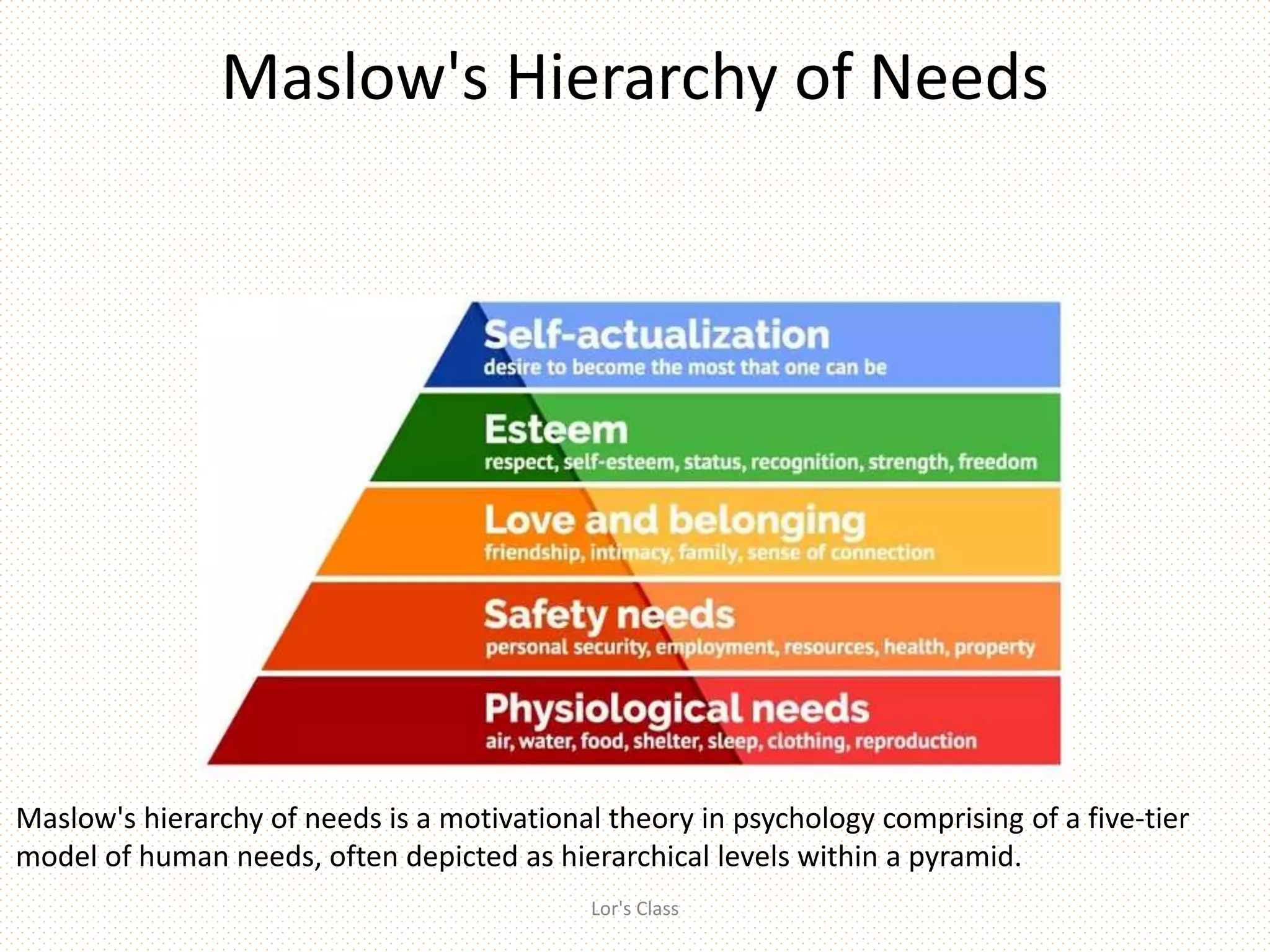
Maslow's hierarchy of needs is a motivational theory in psychology comprising of a five-tier
model of human needs, often depicted as hierarchical levels within a pyramid.
Lor's Class
Maslow's Hierarchy of Needs
• Abraham Maslow stated that people
are motivated to achieve certain needs
and that some needs take precedence
over others.
• He also noted that the order of needs
might be flexible based on external
circumstances or individual
differences. For example, for some
individuals, the need for self-esteem is
more important than the need for
love. For others, the need for creative
fulfillment may supersede even the
most basic needs.
• 1. Physiological needs -
these are biological
requirements for human
survival, e.g. air, food,
drink, shelter, clothing,
warmth, sex, sleep.
• If these needs are not
satisfied the human
body cannot function
optimally. Maslow
considered physiological
needs the most
important as all the
other needs become
secondary until these
needs are met.
Lor's Class
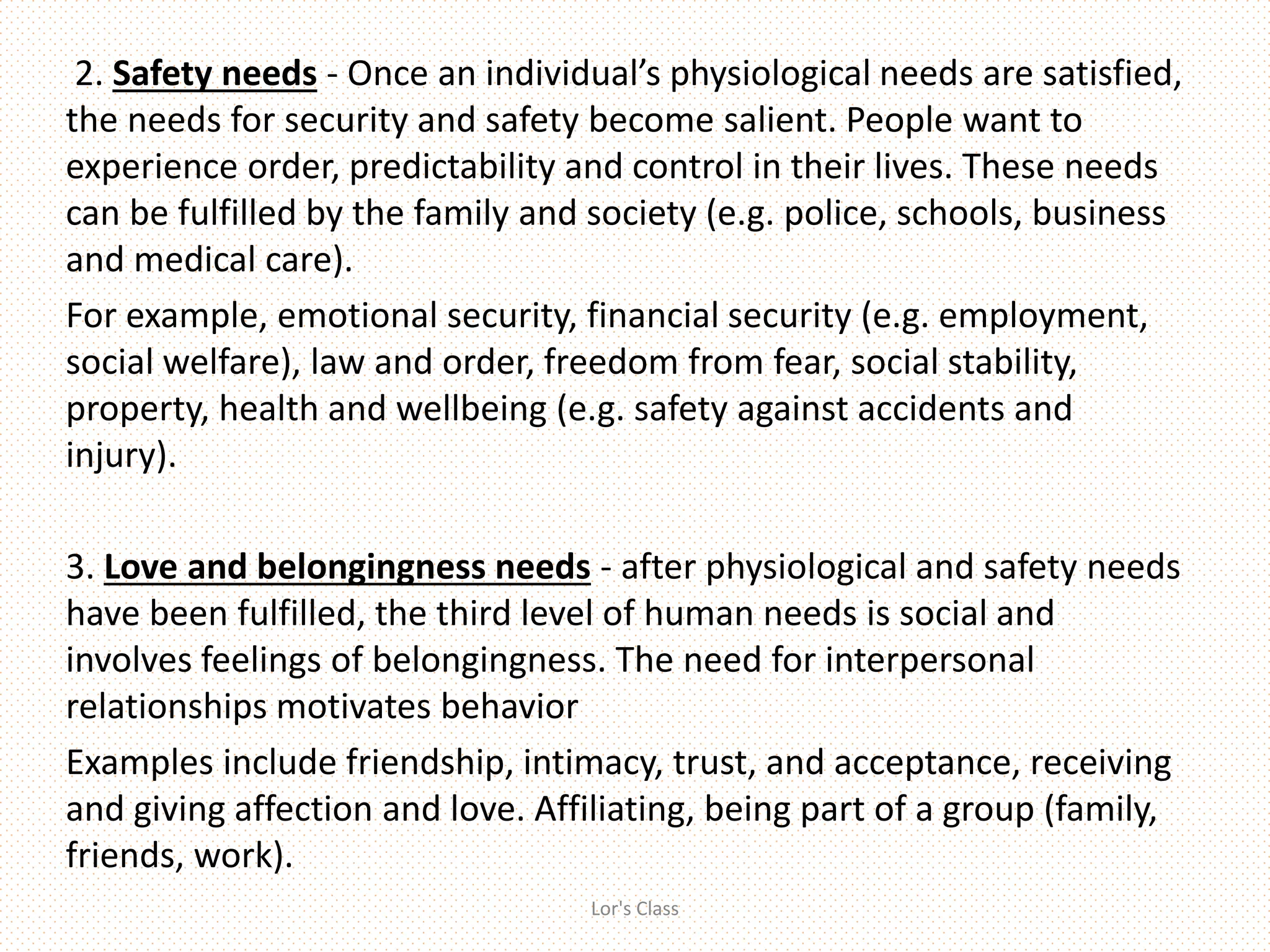
2. Safety needs - Once an individual’s physiological needs are satisfied,
the needs for security and safety become salient. People want to
experience order, predictability and control in their lives. These needs
can be fulfilled by the family and society (e.g. police, schools, business
and medical care).
For example, emotional security, financial security (e.g. employment,
social welfare), law and order, freedom from fear, social stability,
property, health and wellbeing (e.g. safety against accidents and
injury).
3. Love and belongingness needs - after physiological and safety needs
have been fulfilled, the third level of human needs is social and
involves feelings of belongingness. The need for interpersonal
relationships motivates behavior
Examples include friendship, intimacy, trust, and acceptance, receiving
and giving affection and love. Affiliating, being part of a group (family,
friends, work).
Lor's Class
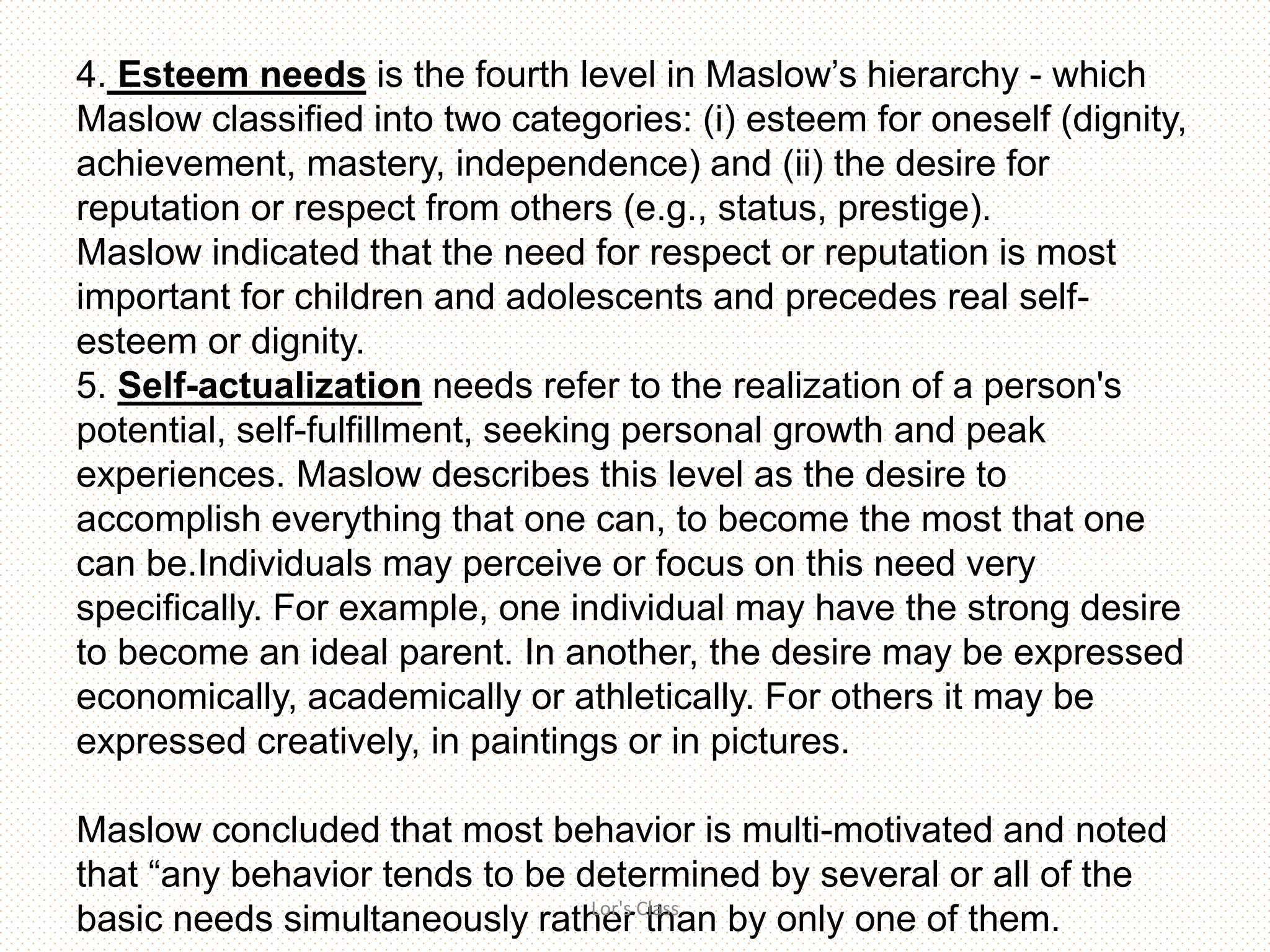
4. Esteem needs is the fourth level in Maslow’s hierarchy - which
Maslow classified into two categories: (i) esteem for oneself (dignity,
achievement, mastery, independence) and (ii) the desire for
reputation or respect from others (e.g., status, prestige).
Maslow indicated that the need for respect or reputation is most
important for children and adolescents and precedes real self-
esteem or dignity.
5. Self-actualization needs refer to the realization of a person's
potential, self-fulfillment, seeking personal growth and peak
experiences. Maslow describes this level as the desire to
accomplish everything that one can, to become the most that one
can be.Individuals may perceive or focus on this need very
specifically. For example, one individual may have the strong desire
to become an ideal parent. In another, the desire may be expressed
economically, academically or athletically. For others it may be
expressed creatively, in paintings or in pictures.
Maslow concluded that most behavior is multi-motivated and noted
that “any behavior tends to be determined by several or all of the
basic needs simultaneously rather than by only one of them.Lor's Class
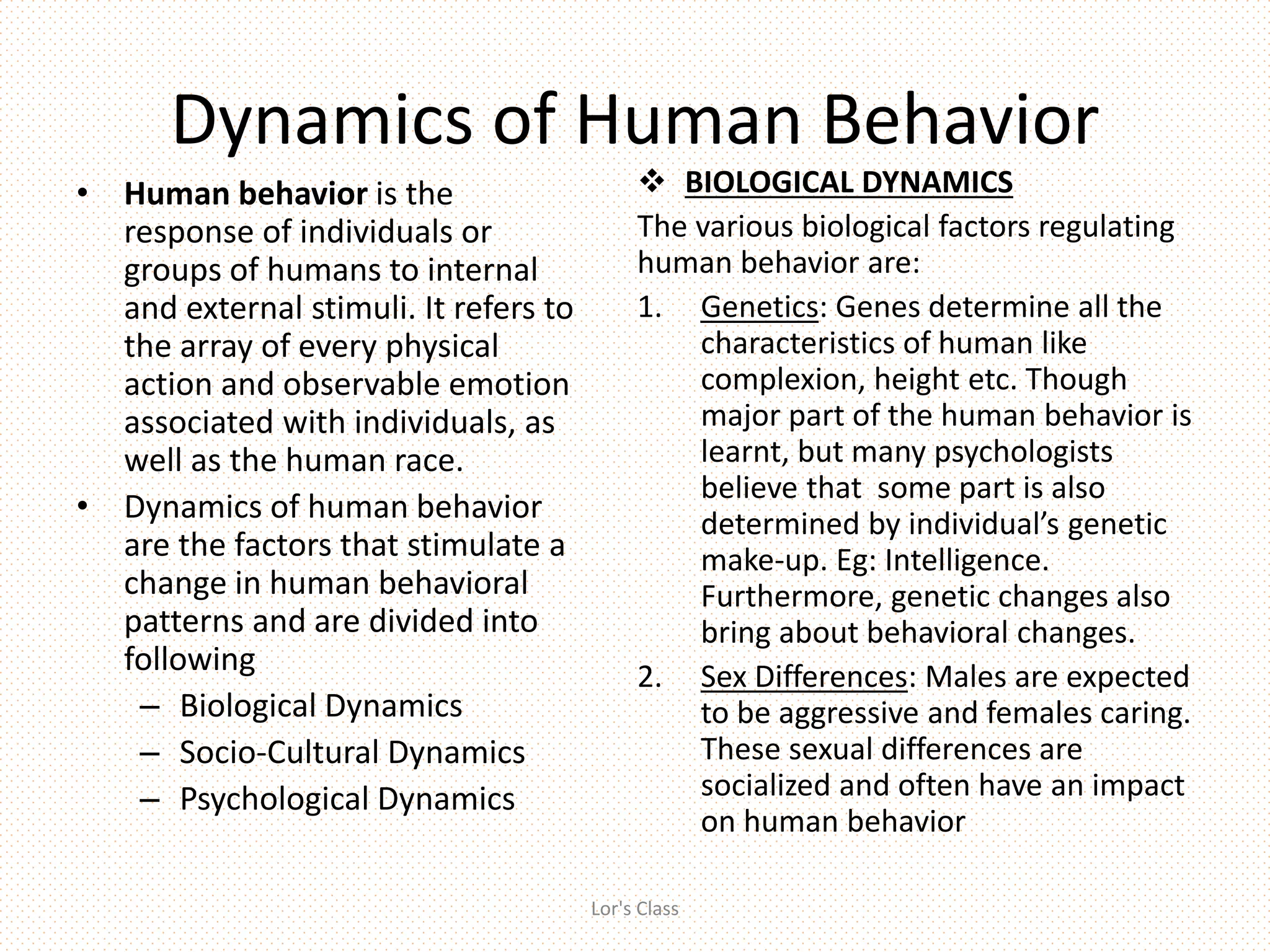
Dynamics of Human Behavior
• Human behavior is the
response of individuals or
groups of humans to internal
and external stimuli. It refers to
the array of every physical
action and observable emotion
associated with individuals, as
well as the human race.
• Dynamics of human behavior
are the factors that stimulate a
change in human behavioral
patterns and are divided into
following
– Biological Dynamics
– Socio-Cultural Dynamics
– Psychological Dynamics
 BIOLOGICAL DYNAMICS
The various biological factors regulating
human behavior are:
1. Genetics: Genes determine all the
characteristics of human like
complexion, height etc. Though
major part of the human behavior is
learnt, but many psychologists
believe that some part is also
determined by individual’s genetic
make-up. Eg: Intelligence.
Furthermore, genetic changes also
bring about behavioral changes.
2. Sex Differences: Males are expected
to be aggressive and females caring.
These sexual differences are
socialized and often have an impact
on human behavior
Lor's Class
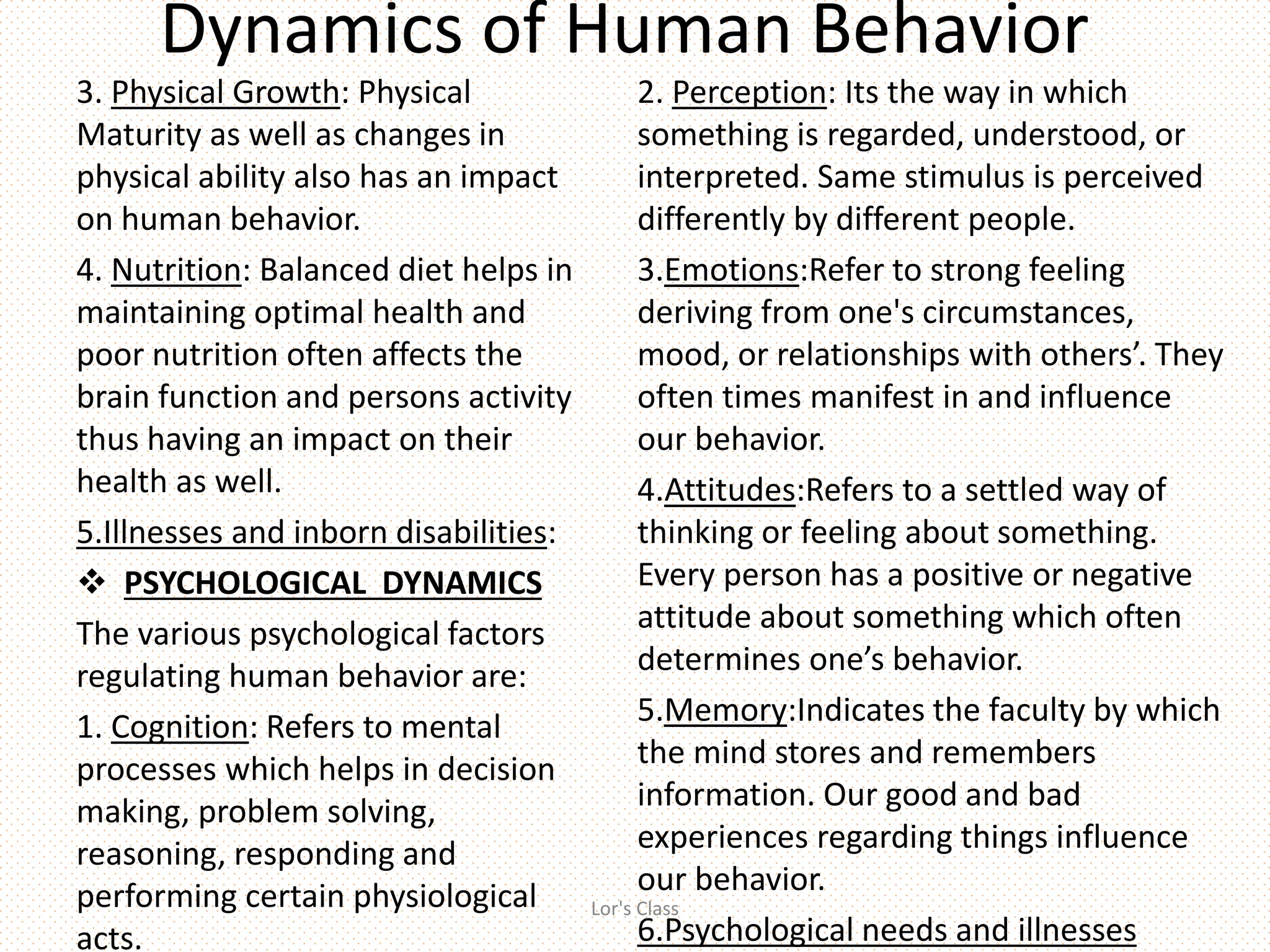
Dynamics of Human Behavior
3. Physical Growth: Physical
Maturity as well as changes in
physical ability also has an impact
on human behavior.
4. Nutrition: Balanced diet helps in
maintaining optimal health and
poor nutrition often affects the
brain function and persons activity
thus having an impact on their
health as well.
5.Illnesses and inborn disabilities:
 PSYCHOLOGICAL DYNAMICS
The various psychological factors
regulating human behavior are:
1. Cognition: Refers to mental
processes which helps in decision
making, problem solving,
reasoning, responding and
performing certain physiological
acts.
2. Perception: Its the way in which
something is regarded, understood, or
interpreted. Same stimulus is perceived
differently by different people.
3.Emotions:Refer to strong feeling
deriving from one's circumstances,
mood, or relationships with others’. They
often times manifest in and influence
our behavior.
4.Attitudes:Refers to a settled way of
thinking or feeling about something.
Every person has a positive or negative
attitude about something which often
determines one’s behavior.
5.Memory:Indicates the faculty by which
the mind stores and remembers
information. Our good and bad
experiences regarding things influence
our behavior.
6.Psychological needs and illnesses
Lor's Class
Dynamics of Human Behavior
 SOCIO-CULTURAL DYNAMICS
Social factors impacting human
behavior are:
• Social Norms and values,
standard of living, educational
and social status, impact of
technological advancements,
family structure, social
activities, religious beliefs,
economical status, impacts of
modernization and
urbanization, social
preferences towards clothing
and foods, and gender
expectations.
Cultural factors impacting human
behavior are:
• Traditions, customs, language
changes, cultural ceremonies,
ethnocentrism and
xenocentrism, cultural
variations and responses ,
cultural music norms and
values.
Lor's Class
References
• https://www.simplypsychology.org/maslow.ht
ml
• https://www.studyandexam.com/behaviour-
dynamics.html
• https://www.slideshare.net/ShaellsJoshi/basic
-human-needs-growth-and-
development?qid=7e96097d-aee9-4f2d-8a98-
a53b96c69d42&v=&b=&from_search=1
Lor's Class
Thank you
Lor's Class

Basic human needs and dynamics of human behavior for nursing students

  • 1.
    Basic Human Needs and Dynamicsof Human Behavior By Mrs. Lorita Furtado Asst.Lecturer Q.H.C. College of Nursing Lor's Class
  • 2.
    Introduction  NEEDS • Aneed is something that is necessary for an organism to live a healthy life. • Its deficiency causes a clear adverse outcome: a dysfunction or death • Needs can be -Objective: Eg:Need for food -Subjective: Eg: Self Esteem need  DRIVE • Its an urgent basic need pressing for satisfaction, usually rooted in some physiological tension, deficiency, or imbalance (e.g., hunger and thirst) and impelling the organism to action. • Drives can be – Innate= directly related to basic physiological needs (e.g., food, air, and water) – Learned (e.g., drug addiction). Lor's Class
  • 3.
    Maslow's Hierarchy ofNeeds Maslow's hierarchy of needs is a motivational theory in psychology comprising of a five-tier model of human needs, often depicted as hierarchical levels within a pyramid. Lor's Class
  • 4.
    Maslow's Hierarchy ofNeeds • Abraham Maslow stated that people are motivated to achieve certain needs and that some needs take precedence over others. • He also noted that the order of needs might be flexible based on external circumstances or individual differences. For example, for some individuals, the need for self-esteem is more important than the need for love. For others, the need for creative fulfillment may supersede even the most basic needs. • 1. Physiological needs - these are biological requirements for human survival, e.g. air, food, drink, shelter, clothing, warmth, sex, sleep. • If these needs are not satisfied the human body cannot function optimally. Maslow considered physiological needs the most important as all the other needs become secondary until these needs are met. Lor's Class
  • 5.
    2. Safety needs- Once an individual’s physiological needs are satisfied, the needs for security and safety become salient. People want to experience order, predictability and control in their lives. These needs can be fulfilled by the family and society (e.g. police, schools, business and medical care). For example, emotional security, financial security (e.g. employment, social welfare), law and order, freedom from fear, social stability, property, health and wellbeing (e.g. safety against accidents and injury). 3. Love and belongingness needs - after physiological and safety needs have been fulfilled, the third level of human needs is social and involves feelings of belongingness. The need for interpersonal relationships motivates behavior Examples include friendship, intimacy, trust, and acceptance, receiving and giving affection and love. Affiliating, being part of a group (family, friends, work). Lor's Class
  • 6.
    4. Esteem needsis the fourth level in Maslow’s hierarchy - which Maslow classified into two categories: (i) esteem for oneself (dignity, achievement, mastery, independence) and (ii) the desire for reputation or respect from others (e.g., status, prestige). Maslow indicated that the need for respect or reputation is most important for children and adolescents and precedes real self- esteem or dignity. 5. Self-actualization needs refer to the realization of a person's potential, self-fulfillment, seeking personal growth and peak experiences. Maslow describes this level as the desire to accomplish everything that one can, to become the most that one can be.Individuals may perceive or focus on this need very specifically. For example, one individual may have the strong desire to become an ideal parent. In another, the desire may be expressed economically, academically or athletically. For others it may be expressed creatively, in paintings or in pictures. Maslow concluded that most behavior is multi-motivated and noted that “any behavior tends to be determined by several or all of the basic needs simultaneously rather than by only one of them.Lor's Class
  • 7.
    Dynamics of HumanBehavior • Human behavior is the response of individuals or groups of humans to internal and external stimuli. It refers to the array of every physical action and observable emotion associated with individuals, as well as the human race. • Dynamics of human behavior are the factors that stimulate a change in human behavioral patterns and are divided into following – Biological Dynamics – Socio-Cultural Dynamics – Psychological Dynamics  BIOLOGICAL DYNAMICS The various biological factors regulating human behavior are: 1. Genetics: Genes determine all the characteristics of human like complexion, height etc. Though major part of the human behavior is learnt, but many psychologists believe that some part is also determined by individual’s genetic make-up. Eg: Intelligence. Furthermore, genetic changes also bring about behavioral changes. 2. Sex Differences: Males are expected to be aggressive and females caring. These sexual differences are socialized and often have an impact on human behavior Lor's Class
  • 8.
    Dynamics of HumanBehavior 3. Physical Growth: Physical Maturity as well as changes in physical ability also has an impact on human behavior. 4. Nutrition: Balanced diet helps in maintaining optimal health and poor nutrition often affects the brain function and persons activity thus having an impact on their health as well. 5.Illnesses and inborn disabilities:  PSYCHOLOGICAL DYNAMICS The various psychological factors regulating human behavior are: 1. Cognition: Refers to mental processes which helps in decision making, problem solving, reasoning, responding and performing certain physiological acts. 2. Perception: Its the way in which something is regarded, understood, or interpreted. Same stimulus is perceived differently by different people. 3.Emotions:Refer to strong feeling deriving from one's circumstances, mood, or relationships with others’. They often times manifest in and influence our behavior. 4.Attitudes:Refers to a settled way of thinking or feeling about something. Every person has a positive or negative attitude about something which often determines one’s behavior. 5.Memory:Indicates the faculty by which the mind stores and remembers information. Our good and bad experiences regarding things influence our behavior. 6.Psychological needs and illnesses Lor's Class
  • 9.
    Dynamics of HumanBehavior  SOCIO-CULTURAL DYNAMICS Social factors impacting human behavior are: • Social Norms and values, standard of living, educational and social status, impact of technological advancements, family structure, social activities, religious beliefs, economical status, impacts of modernization and urbanization, social preferences towards clothing and foods, and gender expectations. Cultural factors impacting human behavior are: • Traditions, customs, language changes, cultural ceremonies, ethnocentrism and xenocentrism, cultural variations and responses , cultural music norms and values. Lor's Class
  • 10.
    References • https://www.simplypsychology.org/maslow.ht ml • https://www.studyandexam.com/behaviour- dynamics.html •https://www.slideshare.net/ShaellsJoshi/basic -human-needs-growth-and- development?qid=7e96097d-aee9-4f2d-8a98- a53b96c69d42&v=&b=&from_search=1 Lor's Class
  • 11.