Dental Anatomy
Lecture 7
Permanent Canines
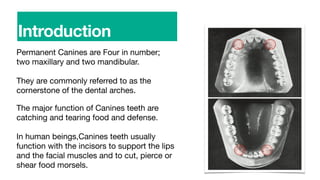
Permanent Canines are Four in number;
two maxillary and two mandibular.
They are commonly referred to as the
cornerstone of the dental arches.
The major function of Canines teeth are
catching and tearing food and defense.
In human beings,Canines teeth usually
function with the incisors to support the lips
and the facial muscles and to cut, pierce or
shear food morsels.
Introduction
Characteristic features of Canines
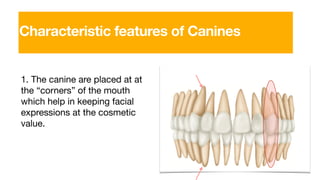
1. The canine are placed at at
the ā€œcornersā€ of the mouth
which help in keeping facial
expressions at the cosmetic
value.
2. The canines are the longest
teeth in the mouth.
Characteristic features of Canines
3. The canines are the strongest
teeth in the mouth.
Characteristic features of Canines
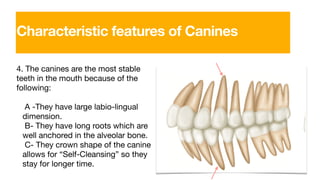
4. The canines are the most stable
teeth in the mouth because of the
following:
A -They have large labio-lingual
dimension.
B- They have long roots which are
well anchored in the alveolar bone.
C- They crown shape of the canine
allows for ā€œSelf-Cleansingā€ so they
stay for longer time.
Characteristic features of Canines
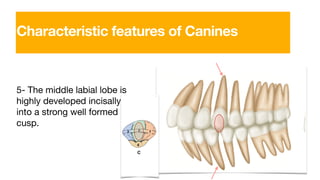
5- The middle labial lobe is
highly developed incisally
into a strong well formed
cusp.
Characteristic features of Canines
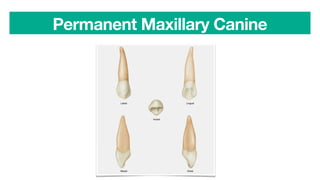
Permanent Maxillary Canine
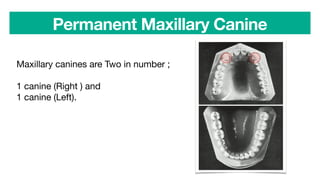
Maxillary canines are Two in number ;
1 canine (Right ) and
1 canine (Left).
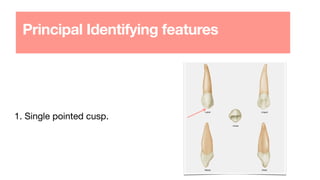
1. Single pointed cusp.
Principal Identifying features
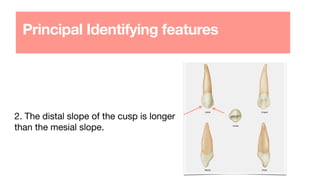
2. The distal slope of the cusp is longer
than the mesial slope.
Principal Identifying features
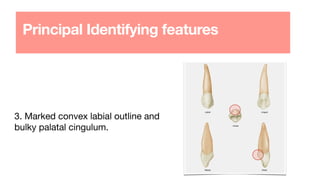
3. Marked convex labial outline and
bulky palatal cingulum.
Principal Identifying features
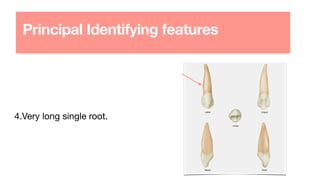
4.Very long single root.
Principal Identifying features
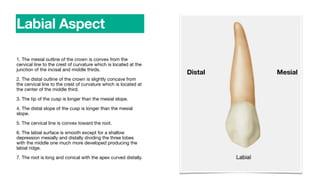
1. The mesial outline of the crown is convex from the
cervical line to the crest of curvature which is located at the
junction of the incisal and middle thirds.
2. The distal outline of the crown is slightly concave from
the cervical line to the crest of curvature which is located at
the center of the middle third.
3. The tip of the cusp is longer than the mesial slope.
4. The distal slope of the cusp is longer than the mesial
slope.
5. The cervical line is convex toward the root.
6. The labial surface is smooth except for a shallow
depression mesially and distally dividing the three lobes
with the middle one much more developed producing the
labial ridge.
7. The root is long and conical with the apex curved distally.
Labial Aspect
Distal Mesial
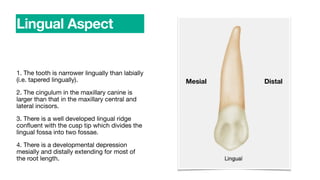
1. The tooth is narrower lingually than labially
(i.e. tapered lingually).
2. The cingulum in the maxillary canine is
larger than that in the maxillary central and
lateral incisors.
3. There is a well developed lingual ridge
con
fl
uent with the cusp tip which divides the
lingual fossa into two fossae.
4. There is a developmental depression
mesially and distally extending for most of
the root length.
Lingual Aspect
Distal
Mesial
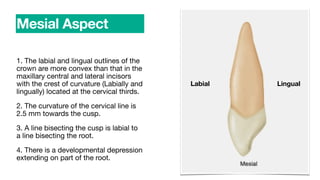
1. The labial and lingual outlines of the
crown are more convex than that in the
maxillary central and lateral incisors
with the crest of curvature (Labially and
lingually) located at the cervical thirds.
2. The curvature of the cervical line is
2.5 mm towards the cusp.
3. A line bisecting the cusp is labial to
a line bisecting the root.
4. There is a developmental depression
extending on part of the root.
Mesial Aspect
Labial Lingual
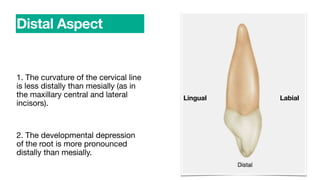
1. The curvature of the cervical line
is less distally than mesially (as in
the maxillary central and lateral
incisors).
2. The developmental depression
of the root is more pronounced
distally than mesially.
Distal Aspect
Labial
Lingual
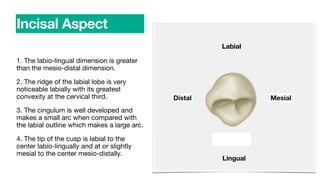
1. The labio-lingual dimension is greater
than the mesio-distal dimension.
2. The ridge of the labial lobe is very
noticeable labially with its greatest
convexity at the cervical third.
3. The cingulum is well developed and
makes a small arc when compared with
the labial outline which makes a large arc.
4. The tip of the cusp is labial to the
center labio-lingually and at or slightly
mesial to the center mesio-distally.
Incisal Aspect
Labial
Lingual
Distal Mesial
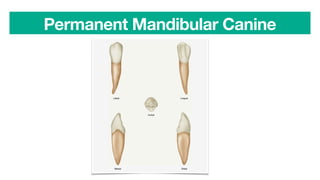
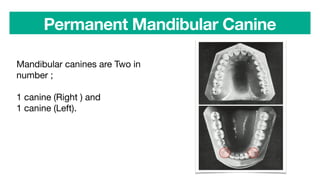
Permanent Mandibular Canine
Mandibular canines are Two in
number ;
1 canine (Right ) and
1 canine (Left).
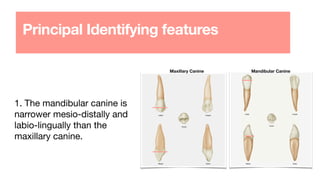
Principal Identifying features
1. The mandibular canine is
narrower mesio-distally and
labio-lingually than the
maxillary canine.
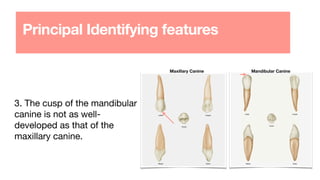
Maxillary Canine Mandibular Canine
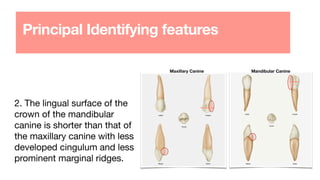
Principal Identifying features
2. The lingual surface of the
crown of the mandibular
canine is shorter than that of
the maxillary canine with less
developed cingulum and less
prominent marginal ridges.
Maxillary Canine Mandibular Canine
Principal Identifying features
3. The cusp of the mandibular
canine is not as well-
developed as that of the
maxillary canine.
Principal Identifying features
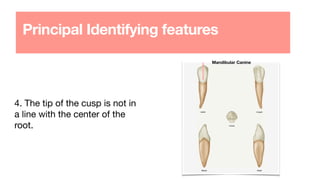
4. The tip of the cusp is not in
a line with the center of the
root.
Mandibular Canine
Principal Identifying features
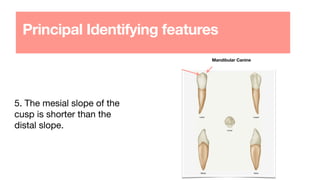
5. The mesial slope of the
cusp is shorter than the
distal slope.
Mandibular Canine
Principal Identifying features
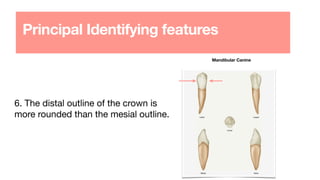
6. The distal outline of the crown is
more rounded than the mesial outline.
Mandibular Canine
Principal Identifying features
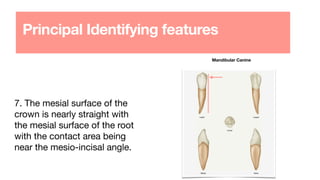
7. The mesial surface of the
crown is nearly straight with
the mesial surface of the root
with the contact area being
near the mesio-incisal angle.
Mandibular Canine
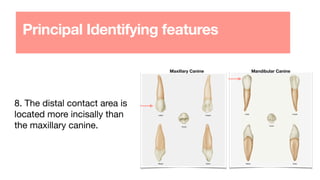
Maxillary Canine Mandibular Canine
Principal Identifying features
8. The distal contact area is
located more incisally than
the maxillary canine.
END

Tutorial, Lecture 7 .pdf

  • 1.
  • 2.
    Permanent Canines areFour in number; two maxillary and two mandibular. They are commonly referred to as the cornerstone of the dental arches. The major function of Canines teeth are catching and tearing food and defense. In human beings,Canines teeth usually function with the incisors to support the lips and the facial muscles and to cut, pierce or shear food morsels. Introduction
  • 3.
    Characteristic features ofCanines 1. The canine are placed at at the ā€œcornersā€ of the mouth which help in keeping facial expressions at the cosmetic value.
  • 4.
    2. The caninesare the longest teeth in the mouth. Characteristic features of Canines
  • 5.
    3. The caninesare the strongest teeth in the mouth. Characteristic features of Canines
  • 6.
    4. The caninesare the most stable teeth in the mouth because of the following: A -They have large labio-lingual dimension. B- They have long roots which are well anchored in the alveolar bone. C- They crown shape of the canine allows for ā€œSelf-Cleansingā€ so they stay for longer time. Characteristic features of Canines
  • 7.
    5- The middlelabial lobe is highly developed incisally into a strong well formed cusp. Characteristic features of Canines
  • 8.
  • 9.
    Permanent Maxillary Canine Maxillarycanines are Two in number ; 1 canine (Right ) and 1 canine (Left).
  • 10.
    1. Single pointedcusp. Principal Identifying features
  • 11.
    2. The distalslope of the cusp is longer than the mesial slope. Principal Identifying features
  • 12.
    3. Marked convexlabial outline and bulky palatal cingulum. Principal Identifying features
  • 13.
    4.Very long singleroot. Principal Identifying features
  • 14.
    1. The mesialoutline of the crown is convex from the cervical line to the crest of curvature which is located at the junction of the incisal and middle thirds. 2. The distal outline of the crown is slightly concave from the cervical line to the crest of curvature which is located at the center of the middle third. 3. The tip of the cusp is longer than the mesial slope. 4. The distal slope of the cusp is longer than the mesial slope. 5. The cervical line is convex toward the root. 6. The labial surface is smooth except for a shallow depression mesially and distally dividing the three lobes with the middle one much more developed producing the labial ridge. 7. The root is long and conical with the apex curved distally. Labial Aspect Distal Mesial
  • 15.
    1. The toothis narrower lingually than labially (i.e. tapered lingually). 2. The cingulum in the maxillary canine is larger than that in the maxillary central and lateral incisors. 3. There is a well developed lingual ridge con fl uent with the cusp tip which divides the lingual fossa into two fossae. 4. There is a developmental depression mesially and distally extending for most of the root length. Lingual Aspect Distal Mesial
  • 16.
    1. The labialand lingual outlines of the crown are more convex than that in the maxillary central and lateral incisors with the crest of curvature (Labially and lingually) located at the cervical thirds. 2. The curvature of the cervical line is 2.5 mm towards the cusp. 3. A line bisecting the cusp is labial to a line bisecting the root. 4. There is a developmental depression extending on part of the root. Mesial Aspect Labial Lingual
  • 17.
    1. The curvatureof the cervical line is less distally than mesially (as in the maxillary central and lateral incisors). 2. The developmental depression of the root is more pronounced distally than mesially. Distal Aspect Labial Lingual
  • 18.
    1. The labio-lingualdimension is greater than the mesio-distal dimension. 2. The ridge of the labial lobe is very noticeable labially with its greatest convexity at the cervical third. 3. The cingulum is well developed and makes a small arc when compared with the labial outline which makes a large arc. 4. The tip of the cusp is labial to the center labio-lingually and at or slightly mesial to the center mesio-distally. Incisal Aspect Labial Lingual Distal Mesial
  • 19.
  • 20.
    Permanent Mandibular Canine Mandibularcanines are Two in number ; 1 canine (Right ) and 1 canine (Left).
  • 21.
    Principal Identifying features 1.The mandibular canine is narrower mesio-distally and labio-lingually than the maxillary canine. Maxillary Canine Mandibular Canine
  • 22.
    Principal Identifying features 2.The lingual surface of the crown of the mandibular canine is shorter than that of the maxillary canine with less developed cingulum and less prominent marginal ridges. Maxillary Canine Mandibular Canine
  • 23.
    Maxillary Canine MandibularCanine Principal Identifying features 3. The cusp of the mandibular canine is not as well- developed as that of the maxillary canine.
  • 24.
    Principal Identifying features 4.The tip of the cusp is not in a line with the center of the root. Mandibular Canine
  • 25.
    Principal Identifying features 5.The mesial slope of the cusp is shorter than the distal slope. Mandibular Canine
  • 26.
    Principal Identifying features 6.The distal outline of the crown is more rounded than the mesial outline. Mandibular Canine
  • 27.
    Principal Identifying features 7.The mesial surface of the crown is nearly straight with the mesial surface of the root with the contact area being near the mesio-incisal angle. Mandibular Canine
  • 28.
    Maxillary Canine MandibularCanine Principal Identifying features 8. The distal contact area is located more incisally than the maxillary canine.
  • 29.