Presented by:-
Smt. Jyotsnarani Panda
Asst. Professor of Chemistry, F.M. (Auto) College ,
Balasore
PEPTIDES
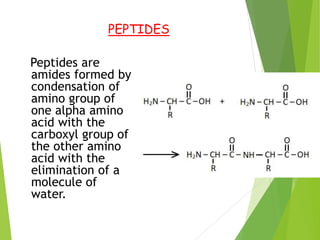
Peptides are
amides formed by
condensation of
amino group of
one alpha amino
acid with the
carboxyl group of
the other amino
acid with the
elimination of a
molecule of
water.
N-Terminal & C-Terminal Amino Acid
Residues
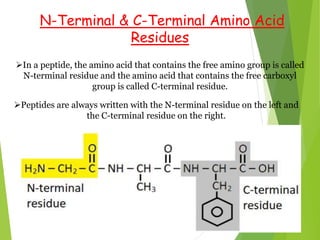
In a peptide, the amino acid that contains the free amino group is called
N-terminal residue and the amino acid that contains the free carboxyl
group is called C-terminal residue.
Peptides are always written with the N-terminal residue on the left and
the C-terminal residue on the right.
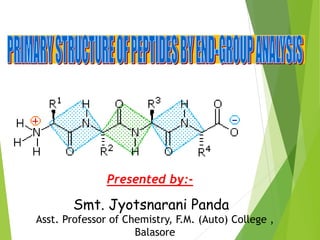
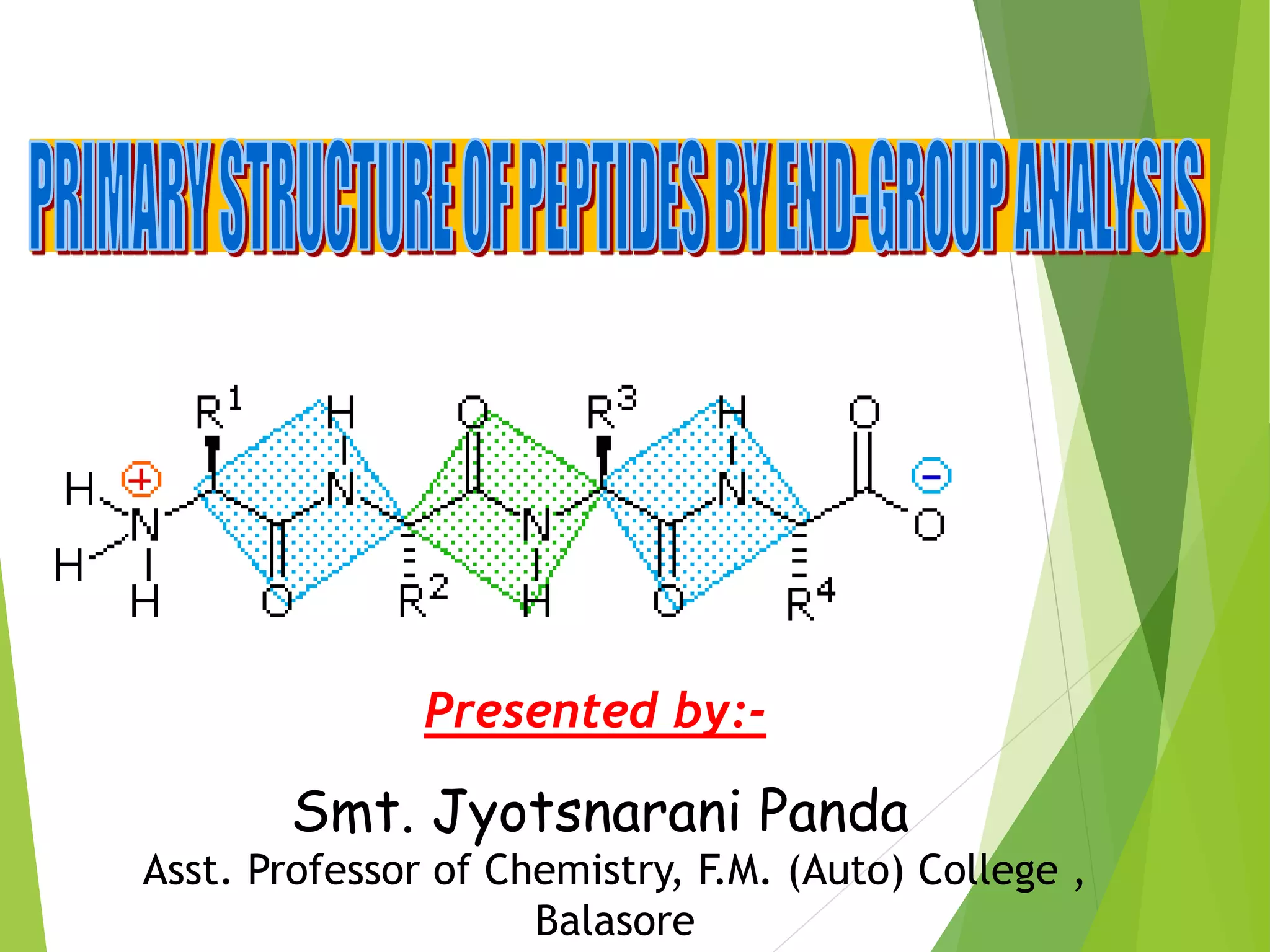
X-ray analysis has revealed that the entire peptide linkage is
flat.
Structure Of Peptide Linkage
In a peptide linkage the oxygen atom and the hydrogen atom
bonded to N, are trans to each other.
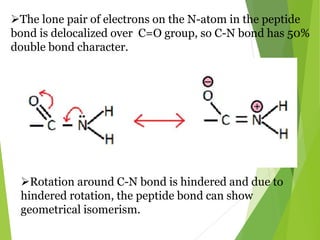
The lone pair of electrons on the N-atom in the peptide
bond is delocalized over C=O group, so C-N bond has 50%
double bond character.
Rotation around C-N bond is hindered and due to
hindered rotation, the peptide bond can show
geometrical isomerism.
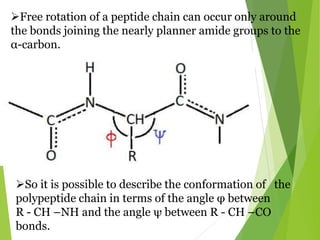
Free rotation of a peptide chain can occur only around
the bonds joining the nearly planner amide groups to the
α-carbon.
So it is possible to describe the conformation of the
polypeptide chain in terms of the angle φ between
R - CH –NH and the angle ψ between R - CH –CO
bonds.
Determination of Primary Structure of Peptides:-
The exact sequence of the amino acids that are present in a
polypeptide chain, is called the primary structure of the
polypeptide.
The polypeptide is treated with a suitable reagent which
reacts either with the N-terminal or the C-terminal amino acid
residue to form the tagged peptide.
The tagged peptide is then subjected to partial hydrolysis
that releases the tagged amino acid which is then identified.
This process is repeated a number of times till the entire
peptide chain is degraded and all the amino acids are
identified.
END GROUP ANALYSIS:-
N-terminal residue analysis:-
Sanger’s Method:-
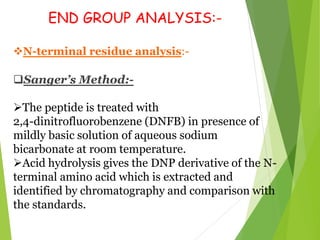
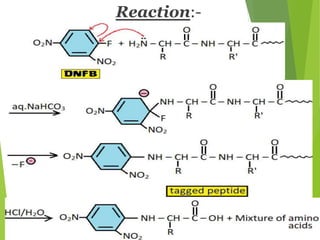
The peptide is treated with
2,4-dinitrofluorobenzene (DNFB) in presence of
mildly basic solution of aqueous sodium
bicarbonate at room temperature.
Acid hydrolysis gives the DNP derivative of the N-
terminal amino acid which is extracted and
identified by chromatography and comparison with
the standards.
Reaction:-
Dansyl Method:-
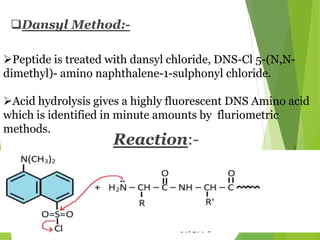
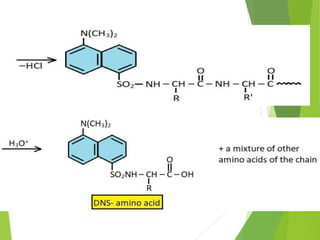
Peptide is treated with dansyl chloride, DNS-Cl 5-(N,N-
dimethyl)- amino naphthalene-1-sulphonyl chloride.
Acid hydrolysis gives a highly fluorescent DNS Amino acid
which is identified in minute amounts by fluriometric
methods.
Reaction:-
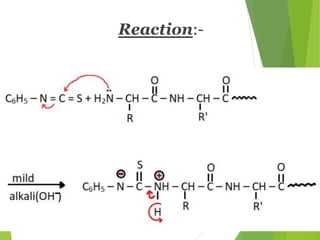
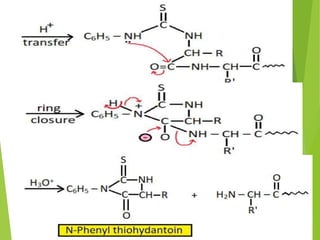
Edman Degradation:-
Nucleophilic addition of the free amino group of the
polypeptide to the C=N of phenyl isothiocyanate in a mild
basic medium.
Ring closure forms a N-phenylthiohydantoin which
detaches itself from the rest of the peptide which remains
intact with all its sequences.
N-phenylthiohydantoin is identified chromatographically
by comparing with standards. This leads to identification of
N-terminal amino acid.
The residual peptide chain is subjected to Edman
degradation repeatedly and all the amino acids in the
polypeptide are identified.
Reaction:-
C-terminal Residue Analysis:-
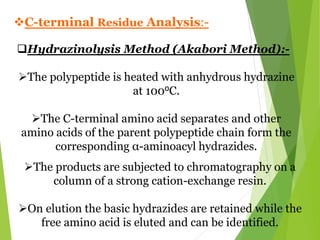
Hydrazinolysis Method (Akabori Method):-
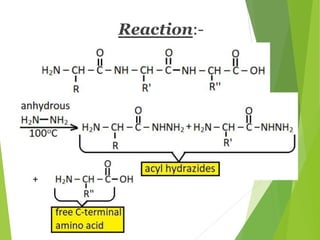
The polypeptide is heated with anhydrous hydrazine
at 100oC.
The C-terminal amino acid separates and other
amino acids of the parent polypeptide chain form the
corresponding α-aminoacyl hydrazides.
The products are subjected to chromatography on a
column of a strong cation-exchange resin.
On elution the basic hydrazides are retained while the
free amino acid is eluted and can be identified.
Reaction:-
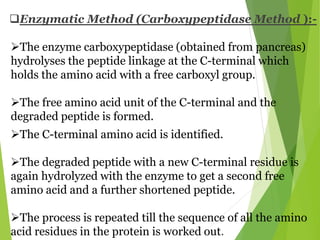
Enzymatic Method (Carboxypeptidase Method ):-
The enzyme carboxypeptidase (obtained from pancreas)
hydrolyses the peptide linkage at the C-terminal which
holds the amino acid with a free carboxyl group.
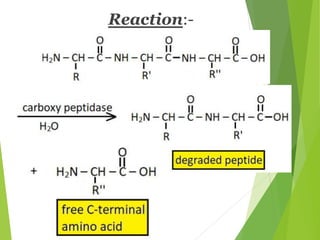
The free amino acid unit of the C-terminal and the
degraded peptide is formed.
The C-terminal amino acid is identified.
The degraded peptide with a new C-terminal residue is
again hydrolyzed with the enzyme to get a second free
amino acid and a further shortened peptide.
The process is repeated till the sequence of all the amino
acid residues in the protein is worked out.
Reaction:-
PRIMARY STRUCTURE OF PEPTIDES

PRIMARY STRUCTURE OF PEPTIDES

  • 1.
    Presented by:- Smt. JyotsnaraniPanda Asst. Professor of Chemistry, F.M. (Auto) College , Balasore
  • 2.
    PEPTIDES Peptides are amides formedby condensation of amino group of one alpha amino acid with the carboxyl group of the other amino acid with the elimination of a molecule of water.
  • 3.
    N-Terminal & C-TerminalAmino Acid Residues In a peptide, the amino acid that contains the free amino group is called N-terminal residue and the amino acid that contains the free carboxyl group is called C-terminal residue. Peptides are always written with the N-terminal residue on the left and the C-terminal residue on the right.
  • 4.
    X-ray analysis hasrevealed that the entire peptide linkage is flat. Structure Of Peptide Linkage In a peptide linkage the oxygen atom and the hydrogen atom bonded to N, are trans to each other.
  • 5.
    The lone pairof electrons on the N-atom in the peptide bond is delocalized over C=O group, so C-N bond has 50% double bond character. Rotation around C-N bond is hindered and due to hindered rotation, the peptide bond can show geometrical isomerism.
  • 6.
    Free rotation ofa peptide chain can occur only around the bonds joining the nearly planner amide groups to the α-carbon. So it is possible to describe the conformation of the polypeptide chain in terms of the angle φ between R - CH –NH and the angle ψ between R - CH –CO bonds.
  • 7.
    Determination of PrimaryStructure of Peptides:- The exact sequence of the amino acids that are present in a polypeptide chain, is called the primary structure of the polypeptide. The polypeptide is treated with a suitable reagent which reacts either with the N-terminal or the C-terminal amino acid residue to form the tagged peptide. The tagged peptide is then subjected to partial hydrolysis that releases the tagged amino acid which is then identified. This process is repeated a number of times till the entire peptide chain is degraded and all the amino acids are identified.
  • 8.
    END GROUP ANALYSIS:- N-terminalresidue analysis:- Sanger’s Method:- The peptide is treated with 2,4-dinitrofluorobenzene (DNFB) in presence of mildly basic solution of aqueous sodium bicarbonate at room temperature. Acid hydrolysis gives the DNP derivative of the N- terminal amino acid which is extracted and identified by chromatography and comparison with the standards.
  • 9.
  • 10.
    Dansyl Method:- Peptide istreated with dansyl chloride, DNS-Cl 5-(N,N- dimethyl)- amino naphthalene-1-sulphonyl chloride. Acid hydrolysis gives a highly fluorescent DNS Amino acid which is identified in minute amounts by fluriometric methods. Reaction:-
  • 12.
    Edman Degradation:- Nucleophilic additionof the free amino group of the polypeptide to the C=N of phenyl isothiocyanate in a mild basic medium. Ring closure forms a N-phenylthiohydantoin which detaches itself from the rest of the peptide which remains intact with all its sequences. N-phenylthiohydantoin is identified chromatographically by comparing with standards. This leads to identification of N-terminal amino acid. The residual peptide chain is subjected to Edman degradation repeatedly and all the amino acids in the polypeptide are identified.
  • 13.
  • 15.
    C-terminal Residue Analysis:- HydrazinolysisMethod (Akabori Method):- The polypeptide is heated with anhydrous hydrazine at 100oC. The C-terminal amino acid separates and other amino acids of the parent polypeptide chain form the corresponding α-aminoacyl hydrazides. The products are subjected to chromatography on a column of a strong cation-exchange resin. On elution the basic hydrazides are retained while the free amino acid is eluted and can be identified.
  • 16.
  • 17.
    Enzymatic Method (CarboxypeptidaseMethod ):- The enzyme carboxypeptidase (obtained from pancreas) hydrolyses the peptide linkage at the C-terminal which holds the amino acid with a free carboxyl group. The free amino acid unit of the C-terminal and the degraded peptide is formed. The C-terminal amino acid is identified. The degraded peptide with a new C-terminal residue is again hydrolyzed with the enzyme to get a second free amino acid and a further shortened peptide. The process is repeated till the sequence of all the amino acid residues in the protein is worked out.
  • 18.