STRUCTURAL ELUCIDATION OF LACTOSE
Presented by;
M Pharm (Pharmaceutical Chemistry) students
Gunturu .Aparna
Akshintala. Sree Gayatri
Thota. Madhu latha
Kamre. Sunil
Daram. Sekhar
University college of pharmaceutical sciences
Department of pharmaceutical chemistry
Acharya Nagarjuna University
Guntur
1
STRUCTURAL ELUCIDATION OF
LACTOSE
 Lactose occures in mammalian milk, e.g.,cow’s milk
contains 4 to 6 % and human milk conains 5 to 8% of
this sugar.
 Lactose molecular formula is C12H22O11
 Lactose reduces on fehling’s solution, Tollen’s
solution and benedict’s solution, it forms an osazone
and exhibits mutarotation. Therfore, lactose must
possess at least one carbonyl group which is not
involved in he disaccharide linkage.
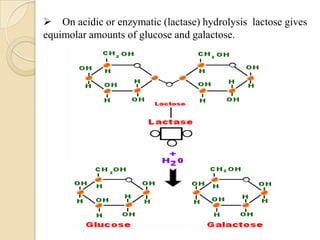
 On acidic or enzymatic (lactase) hydrolysis lactose gives
equimolar amounts of glucose and galactose.
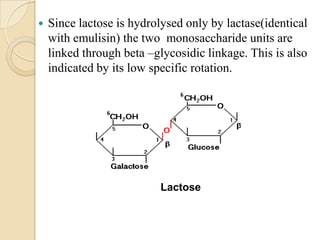
 Since lactose is hydrolysed only by lactase(identical
with emulisin) the two monosaccharide units are
linked through beta –glycosidic linkage. This is also
indicated by its low specific rotation.
Lactose
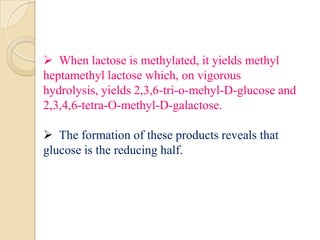
 When lactose is methylated, it yields methyl
heptamethyl lactose which, on vigorous
hydrolysis, yields 2,3,6-tri-o-mehyl-D-glucose and
2,3,4,6-tetra-O-methyl-D-galactose.
 The formation of these products reveals that
glucose is the reducing half.
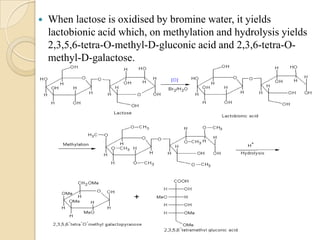
 When lactose is oxidised by bromine water, it yields
lactobionic acid which, on methylation and hydrolysis yields
2,3,5,6-tetra-O-methyl-D-gluconic acid and 2,3,6-tetra-O-
methyl-D-galactose.
 The formation of these products reveals that in lactose
C-1 of glucose is linked to C-4 of galactose.
 This further reveals that glucose is a reducing part and
D-galactose in non-reducing part in lactose.
 The point of linkage (C-4) of galactose unit is further
confirmed by osazone formation.
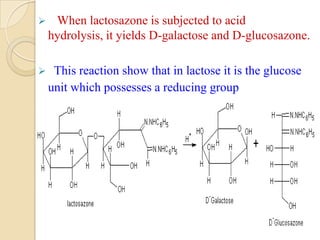
 When lactosazone is subjected to acid
hydrolysis, it yields D-galactose and D-glucosazone.
 This reaction show that in lactose it is the glucose
unit which possesses a reducing group
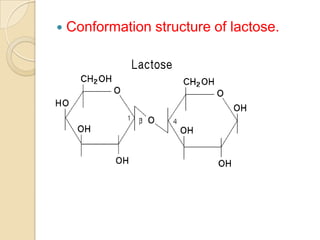
 Conformation structure of lactose.

Strucural elucidaion lactose

  • 1.
    STRUCTURAL ELUCIDATION OFLACTOSE Presented by; M Pharm (Pharmaceutical Chemistry) students Gunturu .Aparna Akshintala. Sree Gayatri Thota. Madhu latha Kamre. Sunil Daram. Sekhar University college of pharmaceutical sciences Department of pharmaceutical chemistry Acharya Nagarjuna University Guntur 1
  • 2.
  • 3.
     Lactose occuresin mammalian milk, e.g.,cow’s milk contains 4 to 6 % and human milk conains 5 to 8% of this sugar.  Lactose molecular formula is C12H22O11  Lactose reduces on fehling’s solution, Tollen’s solution and benedict’s solution, it forms an osazone and exhibits mutarotation. Therfore, lactose must possess at least one carbonyl group which is not involved in he disaccharide linkage.
  • 4.
     On acidicor enzymatic (lactase) hydrolysis lactose gives equimolar amounts of glucose and galactose.
  • 5.
     Since lactoseis hydrolysed only by lactase(identical with emulisin) the two monosaccharide units are linked through beta –glycosidic linkage. This is also indicated by its low specific rotation. Lactose
  • 6.
     When lactoseis methylated, it yields methyl heptamethyl lactose which, on vigorous hydrolysis, yields 2,3,6-tri-o-mehyl-D-glucose and 2,3,4,6-tetra-O-methyl-D-galactose.  The formation of these products reveals that glucose is the reducing half.
  • 7.
     When lactoseis oxidised by bromine water, it yields lactobionic acid which, on methylation and hydrolysis yields 2,3,5,6-tetra-O-methyl-D-gluconic acid and 2,3,6-tetra-O- methyl-D-galactose.
  • 8.
     The formationof these products reveals that in lactose C-1 of glucose is linked to C-4 of galactose.  This further reveals that glucose is a reducing part and D-galactose in non-reducing part in lactose.  The point of linkage (C-4) of galactose unit is further confirmed by osazone formation.
  • 9.
     When lactosazoneis subjected to acid hydrolysis, it yields D-galactose and D-glucosazone.  This reaction show that in lactose it is the glucose unit which possesses a reducing group
  • 10.