Pelvic floor and Perineal
body
Themba Hospital FCOG(SA) Part 1 Tutorials
By Dr N.E Manana
Pelvic floor
• The pelvic floor is formed by :
1. The pelvic diaphragm and
2. The perineal membrane and muscle of the deep perineal pouch
Pelvic diaphragm
• Is the muscular part of the pelvic floor, it is bowl shaped, attached
superiorly to the pelvic wall
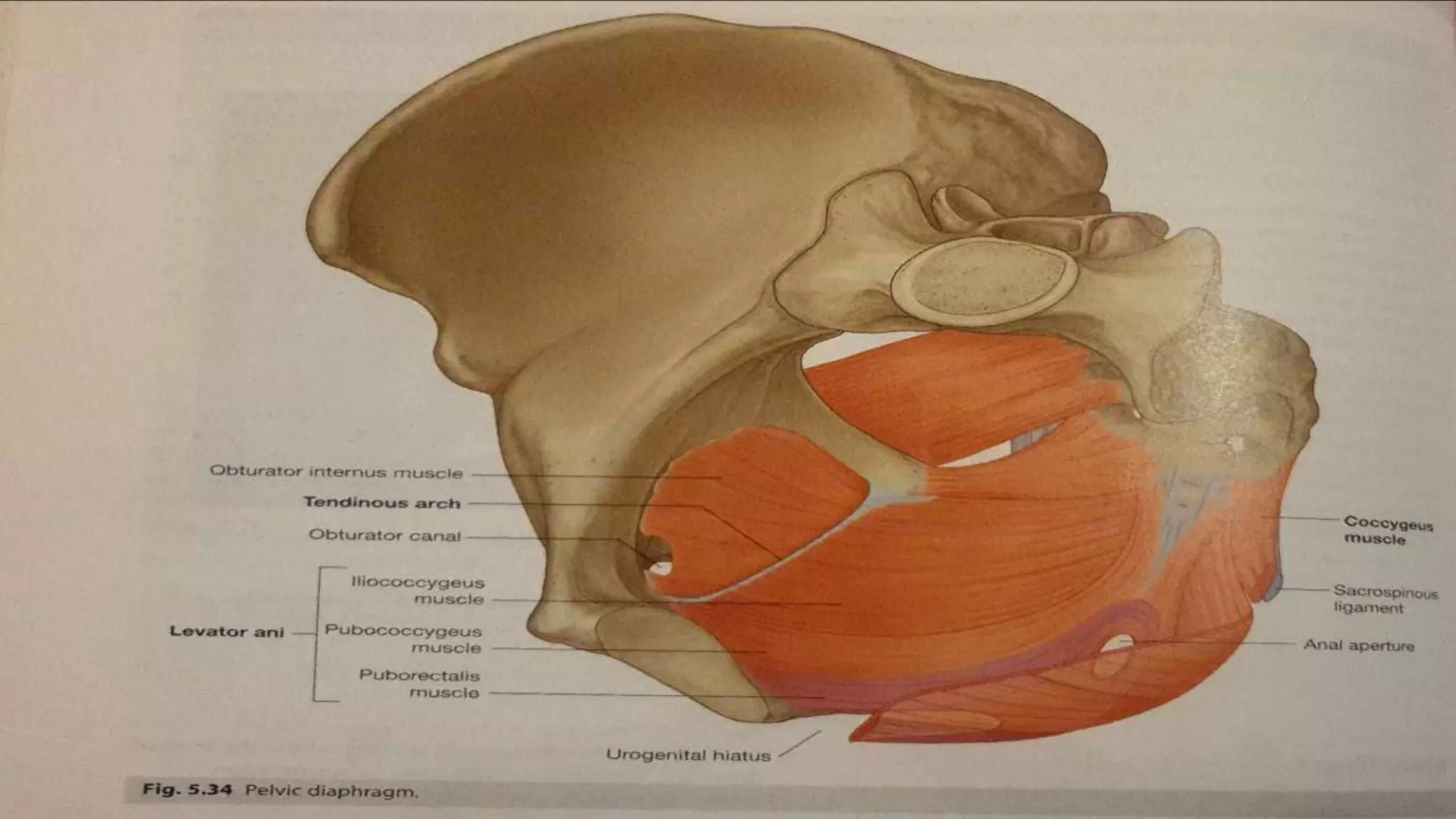
• It consists of the levator ani and the coccygeus muscles
• Its circular line of attachment passes between the sciatic foramen,
greater sciatic above and lesser sciatic below
• 5.34
Pelvic diaphragm
Levator ani
• The muscles originating from the pelvic wall, course medially and inferiorly
and join together in the midline
• Attachment to the pelvic wall follows a contour which include; posterior
pubic body, tendinous arch over the obturator internus muscle and ischial
spine
• In females the muscle blend together posterior to the vagina and around
the anus in anal aperture in both sexes (Anococcygeal ligament)
• Anteriorly they form a U-shaped defect (Urogenital hiatus)
• Levator ani has 3 collections of fibers: 1. Pubococcygeus, 2. Puborectalis
and 3. Iliococygeus muscles
Pelvic diaphragm
Coccygeus
• The are 2 muscles, one on each side, triangular in shape, overlying the SSL
• The base is attached to the lateral margins of the coccyx and sacrum, and
the apex is attached to the tips of the ischial spines
• They are innervated by the branches of the anterior rami of S4-S5
• Participate in supporting the posterior aspect of the pelvic floor
• Table 5.2
Perineal membrane and deep perineal pouch
• The perineal membrane is a thick fascia, triangular shaped, attached to the
pubic arch
• Orientated in a horizontal plain, with a free posterior margin
• Anterior the a small gap between the membrane and the inferior pubic
ligament
• The is a thin space above it termed the deep perineal pouch, which
contains skeletal muscles and neurovascular elements
• The pouch is open above, only enclosed by the urogenital hiatus, therefor
contributing to the pelvic floor
• It provides attachment for roots of the external genitalia and assoc muscles
Perineal membrane and deep perineal pouch
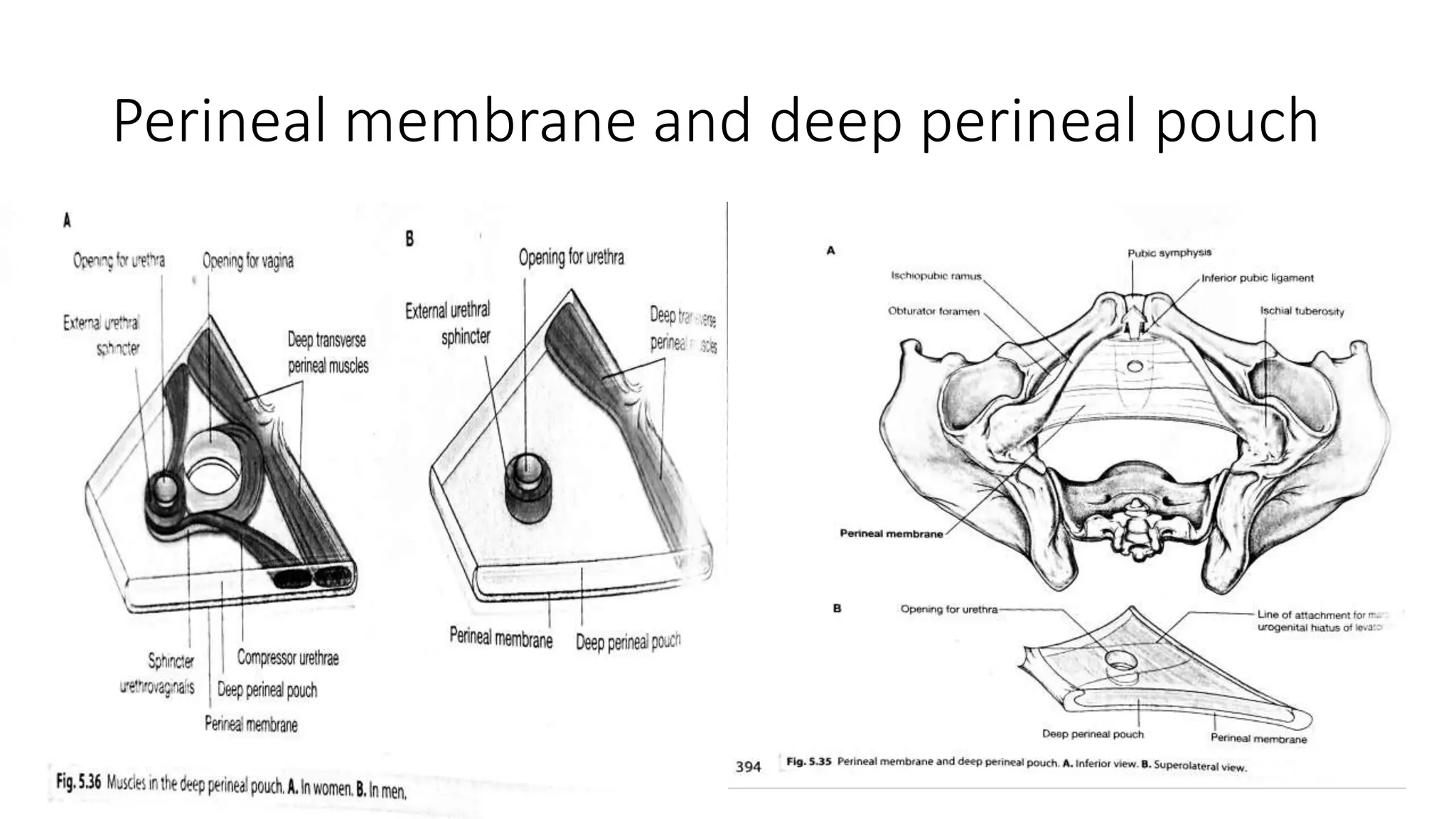
• 5.36
Perineal membrane and deep perineal pouch
• Anterior a group of muscle fibers surround the urethra (External
urethral sphincter)
• Two additional groups are assoc with the urethra and the vagina;
sphincter urethrovaginalis and compressor urethrae
• Together they facilitate closure of the urethra
• Deep transverse perineal muscle parallels the free margin of the
perineal membrane and joins with its partner in the midline
• They stabilise the perineal body
Perineal body
• Is an ill defined but important connective tissue structure into which
muscles of the pelvic floor and perineum attach
• It is in the midline along the posterior border of the perineal
membrane which it is attached to
• It is also attached to the posterior end of the urogenital hiatus
• Muscle attached: 1. Deep transvers perineal muscle, 2. Sphincter
urethrovaginalis, 3. External anal sphincter, 4. Superficial transverse
perineal muscle and 5. the Bulbospongiosus muscles
• Pic 5.68
Thank you

Pelvic floor and perineal body

  • 1.
    Pelvic floor andPerineal body Themba Hospital FCOG(SA) Part 1 Tutorials By Dr N.E Manana
  • 2.
    Pelvic floor • Thepelvic floor is formed by : 1. The pelvic diaphragm and 2. The perineal membrane and muscle of the deep perineal pouch Pelvic diaphragm • Is the muscular part of the pelvic floor, it is bowl shaped, attached superiorly to the pelvic wall • It consists of the levator ani and the coccygeus muscles • Its circular line of attachment passes between the sciatic foramen, greater sciatic above and lesser sciatic below
  • 3.
  • 4.
    Pelvic diaphragm Levator ani •The muscles originating from the pelvic wall, course medially and inferiorly and join together in the midline • Attachment to the pelvic wall follows a contour which include; posterior pubic body, tendinous arch over the obturator internus muscle and ischial spine • In females the muscle blend together posterior to the vagina and around the anus in anal aperture in both sexes (Anococcygeal ligament) • Anteriorly they form a U-shaped defect (Urogenital hiatus) • Levator ani has 3 collections of fibers: 1. Pubococcygeus, 2. Puborectalis and 3. Iliococygeus muscles
  • 5.
    Pelvic diaphragm Coccygeus • Theare 2 muscles, one on each side, triangular in shape, overlying the SSL • The base is attached to the lateral margins of the coccyx and sacrum, and the apex is attached to the tips of the ischial spines • They are innervated by the branches of the anterior rami of S4-S5 • Participate in supporting the posterior aspect of the pelvic floor
  • 6.
  • 7.
    Perineal membrane anddeep perineal pouch • The perineal membrane is a thick fascia, triangular shaped, attached to the pubic arch • Orientated in a horizontal plain, with a free posterior margin • Anterior the a small gap between the membrane and the inferior pubic ligament • The is a thin space above it termed the deep perineal pouch, which contains skeletal muscles and neurovascular elements • The pouch is open above, only enclosed by the urogenital hiatus, therefor contributing to the pelvic floor • It provides attachment for roots of the external genitalia and assoc muscles
  • 8.
    Perineal membrane anddeep perineal pouch • 5.36
  • 9.
    Perineal membrane anddeep perineal pouch • Anterior a group of muscle fibers surround the urethra (External urethral sphincter) • Two additional groups are assoc with the urethra and the vagina; sphincter urethrovaginalis and compressor urethrae • Together they facilitate closure of the urethra • Deep transverse perineal muscle parallels the free margin of the perineal membrane and joins with its partner in the midline • They stabilise the perineal body
  • 10.
    Perineal body • Isan ill defined but important connective tissue structure into which muscles of the pelvic floor and perineum attach • It is in the midline along the posterior border of the perineal membrane which it is attached to • It is also attached to the posterior end of the urogenital hiatus • Muscle attached: 1. Deep transvers perineal muscle, 2. Sphincter urethrovaginalis, 3. External anal sphincter, 4. Superficial transverse perineal muscle and 5. the Bulbospongiosus muscles
  • 11.
  • 12.