The Thyroid Gland
Themba Hospital FCOG(SA) Part 1 Tutorials
By Dr N.E Manana
INTRODUCTION
• The thyroid gland is one of the larger endocrine glands of the body,
the gland has two primary functions.
• The first is to secrete the thyroid hormones, which maintain the level
of metabolism in the tissues that is optimal for their normal function.
• Thyroid hormones stimulate O2 consumption by most of the cells in
the body, help to regulate lipid and carbohydrate metabolism,
• And thereby influence body mass and mentation
• The second function of the thyroid gland is to secrete calcitonin, a
hormone that regulates circulating levels of calcium
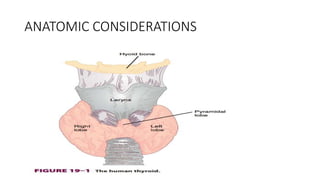
ANATOMIC CONSIDERATIONS
• 19.1
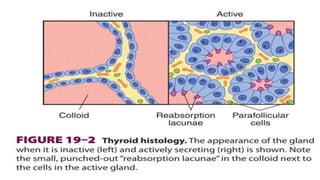
• 19.2
FORMATION & SECRETION
• The primary hormone secreted by the thyroid is thyroxine (T 4 ),
along with much lesser amounts of triiodothyronine (T 3 )
• T3 has much greater biological activity than T4 and is specifically
generated at its site of action in peripheral tissues by deiodination of
T4
• Both hormones are iodine containing amino acid
• Small amounts of reverse triiodothyronine (3,3′,5′-triiodothyronine,
RT 3 ) and other compounds are also found in thyroid venous blood.
RT 3 is not biologically active.
IODINE HOMEOSTASIS
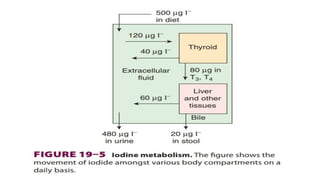
• Iodine is an essential raw material for thyroid hormone synthesis
• The minimum daily iodine intake that will maintain normal thyroid
function is 150μg in adults
• The principal organs that take up circulating I – are the thyroid, which
uses it to make thyroid hormones, and the kidneys, which excrete it in
the urine.
• The thyroid secretes 80 μg/d in the form of T3 and T4 , while 40μg/d
diffuses back into the extracellular fluid (ECF)
• Circulating T3 and T4 are metabolized in the liver and other tissues,
with the release of a further 60μg of I – per day into the ECF
• 19.5
SYNTHESIS & SECRETION
• At the interface between the thyrocyte and the colloid, iodide undergoes a
process referred to as organification
• First, it is oxidized to iodine, and then incorporated into the carbon 3
position of tyrosine residues that are part of the thyroglobulin molecule in
the colloid
• Thyroglobulin is synthesized in the thyroid cells and secreted into the
colloid by exocytosis of granules
• The oxidation and reaction of iodide with the secreted thyroglobulin is
mediated by thyroid peroxidase
• When there is a need for thyroid hormone secretion, colloid is internalized
by the thyrocytes by endocytosis, and directed toward lysosomal
degradation
SYNTHESIS & SECRETION
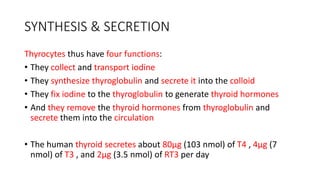
Thyrocytes thus have four functions:
• They collect and transport iodine
• They synthesize thyroglobulin and secrete it into the colloid
• They fix iodine to the thyroglobulin to generate thyroid hormones
• And they remove the thyroid hormones from thyroglobulin and
secrete them into the circulation
• The human thyroid secretes about 80μg (103 nmol) of T4 , 4μg (7
nmol) of T3 , and 2μg (3.5 nmol) of RT3 per day
TRANSPORT
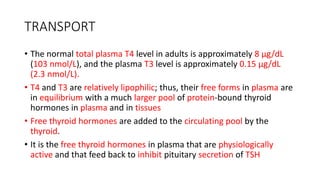
• The normal total plasma T4 level in adults is approximately 8 μg/dL
(103 nmol/L), and the plasma T3 level is approximately 0.15 μg/dL
(2.3 nmol/L).
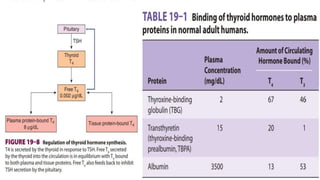
• T4 and T3 are relatively lipophilic; thus, their free forms in plasma are
in equilibrium with a much larger pool of protein-bound thyroid
hormones in plasma and in tissues
• Free thyroid hormones are added to the circulating pool by the
thyroid.
• It is the free thyroid hormones in plasma that are physiologically
active and that feed back to inhibit pituitary secretion of TSH
• 19.8 and table 19.1
METABOLISM OF THYROID HORMONES
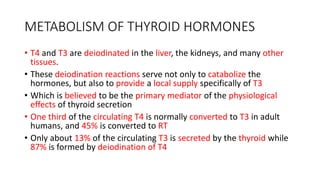
• T4 and T3 are deiodinated in the liver, the kidneys, and many other
tissues.
• These deiodination reactions serve not only to catabolize the
hormones, but also to provide a local supply specifically of T3
• Which is believed to be the primary mediator of the physiological
effects of thyroid secretion
• One third of the circulating T4 is normally converted to T3 in adult
humans, and 45% is converted to RT
• Only about 13% of the circulating T3 is secreted by the thyroid while
87% is formed by deiodination of T4
EFFECTS OF TSH
• When the pituitary is removed, thyroid function is depressed and the
gland atrophies; when TSH is administered, thyroid function is
stimulated
• Within a few minutes after the injection of TSH, there are increases in
iodide binding; synthesis of T3 , T4 , and iodotyrosines; secretion of
thyroglobulin into the colloid; and endocytosis of colloid
• Iodide trapping is increased in a few hours; blood flow increases; and,
with chronic TSH treatment, the cells hypertrophy
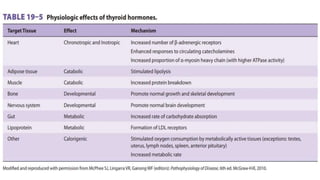
EFFECTS OF THYROID HORMONES
• 19.5
Thank you

5. the thyroid gland

  • 1.
    The Thyroid Gland ThembaHospital FCOG(SA) Part 1 Tutorials By Dr N.E Manana
  • 2.
    INTRODUCTION • The thyroidgland is one of the larger endocrine glands of the body, the gland has two primary functions. • The first is to secrete the thyroid hormones, which maintain the level of metabolism in the tissues that is optimal for their normal function. • Thyroid hormones stimulate O2 consumption by most of the cells in the body, help to regulate lipid and carbohydrate metabolism, • And thereby influence body mass and mentation • The second function of the thyroid gland is to secrete calcitonin, a hormone that regulates circulating levels of calcium
  • 3.
  • 4.
  • 5.
    FORMATION & SECRETION •The primary hormone secreted by the thyroid is thyroxine (T 4 ), along with much lesser amounts of triiodothyronine (T 3 ) • T3 has much greater biological activity than T4 and is specifically generated at its site of action in peripheral tissues by deiodination of T4 • Both hormones are iodine containing amino acid • Small amounts of reverse triiodothyronine (3,3′,5′-triiodothyronine, RT 3 ) and other compounds are also found in thyroid venous blood. RT 3 is not biologically active.
  • 6.
    IODINE HOMEOSTASIS • Iodineis an essential raw material for thyroid hormone synthesis • The minimum daily iodine intake that will maintain normal thyroid function is 150μg in adults • The principal organs that take up circulating I – are the thyroid, which uses it to make thyroid hormones, and the kidneys, which excrete it in the urine. • The thyroid secretes 80 μg/d in the form of T3 and T4 , while 40μg/d diffuses back into the extracellular fluid (ECF) • Circulating T3 and T4 are metabolized in the liver and other tissues, with the release of a further 60μg of I – per day into the ECF
  • 7.
  • 8.
    SYNTHESIS & SECRETION •At the interface between the thyrocyte and the colloid, iodide undergoes a process referred to as organification • First, it is oxidized to iodine, and then incorporated into the carbon 3 position of tyrosine residues that are part of the thyroglobulin molecule in the colloid • Thyroglobulin is synthesized in the thyroid cells and secreted into the colloid by exocytosis of granules • The oxidation and reaction of iodide with the secreted thyroglobulin is mediated by thyroid peroxidase • When there is a need for thyroid hormone secretion, colloid is internalized by the thyrocytes by endocytosis, and directed toward lysosomal degradation
  • 9.
    SYNTHESIS & SECRETION Thyrocytesthus have four functions: • They collect and transport iodine • They synthesize thyroglobulin and secrete it into the colloid • They fix iodine to the thyroglobulin to generate thyroid hormones • And they remove the thyroid hormones from thyroglobulin and secrete them into the circulation • The human thyroid secretes about 80μg (103 nmol) of T4 , 4μg (7 nmol) of T3 , and 2μg (3.5 nmol) of RT3 per day
  • 10.
    TRANSPORT • The normaltotal plasma T4 level in adults is approximately 8 μg/dL (103 nmol/L), and the plasma T3 level is approximately 0.15 μg/dL (2.3 nmol/L). • T4 and T3 are relatively lipophilic; thus, their free forms in plasma are in equilibrium with a much larger pool of protein-bound thyroid hormones in plasma and in tissues • Free thyroid hormones are added to the circulating pool by the thyroid. • It is the free thyroid hormones in plasma that are physiologically active and that feed back to inhibit pituitary secretion of TSH
  • 11.
    • 19.8 andtable 19.1
  • 12.
    METABOLISM OF THYROIDHORMONES • T4 and T3 are deiodinated in the liver, the kidneys, and many other tissues. • These deiodination reactions serve not only to catabolize the hormones, but also to provide a local supply specifically of T3 • Which is believed to be the primary mediator of the physiological effects of thyroid secretion • One third of the circulating T4 is normally converted to T3 in adult humans, and 45% is converted to RT • Only about 13% of the circulating T3 is secreted by the thyroid while 87% is formed by deiodination of T4
  • 13.
    EFFECTS OF TSH •When the pituitary is removed, thyroid function is depressed and the gland atrophies; when TSH is administered, thyroid function is stimulated • Within a few minutes after the injection of TSH, there are increases in iodide binding; synthesis of T3 , T4 , and iodotyrosines; secretion of thyroglobulin into the colloid; and endocytosis of colloid • Iodide trapping is increased in a few hours; blood flow increases; and, with chronic TSH treatment, the cells hypertrophy
  • 14.
    EFFECTS OF THYROIDHORMONES • 19.5
  • 15.

Editor's Notes

  • #3 The thyroid is not essential for life, but its absence or hypofunction during fetal and neonatal life results in severe mental retardation and dwarfism Thyroid function is controlled by the thyroid-stimulating hormone (TSH, thyrotropin) of the anterior pituitary. The secretion of this hormone is in turn increased by thyrotropin-releasing hormone (TRH) from the hypothalamus and is also subject to negative feedback control by high circulating levels of thyroid hormones acting on the anterior pituitary and the hypothalamus
  • #4 The thyroid is a butterfly-shaped gland that straddles the trachea in the front of the neck It develops from an evagination of the floor of the pharynx, and a thyroglossal duct marking the path of the thyroid from the tongue to the neck sometimes persists in the adult The two lobes of the human thyroid are connected by a bridge of tissue, the thyroid isthmus, and there is sometimes a pyramidal lobe arising from the isthmus in front of the larynx The gland is well vascularized, and the thyroid has one of the highest rates of blood flow per gram of tissue of any organ in the body. The portion of the thyroid concerned with the production of thyroid hormone consists of multiple acini (follicles) Each spherical follicle is surrounded by a single layer of polarized epithelial cells and filled with pink-staining proteinaceous material called colloid
  • #5 Colloid consists predominantly of the glycoprotein, thyroglobulin. When the gland is inactive, the colloid is abundant, the follicles are large, and the cells lining them are flat. When the gland is active, the follicles are small, the cells are cuboid or columnar, and areas where the colloid is being actively reabsorbed into the thyrocytes are visible as “reabsorption lacunae” Microvilli project into the colloid from the apexes of the thyroid cells and canaliculi extend into them. The endoplasmic reticulum is prominent, a feature common to most glandular cells, and secretory granules containing thyroglobulin are seen The individual thyroid cells rest on a basal lamina that separates them from the adjacent capillaries. Th e capillaries are fenestrated, like those of other endocrine glands
  • #7 In most developed countries, supplementation of table salt means that the average dietary intake is approximately 500 μg/d. Some thyroid hormone derivatives are excreted in the bile, and some of the iodine in them is reabsorbed (enterohepatic circulation), but there is a net loss of I – in the stool of approximately 20 μg/d. The total amount of I – entering the ECF is thus 500 + 40 + 60, or 600 μg/d; 20% of this I – enters the thyroid, whereas 80% is excreted in the urine.
  • #8 The basolateral membranes of thyrocytes facing the capillaries contain a symporter that transports two Na + ions and one I – ion into the cell with each cycle, against the electrochemical gradient for I This Na + /I – symporter (NIS) is capable of producing intracellular I – concentrations that are 20–40 times as great as the concentration in plasma. The process involved is secondary active transport with the energy provided by active transport of Na + out of thyroid cells by Na, K ATPase. NIS is regulated both by transcriptional means and by active trafficking into and out of the thyrocyte basolateral membrane; in particular, thyroid stimulating hormone (TSH; see below) induces both NIS expression and the retention of NIS in the basolateral membrane, where it can mediate sustained iodide uptake. Iodide must also exit the thyrocyte across the apical membrane to access the colloid, where the initial steps of thyroid hormone synthesis occur. This transport step is believed to be mediated, at least in part, by a Cl – /I – exchanger known as pendrin.
  • #9 The pyroglobulin is a glycoprotein made up of two subunits and has a molecular weight of 660 kDa. It contains 10% carbohydrate by weight. It also contains 123 tyrosine residues, but only 4–8 of these are normally incorporated into thyroid hormones The thyroid hormones so produced remain part of the thyroglobulin molecule until needed. As such, colloid represents a reservoir of thyroid hormones, and humans can ingest a diet completely devoid of iodide for up to 2 months before a decline in circulating thyroid hormone levels is seen
  • #10 Thyroid hormone synthesis is a multistep process. Thyroid peroxidase generates reactive iodine species that can attack thyroglobulin. The first product is monoiodotyrosine (MIT). MIT is next iodinated on the carbon 5 position to form diiodotyrosine (DIT). Two DIT molecules then undergo an oxidative condensation to form T 4 with the elimination of the alanine side chain from the molecule that forms the outer ring T3 is formed by condensation of MIT with DIT In the normal human thyroid, the average distribution of iodinated compounds is 3% MIT, 33% DIT, 35% T 4 , and 7% T 3 . MIT and DIT are not secreted. Th ese iodinated tyrosines are deiodinated by a microsomal iodotyrosine deiodinase. This represents a mechanism to recover iodine and bound tyrosines and recycle them for additional rounds of hormone synthesis. The iodine liberated by deiodination of MIT and DIT is reutilized in the gland and normally provides about twice as much iodide for hormone synthesis as NIS does. In patients with congenital absence of the iodotyrosine deiodinase, MIT and DIT appear in the urine and there are symptoms of iodine deficiency Iodinated thyronines are resistant to the activity of iodotyrosine deiodinase, thus allowing T 4 and T 3 to pass into the circulation.
  • #11 The function of protein binding appears to be maintenance of a large pool of hormone that can readily be mobilized as needed. In addition, at least for T 3 , hormone binding prevents excess uptake by the fi rst cells encountered and promotes uniform tissue distribution
  • #12 The plasma proteins that bind thyroid hormones are albumin, a prealbumin called transthyretin (formerly called thyroxine-binding prealbumin), and a globulin known as thyroxine-binding globulin (TBG). Of the three proteins, albumin has the largest capacity to bind T 4 (ie, it can bind the most T 4 before becoming saturated) and TBG has the smallest capacity. However, the affinities of the proteins for T4 (ie, the avidity with which they bind T 4 under physiologic conditions) are such that most of the circulating T4 is bound to TBG (), with over a third of the binding sites on the protein occupied. Smaller amounts of T 4 are bound to transthyretin and albumin. The half-life of transthyretin is 2 days, that of TBG is 5 days, and that of albumin is 13 days
  • #13 ; similarly, only 5% of the circulating RT 3 is secreted by the thyroid and 95% is formed by deiodination of T4 It should be noted as well that marked differences in the ratio of T 3 to T 4 occur in various tissues. Two tissues that have very high T 3 /T 4 ratios are the pituitary and the cerebral cortex, due to the expression of specific deiodinases, Some of the T 4 and T 3 is further converted to deiodotyrosines by deiodinases. T 4 and T 3 are also conjugated in the liver to form sulfates and glucuronides. These conjugates enter the bile and pass into the intestine. The thyroid conjugates are hydrolyzed, and some are thereaft er reabsorbed (enterohepatic circulation), but others are excreted in the stool. In addition, some T 4 and T 3 passes directly from the circulation to the intestinal lumen. The iodide lost by these routes amounts to about 4% of the total daily iodide loss.
  • #14 Whenever TSH stimulation is prolonged, the thyroid becomes detectably enlarged. Enlargement of the thyroid is called a goiter . The TSH receptor is a typical G protein-coupled, seven-transmembrane receptor that activates adenylyl cyclase through G s . It also activates phospholipase C (PLC). Like other glycoprotein hormone receptors, it has an extended, glycosylated extracellular domain.
  • #15 effects of thyroid hormones in the body are secondary to stimulation of O 2 consumption (calorigenic action help regulate lipid metabolism, and increase the absorption of carbohydrates from the intestine They also increase the dissociation of oxygen from hemoglobin by increasing red cell 2,3-diphosphoglycerate (DPG) Thyroid hormones enter cells and T 3 binds to TR in the nuclei. T 4 can also bind, but not as avidly The hormone–receptor complex then binds to DNA via zinc fingers and increases (or in some cases, decreases) the expression of a variety of different genes that code for proteins that regulate cell function (see Chapters 1 and 16). Th us, the nuclear receptors for thyroid hormones are members of the superfamily of hormone-sensitive nuclear transcription factors.