Amnionic Fluid
Themba Hospital FCOG(SA) Part 1 Tutorials
By Dr N.E Manana
Intro
• Amnionic fluid serves several roles during pregnancy.
• It creates a physical space for fetal movement, which is necessary for
normal musculoskeletal development
• It permits fetal swallowing—essential for gastrointestinal tract
development,
• and fetal breathing—necessary for lung development.
• Amnionic fluid guards against umbilical cord compression and
protects the fetus from trauma
• It even has bacteriostatic properties
NORMAL AMNIONIC FLUID VOLUME
• Amnionic fluid volume increases from approximately 30 mL at
10weeks to 200 mL by 16weeks and reaches 800 mL by the mid-third
trimester
• This fluid is approximately 98-percent water. A full-term fetus
contains roughly 2800 mL of water, and the placenta another 400 mL,
such that the term uterus holds nearly 4 liters of water
• Abnormally decreased fluid volume is termed oligohydramnios,
whereas abnormally increased fluid volume is termed hydramnios or
polyhydramnios
Physiology
• Early in pregnancy, the amnionic cavity is filled with fluid that is similar in
composition to extracellular fluid
• During the first half of pregnancy, transfer of water and other small
molecules takes place across the amnion—transmembranous flow, across
the fetal vessels on placental surface—intramembranous flow, and across
fetal skin
• Fetal urine production begins between 8 and 11weeks, but it does not
become a major component of amnionic fluid until the second trimester.
• This latter observation explains why fetuses with lethal renal abnormalities
may not manifest severe oligohydramnios until after 18 weeks
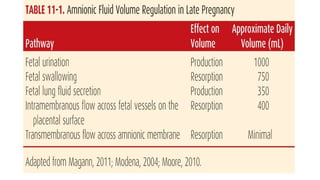
• Table 11.1
Measurement
• The actual volume of amnionic fluid is rarely measured outside of the
research setting
• Amnionic fluid volume evaluation is a component of every standard
sonogram performed in the second or third trimester
• Volume is typically assessed semiquantitatively, by measuring either a
single pocket or the amnionic fluid index—AFI
Single Deepest Pocket
• This is also called the maximum vertical pocket. The ultrasound
transducer is held perpendicular to the floor and parallel to the long
axis of the pregnant woman
• In the sagittal plane, the largest vertical pocket of fluid is identified,
the fluid pocket may contain fetal parts or loops of umbilical cord, but
these are not included in the measurement
• The normal range for single deepest pocket that is most commonly
used is 2 to 8 cm, with values above and below this indicating
hydramnios and oligohydramnios, respectively
Amnionic Fluid Index (AFI)
• This was described by Phelan and coworkers (1987) more than 25 years
ago, and it remains one of the most commonly used methods of amnionic
fluid volume assessment
• The uterus is divided into four equal quadrants—the right- and left-upper
and lower quadrants.
• The AFI is the sum of the single deepest pocket from each quadrant.
• A fluid pocket may contain fetal parts or umbilical cord loops, but these are
not included in the measurement.
HYDRAMNIOS
• This is an abnormally increased amnionic fluid volume, and it
complicates 1 to 2 percent of pregnancies
• Also termed polyhydramnios, hydramnios may be suspected if the
uterine size exceeds that expected for gestational age.
• Hydramnios may be further categorized according to degree
• Mild hydramnios is the most common, comprising approximately two
thirds of cases
• In general, severe hydramnios is far more likely to have an underlying
etiology and to have consequences
HYDRAMNIOS: Aetiology
• Common underlying causes of hydramnios include fetal congenital
anomalies in approximately 15 percent and diabetes in 15 to 20
percent
• Congenital infection and red blood cell alloimmunization are less
frequent reasons
• Infections that may present with hydramnios include
cytomegalovirus, toxoplasmosis, syphilis, and parvovirus
• Because the etiologies of hydramnios are so varied, hydramnios
treatment also varies and is tailored in most cases to the underlying
cause
Idiopathic Hydramnios
• When there is no obvious cause of hydramnios it is considered
idiopathic, this accounts for up to 70 percent of cases
•
• Pregnancies with idiopathic hydramnios have been reported to have
at least twice the likelihood of infant birthweight exceeding 4000g
• A rationale for this association is that larger infants have higher urine
output
• Mild, idiopathic hydramnios is most commonly a benign finding, and
associated pregnancy outcomes are usually good.
Complications
• Unless hydramnios is severe or develops rapidly, maternal symptoms
are infrequent
• Symptoms may arise from pressure upon adjacent organs
• When distention is excessive, the mother may suffer dyspnea and
orthopnea
• Edema may develop as a consequence of major venous system
compression, and it tends to be most pronounced in the lower
extremities, vulva, and abdominal wall
• Maternal complications associated with hydramnios include placental
abruption, uterine dysfunction, and postpartum hemorrhage
Pregnancy Outcomes
• Some outcomes that have been reported to be increased with
hydramnios include cesarean delivery rate, birthweight > 4000g, and
importantly, perinatal mortality rate
• The cesarean delivery rate is increased approximately threefold
• When hydramnios has been identified, and the perinatal mortality
rate rises approximately fourfold
Management
• Occasionally, severe hydramnios may result in early preterm labor or
the development of maternal respiratory compromise.
• In such cases, large-volume amniocentesis—termed
amnioreduction—may be needed
• Approximately 1000 to 1500 mL of fluid is slowly withdrawn during
approximately 30 minutes, depending on the severity of hydramnios
and gestational age
• The goal is to restore amnionic fluid volume to upper normal range
• Subsequent amnioreduction procedures may be required as often as
weekly or even semi-weekly
OLIGOHYDRAMNIOS
• Oligohydramnios complicates approximately 1 to 2 percent of
pregnancies
• Unlike hydramnios, which is often mild and confers a benign
prognosis in the absence of an underlying etiology, oligohydramnios is
a cause for concern
• When no measurable pocket of amnionic fluid is identified, the term
anhydramnios may be used.
• The sonographic diagnosis of oligohydramnios is usually based on an
AFI ≤ 5 cm or on a single deepest pocket of amnionic fluid ≤ 2 cm
Aetiology
• Include those in which the amnionic fluid volume has been severely
decreased since the early second trimester and those in which the
fluid volume was normal until near-term or even full-term.
• The prognosis depends heavily on the underlying etiology
• Early-Onset Oligohydramnios: it may reflect a fetal abnormality that
precludes normal urination, or it may represent a placental
abnormality severe enough to impair perfusion
• Oligohydramnios after Midpregnancy: it more likely is associated with
fetal-growth restriction, a placental abnormality, or a maternal
complication such as preeclampsia or vascular disease
Congenital Anomalies
• Among those with fetal abnormalities, most cases of severely
decreased amnionic fluid volume beginning early in gestation are
secondary to genitourinary anomalies
• Anomalies of other organ systems, aneuploidy, and other genetic
syndromes also have the potential to cause oligohydramnios
indirectly, either from fetal decompensation, FGR, or an
accompanying placental abnormality
• Overall, approximately 3 percent of newborns with congenital
anomalies have oligohydramnios found during prenatal sonography
Medication
• Oligohydramnios has been associated with exposure to drugs that
block the renin-angiotensin system.
• These include ACE inhibitors and NSAIDs.
• When taken in the second or third trimester, ACE inhibitors and
angiotensin-receptor blockers may create fetal hypotension, renal
hypoperfusion, and renal ischemia, with subsequent anuric renal
failure
Pregnancy Outcomes
• Oligohydramnios is associated with increased risk of adverse
pregnancy outcomes, more likely than those with AFIs > 5 cm to have
malformations
• Even in the absence of malformations, higher rates of fetal stillbirth,
growth restriction, nonreassuring heart rate pattern, and meconium
aspiration syndrome were noted
• Chauhan and coworkers (1999) found that women with
oligohydramnios had a twofold increased risk for cesarean delivery for
fetal distress and a fivefold risk for an Apgar score < 7 at 5 minutes
Pulmonary Hypoplasia
• When decreased amnionic fluid is first identified before the mid-
second trimester, particularly before 20 to 22weeks, pulmonary
hypoplasia is a significant concern

• The underlying etiology is a major factor in the prognosis
• Severe oligohydramnios secondary to a renal abnormality generally
has a lethal prognosis
• If a placental hematoma or chronic abruption is severe enough to
result in oligohydramnios
Management
• As with hydramnios, management targets the underlying etiology
when feasible.
• Initially, an evaluation for fetal anomalies and growth is essential.
• In a pregnancy complicated by oligohydramnios and FGR, close fetal
surveillance is important
• In many cases, evidence for fetal or maternal compromise will
override potential complications from preterm delivery
• Oligohydramnios detected before 36 weeks in the presence of normal
fetal anatomy and growth may be managed expectantly in
conjunction with increased fetal surveillance
Thank you

7. Amnionic Fluid.pptx

  • 1.
    Amnionic Fluid Themba HospitalFCOG(SA) Part 1 Tutorials By Dr N.E Manana
  • 2.
    Intro • Amnionic fluidserves several roles during pregnancy. • It creates a physical space for fetal movement, which is necessary for normal musculoskeletal development • It permits fetal swallowing—essential for gastrointestinal tract development, • and fetal breathing—necessary for lung development. • Amnionic fluid guards against umbilical cord compression and protects the fetus from trauma • It even has bacteriostatic properties
  • 3.
    NORMAL AMNIONIC FLUIDVOLUME • Amnionic fluid volume increases from approximately 30 mL at 10weeks to 200 mL by 16weeks and reaches 800 mL by the mid-third trimester • This fluid is approximately 98-percent water. A full-term fetus contains roughly 2800 mL of water, and the placenta another 400 mL, such that the term uterus holds nearly 4 liters of water • Abnormally decreased fluid volume is termed oligohydramnios, whereas abnormally increased fluid volume is termed hydramnios or polyhydramnios
  • 4.
    Physiology • Early inpregnancy, the amnionic cavity is filled with fluid that is similar in composition to extracellular fluid • During the first half of pregnancy, transfer of water and other small molecules takes place across the amnion—transmembranous flow, across the fetal vessels on placental surface—intramembranous flow, and across fetal skin • Fetal urine production begins between 8 and 11weeks, but it does not become a major component of amnionic fluid until the second trimester. • This latter observation explains why fetuses with lethal renal abnormalities may not manifest severe oligohydramnios until after 18 weeks
  • 5.
  • 6.
    Measurement • The actualvolume of amnionic fluid is rarely measured outside of the research setting • Amnionic fluid volume evaluation is a component of every standard sonogram performed in the second or third trimester • Volume is typically assessed semiquantitatively, by measuring either a single pocket or the amnionic fluid index—AFI
  • 7.
    Single Deepest Pocket •This is also called the maximum vertical pocket. The ultrasound transducer is held perpendicular to the floor and parallel to the long axis of the pregnant woman • In the sagittal plane, the largest vertical pocket of fluid is identified, the fluid pocket may contain fetal parts or loops of umbilical cord, but these are not included in the measurement • The normal range for single deepest pocket that is most commonly used is 2 to 8 cm, with values above and below this indicating hydramnios and oligohydramnios, respectively
  • 8.
    Amnionic Fluid Index(AFI) • This was described by Phelan and coworkers (1987) more than 25 years ago, and it remains one of the most commonly used methods of amnionic fluid volume assessment • The uterus is divided into four equal quadrants—the right- and left-upper and lower quadrants. • The AFI is the sum of the single deepest pocket from each quadrant. • A fluid pocket may contain fetal parts or umbilical cord loops, but these are not included in the measurement.
  • 9.
    HYDRAMNIOS • This isan abnormally increased amnionic fluid volume, and it complicates 1 to 2 percent of pregnancies • Also termed polyhydramnios, hydramnios may be suspected if the uterine size exceeds that expected for gestational age. • Hydramnios may be further categorized according to degree • Mild hydramnios is the most common, comprising approximately two thirds of cases • In general, severe hydramnios is far more likely to have an underlying etiology and to have consequences
  • 10.
    HYDRAMNIOS: Aetiology • Commonunderlying causes of hydramnios include fetal congenital anomalies in approximately 15 percent and diabetes in 15 to 20 percent • Congenital infection and red blood cell alloimmunization are less frequent reasons • Infections that may present with hydramnios include cytomegalovirus, toxoplasmosis, syphilis, and parvovirus • Because the etiologies of hydramnios are so varied, hydramnios treatment also varies and is tailored in most cases to the underlying cause
  • 11.
    Idiopathic Hydramnios • Whenthere is no obvious cause of hydramnios it is considered idiopathic, this accounts for up to 70 percent of cases • • Pregnancies with idiopathic hydramnios have been reported to have at least twice the likelihood of infant birthweight exceeding 4000g • A rationale for this association is that larger infants have higher urine output • Mild, idiopathic hydramnios is most commonly a benign finding, and associated pregnancy outcomes are usually good.
  • 12.
    Complications • Unless hydramniosis severe or develops rapidly, maternal symptoms are infrequent • Symptoms may arise from pressure upon adjacent organs • When distention is excessive, the mother may suffer dyspnea and orthopnea • Edema may develop as a consequence of major venous system compression, and it tends to be most pronounced in the lower extremities, vulva, and abdominal wall • Maternal complications associated with hydramnios include placental abruption, uterine dysfunction, and postpartum hemorrhage
  • 13.
    Pregnancy Outcomes • Someoutcomes that have been reported to be increased with hydramnios include cesarean delivery rate, birthweight > 4000g, and importantly, perinatal mortality rate • The cesarean delivery rate is increased approximately threefold • When hydramnios has been identified, and the perinatal mortality rate rises approximately fourfold
  • 14.
    Management • Occasionally, severehydramnios may result in early preterm labor or the development of maternal respiratory compromise. • In such cases, large-volume amniocentesis—termed amnioreduction—may be needed • Approximately 1000 to 1500 mL of fluid is slowly withdrawn during approximately 30 minutes, depending on the severity of hydramnios and gestational age • The goal is to restore amnionic fluid volume to upper normal range • Subsequent amnioreduction procedures may be required as often as weekly or even semi-weekly
  • 15.
    OLIGOHYDRAMNIOS • Oligohydramnios complicatesapproximately 1 to 2 percent of pregnancies • Unlike hydramnios, which is often mild and confers a benign prognosis in the absence of an underlying etiology, oligohydramnios is a cause for concern • When no measurable pocket of amnionic fluid is identified, the term anhydramnios may be used. • The sonographic diagnosis of oligohydramnios is usually based on an AFI ≤ 5 cm or on a single deepest pocket of amnionic fluid ≤ 2 cm
  • 16.
    Aetiology • Include thosein which the amnionic fluid volume has been severely decreased since the early second trimester and those in which the fluid volume was normal until near-term or even full-term. • The prognosis depends heavily on the underlying etiology • Early-Onset Oligohydramnios: it may reflect a fetal abnormality that precludes normal urination, or it may represent a placental abnormality severe enough to impair perfusion • Oligohydramnios after Midpregnancy: it more likely is associated with fetal-growth restriction, a placental abnormality, or a maternal complication such as preeclampsia or vascular disease
  • 17.
    Congenital Anomalies • Amongthose with fetal abnormalities, most cases of severely decreased amnionic fluid volume beginning early in gestation are secondary to genitourinary anomalies • Anomalies of other organ systems, aneuploidy, and other genetic syndromes also have the potential to cause oligohydramnios indirectly, either from fetal decompensation, FGR, or an accompanying placental abnormality • Overall, approximately 3 percent of newborns with congenital anomalies have oligohydramnios found during prenatal sonography
  • 18.
    Medication • Oligohydramnios hasbeen associated with exposure to drugs that block the renin-angiotensin system. • These include ACE inhibitors and NSAIDs. • When taken in the second or third trimester, ACE inhibitors and angiotensin-receptor blockers may create fetal hypotension, renal hypoperfusion, and renal ischemia, with subsequent anuric renal failure
  • 19.
    Pregnancy Outcomes • Oligohydramniosis associated with increased risk of adverse pregnancy outcomes, more likely than those with AFIs > 5 cm to have malformations • Even in the absence of malformations, higher rates of fetal stillbirth, growth restriction, nonreassuring heart rate pattern, and meconium aspiration syndrome were noted • Chauhan and coworkers (1999) found that women with oligohydramnios had a twofold increased risk for cesarean delivery for fetal distress and a fivefold risk for an Apgar score < 7 at 5 minutes
  • 20.
    Pulmonary Hypoplasia • Whendecreased amnionic fluid is first identified before the mid- second trimester, particularly before 20 to 22weeks, pulmonary hypoplasia is a significant concern • The underlying etiology is a major factor in the prognosis • Severe oligohydramnios secondary to a renal abnormality generally has a lethal prognosis • If a placental hematoma or chronic abruption is severe enough to result in oligohydramnios
  • 21.
    Management • As withhydramnios, management targets the underlying etiology when feasible. • Initially, an evaluation for fetal anomalies and growth is essential. • In a pregnancy complicated by oligohydramnios and FGR, close fetal surveillance is important • In many cases, evidence for fetal or maternal compromise will override potential complications from preterm delivery • Oligohydramnios detected before 36 weeks in the presence of normal fetal anatomy and growth may be managed expectantly in conjunction with increased fetal surveillance
  • 22.

Editor's Notes

  • #3 Amnionic fluid volume abnormalities may reflect a problem with fluid production or its circulation, such as underlying fetal or placental pathology These volume extremes may be associated with increased risks for adverse pregnancy outcome
  • #5 This latter observation explains why fetuses with lethal renal abnormalities may not manifest severe oligohydramnios until after 18 weeks Water transport across the fetal skin continues until keratinization occurs at 22 to 25 weeks. This explains why extremely preterm infants can experience significant fluid loss across their skin.
  • #6 First, fetal urination is the primary amnionic fluid source by the second half of pregnancy. By term, fetal urine production may exceed 1 liter per day—such that the entire amnionic fluid volume is recirculated on a daily basis Fetal urine osmolality is significantly hypotonic to that of maternal and fetal plasma and similar to that of amnionic fluid. Specifically, the osmolality of maternal and fetal plasma is approximately 280 mOsm/mL, whereas that of amnionic fluid is about 260 mOsm/L This hypotonicity of fetal urine—and thus of amnionic fluid— accounts for significant intramembranous fluid transfer across and into fetal vessels on the placental surface, and thus into the fetus. This transfer reaches 400 mL per day and is a second regulator of fluid volume In the setting of maternal dehydration, the resultant increase in maternal osmolality favors fluid transfer from the fetus to the mother, and then from the amnionic fluid compartment into the fetus An important third source of amnionic fluid regulation is the respiratory tract. Approximately 350 mL of lung fluid is produced daily late in gestation, and half of this is immediately swallowed. Last, fetal swallowing is the primary mechanism for amnionic fluid resorption and averages 500 to 1000 mL per day Impaired swallowing, secondary to either a central nervous system abnormality or gastrointestinal tract obstruction, can result in an impressive degree of hydramnios. The other pathways—transmembranous flow and flow across
  • #7 Direct measurement and dye-dilution methods of fluid quantification have contributed to an understanding of normal physiology The dye-dilution method involves injection of a small quantity of a dye such as aminohippurate into the amnionic cavity under sonographic guidance. The amnionic fluid is then sampled to determine the dye concentration and hence to calculate the fluid volume in which it was diluted. Magann and colleagues (1997) used dye-dilution measurements and found that the amnionic fluid volume continues to increase with advancing gestation. Specifically, the average fluid volume was approximately 400 mL between 22 and 30 weeks, doubling thereafter to a mean of 800 mL. The volume remained at this level until 40 weeks and then declined by approximately 8 percent per week thereafter
  • #8 These thresholds are based on data from Chamberlain and associates (1984) and correspond to the 3rd and 97th percentiles. This group also reported increased perinatal mortality rates among nonanomalous infants if the single deepest pocket was below the normal range. The fetal biophysical profile similarly uses a 2-cm single deepest vertical pocket threshold to indicate a normal amnionic fluid volume (American College of Obstetricians and Gynecologists, 2012 Other less commonly used thresholds to determine amnionic fluid volume adequacy involve measurement of a single pocket in both the vertical and transverse planes. Adequate fluid volume is defined as a 2 × 1 cm pocket, a 2 × 2 cm pocket, or a pocket that is at least 15 cm2 When evaluating twin pregnancies and other multifetal gestations, a single deepest pocket of amnionic fluid is assessed in each gestational sac, again using a normal range of 2 to 8 cm (Hernandez, 2012; Society for Maternal-Fetal Medicine, 2013)
  • #9 Color Doppler is generally used to verify that no umbilical cord is included in the measurement As with the single deepest fluid pocket measurement, the ultrasound transducer is held perpendicular to the floor and parallel to the long axis of the pregnant woman The intraobserver variability of the AFI is approximately 1 cm and the interobserver variability about 2 cm. There are larger variations when fluid volumes are above the normal range A useful guideline is that the AFI is approximately three times the single deepest pocket of fluid encountered (Hill, 2003) Determination of whether the AFI is normal— that is, the thresholds for defining oligohydramnios and hydramnios—may be based on either a static numerical cut-off or a gestational age-specific percentile reference range In the Moore (1990) nomogram, a threshold of 5 cm is < 2.5th percentile throughout the second and third trimesters. A value of 25 cm is > 95th percentile, but is not necessarily the 97.5th percentile, depending on gestational age. Using other published nomograms, a value of 25 cm exceeds the 97.5th percentile At this time, there is no consensus as to whether AFI nomogram use improves prediction of adverse outcome compared with use of a numerical threshold alone, and both are considered acceptable
  • #10 The uterus may feel tense, and palpating fetal small parts or auscultating fetal heart tones may be difficult Such categorization has been primarily used in research studies to stratify risks. Several groups have termed hydramnios as mild if the AFI is 25 to 29.9 cm, moderate if 30 to 34.9 cm, and severe if 35 cm or more (Dashe, 2002; Lazebnik, 1999; PriPaz, 2012). Moderate hydramnios accounts for about 20 percent, and severe hydramnios approximately 15 percent Using the single deepest pocket of amnionic fluid, criteria for mild is 8 to 9.9 cm, moderate is 10 to 11.9 cm, and severe hydramnios, ≥ 12 cm
  • #11 Hydramnios is often a component of hydrops fetalis, and several of the above etiologies—selected anomalies, infections, and alloimmunization—may result in a hydropic fetus and placenta maternal hyperglycemia causes fetal hyperglycemia, with resulting fetal osmotic diuresis into the amnionic fluid compartment. Severe central nervous system abnormalities, such as anencephaly, hydranencephaly, or holoprosencephaly, can result in hydramnios due to impaired fetal swallowing. Fetal neuromuscular disorders such as myotonic dystrophy also may lead to excessive amnionic fluid. Obstruction of the fetal upper gastrointestinal tract—esophageal or duodenal atresia—is often associated with hydramnios. Other obstructive causes include clefts, micrognathia, congenital high-airway obstruction sequence, and fetal neck masses Severe fetal thoracic abnormalities, such as diaphragmatic hernia, cystic adenomatoid malformation, and pulmonary sequestration, may be associated with hydramnios due to mediastinal shift and impaired swallowing, occasionally with development of hydrop And although rare, tumors such as fetal sacrococcygeal teratoma, fetal mesoblastic nephroma, and large placental chorioangiomas are frequently accompanied by abnormally increased amnionic fluid volume at Parkland Hospital, the prevalence of an anomalous infant was approximately 8 percent with mild hydramnios, 12 percent with moderate hydramnios, and more than 30 percent with severe hydramnios (Dashe, 2002) If no abnormality was detected with targeted sonography, the likelihood of a major anomaly identified at birth was 1 to 2 percent if the hydramnios was mild or moderate but exceeded 10 percent if hydramnios was severe
  • #13 With chronic hydramnios, fluid accumulates gradually, and a woman may tolerate excessive abdominal distention with relatively little discomfort Acute hydramnios, however, tends to develop earlier in pregnancy. It may result in preterm labor before 28 weeks or in symptoms that become so debilitating as to necessitate intervention. Rarely, oliguria may result from ureteral obstruction by the enlarged uterus Placental abruption is fortunately infrequent. It may result from the rapid decompression of an overdistended uterus that follows fetal-membrane rupture or therapeutic amnioreduction. With prematurely ruptured membranes, a placental abruption occasionally occurs days or weeks after amniorrhexis. Uterine dysfunction consequent to overdistention may lead to postpartum atony and, in turn, postpartum hemorrhag
  • #14 Considering that uterine distention from hydramnios may result in uterine size approaching that of a term gestation, preterm delivery is a logical concern. Somewhat surprisingly, studies of idiopathic hydramnios have generally found no association with preterm birth (Magann, 2010; Many, 1995; Panting-Kemp, 1999). Conversely, severe hydramnios and hydramnios concurrent with recognized fetal abnormalities have been linked with preterm birth Risks appear to be compounded when a growth-restricted fetus is identified with hydramnios. Erez and associates (2005) reported that this combination was independently associated with a 20-fold increase in the perinatal mortality rate. The combination also has a recognized association with trisomy 18
  • #15 The needle insertion technique is the same as for amniocentesis, described in Chapter 14 (p. 297). However, either an evacuated container bottle or a larger syringe is connected to the needle via sterile intravenous tubing with a stopcock Importantly, amnioreduction is typically performed later in gestation and carries additional risks of membrane rupture, preterm labor or its exacerbation, and placental abruption.
  • #16 The diagnosis also may be based on an AFI below the 5th or 2.5th percentile determined by a gestational-age-specific nomogram Or, it may be based on subjective assessment of decreased amnionic fluid volume This is an abnormally decreased amount of amnionic fluid. When evaluating twin pregnancies for twintwin transfusion syndrome, a single deepest pocket ≤ 2 cm is used to define oligohydramnios In general, no one criterion is considered superior to the others. As discussed subsequently, however, use of AFI rather than single deepest pocket will identify more pregnancies as having oligohydramnios, albeit without evidence of pregnancy outcome improvement
  • #17 Early-Onset Oligohydramnios When amnionic fluid volume is abnormally decreased from the early second trimester In either circumstance, the prognosis is poor. Second-trimester rupture of the fetal membranes may result in oligohydramnios—and should be excluded. More commonly, membrane rupture presents with fluid leakage, vaginal bleeding, or uterine contractions. With early-onset oligohydramnios, targeted sonography should be offered to assess for fetal abnormalities. Oligohydramnios after Midpregnancy When amnionic fluid volume becomes abnormally decreased in the late second or in the third trimester In such cases, the underlying etiology is often presumed to be uteroplacental insufficiency, which can impair fetal growth and reduce fetal urine output. Exposure to selected medications has also been linked with oligohydramnios as discussed subsequently. Investigation of third-trimester oligohydramnios generally includes evaluation for membrane rupture and sonography to assess growth. Umbilical artery Doppler studies may be performed if growth restriction is identified Magann and coworkers (1997) found that amnionic fluid volume decreased by approximately 8 percent per week beyond 40 weeks. In postterm pregnancies, oligohydramnios has been associated with nonreassuring fetal heart rate patterns and adverse pregnancy
  • #18 By approximately 18 weeks, the fetal kidneys are the main contributor to amnionic fluid volume Selected renal abnormalities that lead to absent fetal urine production include bilateral renal agenesis, bilateral multicystic dysplastic kidney, unilateral renal agenesis with contralateral multicystic dysplastic kidney, and the infantile form of autosomal recessive polycystic kidney disease. Urinary abnormalities may also result in oligohydramnios because of fetal bladder outlet obstruction. Examples of this are posterior urethral valves, urethral atresia or stenosis, or the megacystis microcolon intestinal hypoperistalsis syndrome If no amnionic fluid is visible beyond the mid-second trimester due to a genitourinary etiology, the prognosis is extremely poor unless fetal therapy is an option
  • #19 These adverse outcomes appear to be more prevalent following exposure to angiotensin-receptor blockers, but both medication types are contraindicated in pregnancy NSAIDs have been associated with fetal ductus arteriosus constriction and with decreased fetal urine production. In neonates, their use may result in acute and chronic renal insufficiency (Fanos, 2011). All these agents are also discussed in Chapter 12 (p. 247).
  • #20 Petrozella and associates (2011) similarly reported that with an AFI ≤ 5 cm identified between 24 and 34 weeks, there was increased risk for stillbirth, spontaneous or medically indicated preterm birth, heart rate pattern abnormalities, and growth restriction
  • #21 —the chronic abruption-oligohydramnios sequence—it commonly also causes growth restriction The prognosis for this constellation is similarly poor
  • #22 Amnioinfusion, as discussed in Chapter 24 (p. 494), may be used intrapartum in the setting of variable fetal heart rate decelerations. It is not considered treatment for oligohydramnios per se, although the decelerations are presumed secondary to umbilical cord compression resulting from lack of amnionic fluid. Amnioinfusion is not the standard of care for other etiologies of oligohydramnios and is not generally recommended.