Endometriosis
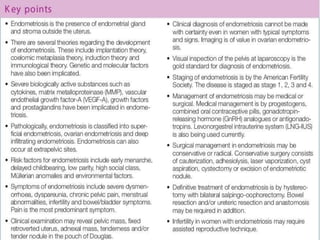
“Presence of endometrial glands and stroma
outside the uterus“
Common in reproductive andadolescentagegroup
Prevalence:8-10%
Common benign gynaecological condition
Similarities to malignancy – disease progression, local
invasion, widespread dissemination
itis estrogen dependent and its resolve after menopause.
RISK FACTORS IN ENDOMETRIOSIS
•Menstrual cycle
-Early menarche
-Heavy menstrual bleeding
-Short menstrual cycles
•Delayed childbirth – voluntary / involuntary
•Nulliparity/ low parity
•Higher social class
•History of endometriosis in first degree relatives
•Lower body mass index
•Obstructive Mullerian anomalies
•Exposure to dioxins
Pathogenesis ofendometriosis
• Etiology is unknown
• There are several theories
1) Implantationtheory – SAMPSON
Endometrial fragments transported through the tubes
into the peritoneal cavity by Retrograde menstruation
are responsible for the development of endometriosis
Endometriosis common in dependent portions of pelvis
•Ovary
•Cul-de-sac
•Uterosacral ligaments
•Rectovaginal septum
•Posterior surface of uterus
2) Coelomic metaplasia theory - MEYER
Cells of original coelomic epithelium can
undergo metaplastic changein to endometrial
tissue. Thistheorycan explain endometriosis in
pleura and peritoneal cavity.
3) Induction theory
Degenerating menstrual endometrium releases
endogenous factors that induce metaplasia of
coelomic epithelium
4)Vascular and lymphaticspread
Vascularand lymphatic embolization of endometrial
tissue canexplain occurrence of endometriotic
deposits in cervix, vagina,vulva, GI tract, lungs,
pleural cavity, surgical scars, lymph nodes
5) Immunological theory
Decreased cellular immunity to endometriotic
tissue – reduced clearance from peritoneal cavity –
altered function of macrophages
6) Genetic factors – familial predisposition- 7 fold
increase in incidence in relatives of women with
endometriosis
7) Molecular defects
Biologically active substances produced in ectopic
endometrium
Cytokines Adhesion to peritoneal
surface
MMP Invasion
VEGF- 1 Angiogenesis
Growth factors Growth
Oestrogen Proliferative changes
Prostaglandins inflammation
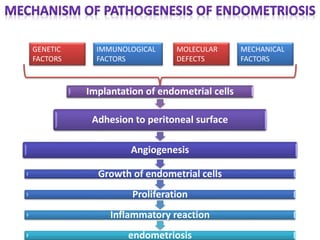
GENETIC
FACTORS
IMMUNOLOGICAL
FACTORS
MOLECULAR
DEFECTS
MECHANICAL
FACTORS
Implantation of endometrial cells
Adhesion to peritoneal surface
Angiogenesis
Growth of endometrial cells
Proliferation
Inflammatory reaction
endometriosis
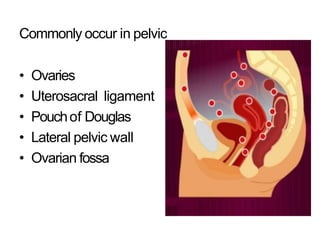
Commonly occur in pelvic
• Ovaries
• Uterosacral ligament
• Pouchof Douglas
• Lateral pelvic wall
• Ovarian fossa
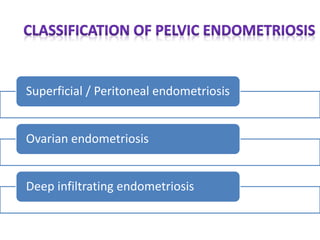
Superficial / Peritoneal endometriosis
Ovarian endometriosis
Deep infiltrating endometriosis
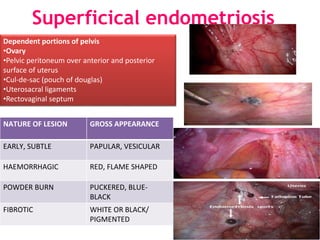
Superficical endometriosis
Dependent portions of pelvis
•Ovary
•Pelvic peritoneum over anterior and posterior
surface of uterus
•Cul-de-sac (pouch of douglas)
•Uterosacral ligaments
•Rectovaginal septum
NATURE OF LESION GROSS APPEARANCE
EARLY, SUBTLE PAPULAR, VESICULAR
HAEMORRHAGIC RED, FLAME SHAPED
POWDER BURN PUCKERED, BLUE-
BLACK
FIBROTIC WHITE OR BLACK/
PIGMENTED
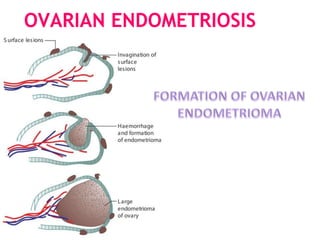
OVARIAN ENDOMETRIOSIS
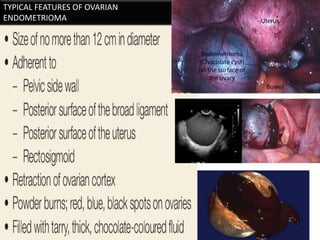
TYPICAL FEATURES OF OVARIAN
ENDOMETRIOMA
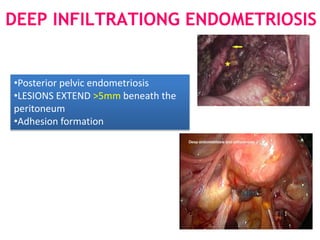
DEEP INFILTRATIONG ENDOMETRIOSIS
•Posterior pelvic endometriosis
•LESIONS EXTEND >5mm beneath the
peritoneum
•Adhesion formation
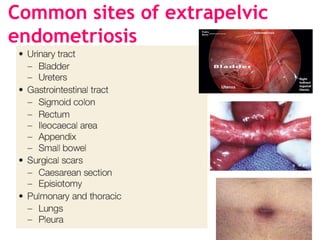
Common sites of extrapelvic
endometriosis
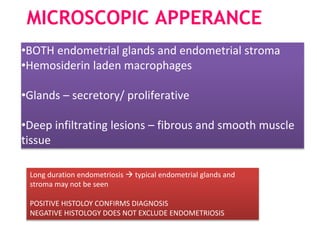
MICROSCOPIC APPERANCE
•BOTH endometrial glands and endometrial stroma
•Hemosiderin laden macrophages
•Glands – secretory/ proliferative
•Deep infiltrating lesions – fibrous and smooth muscle
tissue
Long duration endometriosis  typical endometrial glands and
stroma may not be seen
POSITIVE HISTOLOY CONFIRMS DIAGNOSIS
NEGATIVE HISTOLOGY DOES NOT EXCLUDE ENDOMETRIOSIS
ENDOMETRIOSIS AND MALIGNANCY
Rarely ovarian clear cell carcinoma and endometrioid
carcinoma can develop in endometriosis
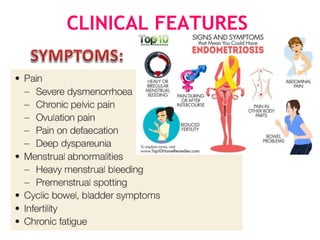
CLINICAL FEATURES
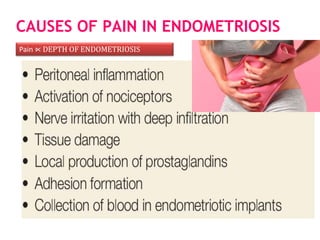
CAUSES OF PAIN IN ENDOMETRIOSIS
Pain ⋉ DEPTH OF ENDOMETRIOSIS
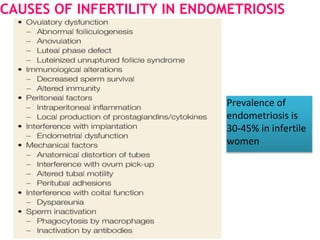
CAUSES OF INFERTILITY IN ENDOMETRIOSIS
Prevalence of
endometriosis is
30-45% in infertile
women
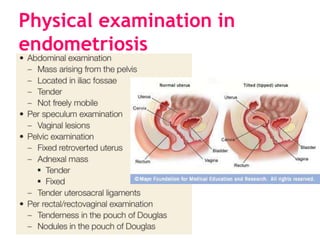
Physical examination in
endometriosis
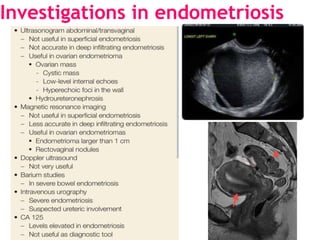
Investigations in endometriosis
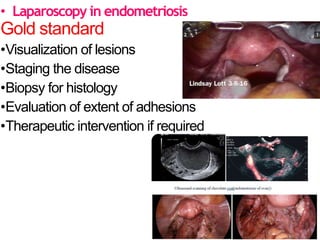
• Laparoscopy in endometriosis
Gold standard
•Visualization of lesions
•Staging the disease
•Biopsy for histology
•Evaluation of extent of adhesions
•Therapeutic intervention if required
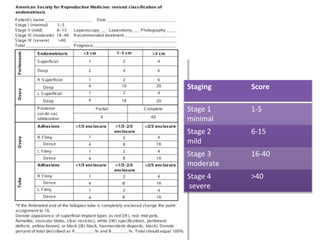
Staging Score
Stage 1
minimal
1-5
Stage 2
mild
6-15
Stage 3
moderate
16-40
Stage 4
severe
>40
Management
• No definitive cure
• Short term goals – pain relief , fertility
• Long term goals – prevention of
disease progression and recurrence
Medical management
Principle is to create aperiod of amenorrhoea
sothat endometriosis tissue will undergo
atropic changesand endometriosis will undergo
regression
This canbe achieved by either creatinga
situation of pseudo-pregnancy or post
menopause
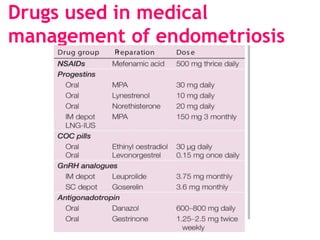
Drugs used in medical
management of endometriosis
P
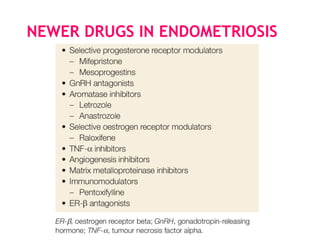
NEWER DRUGS IN ENDOMETRIOSIS
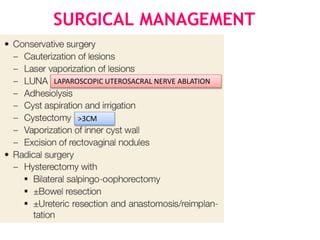
SURGICAL MANAGEMENT
LAPAROSCOPIC UTEROSACRAL NERVE ABLATION
>3CM
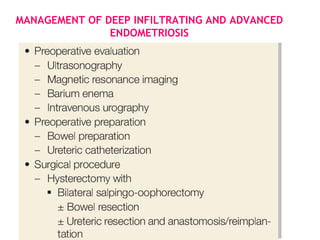
MANAGEMENT OF DEEP INFILTRATING AND ADVANCED
ENDOMETRIOSIS
ENDOMETRIOSIS
ENDOMETRIOSIS

ENDOMETRIOSIS

  • 1.
  • 2.
    “Presence of endometrialglands and stroma outside the uterus“ Common in reproductive andadolescentagegroup Prevalence:8-10% Common benign gynaecological condition Similarities to malignancy – disease progression, local invasion, widespread dissemination itis estrogen dependent and its resolve after menopause.
  • 3.
    RISK FACTORS INENDOMETRIOSIS •Menstrual cycle -Early menarche -Heavy menstrual bleeding -Short menstrual cycles •Delayed childbirth – voluntary / involuntary •Nulliparity/ low parity •Higher social class •History of endometriosis in first degree relatives •Lower body mass index •Obstructive Mullerian anomalies •Exposure to dioxins
  • 4.
    Pathogenesis ofendometriosis • Etiologyis unknown • There are several theories 1) Implantationtheory – SAMPSON Endometrial fragments transported through the tubes into the peritoneal cavity by Retrograde menstruation are responsible for the development of endometriosis Endometriosis common in dependent portions of pelvis •Ovary •Cul-de-sac •Uterosacral ligaments •Rectovaginal septum •Posterior surface of uterus
  • 5.
    2) Coelomic metaplasiatheory - MEYER Cells of original coelomic epithelium can undergo metaplastic changein to endometrial tissue. Thistheorycan explain endometriosis in pleura and peritoneal cavity. 3) Induction theory Degenerating menstrual endometrium releases endogenous factors that induce metaplasia of coelomic epithelium
  • 6.
    4)Vascular and lymphaticspread Vascularandlymphatic embolization of endometrial tissue canexplain occurrence of endometriotic deposits in cervix, vagina,vulva, GI tract, lungs, pleural cavity, surgical scars, lymph nodes 5) Immunological theory Decreased cellular immunity to endometriotic tissue – reduced clearance from peritoneal cavity – altered function of macrophages 6) Genetic factors – familial predisposition- 7 fold increase in incidence in relatives of women with endometriosis 7) Molecular defects
  • 7.
    Biologically active substancesproduced in ectopic endometrium Cytokines Adhesion to peritoneal surface MMP Invasion VEGF- 1 Angiogenesis Growth factors Growth Oestrogen Proliferative changes Prostaglandins inflammation
  • 8.
    GENETIC FACTORS IMMUNOLOGICAL FACTORS MOLECULAR DEFECTS MECHANICAL FACTORS Implantation of endometrialcells Adhesion to peritoneal surface Angiogenesis Growth of endometrial cells Proliferation Inflammatory reaction endometriosis
  • 9.
    Commonly occur inpelvic • Ovaries • Uterosacral ligament • Pouchof Douglas • Lateral pelvic wall • Ovarian fossa
  • 10.
    Superficial / Peritonealendometriosis Ovarian endometriosis Deep infiltrating endometriosis
  • 11.
    Superficical endometriosis Dependent portionsof pelvis •Ovary •Pelvic peritoneum over anterior and posterior surface of uterus •Cul-de-sac (pouch of douglas) •Uterosacral ligaments •Rectovaginal septum NATURE OF LESION GROSS APPEARANCE EARLY, SUBTLE PAPULAR, VESICULAR HAEMORRHAGIC RED, FLAME SHAPED POWDER BURN PUCKERED, BLUE- BLACK FIBROTIC WHITE OR BLACK/ PIGMENTED
  • 12.
  • 13.
    TYPICAL FEATURES OFOVARIAN ENDOMETRIOMA
  • 14.
    DEEP INFILTRATIONG ENDOMETRIOSIS •Posteriorpelvic endometriosis •LESIONS EXTEND >5mm beneath the peritoneum •Adhesion formation
  • 15.
    Common sites ofextrapelvic endometriosis
  • 16.
    MICROSCOPIC APPERANCE •BOTH endometrialglands and endometrial stroma •Hemosiderin laden macrophages •Glands – secretory/ proliferative •Deep infiltrating lesions – fibrous and smooth muscle tissue Long duration endometriosis  typical endometrial glands and stroma may not be seen POSITIVE HISTOLOY CONFIRMS DIAGNOSIS NEGATIVE HISTOLOGY DOES NOT EXCLUDE ENDOMETRIOSIS
  • 17.
    ENDOMETRIOSIS AND MALIGNANCY Rarelyovarian clear cell carcinoma and endometrioid carcinoma can develop in endometriosis
  • 18.
  • 19.
    CAUSES OF PAININ ENDOMETRIOSIS Pain ⋉ DEPTH OF ENDOMETRIOSIS
  • 20.
    CAUSES OF INFERTILITYIN ENDOMETRIOSIS Prevalence of endometriosis is 30-45% in infertile women
  • 21.
  • 22.
  • 23.
    • Laparoscopy inendometriosis Gold standard •Visualization of lesions •Staging the disease •Biopsy for histology •Evaluation of extent of adhesions •Therapeutic intervention if required
  • 24.
    Staging Score Stage 1 minimal 1-5 Stage2 mild 6-15 Stage 3 moderate 16-40 Stage 4 severe >40
  • 25.
    Management • No definitivecure • Short term goals – pain relief , fertility • Long term goals – prevention of disease progression and recurrence
  • 26.
    Medical management Principle isto create aperiod of amenorrhoea sothat endometriosis tissue will undergo atropic changesand endometriosis will undergo regression This canbe achieved by either creatinga situation of pseudo-pregnancy or post menopause
  • 27.
    Drugs used inmedical management of endometriosis P
  • 28.
    NEWER DRUGS INENDOMETRIOSIS
  • 29.
  • 30.
    MANAGEMENT OF DEEPINFILTRATING AND ADVANCED ENDOMETRIOSIS