BIOPHARMACEUTICAL
CLASSIFICATION SYSTEM (BCS)
 Mr. Nandakishor B Deshmukh
 Assistant Professor
 Department of Pharmaceutics
 Shraddha institute of Pharmacy, kondala zambre, washim
 Subject – Industrial Pharmacy -I
 Class- B-Pharm- III Sem V
1
CONTENT
 Introduction
Factor affecting on biopharmaceutical classification system
Biopharmaceutical classification system [classes]
 Application of biopharmaceutical classification system
 Application of preformulation considerations in the development of
a. Solid
b. Liquid oral
c. Parenteral dosage forms Its impact on stability of dosage forms.
2
Introduction
The Biopharmaceutical Classification System was first developed by in 1995, by Amidon
et al & his colleagues.
 Definition:
“The Biopharmaceutical Classification System is a scientific framework for classifying a
drug substance based on its aqueous solubility & intestinal permeability & dissolution
rate”.
To saved time fast screening is required so drug substances are classified on basis of
solubility and permeability. This classification is called Biopharmaceutical
Classification System.
3
Biopharmaceutical Classification System
 The Biopharmaceutical Classification System has been developed to provide
a scientific approach to allow for to prediction in vivo pharmacokinetics of oral
immediate release (IR) drug product by classifying drug compound based on
their.
SOLUBILITY
PERMEABILITY
DISSOLUTION
4
SOLUBILITY
The MaximumAmount of solute dissolved in a given solvent
under standard conditions of temperature, pressure and pH.
Solubility is the ability of the drug to be solution after dissolution
The higher single unit dose is completely soluble in 250 ml at
pH 1- 6.8 ( 37˚C ).
5
PERMEABILITY
Permeability of the drug to pass the biological membrane
which is the lipophilic.
 Permeability is indirectly based on the extent of absorption of a
drug substance .
 Drug substance is considered to be highly permeable, when the
extent of absorption in human determined to be 90% or more of
administered drug or compare to in vivo reference dose.
6
DISSOLUTION
 It is process in which solid substance solubilises in given solvent i.e mass
transfer from solid surface to liquid phase.
 Using USP apparatus I at 100 rpm or USP apparatus II at 50 rpm .
 Dissolution Media [900 ml],
1. 0.1 N HCl or simulated gastric fluid (pH 1.2) without enzyme.
2. pH 4.5 buffer & pH 6.8 buffer.
3. Simulated intestinal fluid without enzyme.
7
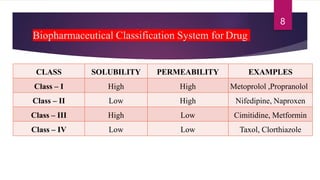
Biopharmaceutical Classification System for Drug
8
CLASS SOLUBILITY PERMEABILITY EXAMPLES
Class – I High High Metoprolol ,Propranolol
Class – II Low High Nifedipine, Naproxen
Class – III High Low Cimitidine, Metformin
Class – IV Low Low Taxol, Clorthiazole
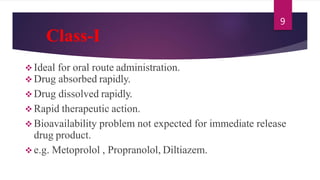
Class-I
 Ideal for oral route administration.
 Drug absorbed rapidly.
 Drug dissolved rapidly.
 Rapid therapeutic action.
 Bioavailability problem not expected for immediate release
drug product.
 e.g. Metoprolol , Propranolol, Diltiazem.
9
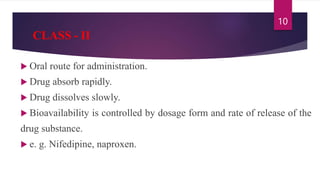
CLASS - II
 Oral route for administration.
 Drug absorb rapidly.
 Drug dissolves slowly.
 Bioavailability is controlled by dosage form and rate of release of the
drug substance.
 e. g. Nifedipine, naproxen.
10
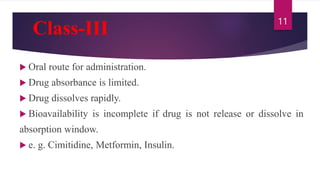
Class-III
 Oral route for administration.
 Drug absorbance is limited.
 Drug dissolves rapidly.
 Bioavailability is incomplete if drug is not release or dissolve in
absorption window.
 e. g. Cimitidine, Metformin, Insulin.
11
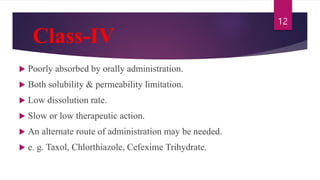
Class-IV
 Poorly absorbed by orally administration.
 Both solubility & permeability limitation.
 Low dissolution rate.
 Slow or low therapeutic action.
 An alternate route of administration may be needed.
 e. g. Taxol, Chlorthiazole, Cefexime Trihydrate.
12
Application:
I. To predict in vivo performance of drug product using solubility and
permeability measurements.
II. Aid in earliest stages of drug discovery research.
III.To use in biowaiver considerations.
IV.For research scientist to decide upon which drug delivery technology to
follow or develop.
V. Also for the regulation of bioequivalence of the drug product during scale
up and post approval.
13
Application of preformulation
considerations in the development of solid,
liquid oral and parenteral dosage forms and
its impact on stability of dosage forms.
14
STABILITY STUDIES
I. It provides evidence on how the quality of a drug substance or drug product
varies with time under the influence of a variety of environmental factors
such as temperature, Humidity and light.
II. Establish a re-test period for the drug substance or a shelf life for the drug
product and recommended storage conditions.
III.Because physical, chemical or microbiological changes might impact the
efficiency and security of the final product.
15
Stability Studies are preformed on
I.Drug Substances (DS)
The unformulated drug substance that may subsequently be formulated with excipients
to produce the dosage form.
II.Drug Products (DP)
The dosage form in the final immediate packaging intended for marketing.
Controlled and documented determination of acceptable changes of the drug
substance or drug product.
16
The Stability changes are
 Physical changes
I. Appearance
II. Melting point
III. Clarity and color of solution
IV. Moisture
V. Crystal modification (Polymorphism)
VI. Particle size
 Chemical changes
I. Increase in Degradation
II. Decrease of Assay
III. Microbial changes
IV. Stability studies at different stages
V. Stress- and accelerated Testing with drug substances
VI. Stability on pre-formulation batches
VII. Stress testing on scale-up Batches
VIII. Accelerated and long term testing for registration
IX. On-going Stability testing
X. Follow-up Stabilities
17
TESTING SCOPE FOR SOLID DOSAGE
 Physical-chemical properties
I. Appearance
II. Elasticity
III. Mean mass
IV. Moisture
V. Hardness
VI. Disintegration
VII.Dissolution
Chemical properties
I. Assay
II. Degradation
III. Microbial properties
IV.Container closure system properties
 Functionality tests (e.g. extraction from blister
18
TESTING SCOPE FOR ORAL LIQUID
FORM
 Physical-chemical properties
I. pH
II. Color & clarity of solution
III.Viscosity
IV.Particle size distribution (for oral
suspensions only)
 Chemical properties
I. Assay
II. Degradation products
III. Degradation preservatives
IV. Content antioxidants.
 Microbial properties
 Container closure system properties
I. Functionality tests
19
TESTING SCOPE FOR LIQUID FORMS
FOR INJ. AND PARENTRAL
 Physical-chemical properties
I. pH
II. Loss on weight
III. Color & clarity of solution
 Microbial properties
 Container closure system properties
I. Functionality tests
 Chemical properties
I. Assay
II.Degradation products
III.Degradation preservatives
IV.Content antioxidants
20
21

BIOPHARMACEUTICAL CLASSIFICATION SYSTEM (BCS)

  • 1.
    BIOPHARMACEUTICAL CLASSIFICATION SYSTEM (BCS) Mr. Nandakishor B Deshmukh  Assistant Professor  Department of Pharmaceutics  Shraddha institute of Pharmacy, kondala zambre, washim  Subject – Industrial Pharmacy -I  Class- B-Pharm- III Sem V 1
  • 2.
    CONTENT  Introduction Factor affectingon biopharmaceutical classification system Biopharmaceutical classification system [classes]  Application of biopharmaceutical classification system  Application of preformulation considerations in the development of a. Solid b. Liquid oral c. Parenteral dosage forms Its impact on stability of dosage forms. 2
  • 3.
    Introduction The Biopharmaceutical ClassificationSystem was first developed by in 1995, by Amidon et al & his colleagues.  Definition: “The Biopharmaceutical Classification System is a scientific framework for classifying a drug substance based on its aqueous solubility & intestinal permeability & dissolution rate”. To saved time fast screening is required so drug substances are classified on basis of solubility and permeability. This classification is called Biopharmaceutical Classification System. 3
  • 4.
    Biopharmaceutical Classification System The Biopharmaceutical Classification System has been developed to provide a scientific approach to allow for to prediction in vivo pharmacokinetics of oral immediate release (IR) drug product by classifying drug compound based on their. SOLUBILITY PERMEABILITY DISSOLUTION 4
  • 5.
    SOLUBILITY The MaximumAmount ofsolute dissolved in a given solvent under standard conditions of temperature, pressure and pH. Solubility is the ability of the drug to be solution after dissolution The higher single unit dose is completely soluble in 250 ml at pH 1- 6.8 ( 37˚C ). 5
  • 6.
    PERMEABILITY Permeability of thedrug to pass the biological membrane which is the lipophilic.  Permeability is indirectly based on the extent of absorption of a drug substance .  Drug substance is considered to be highly permeable, when the extent of absorption in human determined to be 90% or more of administered drug or compare to in vivo reference dose. 6
  • 7.
    DISSOLUTION  It isprocess in which solid substance solubilises in given solvent i.e mass transfer from solid surface to liquid phase.  Using USP apparatus I at 100 rpm or USP apparatus II at 50 rpm .  Dissolution Media [900 ml], 1. 0.1 N HCl or simulated gastric fluid (pH 1.2) without enzyme. 2. pH 4.5 buffer & pH 6.8 buffer. 3. Simulated intestinal fluid without enzyme. 7
  • 8.
    Biopharmaceutical Classification Systemfor Drug 8 CLASS SOLUBILITY PERMEABILITY EXAMPLES Class – I High High Metoprolol ,Propranolol Class – II Low High Nifedipine, Naproxen Class – III High Low Cimitidine, Metformin Class – IV Low Low Taxol, Clorthiazole
  • 9.
    Class-I  Ideal fororal route administration.  Drug absorbed rapidly.  Drug dissolved rapidly.  Rapid therapeutic action.  Bioavailability problem not expected for immediate release drug product.  e.g. Metoprolol , Propranolol, Diltiazem. 9
  • 10.
    CLASS - II Oral route for administration.  Drug absorb rapidly.  Drug dissolves slowly.  Bioavailability is controlled by dosage form and rate of release of the drug substance.  e. g. Nifedipine, naproxen. 10
  • 11.
    Class-III  Oral routefor administration.  Drug absorbance is limited.  Drug dissolves rapidly.  Bioavailability is incomplete if drug is not release or dissolve in absorption window.  e. g. Cimitidine, Metformin, Insulin. 11
  • 12.
    Class-IV  Poorly absorbedby orally administration.  Both solubility & permeability limitation.  Low dissolution rate.  Slow or low therapeutic action.  An alternate route of administration may be needed.  e. g. Taxol, Chlorthiazole, Cefexime Trihydrate. 12
  • 13.
    Application: I. To predictin vivo performance of drug product using solubility and permeability measurements. II. Aid in earliest stages of drug discovery research. III.To use in biowaiver considerations. IV.For research scientist to decide upon which drug delivery technology to follow or develop. V. Also for the regulation of bioequivalence of the drug product during scale up and post approval. 13
  • 14.
    Application of preformulation considerationsin the development of solid, liquid oral and parenteral dosage forms and its impact on stability of dosage forms. 14
  • 15.
    STABILITY STUDIES I. Itprovides evidence on how the quality of a drug substance or drug product varies with time under the influence of a variety of environmental factors such as temperature, Humidity and light. II. Establish a re-test period for the drug substance or a shelf life for the drug product and recommended storage conditions. III.Because physical, chemical or microbiological changes might impact the efficiency and security of the final product. 15
  • 16.
    Stability Studies arepreformed on I.Drug Substances (DS) The unformulated drug substance that may subsequently be formulated with excipients to produce the dosage form. II.Drug Products (DP) The dosage form in the final immediate packaging intended for marketing. Controlled and documented determination of acceptable changes of the drug substance or drug product. 16
  • 17.
    The Stability changesare  Physical changes I. Appearance II. Melting point III. Clarity and color of solution IV. Moisture V. Crystal modification (Polymorphism) VI. Particle size  Chemical changes I. Increase in Degradation II. Decrease of Assay III. Microbial changes IV. Stability studies at different stages V. Stress- and accelerated Testing with drug substances VI. Stability on pre-formulation batches VII. Stress testing on scale-up Batches VIII. Accelerated and long term testing for registration IX. On-going Stability testing X. Follow-up Stabilities 17
  • 18.
    TESTING SCOPE FORSOLID DOSAGE  Physical-chemical properties I. Appearance II. Elasticity III. Mean mass IV. Moisture V. Hardness VI. Disintegration VII.Dissolution Chemical properties I. Assay II. Degradation III. Microbial properties IV.Container closure system properties  Functionality tests (e.g. extraction from blister 18
  • 19.
    TESTING SCOPE FORORAL LIQUID FORM  Physical-chemical properties I. pH II. Color & clarity of solution III.Viscosity IV.Particle size distribution (for oral suspensions only)  Chemical properties I. Assay II. Degradation products III. Degradation preservatives IV. Content antioxidants.  Microbial properties  Container closure system properties I. Functionality tests 19
  • 20.
    TESTING SCOPE FORLIQUID FORMS FOR INJ. AND PARENTRAL  Physical-chemical properties I. pH II. Loss on weight III. Color & clarity of solution  Microbial properties  Container closure system properties I. Functionality tests  Chemical properties I. Assay II.Degradation products III.Degradation preservatives IV.Content antioxidants 20
  • 21.