Class- B-pharm- III Sem V
Subject - . Industrial Pharmacy-I
Topic Name : Soft Gelatin Capsules
Mr Nandakishor B Deshmukh.
Assistant Professor
Department Of Pharmaceutics
Shraddha Institute Of Pharmacy, Kondala
Zambre, Washim
SOFT GELATIN CAPSULES
• Definition: Soft gelatin capsules are made of gelatin to
which glycerin or a polyhydric
• alcohol such as sorbitol has been added. Soft gelatin
capsules, which contain more moisture than hard
capsules, may have a preservative, such as
methylparaben and/or propylparaben, to retard
microbial growth.
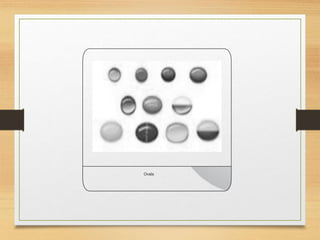
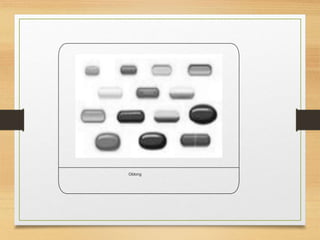
• These are solid dosage forms in which powder, paste, or
liquid medicaments are enclosed in a soft, globular
gelatin shell. They may be round, oval, or oblong in
shape.
Nature of Shell and Capsules
Contents
• soft gelatin are made up of gelatin.
• Gelatin:
• Plasticizers:
• Water:
• Colourants
• Bloom Strength:
• Viscosity:
• Flavouring Agent
• Sweetening Agent
• Preservatives
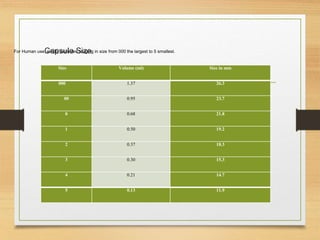
Capsule Size
Size Volume (ml) Size in mm
000 1.37 26.3
00 0.95 23.7
0 0.68 21.8
1 0.50 19.2
2 0.37 18.3
3 0.30 15.3
4 0.21 14.7
5 0.13 11.9
For Human use, empty capsules ranging in size from 000 the largest to 5 smallest.
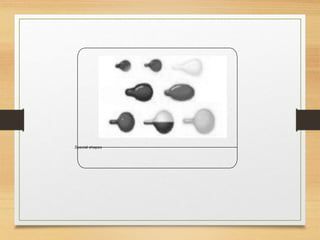
Special shapes
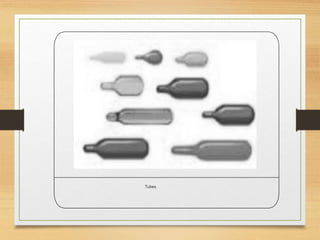
Tubes
Ovals
Oblong
Importance of Base Adsorption and Minim/gram
• Importance:
• It helps to determine base adsorption and fluidity of a
mixture.
• It is used to determine the minim per gram factor (M/g) of
the solid.
• It is also important of establishing specification for the
control of physical properties of solid.
• The convenience of using M/g factors is particularly
evident in the vitamin field, where there may be many
ingredients and numerous combinations.
• They are used to rapidly calculate capsules size
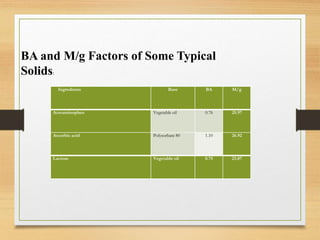
Ingredients Base BA M/g
Acetaminophen Vegetable oil 0.76 25.97
Ascorbic acid Polysorbate 80 1.10 26.92
Lactose Vegetable oil 0.75 23.87
BA and M/g Factors of Some Typical
Solids:
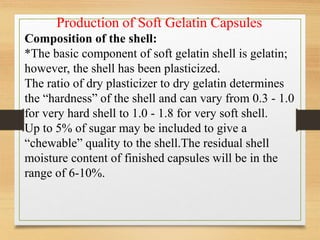
Production of Soft Gelatin Capsules
Composition of the shell:
*The basic component of soft gelatin shell is gelatin;
however, the shell has been plasticized.
The ratio of dry plasticizer to dry gelatin determines
the “hardness” of the shell and can vary from 0.3 - 1.0
for very hard shell to 1.0 - 1.8 for very soft shell.
Up to 5% of sugar may be included to give a
“chewable” quality to the shell.The residual shell
moisture content of finished capsules will be in the
range of 6-10%.
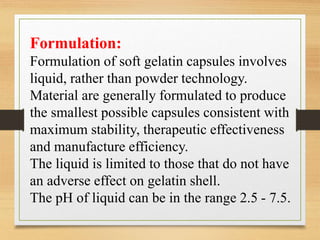
Formulation:
Formulation of soft gelatin capsules involves
liquid, rather than powder technology.
Material are generally formulated to produce
the smallest possible capsules consistent with
maximum stability, therapeutic effectiveness
and manufacture efficiency.
The liquid is limited to those that do not have
an adverse effect on gelatin shell.
The pH of liquid can be in the range 2.5 - 7.5.
Soft Gelatin Capsules are manufactured
by following four methods:
i. Plate process,
ii. Rotary die process,
iii. Reciprocating die,
iv. Accogel machine.
Plate Process:
* Place the gelatin sheet over a die plate
containing numerous die pockets.
* Application of vacuum to draw the sheet in to
the die pockets.
* Fill the pockets with liquid or paste.
* Place another gelatin sheet over the filled
pockets, and
Sandwich under a die press where the capsules
are formed and cut out
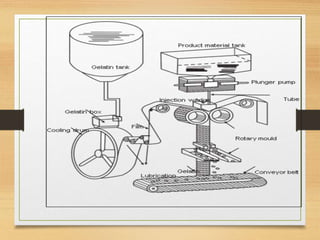
Rotary Die Process:
* In this machine the soft gelatin capsules are prepared
and then filled immediately with liquid medicaments, it is
having two hoppers and two rotating dies
* Liquid mixture is placed in one hopper and the liquid
medicament in another Hopper.
* The two rotating dies rotate in opposite directions when
the fluid gelatin mixture enters the machine from the
hopper it produces two continuous ribbons.
* These half shells of the capsule are formed.
At this stage the measured quantity of the medicament is
filled in to it with the stroke of a pump with the
subsequent movement of the dies, the other half capsule is
formed.
Reciprocating Die Process:
* The early success of the rotary die process
led others to develop continuous methods of
soft gelatin capsules manufacture.
*One such method, known as the
reciprocating die process, was announced in
1949 and was developed by the Nortan
Company, Worchester, MA.
Quality Control Tests
• Disintegration Test
• Weight variation
• Content Uniformity
• Dissolution Test
• Physical Quality Control
capsule colour
Stability Testing of Soft Gelatin Capsules
• Moisture Permeation Test:
• Physical Stability:
Applications of Soft Gelatin Tablets
• As an oral dosage form.
• As a suppository dosage form.
• As a specialty package in tube form, for human and
veterinary use, single dose application for topical,
ophthalmic, and rectal ointments.
• It is used in water immiscible, volatile, and non-volatile
liquid such as vegetable and aromatic oils, aromatic and
aliphatic hydrocarbons, ether, esters, alcohol, and
organic acids.
• Solid also encapsulated into soft gelatin capsules as
solution in one of the suitable liquid solvent, as
suspension, or as dry powder, granules, or pelletized
materials.

SOFT GELETIN CAPSULES

  • 1.
    Class- B-pharm- IIISem V Subject - . Industrial Pharmacy-I Topic Name : Soft Gelatin Capsules Mr Nandakishor B Deshmukh. Assistant Professor Department Of Pharmaceutics Shraddha Institute Of Pharmacy, Kondala Zambre, Washim
  • 2.
    SOFT GELATIN CAPSULES •Definition: Soft gelatin capsules are made of gelatin to which glycerin or a polyhydric • alcohol such as sorbitol has been added. Soft gelatin capsules, which contain more moisture than hard capsules, may have a preservative, such as methylparaben and/or propylparaben, to retard microbial growth. • These are solid dosage forms in which powder, paste, or liquid medicaments are enclosed in a soft, globular gelatin shell. They may be round, oval, or oblong in shape.
  • 3.
    Nature of Shelland Capsules Contents • soft gelatin are made up of gelatin. • Gelatin: • Plasticizers: • Water: • Colourants • Bloom Strength: • Viscosity: • Flavouring Agent • Sweetening Agent • Preservatives
  • 4.
    Capsule Size Size Volume(ml) Size in mm 000 1.37 26.3 00 0.95 23.7 0 0.68 21.8 1 0.50 19.2 2 0.37 18.3 3 0.30 15.3 4 0.21 14.7 5 0.13 11.9 For Human use, empty capsules ranging in size from 000 the largest to 5 smallest.
  • 5.
  • 6.
  • 7.
  • 8.
  • 9.
    Importance of BaseAdsorption and Minim/gram • Importance: • It helps to determine base adsorption and fluidity of a mixture. • It is used to determine the minim per gram factor (M/g) of the solid. • It is also important of establishing specification for the control of physical properties of solid. • The convenience of using M/g factors is particularly evident in the vitamin field, where there may be many ingredients and numerous combinations. • They are used to rapidly calculate capsules size
  • 10.
    Ingredients Base BAM/g Acetaminophen Vegetable oil 0.76 25.97 Ascorbic acid Polysorbate 80 1.10 26.92 Lactose Vegetable oil 0.75 23.87 BA and M/g Factors of Some Typical Solids:
  • 11.
    Production of SoftGelatin Capsules Composition of the shell: *The basic component of soft gelatin shell is gelatin; however, the shell has been plasticized. The ratio of dry plasticizer to dry gelatin determines the “hardness” of the shell and can vary from 0.3 - 1.0 for very hard shell to 1.0 - 1.8 for very soft shell. Up to 5% of sugar may be included to give a “chewable” quality to the shell.The residual shell moisture content of finished capsules will be in the range of 6-10%.
  • 12.
    Formulation: Formulation of softgelatin capsules involves liquid, rather than powder technology. Material are generally formulated to produce the smallest possible capsules consistent with maximum stability, therapeutic effectiveness and manufacture efficiency. The liquid is limited to those that do not have an adverse effect on gelatin shell. The pH of liquid can be in the range 2.5 - 7.5.
  • 13.
    Soft Gelatin Capsulesare manufactured by following four methods: i. Plate process, ii. Rotary die process, iii. Reciprocating die, iv. Accogel machine.
  • 14.
    Plate Process: * Placethe gelatin sheet over a die plate containing numerous die pockets. * Application of vacuum to draw the sheet in to the die pockets. * Fill the pockets with liquid or paste. * Place another gelatin sheet over the filled pockets, and Sandwich under a die press where the capsules are formed and cut out
  • 15.
    Rotary Die Process: *In this machine the soft gelatin capsules are prepared and then filled immediately with liquid medicaments, it is having two hoppers and two rotating dies * Liquid mixture is placed in one hopper and the liquid medicament in another Hopper. * The two rotating dies rotate in opposite directions when the fluid gelatin mixture enters the machine from the hopper it produces two continuous ribbons. * These half shells of the capsule are formed. At this stage the measured quantity of the medicament is filled in to it with the stroke of a pump with the subsequent movement of the dies, the other half capsule is formed.
  • 17.
    Reciprocating Die Process: *The early success of the rotary die process led others to develop continuous methods of soft gelatin capsules manufacture. *One such method, known as the reciprocating die process, was announced in 1949 and was developed by the Nortan Company, Worchester, MA.
  • 18.
    Quality Control Tests •Disintegration Test • Weight variation • Content Uniformity • Dissolution Test • Physical Quality Control capsule colour
  • 19.
    Stability Testing ofSoft Gelatin Capsules • Moisture Permeation Test: • Physical Stability:
  • 20.
    Applications of SoftGelatin Tablets • As an oral dosage form. • As a suppository dosage form. • As a specialty package in tube form, for human and veterinary use, single dose application for topical, ophthalmic, and rectal ointments. • It is used in water immiscible, volatile, and non-volatile liquid such as vegetable and aromatic oils, aromatic and aliphatic hydrocarbons, ether, esters, alcohol, and organic acids. • Solid also encapsulated into soft gelatin capsules as solution in one of the suitable liquid solvent, as suspension, or as dry powder, granules, or pelletized materials.