
Artificial Intelligence Used In Pharmacy
By
Mr. Shravan S. Sawarkar
Under the Guidance of
Prof. Nandakishor B. Deshmukh
M.Pharm (Department of
Pharmaceutics)
Shraddha Institute Of Pharmacy, (B -Pharm) kondala Zambre,
Washim
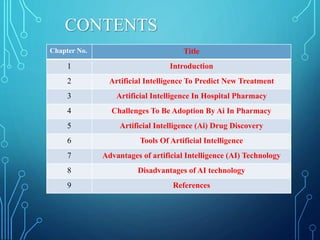
CONTENTS
Chapter No. Title
1 Introduction
2 Artificial Intelligence To Predict New Treatment
3 Artificial Intelligence In Hospital Pharmacy
4 Challenges To Be Adoption By Ai In Pharmacy
5 Artificial Intelligence (Ai) Drug Discovery
6 Tools Of Artificial Intelligence
7 Advantages of artificial Intelligence (AI) Technology
8 Disadvantages of AI technology
9 References
INTRODUCTION
Artificial intelligence in pharmacy refers to the application of AI
techniques and technologies within the field of pharmacy and healthcare to
optimize various processes.
This includes tasks such as drug discovery medication management
patient care, and data analysis. AI can assist pharmacists and healthcare
professionals in tasks like drug interaction checking, dosage
recommendations inventory management, and even personalized medicine
by analyzing patient data to tailor treatments.
AI in pharmacy aims to enhance efficiency accuracy and patient outcomes
in the pharmaceutical and healthcare sectors. Artificial intelligence (AI)
has rapidly transformed the pharmacy industry by introducing advanced
technologies to streamline processes enhance patient care and improve
overall efficiency.
Artificial Intelligence (AI) is a branch of computer science that solves
problems through symbols and engineering processes Artificial
Intelligence .
The main purpose of artificial intelligence is to interpret important
information that formulates problems and offers abstract solutions.
Artificial intelligence as a field develops and uses algorithms to analyse,
learn and interpret data.
In recent years, the pharmaceutical industry has discovered new and
innovative ways to use these powerful tools to help solve some of the
biggest challenges facing the pharmaceutical industry today.
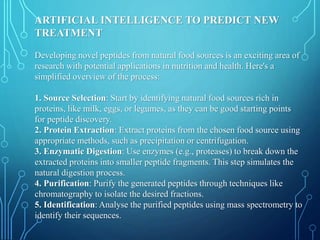
ARTIFICIAL INTELLIGENCE TO PREDICT NEW
TREATMENT
Developing novel peptides from natural food sources is an exciting area of
research with potential applications in nutrition and health. Here's a
simplified overview of the process:
1. Source Selection: Start by identifying natural food sources rich in
proteins, like milk, eggs, or legumes, as they can be good starting points
for peptide discovery.
2. Protein Extraction: Extract proteins from the chosen food source using
appropriate methods, such as precipitation or centrifugation.
3. Enzymatic Digestion: Use enzymes (e.g., proteases) to break down the
extracted proteins into smaller peptide fragments. This step simulates the
natural digestion process.
4. Purification: Purify the generated peptides through techniques like
chromatography to isolate the desired fractions.
5. Identification: Analyse the purified peptides using mass spectrometry to
identify their sequences.
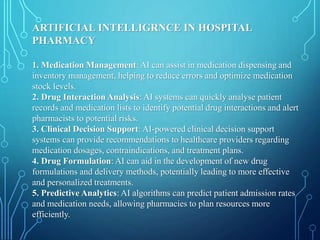
ARTIFICIAL INTELLIGRNCE IN HOSPITAL
PHARMACY
1. Medication Management: AI can assist in medication dispensing and
inventory management, helping to reduce errors and optimize medication
stock levels.
2. Drug Interaction Analysis: AI systems can quickly analyse patient
records and medication lists to identify potential drug interactions and alert
pharmacists to potential risks.
3. Clinical Decision Support: AI-powered clinical decision support
systems can provide recommendations to healthcare providers regarding
medication dosages, contraindications, and treatment plans.
4. Drug Formulation: AI can aid in the development of new drug
formulations and delivery methods, potentially leading to more effective
and personalized treatments.
5. Predictive Analytics: AI algorithms can predict patient admission rates
and medication needs, allowing pharmacies to plan resources more
efficiently.
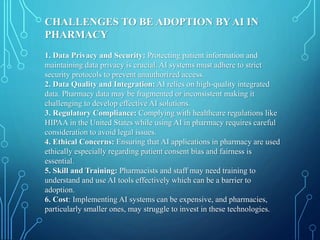
CHALLENGES TO BE ADOPTION BY AI IN
PHARMACY
1. Data Privacy and Security: Protecting patient information and
maintaining data privacy is crucial. AI systems must adhere to strict
security protocols to prevent unauthorized access.
2. Data Quality and Integration: AI relies on high-quality integrated
data. Pharmacy data may be fragmented or inconsistent making it
challenging to develop effective AI solutions.
3. Regulatory Compliance: Complying with healthcare regulations like
HIPAA in the United States while using AI in pharmacy requires careful
consideration to avoid legal issues.
4. Ethical Concerns: Ensuring that AI applications in pharmacy are used
ethically especially regarding patient consent bias and fairness is
essential.
5. Skill and Training: Pharmacists and staff may need training to
understand and use AI tools effectively which can be a barrier to
adoption.
6. Cost: Implementing AI systems can be expensive, and pharmacies,
particularly smaller ones, may struggle to invest in these technologies.
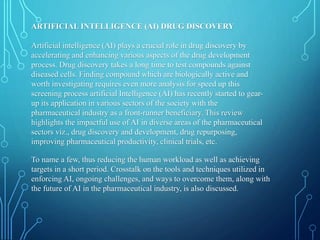
ARTIFICIAL INTELLIGENCE (AI) DRUG DISCOVERY
Artificial intelligence (AI) plays a crucial role in drug discovery by
accelerating and enhancing various aspects of the drug development
process. Drug discovery takes a long time to test compounds against
diseased cells. Finding compound which are biologically active and
worth investigating requires even more analysis for speed up this
screening process artificial Intelligence (AI) has recently started to gear-
up its application in various sectors of the society with the
pharmaceutical industry as a front-runner beneficiary. This review
highlights the impactful use of AI in diverse areas of the pharmaceutical
sectors viz., drug discovery and development, drug repurposing,
improving pharmaceutical productivity, clinical trials, etc.
To name a few, thus reducing the human workload as well as achieving
targets in a short period. Crosstalk on the tools and techniques utilized in
enforcing AI, ongoing challenges, and ways to overcome them, along with
the future of AI in the pharmaceutical industry, is also discussed.
TOOLS OF ARTIFICIAL INTELLIGENCE
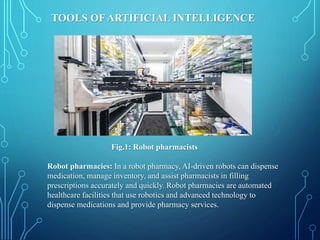
Fig.1: Robot pharmacists
Robot pharmacies: In a robot pharmacy, AI-driven robots can dispense
medication, manage inventory, and assist pharmacists in filling
prescriptions accurately and quickly. Robot pharmacies are automated
healthcare facilities that use robotics and advanced technology to
dispense medications and provide pharmacy services.
These pharmacies can offer several benefits, such as increased
accuracy in filling prescriptions, 24/7 accessibility, and reduced
wait times for customers. Robots in these pharmacies can count
pills, package medications, and even assist with medication
management for patients.
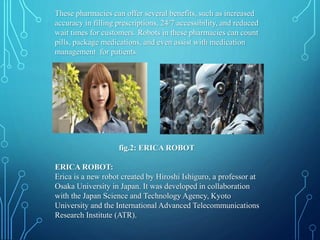
fig.2: ERICA ROBOT
ERICA ROBOT:
Erica is a new robot created by Hiroshi Ishiguro, a professor at
Osaka University in Japan. It was developed in collaboration
with the Japan Science and Technology Agency, Kyoto
University and the International Advanced Telecommunications
Research Institute (ATR).
He speaks Japanese and has a mixture of European and Asian facial
features. Like any normal person, he loves animated movies, wants to
travel to South Asia, and wants to spend his life with someone he can
talk to.
The robot cannot walk on its own; but has developed the ability to
understand and answer questions using human facial expressions, a
robot nose, eyes, etc. has created.
Tug Robots:
Aethon TUG robots are designed to move autonomously in hospitals,
distribute medicines, meals, samples, supplies, and carry heavy items
such as linens and garbage. Comes in two configurations, ... fixed and
support cart, as well as a swap base platform that can be used to
transport the rack, rear legs and cart. While rigid trucks are used to
transport drugs, sensitive materials and laboratories, exchange
platforms are also used to: Vyas et al: Artificial Intelligence: A New
Era in the pharmaceutical business Asia Magazine Drug April 2018 -
12 June 75 Transport information that can be loaded on different racks:
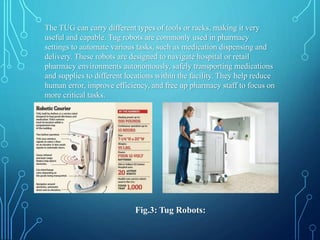
The TUG can carry different types of tools or racks, making it very
useful and capable. Tug robots are commonly used in pharmacy
settings to automate various tasks, such as medication dispensing and
delivery. These robots are designed to navigate hospital or retail
pharmacy environments autonomously, safely transporting medications
and supplies to different locations within the facility. They help reduce
human error, improve efficiency, and free up pharmacy staff to focus on
more critical tasks.
Fig.3: Tug Robots:
Advantages of artificial Intelligence (AI) Technology
1. Automation: AI can perform repetitive tasks more efficiently and
accurately than humans leading to increased productivity and cost
savings.
2. Decision Making: AI systems can analyse vast amounts of data to
make informed and data-driven decisions in real-time.
3. 24/7 Availability: AI-powered chatbots and virtual assistants can
provide round-the-clock customer support and assistance.
4. Personalization: AI can tailor recommendations and experiences
based on user preferences enhancing customer satisfaction.
5. Improved Healthcare: AI can assist in medical diagnosis drug
discovery and personalized treatment plans leading to better
healthcare outcomes.
6. Enhanced Security: AI can detect and respond to cybersecurity
threats more effectively protecting sensitive data and systems.
7. Predictive Analytics: AI can forecast trends and identify potential
issues helping businesses plan and mitigate risks.
Disadvantages of AI technology
1. Job Displacement: Automation driven by AI can lead to job loss in certain
industries, as tasks once performed by humans are automated This can be
particularly concerning for jobs that are routine and repetitive.
2. Bias and Fairness: AI systems can inherit biases from the data they are trained
on, leading to unfair or discriminatory outcomes, especially in areas like hiring or
lending where historical biases exist in the data.
3. Privacy Concerns: AI systems often require access to large amounts of data,
which can raise privacy concerns. Improper handling of data can lead to breaches
or misuse of personal information.
4. Lack of Creativity and Empathy: AI lacks the ability to think creatively or
empathize with humans. This can be a limitation in tasks that require emotional
understanding or nuanced decision-making.
5. High Costs: Developing and implementing AI technology can be expensive,
particularly for smaller businesses or organizations. This can create a digital
divide.
6. Security Risks: As AI becomes more prevalent, it can also be exploited by
malicious actors. AI systems can be vulnerable to attacks and AI-generated deep
fakes pose security threats.
References :
1. Russell S, Dewey D. Tegmark M. Research priorities for robust and beneficial
artificial intelligence. Ai Magazine. 2015 Dec 31;36 :105-14. Lakshmi Teja T,
Keerthi P, Debarshi Datta NB. Recent trends in the usage of robotics in pharmacy.
2.Yussupova N, Kovács G, Boyko M, Bogdanova I). Models and methods for
quality management based on artificial intelligence applications. Acta
Polytechnica Hungarica. 2016 Mar;13:45-60 Brady M. Artificial intelligence and
robotics. In Robotics and Artificial Intelligence 1984 (pp. 47-63). Springer, Berlin,
Heidelberg
3. Mesko B. The role of artificial intelligence in precision medicine,
4. Jiang F, Jiang Y, Zhi H, Dong Y, Li H, Ma S, Wang Y, Dong Q, Shen H, Wang
Y. Artificial intelligence in healthcare: past, present and future. 2017 Dec 1;2.
Stroke and vascular neurology.
5. Patil DP. Emotion in artificial intelligence and its life research to facing
troubles. International Journal of Research in Computer Applications and
Robotics. 2016 Apr.
6. Zhang Y, Balochian S, Agarwal P, Bhatnagar V, Housheya OJ. Artificial
intelligence and its applications 2014.
7. Dilsizian SE, Siegel EL. Current cardiology reports. 2014 Jan1:16:441. Artificial
intelligence in medicine and cardiac imaging: harnessing big data and advanced
computing to provide personalized medical diagnosis and treatment. Current
cardiology reports.
8. Neill DB. Using artificial intelligence to improve hospital inpatient care. . 2013
Jun 27:2:92-5. IEEE Intelligent Systems.
9. Roff HM. Advancing human security through artificial intelligence. Chatham
House; 2017
Sr. No. Figures
1 Robot pharmacists
2 Erica Robot
3 Tug Robots
Artificial Intelligence Used In Pharmacy.pptx

Artificial Intelligence Used In Pharmacy.pptx

  • 1.
    Artificial Intelligence UsedIn Pharmacy By Mr. Shravan S. Sawarkar Under the Guidance of Prof. Nandakishor B. Deshmukh M.Pharm (Department of Pharmaceutics) Shraddha Institute Of Pharmacy, (B -Pharm) kondala Zambre, Washim
  • 2.
    CONTENTS Chapter No. Title 1Introduction 2 Artificial Intelligence To Predict New Treatment 3 Artificial Intelligence In Hospital Pharmacy 4 Challenges To Be Adoption By Ai In Pharmacy 5 Artificial Intelligence (Ai) Drug Discovery 6 Tools Of Artificial Intelligence 7 Advantages of artificial Intelligence (AI) Technology 8 Disadvantages of AI technology 9 References
  • 3.
    INTRODUCTION Artificial intelligence inpharmacy refers to the application of AI techniques and technologies within the field of pharmacy and healthcare to optimize various processes. This includes tasks such as drug discovery medication management patient care, and data analysis. AI can assist pharmacists and healthcare professionals in tasks like drug interaction checking, dosage recommendations inventory management, and even personalized medicine by analyzing patient data to tailor treatments. AI in pharmacy aims to enhance efficiency accuracy and patient outcomes in the pharmaceutical and healthcare sectors. Artificial intelligence (AI) has rapidly transformed the pharmacy industry by introducing advanced technologies to streamline processes enhance patient care and improve overall efficiency.
  • 4.
    Artificial Intelligence (AI)is a branch of computer science that solves problems through symbols and engineering processes Artificial Intelligence . The main purpose of artificial intelligence is to interpret important information that formulates problems and offers abstract solutions. Artificial intelligence as a field develops and uses algorithms to analyse, learn and interpret data. In recent years, the pharmaceutical industry has discovered new and innovative ways to use these powerful tools to help solve some of the biggest challenges facing the pharmaceutical industry today.
  • 5.
    ARTIFICIAL INTELLIGENCE TOPREDICT NEW TREATMENT Developing novel peptides from natural food sources is an exciting area of research with potential applications in nutrition and health. Here's a simplified overview of the process: 1. Source Selection: Start by identifying natural food sources rich in proteins, like milk, eggs, or legumes, as they can be good starting points for peptide discovery. 2. Protein Extraction: Extract proteins from the chosen food source using appropriate methods, such as precipitation or centrifugation. 3. Enzymatic Digestion: Use enzymes (e.g., proteases) to break down the extracted proteins into smaller peptide fragments. This step simulates the natural digestion process. 4. Purification: Purify the generated peptides through techniques like chromatography to isolate the desired fractions. 5. Identification: Analyse the purified peptides using mass spectrometry to identify their sequences.
  • 6.
    ARTIFICIAL INTELLIGRNCE INHOSPITAL PHARMACY 1. Medication Management: AI can assist in medication dispensing and inventory management, helping to reduce errors and optimize medication stock levels. 2. Drug Interaction Analysis: AI systems can quickly analyse patient records and medication lists to identify potential drug interactions and alert pharmacists to potential risks. 3. Clinical Decision Support: AI-powered clinical decision support systems can provide recommendations to healthcare providers regarding medication dosages, contraindications, and treatment plans. 4. Drug Formulation: AI can aid in the development of new drug formulations and delivery methods, potentially leading to more effective and personalized treatments. 5. Predictive Analytics: AI algorithms can predict patient admission rates and medication needs, allowing pharmacies to plan resources more efficiently.
  • 7.
    CHALLENGES TO BEADOPTION BY AI IN PHARMACY 1. Data Privacy and Security: Protecting patient information and maintaining data privacy is crucial. AI systems must adhere to strict security protocols to prevent unauthorized access. 2. Data Quality and Integration: AI relies on high-quality integrated data. Pharmacy data may be fragmented or inconsistent making it challenging to develop effective AI solutions. 3. Regulatory Compliance: Complying with healthcare regulations like HIPAA in the United States while using AI in pharmacy requires careful consideration to avoid legal issues. 4. Ethical Concerns: Ensuring that AI applications in pharmacy are used ethically especially regarding patient consent bias and fairness is essential. 5. Skill and Training: Pharmacists and staff may need training to understand and use AI tools effectively which can be a barrier to adoption. 6. Cost: Implementing AI systems can be expensive, and pharmacies, particularly smaller ones, may struggle to invest in these technologies.
  • 8.
    ARTIFICIAL INTELLIGENCE (AI)DRUG DISCOVERY Artificial intelligence (AI) plays a crucial role in drug discovery by accelerating and enhancing various aspects of the drug development process. Drug discovery takes a long time to test compounds against diseased cells. Finding compound which are biologically active and worth investigating requires even more analysis for speed up this screening process artificial Intelligence (AI) has recently started to gear- up its application in various sectors of the society with the pharmaceutical industry as a front-runner beneficiary. This review highlights the impactful use of AI in diverse areas of the pharmaceutical sectors viz., drug discovery and development, drug repurposing, improving pharmaceutical productivity, clinical trials, etc. To name a few, thus reducing the human workload as well as achieving targets in a short period. Crosstalk on the tools and techniques utilized in enforcing AI, ongoing challenges, and ways to overcome them, along with the future of AI in the pharmaceutical industry, is also discussed.
  • 9.
    TOOLS OF ARTIFICIALINTELLIGENCE Fig.1: Robot pharmacists Robot pharmacies: In a robot pharmacy, AI-driven robots can dispense medication, manage inventory, and assist pharmacists in filling prescriptions accurately and quickly. Robot pharmacies are automated healthcare facilities that use robotics and advanced technology to dispense medications and provide pharmacy services.
  • 10.
    These pharmacies canoffer several benefits, such as increased accuracy in filling prescriptions, 24/7 accessibility, and reduced wait times for customers. Robots in these pharmacies can count pills, package medications, and even assist with medication management for patients. fig.2: ERICA ROBOT ERICA ROBOT: Erica is a new robot created by Hiroshi Ishiguro, a professor at Osaka University in Japan. It was developed in collaboration with the Japan Science and Technology Agency, Kyoto University and the International Advanced Telecommunications Research Institute (ATR).
  • 11.
    He speaks Japaneseand has a mixture of European and Asian facial features. Like any normal person, he loves animated movies, wants to travel to South Asia, and wants to spend his life with someone he can talk to. The robot cannot walk on its own; but has developed the ability to understand and answer questions using human facial expressions, a robot nose, eyes, etc. has created. Tug Robots: Aethon TUG robots are designed to move autonomously in hospitals, distribute medicines, meals, samples, supplies, and carry heavy items such as linens and garbage. Comes in two configurations, ... fixed and support cart, as well as a swap base platform that can be used to transport the rack, rear legs and cart. While rigid trucks are used to transport drugs, sensitive materials and laboratories, exchange platforms are also used to: Vyas et al: Artificial Intelligence: A New Era in the pharmaceutical business Asia Magazine Drug April 2018 - 12 June 75 Transport information that can be loaded on different racks:
  • 12.
    The TUG cancarry different types of tools or racks, making it very useful and capable. Tug robots are commonly used in pharmacy settings to automate various tasks, such as medication dispensing and delivery. These robots are designed to navigate hospital or retail pharmacy environments autonomously, safely transporting medications and supplies to different locations within the facility. They help reduce human error, improve efficiency, and free up pharmacy staff to focus on more critical tasks. Fig.3: Tug Robots:
  • 13.
    Advantages of artificialIntelligence (AI) Technology 1. Automation: AI can perform repetitive tasks more efficiently and accurately than humans leading to increased productivity and cost savings. 2. Decision Making: AI systems can analyse vast amounts of data to make informed and data-driven decisions in real-time. 3. 24/7 Availability: AI-powered chatbots and virtual assistants can provide round-the-clock customer support and assistance. 4. Personalization: AI can tailor recommendations and experiences based on user preferences enhancing customer satisfaction. 5. Improved Healthcare: AI can assist in medical diagnosis drug discovery and personalized treatment plans leading to better healthcare outcomes. 6. Enhanced Security: AI can detect and respond to cybersecurity threats more effectively protecting sensitive data and systems. 7. Predictive Analytics: AI can forecast trends and identify potential issues helping businesses plan and mitigate risks.
  • 14.
    Disadvantages of AItechnology 1. Job Displacement: Automation driven by AI can lead to job loss in certain industries, as tasks once performed by humans are automated This can be particularly concerning for jobs that are routine and repetitive. 2. Bias and Fairness: AI systems can inherit biases from the data they are trained on, leading to unfair or discriminatory outcomes, especially in areas like hiring or lending where historical biases exist in the data. 3. Privacy Concerns: AI systems often require access to large amounts of data, which can raise privacy concerns. Improper handling of data can lead to breaches or misuse of personal information. 4. Lack of Creativity and Empathy: AI lacks the ability to think creatively or empathize with humans. This can be a limitation in tasks that require emotional understanding or nuanced decision-making. 5. High Costs: Developing and implementing AI technology can be expensive, particularly for smaller businesses or organizations. This can create a digital divide. 6. Security Risks: As AI becomes more prevalent, it can also be exploited by malicious actors. AI systems can be vulnerable to attacks and AI-generated deep fakes pose security threats.
  • 15.
    References : 1. RussellS, Dewey D. Tegmark M. Research priorities for robust and beneficial artificial intelligence. Ai Magazine. 2015 Dec 31;36 :105-14. Lakshmi Teja T, Keerthi P, Debarshi Datta NB. Recent trends in the usage of robotics in pharmacy. 2.Yussupova N, Kovács G, Boyko M, Bogdanova I). Models and methods for quality management based on artificial intelligence applications. Acta Polytechnica Hungarica. 2016 Mar;13:45-60 Brady M. Artificial intelligence and robotics. In Robotics and Artificial Intelligence 1984 (pp. 47-63). Springer, Berlin, Heidelberg 3. Mesko B. The role of artificial intelligence in precision medicine, 4. Jiang F, Jiang Y, Zhi H, Dong Y, Li H, Ma S, Wang Y, Dong Q, Shen H, Wang Y. Artificial intelligence in healthcare: past, present and future. 2017 Dec 1;2. Stroke and vascular neurology. 5. Patil DP. Emotion in artificial intelligence and its life research to facing troubles. International Journal of Research in Computer Applications and Robotics. 2016 Apr. 6. Zhang Y, Balochian S, Agarwal P, Bhatnagar V, Housheya OJ. Artificial intelligence and its applications 2014.
  • 16.
    7. Dilsizian SE,Siegel EL. Current cardiology reports. 2014 Jan1:16:441. Artificial intelligence in medicine and cardiac imaging: harnessing big data and advanced computing to provide personalized medical diagnosis and treatment. Current cardiology reports. 8. Neill DB. Using artificial intelligence to improve hospital inpatient care. . 2013 Jun 27:2:92-5. IEEE Intelligent Systems. 9. Roff HM. Advancing human security through artificial intelligence. Chatham House; 2017 Sr. No. Figures 1 Robot pharmacists 2 Erica Robot 3 Tug Robots