
Breeding Techniques In Vegetables
Presented By:
Muhammad Arslan Qamar
13-Arid-377
Contents:
• Definition of Breeding
• Objectives of Breeding
• Breeding methods in vegetables
Mass selection
Bulk Method
Pedigree
Pure-line
Synthetic Population
Composite Cross
Line Breeding
Back Crossing
Breeding
• It is the reproduction that is producing of offspring,
usually animals or plants .
• Goals of Breeding:
o High Yield
o Earliness
o Low proportion of seed
o Soft Flesh
o Avoid Lodging
o Resistance to insects & pests
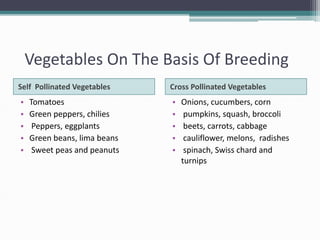
Vegetables On The Basis Of Breeding
Self Pollinated Vegetables Cross Pollinated Vegetables
• Tomatoes
• Green peppers, chilies
• Peppers, eggplants
• Green beans, lima beans
• Sweet peas and peanuts
• Onions, cucumbers, corn
• pumpkins, squash, broccoli
• beets, carrots, cabbage
• cauliflower, melons, radishes
• spinach, Swiss chard and
turnips
Mass Selection
• The mass selection method works with crossers and
multi-line selfers.
• The plant breeder starts with a highly variable
population and collecting the seed of only those
plants with desirable traits.
• These seeds are then bulked and planted the next
year and the process repeats.
Types Of Mass Selection
• Two types of this selection,
 Positive mass selection
 Negative mass selection
Advantages Of Mass Selection
• Simple, rapid and cheap procedure.
• Plants procedured by mass selection have wide
adaptability, wide genetic base.
• Use for the improvement of land races.
Bulk Method
• This is the practice of growing genetically diverse
populations of self-pollinated crops in a bulk plot.
• This method relies on natural or environmental
selection over many generations, so it requires much
patience and observation.
• Bulking generally produces slightly variable varieties
that may be more easily be adapted to local
conditions.
Steps Involved…
• Plant out stock seed from a variable seeds of an F1
cross.
• For F2, F3, and F4 generations, save all seed and
grow out the same number again.
• Plant out the F5 generation in spaced rows, then
select and save seed from certain desirable plants.
• Plant seed from each plant into its own separate row.
Cont…
• Select and save seed from all plants in desirable rows
and plant out in larger observational trials.
• Select the best lines from these trials and plant them
out into replicated trials.
• Choose the best line from the trial.
Pedigree
• This method involves detailed records of ancestry of
an individual family.
• This method takes more observational work, but
progress may be made more quickly and more
uniform lines may be produced.
Steps involved…
• Make an initial cross and bulk seed of the F1
generation.
• Pick several best selfed plants from the F2.
• Save seed and keep it separate.
• Plant the seed from each selfed individual plant in
separate rows or blocks. Each row or block is called a
family.
Cont…
• Through the F3-F7 generations, continue selecting
the best plants from the best rows from the best
families.
• From the F7 generation, select and save seed from
all plants in the best families and plant out in larger
observational trials.
PURELINE
The procedure is as follows:
• Make an initial cross
• Grow out the F1 without any selection.
• Grow out as many selfed F2 plants as possible.
• Select the best F2 plants; save each plant’s seed
separately.
Cont…
• Plant out each plant’s progenies separately, each F2
group is seen as a family.
• Continue to grow out the F2 families for many
generations.
• The best families should be stabilized by generations
five through seven.
SYNTHETIC POPULATIONS
• This is a great way to create diverse new landraces.
• Synthetic populations do better than regular open-
pollinated types but are not as high yielding.
It involves,
• Start with two or more variable landraces.
Cont…
• Make all possible hybrid combinations between all
plants.
• Pool all of the seeds of the hybrids together & plant
them out.
• Allow these plants to naturally and randomly
homogenize and mix.
• Over the next three to five generations, select out
the best plants.
COMPOSITE CROSS
• It is a systematic combination of all varieties
involved.
The steps in creating a composite population include,
• Select several desired parents.
• Perform several generations of controlled crosses
until you have a hybrid with equal amounts of
genetic input from each parent.
Cont…
• Allow your composite plants to self-pollinate or to
pollinate with a sibling.
• Select for superior lines using recurrent mass
selection, bulking, pedigree, or line selection.
Line Breeding
• superior plants are selected and then a row of
progeny is grown and the best plants within the best
rows are selected.
• Multiple lines are made and desired traits are
stabilized.
It involves,
• Select desired parents and make the cross.
Cont…
• Grow the F1 and bulk the seeds.
• Start plant to row selection in the F2 or a later
generation.
• Repeat for several generations with multiple lines
until the desired traits are stabilized.
BACKCROSSING
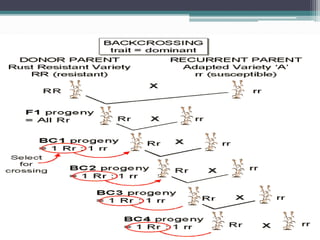
• This technique is generally used to transfer a trait or
set of traits from one variety to another.
It involves,
• Select the recurrent parent and the donor parent
and create the F1.
• If the desired trait is dominant, cross the F1 to the
recurrent parent immediately.
• If the desired trait is recessive, allow the F1 to self or
cross with F1 siblings.
Cont…
• Then select an F2 plant with the desired trait and
backcross it to the recurrent parent.
• Repeat backcrossing until you have reached a similar
enough phenotype to your recurrent parent with the
desired trait from the donor.
• Then stabilize using recurrent selection, pedigree or
pureline selection.
References:
• http://www.tankonyvtar.hu/en/tartalom/tamop412A/20
11_0009_Pepo_Pal-
Applied_Genetics_and_Biotechnology/ch08.html
• http://hariprathab.blogspot.com/2014/03/pure-line-
selection-plant-breeding.html
• https://www.google.com.pk/search?q=pedigree+method
&source=lnms&tbm=isch&sa=X&ved=0ahUKEwiWvtCH9
OfMAhXGtRoKHXIaDMMQ_AUIBygB&biw=1366&bih=62
3#imgrc=vnj5HCj1l8r5WM%3A
• http://theseedsite.co.uk/hybrids.html
• Plant breeding . Manzoor ahmed khan, Managing author
Elena bashir, Robyn bantel, Editors
vegetable Breeding by adnan

vegetable Breeding by adnan

  • 2.
    Breeding Techniques InVegetables Presented By: Muhammad Arslan Qamar 13-Arid-377
  • 3.
    Contents: • Definition ofBreeding • Objectives of Breeding • Breeding methods in vegetables Mass selection Bulk Method Pedigree Pure-line Synthetic Population Composite Cross Line Breeding Back Crossing
  • 4.
    Breeding • It isthe reproduction that is producing of offspring, usually animals or plants . • Goals of Breeding: o High Yield o Earliness o Low proportion of seed o Soft Flesh o Avoid Lodging o Resistance to insects & pests
  • 5.
    Vegetables On TheBasis Of Breeding Self Pollinated Vegetables Cross Pollinated Vegetables • Tomatoes • Green peppers, chilies • Peppers, eggplants • Green beans, lima beans • Sweet peas and peanuts • Onions, cucumbers, corn • pumpkins, squash, broccoli • beets, carrots, cabbage • cauliflower, melons, radishes • spinach, Swiss chard and turnips
  • 6.
    Mass Selection • Themass selection method works with crossers and multi-line selfers. • The plant breeder starts with a highly variable population and collecting the seed of only those plants with desirable traits. • These seeds are then bulked and planted the next year and the process repeats.
  • 8.
    Types Of MassSelection • Two types of this selection,  Positive mass selection  Negative mass selection
  • 9.
    Advantages Of MassSelection • Simple, rapid and cheap procedure. • Plants procedured by mass selection have wide adaptability, wide genetic base. • Use for the improvement of land races.
  • 10.
    Bulk Method • Thisis the practice of growing genetically diverse populations of self-pollinated crops in a bulk plot. • This method relies on natural or environmental selection over many generations, so it requires much patience and observation. • Bulking generally produces slightly variable varieties that may be more easily be adapted to local conditions.
  • 11.
    Steps Involved… • Plantout stock seed from a variable seeds of an F1 cross. • For F2, F3, and F4 generations, save all seed and grow out the same number again. • Plant out the F5 generation in spaced rows, then select and save seed from certain desirable plants. • Plant seed from each plant into its own separate row.
  • 12.
    Cont… • Select andsave seed from all plants in desirable rows and plant out in larger observational trials. • Select the best lines from these trials and plant them out into replicated trials. • Choose the best line from the trial.
  • 13.
    Pedigree • This methodinvolves detailed records of ancestry of an individual family. • This method takes more observational work, but progress may be made more quickly and more uniform lines may be produced.
  • 14.
    Steps involved… • Makean initial cross and bulk seed of the F1 generation. • Pick several best selfed plants from the F2. • Save seed and keep it separate. • Plant the seed from each selfed individual plant in separate rows or blocks. Each row or block is called a family.
  • 15.
    Cont… • Through theF3-F7 generations, continue selecting the best plants from the best rows from the best families. • From the F7 generation, select and save seed from all plants in the best families and plant out in larger observational trials.
  • 17.
    PURELINE The procedure isas follows: • Make an initial cross • Grow out the F1 without any selection. • Grow out as many selfed F2 plants as possible. • Select the best F2 plants; save each plant’s seed separately.
  • 18.
    Cont… • Plant outeach plant’s progenies separately, each F2 group is seen as a family. • Continue to grow out the F2 families for many generations. • The best families should be stabilized by generations five through seven.
  • 20.
    SYNTHETIC POPULATIONS • Thisis a great way to create diverse new landraces. • Synthetic populations do better than regular open- pollinated types but are not as high yielding. It involves, • Start with two or more variable landraces.
  • 21.
    Cont… • Make allpossible hybrid combinations between all plants. • Pool all of the seeds of the hybrids together & plant them out. • Allow these plants to naturally and randomly homogenize and mix. • Over the next three to five generations, select out the best plants.
  • 22.
    COMPOSITE CROSS • Itis a systematic combination of all varieties involved. The steps in creating a composite population include, • Select several desired parents. • Perform several generations of controlled crosses until you have a hybrid with equal amounts of genetic input from each parent.
  • 23.
    Cont… • Allow yourcomposite plants to self-pollinate or to pollinate with a sibling. • Select for superior lines using recurrent mass selection, bulking, pedigree, or line selection.
  • 24.
    Line Breeding • superiorplants are selected and then a row of progeny is grown and the best plants within the best rows are selected. • Multiple lines are made and desired traits are stabilized. It involves, • Select desired parents and make the cross.
  • 25.
    Cont… • Grow theF1 and bulk the seeds. • Start plant to row selection in the F2 or a later generation. • Repeat for several generations with multiple lines until the desired traits are stabilized.
  • 26.
    BACKCROSSING • This techniqueis generally used to transfer a trait or set of traits from one variety to another. It involves, • Select the recurrent parent and the donor parent and create the F1. • If the desired trait is dominant, cross the F1 to the recurrent parent immediately. • If the desired trait is recessive, allow the F1 to self or cross with F1 siblings.
  • 27.
    Cont… • Then selectan F2 plant with the desired trait and backcross it to the recurrent parent. • Repeat backcrossing until you have reached a similar enough phenotype to your recurrent parent with the desired trait from the donor. • Then stabilize using recurrent selection, pedigree or pureline selection.
  • 29.
    References: • http://www.tankonyvtar.hu/en/tartalom/tamop412A/20 11_0009_Pepo_Pal- Applied_Genetics_and_Biotechnology/ch08.html • http://hariprathab.blogspot.com/2014/03/pure-line- selection-plant-breeding.html •https://www.google.com.pk/search?q=pedigree+method &source=lnms&tbm=isch&sa=X&ved=0ahUKEwiWvtCH9 OfMAhXGtRoKHXIaDMMQ_AUIBygB&biw=1366&bih=62 3#imgrc=vnj5HCj1l8r5WM%3A • http://theseedsite.co.uk/hybrids.html • Plant breeding . Manzoor ahmed khan, Managing author Elena bashir, Robyn bantel, Editors