Development of Hybrid
Varieties in Cross
Pollinated Crops
Speaker: Vipin Kumar Pandey (Ph.D. Scholar)
CLASS PRESENTATION (GP-603)
Presentation Date: 12-1-2018
INTRODUCTION
• The two most important features of cross pollinated species are:-
 Inbreeding depression and
 Heterosis
• In population improvement scheme for cross pollinated species are:
 Keeping low level of inbreeding depression
 High Heterosis
• In the hybrid varieties utilize full Heterosis while synthetic varieties
utilize a part of Heterosis.
Development of hybrid varieties differs from species to species. The
production of hybrid varieties in maize consists of three main steps.
I) Development of inbreds.
II) Selection of productive inbreds and
III) Production of hybrid seed.
I) Development of Inbreds:
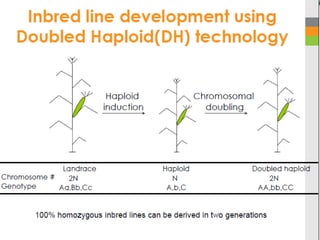
 It is an important step in the production of hybrids. There are two methods of
developing inbred lines
By selfing of heterozygous population and
By doubling of haploids.
In 1909 Shull suggested that inbreds should be developed from
open pollinated varieties by continued selfing.
Difficulties of shulls schem:-
Unavailability of outstanding inbrids.
Hybrid seed produced per acre was low.
Pollen production was low.
Poorly hybrid seed developed.
Double cross scheme proposed by Jones in 1918.
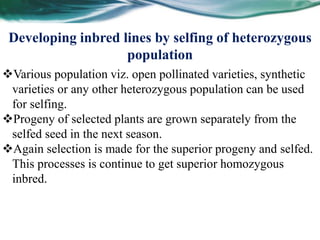
Various population viz. open pollinated varieties, synthetic
varieties or any other heterozygous population can be used
for selfing.
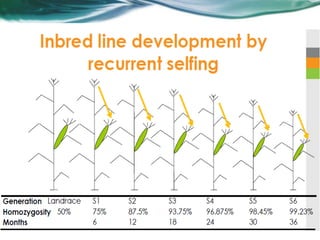
Progeny of selected plants are grown separately from the
selfed seed in the next season.
Again selection is made for the superior progeny and selfed.
This processes is continue to get superior homozygous
inbred.
Developing inbred lines by selfing of heterozygous
population
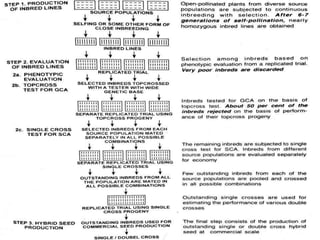
Evaluation and Selection of Inbreds Lines:
 The inbred is evaluated from its performance in hybrid combination with other
inbreds.
 They are evaluated on the basis of their general combining ability and specific
combing ability.
a) Top Cross Method:
Davis suggested this method in 1927. It refers to a cross between an inbred line and an
open pollinated variety. Single inbred lines say 100 are crossed to a common tester (
Open pollinated variety ) to produce 100 single crosses. The yield performance of these
crosses is evaluated in replicated trails on multi locations. The line, which produces high
yielding single cross with tester, are selected. Inbred line which give high yield in top
crosses generally produce high yielding single crosses.
b) Single Cross Method:
This method is used to measure the specific combining ability ( SCA) of those inbreds,
which are selected on the basis of top cross performance. The selected lines are crossed
in all possible combination. These single crosses are evaluated in replicated trials over
several locations for yield performance. The best performing single crosses are identified
for release as a variety. This method can evaluate only limited number of inbreds at a
time.
Time of Testing:
The testing of inbred for general combining ability should be started from 3 rd, 4 th, and
5 th generation of selfing. This will help in retaining of inbreds with good combining
ability and elimination of lines with poor combining ability.
III) Production of Hybrid Seed:
After identification of superior line of the hybrid seed is produced. There are three types
of Intervarietal hybrid.
a) Single cross hybrid,
b) b) Three way cross hybrid and
c) c) Double cross hybrid.
 In case of single and three way cross hybrids, the rows of female
and male parents are planted in 2:1 ratio. The tassels of female
parent are removed and natural cross pollination is allowed.
 In case of three way cross hybrid, the single cross hybrid is used as
female parent and inbred lines as male parent.
 While in case of double cross hybrid , the rows of female and male
parent are planted in 3:1 or 4:1 ratio.
 The seed production is carried out in isolation to prevent crossing
with other compatible genotypes and maintain the high genetic
purity.
References
• Allard, R. W. 1960. Principles of plant breeding. John Wiley and Sons, inc, new
York.
• Comstock, R. E., Robinson, H. F. and Harvey P. H. 1949. A breeding procedure
designed to make maximum use of both general and specific combining ability.
Agron. J. 41: 360-367.
• Singh, B.D. 2012. Plant breeding principles and methods, Kalyani
Publishers, New Delhi-110002.
• www.agriinfo.in/default.aspx?page=topic&superid=3&topicid=1773
Development of hybrid s

Development of hybrid s

  • 1.
    Development of Hybrid Varietiesin Cross Pollinated Crops Speaker: Vipin Kumar Pandey (Ph.D. Scholar) CLASS PRESENTATION (GP-603) Presentation Date: 12-1-2018
  • 2.
    INTRODUCTION • The twomost important features of cross pollinated species are:-  Inbreeding depression and  Heterosis • In population improvement scheme for cross pollinated species are:  Keeping low level of inbreeding depression  High Heterosis • In the hybrid varieties utilize full Heterosis while synthetic varieties utilize a part of Heterosis. Development of hybrid varieties differs from species to species. The production of hybrid varieties in maize consists of three main steps. I) Development of inbreds. II) Selection of productive inbreds and III) Production of hybrid seed.
  • 3.
    I) Development ofInbreds:  It is an important step in the production of hybrids. There are two methods of developing inbred lines By selfing of heterozygous population and By doubling of haploids. In 1909 Shull suggested that inbreds should be developed from open pollinated varieties by continued selfing. Difficulties of shulls schem:- Unavailability of outstanding inbrids. Hybrid seed produced per acre was low. Pollen production was low. Poorly hybrid seed developed. Double cross scheme proposed by Jones in 1918.
  • 4.
    Various population viz.open pollinated varieties, synthetic varieties or any other heterozygous population can be used for selfing. Progeny of selected plants are grown separately from the selfed seed in the next season. Again selection is made for the superior progeny and selfed. This processes is continue to get superior homozygous inbred. Developing inbred lines by selfing of heterozygous population
  • 8.
    Evaluation and Selectionof Inbreds Lines:  The inbred is evaluated from its performance in hybrid combination with other inbreds.  They are evaluated on the basis of their general combining ability and specific combing ability. a) Top Cross Method: Davis suggested this method in 1927. It refers to a cross between an inbred line and an open pollinated variety. Single inbred lines say 100 are crossed to a common tester ( Open pollinated variety ) to produce 100 single crosses. The yield performance of these crosses is evaluated in replicated trails on multi locations. The line, which produces high yielding single cross with tester, are selected. Inbred line which give high yield in top crosses generally produce high yielding single crosses. b) Single Cross Method: This method is used to measure the specific combining ability ( SCA) of those inbreds, which are selected on the basis of top cross performance. The selected lines are crossed in all possible combination. These single crosses are evaluated in replicated trials over several locations for yield performance. The best performing single crosses are identified for release as a variety. This method can evaluate only limited number of inbreds at a time.
  • 9.
    Time of Testing: Thetesting of inbred for general combining ability should be started from 3 rd, 4 th, and 5 th generation of selfing. This will help in retaining of inbreds with good combining ability and elimination of lines with poor combining ability.
  • 10.
    III) Production ofHybrid Seed: After identification of superior line of the hybrid seed is produced. There are three types of Intervarietal hybrid. a) Single cross hybrid, b) b) Three way cross hybrid and c) c) Double cross hybrid.  In case of single and three way cross hybrids, the rows of female and male parents are planted in 2:1 ratio. The tassels of female parent are removed and natural cross pollination is allowed.  In case of three way cross hybrid, the single cross hybrid is used as female parent and inbred lines as male parent.  While in case of double cross hybrid , the rows of female and male parent are planted in 3:1 or 4:1 ratio.  The seed production is carried out in isolation to prevent crossing with other compatible genotypes and maintain the high genetic purity.
  • 11.
    References • Allard, R.W. 1960. Principles of plant breeding. John Wiley and Sons, inc, new York. • Comstock, R. E., Robinson, H. F. and Harvey P. H. 1949. A breeding procedure designed to make maximum use of both general and specific combining ability. Agron. J. 41: 360-367. • Singh, B.D. 2012. Plant breeding principles and methods, Kalyani Publishers, New Delhi-110002. • www.agriinfo.in/default.aspx?page=topic&superid=3&topicid=1773