Pediatric Lymphomas
Resident Education
Lecture Series
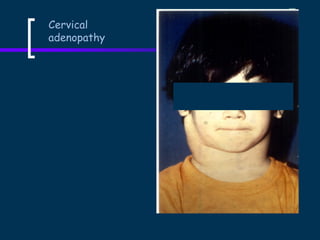
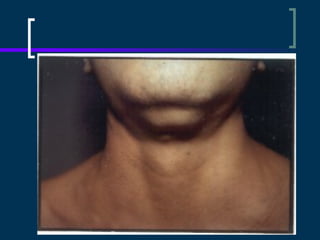
Cervical
adenopathy
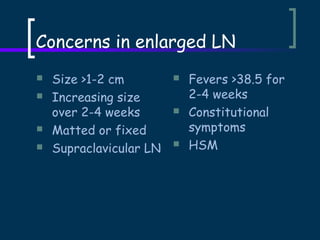
Concerns in enlarged LN






Size >1-2 cm
Increasing size
over 2-4 weeks
Matted or fixed
Supraclavicular LN







Fevers >38.5 for
2-4 weeks
Constitutional
symptoms
HSM
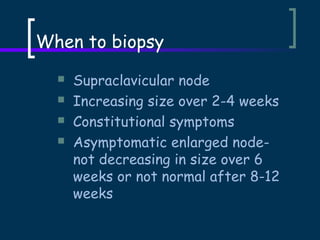
When to biopsy





Supraclavicular node
Increasing size over 2-4 weeks
Constitutional symptoms
Asymptomatic enlarged nodenot decreasing in size over 6
weeks or not normal after 8-12
weeks
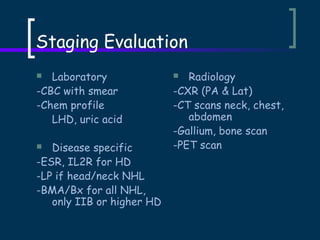
Staging Evaluation
Laboratory
-CBC with smear
-Chem profile
LHD, uric acid


Disease specific
-ESR, IL2R for HD
-LP if head/neck NHL
-BMA/Bx for all NHL,
only IIB or higher HD


Radiology
-CXR (PA & Lat)
-CT scans neck, chest,
abdomen
-Gallium, bone scan
-PET scan

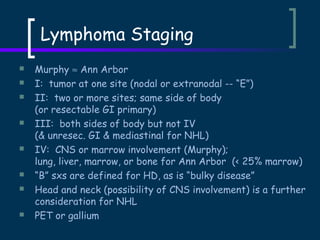
Lymphoma Staging













Murphy ≈ Ann Arbor
I: tumor at one site (nodal or extranodal -- “E”)
II: two or more sites; same side of body
(or resectable GI primary)
III: both sides of body but not IV
(& unresec. GI & mediastinal for NHL)
IV: CNS or marrow involvement (Murphy);
lung, liver, marrow, or bone for Ann Arbor (< 25% marrow)
“B” sxs are defined for HD, as is “bulky disease”
Head and neck (possibility of CNS involvement) is a further
consideration for NHL
PET or gallium
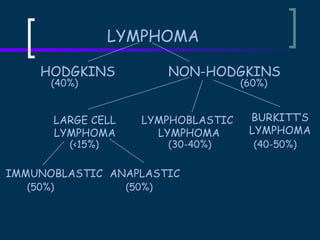
LYMPHOMA
HODGKINS

NON-HODGKINS

(40%)

LARGE CELL
LYMPHOMA
(<15%)

(60%)

LYMPHOBLASTIC
LYMPHOMA
(30-40%)

IMMUNOBLASTIC ANAPLASTIC
(50%)

(50%)

BURKITT’S
LYMPHOMA
(40-50%)
Non-Hodgkin’s Lymphoma
Malignant solid tumor of immune system
Undifferentiated lymphoid cells
Spread: aggressive, diffuse,
unpredictable
Lymphoid tissue; BM and CNS infiltration
High growth fraction and doubling time
Dx and Rx ASAP
Rapid CTX response; tumor lysis concern
Incidence/Etiology - NHL
6% childhood cancer
60% of childhood lymphomas
Peak age of 5-15; M:F ratio of 2.5:1
Increased with
SCIDS, HIV, EBV
post t-cell depleted BMT
post solid organ transplant

Geographic, viral, genetic & immunologic
factors
Types of NHL
Lymphoblastic (30-35%)
 90 % immature T cells (very similar to
T-ALL)







remainder pre-B phenotype (as in ALL)

50-70% anterior mediastinum
neck, supraclavicular, axillary
adenopathy
Classic: older child with intussusception
Small non-cleaved cell (40-50%)
--Mature B-cell phenotype
--Burkitt's and non-Burkitt's
--90% abdomen
--Ascites and intusussception
--Endemic in Africa (Burkitt's), with
EBV 97%
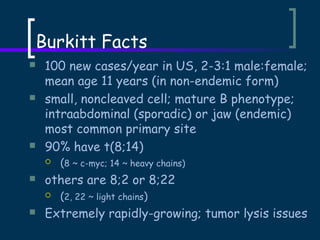
Burkitt Facts






100 new cases/year in US, 2-3:1 male:female;
mean age 11 years (in non-endemic form)
small, noncleaved cell; mature B phenotype;
intraabdominal (sporadic) or jaw (endemic)
most common primary site
90% have t(8;14)




others are 8;2 or 8;22




(8 ~ c-myc; 14 ~ heavy chains)
(2, 22 ~ light chains)

Extremely rapidly-growing; tumor lysis issues
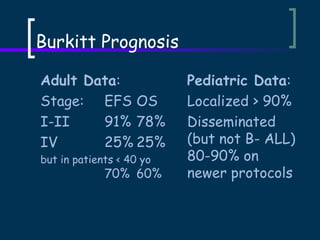
Burkitt Prognosis
Adult Data:
Stage: EFS OS
I-II
91% 78%
IV
25% 25%
but in patients < 40 yo

70% 60%

Pediatric Data:
Localized > 90%
Disseminated
(but not B- ALL)
80-90% on
newer protocols
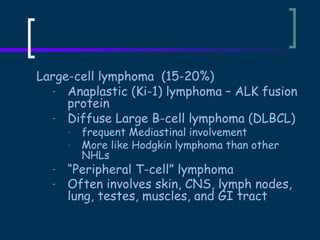
Large-cell lymphoma (15-20%)
- Anaplastic (Ki-1) lymphoma – ALK fusion
protein
- Diffuse Large B-cell lymphoma (DLBCL)
-

-

frequent Mediastinal involvement
More like Hodgkin lymphoma than other
NHLs

“Peripheral T-cell” lymphoma
Often involves skin, CNS, lymph nodes,
lung, testes, muscles, and GI tract


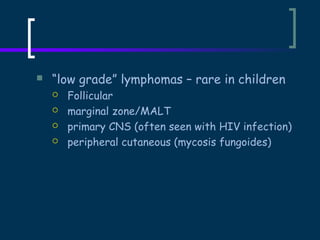
“low grade” lymphomas – rare in children





Follicular
marginal zone/MALT
primary CNS (often seen with HIV infection)
peripheral cutaneous (mycosis fungoides)
Clinical Presentations
Abdomen: (35%): pain, distention,
jaundice, GI problems, mass
Head/neck (13%): lymphadenopathy, jaw
swelling, single enlarged tonsil, nasal
obstruction, rhinorrhea, cranial nerve
palsies
Mediastinum (26%): SVC syndrome
CNS (rare): HA, V, irritability, papilledema
+Fever, malaise, night sweats, wt. loss,
Prognosis affected by…
Incomplete remission in first 2 mos. Rx
Large tumor burden (LDH >1000)
Stages III and IV: CNS or BM
involvement
Delay in treatment
Relapse
**More favorable: Stage I or II, head/neck,
peripheral nodes, GI tract
NHL Treatment
Surgery for diagnostic bx or second look
Radiation Therapy: emergency airway
obstruction or CNS complication – may be
used for local control of residual mass
Chemotherapy: Combination chemo is
usual, with overall cure rates 60-80+%;
high risk of tumor lysis and hyperuricemia
Relapse: Re-induction, followed by BMT
Hodgkin’s Disease
Immune system malignancy, involving
B or T lymphocytes
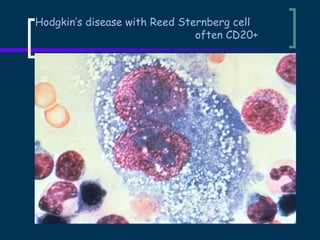
Reed-Sternberg cells
Spread: slow, predictable, with
extension to contiguous lymph nodes
Infiltration to non-lymphoid organs
is rare
Hodgkin’s disease with Reed Sternberg cell
often CD20+
Incidence and Etiology
Hodgkin’s 5% of childhood cancers
Bimodal peaks, at 15-35 and >50;
rare < 5
M:F ratio of 3:1; variation r/t
geography and SES, and type
Increased in immunologic disorders,
HIV, EBV
Types of Hodgkin’s
Lymphoma
Nodular sclerosing (NS), 40-60%, lower
cervical, supraclavicular, mediastinal
nodes
Mixed cellularity (MC), 15-30%; advanced
disease with extranodal involvement
Lymphocyte predominance (LP), 5-15%,
presents as localized disease
Lymphocyte depletion (LD) (<5%);
widespread disease
Clinical Presentation
Painless lymph node swelling (90%) that
persists despite antibiotic therapy
Palpable non-tender, firm, mobile, rubbery
nodes; Mediastinal adenopathy (60%);
SVC
Bulky: when mass is > 1/3 thorax diameter
B symptoms: Fever of >38C for 3 days,
drenching night sweats, 10% weight loss
Mediastinal masses





Risk for anesthesia (esp. if tracheal
compression > 50% by CT)
Least invasive diagnostic procedure
therefore indicated (incl. thoracentesis)
Emergent steroids or RT generally
acceptable prior to biopsy
HD and DLBCL tend to have areas of
necrosis and therefore look more
“bumpy” than T-ALL
Prognosis
FAVORABLE:
<10, F, favorable subtypes (LP and NS)
and
Stage I non-bulky disease
UNFAVORABLE:
Persistently elevated ESR;
LD histopathology;
bulky disease--largest dimension >10cm;
B symptoms;
Treatment and Prognosis
Dependent on age, stage, and tumor burden
RT alone, CTX alone
RT: varies from involved field for localized
disease to extended field to total nodal
irradiation, inverted Y plus mantle
most often multimodal therapy, with lowdose involved field RT and multi-agent CTX
Combined modality 70-90% LT cure
Hodgkin Px and Rx



Splenectomy generally no longer used
Exact type and ratio of combined
modality therapy changes… due to
differences in success rates for
salvage therapy and concerns for late
effects of therapy



Second malignancy risks
Sterility risks
From ABP

Certifying Exam Content Outline



Know how to evaluate a child with an
acute cervical lymphadenopathy
Know the differential diagnosis of
neck masses:





lymphoma,
cystic hygroma,
thyroglossal duct cyst
branchial cleft abnormalities
From ABP

Certifying Exam Content Outline, continued








Recognize the need for evaluation of
supraclavicular lymph node enlargement
Identify the chest x-ray as an important part of
the initial evaluation of the patient with an
unexplained lymphadenopathy
Know that overwhelming sepsis is a serious
complication in patients with Hodgkin disease
who have undergone splenectomy,
and know that such patients should be evaluated
thoroughly if fever develops
Credits


Meghen Browning MD
Anne Warwick MD MPH

pediatric lymphomas

  • 1.
  • 2.
  • 4.
    Concerns in enlargedLN     Size >1-2 cm Increasing size over 2-4 weeks Matted or fixed Supraclavicular LN    Fevers >38.5 for 2-4 weeks Constitutional symptoms HSM
  • 5.
    When to biopsy     Supraclavicularnode Increasing size over 2-4 weeks Constitutional symptoms Asymptomatic enlarged nodenot decreasing in size over 6 weeks or not normal after 8-12 weeks
  • 6.
    Staging Evaluation Laboratory -CBC withsmear -Chem profile LHD, uric acid  Disease specific -ESR, IL2R for HD -LP if head/neck NHL -BMA/Bx for all NHL, only IIB or higher HD  Radiology -CXR (PA & Lat) -CT scans neck, chest, abdomen -Gallium, bone scan -PET scan 
  • 7.
    Lymphoma Staging         Murphy ≈Ann Arbor I: tumor at one site (nodal or extranodal -- “E”) II: two or more sites; same side of body (or resectable GI primary) III: both sides of body but not IV (& unresec. GI & mediastinal for NHL) IV: CNS or marrow involvement (Murphy); lung, liver, marrow, or bone for Ann Arbor (< 25% marrow) “B” sxs are defined for HD, as is “bulky disease” Head and neck (possibility of CNS involvement) is a further consideration for NHL PET or gallium
  • 8.
  • 9.
    Non-Hodgkin’s Lymphoma Malignant solidtumor of immune system Undifferentiated lymphoid cells Spread: aggressive, diffuse, unpredictable Lymphoid tissue; BM and CNS infiltration High growth fraction and doubling time Dx and Rx ASAP Rapid CTX response; tumor lysis concern
  • 10.
    Incidence/Etiology - NHL 6%childhood cancer 60% of childhood lymphomas Peak age of 5-15; M:F ratio of 2.5:1 Increased with SCIDS, HIV, EBV post t-cell depleted BMT post solid organ transplant Geographic, viral, genetic & immunologic factors
  • 11.
    Types of NHL Lymphoblastic(30-35%)  90 % immature T cells (very similar to T-ALL)     remainder pre-B phenotype (as in ALL) 50-70% anterior mediastinum neck, supraclavicular, axillary adenopathy Classic: older child with intussusception
  • 12.
    Small non-cleaved cell(40-50%) --Mature B-cell phenotype --Burkitt's and non-Burkitt's --90% abdomen --Ascites and intusussception --Endemic in Africa (Burkitt's), with EBV 97%
  • 13.
    Burkitt Facts    100 newcases/year in US, 2-3:1 male:female; mean age 11 years (in non-endemic form) small, noncleaved cell; mature B phenotype; intraabdominal (sporadic) or jaw (endemic) most common primary site 90% have t(8;14)   others are 8;2 or 8;22   (8 ~ c-myc; 14 ~ heavy chains) (2, 22 ~ light chains) Extremely rapidly-growing; tumor lysis issues
  • 14.
    Burkitt Prognosis Adult Data: Stage:EFS OS I-II 91% 78% IV 25% 25% but in patients < 40 yo 70% 60% Pediatric Data: Localized > 90% Disseminated (but not B- ALL) 80-90% on newer protocols
  • 15.
    Large-cell lymphoma (15-20%) -Anaplastic (Ki-1) lymphoma – ALK fusion protein - Diffuse Large B-cell lymphoma (DLBCL) - - frequent Mediastinal involvement More like Hodgkin lymphoma than other NHLs “Peripheral T-cell” lymphoma Often involves skin, CNS, lymph nodes, lung, testes, muscles, and GI tract
  • 16.
     “low grade” lymphomas– rare in children     Follicular marginal zone/MALT primary CNS (often seen with HIV infection) peripheral cutaneous (mycosis fungoides)
  • 17.
    Clinical Presentations Abdomen: (35%):pain, distention, jaundice, GI problems, mass Head/neck (13%): lymphadenopathy, jaw swelling, single enlarged tonsil, nasal obstruction, rhinorrhea, cranial nerve palsies Mediastinum (26%): SVC syndrome CNS (rare): HA, V, irritability, papilledema +Fever, malaise, night sweats, wt. loss,
  • 18.
    Prognosis affected by… Incompleteremission in first 2 mos. Rx Large tumor burden (LDH >1000) Stages III and IV: CNS or BM involvement Delay in treatment Relapse **More favorable: Stage I or II, head/neck, peripheral nodes, GI tract
  • 19.
    NHL Treatment Surgery fordiagnostic bx or second look Radiation Therapy: emergency airway obstruction or CNS complication – may be used for local control of residual mass Chemotherapy: Combination chemo is usual, with overall cure rates 60-80+%; high risk of tumor lysis and hyperuricemia Relapse: Re-induction, followed by BMT
  • 20.
    Hodgkin’s Disease Immune systemmalignancy, involving B or T lymphocytes Reed-Sternberg cells Spread: slow, predictable, with extension to contiguous lymph nodes Infiltration to non-lymphoid organs is rare
  • 21.
    Hodgkin’s disease withReed Sternberg cell often CD20+
  • 22.
    Incidence and Etiology Hodgkin’s5% of childhood cancers Bimodal peaks, at 15-35 and >50; rare < 5 M:F ratio of 3:1; variation r/t geography and SES, and type Increased in immunologic disorders, HIV, EBV
  • 23.
    Types of Hodgkin’s Lymphoma Nodularsclerosing (NS), 40-60%, lower cervical, supraclavicular, mediastinal nodes Mixed cellularity (MC), 15-30%; advanced disease with extranodal involvement Lymphocyte predominance (LP), 5-15%, presents as localized disease Lymphocyte depletion (LD) (<5%); widespread disease
  • 24.
    Clinical Presentation Painless lymphnode swelling (90%) that persists despite antibiotic therapy Palpable non-tender, firm, mobile, rubbery nodes; Mediastinal adenopathy (60%); SVC Bulky: when mass is > 1/3 thorax diameter B symptoms: Fever of >38C for 3 days, drenching night sweats, 10% weight loss
  • 25.
    Mediastinal masses     Risk foranesthesia (esp. if tracheal compression > 50% by CT) Least invasive diagnostic procedure therefore indicated (incl. thoracentesis) Emergent steroids or RT generally acceptable prior to biopsy HD and DLBCL tend to have areas of necrosis and therefore look more “bumpy” than T-ALL
  • 26.
    Prognosis FAVORABLE: <10, F, favorablesubtypes (LP and NS) and Stage I non-bulky disease UNFAVORABLE: Persistently elevated ESR; LD histopathology; bulky disease--largest dimension >10cm; B symptoms;
  • 27.
    Treatment and Prognosis Dependenton age, stage, and tumor burden RT alone, CTX alone RT: varies from involved field for localized disease to extended field to total nodal irradiation, inverted Y plus mantle most often multimodal therapy, with lowdose involved field RT and multi-agent CTX Combined modality 70-90% LT cure
  • 28.
    Hodgkin Px andRx   Splenectomy generally no longer used Exact type and ratio of combined modality therapy changes… due to differences in success rates for salvage therapy and concerns for late effects of therapy   Second malignancy risks Sterility risks
  • 30.
    From ABP Certifying ExamContent Outline   Know how to evaluate a child with an acute cervical lymphadenopathy Know the differential diagnosis of neck masses:     lymphoma, cystic hygroma, thyroglossal duct cyst branchial cleft abnormalities
  • 31.
    From ABP Certifying ExamContent Outline, continued     Recognize the need for evaluation of supraclavicular lymph node enlargement Identify the chest x-ray as an important part of the initial evaluation of the patient with an unexplained lymphadenopathy Know that overwhelming sepsis is a serious complication in patients with Hodgkin disease who have undergone splenectomy, and know that such patients should be evaluated thoroughly if fever develops
  • 32.