Long term complication of
menopause
Osteoporosis
Dementia
Cardiovascular disease
Medical student MBBS year 4 UniSZA –
Siti hamidah
OSTEOPOROSIS
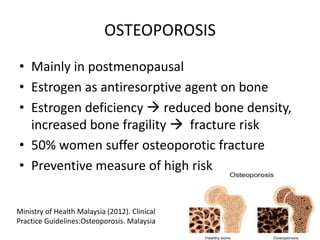
• Mainly in postmenopausal
• Estrogen as antiresorptive agent on bone
• Estrogen deficiency  reduced bone density,
increased bone fragility  fracture risk
• 50% women suffer osteoporotic fracture
• Preventive measure of high risk
Ministry of Health Malaysia (2012). Clinical
Practice Guidelines:Osteoporosis. Malaysia
Risk of osteoporotic fracture in
postmenopausal women
Non-modifiable
1. Advancing age
2. Ethnic group (Oriental &
Caucasian)
3. Female gender
4. Premature menopause (< 45
years) including surgical
menopause
5. Family history of osteoporotic
hip fracture in first degree
relative
6. Personal history of fracture as
an adult
Modifiable
Low calcium and/or vitamin D
intake
Sedentary lifestyle
Cigarette smoking.
Excessive alcohol intake (>3
units/day)
Excessive caffeine intake (>3
drinks/day)
Low body weight (BMI < 19kg/m2)
Estrogen deficiency
Impaired vision
Recurrent falls
Ministry of Health Malaysia (2012). Clinical Practice Guidelines:Osteoporosis. Malaysia
Presentation
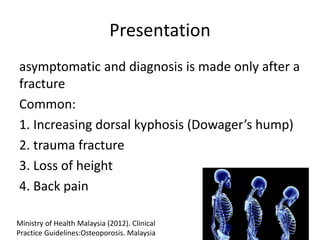
asymptomatic and diagnosis is made only after a
fracture
Common:
1. Increasing dorsal kyphosis (Dowager’s hump)
2. trauma fracture
3. Loss of height
4. Back pain
Ministry of Health Malaysia (2012). Clinical
Practice Guidelines:Osteoporosis. Malaysia
diagnosis
• made after excluding secondary causes
• history, physical examination
• laboratory investigations
gold standard  bone mineral density (BMD)
using dual energy x-ray absorptiometry (DXA).
If not available, calculating the risk of fractures
using Fracture Risk Assessment Tool (FRAX) can
help in deciding treatment strategies
Ministry of Health Malaysia (2012). Clinical
Practice Guidelines:Osteoporosis. Malaysia
criteria
• individual's age (40-90 y) , sex, weight, height,
prior fracture, parental history of hip fracture,
• smoking, long-term use of glucocorticoids,
rheumatoid arthritis and alcohol
consumption.
Ministry of Health Malaysia (2012). Clinical
Practice Guidelines:Osteoporosis. Malaysia
screening
• based on age and weight, Osteoporosis
• Self-Assessment Tool for Asians (OSTA), was
developed for postmenopausal Asian women.
Ministry of Health Malaysia (2012). Clinical
Practice Guidelines:Osteoporosis. Malaysia
investigation
The main aims of investigations are to:
• 1. Confirm the diagnosis of osteoporosis
• 2. Assess fracture risk
• 3. Exclude secondary causes
Initial investigations include:
• 1. Full blood count and erythrocyte sedimentation rate
(ESR)
• 2. Bone profile: serum calcium, phosphate, albumin
• 3. Alkaline phosphatase
• 4. Renal function
• 5. Plain X-rays Ministry of Health Malaysia (2012). Clinical
Practice Guidelines:Osteoporosis. Malaysia
Prevention
• Exercise
• Nutrition: Calcium,protein and vit D
• Limit smoking,caffein
• Fall prevention (reduced muscle strength,Low vitamin D
levels,Poor vision,Hazards in the home (e.g. inadequate lighting,
slippery floors)
• Bisphosphonate (reduce bone absrption)
• Raloxifene (selective estrogen receptor modulator)
• Tibolone, selective tissue estrogenic activity regulator. Increases
lumbar spine BMD by 6.6% and hip BMD by 2.8% with decrease
in vertebral fractures by 45% and non-vertebral fractures by
26%.
• HRT
Ministry of Health Malaysia (2012). Clinical Practice Guidelines:Osteoporosis. Malaysia
Cardiovascular Diseases
• A decline in estrogen level may be a factor
because it believed to have positive effect on
the inner layer of arterial wall, help to keep it
flexible
• Associated with increase bp after menopause,
LDL cholestrol increase and HDL cholestrol
tend to decline
(American heart association)
Refresh…….
• Cardiovascular disease (CVD) includes:
1. Coronary heart disease (CHD) as manifested by angina
pectoris, MI, heart failure (HF) and coronary death
2. Cerebrovascular disease manifested as transient
ischaemic attack (TIA) and stroke
3. Peripheral arterial disease (PAD) manifested as
intermittent claudication and critical limb ischaemia
(CLI)
4. Aortic atherosclerosis and thoracic or abdominal
aortic aneurysm. Although these are manifestations
of atherosclerosis, in some clinical studies, they are
not included in the definition of CVD
CPG prevention cardiovascular disease in women 2008
CARDIOVASCULAR RISK FACTORS
a) Non-modifiable risk factors
1. personal history of CHD and/or CHD equivalents
2. age (over 55)
3. family history of premature CHD
b) Modifiable risk factors
1. dyslipidaemia
2. hypertension
3. diabetes mellitus/pre-diabetes
4. metabolic syndrome
5. obesity
6. smoking
7. physical inactivity
CPG prevention cardiovascular disease in women 2008
Assessment of CVD risk involves:
–– History: Looking for symptoms of CHD or CHD
Equivalents, family history of premature CHD,
smoking status, physical activity
–– Physical Examination: Height, weight, BMI,
waist circumference, pulses, blood pressure
–– Investigations: Blood sugar, lipid profile
CPG prevention cardiovascular disease in women 2008
TOTAL CARDIOVASCULAR RISK
ASSESSMENT
• Framingham Risk Score (FRS)
• SCORE system
• WHO/ISH Cardiovascular Risk Prediction
Charts
CPG prevention cardiovascular disease in women 2008
RECOMMENDATIONS FOR
PREVENTION OF CVD IN
WOMEN
• Lifestyles changes : dietary, exercise, weight
reduction, stop smoking
• aspirin
CPG prevention cardiovascular disease in women 2008
DEMENTIA
• Estrogen stimulates the brain’s neurotransmitter
that are responsible for memory and language
Healthline.com
• However the link between circulating estrogen
and cognitive impairment is weak
• Clinical trial of midlife hormone therapy have not
shown improved cognition
By the north american menapouse society : www.
Menapouse.org

MENAPOUSA ( LONG TERM COMPLICATION)

  • 1.
    Long term complicationof menopause Osteoporosis Dementia Cardiovascular disease Medical student MBBS year 4 UniSZA – Siti hamidah
  • 2.
    OSTEOPOROSIS • Mainly inpostmenopausal • Estrogen as antiresorptive agent on bone • Estrogen deficiency  reduced bone density, increased bone fragility  fracture risk • 50% women suffer osteoporotic fracture • Preventive measure of high risk Ministry of Health Malaysia (2012). Clinical Practice Guidelines:Osteoporosis. Malaysia
  • 3.
    Risk of osteoporoticfracture in postmenopausal women Non-modifiable 1. Advancing age 2. Ethnic group (Oriental & Caucasian) 3. Female gender 4. Premature menopause (< 45 years) including surgical menopause 5. Family history of osteoporotic hip fracture in first degree relative 6. Personal history of fracture as an adult Modifiable Low calcium and/or vitamin D intake Sedentary lifestyle Cigarette smoking. Excessive alcohol intake (>3 units/day) Excessive caffeine intake (>3 drinks/day) Low body weight (BMI < 19kg/m2) Estrogen deficiency Impaired vision Recurrent falls Ministry of Health Malaysia (2012). Clinical Practice Guidelines:Osteoporosis. Malaysia
  • 4.
    Presentation asymptomatic and diagnosisis made only after a fracture Common: 1. Increasing dorsal kyphosis (Dowager’s hump) 2. trauma fracture 3. Loss of height 4. Back pain Ministry of Health Malaysia (2012). Clinical Practice Guidelines:Osteoporosis. Malaysia
  • 5.
    diagnosis • made afterexcluding secondary causes • history, physical examination • laboratory investigations gold standard  bone mineral density (BMD) using dual energy x-ray absorptiometry (DXA). If not available, calculating the risk of fractures using Fracture Risk Assessment Tool (FRAX) can help in deciding treatment strategies Ministry of Health Malaysia (2012). Clinical Practice Guidelines:Osteoporosis. Malaysia
  • 6.
    criteria • individual's age(40-90 y) , sex, weight, height, prior fracture, parental history of hip fracture, • smoking, long-term use of glucocorticoids, rheumatoid arthritis and alcohol consumption. Ministry of Health Malaysia (2012). Clinical Practice Guidelines:Osteoporosis. Malaysia
  • 7.
    screening • based onage and weight, Osteoporosis • Self-Assessment Tool for Asians (OSTA), was developed for postmenopausal Asian women. Ministry of Health Malaysia (2012). Clinical Practice Guidelines:Osteoporosis. Malaysia
  • 8.
    investigation The main aimsof investigations are to: • 1. Confirm the diagnosis of osteoporosis • 2. Assess fracture risk • 3. Exclude secondary causes Initial investigations include: • 1. Full blood count and erythrocyte sedimentation rate (ESR) • 2. Bone profile: serum calcium, phosphate, albumin • 3. Alkaline phosphatase • 4. Renal function • 5. Plain X-rays Ministry of Health Malaysia (2012). Clinical Practice Guidelines:Osteoporosis. Malaysia
  • 9.
    Prevention • Exercise • Nutrition:Calcium,protein and vit D • Limit smoking,caffein • Fall prevention (reduced muscle strength,Low vitamin D levels,Poor vision,Hazards in the home (e.g. inadequate lighting, slippery floors) • Bisphosphonate (reduce bone absrption) • Raloxifene (selective estrogen receptor modulator) • Tibolone, selective tissue estrogenic activity regulator. Increases lumbar spine BMD by 6.6% and hip BMD by 2.8% with decrease in vertebral fractures by 45% and non-vertebral fractures by 26%. • HRT Ministry of Health Malaysia (2012). Clinical Practice Guidelines:Osteoporosis. Malaysia
  • 10.
    Cardiovascular Diseases • Adecline in estrogen level may be a factor because it believed to have positive effect on the inner layer of arterial wall, help to keep it flexible • Associated with increase bp after menopause, LDL cholestrol increase and HDL cholestrol tend to decline (American heart association)
  • 11.
    Refresh……. • Cardiovascular disease(CVD) includes: 1. Coronary heart disease (CHD) as manifested by angina pectoris, MI, heart failure (HF) and coronary death 2. Cerebrovascular disease manifested as transient ischaemic attack (TIA) and stroke 3. Peripheral arterial disease (PAD) manifested as intermittent claudication and critical limb ischaemia (CLI) 4. Aortic atherosclerosis and thoracic or abdominal aortic aneurysm. Although these are manifestations of atherosclerosis, in some clinical studies, they are not included in the definition of CVD CPG prevention cardiovascular disease in women 2008
  • 12.
    CARDIOVASCULAR RISK FACTORS a)Non-modifiable risk factors 1. personal history of CHD and/or CHD equivalents 2. age (over 55) 3. family history of premature CHD b) Modifiable risk factors 1. dyslipidaemia 2. hypertension 3. diabetes mellitus/pre-diabetes 4. metabolic syndrome 5. obesity 6. smoking 7. physical inactivity CPG prevention cardiovascular disease in women 2008
  • 13.
    Assessment of CVDrisk involves: –– History: Looking for symptoms of CHD or CHD Equivalents, family history of premature CHD, smoking status, physical activity –– Physical Examination: Height, weight, BMI, waist circumference, pulses, blood pressure –– Investigations: Blood sugar, lipid profile CPG prevention cardiovascular disease in women 2008
  • 14.
    TOTAL CARDIOVASCULAR RISK ASSESSMENT •Framingham Risk Score (FRS) • SCORE system • WHO/ISH Cardiovascular Risk Prediction Charts CPG prevention cardiovascular disease in women 2008
  • 15.
    RECOMMENDATIONS FOR PREVENTION OFCVD IN WOMEN • Lifestyles changes : dietary, exercise, weight reduction, stop smoking • aspirin CPG prevention cardiovascular disease in women 2008
  • 16.
    DEMENTIA • Estrogen stimulatesthe brain’s neurotransmitter that are responsible for memory and language Healthline.com • However the link between circulating estrogen and cognitive impairment is weak • Clinical trial of midlife hormone therapy have not shown improved cognition By the north american menapouse society : www. Menapouse.org