z
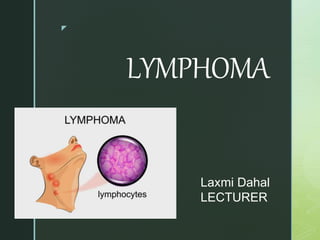
LYMPHOMA
Laxmi Dahal
LECTURER
z
General Objective
 At the end of the session, participants will be
able to explain about lymphoma.
2/13/2023 2
z
Specific objectives
 At the end of the session, participants will
be able to:
- Define lymphoma
- Explain the epidemiology of lymphomas
- Classify lymphoma
- List the causes of lymphoma
2/13/2023 3
z
Specific objectives
- Enlist the clinical manifestations of
lymphoma
- State the diagnostic criteria lymphoma
- Explain the management of lymphoma
- State the prognosis of lymphoma
2/13/2023 4
z
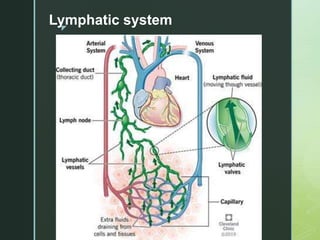
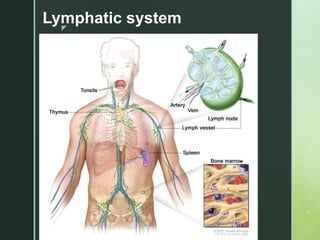
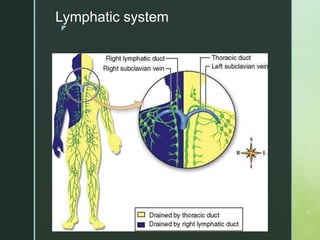
Lymphatic system
z
Lymphatic system
z
Lymphatic system
z
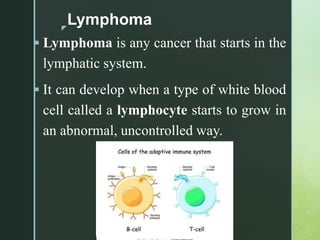
Lymphoma
 Lymphoma is any cancer that starts in the
lymphatic system.
 It can develop when a type of white blood
cell called a lymphocyte starts to grow in
an abnormal, uncontrolled way.
z
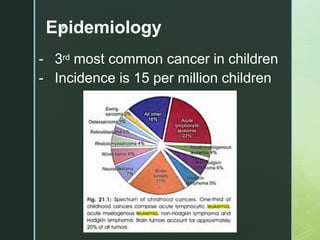
Epidemiology
- 3rd most common cancer in children
- Incidence is 15 per million children
z
Classification
Hodgkin disease
Non- Hodgkin disease
z
Hodgkin’s Lymphoma
 Hodgkin’s disease (HD) is a
malignant disorder of
lymphoreticular system; a
lymphoreticular neoplasm
primarily of B cell lineage involving
lymph nodes.
z
Hodgkin disease:
Malignant process of lymphoreticular
system
6% of childhood cancer
5% of cancer in < 14 yr
15% in person 15-19 yr
Rare < 10 yr
z
Epidemiology:
Bimodal incidence
Second peak after 50 y
Sex: Male > Female
Associated with specific HLA antigen
Infectious agents
Human herpes virus
6 Cytomegalovirus
Epstein – Barr virus
Immunodeficiency
z
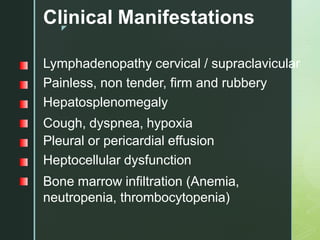
Clinical Manifestations
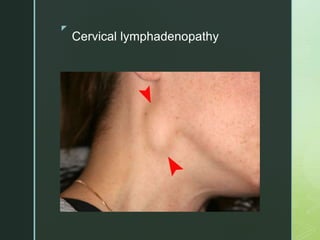
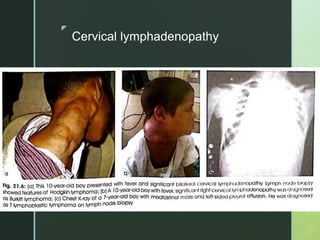
Lymphadenopathy cervical / supraclavicular
Painless, non tender, firm and rubbery
Hepatosplenomegaly
Cough, dyspnea, hypoxia
Pleural or pericardial effusion
Heptocellular dysfunction
Bone marrow infiltration (Anemia,
neutropenia, thrombocytopenia)
z
Cervical lymphadenopathy
z
Cervical lymphadenopathy
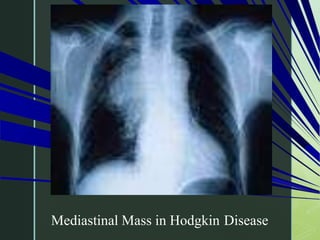
Mediastinal Mass in Hodgkin Disease
z
Systemic Symptoms (B symptoms)
Important in staging
Unexplained fever > 390C
Weight loss > 10% in 3m
Drenching night sweats
Immune System abnormalities
Anergy to delayed-hypersensitivity skin test
Abnormal cellular immune response
Decreased CD4:CD8 ratio
Reduce natural killer cell cytotoxicity
z
DIAGNOSIS
Excisional Biopsy
Light Microscopy
Immunocytochemistry
Molecular Studies
Chest X – Ray
Mediastinal Mass
CT Scan
Chest
Abdomen
Pelvis
Blood & ESR
LFT’s
Bone Marrow Aspiration
Serum Copper & Ferritin
Bone Scan
PET
z
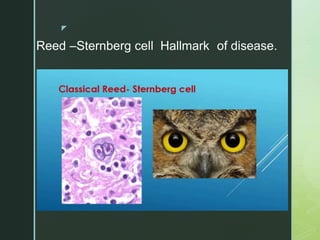
Reed –Sternberg cell Hallmark of disease.
z
Ann Arbor Staging Classification for
Hodgkin Disease
▪ Stage I
Involvement of a single lymph node (1)
or of a single extra lymphatic site or
organ(1f)
• Stage II
Involvement of two or more lymph node
regions on the same side of the
diaphragm(II)
or localised involvement of an extra
lymphatic site or organ and one or more
lymph node regions on the same side of
the diaphragm (IIf)
z STAGING
 Stage III
Involvement of lymph node regions on both
sides of the diaphragm (III) which may be
accompanied by the involvement of spleen
(IIIS) or by localized involvement of an extra
lymphatic site or organ ( IIIf) or both ( IIIsf)
 Stage IV
Diffuse or disseminated involvement of one
or more extra lymphatic organs or tissues
with or without associated lymph node
involvement.
z
Staging
 The absence or presence of fever >
38C for three consecutive days ,
drenching night sweats , or
unexplained loss of > 10% body weight
in the 6 months preceding admission
are to be denoted in all cases by the
suffice letters A & B respectively.
z
TREATMENT
Treatment depends on :
Stage of disease
Age at diagnosis
Presence / absence of B
symptoms
Presence of hilar
lymphadenopathy
Presence of bulky nodal disease
Current Treatment Regimen
Combined chemotherapy with or without low dose
involved field radiation therapy.
z
Chemotherapy Regimens
▪
▪
▪
▪
MOPP
(Mechlorethamine , Vincristine ,
Procarbazine , Prednisolone)
COPP
(Cyclophosphamide , Vincristine ,
Procarbazine , Prednisolone)
ABVD
(Adriamycin , Bleomycin , Vinblastine ,
Dacarbazine)
BEACOPP ( For advanced stage disease)
(Bleomycin , Etoposide , Doxorubicin ,
Cyclophosphamide , Vincristine ,
Procarbazine , Prednisolone)
z
P00R PROGNOSTIC
FACTORS
Tumor Bulk
Advanced stage at diagnosis
Presence of B symptoms
z LONG TERM
COMPLICATIONS
Secondary malignancy
Acute Myelogenous Leukemia
Non Hodgkin lymphoma
Carcinomas of breast , lungs & thyroid
Short stature
Hypothyroidism
Sterility
Dental caries
Sub clinical pulmonary dysfunction
Ischemic heart disease
z
PROGNOSIS
Early Stage Disease
5 year survival ….95%
Advanced Stage Disease
5 year survival ….90%
Relapses common within first 3 years
from diagnosis
Relapses treated with Autologous Stem
Cell Transplantation
z
NON-HODGKIN
LYMPHOMA
z EPIDEMIOLOGY
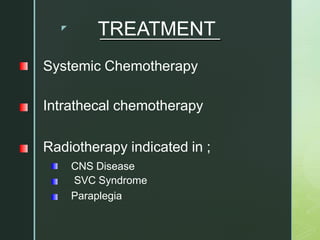
60% of all lymphomas in children
8-10% of all malignancies in children between 5-
19 yrs of age
Secondary causes of NHL include;
Inherited / acquired immune deficiencies
Viruses
HIV
EBV
Genetic Syndromes
Ataxia Telangiectasia
Bloom syndrome
z
CLINICAL MANIFESTATIONS
Lymphadenopathy
Superior vena cava syndrome
Dyspnea
Abdominal Mass
Intestinal obstruction /
intussusception Ascites
Nasal Stuffiness
Earache
Tonsil enlargement
Localised bone involvement
Acute paraplegia secondary to CNS / spinal
cord compression
Tumor Lysis Syndrome
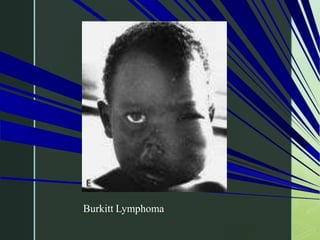
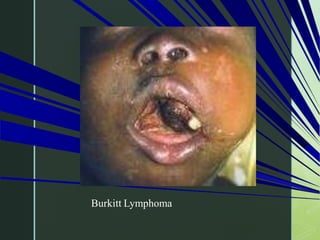
Burkitt Lymphoma
Burkitt Lymphoma
z
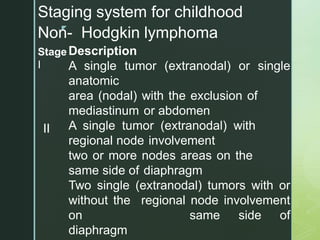
Staging system for childhood
Non- Hodgkin lymphoma
Stage
I
II
Description
A single tumor (extranodal) or single
anatomic
area (nodal) with the exclusion of
mediastinum or abdomen
A single tumor (extranodal) with
regional node involvement
two or more nodes areas on the
same side of diaphragm
Two single (extranodal) tumors with or
without the regional node involvement
on same side of
diaphragm
z
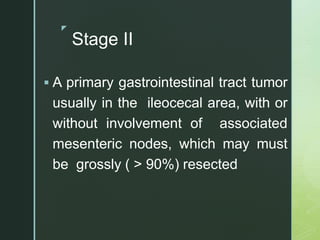
Stage II
 A primary gastrointestinal tract tumor
usually in the ileocecal area, with or
without involvement of associated
mesenteric nodes, which may must
be grossly ( > 90%) resected
z
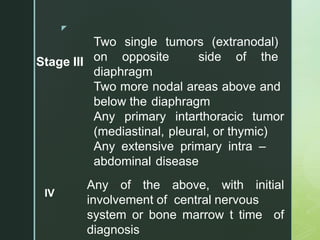
Stage III
Two single tumors (extranodal)
on opposite side of the
diaphragm
Two more nodal areas above and
below the diaphragm
Any primary intarthoracic tumor
(mediastinal, pleural, or thymic)
Any extensive primary intra –
abdominal disease
IV
Any of the above, with initial
involvement of central nervous
system or bone marrow t time of
diagnosis
z
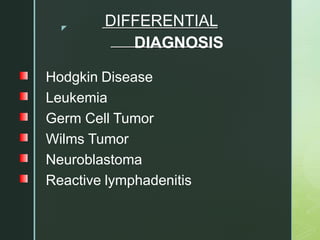
DIFFERENTIAL
DIAGNOSIS
Hodgkin Disease
Leukemia
Germ Cell Tumor
Wilms Tumor
Neuroblastoma
Reactive lymphadenitis
z
LABORATORY FINDINGS
Tissue biopsy for;
Flow cytometry
Karyotyping
Complete Blood Count
Serum Electrolytes, Calcium , Phosphorus , Uric acid
LFT’s & RFT’s
Bone Marrow Aspiration & Biopsy
CSF Examination
Chest X Ray
CT Scan
Head & Neck
Chest
Abdomen & Pelvis
PET Scan & Bone Scan
z
TREATMENT
Systemic Chemotherapy
Intrathecal chemotherapy
Radiotherapy indicated in ;
CNS Disease
SVC Syndrome
Paraplegia
z
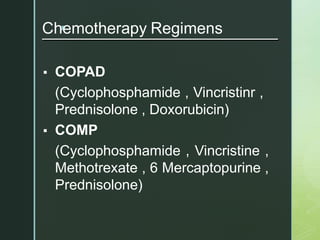
Chemotherapy Regimens
▪ COPAD
(Cyclophosphamide , Vincristinr ,
Prednisolone , Doxorubicin)
▪ COMP
(Cyclophosphamide , Vincristine ,
Methotrexate , 6 Mercaptopurine ,
Prednisolone)
z
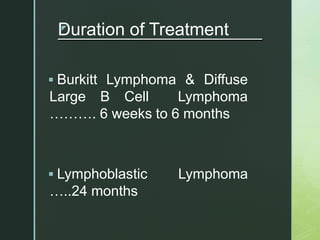
Duration of Treatment
 Burkitt Lymphoma & Diffuse
Large B Cell Lymphoma
………. 6 weeks to 6 months
 Lymphoblastic Lymphoma
…..24 months
z
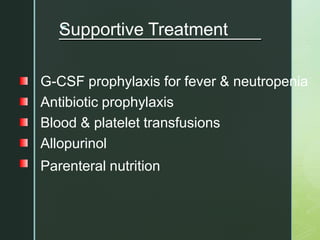
Supportive Treatment
G-CSF prophylaxis for fever & neutropenia
Antibiotic prophylaxis
Blood & platelet transfusions
Allopurinol
Parenteral nutrition
z
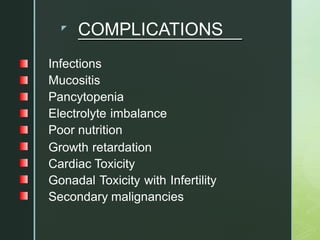
COMPLICATIONS
Infections
Mucositis
Pancytopenia
Electrolyte imbalance
Poor nutrition
Growth retardation
Cardiac Toxicity
Gonadal Toxicity with Infertility
Secondary malignancies
z
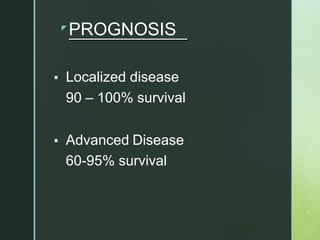
PROGNOSIS
▪ Localized disease
90 – 100% survival
▪ Advanced Disease
60-95% survival
z
z
REFERENCES
• Ghai O, Paul V, Bagga A. Essential Pediatrics. 7th ed. CBS
Publisher & Distributers; 2008.
• Lymphoma in Children [Internet]. Stjude.org. 2021 [cited 16 May 2021]. Available
from:
https://www.stjude.org/disease/lymphoma.html#:~:text=Childhood%20lymphoma%2
0is%20rare.,under%20the%20age%20of%2014.
• Lymphoma Action | Lymphoma in children [Internet]. Lymphoma Action. 2021 [cited
16 May 2021]. Available from: https://lymphoma-action.org.uk/types-lymphoma-
lymphoma-children-and-young-people/lymphoma-children.
• https://doi.org/10.1093/ije/24.1.27
2/13/2023 46
z
THANK YOU

5. lymphomas.pptx

  • 1.
  • 2.
    z General Objective  Atthe end of the session, participants will be able to explain about lymphoma. 2/13/2023 2
  • 3.
    z Specific objectives  Atthe end of the session, participants will be able to: - Define lymphoma - Explain the epidemiology of lymphomas - Classify lymphoma - List the causes of lymphoma 2/13/2023 3
  • 4.
    z Specific objectives - Enlistthe clinical manifestations of lymphoma - State the diagnostic criteria lymphoma - Explain the management of lymphoma - State the prognosis of lymphoma 2/13/2023 4
  • 5.
  • 6.
  • 7.
  • 8.
    z Lymphoma  Lymphoma isany cancer that starts in the lymphatic system.  It can develop when a type of white blood cell called a lymphocyte starts to grow in an abnormal, uncontrolled way.
  • 9.
    z Epidemiology - 3rd mostcommon cancer in children - Incidence is 15 per million children
  • 10.
  • 11.
    z Hodgkin’s Lymphoma  Hodgkin’sdisease (HD) is a malignant disorder of lymphoreticular system; a lymphoreticular neoplasm primarily of B cell lineage involving lymph nodes.
  • 12.
    z Hodgkin disease: Malignant processof lymphoreticular system 6% of childhood cancer 5% of cancer in < 14 yr 15% in person 15-19 yr Rare < 10 yr
  • 13.
    z Epidemiology: Bimodal incidence Second peakafter 50 y Sex: Male > Female Associated with specific HLA antigen Infectious agents Human herpes virus 6 Cytomegalovirus Epstein – Barr virus Immunodeficiency
  • 14.
    z Clinical Manifestations Lymphadenopathy cervical/ supraclavicular Painless, non tender, firm and rubbery Hepatosplenomegaly Cough, dyspnea, hypoxia Pleural or pericardial effusion Heptocellular dysfunction Bone marrow infiltration (Anemia, neutropenia, thrombocytopenia)
  • 15.
  • 16.
  • 17.
    Mediastinal Mass inHodgkin Disease
  • 18.
    z Systemic Symptoms (Bsymptoms) Important in staging Unexplained fever > 390C Weight loss > 10% in 3m Drenching night sweats Immune System abnormalities Anergy to delayed-hypersensitivity skin test Abnormal cellular immune response Decreased CD4:CD8 ratio Reduce natural killer cell cytotoxicity
  • 19.
    z DIAGNOSIS Excisional Biopsy Light Microscopy Immunocytochemistry MolecularStudies Chest X – Ray Mediastinal Mass CT Scan Chest Abdomen Pelvis Blood & ESR LFT’s Bone Marrow Aspiration Serum Copper & Ferritin Bone Scan PET
  • 20.
    z Reed –Sternberg cellHallmark of disease.
  • 21.
    z Ann Arbor StagingClassification for Hodgkin Disease ▪ Stage I Involvement of a single lymph node (1) or of a single extra lymphatic site or organ(1f) • Stage II Involvement of two or more lymph node regions on the same side of the diaphragm(II) or localised involvement of an extra lymphatic site or organ and one or more lymph node regions on the same side of the diaphragm (IIf)
  • 22.
    z STAGING  StageIII Involvement of lymph node regions on both sides of the diaphragm (III) which may be accompanied by the involvement of spleen (IIIS) or by localized involvement of an extra lymphatic site or organ ( IIIf) or both ( IIIsf)  Stage IV Diffuse or disseminated involvement of one or more extra lymphatic organs or tissues with or without associated lymph node involvement.
  • 23.
    z Staging  The absenceor presence of fever > 38C for three consecutive days , drenching night sweats , or unexplained loss of > 10% body weight in the 6 months preceding admission are to be denoted in all cases by the suffice letters A & B respectively.
  • 24.
    z TREATMENT Treatment depends on: Stage of disease Age at diagnosis Presence / absence of B symptoms Presence of hilar lymphadenopathy Presence of bulky nodal disease Current Treatment Regimen Combined chemotherapy with or without low dose involved field radiation therapy.
  • 25.
    z Chemotherapy Regimens ▪ ▪ ▪ ▪ MOPP (Mechlorethamine ,Vincristine , Procarbazine , Prednisolone) COPP (Cyclophosphamide , Vincristine , Procarbazine , Prednisolone) ABVD (Adriamycin , Bleomycin , Vinblastine , Dacarbazine) BEACOPP ( For advanced stage disease) (Bleomycin , Etoposide , Doxorubicin , Cyclophosphamide , Vincristine , Procarbazine , Prednisolone)
  • 26.
    z P00R PROGNOSTIC FACTORS Tumor Bulk Advancedstage at diagnosis Presence of B symptoms
  • 27.
    z LONG TERM COMPLICATIONS Secondarymalignancy Acute Myelogenous Leukemia Non Hodgkin lymphoma Carcinomas of breast , lungs & thyroid Short stature Hypothyroidism Sterility Dental caries Sub clinical pulmonary dysfunction Ischemic heart disease
  • 28.
    z PROGNOSIS Early Stage Disease 5year survival ….95% Advanced Stage Disease 5 year survival ….90% Relapses common within first 3 years from diagnosis Relapses treated with Autologous Stem Cell Transplantation
  • 29.
  • 30.
    z EPIDEMIOLOGY 60% ofall lymphomas in children 8-10% of all malignancies in children between 5- 19 yrs of age Secondary causes of NHL include; Inherited / acquired immune deficiencies Viruses HIV EBV Genetic Syndromes Ataxia Telangiectasia Bloom syndrome
  • 31.
    z CLINICAL MANIFESTATIONS Lymphadenopathy Superior venacava syndrome Dyspnea Abdominal Mass Intestinal obstruction / intussusception Ascites Nasal Stuffiness Earache Tonsil enlargement Localised bone involvement Acute paraplegia secondary to CNS / spinal cord compression Tumor Lysis Syndrome
  • 32.
  • 33.
  • 34.
    z Staging system forchildhood Non- Hodgkin lymphoma Stage I II Description A single tumor (extranodal) or single anatomic area (nodal) with the exclusion of mediastinum or abdomen A single tumor (extranodal) with regional node involvement two or more nodes areas on the same side of diaphragm Two single (extranodal) tumors with or without the regional node involvement on same side of diaphragm
  • 35.
    z Stage II  Aprimary gastrointestinal tract tumor usually in the ileocecal area, with or without involvement of associated mesenteric nodes, which may must be grossly ( > 90%) resected
  • 36.
    z Stage III Two singletumors (extranodal) on opposite side of the diaphragm Two more nodal areas above and below the diaphragm Any primary intarthoracic tumor (mediastinal, pleural, or thymic) Any extensive primary intra – abdominal disease IV Any of the above, with initial involvement of central nervous system or bone marrow t time of diagnosis
  • 37.
    z DIFFERENTIAL DIAGNOSIS Hodgkin Disease Leukemia Germ CellTumor Wilms Tumor Neuroblastoma Reactive lymphadenitis
  • 38.
    z LABORATORY FINDINGS Tissue biopsyfor; Flow cytometry Karyotyping Complete Blood Count Serum Electrolytes, Calcium , Phosphorus , Uric acid LFT’s & RFT’s Bone Marrow Aspiration & Biopsy CSF Examination Chest X Ray CT Scan Head & Neck Chest Abdomen & Pelvis PET Scan & Bone Scan
  • 39.
    z TREATMENT Systemic Chemotherapy Intrathecal chemotherapy Radiotherapyindicated in ; CNS Disease SVC Syndrome Paraplegia
  • 40.
    z Chemotherapy Regimens ▪ COPAD (Cyclophosphamide, Vincristinr , Prednisolone , Doxorubicin) ▪ COMP (Cyclophosphamide , Vincristine , Methotrexate , 6 Mercaptopurine , Prednisolone)
  • 41.
    z Duration of Treatment Burkitt Lymphoma & Diffuse Large B Cell Lymphoma ………. 6 weeks to 6 months  Lymphoblastic Lymphoma …..24 months
  • 42.
    z Supportive Treatment G-CSF prophylaxisfor fever & neutropenia Antibiotic prophylaxis Blood & platelet transfusions Allopurinol Parenteral nutrition
  • 43.
    z COMPLICATIONS Infections Mucositis Pancytopenia Electrolyte imbalance Poor nutrition Growthretardation Cardiac Toxicity Gonadal Toxicity with Infertility Secondary malignancies
  • 44.
    z PROGNOSIS ▪ Localized disease 90– 100% survival ▪ Advanced Disease 60-95% survival
  • 45.
  • 46.
    z REFERENCES • Ghai O,Paul V, Bagga A. Essential Pediatrics. 7th ed. CBS Publisher & Distributers; 2008. • Lymphoma in Children [Internet]. Stjude.org. 2021 [cited 16 May 2021]. Available from: https://www.stjude.org/disease/lymphoma.html#:~:text=Childhood%20lymphoma%2 0is%20rare.,under%20the%20age%20of%2014. • Lymphoma Action | Lymphoma in children [Internet]. Lymphoma Action. 2021 [cited 16 May 2021]. Available from: https://lymphoma-action.org.uk/types-lymphoma- lymphoma-children-and-young-people/lymphoma-children. • https://doi.org/10.1093/ije/24.1.27 2/13/2023 46
  • 47.

Editor's Notes

  • #10 Two broad categories Hodgkin disease Non- Hodgkin disease
  • #12 and the lymphatic system has unique molecular, histologic, immune phenotypic and clinical features. The lymphoreticular system consists of the spleen, lymphnodes, lymphatic vessels, thymus, and bone marrow
  • #14 Bimodal: having 2 mode 4: 1 for 3-7 yr 3: 1 for 7-9 yr 1-3: 1 for > 10 yr Human leukocyte Antigen
  • #15 Disease below diaphragm is rare (only3%)
  • #19 Drenching: soak Anergy: absence of the normal immune response to a particular antigen or allergen.
  • #20 A positron emission tomography (PET) scan is an imaging test that allows your doctor to check for diseases in your body. The scan uses a special dye containing radioactive tracers. These tracers are either swallowed, inhaled, or injected into a vein in your arm depending on what part of the body is being examined fluorodeoxyglucose (FDG)-positron emission tomography (PET). The role of this procedure is to detect metabolically active .
  • #21 Large (15-45 m) multiple / multilobulated nuclei. Colonal in origin. Arises from germinal center B cells.
  • #25 Hilar lymphadenopathy is a common radiological finding associated with fungal infections, mycobacterial infections, and sarcoidosis. However, it is rarely seen in viral pneumonia.
  • #29 Sometimes, despite the best care and significant progress made in treatment, cancer comes back. When this happens it is called a recurrence or relapse. 
  • #31 Ataxia Telangiectasia : Ataxia telangiectasia (A-T) is an autosomal recessive disorder primarily characterized by cerebellar degeneration, telangiectasia, immunodeficiency, cancer susceptibility and radiation sensitivity. A-T is often referred to as a genome instability or DNA damage response syndrome Bloom syndrome (BSyn) is a rare genetic disorder characterized by short stature; a sun-sensitive, red rash that occurs primarily over the nose and cheeks; mild immune deficiency with increased susceptibility to infections; insulin resistance that resembles type 2 diabetes; and most importantly, a markedly increased
  • #40 Superior vena cava syndrome (SVCS) happens when the superior vena cava is partially blocked or compressed. Swelling of your face, neck, upper body, and arms Trouble breathing or shortness of breath Coughing