Dr.G.Rajkumar
Professor Paediatrics
LYMPHOMA
3rd most common cancer in children
Incidence is 15 per million children
Two broad categories
1- Hodgkin disease
2- Non- Hodgkin disease
HODGKIN DISEASE:
• Malignant process of lymphoreticular system
• 6% of childhood cancer
• 5% of cancer in < 14 yr
• 15% in person 15-19 yr
• Rare < 10 yr
Epidemiology
• Bimodal incidence
• Early peak middle to late 20s
• Second peak after 50 yr
• Sex Male : Female
• 4: 1 for 3-7 yr
• 3: 1 for 7-9 yr
• 1-3: 1 for > 10 yr
• 100 folds risk for unaffected monozygotic twin of affected twin
• Associated with specific HLA antigen
• Infectious agents
• Human herpes virus 6, CMV, Epstein – Barr virus
• Immunodeficiency
ETIOLOGY
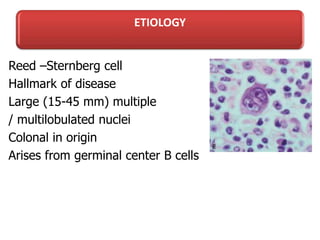
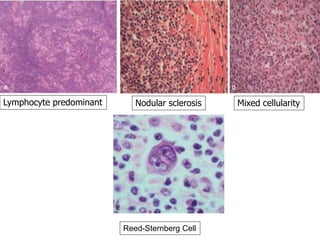
Reed –Sternberg cell
Hallmark of disease
Large (15-45 mm) multiple
/ multilobulated nuclei
Colonal in origin
Arises from germinal center B cells
RYE CLASSIFICATION SYSTEM
1- Lymphocyte predominant
2- Mixed cellularity
3- Nodular sclerosis
4- Lymphocyte depletion
Lymphocyte Predominant
10-15% of patients
More common in male
Younger patients
Localized disease
Mixed cellularity
30% of patients
< 10 yr of age
Advanced disease
Extranodal extension
Lymphocyte depletion
Rare in children
Common with HIV
Nodular sclerosis
Most common
40% of younger patients
70% of adolescents
REAL Classification
( Revised European – American Classification of
Lymphoid Neoplasms )
 Nodular lymphocyte predominance
 Classical Hodgkin lymphoma
 Lymphocyte rich
 Mix cellularity
 Nodular sclerosis
 Lymphocyte depletion
 Anaplastic large cell lymphoma Hodgkin like
Lymphocyte predominant Nodular sclerosis Mixed cellularity
Reed-Sternberg Cell
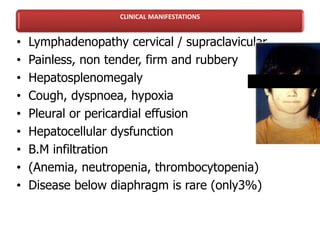
CLINICAL MANIFESTATIONS
• Lymphadenopathy cervical / supraclavicular
• Painless, non tender, firm and rubbery
• Hepatosplenomegaly
• Cough, dyspnoea, hypoxia
• Pleural or pericardial effusion
• Hepatocellular dysfunction
• B.M infiltration
• (Anemia, neutropenia, thrombocytopenia)
• Disease below diaphragm is rare (only3%)
Systemic Symptoms (B symptoms)
• Important in staging
• Unexplained fever > 390C
• Weight loss > 10% in 3m
• Drenching night sweats
• Immune System abnormalities
• Anergy to delayed-hypersensitivity skin test
• Abnormal cellular immune response
• Decreased CD4:CD8 ratio
• Reduce natural killer cell cytotoxicity
DIAGNOSIS
• Excisional Biopsy
 Light Microscopy
 Immunocytochemistry
 Molecular Studies
• Chest X – Ray
 Mediastinal Mass
• CT Scan
 Chest
 Abdomen
 Pelvis
• Blood CP & ESR
• LFT’s
• Bone Marrow
Aspiration
• Serum Copper &
Ferritin
• Bone Scan
• Gallium 67 Scan /
FDG/PET
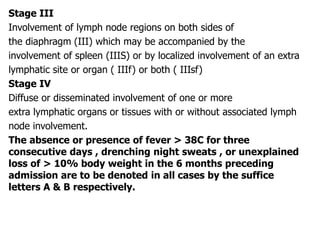
ANN ARBOR STAGING CLASSIFICATION FOR
HODGKIN DISEASE
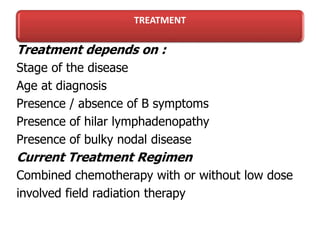
Stage I
Involvement of a single lymph node (1)
or of a single extra lymphatic site or organ(1f)f)
Stage II
Involvement of two or more lymph node regions on
the same side of the diaphragm(II)
or localised involvement of an extra lymphatic site
or organ and one or more lymph node regions
on the same side of the diaphragm (IIf)f)
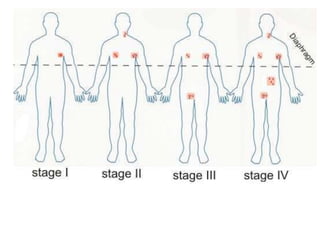
Stage III
Involvement of lymph node regions on both sides of
the diaphragm (III) which may be accompanied by the
involvement of spleen (IIIS) or by localized involvement of an extra
lymphatic site or organ ( IIIf) or both ( IIIsf)
Stage IV
Diffuse or disseminated involvement of one or more
extra lymphatic organs or tissues with or without associated lymph
node involvement.
The absence or presence of fever > 38C for three
consecutive days , drenching night sweats , or unexplained
loss of > 10% body weight in the 6 months preceding
admission are to be denoted in all cases by the suffice
letters A & B respectively.
TREATMENT
Treatment depends on :
Stage of the disease
Age at diagnosis
Presence / absence of B symptoms
Presence of hilar lymphadenopathy
Presence of bulky nodal disease
Current Treatment Regimen
Combined chemotherapy with or without low dose
involved field radiation therapy
Chemotherapy Regimens
MOPP
(Mechlorethamine , Vincristine , Procarbazine ,
Prednisolone)
COPP
(Cyclophosphamide , Vincristine , Procarbazine ,
Prednisolone)
ABVD
(Adriamycin , Bleomycin , Vinblastine , Dacarbazine)
BEACOPP ( For advanced stage disease )
(Bleomycin , Etoposide , Doxorubicin ,
Cyclophosphamide , Vincristine , Procarbazine ,
Prednisolone)
PROGNOSTIC FACTORS
• Prognosis
• FAVORABLE:
• <10, F, favorable subtypes (LP and NS)
• and
• Stage I non-bulky disease
• UNFAVORABLE:
• Persistently elevated ESR;
• LD histopathology;
• bulky disease--largest dimension >10cm;
• B symptoms;
LONG TERM COMPLICATIONS
Secondary malignancy
 Acute Myelogenous Leukemia
 Non Hodgkin lymphoma
 Carcinomas of breast , lungs & thyroid
Short stature
Hypothyroidism
Sterility
Dental caries
Sub clinical pulmonary dysfunction
Ischemic heart disease
PROGNOSIS
Early Stage Disease
5 year survival ….95%
Advanced Stage Disease
5 year survival ….90%
Relapses common within first 3 years
from diagnosis
Relapses treated with Autologous Stem
Cell Transplantation
EPIDEMIOLOGY
• 6% of childhood cancer 60% of all lymphomas in
children(M:F 2.5:1)
• 8-10% of all malignancies in children between 5- 19 yrs
of age
• Secondary causes of NHL include;
 Inherited / acquired immune deficiencies
 Viruses
 HIV
 EBV
 Post BMT, Post solid organ transplant
 Ataxia Telangiectasia
 Bloom syndrome
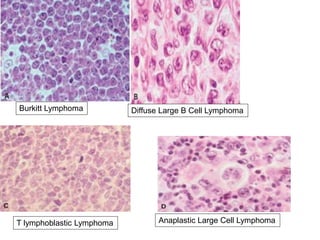
PATHOLOGICAL SUB TYPES OF NHL
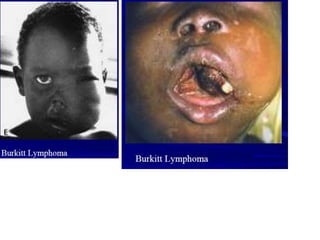
Burkitt Lymphoma
40% of NHL
B Cell Origin
Lymphoblastic Lymphoma
30% of NHL
80% T Cell Origin & 20% B Cell Origin
Diffuse Large B Cell Lymphoma
20% of NHL
B Cell Origin
Anaplastic Large Cell Lymphoma
10% of NHL
70% T Cell Origin
Burkitt Lymphoma Diffuse Large B Cell Lymphoma
T lymphoblastic Lymphoma Anaplastic Large Cell Lymphoma
Lymphoblastic (30-35%)
90 % immature T cells (very similar to
T-ALL)
remainder pre-B phenotype (as in ALL)
50-70% anterior mediastinum
neck, supraclavicular, axillary
adenopathy
Classic: older child with intussusception
Small non-cleaved cell (40-50%)
--Mature B-cell phenotype
--Burkitt's and non-Burkitt's
--90% abdomen
--Ascites and intusussception
--Endemic in Africa (Burkitt's), with
EBV 97%
Large-cell lymphoma (15-20%)
- Anaplastic (Ki-1) lymphoma – ALK fusion
protein
- Diffuse Large B-cell lymphoma (DLBCL)
- frequent Mediastinal involvement
- More like Hodgkin lymphoma than other
NHLs
- “Peripheral T-cell” lymphoma
- Often involves skin, CNS, lymph nodes,
lung, testes, muscles, and GI tract
CLINICAL MANIFESTATIONS
Burkitt Lymphoma
Abdominal Tumor
Head & Neck Disease
Involvement of bone marrow & CNS
Lymphoblastic Lymphoma
Intrathoracic / mediastinal supradiaphragmatic mass
Involvement of bone marrow & CNS
Diffuse Large B Cell Lymphoma
Abdominal Mass/ Mediastinal Mass
Anaplastic Large Cell Lymphoma
Primary cutaneous manifestation
Systemic disease ( fever , weight loss)
Dissemination to liver , spleen , lung , mediastinum & skin
CLINICAL MANIFESTATIONS ( cont )
• Lymphadenopathy
• Superior vena cava syndrome
• Dyspnea
• Abdominal Mass
• Intestinal obstruction / intussusception
• Ascites
• Nasal Stuffiness
• Earache
• Tonsil enlargement
• Localised bone involvement
• Acute paraplegia secondary to CNS / spinal cord
• compression
• Tumor Lysis Syndrome
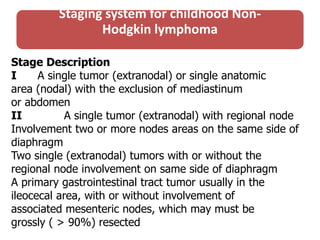
Staging system for childhood Non-
Hodgkin lymphoma
Stage Description
I A single tumor (extranodal) or single anatomic
area (nodal) with the exclusion of mediastinum
or abdomen
II A single tumor (extranodal) with regional node
Involvement two or more nodes areas on the same side of
diaphragm
Two single (extranodal) tumors with or without the
regional node involvement on same side of diaphragm
A primary gastrointestinal tract tumor usually in the
ileocecal area, with or without involvement of
associated mesenteric nodes, which may must be
grossly ( > 90%) resected
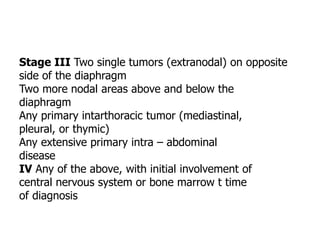
Stage III Two single tumors (extranodal) on opposite
side of the diaphragm
Two more nodal areas above and below the
diaphragm
Any primary intarthoracic tumor (mediastinal,
pleural, or thymic)
Any extensive primary intra – abdominal
disease
IV Any of the above, with initial involvement of
central nervous system or bone marrow t time
of diagnosis
DIFFERENTIAL DIAGNOSIS
 Hodgkin Disease
 Leukemia
 Germ Cell Tumor
 Wilms Tumor
 Neuroblastoma
 Rhabdomyosarcoma
 Reactive lymphadenitis
LABORATORY FINDINGS
• Tissue biopsy for;
 Flow cytometry
 Karyotyping
• Complete Blood Count
• Serum Electrolytes, Calcium , Phosphorus , Uric acid
• LFT’s & RFT’s
• Bone Marrow Aspiration & Biopsy
• CSF Examination
• Chest X Ray
• CT Scan
 Head & Neck
 Chest
 Abdomen & Pelvis
• PET Scan & Bone Scan
TREATMENT
• Systemic Chemotherapy
• Intrathecal chemotherapy
• Radiotherapy indicated in ;
 CNS Disease
 SVC Syndrome
 Paraplegia
Chemotherapy Regimens
COPAD
(Cyclophosphamide , Vincristinr ,
Prednisolone , Doxorubicin)
COMP
(Cyclophosphamide , Vincristine ,
Methotrexate , 6 Mercaptopurine ,
Prednisolone)
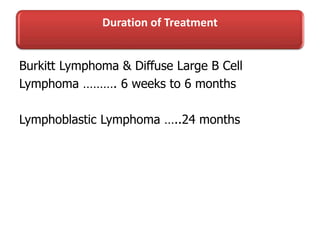
Duration of Treatment
Burkitt Lymphoma & Diffuse Large B Cell
Lymphoma ………. 6 weeks to 6 months
Lymphoblastic Lymphoma …..24 months
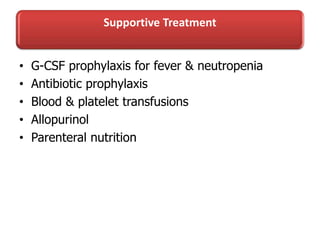
Supportive Treatment
• G-CSF prophylaxis for fever & neutropenia
• Antibiotic prophylaxis
• Blood & platelet transfusions
• Allopurinol
• Parenteral nutrition
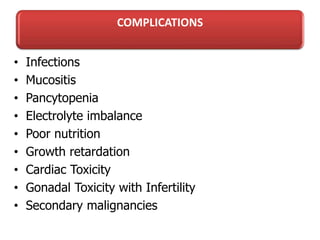
COMPLICATIONS
• Infections
• Mucositis
• Pancytopenia
• Electrolyte imbalance
• Poor nutrition
• Growth retardation
• Cardiac Toxicity
• Gonadal Toxicity with Infertility
• Secondary malignancies
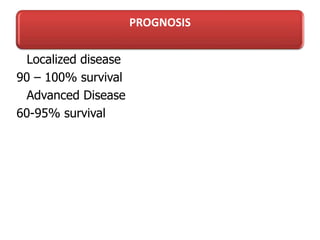
PROGNOSIS
Localized disease
90 – 100% survival
Advanced Disease
60-95% survival
Lymphoma in children Dr G.Rajkumar

Lymphoma in children Dr G.Rajkumar

  • 1.
  • 2.
    LYMPHOMA 3rd most commoncancer in children Incidence is 15 per million children Two broad categories 1- Hodgkin disease 2- Non- Hodgkin disease
  • 3.
    HODGKIN DISEASE: • Malignantprocess of lymphoreticular system • 6% of childhood cancer • 5% of cancer in < 14 yr • 15% in person 15-19 yr • Rare < 10 yr
  • 4.
    Epidemiology • Bimodal incidence •Early peak middle to late 20s • Second peak after 50 yr • Sex Male : Female • 4: 1 for 3-7 yr • 3: 1 for 7-9 yr • 1-3: 1 for > 10 yr • 100 folds risk for unaffected monozygotic twin of affected twin • Associated with specific HLA antigen • Infectious agents • Human herpes virus 6, CMV, Epstein – Barr virus • Immunodeficiency
  • 5.
    ETIOLOGY Reed –Sternberg cell Hallmarkof disease Large (15-45 mm) multiple / multilobulated nuclei Colonal in origin Arises from germinal center B cells
  • 6.
    RYE CLASSIFICATION SYSTEM 1-Lymphocyte predominant 2- Mixed cellularity 3- Nodular sclerosis 4- Lymphocyte depletion
  • 7.
    Lymphocyte Predominant 10-15% ofpatients More common in male Younger patients Localized disease Mixed cellularity 30% of patients < 10 yr of age Advanced disease Extranodal extension
  • 8.
    Lymphocyte depletion Rare inchildren Common with HIV Nodular sclerosis Most common 40% of younger patients 70% of adolescents
  • 9.
    REAL Classification ( RevisedEuropean – American Classification of Lymphoid Neoplasms )  Nodular lymphocyte predominance  Classical Hodgkin lymphoma  Lymphocyte rich  Mix cellularity  Nodular sclerosis  Lymphocyte depletion  Anaplastic large cell lymphoma Hodgkin like
  • 10.
    Lymphocyte predominant Nodularsclerosis Mixed cellularity Reed-Sternberg Cell
  • 11.
    CLINICAL MANIFESTATIONS • Lymphadenopathycervical / supraclavicular • Painless, non tender, firm and rubbery • Hepatosplenomegaly • Cough, dyspnoea, hypoxia • Pleural or pericardial effusion • Hepatocellular dysfunction • B.M infiltration • (Anemia, neutropenia, thrombocytopenia) • Disease below diaphragm is rare (only3%)
  • 12.
    Systemic Symptoms (Bsymptoms) • Important in staging • Unexplained fever > 390C • Weight loss > 10% in 3m • Drenching night sweats • Immune System abnormalities • Anergy to delayed-hypersensitivity skin test • Abnormal cellular immune response • Decreased CD4:CD8 ratio • Reduce natural killer cell cytotoxicity
  • 13.
    DIAGNOSIS • Excisional Biopsy Light Microscopy  Immunocytochemistry  Molecular Studies • Chest X – Ray  Mediastinal Mass • CT Scan  Chest  Abdomen  Pelvis • Blood CP & ESR • LFT’s • Bone Marrow Aspiration • Serum Copper & Ferritin • Bone Scan • Gallium 67 Scan / FDG/PET
  • 14.
    ANN ARBOR STAGINGCLASSIFICATION FOR HODGKIN DISEASE Stage I Involvement of a single lymph node (1) or of a single extra lymphatic site or organ(1f)f) Stage II Involvement of two or more lymph node regions on the same side of the diaphragm(II) or localised involvement of an extra lymphatic site or organ and one or more lymph node regions on the same side of the diaphragm (IIf)f)
  • 15.
    Stage III Involvement oflymph node regions on both sides of the diaphragm (III) which may be accompanied by the involvement of spleen (IIIS) or by localized involvement of an extra lymphatic site or organ ( IIIf) or both ( IIIsf) Stage IV Diffuse or disseminated involvement of one or more extra lymphatic organs or tissues with or without associated lymph node involvement. The absence or presence of fever > 38C for three consecutive days , drenching night sweats , or unexplained loss of > 10% body weight in the 6 months preceding admission are to be denoted in all cases by the suffice letters A & B respectively.
  • 17.
    TREATMENT Treatment depends on: Stage of the disease Age at diagnosis Presence / absence of B symptoms Presence of hilar lymphadenopathy Presence of bulky nodal disease Current Treatment Regimen Combined chemotherapy with or without low dose involved field radiation therapy
  • 18.
    Chemotherapy Regimens MOPP (Mechlorethamine ,Vincristine , Procarbazine , Prednisolone) COPP (Cyclophosphamide , Vincristine , Procarbazine , Prednisolone) ABVD (Adriamycin , Bleomycin , Vinblastine , Dacarbazine) BEACOPP ( For advanced stage disease ) (Bleomycin , Etoposide , Doxorubicin , Cyclophosphamide , Vincristine , Procarbazine , Prednisolone)
  • 19.
    PROGNOSTIC FACTORS • Prognosis •FAVORABLE: • <10, F, favorable subtypes (LP and NS) • and • Stage I non-bulky disease • UNFAVORABLE: • Persistently elevated ESR; • LD histopathology; • bulky disease--largest dimension >10cm; • B symptoms;
  • 20.
    LONG TERM COMPLICATIONS Secondarymalignancy  Acute Myelogenous Leukemia  Non Hodgkin lymphoma  Carcinomas of breast , lungs & thyroid Short stature Hypothyroidism Sterility Dental caries Sub clinical pulmonary dysfunction Ischemic heart disease
  • 21.
    PROGNOSIS Early Stage Disease 5year survival ….95% Advanced Stage Disease 5 year survival ….90% Relapses common within first 3 years from diagnosis Relapses treated with Autologous Stem Cell Transplantation
  • 23.
    EPIDEMIOLOGY • 6% ofchildhood cancer 60% of all lymphomas in children(M:F 2.5:1) • 8-10% of all malignancies in children between 5- 19 yrs of age • Secondary causes of NHL include;  Inherited / acquired immune deficiencies  Viruses  HIV  EBV  Post BMT, Post solid organ transplant  Ataxia Telangiectasia  Bloom syndrome
  • 24.
    PATHOLOGICAL SUB TYPESOF NHL Burkitt Lymphoma 40% of NHL B Cell Origin Lymphoblastic Lymphoma 30% of NHL 80% T Cell Origin & 20% B Cell Origin Diffuse Large B Cell Lymphoma 20% of NHL B Cell Origin Anaplastic Large Cell Lymphoma 10% of NHL 70% T Cell Origin
  • 25.
    Burkitt Lymphoma DiffuseLarge B Cell Lymphoma T lymphoblastic Lymphoma Anaplastic Large Cell Lymphoma
  • 26.
    Lymphoblastic (30-35%) 90 %immature T cells (very similar to T-ALL) remainder pre-B phenotype (as in ALL) 50-70% anterior mediastinum neck, supraclavicular, axillary adenopathy Classic: older child with intussusception
  • 27.
    Small non-cleaved cell(40-50%) --Mature B-cell phenotype --Burkitt's and non-Burkitt's --90% abdomen --Ascites and intusussception --Endemic in Africa (Burkitt's), with EBV 97%
  • 28.
    Large-cell lymphoma (15-20%) -Anaplastic (Ki-1) lymphoma – ALK fusion protein - Diffuse Large B-cell lymphoma (DLBCL) - frequent Mediastinal involvement - More like Hodgkin lymphoma than other NHLs - “Peripheral T-cell” lymphoma - Often involves skin, CNS, lymph nodes, lung, testes, muscles, and GI tract
  • 29.
    CLINICAL MANIFESTATIONS Burkitt Lymphoma AbdominalTumor Head & Neck Disease Involvement of bone marrow & CNS Lymphoblastic Lymphoma Intrathoracic / mediastinal supradiaphragmatic mass Involvement of bone marrow & CNS Diffuse Large B Cell Lymphoma Abdominal Mass/ Mediastinal Mass Anaplastic Large Cell Lymphoma Primary cutaneous manifestation Systemic disease ( fever , weight loss) Dissemination to liver , spleen , lung , mediastinum & skin
  • 30.
    CLINICAL MANIFESTATIONS (cont ) • Lymphadenopathy • Superior vena cava syndrome • Dyspnea • Abdominal Mass • Intestinal obstruction / intussusception • Ascites • Nasal Stuffiness • Earache • Tonsil enlargement • Localised bone involvement • Acute paraplegia secondary to CNS / spinal cord • compression • Tumor Lysis Syndrome
  • 32.
    Staging system forchildhood Non- Hodgkin lymphoma Stage Description I A single tumor (extranodal) or single anatomic area (nodal) with the exclusion of mediastinum or abdomen II A single tumor (extranodal) with regional node Involvement two or more nodes areas on the same side of diaphragm Two single (extranodal) tumors with or without the regional node involvement on same side of diaphragm A primary gastrointestinal tract tumor usually in the ileocecal area, with or without involvement of associated mesenteric nodes, which may must be grossly ( > 90%) resected
  • 33.
    Stage III Twosingle tumors (extranodal) on opposite side of the diaphragm Two more nodal areas above and below the diaphragm Any primary intarthoracic tumor (mediastinal, pleural, or thymic) Any extensive primary intra – abdominal disease IV Any of the above, with initial involvement of central nervous system or bone marrow t time of diagnosis
  • 34.
    DIFFERENTIAL DIAGNOSIS  HodgkinDisease  Leukemia  Germ Cell Tumor  Wilms Tumor  Neuroblastoma  Rhabdomyosarcoma  Reactive lymphadenitis
  • 35.
    LABORATORY FINDINGS • Tissuebiopsy for;  Flow cytometry  Karyotyping • Complete Blood Count • Serum Electrolytes, Calcium , Phosphorus , Uric acid • LFT’s & RFT’s • Bone Marrow Aspiration & Biopsy • CSF Examination • Chest X Ray • CT Scan  Head & Neck  Chest  Abdomen & Pelvis • PET Scan & Bone Scan
  • 36.
    TREATMENT • Systemic Chemotherapy •Intrathecal chemotherapy • Radiotherapy indicated in ;  CNS Disease  SVC Syndrome  Paraplegia
  • 37.
    Chemotherapy Regimens COPAD (Cyclophosphamide ,Vincristinr , Prednisolone , Doxorubicin) COMP (Cyclophosphamide , Vincristine , Methotrexate , 6 Mercaptopurine , Prednisolone)
  • 38.
    Duration of Treatment BurkittLymphoma & Diffuse Large B Cell Lymphoma ………. 6 weeks to 6 months Lymphoblastic Lymphoma …..24 months
  • 39.
    Supportive Treatment • G-CSFprophylaxis for fever & neutropenia • Antibiotic prophylaxis • Blood & platelet transfusions • Allopurinol • Parenteral nutrition
  • 40.
    COMPLICATIONS • Infections • Mucositis •Pancytopenia • Electrolyte imbalance • Poor nutrition • Growth retardation • Cardiac Toxicity • Gonadal Toxicity with Infertility • Secondary malignancies
  • 41.
    PROGNOSIS Localized disease 90 –100% survival Advanced Disease 60-95% survival