Pediatric Fluids and
           Electrolytes
      Rachel Sykes, PharmD, BCPS
            Clinical Assistant Professor
         Ernest Mario School of Pharmacy
                 Rutgers University
          Saint Barnabas Medical Center

          September 27, 2007


               Objectives
• Describe how pediatric body composition
  changes over time
• Identify the three main components of fluid
  therapy
• Calculate the maintenance fluid rate for a
  child using the Holliday -Segar Method
• Determine appropriate fluid components
  for a hospitalized child


               Objectives
• Calculate fluid rates for a child with
  dehydration
• Determine a 3% saline volume and rate for
  a child with severe hyponatremia
• Recommend an oral rehydration regimen
  for a child with mild dehydration


                                                1
Body Fluids

      • Total Body Water =
        Extracellular Fluid (ECF) + Intracellular Fluid (ICF)
      • ECF = Plasma + Interstitial Fluid
      • Total Body Water expressed in terms of % body
        weight (adolescent or adult):


                  ICF (30-40%)                                Interstitial            Plasma
                                                              (15%)                   (5%)


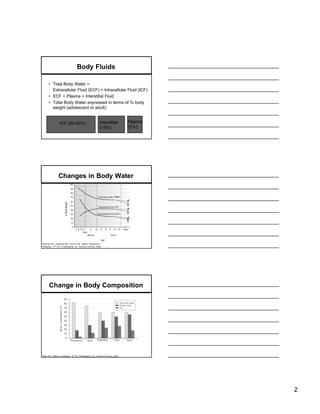
                 Changes in Body Water


Behrman RE, Kliegman RM, Jenson HB. Nelson Textbook of
Pediatrics. 17 th Ed. Philadelphia, PA: Elsevier Science; 2004.


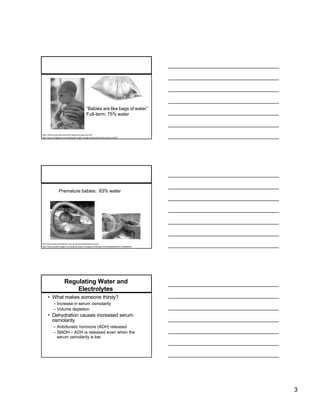
       Change in Body Composition


Miller RD. Miller’s Anesthesia . 6 th Ed. Philadelphia, PA: Elsevier Science; 2005.


                                                                                               2
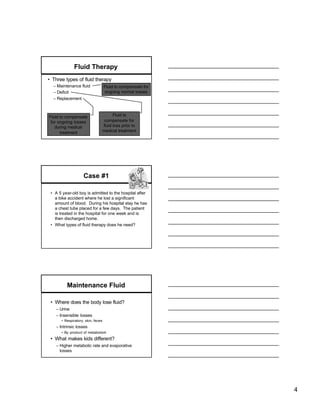
“Babies are like bags of water”
                                            Full-term: 75% water


http://chfs.ky.gov/dph/ach/ecd/newbornscreening.htm
http://www.inmagine.com/rubberball-single-image-set-photos/Rubberball-rbv005


                Premature babies: 83% water


http://www.sciencemuseum.org.uk/antenna/babybrainscans/
http://www.jupiterimages.com/popup2.aspx?navigationSubType=itemdetails&itemID =22684522


                      Regulating Water and
                          Electrolytes
     • What makes someone thirsty?
           – Increase in serum osmolarity
           – Volume depletion
     • Dehydration causes increased serum
       osmolarity
           – Antidiuretic hormone (ADH) released
           – SIADH – ADH is released even when the
             serum osmolarity is low


                                                                                          3
Fluid Therapy
• Three types of fluid therapy
  – Maintenance fluid              Fluid to compensate for
  – Deficit                        ongoing normal losses
  – Replacement


Fluid to compensate                      Fluid to
 for ongoing losses                 compensate for
   during medical                  fluid loss prior to
      treatment                    medical treatment


                    Case #1

 • A 5 year-old boy is admitted to the hospital after
   a bike accident where he lost a significant
   amount of blood. During his hospital stay he has
   a chest tube placed for a few days. The patient
   is treated in the hospital for one week and is
   then discharged home.
 • What types of fluid therapy does he need?


         Maintenance Fluid

 • Where does the body lose fluid?
   – Urine
   – Insensible losses
      • Respiratory, skin, feces
   – Intrinsic losses
      • By -product of metabolism
 • What makes kids different?
   – Higher metabolic rate and evaporative
     losses


                                                             4
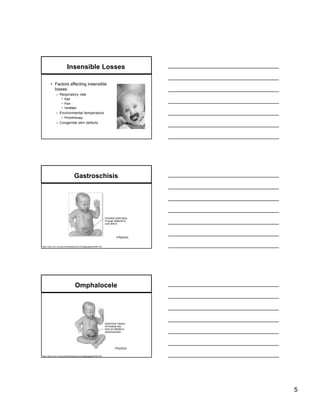
Insensible Losses

        • Factors affecting insensible
          losses
             – Respiratory rate
                   • Age
                   • Pain
                   • Ventilator
             – Environmental temperature
                   • Phototherapy
             – Congenital skin defects


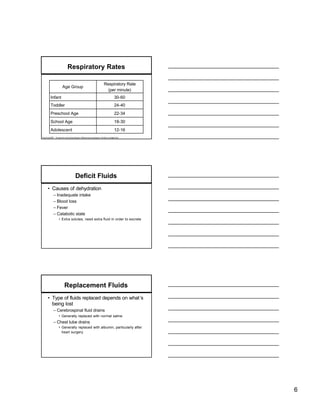
                               Gastroschisis


http://www.nlm.nih.gov/medlineplus/ency/imagepages/9028.htm


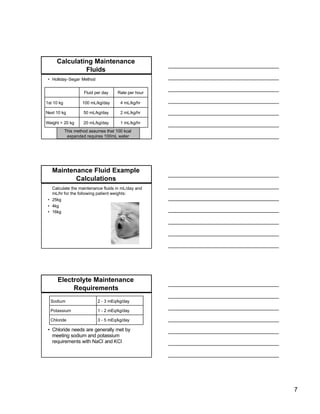
                                Omphalocele


http://www.nlm.nih.gov/medlineplus/ency/imagepages/9030.htm


                                                              5
Respiratory Rates

                                                             Respiratory Rate
                   Age Group
                                                               (per minute)
        Infant                                                         30-60
        Toddler                                                        24-40
        Preschool Age                                                  22-34
        School Age                                                     18-30
        Adolescent                                                     12-16
HazinskiMF. Anatomic and physiologic differences between children andadults.


                                Deficit Fluids
     • Causes of dehydration
          – Inadequate intake
          – Blood loss
          – Fever
          – Catabolic state
                • Extra solutes, need extra fluid in order to excrete


                     Replacement Fluids
     • Type of fluids replaced depends on what ’s
       being lost
          – Cerebrospinal fluid drains
                • Generally replaced with normal saline
          – Chest tube drains
                • Generally replaced with albumin, particularly after
                  heart surgery


                                                                                6
Calculating Maintenance
              Fluids
 • Holliday-Segar Method


                     Fluid per day    Rate per hour

1st 10 kg           100 mL/kg/day      4 mL/kg/hr

Next 10 kg           50 mL/kg/day      2 mL/kg/hr

Weight > 20 kg       20 mL/kg/day      1 mL/kg/hr
            This method assumes that 100 kcal
             expended requires 100mL water


   Maintenance Fluid Example
          Calculations
   Calculate the maintenance fluids in mL/day and
   mL/hr for the following patient weights:
 • 25kg
 • 4kg
 • 16kg


      Electrolyte Maintenance
           Requirements
  Sodium                    2 - 3 mEq/kg/day

  Potassium                 1 - 2 mEq/kg/day

  Chloride                  3 - 5 mEq/kg/day

 • Chloride needs are generally met by
   meeting sodium and potassium
   requirements with NaCl and KCl


                                                      7
What is the usual maintenance fluid
            for a child?
• 28 kg, well-hydrated child - What fluid would you
  recommend?
• FIRST - calculate the amount of fluid you need
• NEXT - calculate how much sodium and
  potassium you need
• FINALLY - pick a fluid based upon what is
  commercially available if you can


        Increased Maintenance
             Requirements
•   Fever
•   Vomiting
•   Hyperventilation
•   Hypermetabolic states
•   High environmental temperature
•   Intestinal losses
•   Burns


       Decreased Maintenance
           Requirements
• Increased environmental humidity
• Hypothermia
• Hypometabolic states


                                                      8
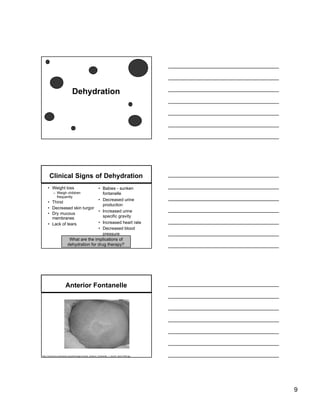
Dehydration


         Clinical Signs of Dehydration
     • Weight loss                • Babies - sunken
          – Weigh children          fontanelle
            frequently
                                  • Decreased urine
     •   Thirst
                                    production
     •   Decreased skin turgor
                                  • Increased urine
     •   Dry mucous
         membranes                  specific gravity
     •   Lack of tears            • Increased heart rate
                                  • Decreased blood
                                    pressure
                   What are the implications of
                 dehydration for drug therapy?


                      Anterior Fontanelle


http://commons.wikimedia.org/wiki/Image:Human_anterior_fontanelle_1_month_dscn1449.jpg


                                                                                         9
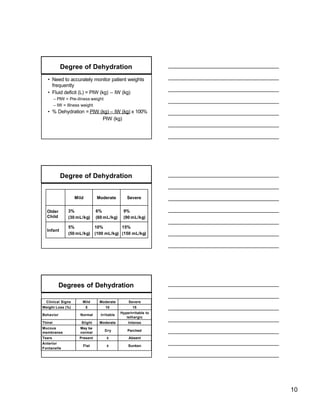
Degree of Dehydration
   • Need to accurately monitor patient weights
     frequently
   • Fluid deficit (L) = PIW (kg) – IW (kg)
         – PIW = Pre-illness weight
         – IW = Illness weight
   • % Dehydration = PIW (kg) – IW (kg) x 100%
                          PIW (kg)


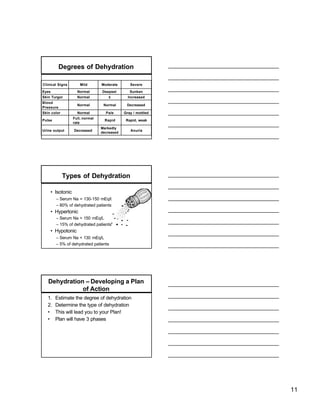
            Degree of Dehydration


                   Mild          Moderate        Severe


  Older         3%              6%             9%
  Child         (30 mL/kg)      (60 mL/kg)     (90 mL/kg)

                5%              10%         15%
  Infant
                (50 mL/kg)      (100 mL/kg) (150 mL/kg)


           Degrees of Dehydration

  Clinical Signs        Mild      Moderate        Severe
Weight Loss (%)           5           10             15
                                              Hyperirritable to
Behavior               Normal     Irritable
                                                 lethargic
Thirst                 Slight     Moderate        Intense
Mucous                 May be
                                      Dry         Parched
membranes              normal
Tears                 Present         ±           Absent
Anterior
                        Flat          ±           Sunken
Fontanelle


                                                                  10
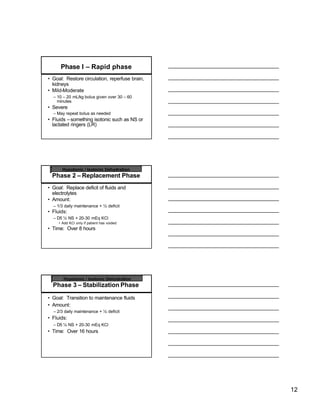
Degrees of Dehydration

Clinical Signs       Mild       Moderate       Severe

Eyes               Normal       Deepset        Sunken
Skin Turgor        Normal           ±         Increased
Blood
                   Normal        Normal      Decreased
Pressure
Skin color         Normal         Pale      Gray / mottled
                 Full, normal
Pulse                             Rapid      Rapid, weak
                 rate
                                Markedly
Urine output     Decreased                     Anuria
                                decreased


             Types of Dehydration

    • Isotonic
        – Serum Na = 130-150 mEq/L
        – 80% of dehydrated patients
    • Hypertonic
        – Serum Na > 150 mEq/L
        – 15% of dehydrated patients
    • Hypotonic
        – Serum Na < 130 mEq/L
        – 5% of dehydrated patients


   Dehydration – Developing a Plan
              of Action
   1.   Estimate the degree of dehydration
   2.   Determine the type of dehydration
   •    This will lead you to your Plan!
   •    Plan will have 3 phases


                                                             11
Phase I – Rapid phase
• Goal: Restore circulation, reperfuse brain,
  kidneys
• Mild-Moderate
  – 10 – 20 mL/kg bolus given over 30 – 60
    minutes
• Severe
  – May repeat bolus as needed
• Fluids – something isotonic such as NS or
  lactated ringers (LR)


       Hypotonic / Isotonic Dehydration
  Phase 2 – Replacement Phase
• Goal: Replace deficit of fluids and
  electrolytes
• Amount:
  – 1/3 daily maintenance + ½ deficit
• Fluids:
  – D5 ½ NS + 20-30 mEq KCl
     • Add KCl only if patient has voided
• Time: Over 8 hours


       Hypotonic / Isotonic Dehydration
  Phase 3 – Stabilization Phase

• Goal: Transition to maintenance fluids
• Amount:
  – 2/3 daily maintenance + ½ deficit
• Fluids:
  – D5 ¼ NS + 20-30 mEq KCl
• Time: Over 16 hours


                                                12
Hypertonic Dehydration
  Phase 2 – Replacement Phase
• Goal: Replace deficit of fluids and electrolytes
  and daily maintenance
• Amount:
   – Deficits + daily maintenance
• Fluid:
   – D5 ¼NS + 20-30 mEq/L KCl
• Give over 24-48 hours
• IMPORTANT: Lower serum Na by no more than
  10-12 mEq/L/day


               Hypertonic Dehydration
  Phase 3 – Replacement Phase

• Goal: Replace ongoing losses and
  transition towards maintenance fluid
  therapy
• Amount:
   – Replacement + daily maintenance
• Fluid:
   – D5 ¼NS + 20-30 mEq/L KCl


  Acute Severe Hyponatremia
• Serum Na < 120, CNS symptoms
• Administer 3% saline
• Total volume =
   – [(130 - serum Na)(0.6)(wt in kg)] x 2
• Give 1/2 total in < 1 hr and remainder over
  the next 2 hours if symptoms persist


                                                     13
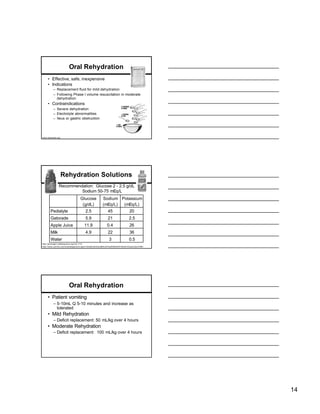
Oral Rehydration
     • Effective, safe, inexpensive
     • Indications
          – Replacement fluid for mild dehydration
          – Following Phase I volume resuscitation in moderate
            dehydration
     • Contraindications
          – Severe dehydration
          – Electrolyte abnormalities
          – Ileus or gastric obstruction


www.rehydrate.org


                    Rehydration Solutions
               Recommendation: Glucose 2 - 2.5 g/dL
                        Sodium 50-75 mEq/L
                               Glucose            Sodium Potassium
                                (g/dL)            (mEq/L) (mEq/L)
       Pedialyte                    2.5                45                20
       Gatorade                     5.9                21               2.5
       Apple Juice                 11.9               0.4                26
       Milk                         4.9                22                36
       Water                                            3               0.5
http://almostgirl.coffeespoons.org/?p=1131
http://www.yummy.com/subcategorylist.aspx?cGw8n4AckUu5BAvSiFaUNV
                                                               n9hS91DEsEXmQyGJauVHM=


                      Oral Rehydration
     • Patient vomiting
          – 5-10mL Q 5-10 minutes and increase as
            tolerated
     • Mild Rehydration
          – Deficit replacement: 50 mL/kg over 4 hours
     • Moderate Rehydration
          – Deficit replacement: 100 mL/kg over 4 hours


                                                                                        14
Hyperkalemia
    • Can cause life-threatening arrhythmias
         – Bradycardia
         – Ventricular dysrhythmias
    • First determine why the serum level might
      be high
         – Heel stick?
         – KCl in fluids?


         Blood Collection in Newborns


http://health.state. ga. us/programs/nsmscd/screening_form.asp
http://www.nlm.nih.gov/medlineplus/ency/imagepages/2961.htm


                             Hyperkalemia
    • Treatment
         – Calcium
         – Bicarbonate
         – Insulin (with glucose)
         – Albuterol


                                                                 15
Case #3
• JW, a 16 month old boy (11kg), is brought
  into your pharmacy by his mother. JW’s
  mom says that he had a mild bout of
  diarrhea a few days ago, and she is still
  noticing fewer wet diapers. Otherwise, he
  has no symptoms.
  JW’s mother would like to know what she
  should do. What do you recommend?


                 Case #4
• DR is a 4 year old girl (16kg) who presents
  to the emergency room with fatigue,
  headache, generalized malaise, and
  severe gastrointestinal distress. The ER
  team gets a chem-7 and discovers her
  sodium to be 118. They would like to give
  3% NS and ask you for a recommendation
  on how much to give, and at what rate.


                 Case #5
• LM is a 4 month old, 7kg (preillness) girl
  who presents to the ER with a sunken
  fontanelle, dusky skin, lethargy, and is not
  crying. She has not urinated in several
  hours. Current weight is 6kg. Her sodium
  is 137.
  What type and degree of dehydration does
  she have?
  How do you recommend treating her?


                                                 16
Case #5
• How do I double-check my answer?


                It’s easy! Just add up all
                    the fluid you gave.
                It should equal the deficit
                 + the daily maintenance
                       requirement.


                                              17

Pediatric fluids and electrolytes

  • 1.
    Pediatric Fluids and Electrolytes Rachel Sykes, PharmD, BCPS Clinical Assistant Professor Ernest Mario School of Pharmacy Rutgers University Saint Barnabas Medical Center September 27, 2007 Objectives • Describe how pediatric body composition changes over time • Identify the three main components of fluid therapy • Calculate the maintenance fluid rate for a child using the Holliday -Segar Method • Determine appropriate fluid components for a hospitalized child Objectives • Calculate fluid rates for a child with dehydration • Determine a 3% saline volume and rate for a child with severe hyponatremia • Recommend an oral rehydration regimen for a child with mild dehydration 1
  • 2.
    Body Fluids • Total Body Water = Extracellular Fluid (ECF) + Intracellular Fluid (ICF) • ECF = Plasma + Interstitial Fluid • Total Body Water expressed in terms of % body weight (adolescent or adult): ICF (30-40%) Interstitial Plasma (15%) (5%) Changes in Body Water Behrman RE, Kliegman RM, Jenson HB. Nelson Textbook of Pediatrics. 17 th Ed. Philadelphia, PA: Elsevier Science; 2004. Change in Body Composition Miller RD. Miller’s Anesthesia . 6 th Ed. Philadelphia, PA: Elsevier Science; 2005. 2
  • 3.
    “Babies are likebags of water” Full-term: 75% water http://chfs.ky.gov/dph/ach/ecd/newbornscreening.htm http://www.inmagine.com/rubberball-single-image-set-photos/Rubberball-rbv005 Premature babies: 83% water http://www.sciencemuseum.org.uk/antenna/babybrainscans/ http://www.jupiterimages.com/popup2.aspx?navigationSubType=itemdetails&itemID =22684522 Regulating Water and Electrolytes • What makes someone thirsty? – Increase in serum osmolarity – Volume depletion • Dehydration causes increased serum osmolarity – Antidiuretic hormone (ADH) released – SIADH – ADH is released even when the serum osmolarity is low 3
  • 4.
    Fluid Therapy • Threetypes of fluid therapy – Maintenance fluid Fluid to compensate for – Deficit ongoing normal losses – Replacement Fluid to compensate Fluid to for ongoing losses compensate for during medical fluid loss prior to treatment medical treatment Case #1 • A 5 year-old boy is admitted to the hospital after a bike accident where he lost a significant amount of blood. During his hospital stay he has a chest tube placed for a few days. The patient is treated in the hospital for one week and is then discharged home. • What types of fluid therapy does he need? Maintenance Fluid • Where does the body lose fluid? – Urine – Insensible losses • Respiratory, skin, feces – Intrinsic losses • By -product of metabolism • What makes kids different? – Higher metabolic rate and evaporative losses 4
  • 5.
    Insensible Losses • Factors affecting insensible losses – Respiratory rate • Age • Pain • Ventilator – Environmental temperature • Phototherapy – Congenital skin defects Gastroschisis http://www.nlm.nih.gov/medlineplus/ency/imagepages/9028.htm Omphalocele http://www.nlm.nih.gov/medlineplus/ency/imagepages/9030.htm 5
  • 6.
    Respiratory Rates Respiratory Rate Age Group (per minute) Infant 30-60 Toddler 24-40 Preschool Age 22-34 School Age 18-30 Adolescent 12-16 HazinskiMF. Anatomic and physiologic differences between children andadults. Deficit Fluids • Causes of dehydration – Inadequate intake – Blood loss – Fever – Catabolic state • Extra solutes, need extra fluid in order to excrete Replacement Fluids • Type of fluids replaced depends on what ’s being lost – Cerebrospinal fluid drains • Generally replaced with normal saline – Chest tube drains • Generally replaced with albumin, particularly after heart surgery 6
  • 7.
    Calculating Maintenance Fluids • Holliday-Segar Method Fluid per day Rate per hour 1st 10 kg 100 mL/kg/day 4 mL/kg/hr Next 10 kg 50 mL/kg/day 2 mL/kg/hr Weight > 20 kg 20 mL/kg/day 1 mL/kg/hr This method assumes that 100 kcal expended requires 100mL water Maintenance Fluid Example Calculations Calculate the maintenance fluids in mL/day and mL/hr for the following patient weights: • 25kg • 4kg • 16kg Electrolyte Maintenance Requirements Sodium 2 - 3 mEq/kg/day Potassium 1 - 2 mEq/kg/day Chloride 3 - 5 mEq/kg/day • Chloride needs are generally met by meeting sodium and potassium requirements with NaCl and KCl 7
  • 8.
    What is theusual maintenance fluid for a child? • 28 kg, well-hydrated child - What fluid would you recommend? • FIRST - calculate the amount of fluid you need • NEXT - calculate how much sodium and potassium you need • FINALLY - pick a fluid based upon what is commercially available if you can Increased Maintenance Requirements • Fever • Vomiting • Hyperventilation • Hypermetabolic states • High environmental temperature • Intestinal losses • Burns Decreased Maintenance Requirements • Increased environmental humidity • Hypothermia • Hypometabolic states 8
  • 9.
    Dehydration Clinical Signs of Dehydration • Weight loss • Babies - sunken – Weigh children fontanelle frequently • Decreased urine • Thirst production • Decreased skin turgor • Increased urine • Dry mucous membranes specific gravity • Lack of tears • Increased heart rate • Decreased blood pressure What are the implications of dehydration for drug therapy? Anterior Fontanelle http://commons.wikimedia.org/wiki/Image:Human_anterior_fontanelle_1_month_dscn1449.jpg 9
  • 10.
    Degree of Dehydration • Need to accurately monitor patient weights frequently • Fluid deficit (L) = PIW (kg) – IW (kg) – PIW = Pre-illness weight – IW = Illness weight • % Dehydration = PIW (kg) – IW (kg) x 100% PIW (kg) Degree of Dehydration Mild Moderate Severe Older 3% 6% 9% Child (30 mL/kg) (60 mL/kg) (90 mL/kg) 5% 10% 15% Infant (50 mL/kg) (100 mL/kg) (150 mL/kg) Degrees of Dehydration Clinical Signs Mild Moderate Severe Weight Loss (%) 5 10 15 Hyperirritable to Behavior Normal Irritable lethargic Thirst Slight Moderate Intense Mucous May be Dry Parched membranes normal Tears Present ± Absent Anterior Flat ± Sunken Fontanelle 10
  • 11.
    Degrees of Dehydration ClinicalSigns Mild Moderate Severe Eyes Normal Deepset Sunken Skin Turgor Normal ± Increased Blood Normal Normal Decreased Pressure Skin color Normal Pale Gray / mottled Full, normal Pulse Rapid Rapid, weak rate Markedly Urine output Decreased Anuria decreased Types of Dehydration • Isotonic – Serum Na = 130-150 mEq/L – 80% of dehydrated patients • Hypertonic – Serum Na > 150 mEq/L – 15% of dehydrated patients • Hypotonic – Serum Na < 130 mEq/L – 5% of dehydrated patients Dehydration – Developing a Plan of Action 1. Estimate the degree of dehydration 2. Determine the type of dehydration • This will lead you to your Plan! • Plan will have 3 phases 11
  • 12.
    Phase I –Rapid phase • Goal: Restore circulation, reperfuse brain, kidneys • Mild-Moderate – 10 – 20 mL/kg bolus given over 30 – 60 minutes • Severe – May repeat bolus as needed • Fluids – something isotonic such as NS or lactated ringers (LR) Hypotonic / Isotonic Dehydration Phase 2 – Replacement Phase • Goal: Replace deficit of fluids and electrolytes • Amount: – 1/3 daily maintenance + ½ deficit • Fluids: – D5 ½ NS + 20-30 mEq KCl • Add KCl only if patient has voided • Time: Over 8 hours Hypotonic / Isotonic Dehydration Phase 3 – Stabilization Phase • Goal: Transition to maintenance fluids • Amount: – 2/3 daily maintenance + ½ deficit • Fluids: – D5 ¼ NS + 20-30 mEq KCl • Time: Over 16 hours 12
  • 13.
    Hypertonic Dehydration Phase 2 – Replacement Phase • Goal: Replace deficit of fluids and electrolytes and daily maintenance • Amount: – Deficits + daily maintenance • Fluid: – D5 ¼NS + 20-30 mEq/L KCl • Give over 24-48 hours • IMPORTANT: Lower serum Na by no more than 10-12 mEq/L/day Hypertonic Dehydration Phase 3 – Replacement Phase • Goal: Replace ongoing losses and transition towards maintenance fluid therapy • Amount: – Replacement + daily maintenance • Fluid: – D5 ¼NS + 20-30 mEq/L KCl Acute Severe Hyponatremia • Serum Na < 120, CNS symptoms • Administer 3% saline • Total volume = – [(130 - serum Na)(0.6)(wt in kg)] x 2 • Give 1/2 total in < 1 hr and remainder over the next 2 hours if symptoms persist 13
  • 14.
    Oral Rehydration • Effective, safe, inexpensive • Indications – Replacement fluid for mild dehydration – Following Phase I volume resuscitation in moderate dehydration • Contraindications – Severe dehydration – Electrolyte abnormalities – Ileus or gastric obstruction www.rehydrate.org Rehydration Solutions Recommendation: Glucose 2 - 2.5 g/dL Sodium 50-75 mEq/L Glucose Sodium Potassium (g/dL) (mEq/L) (mEq/L) Pedialyte 2.5 45 20 Gatorade 5.9 21 2.5 Apple Juice 11.9 0.4 26 Milk 4.9 22 36 Water 3 0.5 http://almostgirl.coffeespoons.org/?p=1131 http://www.yummy.com/subcategorylist.aspx?cGw8n4AckUu5BAvSiFaUNV n9hS91DEsEXmQyGJauVHM= Oral Rehydration • Patient vomiting – 5-10mL Q 5-10 minutes and increase as tolerated • Mild Rehydration – Deficit replacement: 50 mL/kg over 4 hours • Moderate Rehydration – Deficit replacement: 100 mL/kg over 4 hours 14
  • 15.
    Hyperkalemia • Can cause life-threatening arrhythmias – Bradycardia – Ventricular dysrhythmias • First determine why the serum level might be high – Heel stick? – KCl in fluids? Blood Collection in Newborns http://health.state. ga. us/programs/nsmscd/screening_form.asp http://www.nlm.nih.gov/medlineplus/ency/imagepages/2961.htm Hyperkalemia • Treatment – Calcium – Bicarbonate – Insulin (with glucose) – Albuterol 15
  • 16.
    Case #3 • JW,a 16 month old boy (11kg), is brought into your pharmacy by his mother. JW’s mom says that he had a mild bout of diarrhea a few days ago, and she is still noticing fewer wet diapers. Otherwise, he has no symptoms. JW’s mother would like to know what she should do. What do you recommend? Case #4 • DR is a 4 year old girl (16kg) who presents to the emergency room with fatigue, headache, generalized malaise, and severe gastrointestinal distress. The ER team gets a chem-7 and discovers her sodium to be 118. They would like to give 3% NS and ask you for a recommendation on how much to give, and at what rate. Case #5 • LM is a 4 month old, 7kg (preillness) girl who presents to the ER with a sunken fontanelle, dusky skin, lethargy, and is not crying. She has not urinated in several hours. Current weight is 6kg. Her sodium is 137. What type and degree of dehydration does she have? How do you recommend treating her? 16
  • 17.
    Case #5 • Howdo I double-check my answer? It’s easy! Just add up all the fluid you gave. It should equal the deficit + the daily maintenance requirement. 17