
KAPOSI'S SARCOMA
COLUMBUS UNIVERSITY
FACULTY OF MEDICINE AND HEALTH
SCIENCES
ENGLISH SPEECH:
“CLINICAL DISEASES OR MEDICAL
CONDITIONS”
PRESENTED BY:
DIEGO MONTENEGRO
It predominantly affects
men and is enigmatic
geographical distributions.
DEFINITION
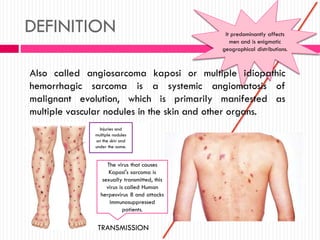
Also called angiosarcoma kaposi or multiple idiopathic
hemorrhagic sarcoma is a systemic angiomatosis of
malignant evolution, which is primarily manifested as
multiple vascular nodules in the skin and other organs.
Injuries and
multiple nodules
on the skin and
under the same.
The virus that causes
Kaposi's sarcoma is
sexually transmitted, this
virus is called Human
herpesvirus 8 and attacks
immunosuppressed
patients.
TRANSMISSION
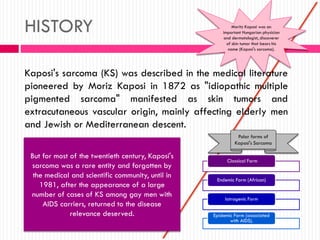
Moritz Kaposi was an
important Hungarian physician
and dermatologist, discoverer
of skin tumor that bears his
name (Kaposi's sarcoma).
HISTORY
Kaposi's sarcoma (KS) was described in the medical literature
pioneered by Moriz Kaposi in 1872 as "idiopathic multiple
pigmented sarcoma" manifested as skin tumors and
extracutaneous vascular origin, mainly affecting elderly men
and Jewish or Mediterranean descent.
But for most of the twentieth century, Kaposi's
sarcoma was a rare entity and forgotten by
the medical and scientific community, until in
1981, after the appearance of a large
number of cases of KS among gay men with
AIDS carriers, returned to the disease
relevance deserved.
Classical Form
Endemic Form (African)
Iatrogenic Form
Epidemic Form (associated
with AIDS).
Polar forms of
Kaposi's Sarcoma
SYMPTOMS
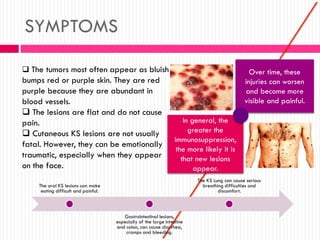
 The tumors most often appear as bluish
bumps red or purple skin. They are red
purple because they are abundant in
blood vessels.
 The lesions are flat and do not cause
pain.
 Cutaneous KS lesions are not usually
fatal. However, they can be emotionally
traumatic, especially when they appear
on the face.
Over time, these
injuries can worsen
and become more
visible and painful.
In general, the
greater the
immunosuppression,
the more likely it is
that new lesions
appear.
The oral KS lesions can make
eating difficult and painful.
Gastrointestinal lesions,
especially of the large intestine
and colon, can cause diarrhea,
cramps and bleeding.
The KS Lung can cause serious
breathing difficulties and
discomfort.
TREATMENT
The address of this
condition depends on:
How inhibit the immune
system is?
Number and location
of tumors.
Symptoms.
Treatments include:
Antiviral therapy
against HIV.
Combination with
chemotherapy.
Freezing
(cryotherapy).
Radiotherapy.
Lesions may
return after
treatment.
CASE Clinical and epidemiological
classic Kaposi sarcoma and
epidemic profile: a
retrospective study at the
National Hospital Cayetano
HerediaBetween 1969 and 2003, 86 cases of KS,
21 of which were of classical variety
(24.41%) and 65 of the epidemic variety
(75.58%) were found.
The first case of classic KS was diagnosed
in 1971, while the first case of epidemic
KS was diagnosed in 1987; both with
confirmatory histopathology.
From 1987 to 2003,
3207 patients were
treated HIV + and were
diagnosed by biopsy
confirming 65 cases of
epidemic KS, giving an
overall incidence of
20.26 per 1 000 HIV +
patients seen.
Of the 21 cases of classic KS, 15
were men (71.42%) and six
women (28.57%), aged between
33 and 86 years. While the 65
cases of epidemic KS, 60 were
men (93.85%) and five women
(6.15%), aged between 19 and
60 years.
Kaposi's Sarcoma

Kaposi's Sarcoma

  • 1.
    KAPOSI'S SARCOMA COLUMBUS UNIVERSITY FACULTYOF MEDICINE AND HEALTH SCIENCES ENGLISH SPEECH: “CLINICAL DISEASES OR MEDICAL CONDITIONS” PRESENTED BY: DIEGO MONTENEGRO
  • 2.
    It predominantly affects menand is enigmatic geographical distributions. DEFINITION Also called angiosarcoma kaposi or multiple idiopathic hemorrhagic sarcoma is a systemic angiomatosis of malignant evolution, which is primarily manifested as multiple vascular nodules in the skin and other organs. Injuries and multiple nodules on the skin and under the same. The virus that causes Kaposi's sarcoma is sexually transmitted, this virus is called Human herpesvirus 8 and attacks immunosuppressed patients. TRANSMISSION
  • 3.
    Moritz Kaposi wasan important Hungarian physician and dermatologist, discoverer of skin tumor that bears his name (Kaposi's sarcoma). HISTORY Kaposi's sarcoma (KS) was described in the medical literature pioneered by Moriz Kaposi in 1872 as "idiopathic multiple pigmented sarcoma" manifested as skin tumors and extracutaneous vascular origin, mainly affecting elderly men and Jewish or Mediterranean descent. But for most of the twentieth century, Kaposi's sarcoma was a rare entity and forgotten by the medical and scientific community, until in 1981, after the appearance of a large number of cases of KS among gay men with AIDS carriers, returned to the disease relevance deserved. Classical Form Endemic Form (African) Iatrogenic Form Epidemic Form (associated with AIDS). Polar forms of Kaposi's Sarcoma
  • 4.
    SYMPTOMS  The tumorsmost often appear as bluish bumps red or purple skin. They are red purple because they are abundant in blood vessels.  The lesions are flat and do not cause pain.  Cutaneous KS lesions are not usually fatal. However, they can be emotionally traumatic, especially when they appear on the face. Over time, these injuries can worsen and become more visible and painful. In general, the greater the immunosuppression, the more likely it is that new lesions appear. The oral KS lesions can make eating difficult and painful. Gastrointestinal lesions, especially of the large intestine and colon, can cause diarrhea, cramps and bleeding. The KS Lung can cause serious breathing difficulties and discomfort.
  • 5.
    TREATMENT The address ofthis condition depends on: How inhibit the immune system is? Number and location of tumors. Symptoms. Treatments include: Antiviral therapy against HIV. Combination with chemotherapy. Freezing (cryotherapy). Radiotherapy. Lesions may return after treatment.
  • 6.
    CASE Clinical andepidemiological classic Kaposi sarcoma and epidemic profile: a retrospective study at the National Hospital Cayetano HerediaBetween 1969 and 2003, 86 cases of KS, 21 of which were of classical variety (24.41%) and 65 of the epidemic variety (75.58%) were found. The first case of classic KS was diagnosed in 1971, while the first case of epidemic KS was diagnosed in 1987; both with confirmatory histopathology. From 1987 to 2003, 3207 patients were treated HIV + and were diagnosed by biopsy confirming 65 cases of epidemic KS, giving an overall incidence of 20.26 per 1 000 HIV + patients seen. Of the 21 cases of classic KS, 15 were men (71.42%) and six women (28.57%), aged between 33 and 86 years. While the 65 cases of epidemic KS, 60 were men (93.85%) and five women (6.15%), aged between 19 and 60 years.