
FLUIDS
BY
WASEEM ASHRAF
Fluids
 Water-most abundant compound
60% of total body weight in men
50% of total boby weight in women
 Total body water –function of several
variables like:
 Lean body mass n age
 Lean body mass: mass of functional
tissues (bones,essential fat, vital
organs)
 Storage fats –little water; TBW> in lean
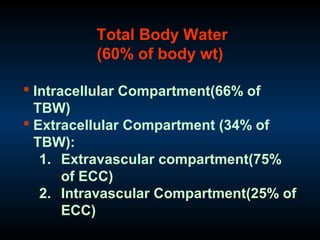
Total Body Water
(60% of body wt)
 Intracellular Compartment(66% of
TBW)
 Extracellular Compartment (34% of
TBW):
1. Extravascular compartment(75%
of ECC)
2. Intravascular Compartment(25% of
ECC)
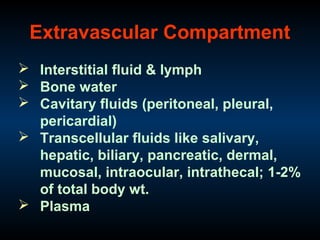
Extravascular Compartment
 Interstitial fluid & lymph
 Bone water
 Cavitary fluids (peritoneal, pleural,
pericardial)
 Transcellular fluids like salivary,
hepatic, biliary, pancreatic, dermal,
mucosal, intraocular, intrathecal; 1-2%
of total body wt.
 Plasma
Total body water
Build Male Female
Thin 65% 55%
Average 60% 50%
Obese 55% 45%
New born infants-75-80%
After adolescence TBW declines
Fluid intake
 - Exogenous
 - Endogenous
Exogenous: 2-3l /24 hrs
Endogenous:oxidation of ingested food(500 ml/24 hours)
Infants n Children: requirement is greater bcoz of:
Larger surface area/unit of body wt
Greater metabolic activity due to growth
Poor concentrating ability of immature kidney
Fluid input
Fluid output
Water is lost by four routes:
Lungs:400 ml/24 hrs
Skin:500ml/24hrs
Urine:1500ml/24hrs
Minimum 400ml urine output reqd to
excrete end products of metabolism
Faeces:60-150ml/24hrs
Perioperative Fluid Management
 Provide normal maintainance fluids
 Correct any preexisting deficits
 Replace ongoing losses due to
surgical disease n its treatment
 Adjust the type n qlty of fluids as
per the basal function of vital organ
system
•When?
• What?
• How much?
• How long?
• Maintenance Therapy
• Children normally have large variations in
their daily intake of water and electrolytes.
• The only exceptions are patients who
receive fixed dietary regimens orally, via a
gastric tube, or as intravenous total
parenteral nutrition.
• Healthy children can tolerate significant
variations
• The calculated water and electrolyte needs
that form the basis of maintenance therapy
are not absolute requirements.
Maintenance Therapy
Goals of Maintenance Fluids
Prevent dehydration
 Prevent electrolyte disorders
 Prevent ketoacidosis
 Prevent protein degradation
• preoperative and postoperative surgical
patients; many nonsurgical patients also
require maintenance fluids.
• a healthy adolescent can easily tolerate 12 or
18 hr without oral intake.
• In contrast, a 6 mo old child waiting for
surgery should begin receiving intravenous
fluids within 8 hr of the last feeding
• A child with suffering from nephrogenic
diabetes insipidus should begin receiving
intravenous fluids soon after being made
NPO.
Solution
mEq/L
Na+ K+ Cl- HCO3
-
Ca++ g/L
glucose
Principal uses
D5% - - - - - 50 Correction or
replacement of insensible
loss
D10% - - - - - 100 -do-
.9% isotonic
(normal) saline
154 - 154 - - - ECF replacement,
correction of
hyponatremia
45% - ½ NS 77 - 77 - - - Na+ maintenance, gastric
fluid replacement
5% NS 850 - 850 - - - Correction of
symptomatic
hyponatremia
Lactated ringers
solution
130 4 109 28 3 - Best ECF replacement;
correction of isotonic
deficit
Commonly used parenteral solutions
o Normal saline (NS) and Ringer lactate
(LR) are isotonic solutions;.
o The usual choices for maintenance
fluid therapy in children are ½ NS and
0.2 NS. These solutions are available
with 5% dextrose (D5).
o In addition, they are available with 20
mEq/L of potassium chloride, 10 mEq/L
of potassium chloride, or no
potassium..
Role of glucose
• Maintenance fluids usually contain 5%
dextrose (D5), which provides 17 calories/100
mL and nearly 20% of the daily caloric needs.
• This is enough to prevent ketone production
and helps to minimize protein degradation,
but the child will lose weight on this regimen.
• This is the principal reason why a patient
needs to be started on total parental nutrition
SELECTION OF MAINTENANCE FLUIDS.
 Children typically receive either D5 ½
NS + 20 mEq/L KCl or D5 0.2 NS + 20
mEq/L KCl.
 Children weighing less than
approximately 10 kg do best with the
solution containing 0.2 NS because of
their high water needs per kilogram.
 Larger children and adults may receive
the solution with ½ NS.
 children with renal insufficiency may be
hyperkalemic or unable to excrete potassium and
may not tolerate 20 mEq/L of potassium).
 In children with complicated pathophysiologic
derangements, it may be necessary to empirically
adjust the electrolyte composition and rate of
maintenance fluids based on electrolyte
measurements and assessment of fluid balance.
 In all children, it is critical to carefully monitor
weight, urine output, and electrolytes to determine
over- or underhydration, hyponatremia, or other
electrolyte disturbances, and to then adjust the rate
or composition of the intravenous solution.
SELECTION OF MAINTENANCE FLUIDS.
Fluid Balance Studies
 Daily fluid requirement calculated by:
 Sum of urine output(1.5 l)& insensible
water loss from skin and respiratory
tract(500-1000 ml/day) minus the
amount of water produced by
endogenous metabolism (300 ml/day)
 Hence it is customary to administer
2000-3000 ml of water daily to produce
a urine output of 1000-1500 ml
Maintenance Therapy
Fluid requirement calculated on the basis of
patient weight or energy expenditure or
fluid balance studies
I) WT: 4-2-1 rule
Wt (kg) Volume reqd
0-10 4 ml/kg/hr
11-20 40ml+2ml/kg/hr
above 10kg
>20 60ml+1ml/kg/hr
above 20 kg
AGE
Pt category Vol. reqd.
Neonate 3ml/kg/hr
Infant 4-6ml/kg/hr
Child 2-4 ml/kg/hr
Adult 1.5-2ml/kg/hr
Causes of increased water
needs
• SKIN
• Radiant warmer
• Incubator (premature infant)
Phototherapy
• Fever
• Sweat
• Burns
• LUNG
–TACHAPNEA
–TRACHOSTOMY
• GIT
–DIARRHOEA
–EMESIS
–NG SUCTION
• RENAL
–POLYURIA
• MISC
–SURGICAL DRAIN
–THIRD SPACING
CAUSES OF DECREASED
WATER NEEDS
• SKIN
– INCUBATER
• LUNGS
– HUMIDIFIED VENTILATOR
• RENAL
– OLIGURIA
– ANURIA
• MISC
– HYPOTHYROIDISM
• .
Replacement Therapy
Replacement Therapy
 Replacing preop, intraop n postop deficits
 Preop deficits: fasting of 6-8 hrs in elective
surgery;deficit calculated by hrly
maintenance fluid multiplied by hrs of
restriction,50% replaced in 1st
hr n 25% in
each of next 2 hrs
 Additional preop deficits:
 Internal fluid loss: cavitary fluid loss,3rd
space loss
 External fluid loss: GIT, Blood loss
Replacement Therapy
• The gastrointestinal (GI) tract is potentially a source
of considerable water loss.
• GI water losses are accompanied by electrolytes and
thus may cause disturbances in intravascular
volume and electrolyte concentrations.
• GI losses are often associated with loss of
potassium, leading to hypokalemia.
• Because of the high bicarbonate concentration in
stool, children with diarrhea usually have a
metabolic acidosis, which may be accentuated if
volume depletion causes hypoperfusion and a
concurrent lactic acidosis.
• Emesis or losses from an NG tube can cause a
metabolic alkalosis
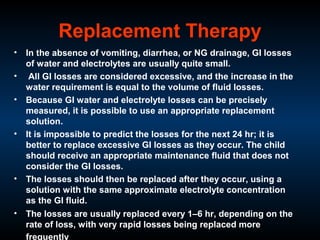
• In the absence of vomiting, diarrhea, or NG drainage, GI losses
of water and electrolytes are usually quite small.
• All GI losses are considered excessive, and the increase in the
water requirement is equal to the volume of fluid losses.
• Because GI water and electrolyte losses can be precisely
measured, it is possible to use an appropriate replacement
solution.
• It is impossible to predict the losses for the next 24 hr; it is
better to replace excessive GI losses as they occur. The child
should receive an appropriate maintenance fluid that does not
consider the GI losses.
• The losses should then be replaced after they occur, using a
solution with the same approximate electrolyte concentration
as the GI fluid.
• The losses are usually replaced every 1–6 hr, depending on the
rate of loss, with very rapid losses being replaced more
frequently.
Replacement Therapy
• AVERAGE COMPOSITION OF DIARRHEA
• Sodium: 55 mEq/L
• Potassium: 25 mEq/L
• Bicarbonate: 15 mEq/L
• APPROACH TO REPLACEMENT OF
ONGOING LOSSES
• Solution: D5 0.2 normal saline + 20 mEq/L
sodium bicarbonate + 20 mEq/L KCl
Replace stool mL/mL every 1–6 hr
• Loss of gastric fluid, via either emesis or NG
suction, is also likely to cause dehydration in
that most such patients have impaired oral
intake of fluids.
• Electrolyte disturbances, particularly
hypokalemia and metabolic alkalosis, are
also common.
• These complications can be avoided by
judicious use of a replacement solution.
•
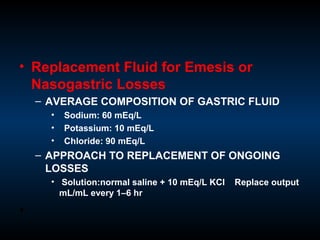
• Replacement Fluid for Emesis or
Nasogastric Losses
– AVERAGE COMPOSITION OF GASTRIC FLUID
• Sodium: 60 mEq/L
• Potassium: 10 mEq/L
• Chloride: 90 mEq/L
– APPROACH TO REPLACEMENT OF ONGOING
LOSSES
• Solution:normal saline + 10 mEq/L KCl Replace output
mL/mL every 1–6 hr
•
• Adjusting Fluid Therapy for Altered Renal
Output
OLIGURIA/ANURIA
• Place patient on insensible fluids (25–40% of
maintenance)
• Replace urine output mL/mL with ½ normal
saline
• POLYURIA
• Place patient on insensible fluids (25–40% of
maintenance)
• Measure urine electrolytes
• Replace urine output mL/mL with solution
based on measured urine electrolytes
MISC
• Surgical drains and chest tubes can produce measurable fluid output.
These losses should be replaced when they are significant. They can
be measured and replaced with an appropriate replacement solution.
• Third space losses manifest with edema and ascites and are due to a
shift of fluid from the intravascular space into the intersitial space.
Although these losses cannot be quantitated easily, third space losses
can be large and may lead to intravascular volume depletion, despite
the patient's weight gain. Replacement of third space fluid is
empirical, but should be anticipated in patients who are at risk, such
as children who have burns or abdominal surgery.
• Third space losses and chest tube output are isotonic; thus, they
usually require replacement with an isotonic fluid, such as NS or LR.
Adjustments in the amount of replacement fluid for third space losses
are based on continuing assessment of the patient's intravascular
volume status.
• Protein losses from chest tube drainage can be significant,
occasionally necessitating that 5% albumin be used as a replacement
solution.
Fluid
mEq/L
Na+ K+ Cl+ Cl-
HCO3
-
PO4
-
Prot SO4
Plasma 142 4.5 - 100 25 2 16 1
Gastric juice
High acid
Low acid
45
100
30
45
70
.015
120
115
25
30
-
-
-
-
-
-
Intestinal juice 120 20 - 110 30 - - -
Bile 140 5 - - 40 - - -
Pancreatic juice 130 15 - - 80 - - -
Intracellular fluid 10 150 - 5 10 100 60 20
Electrolyte composition of body fluids
Volume of gastrointestinal fluids
Fluid Vol(ml/day)
Saline 1500
Gastric secretions 2000

Bile 500 -1500
Pancreatic juice 700
Small bowel secretions 3000
(Succus entercus)
Total 8200-9200
DEFICIT THERAPY
Mild dehydration (<5% in an infant; <3%
in an older child or adult):
o normal or increased pulse;
odecreased urine output;
o thirsty;
o normal physical findings

• Moderate dehydration (5–10% in an
infant; 3–6% in an older child or adult):
• tachycardia;
• little or no urine output;
• irritable/lethargic;
• sunken eyes and fontanel;
• decreased tears;
• dry mucous membranes;
• mild delay in elasticity (skin turgor); delayed capillary refill
(>1.5 sec);
• cool and pale
• Severe dehydration (>10% in an infant;
>6% in an older child or adult):
– rapid and weak or absent peripheral pulses;
– decreased blood pressure;
– no urine output;
– very sunken eyes and fontanel;
– no tears;
parched mucous membranes;
– delayed elasticity (poor skin turgor);
– very delayed capillary refill (>3 sec);
– cold and mottled;
– limp, depressed consciousness
• Clinical assessment of dehydration is
only an estimate
• history usually suggests the etiology of
the dehydration
• Some children with dehydration are
appropriately thirsty,
• in others, the lack of intake is part of
the pathophysiology of the dehydration
Investigations
• Serum electrolytes
• Blood urea nitrogen (BUN) and serum
creatinine concentration
• Urinalysis
• CALCULATION OF THE FLUID DEFICIT
• Determining the fluid deficit
necessitates clinically determining the
percent dehydration and multiplying this
percentage by the patient's weight;
• a child who weighs 10 kg and is 10%
dehydrated has a fluid deficit of 1 L.
APPROACH TO DEHYDRATION
• child with dehydration requires acute
intervention to ensure that there is adequate
tissue perfusion
• Restore intravascular volume Normal
saline: 20 mL/kg over 20 min Repeat as
needed
• The child with severe dehydration may
require multiple fluid boluses and may need
to receive the boluses as fast as possible.
• In a child with a known or probable
metabolic alkalosis (the child with isolated
vomiting), LR should not be used because
the lactate will worsen the alkalosis
• Colloids, such as blood, 5% albumin, and plasma,
are rarely needed for fluid boluses.
• A crystalloid solution (NS or LR) is satisfactory, with
both less infectious risk and lower cost.
• Blood is obviously indicated in the child with
significant anemia or acute blood loss.
• Plasma is useful for children with a coagulopathy.
The child with hypoalbuminemia may benefit from
5% albumin, although there is evidence that albumin
infusions increase mortality in adults.
• The volume and the infusion rate for colloids are
generally modified compared with crystalloids
Fluid Management of Dehydration
• Restore intravascular volume Normal saline: 20
mL/kg over 20 min Repeat as needed
• Rapid volume repletion: 20 mL/kg normal saline or
Ringer Lactate (maximum = 1 L) over 2 hr
• Calculate 24-hr fluid needs: maintenance + deficit
volume
• Subtract isotonic fluid already administered from 24
hr fluid needs
• Administer remaining volume over 24 hr using D5 ½
normal saline + 20 mEq/L KCl Replace ongoing
losses as they occur
MONITERING THERAPY
• VITAL SIGNS
– Pulse
– Blood pressure
• INTAKE AND OUTPUT
– Fluid balance
– Urine output and specific gravity
• PHYSICAL EXAMINATION
– Weight
– Clinical signs of depletion or overload
• ELECTROLYTES
THANKYOU

Fluids

  • 1.
  • 2.
    Fluids  Water-most abundantcompound 60% of total body weight in men 50% of total boby weight in women  Total body water –function of several variables like:  Lean body mass n age  Lean body mass: mass of functional tissues (bones,essential fat, vital organs)  Storage fats –little water; TBW> in lean
  • 3.
    Total Body Water (60%of body wt)  Intracellular Compartment(66% of TBW)  Extracellular Compartment (34% of TBW): 1. Extravascular compartment(75% of ECC) 2. Intravascular Compartment(25% of ECC)
  • 4.
    Extravascular Compartment  Interstitialfluid & lymph  Bone water  Cavitary fluids (peritoneal, pleural, pericardial)  Transcellular fluids like salivary, hepatic, biliary, pancreatic, dermal, mucosal, intraocular, intrathecal; 1-2% of total body wt.  Plasma
  • 6.
    Total body water BuildMale Female Thin 65% 55% Average 60% 50% Obese 55% 45% New born infants-75-80% After adolescence TBW declines
  • 8.
    Fluid intake  -Exogenous  - Endogenous Exogenous: 2-3l /24 hrs Endogenous:oxidation of ingested food(500 ml/24 hours) Infants n Children: requirement is greater bcoz of: Larger surface area/unit of body wt Greater metabolic activity due to growth Poor concentrating ability of immature kidney Fluid input
  • 9.
    Fluid output Water islost by four routes: Lungs:400 ml/24 hrs Skin:500ml/24hrs Urine:1500ml/24hrs Minimum 400ml urine output reqd to excrete end products of metabolism Faeces:60-150ml/24hrs
  • 10.
    Perioperative Fluid Management Provide normal maintainance fluids  Correct any preexisting deficits  Replace ongoing losses due to surgical disease n its treatment  Adjust the type n qlty of fluids as per the basal function of vital organ system
  • 11.
  • 12.
  • 13.
  • 14.
  • 15.
  • 16.
    • Children normallyhave large variations in their daily intake of water and electrolytes. • The only exceptions are patients who receive fixed dietary regimens orally, via a gastric tube, or as intravenous total parenteral nutrition. • Healthy children can tolerate significant variations • The calculated water and electrolyte needs that form the basis of maintenance therapy are not absolute requirements. Maintenance Therapy
  • 17.
    Goals of MaintenanceFluids Prevent dehydration  Prevent electrolyte disorders  Prevent ketoacidosis  Prevent protein degradation
  • 18.
    • preoperative andpostoperative surgical patients; many nonsurgical patients also require maintenance fluids. • a healthy adolescent can easily tolerate 12 or 18 hr without oral intake. • In contrast, a 6 mo old child waiting for surgery should begin receiving intravenous fluids within 8 hr of the last feeding • A child with suffering from nephrogenic diabetes insipidus should begin receiving intravenous fluids soon after being made NPO.
  • 19.
    Solution mEq/L Na+ K+ Cl-HCO3 - Ca++ g/L glucose Principal uses D5% - - - - - 50 Correction or replacement of insensible loss D10% - - - - - 100 -do- .9% isotonic (normal) saline 154 - 154 - - - ECF replacement, correction of hyponatremia 45% - ½ NS 77 - 77 - - - Na+ maintenance, gastric fluid replacement 5% NS 850 - 850 - - - Correction of symptomatic hyponatremia Lactated ringers solution 130 4 109 28 3 - Best ECF replacement; correction of isotonic deficit Commonly used parenteral solutions
  • 20.
    o Normal saline(NS) and Ringer lactate (LR) are isotonic solutions;. o The usual choices for maintenance fluid therapy in children are ½ NS and 0.2 NS. These solutions are available with 5% dextrose (D5). o In addition, they are available with 20 mEq/L of potassium chloride, 10 mEq/L of potassium chloride, or no potassium..
  • 21.
    Role of glucose •Maintenance fluids usually contain 5% dextrose (D5), which provides 17 calories/100 mL and nearly 20% of the daily caloric needs. • This is enough to prevent ketone production and helps to minimize protein degradation, but the child will lose weight on this regimen. • This is the principal reason why a patient needs to be started on total parental nutrition
  • 22.
    SELECTION OF MAINTENANCEFLUIDS.  Children typically receive either D5 ½ NS + 20 mEq/L KCl or D5 0.2 NS + 20 mEq/L KCl.  Children weighing less than approximately 10 kg do best with the solution containing 0.2 NS because of their high water needs per kilogram.  Larger children and adults may receive the solution with ½ NS.
  • 23.
     children withrenal insufficiency may be hyperkalemic or unable to excrete potassium and may not tolerate 20 mEq/L of potassium).  In children with complicated pathophysiologic derangements, it may be necessary to empirically adjust the electrolyte composition and rate of maintenance fluids based on electrolyte measurements and assessment of fluid balance.  In all children, it is critical to carefully monitor weight, urine output, and electrolytes to determine over- or underhydration, hyponatremia, or other electrolyte disturbances, and to then adjust the rate or composition of the intravenous solution. SELECTION OF MAINTENANCE FLUIDS.
  • 24.
    Fluid Balance Studies Daily fluid requirement calculated by:  Sum of urine output(1.5 l)& insensible water loss from skin and respiratory tract(500-1000 ml/day) minus the amount of water produced by endogenous metabolism (300 ml/day)  Hence it is customary to administer 2000-3000 ml of water daily to produce a urine output of 1000-1500 ml
  • 25.
    Maintenance Therapy Fluid requirementcalculated on the basis of patient weight or energy expenditure or fluid balance studies I) WT: 4-2-1 rule Wt (kg) Volume reqd 0-10 4 ml/kg/hr 11-20 40ml+2ml/kg/hr above 10kg >20 60ml+1ml/kg/hr above 20 kg
  • 26.
    AGE Pt category Vol.reqd. Neonate 3ml/kg/hr Infant 4-6ml/kg/hr Child 2-4 ml/kg/hr Adult 1.5-2ml/kg/hr
  • 27.
    Causes of increasedwater needs • SKIN • Radiant warmer • Incubator (premature infant) Phototherapy • Fever • Sweat • Burns
  • 28.
  • 29.
  • 30.
    CAUSES OF DECREASED WATERNEEDS • SKIN – INCUBATER • LUNGS – HUMIDIFIED VENTILATOR • RENAL – OLIGURIA – ANURIA • MISC – HYPOTHYROIDISM
  • 31.
  • 32.
    Replacement Therapy  Replacingpreop, intraop n postop deficits  Preop deficits: fasting of 6-8 hrs in elective surgery;deficit calculated by hrly maintenance fluid multiplied by hrs of restriction,50% replaced in 1st hr n 25% in each of next 2 hrs  Additional preop deficits:  Internal fluid loss: cavitary fluid loss,3rd space loss  External fluid loss: GIT, Blood loss
  • 33.
    Replacement Therapy • Thegastrointestinal (GI) tract is potentially a source of considerable water loss. • GI water losses are accompanied by electrolytes and thus may cause disturbances in intravascular volume and electrolyte concentrations. • GI losses are often associated with loss of potassium, leading to hypokalemia. • Because of the high bicarbonate concentration in stool, children with diarrhea usually have a metabolic acidosis, which may be accentuated if volume depletion causes hypoperfusion and a concurrent lactic acidosis. • Emesis or losses from an NG tube can cause a metabolic alkalosis
  • 34.
    • In theabsence of vomiting, diarrhea, or NG drainage, GI losses of water and electrolytes are usually quite small. • All GI losses are considered excessive, and the increase in the water requirement is equal to the volume of fluid losses. • Because GI water and electrolyte losses can be precisely measured, it is possible to use an appropriate replacement solution. • It is impossible to predict the losses for the next 24 hr; it is better to replace excessive GI losses as they occur. The child should receive an appropriate maintenance fluid that does not consider the GI losses. • The losses should then be replaced after they occur, using a solution with the same approximate electrolyte concentration as the GI fluid. • The losses are usually replaced every 1–6 hr, depending on the rate of loss, with very rapid losses being replaced more frequently. Replacement Therapy
  • 35.
    • AVERAGE COMPOSITIONOF DIARRHEA • Sodium: 55 mEq/L • Potassium: 25 mEq/L • Bicarbonate: 15 mEq/L • APPROACH TO REPLACEMENT OF ONGOING LOSSES • Solution: D5 0.2 normal saline + 20 mEq/L sodium bicarbonate + 20 mEq/L KCl Replace stool mL/mL every 1–6 hr
  • 36.
    • Loss ofgastric fluid, via either emesis or NG suction, is also likely to cause dehydration in that most such patients have impaired oral intake of fluids. • Electrolyte disturbances, particularly hypokalemia and metabolic alkalosis, are also common. • These complications can be avoided by judicious use of a replacement solution. •
  • 37.
    • Replacement Fluidfor Emesis or Nasogastric Losses – AVERAGE COMPOSITION OF GASTRIC FLUID • Sodium: 60 mEq/L • Potassium: 10 mEq/L • Chloride: 90 mEq/L – APPROACH TO REPLACEMENT OF ONGOING LOSSES • Solution:normal saline + 10 mEq/L KCl Replace output mL/mL every 1–6 hr •
  • 38.
    • Adjusting FluidTherapy for Altered Renal Output OLIGURIA/ANURIA • Place patient on insensible fluids (25–40% of maintenance) • Replace urine output mL/mL with ½ normal saline • POLYURIA • Place patient on insensible fluids (25–40% of maintenance) • Measure urine electrolytes • Replace urine output mL/mL with solution based on measured urine electrolytes
  • 39.
    MISC • Surgical drainsand chest tubes can produce measurable fluid output. These losses should be replaced when they are significant. They can be measured and replaced with an appropriate replacement solution. • Third space losses manifest with edema and ascites and are due to a shift of fluid from the intravascular space into the intersitial space. Although these losses cannot be quantitated easily, third space losses can be large and may lead to intravascular volume depletion, despite the patient's weight gain. Replacement of third space fluid is empirical, but should be anticipated in patients who are at risk, such as children who have burns or abdominal surgery. • Third space losses and chest tube output are isotonic; thus, they usually require replacement with an isotonic fluid, such as NS or LR. Adjustments in the amount of replacement fluid for third space losses are based on continuing assessment of the patient's intravascular volume status. • Protein losses from chest tube drainage can be significant, occasionally necessitating that 5% albumin be used as a replacement solution.
  • 40.
    Fluid mEq/L Na+ K+ Cl+Cl- HCO3 - PO4 - Prot SO4 Plasma 142 4.5 - 100 25 2 16 1 Gastric juice High acid Low acid 45 100 30 45 70 .015 120 115 25 30 - - - - - - Intestinal juice 120 20 - 110 30 - - - Bile 140 5 - - 40 - - - Pancreatic juice 130 15 - - 80 - - - Intracellular fluid 10 150 - 5 10 100 60 20 Electrolyte composition of body fluids Volume of gastrointestinal fluids Fluid Vol(ml/day) Saline 1500 Gastric secretions 2000  Bile 500 -1500 Pancreatic juice 700 Small bowel secretions 3000 (Succus entercus) Total 8200-9200
  • 41.
  • 42.
    Mild dehydration (<5%in an infant; <3% in an older child or adult): o normal or increased pulse; odecreased urine output; o thirsty; o normal physical findings 
  • 43.
    • Moderate dehydration(5–10% in an infant; 3–6% in an older child or adult): • tachycardia; • little or no urine output; • irritable/lethargic; • sunken eyes and fontanel; • decreased tears; • dry mucous membranes; • mild delay in elasticity (skin turgor); delayed capillary refill (>1.5 sec); • cool and pale
  • 44.
    • Severe dehydration(>10% in an infant; >6% in an older child or adult): – rapid and weak or absent peripheral pulses; – decreased blood pressure; – no urine output; – very sunken eyes and fontanel; – no tears; parched mucous membranes; – delayed elasticity (poor skin turgor); – very delayed capillary refill (>3 sec); – cold and mottled; – limp, depressed consciousness
  • 45.
    • Clinical assessmentof dehydration is only an estimate • history usually suggests the etiology of the dehydration • Some children with dehydration are appropriately thirsty, • in others, the lack of intake is part of the pathophysiology of the dehydration
  • 46.
    Investigations • Serum electrolytes •Blood urea nitrogen (BUN) and serum creatinine concentration • Urinalysis
  • 47.
    • CALCULATION OFTHE FLUID DEFICIT • Determining the fluid deficit necessitates clinically determining the percent dehydration and multiplying this percentage by the patient's weight; • a child who weighs 10 kg and is 10% dehydrated has a fluid deficit of 1 L.
  • 48.
    APPROACH TO DEHYDRATION •child with dehydration requires acute intervention to ensure that there is adequate tissue perfusion • Restore intravascular volume Normal saline: 20 mL/kg over 20 min Repeat as needed • The child with severe dehydration may require multiple fluid boluses and may need to receive the boluses as fast as possible. • In a child with a known or probable metabolic alkalosis (the child with isolated vomiting), LR should not be used because the lactate will worsen the alkalosis
  • 49.
    • Colloids, suchas blood, 5% albumin, and plasma, are rarely needed for fluid boluses. • A crystalloid solution (NS or LR) is satisfactory, with both less infectious risk and lower cost. • Blood is obviously indicated in the child with significant anemia or acute blood loss. • Plasma is useful for children with a coagulopathy. The child with hypoalbuminemia may benefit from 5% albumin, although there is evidence that albumin infusions increase mortality in adults. • The volume and the infusion rate for colloids are generally modified compared with crystalloids
  • 50.
    Fluid Management ofDehydration • Restore intravascular volume Normal saline: 20 mL/kg over 20 min Repeat as needed • Rapid volume repletion: 20 mL/kg normal saline or Ringer Lactate (maximum = 1 L) over 2 hr • Calculate 24-hr fluid needs: maintenance + deficit volume • Subtract isotonic fluid already administered from 24 hr fluid needs • Administer remaining volume over 24 hr using D5 ½ normal saline + 20 mEq/L KCl Replace ongoing losses as they occur
  • 51.
    MONITERING THERAPY • VITALSIGNS – Pulse – Blood pressure • INTAKE AND OUTPUT – Fluid balance – Urine output and specific gravity • PHYSICAL EXAMINATION – Weight – Clinical signs of depletion or overload • ELECTROLYTES
  • 52.