• Earliest work on jaundice from Baumes-1785,
• and Hervieux-1847
• Kernicterus was first described by Johannes Orth, 1875
• He postulated that jaundice might have hematologic origins
• He noted that the brain in jaundiced adults wasn’t affected.
• Christian Schmorl coined the term in 1903,to describe
yellow staining of basal ganglia.
• Bilirubin may stain brain structure in absence of
microscopic evidence of neuronal injury so kernicterus and
bilirubin encephalopathy were used interchangeably.
 Bilirubin isomer in humans is bilirubin -IX alpha
Which exists as either Dianion or as Bilirubin acid.
Dianion –water soluble, non toxic form.
 Bilirubin acid form is bound to hydrogen bonds and
is insoluble in water (BH2) these isomers are
responsible for toxic affects.
 Bilirubin in plasma exists as Albumin bound complex
which cannot cross the cell wall.
 One Gm of albumin binds 8.5 mg of bilirubin .
 Minute amount of bilirubin is always present in plasma
as free or unbound bilirubin ,it is this molecule that
enters the brain to produce neuronal injury.
 Bilirubin entry into CNS potentially can occur across
the blood brain or cerebrospinal fluid barrier , of the
two transport across the blood brain barrier is more
important.
 Blood brain barrier is composed of the brain capillary
endothelial cells with tight intercellular junctions.
 Prevention of entry of bilirubin depends on the
action of two large families of ABC transporters
(adenosine triphosphate binding cassettes).
 The transporter are MRPs and MDR /PGPs.
(multidrug resistant protein ,multidrug resistance
p-glycoprotein).
 These are located in neurons,Glia and capillary
endothelial cells.
 The function of these transporters are to export
bilirubin from brain cells to extracellular space
and then across capillary endothelial cells to blood
 Any disturbances in action of these transporters
play a major role in determining neuronal
susceptibility to bilirubin injury .
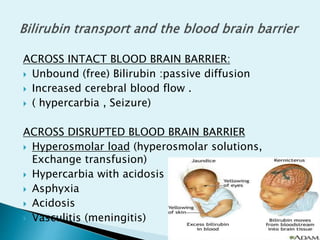
ACROSS INTACT BLOOD BRAIN BARRIER:
 Unbound (free) Bilirubin :passive diffusion
 Increased cerebral blood flow .
 ( hypercarbia , Seizure)
ACROSS DISRUPTED BLOOD BRAIN BARRIER
 Hyperosmolar load (hyperosmolar solutions,
Exchange transfusion)
 Hypercarbia with acidosis
 Asphyxia
 Acidosis
 Vasculitis (meningitis)
 Relatively high hematocrit; more cells to break
down.
 UDP-Glucuronyl Transferase is not fully functional
until 3-4 months of life.
 Relative starvation state and slow transit time,
especially in breastfeeders.
 Breastmilk contains beta-glucuronidase;
enterohepatic circulation is increased
 Polycythemia
 Hemolysis
◦ Rh incompatibility
◦ ABO incompatibility
◦ Abnormal RBCs—G6PD, spherocytosis, thalassemia
 Birth Trauma—Bruising, Cephalohematoma.
 Metabolic Abnormalities—Crigler Najjar, Gilbert
Syndrome.
 Medications—Sulfonamides,ampicillin.
Displaces bilirubin from albumin; same binding site
 Increased bilirubin production.
Increase RBC volume.
Decrease RBC survival.
Increase other sources.
 Defective hepatic uptake of bilirubin from plasma.
Decreased Y protein (ligandin)
Decreased caloric intake in first 48-72 hours.
 Defective bilirubin conjugation
Decrease UDP glucuronyl transferase
 Defective bilirubin excretion.
 Increased enterohepatic circulation.
 Concentration of serum unconjugated bilirubin.
 Concentration of serum albumin.
 Bilirubin binding by albumin.
 Concentration of hydrogen ion(PH).
 Blood brain barrier.
 Neuronal susceptibility.
 Improved bilirubin albumin binding and increased
proportion of free bilirubin .
(endogenous anions)
 Increased proportion of bilirubin as bilirubin acid
(acidosis).
 Increased blood brain transport of bilirubin
(hypercarbia)
 Concomitant neuronal injury with enhanced
susceptibility to bilirubin injury
(hypoxic ischemia)
 Mechanism of injury of neuron by bilirubin remains a
controversial issue.
 Various in vitro and in vivo studies, primarily with
animals indicated disturbance in respiration and
oxidative phosphorylation, glycolysis, glycogen
synthesis, citric acid cycle function ,cyclic AMP
synthesis ,amino acid and protein metabolism.
 DNA synthesis myelination and synthesis and
transport of neurotransmiters are also disruptted.
 Bilirubin exerts its effects involving multiple sites ,it
now appears that this mechanism is injury to cellular
membrane
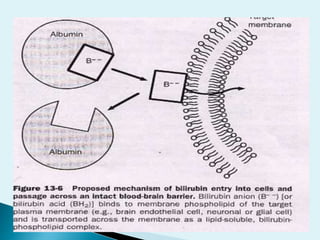
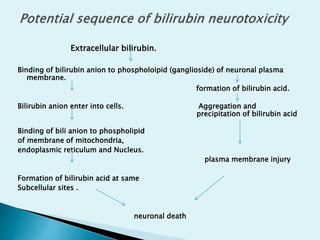
Extracellular bilirubin.
Binding of bilirubin anion to phospholoipid (ganglioside) of neuronal plasma
membrane.
formation of bilirubin acid.
Bilirubin anion enter into cells. Aggregation and
precipitation of bilirubin acid
Binding of bili anion to phospholipid
of membrane of mitochondria,
endoplasmic reticulum and Nucleus.
plasma membrane injury
Formation of bilirubin acid at same
Subcellular sites .
neuronal death
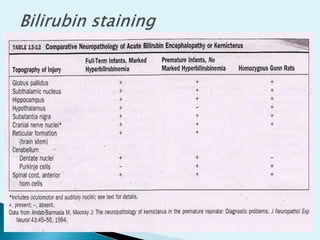
 Acute bilirubin encephalopathy or kernicterus of
the full term infant with marked
hyperbilirubinemia.
 Acute bilirubin encephalopathy or kernicterus of
premature infant without marked
hyperbilirubinemia.
 Secondary bilirubin staining of brain nuclei of the
premature infant( without marked
hyperbilirubinemia).
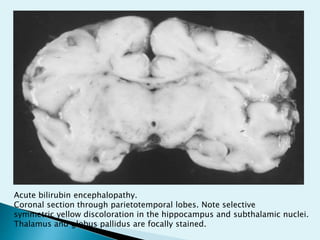
Acute bilirubin encephalopathy.
Coronal section through parietotemporal lobes. Note selective
symmetric yellow discoloration in the hippocampus and subthalamic nuclei.
Thalamus and globus pallidus are focally stained.
 Acute Bilirubin Encephalopathy
◦ Early phase: Hypotonia, lethargy, high pitched cry
and poor suck present in the first few days.
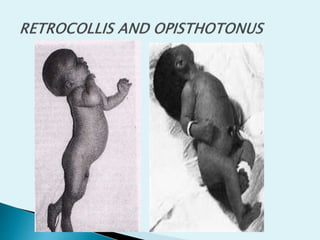
◦ Intermediate phase: hypertonia of extensor muscles
(with opisthotonus,rigidity,oculogyric crisis and
retrocollis)Irritability, fever and seizure.
Many infants die in this phase.
◦ Advanced phase: Pronounced opisthotonus
(hypotonia replaces hypertonia) shrill
cry,apnea,seizures,coma and death
 Extra pyramidal disturbance: Athetosis as early as
18 month and delayed till 8 to 9 years.
 Other Abnormalities: Facial grimacing,
drooling,dysarthria, and difficulty in chewing and
swallowing.
 Hearing loss is usually due to injury of the cochlear
nuclei in the brainstem.
 Gaze abnormalities: Limitation of upward gaze palsies.
Dolls eye maneuver results in full vertical eye
movements.
 Cerebral cortex is relatively spared,so intelligence is
often close to normal.
 Seen in infants who experienced less severe
hyperbilirubinemia with less severe neurological affection.
 Clinical features : hypotonia , active deep tendon reflexes
persistent and delayed acquisition of motor skills.
 Extrapyramidal abnormalities ,especially athetosis. Upward
gaze abnormalities rearly seen.
 Sensorineural hearing loss may be principal manifestation .
 Intellect is relatively spared.
Chronic bilirubin encephalopathy in premature
infants without marked hyperbilirubinaemia.
 Moderate bilirubin levels but complicated by factors
like sepsis, acidosis and other features increases the
risk of toxicity.
 Predominantly auditory
 Mixed auditory and motor .
 Kernicterus is a pathologic diagnosis,not clinical.
Postmortem exam of the brain is the definitive
diagnosis.
 Clinically, kernicterus is suspected based on the
history of hyperbilirubinemia and the clinical
manifestation.
 Visual inspection is not a reliable measure of serum
bilirubin level
 TB and direct bilirubin level
 Blood type (ABO, Rh)
 Direct antibody test (Coombs test)
 Serum albumin
 CBC with differential and peripheral blood smear for RBC
 morphology
 Reticulocyte count
 ETCOc (if technology is available)
 G6PD screen, if indicated by ethnicity or geographic origin
 or if poor response to phototherapy
 Urinalysis for reducing substances
 If history or presentation suggests sepsis, perform blood
 culture, urine culture, and CSF examination for protein,
 glucose, cell count, and culture.
 Brain stem auditory evoked response.
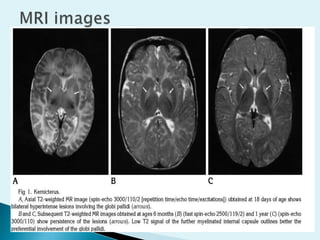
 Neuroradiological technique: CT,NMR ,radionuclide brain
scan ,PET scan .
.
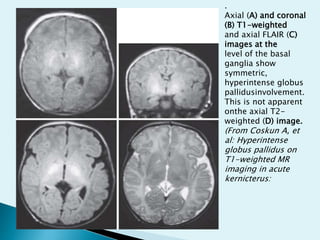
Axial (A) and coronal
(B) T1-weighted
and axial FLAIR (C)
images at the
level of the basal
ganglia show
symmetric,
hyperintense globus
pallidusinvolvement.
This is not apparent
onthe axial T2-
weighted (D) image.
(From Coskun A, et
al: Hyperintense
globus pallidus on
T1-weighted MR
imaging in acute
kernicterus:
Prevention
Maternal screening for isoimmunization

Maternal use of anti Rh immune globulin
Fetal blood transfusion.
SURVEILLANCE AND EARLY DETECTION.
Phototheraphy.
Exchange transfusion.
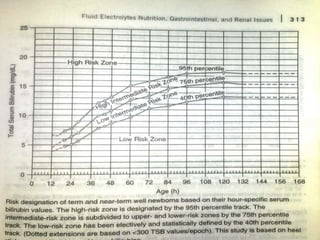
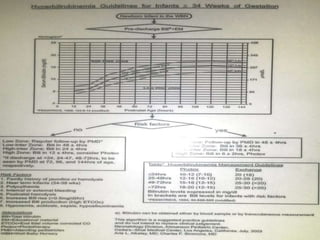
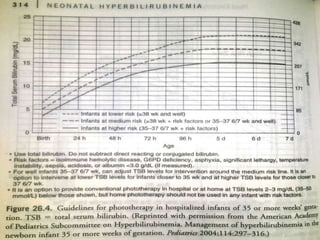
 Phototherapy
◦ Initiate based on UCB level and baby’s age
◦ Isomerizes UCB to Lumirubin, soluble in water and
excreted via the kidney.
 Exchange transfusion
◦ Initiate if phototherapy fails, repeat as needed
◦ Incidence of kernicterus has dropped since the
advent.
 Sn-Mesoporphyrin
◦ Inhibits Heme-oxygenase, which is the rate-limiting
enzyme in heme catabolism.
metalloporphyrin
Phenobarbitone
Agar
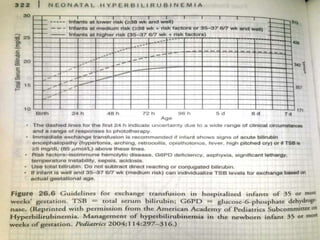
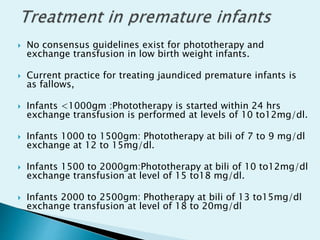
 No consensus guidelines exist for phototherapy and
exchange transfusion in low birth weight infants.
 Current practice for treating jaundiced premature infants is
as fallows,
 Infants <1000gm :Phototherapy is started within 24 hrs
exchange transfusion is performed at levels of 10 to12mg/dl.
 Infants 1000 to 1500gm: Phototherapy at bili of 7 to 9 mg/dl
exchange at 12 to 15mg/dl.
 Infants 1500 to 2000gm:Phototherapy at bili of 10 to12mg/dl
exchange transfusion at level of 15 to18 mg/dl.
 Infants 2000 to 2500gm: Photherapy at bili of 13 to15mg/dl
exchange transfusion at level of 18 to 20mg/dl
 Neurology of newborn by Joseph j Volpe, 5 th
edition 2008 pg no 619 -646
 Fox and Polin fetal and neonatal physiology
volume 2, 4th edition,2011,pg no 1295 -1302
 Manual of neonatal care ,John P Cloherty, 7th
edition, 2012 pg no 317 -319
 Care of the new born, Meharban Singh , 7th
edition ,2010,pg no 261-269.
 Clinics in perinatology joseph volpe,connolly
vol 17 no2 june 1990.
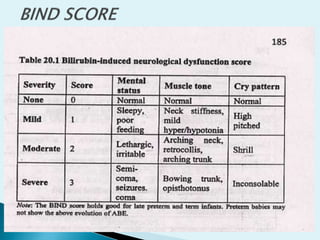
Bind

Bind

  • 2.
    • Earliest workon jaundice from Baumes-1785, • and Hervieux-1847 • Kernicterus was first described by Johannes Orth, 1875 • He postulated that jaundice might have hematologic origins • He noted that the brain in jaundiced adults wasn’t affected. • Christian Schmorl coined the term in 1903,to describe yellow staining of basal ganglia. • Bilirubin may stain brain structure in absence of microscopic evidence of neuronal injury so kernicterus and bilirubin encephalopathy were used interchangeably.
  • 3.
     Bilirubin isomerin humans is bilirubin -IX alpha Which exists as either Dianion or as Bilirubin acid. Dianion –water soluble, non toxic form.  Bilirubin acid form is bound to hydrogen bonds and is insoluble in water (BH2) these isomers are responsible for toxic affects.  Bilirubin in plasma exists as Albumin bound complex which cannot cross the cell wall.  One Gm of albumin binds 8.5 mg of bilirubin .  Minute amount of bilirubin is always present in plasma as free or unbound bilirubin ,it is this molecule that enters the brain to produce neuronal injury.
  • 4.
     Bilirubin entryinto CNS potentially can occur across the blood brain or cerebrospinal fluid barrier , of the two transport across the blood brain barrier is more important.  Blood brain barrier is composed of the brain capillary endothelial cells with tight intercellular junctions.  Prevention of entry of bilirubin depends on the action of two large families of ABC transporters (adenosine triphosphate binding cassettes).
  • 5.
     The transporterare MRPs and MDR /PGPs. (multidrug resistant protein ,multidrug resistance p-glycoprotein).  These are located in neurons,Glia and capillary endothelial cells.  The function of these transporters are to export bilirubin from brain cells to extracellular space and then across capillary endothelial cells to blood  Any disturbances in action of these transporters play a major role in determining neuronal susceptibility to bilirubin injury .
  • 6.
    ACROSS INTACT BLOODBRAIN BARRIER:  Unbound (free) Bilirubin :passive diffusion  Increased cerebral blood flow .  ( hypercarbia , Seizure) ACROSS DISRUPTED BLOOD BRAIN BARRIER  Hyperosmolar load (hyperosmolar solutions, Exchange transfusion)  Hypercarbia with acidosis  Asphyxia  Acidosis  Vasculitis (meningitis)
  • 8.
     Relatively highhematocrit; more cells to break down.  UDP-Glucuronyl Transferase is not fully functional until 3-4 months of life.  Relative starvation state and slow transit time, especially in breastfeeders.  Breastmilk contains beta-glucuronidase; enterohepatic circulation is increased
  • 9.
     Polycythemia  Hemolysis ◦Rh incompatibility ◦ ABO incompatibility ◦ Abnormal RBCs—G6PD, spherocytosis, thalassemia  Birth Trauma—Bruising, Cephalohematoma.  Metabolic Abnormalities—Crigler Najjar, Gilbert Syndrome.  Medications—Sulfonamides,ampicillin. Displaces bilirubin from albumin; same binding site
  • 10.
     Increased bilirubinproduction. Increase RBC volume. Decrease RBC survival. Increase other sources.  Defective hepatic uptake of bilirubin from plasma. Decreased Y protein (ligandin) Decreased caloric intake in first 48-72 hours.  Defective bilirubin conjugation Decrease UDP glucuronyl transferase  Defective bilirubin excretion.  Increased enterohepatic circulation.
  • 11.
     Concentration ofserum unconjugated bilirubin.  Concentration of serum albumin.  Bilirubin binding by albumin.  Concentration of hydrogen ion(PH).  Blood brain barrier.  Neuronal susceptibility.
  • 12.
     Improved bilirubinalbumin binding and increased proportion of free bilirubin . (endogenous anions)  Increased proportion of bilirubin as bilirubin acid (acidosis).  Increased blood brain transport of bilirubin (hypercarbia)  Concomitant neuronal injury with enhanced susceptibility to bilirubin injury (hypoxic ischemia)
  • 13.
     Mechanism ofinjury of neuron by bilirubin remains a controversial issue.  Various in vitro and in vivo studies, primarily with animals indicated disturbance in respiration and oxidative phosphorylation, glycolysis, glycogen synthesis, citric acid cycle function ,cyclic AMP synthesis ,amino acid and protein metabolism.  DNA synthesis myelination and synthesis and transport of neurotransmiters are also disruptted.  Bilirubin exerts its effects involving multiple sites ,it now appears that this mechanism is injury to cellular membrane
  • 14.
    Extracellular bilirubin. Binding ofbilirubin anion to phospholoipid (ganglioside) of neuronal plasma membrane. formation of bilirubin acid. Bilirubin anion enter into cells. Aggregation and precipitation of bilirubin acid Binding of bili anion to phospholipid of membrane of mitochondria, endoplasmic reticulum and Nucleus. plasma membrane injury Formation of bilirubin acid at same Subcellular sites . neuronal death
  • 15.
     Acute bilirubinencephalopathy or kernicterus of the full term infant with marked hyperbilirubinemia.  Acute bilirubin encephalopathy or kernicterus of premature infant without marked hyperbilirubinemia.  Secondary bilirubin staining of brain nuclei of the premature infant( without marked hyperbilirubinemia).
  • 17.
    Acute bilirubin encephalopathy. Coronalsection through parietotemporal lobes. Note selective symmetric yellow discoloration in the hippocampus and subthalamic nuclei. Thalamus and globus pallidus are focally stained.
  • 18.
     Acute BilirubinEncephalopathy ◦ Early phase: Hypotonia, lethargy, high pitched cry and poor suck present in the first few days. ◦ Intermediate phase: hypertonia of extensor muscles (with opisthotonus,rigidity,oculogyric crisis and retrocollis)Irritability, fever and seizure. Many infants die in this phase. ◦ Advanced phase: Pronounced opisthotonus (hypotonia replaces hypertonia) shrill cry,apnea,seizures,coma and death
  • 20.
     Extra pyramidaldisturbance: Athetosis as early as 18 month and delayed till 8 to 9 years.  Other Abnormalities: Facial grimacing, drooling,dysarthria, and difficulty in chewing and swallowing.  Hearing loss is usually due to injury of the cochlear nuclei in the brainstem.  Gaze abnormalities: Limitation of upward gaze palsies. Dolls eye maneuver results in full vertical eye movements.  Cerebral cortex is relatively spared,so intelligence is often close to normal.
  • 21.
     Seen ininfants who experienced less severe hyperbilirubinemia with less severe neurological affection.  Clinical features : hypotonia , active deep tendon reflexes persistent and delayed acquisition of motor skills.  Extrapyramidal abnormalities ,especially athetosis. Upward gaze abnormalities rearly seen.  Sensorineural hearing loss may be principal manifestation .  Intellect is relatively spared.
  • 22.
    Chronic bilirubin encephalopathyin premature infants without marked hyperbilirubinaemia.  Moderate bilirubin levels but complicated by factors like sepsis, acidosis and other features increases the risk of toxicity.  Predominantly auditory  Mixed auditory and motor .
  • 24.
     Kernicterus isa pathologic diagnosis,not clinical. Postmortem exam of the brain is the definitive diagnosis.  Clinically, kernicterus is suspected based on the history of hyperbilirubinemia and the clinical manifestation.  Visual inspection is not a reliable measure of serum bilirubin level
  • 25.
     TB anddirect bilirubin level  Blood type (ABO, Rh)  Direct antibody test (Coombs test)  Serum albumin  CBC with differential and peripheral blood smear for RBC  morphology  Reticulocyte count  ETCOc (if technology is available)  G6PD screen, if indicated by ethnicity or geographic origin  or if poor response to phototherapy  Urinalysis for reducing substances  If history or presentation suggests sepsis, perform blood  culture, urine culture, and CSF examination for protein,  glucose, cell count, and culture.  Brain stem auditory evoked response.  Neuroradiological technique: CT,NMR ,radionuclide brain scan ,PET scan .
  • 27.
    . Axial (A) andcoronal (B) T1-weighted and axial FLAIR (C) images at the level of the basal ganglia show symmetric, hyperintense globus pallidusinvolvement. This is not apparent onthe axial T2- weighted (D) image. (From Coskun A, et al: Hyperintense globus pallidus on T1-weighted MR imaging in acute kernicterus:
  • 28.
    Prevention Maternal screening forisoimmunization Maternal use of anti Rh immune globulin Fetal blood transfusion. SURVEILLANCE AND EARLY DETECTION. Phototheraphy. Exchange transfusion.
  • 29.
     Phototherapy ◦ Initiatebased on UCB level and baby’s age ◦ Isomerizes UCB to Lumirubin, soluble in water and excreted via the kidney.  Exchange transfusion ◦ Initiate if phototherapy fails, repeat as needed ◦ Incidence of kernicterus has dropped since the advent.  Sn-Mesoporphyrin ◦ Inhibits Heme-oxygenase, which is the rate-limiting enzyme in heme catabolism. metalloporphyrin Phenobarbitone Agar
  • 34.
     No consensusguidelines exist for phototherapy and exchange transfusion in low birth weight infants.  Current practice for treating jaundiced premature infants is as fallows,  Infants <1000gm :Phototherapy is started within 24 hrs exchange transfusion is performed at levels of 10 to12mg/dl.  Infants 1000 to 1500gm: Phototherapy at bili of 7 to 9 mg/dl exchange at 12 to 15mg/dl.  Infants 1500 to 2000gm:Phototherapy at bili of 10 to12mg/dl exchange transfusion at level of 15 to18 mg/dl.  Infants 2000 to 2500gm: Photherapy at bili of 13 to15mg/dl exchange transfusion at level of 18 to 20mg/dl
  • 35.
     Neurology ofnewborn by Joseph j Volpe, 5 th edition 2008 pg no 619 -646  Fox and Polin fetal and neonatal physiology volume 2, 4th edition,2011,pg no 1295 -1302  Manual of neonatal care ,John P Cloherty, 7th edition, 2012 pg no 317 -319  Care of the new born, Meharban Singh , 7th edition ,2010,pg no 261-269.  Clinics in perinatology joseph volpe,connolly vol 17 no2 june 1990.