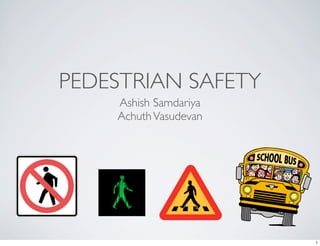
PEDESTRIAN SAFETY
Ashish Samdariya
AchuthVasudevan
1
FOCUS ON.
• Problem & Impact
• Mitigation
2
WHY PEDESTRIAN SAFETY?
Urban sprawl has often left pedestrians stranded.Wide
roads have been built without sidewalks or frequent
crosswalks, and high-speed traffic makes these roadways
particularly deadly. In many areas, intersections with
crosswalks may be as much as a kilometer apart, leaving
pedestrians with no safe way to cross the street.
2012 data on global safety of pedestrians
3
DEATHS PER BILLION KILOMETERS
0
38
75
113
150
Air Bus Rail Car Bicycle Motor-bike Walk
54.2
108.9
44.6
3.10.60.40.1
4
0%
20%
40%
60%
80%
Driver Cyclist Pedestrian MotorCycle Road Condition Weather Others
14%
1%1%2%3%1%
78%
Who’s Failure lead to an Accident
%age
0
20
40
60
80
Truck Bus Car Taxi Motorcycle Bicycle Pedestrian
Traffic Fatalities by Road User
Mumbai Delhi
5
5000
pedestrians are killed
84000
pedestrians are injured
Every Year
Pedestrian accidents
make up
11%
Of all motor
vehicle accidents
180000
Pedestrians were killed
in motor vehicle accidents
Between 1975 and 2005
60%
Of accidents occurred in
Place where no crosswalks
88%
of accidents occurred in
normal weather condition
64%
of accidents occurred
at night
6
Pedestrian crashes typically occur during
the late afternoon and early evening hours
presumably because of the reduced levels of
visibility at a time when many people are on the road.
7
Inefficient Driver
DefectiveVehicle
Bad Environment
Poor Operating Policies
Lack of Education
Inadequate Enforcement
Physical Roadway
Good
engineering
can reduce the
effects of ...
Crash: Causes & PreventionPrevention
8
CURRENT CONDITION
ON ROAD PARKING
30-40% of city roads are occupied with parking at any point of time
9
CURRENT CONDITION
road width
Walkway width
Road width
= ??
street lighting, trees etc. are missing
10
CURRENT CONDITION
In-appropriate design of road cross sections- designed for nobody
11
CURRENT CONDITION
No designs at junctions- resulting in traffic bottlenecks and safety
compromises
12
“equitable space
allocation
for all road users
with a focus on
people rather
than vehicles.”
The National UrbanTransport Policy, India
Photographs are fromTier-1/II cities in India, taken during 2009-2013
13
BANGALORE
• Rush Hour (on a10m wide road)
• Bike (1 PAX)
• Car (1 PAX)
• Bus (70 PAX)
• 1 KM of this road (No Buses)
• Approx. 300 cars & Bikes
• This reduces to only few
buses if public transit to be
used
• But public transit itself is in poor
condition
Congestion??
14
0
3750
7500
11250
15000
2003 2004 2005 2006 2007 2008 2009 2010 2011 2012 2013 (mid)
3052
4767
5297
5667
6138
6908
7469
66816782
8226
9662
487735727816737864957880796875843
Fatal Non-Fatal
ACCIDENTS (BANGALORE)
15
MITIGATION
If we can develop and design streets so that they are
wonderful, fulfilling places to be – community-building places,
attractive for all people
Then we will have successfully designed about one-third of the
city directly and will have had an immense impact on the rest
16
MITIGATION PLAN
• Bicycles lanes, Pedestrian walkways & PublicTransit can:
• Reduce the amount traffic and congestion on the road
• Reduce the amount of air pollution
17
MITIGATION PLAN
• Safe infrastructure (walkways, over/under-pass etc)
• Behavioral Issues (Traffic signs, Fines, Education, Culture)
• Safety engineering (Optimum speed, designs etc.)
PEDESTRIAN SAFETY
18
MITIGATION RESULTS
19
20
• Pollen, dirt and debris can increase glare and reduce visibility
• Keeping windshield clean, so that pedestrians are more visible
• Defensive driving "scan and search" to include pedestrians
along the road and on the sidewalks
• Older pedestrians walk slower, which makes them more
difficult for the eye to pick up. They also need more time to
cross the street.
MITIGATION PLAN
SAFE DRIVING
21
For bike and pedestrian accident prevention,
Give the road your full attention.
22

Pedestrian safety, India

  • 1.
  • 2.
    FOCUS ON. • Problem& Impact • Mitigation 2
  • 3.
    WHY PEDESTRIAN SAFETY? Urbansprawl has often left pedestrians stranded.Wide roads have been built without sidewalks or frequent crosswalks, and high-speed traffic makes these roadways particularly deadly. In many areas, intersections with crosswalks may be as much as a kilometer apart, leaving pedestrians with no safe way to cross the street. 2012 data on global safety of pedestrians 3
  • 4.
    DEATHS PER BILLIONKILOMETERS 0 38 75 113 150 Air Bus Rail Car Bicycle Motor-bike Walk 54.2 108.9 44.6 3.10.60.40.1 4
  • 5.
    0% 20% 40% 60% 80% Driver Cyclist PedestrianMotorCycle Road Condition Weather Others 14% 1%1%2%3%1% 78% Who’s Failure lead to an Accident %age 0 20 40 60 80 Truck Bus Car Taxi Motorcycle Bicycle Pedestrian Traffic Fatalities by Road User Mumbai Delhi 5
  • 6.
    5000 pedestrians are killed 84000 pedestriansare injured Every Year Pedestrian accidents make up 11% Of all motor vehicle accidents 180000 Pedestrians were killed in motor vehicle accidents Between 1975 and 2005 60% Of accidents occurred in Place where no crosswalks 88% of accidents occurred in normal weather condition 64% of accidents occurred at night 6
  • 7.
    Pedestrian crashes typicallyoccur during the late afternoon and early evening hours presumably because of the reduced levels of visibility at a time when many people are on the road. 7
  • 8.
    Inefficient Driver DefectiveVehicle Bad Environment PoorOperating Policies Lack of Education Inadequate Enforcement Physical Roadway Good engineering can reduce the effects of ... Crash: Causes & PreventionPrevention 8
  • 9.
    CURRENT CONDITION ON ROADPARKING 30-40% of city roads are occupied with parking at any point of time 9
  • 10.
    CURRENT CONDITION road width Walkwaywidth Road width = ?? street lighting, trees etc. are missing 10
  • 11.
    CURRENT CONDITION In-appropriate designof road cross sections- designed for nobody 11
  • 12.
    CURRENT CONDITION No designsat junctions- resulting in traffic bottlenecks and safety compromises 12
  • 13.
    “equitable space allocation for allroad users with a focus on people rather than vehicles.” The National UrbanTransport Policy, India Photographs are fromTier-1/II cities in India, taken during 2009-2013 13
  • 14.
    BANGALORE • Rush Hour(on a10m wide road) • Bike (1 PAX) • Car (1 PAX) • Bus (70 PAX) • 1 KM of this road (No Buses) • Approx. 300 cars & Bikes • This reduces to only few buses if public transit to be used • But public transit itself is in poor condition Congestion?? 14
  • 15.
    0 3750 7500 11250 15000 2003 2004 20052006 2007 2008 2009 2010 2011 2012 2013 (mid) 3052 4767 5297 5667 6138 6908 7469 66816782 8226 9662 487735727816737864957880796875843 Fatal Non-Fatal ACCIDENTS (BANGALORE) 15
  • 16.
    MITIGATION If we candevelop and design streets so that they are wonderful, fulfilling places to be – community-building places, attractive for all people Then we will have successfully designed about one-third of the city directly and will have had an immense impact on the rest 16
  • 17.
    MITIGATION PLAN • Bicycleslanes, Pedestrian walkways & PublicTransit can: • Reduce the amount traffic and congestion on the road • Reduce the amount of air pollution 17
  • 18.
    MITIGATION PLAN • Safeinfrastructure (walkways, over/under-pass etc) • Behavioral Issues (Traffic signs, Fines, Education, Culture) • Safety engineering (Optimum speed, designs etc.) PEDESTRIAN SAFETY 18
  • 19.
  • 20.
  • 21.
    • Pollen, dirtand debris can increase glare and reduce visibility • Keeping windshield clean, so that pedestrians are more visible • Defensive driving "scan and search" to include pedestrians along the road and on the sidewalks • Older pedestrians walk slower, which makes them more difficult for the eye to pick up. They also need more time to cross the street. MITIGATION PLAN SAFE DRIVING 21
  • 22.
    For bike andpedestrian accident prevention, Give the road your full attention. 22