www.ptvgroup.comwww.ptvgroup.com
WELCOME TO THE
PTV GROUP.
www.ptvgroup.com
www.ptvgroup.com
Brett Little
www.ptvgroup.comwww.ptvgroup.com
PEDESTRIAN PLANNING & MODELLING
Brett Little
www.ptvgroup.com Page 3
1. INTRODUCTION
What do we mean by pedestrian?
As a mode it is a trip completed on foot.
However, anyone travelling by public transport
is a pedestrian for some part of their trip.
People interchanging between public transport
modes or services.
Those Travelling by car if they park away from their destination.
Those visiting pedestrian environments such as shopping
centres, parks, events etc.
The list goes on……
www.ptvgroup.com Page 4
2. WHY STUDY PEDESTRIANS?
Using London as an Example:
London wide, people make seven million journeys on foot every
day. Accounting for over 30% of the mode split.
Walking is mainly used for shorter trips; 86% of trips of up to half
a km and 58% of trips between half and one km.
Walking is also an important means of getting to and from public
transport services and is involved in most other journeys.
TfL Streets identified the need to quantify changes to the
pedestrian environment.
www.ptvgroup.com Page 5
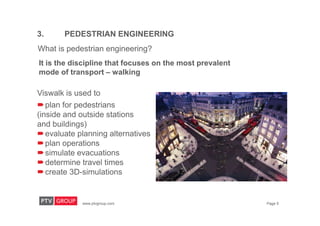
What is pedestrian engineering?
It is the discipline that focuses on the most prevalent
mode of transport – walking
3. PEDESTRIAN ENGINEERING
Viswalk is used to
plan for pedestrians
(inside and outside stations
and buildings)
evaluate planning alternatives
plan operations
simulate evacuations
determine travel times
create 3D-simulations
www.ptvgroup.com Page 6
4. WHAT IS PEDESTRIAN MICRO-SIMULATION?
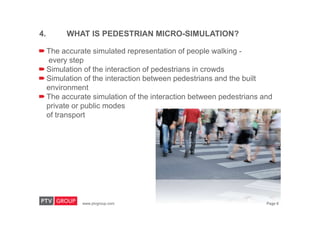
 The accurate simulated representation of people walking -
every step
 Simulation of the interaction of pedestrians in crowds
 Simulation of the interaction between pedestrians and the built
environment
 The accurate simulation of the interaction between pedestrians and
private or public modes
of transport
www.ptvgroup.com Page 7
5. SCOPE
Pedestrian Modelling is a growth field, it is widely used in the
following areas:
Environments
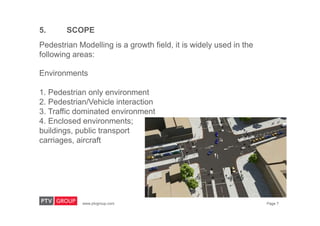
1. Pedestrian only environment
2. Pedestrian/Vehicle interaction
3. Traffic dominated environment
4. Enclosed environments;
buildings, public transport
carriages, aircraft
www.ptvgroup.com Page 8
Uses
Pedestrian modelling can be used within various disciplines some of
which are inter related:
Planning; demand forecasting, strategic level
Feasibility studies
Design; all levels of design up to and including detailed design,
optioneering or iterative design process.
Management; day to day management of streets, stations etc as
well as event management.
Operational, to test public transport frequency or signal control
strategies.
5. SCOPE
www.ptvgroup.com Page 9
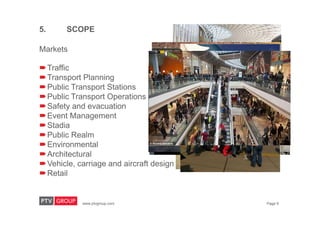
Markets
Traffic
Transport Planning
Public Transport Stations
Public Transport Operations
Safety and evacuation
Event Management
Stadia
Public Realm
Environmental
Architectural
Vehicle, carriage and aircraft design
Retail
5. SCOPE
www.ptvgroup.com Page 10
6. VISION SUITE - MICROSIMULATION
Microscopic Pedestrian
Simulation
Exact microscopic modelling of all
modes - modal microsimulation.
www.ptvgroup.com Page 11
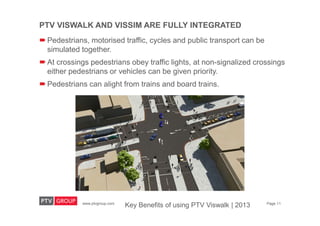
PTV VISWALK AND VISSIM ARE FULLY INTEGRATED
 Pedestrians, motorised traffic, cycles and public transport can be
simulated together.
 At crossings pedestrians obey traffic lights, at non-signalized crossings
either pedestrians or vehicles can be given priority.
 Pedestrians can alight from trains and board trains.
Key Benefits of using PTV Viswalk | 2013
www.ptvgroup.com Page 12
THE SOCIAL FORCE MODEL
 The force on a pedestrian is calculated at any time from the
influences of their desire, other pedestrians and the built
environment such as walls or buildings.
Driving force in the
desired direction of
motion
Forces from borders
Forces from
fellow
pedestrians
Driving force in the
desired direction of
motion
Forces from borders
Forces from
fellow
pedestrians
Ammendments
PTV ammended the Social Force Model with additional functionality to
enable modelling:
Movement through multi-storey buildings,
Crossing streets (with or without regulation)
Board and alight from trains,
Queue in elaborate queuing systems,
Bi-directional movement through an extended but narrow corridors
www.ptvgroup.com Page 13
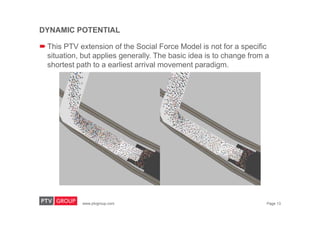
DYNAMIC POTENTIAL
 This PTV extension of the Social Force Model is not for a specific
situation, but applies generally. The basic idea is to change from a
shortest path to a earliest arrival movement paradigm.
www.ptvgroup.com Page 14
7. VISWALK INPUTS
• Inception / Scoping
• Surveys
• Manual
• Video
• Origin/Destination
• Permanent Counters
• Ticketing
• Mobile Phone Data
• Matrix Derivation
• Manual
• Matrix Estimator Tools
• Gravity Models
www.ptvgroup.com Page 15
8. VISWALK OUTPUT
Output Use
Density maps Illustrate problem areas
Level of Service (LOS) Measure changes – input to
business case
Journey times (total and between
origin and destination)
Measure changes – input to
business case
Speed, dwell times of pedestrians Measure pedestrian experience
Record file (detailed trajectory data) Input to other software
Queuing / transaction times Ticketing and retail
placement/design
2D and 3D-animation Illustration for non technical
audience and stakeholders
Key Outputs and their uses
www.ptvgroup.com Page 16
VISWALK OUTPUT – FRUIN LEVEL OF SERVICE
Level of
Service
Footways
(peds/m/min)
Footways
(peds/m2)
LOS Description
A <23.0 <0.31
Flow rate les
than 23 people
per metre per
minute
Free circulation
B 23.0-32.8 0.31-0.43
Flow rate 23 to
33 people per
metre per
minute
For one directional flows, free
circulation. For reverse and
crossing flows, minor conflicts
C 32.8-48.2 0.43-0.72
Flow rate 34 to
49 people per
metre per
minute
Some restriction in selection of
walking speed and ability to pass
others. High probability of conflict.
D 48.2-65.6 0.72-1.08
Flow rate 49 to
66 people per
minute.
Restricted and reduced walking
speed for most pedestrians.
Difficulties in passing. Multiple
conflicts, momentary stoppages of
flow.
E 65.6-82.0 1.08-2.17
Flow rate 66 to
82 people per
metre per
minute.
Restricted and reduced walking
speed for all pedestrians. Shuffling
progress at higher densities.
Extreme difficulties in reverse or
cross flows.
F >82.0 >2.17
Flow rate >82
people per
metre per
minute
Circulation reduced to shuffling.
Reverse and cross flows near
impossible. Frequent contact.
Sporadic forward flow.
www.ptvgroup.com Page 17
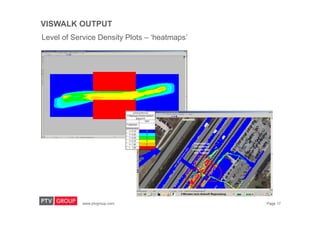
Level of Service Density Plots – ‘heatmaps’
VISWALK OUTPUT
www.ptvgroup.com Page 18
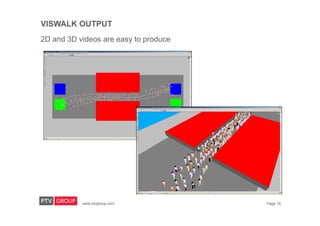
2D and 3D videos are easy to produce
VISWALK OUTPUT
www.ptvgroup.com Page 19
Journey Times – Whole Model and point to point
VISWALK OUTPUT
www.ptvgroup.com Page 20
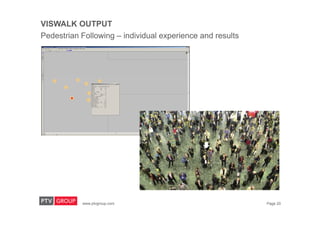
Pedestrian Following – individual experience and results
VISWALK OUTPUT
www.ptvgroup.com Page 21
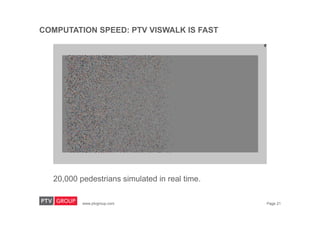
COMPUTATION SPEED: PTV VISWALK IS FAST
20,000 pedestrians simulated in real time.
www.ptvgroup.com Page 22
PTV VISWALK HAS NO HARD SIZE LIMIT
One million pedestrians.
www.ptvgroup.com Page 23
9. CALIBRATION AND VALIDATION
Calibration
www.ptvgroup.com Page 24
Validation
Journey Times
www.ptvgroup.com Page 25
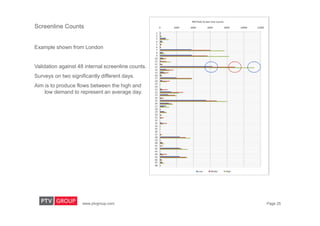
Screenline Counts
Example shown from London
Validation against 48 internal screenline counts.
Surveys on two significantly different days.
Aim is to produce flows between the high and
low demand to represent an average day.
www.ptvgroup.com Page 26
10. VISWALK USES
Interchange between modes of
Transport
Rail and Metro
Buses
Taxi
Walking
Cycling
Private car
www.ptvgroup.com Page 27
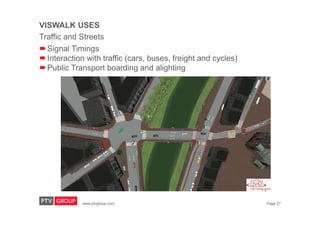
VISWALK USES
Traffic and Streets
Signal Timings
Interaction with traffic (cars, buses, freight and cycles)
Public Transport boarding and alighting
www.ptvgroup.com Page 28
VISWALK USES
Stations - Pedestrian/Train/Station Interaction
 Boarding
 Alighting
 Platform
capacity
 Corridors
 Stairs and
escalators
 Ticket
gates
 Ticket
halls
 Ticket
purchasing
www.ptvgroup.com Page 29
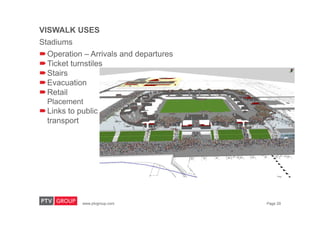
VISWALK USES
Stadiums
Operation – Arrivals and departures
Ticket turnstiles
Stairs
Evacuation
Retail
Placement
Links to public
transport
www.ptvgroup.com Page 30
VISWALK USES
Buildings
Access
Internal Layout
Stairs, lifts
Evacuation
www.ptvgroup.com Page 31
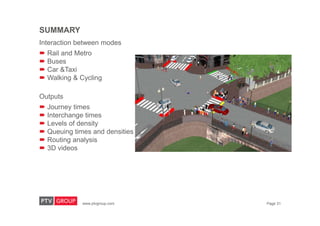
SUMMARY
Interaction between modes
 Rail and Metro
 Buses
 Car &Taxi
 Walking & Cycling
Outputs
 Journey times
 Interchange times
 Levels of density
 Queuing times and densities
 Routing analysis
 3D videos
www.ptvgroup.com Page 32
CONTACT
Brett Little
Solution Director
Pedestrian Engineering & Major Events
brett.little@ptvgroup.com
www.ptvgroup.comwww.ptvgroup.comwww.ptvgroup.com

Pedestrian planning and modelling

  • 1.
    www.ptvgroup.comwww.ptvgroup.com WELCOME TO THE PTVGROUP. www.ptvgroup.com www.ptvgroup.com Brett Little
  • 2.
  • 3.
    www.ptvgroup.com Page 3 1.INTRODUCTION What do we mean by pedestrian? As a mode it is a trip completed on foot. However, anyone travelling by public transport is a pedestrian for some part of their trip. People interchanging between public transport modes or services. Those Travelling by car if they park away from their destination. Those visiting pedestrian environments such as shopping centres, parks, events etc. The list goes on……
  • 4.
    www.ptvgroup.com Page 4 2.WHY STUDY PEDESTRIANS? Using London as an Example: London wide, people make seven million journeys on foot every day. Accounting for over 30% of the mode split. Walking is mainly used for shorter trips; 86% of trips of up to half a km and 58% of trips between half and one km. Walking is also an important means of getting to and from public transport services and is involved in most other journeys. TfL Streets identified the need to quantify changes to the pedestrian environment.
  • 5.
    www.ptvgroup.com Page 5 Whatis pedestrian engineering? It is the discipline that focuses on the most prevalent mode of transport – walking 3. PEDESTRIAN ENGINEERING Viswalk is used to plan for pedestrians (inside and outside stations and buildings) evaluate planning alternatives plan operations simulate evacuations determine travel times create 3D-simulations
  • 6.
    www.ptvgroup.com Page 6 4.WHAT IS PEDESTRIAN MICRO-SIMULATION?  The accurate simulated representation of people walking - every step  Simulation of the interaction of pedestrians in crowds  Simulation of the interaction between pedestrians and the built environment  The accurate simulation of the interaction between pedestrians and private or public modes of transport
  • 7.
    www.ptvgroup.com Page 7 5.SCOPE Pedestrian Modelling is a growth field, it is widely used in the following areas: Environments 1. Pedestrian only environment 2. Pedestrian/Vehicle interaction 3. Traffic dominated environment 4. Enclosed environments; buildings, public transport carriages, aircraft
  • 8.
    www.ptvgroup.com Page 8 Uses Pedestrianmodelling can be used within various disciplines some of which are inter related: Planning; demand forecasting, strategic level Feasibility studies Design; all levels of design up to and including detailed design, optioneering or iterative design process. Management; day to day management of streets, stations etc as well as event management. Operational, to test public transport frequency or signal control strategies. 5. SCOPE
  • 9.
    www.ptvgroup.com Page 9 Markets Traffic TransportPlanning Public Transport Stations Public Transport Operations Safety and evacuation Event Management Stadia Public Realm Environmental Architectural Vehicle, carriage and aircraft design Retail 5. SCOPE
  • 10.
    www.ptvgroup.com Page 10 6.VISION SUITE - MICROSIMULATION Microscopic Pedestrian Simulation Exact microscopic modelling of all modes - modal microsimulation.
  • 11.
    www.ptvgroup.com Page 11 PTVVISWALK AND VISSIM ARE FULLY INTEGRATED  Pedestrians, motorised traffic, cycles and public transport can be simulated together.  At crossings pedestrians obey traffic lights, at non-signalized crossings either pedestrians or vehicles can be given priority.  Pedestrians can alight from trains and board trains. Key Benefits of using PTV Viswalk | 2013
  • 12.
    www.ptvgroup.com Page 12 THESOCIAL FORCE MODEL  The force on a pedestrian is calculated at any time from the influences of their desire, other pedestrians and the built environment such as walls or buildings. Driving force in the desired direction of motion Forces from borders Forces from fellow pedestrians Driving force in the desired direction of motion Forces from borders Forces from fellow pedestrians Ammendments PTV ammended the Social Force Model with additional functionality to enable modelling: Movement through multi-storey buildings, Crossing streets (with or without regulation) Board and alight from trains, Queue in elaborate queuing systems, Bi-directional movement through an extended but narrow corridors
  • 13.
    www.ptvgroup.com Page 13 DYNAMICPOTENTIAL  This PTV extension of the Social Force Model is not for a specific situation, but applies generally. The basic idea is to change from a shortest path to a earliest arrival movement paradigm.
  • 14.
    www.ptvgroup.com Page 14 7.VISWALK INPUTS • Inception / Scoping • Surveys • Manual • Video • Origin/Destination • Permanent Counters • Ticketing • Mobile Phone Data • Matrix Derivation • Manual • Matrix Estimator Tools • Gravity Models
  • 15.
    www.ptvgroup.com Page 15 8.VISWALK OUTPUT Output Use Density maps Illustrate problem areas Level of Service (LOS) Measure changes – input to business case Journey times (total and between origin and destination) Measure changes – input to business case Speed, dwell times of pedestrians Measure pedestrian experience Record file (detailed trajectory data) Input to other software Queuing / transaction times Ticketing and retail placement/design 2D and 3D-animation Illustration for non technical audience and stakeholders Key Outputs and their uses
  • 16.
    www.ptvgroup.com Page 16 VISWALKOUTPUT – FRUIN LEVEL OF SERVICE Level of Service Footways (peds/m/min) Footways (peds/m2) LOS Description A <23.0 <0.31 Flow rate les than 23 people per metre per minute Free circulation B 23.0-32.8 0.31-0.43 Flow rate 23 to 33 people per metre per minute For one directional flows, free circulation. For reverse and crossing flows, minor conflicts C 32.8-48.2 0.43-0.72 Flow rate 34 to 49 people per metre per minute Some restriction in selection of walking speed and ability to pass others. High probability of conflict. D 48.2-65.6 0.72-1.08 Flow rate 49 to 66 people per minute. Restricted and reduced walking speed for most pedestrians. Difficulties in passing. Multiple conflicts, momentary stoppages of flow. E 65.6-82.0 1.08-2.17 Flow rate 66 to 82 people per metre per minute. Restricted and reduced walking speed for all pedestrians. Shuffling progress at higher densities. Extreme difficulties in reverse or cross flows. F >82.0 >2.17 Flow rate >82 people per metre per minute Circulation reduced to shuffling. Reverse and cross flows near impossible. Frequent contact. Sporadic forward flow.
  • 17.
    www.ptvgroup.com Page 17 Levelof Service Density Plots – ‘heatmaps’ VISWALK OUTPUT
  • 18.
    www.ptvgroup.com Page 18 2Dand 3D videos are easy to produce VISWALK OUTPUT
  • 19.
    www.ptvgroup.com Page 19 JourneyTimes – Whole Model and point to point VISWALK OUTPUT
  • 20.
    www.ptvgroup.com Page 20 PedestrianFollowing – individual experience and results VISWALK OUTPUT
  • 21.
    www.ptvgroup.com Page 21 COMPUTATIONSPEED: PTV VISWALK IS FAST 20,000 pedestrians simulated in real time.
  • 22.
    www.ptvgroup.com Page 22 PTVVISWALK HAS NO HARD SIZE LIMIT One million pedestrians.
  • 23.
    www.ptvgroup.com Page 23 9.CALIBRATION AND VALIDATION Calibration
  • 24.
  • 25.
    www.ptvgroup.com Page 25 ScreenlineCounts Example shown from London Validation against 48 internal screenline counts. Surveys on two significantly different days. Aim is to produce flows between the high and low demand to represent an average day.
  • 26.
    www.ptvgroup.com Page 26 10.VISWALK USES Interchange between modes of Transport Rail and Metro Buses Taxi Walking Cycling Private car
  • 27.
    www.ptvgroup.com Page 27 VISWALKUSES Traffic and Streets Signal Timings Interaction with traffic (cars, buses, freight and cycles) Public Transport boarding and alighting
  • 28.
    www.ptvgroup.com Page 28 VISWALKUSES Stations - Pedestrian/Train/Station Interaction  Boarding  Alighting  Platform capacity  Corridors  Stairs and escalators  Ticket gates  Ticket halls  Ticket purchasing
  • 29.
    www.ptvgroup.com Page 29 VISWALKUSES Stadiums Operation – Arrivals and departures Ticket turnstiles Stairs Evacuation Retail Placement Links to public transport
  • 30.
    www.ptvgroup.com Page 30 VISWALKUSES Buildings Access Internal Layout Stairs, lifts Evacuation
  • 31.
    www.ptvgroup.com Page 31 SUMMARY Interactionbetween modes  Rail and Metro  Buses  Car &Taxi  Walking & Cycling Outputs  Journey times  Interchange times  Levels of density  Queuing times and densities  Routing analysis  3D videos
  • 32.
    www.ptvgroup.com Page 32 CONTACT BrettLittle Solution Director Pedestrian Engineering & Major Events brett.little@ptvgroup.com
  • 33.