Pedestrian Design Guidelines
                  “D o n ’t d r i v e… W a l k !”


            © UTTIPEC, Delhi Development Authority, New Delhi
                                             November 2009
The Governing Body of Unified Traffic and Transportation Infrastructure (Plg. & Engg.) Centre
     (UTTIPEC) under the Chairmanship of Sh. Tejendra Khanna, Hon’ble Lt. Governor has approved the
     “Pedestrian Design Guidelines” on 20.11.09 as per the recommendation of the Working Group for
      immediate implementation, enforcement and uniform adoption by all the road owning agencies.
       Working Group had made deliberations in its various meetings with the members, experts and
    resource persons in the field of Urban Planning and Design, who have contributed towards formation
     and finalization of this document. The document contains graphics, sketches, photographs on each
                       aspect apart from brief write ups, to make it more user-friendly.

           Any part of this report if used or reproduced must be duly acknowledged.


2
Streets are valuable public spaces as well as movement corridors.

              Design of Streets is a function of the Street Hierarchy and Adjacent Landuses.

                       Certain Street Design Components are non-negotiable.
These components and additional guidelines for world class streets – have been outlined in this document.
Acknowledgements
The preparation of Draft Pedestrian Design Guidelines was initiated after a detailed presentation on “Great Pavements for Delhi” was made by Ms. Romi Roy,
Sr. Consultant, UTTIPEC in the Governing Body meeting on 24.4.2009. The presentation was appreciated and road owning agencies were requested to adopt
some of the best practices on pilot project basis. As a follow up, Ms. Romi Roy, has compiled these set of guidelines based on best practices available around
the world and customized them to ground conditions and challenges in India, particularly in Delhi. In this, she was helped immensely by the advise, time and
material provided by several experienced and respected experts in the field, mentioned below:

       Sachdeva, Pradeep, Architect, Pradeep Sachdeva Design Associates

       Gandhi, S., Arora, A., Varma, R., Sheth, Y., Sharma, S., Jawed, F., Interface for Cycling Expertise (ICE),
       Manual for Cycling Inclusive Urban Infrastructure Design in the Indian Subcontinent, 2009

       Aggarwal, Anjlee, Executive Director, Samarthayam, Guidelines for Inclusive Pedestrian Facilities, Report for IRC, 2009

       Transport Research And Injury Prevention Programme (TRIPP), IIT Delhi, BRT Design Specifications, 2009

       Choudhury, Anumita R., Associate Director, Centre for Science and Environment,
       Footfalls: Obstacle Course to Livable Cities, Right to Clean Air Campaign, 2009

       Hingorani, Akash, Oasis Designs, Inc.

       INTACH, Delhi Chapter

Sh. S.N. Sahai, Chairman of WG-1A and Sh. Ashok Kumar, Commissioner (Plg.) DDA, Co- Chairman of WG-1A have given their complete support with timely
advise for the taking up and completion of this guideline document within a time frame. Dr. S. P. Bansal, A.C.(Plg)-III, DDA and Sh. Vinod Sakle, Director (Plg.)
UTTIPEC, have provided necessary guidance/advise, which has helped completing the process of preparing the guidelines.

Several external consultants have also voluntarily helped in the preparation of drawings and sketches incorporated in the guidelines including Ms. Ran Chen,
UI2 International, Mr. Nishant Lall, NilaA Architecture & Urban Design, and Ms. Mitali Ganguly.

All the other Sub-group members and special invitees who have attended various meetings of Working Group I-A and the Sub-group have provided necessary
inputs for formulating and finalizing the draft guidelines. List of references is placed at Annexure-I. List of Working Group members, sub-group members and
other participants and special invitees is placed at Annexure-II.
                                                                                                                                       Shri Ashok Bhattacharjee,
                                                                                                                                   Joint Director (Plg.) UTTIPEC,
                                                                                                                              Convenor, Working Group WG 1-A


                                                                                                                                                                    4
Contents
Chapter 1.    Need for Pedestrian Design Guidelines
Chapter 2     Existing Frameworks.
Chapter 3     Essential Goals for Street Design
Chapter 4     Street Hierarchy of Delhi
Chapter 5     Design Toolkit: Mandatory Components
              1.    Minimum Walking (Pedestrian only) Zone
              2.    Frontage Zone or “Dead Width”
              3.    Universal Accessibility Features/ Barrier Free Design
              4.    Multi-Functional Zone with Planting
              5.    Bicycle and Non-Motorized Transport (NMT) Infrastructure
              6.    Crossings
              7.    Medians, Refuge Islands
              8.    Street Lighting
              9.    Urban Utilities
              10.   Public Amenities (Toilets, Bus stops, Dustbins), Hawker Zones, Signage
Chapter 6     Design Toolkit: Additional Requirements (Work in progress)
              11.   Traffic Calming Measures
              12.   Material Selection
              13.   Public Art, Street Furniture and Educative Signage
Annexure I    References
Annexure II   Working Group 1-A Members, Experts, Special Invitees and others.

                                                                                             5
This page is intentionally left blank.
Need for Pedestrian Design Guidelines
Need and prospective Benefits of Pedestrian Design


                                         Inadequate space for pedestrians      Inappropriate kerb heights


                                                Missing sidewalks!                 Missing sidewalks


    Inadequate space for pedestrians    Encroached space by trees, utilities    Inadequate Amenities.
                                                                                        Pedestrian Design Guidelines © UTTIPEC, DDA 2009
8   BACKGROUND
Need and prospective Benefits of Pedestrian Design
  Increased Pedestrian Design consideration in Streets would provide:
      o Increase in comfort for current walking population.

      o Comfortable last mile connectivity from MRTS Stations – therefore
        increased ridership of buses and Metro.

      o Reduced dependency on the car, if shorter trips can be made
        comfortably by foot.

      o More exercise, so better health for people walking.

      o Prioritization of public transport and non-motorized private modes
        in street design

      o Reduced car use leading to reduced congestion and pollution.

      o More equity in the provision of comfortable public spaces and
        amenities to all sections of society.


                                                                             Source: www.siliconeer.com

Pedestrian Design Guidelines © UTTIPEC, DDA 2009
                                                                                                     BACKGROUND   9
Consequences:                                    Current Facts: How many people walk in Delhi?
Only 14% of the city drives, yet most of the
         road space is occupied by them.
        Roads in Delhi have been primarily
designed to increase the speed and ease of
                   movement of car users.
            Car-oriented design priority and
         discouragement of walking through
      inadequate design – has discouraged
people from walking and in turn encouraged
                          car-dependency.
       The following are the consequences:
  Delhi has more cars than the total cars in
 Maharashtra, Tamil Nadu, Gujarat & West
                                   Bengal.
  Pollution levels in Delhi are almost double
     of Mumbai, a city more populated than
                                        Delhi.   Source: Anon 2008, Transport Demand Forecast Study: study and development of an Integrated cum Multi Modal
                                                 Public Transport Network for NCT of Delhi, RITES, MVA Asia Ltd, TERI, May 2008

                                                      34% of the population engages in” Walk-only” trips for their daily travels,
                                                      needs or errands.
                                                      Only 14% population of Delhi rives private cars.


                                                                                                40% of the total Road Length of Delhi has NO
                                                                         40%                    Sidewalks! *
                                                                                                And the ones having sidewalks, lack in quality in terms
                                                                                                of surface, width and geometrics.*

10   BACKGROUND                                  *Source: RITES Transport Demand Forecast Study: May 2008           Pedestrian Design Guidelines © UTTIPEC, DDA 2009
Who walks in Delhi?
Walking for work, education and services…..

                  Of all education trips – 58% walk trips
                  Service and business trips – 31% walk trips (RITES 2001)

Walking and urban poor…….

                  About 60% of people live in low income localities. An earlier estimate shows 22% of
                  people with less than Rs 2000/month income walk in Delhi. Moving slums out to periphery
                  had sharply reduced women employment as accessibility became a problem

Disability and walking……

                  Samarthyam survey: 58% of the disabled found steps, ramps, difficult to negotiate; 45%
                  of elderly found steps and ramps daunting; 20%found uneven, narrow sidewalks difficult.
                  Engineering guidelines for persons with disabilities are not implemented.

Urbanity and life style
               Correlation between active transportation (walking and cycling) and obesity: China –
               1.8kg weight gain after and twice as likely to get obese for a Chinese who acquired a
               car. King County, US – people weigh 7 pounds less on an average in walkable
               neighbourhoods

Unacceptably high accident rates……..

                  Total number of road accidents are very high in Delhi – 2.5 times higher than that of
                  Kolkata, 2.1 times higher than Chennai – personal vehicles cause most of these
                  accidents...

                  Nearly half of fatal accidents in Delhi involve – pedestrians.
Source: Walkability Roundtable, Centre for Science and Environment, July 2009                               Road deaths of pedestrians

     Pedestrian Design Guidelines © UTTIPEC, DDA 2009
                                                                                                                                BACKGROUND   11
This page is intentionally left blank.
Existing Frameworks
Existing Frameworks and Legislation
                       Current Laws and Guidelines that legislate “right to walk” and “right to road space” of
                       Pedestrians:
                  A.   Current IRC Guidelines for Pedestrian and Cycle track design provide basis standards for pedestrian and
                       cycle oriented design but need more augmentation.
                  B.   National Urban Transport Policy 2006 recommends:
                        i.     Integrated land use and transport policy
                        ii.    Equitable distribution of road space between all road users
                        iii.   Priority to the use of public transport
                        iv.    Priority to non-motorized modes
                  C.   Masterplan of Delhi 2021 specifies:
                        i.     All roads should be made pedestrian, disabled and bicycle friendly.
                        ii.    Provision of adequate pedestrian facilities.
                        iii.   Removal of encroachments from sidewalks.
                        iv.    Provision for introducing cycle tracks, pedestrian and disabled friendly features in arterial
                               and sub-arterial roads.
                        v.     In urban extension, cycle tracks should be provided at the sub-arterial and local level roads
                               and streets.
                        vi.    In specific areas, like the Walled City / Chandni Chowk / Sadar Bazar / Karol Bagh / Lajpat Nagar
                               and Trans Yamuna Area, the use of cycles/rickshaw as a non-motorised mode of transport should
                               be consciously planned along with pedestrianisation.
                        vii.   On all roads with ROW greater than 30 m exclusive bus lanes will be planned to implement
                               the Bus Rapid Transit System (BRTS) in a phased manner to cover the whole city.
                  D.   EPCA, Supreme Court directive on increased use of Public Transport in Delhi.
                       “Over the years, it has become clear that each city is fighting a losing battle against air pollution and growing
                       congestion — because of the growing numbers of vehicles. Economic progress of our cities will depend on
                       their environmental health. A turnaround is only possible when cities recognize the need for a transition to
                       public transport and adopt it.”
                       The following UTTIPEC, DDA Guidelines will work towards augmenting and strengthening the above
                       city level targets and frameworks.
                                                                                      Pedestrian Design Guidelines © UTTIPEC, DDA 2009
14   BACKGROUND
Existing Frameworks and Legislation
Many City level Laws converge to safeguard the safety of pedestrians:*

•     Central Motor Vehicles rules (CMVR) 1989 Safety Rules provide passive protection
      for pedestrians, stating that motorists cannot enter pedestrian way and are liable
      to penalty.
                                                                                                Cars parked on pavements are liable to penalty
•     Indian Penal Code (sec 283), sec 34 of Delhi Police Act -- Obstruction in public
      space punishable.

•     Urban street vendor policy, 2007, to protect livelihood rights – recommend Guidelines
      for proper vending zones, as they are service providers on sidewalks…

•     The National Policy on Urban Street Vendors, 2009, approved by the Central
      government, recognizes street vendors (or micro-entrepreneurs) as “an integral and
      legitimate part of the urban retail trade and distribution system.” The national policy
      gives street vendors a legal status and aims at providing legitimate
      vending/hawking zones in city/town master or development plans.
                                                                                                Adéquate & fréquent crosswalks are needed
•     Police Act provides for penalty for jaywalking.

•     Design and engineering guidelines by Indian Road Congress (IRC) are currently
      being revised and updated.

•     Persons with Disabilities Act 1995 (Sec 44) recommends guidelines for the disabled
      persons.

    The following UTTIPEC, DDA guidelines will work towards augmenting and
    strengthening the above city level targets and frameworks.

    *Source: Walkability Roundtable, Centre for Science and Environment
                                                                                                Hawkers are legal
     Pedestrian Design Guidelines © UTTIPEC, DDA 2009
                                                                                                                        BACKGROUND          15
This page is intentionally left blank.
Essential Goals
GOALS FOR “INTEGRATED” STREETS FOR DELHI:
                                                               GOAL 1:
                                                               MOBILITY AND
                                                               ACCCESSIBILITY –
                                                               Maximum number of people
                                                               should be able to move fast,
                                                               safely and conveniently through
                                                               the city.


                     Safety                                    GOAL 2:
     Mobility
                    & Comfort
                                                               SAFETY AND
             Integrated                                        COMFORT –
                                                               Make streets safe clean and
                                                               walkable, create climate
              Ecology                                          sensitive design.


                                                               GOAL 3:
                                                               ECOLOGY –
                                                               Reduce impact on the natural
                                                               environment; and Reduce
                                                               pressure on built infrastructure.


                                                            Pedestrian Design Guidelines © UTTIPEC, DDA 2009
18   GOALS
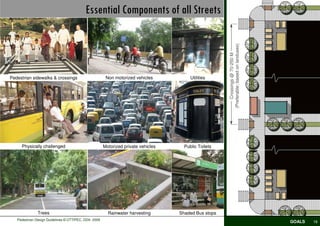
Essential Components of all Streets


                                                                                                      (Preferable; based on landuses)
                                                                                                          Crossings @ 70-250 M
Pedestrian sidewalks & crossings                       Non motorized vehicles           Utilities


     Physically challenged                            Motorized private vehicles     Public Toilets


              Trees                                     Rainwater harvesting       Shaded Bus stops
   Pedestrian Design Guidelines © UTTIPEC, DDA 2009
                                                                                                                                        GOALS   19
Mobility Goals:                            Ensure preferred public transport use
                                             1


To ensure preferable public
transport use:
                                           Car-dominated street, uncomfortable for pedestrians.   Street with equal priority & comfort for all users.

1.   To Retrofit Streets for equal or
     higher priority for Public Transit      2
     and Pedestrians.

2.   Provide transit-oriented mixed
     landuse patterns and redensify city
     within 10 minutes walk of MRTS
     stops.
                                            Segregated Uses, Random density                          Mixed Uses, Transit-Density Pyramid
3.   Provide dedicated lanes for HOVs
     (high occupancy vehicles) and
     carpool during peak hours.              3


                                                                                          4


                                                                                                      Pedestrian Design Guidelines © UTTIPEC, DDA 2009
20   GOALS
Provide safety, comfort and amenities to all users Safety, Comfort Goals:


4     5                                                6   7   To ensure pedestrian safety:
                                                               4.   Create “eyes on the street” – by
                                                                    removing setbacks and boundary
                                                                    walls and building to the edge of the
                                                                    street ROW. This would allow people
                                                                    from inside to look out on to the
                                                                    pavement, thus discouraging
                                                                    misbehaviour, shady corners,
                                                                    peeing, etc.)
                                                               5.   Require commercial facades to have
                                                                    minimum 30% transparency.
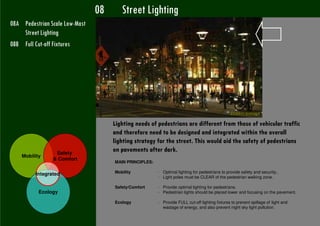
                                                               6.   Provide adequate Street Lighting for
                                                                    pedestrians and bicycles.
                                                               7.   Create commercial/ hawking zones at
                    Eyes on the street                              regular intervals (10 minute walk
                                                                    from every home in the city) to
                                                                    encourage walkability, increase
                                                                    street activity and provide safety.
                                                                    (e.g. Mumbai, Shanghai)


    Pedestrian Design Guidelines © UTTIPEC, DDA 2009
                                                                                            GOALS      21
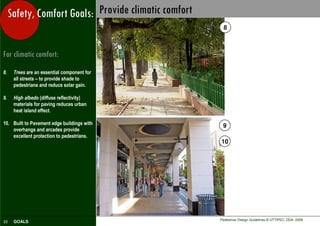
Safety, Comfort Goals: Provide climatic comfort
                                                         8


For climatic comfort:
8.    Trees are an essential component for
      all streets – to provide shade to
      pedestrians and reduce solar gain.

9.    High albedo (diffuse reflectivity)
      materials for paving reduces urban
      heat island effect.

10. Built to Pavement edge buildings with               9
    overhangs and arcades provide
    excellent protection to pedestrians.
                                                       10


                                                       Pedestrian Design Guidelines © UTTIPEC, DDA 2009
22    GOALS
Provide universal accessibility and civic amenities Safety, Comfort Goals:
                               11

                               12

                                                                                                 To ensure universal accessibility
                                                                                                 and amenities for all street users:
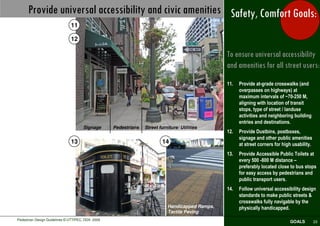
                                                                                                 11.   Provide at-grade crosswalks (and
                                                                                                       overpasses on highways) at
                                                                                                       maximum intervals of ~70-250 M,
                                                                                                       aligning with location of transit
                                                                                                       stops, type of street / landuse
                                                                                                       activities and neighboring building
                                                                                                       entries and destinations.
                                      Signage      Pedestrians   Street furniture/ Utilities
                                                                                                 12.   Provide Dustbins, postboxes,
                                                                                                       signage and other public amenities
                               13                                         14                           at street corners for high usability.
                                                                                                 13.   Provide Accessible Public Toilets at
                                                                                                       every 500 -800 M distance –
                                                                                                       preferably located close to bus stops
                                                                                                       for easy access by pedestrians and
                                                                                                       public transport users.
                                                                                                 14.   Follow universal accessibility design
                                                                                                       standards to make public streets &
                                                                                                       crosswalks fully navigable by the
                                                                            Handicapped Ramps,         physically handicapped.
                                                                            Tactile Paving
Pedestrian Design Guidelines © UTTIPEC, DDA 2009
                                                                                                                                GOALS          23
Ecological Goals:                            Reduce heat island effect & aid storm water management.
                                                                                                15

                                                                                                16

To reduce urban Heat Island
Effect and aid natural storm
water management:
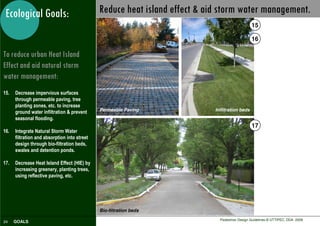
15.   Decrease impervious surfaces
      through permeable paving, tree
      planting zones, etc. to increase
                                              Permeable Paving              Infiltration beds
      ground water infiltration & prevent
      seasonal flooding.
                                                                                                17
16.   Integrate Natural Storm Water
      filtration and absorption into street
      design through bio-filtration beds,
      swales and detention ponds.

17.   Decrease Heat Island Effect (HIE) by
      increasing greenery, planting trees,
      using reflective paving, etc.


                                              Bio-filtration beds
                                                                              Pedestrian Design Guidelines © UTTIPEC, DDA 2009
24    GOALS
Street Hierarchy of Delhi
Road Network Hierarchy of Delhi:
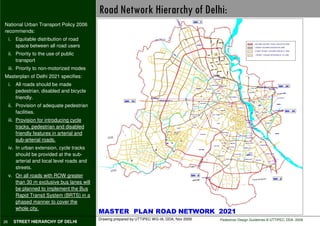
National Urban Transport Policy 2006
recommends:
     i. Equitable distribution of road
        space between all road users
     ii. Priority to the use of public
         transport
     iii. Priority to non-motorized modes
Masterplan of Delhi 2021 specifies:
     i. All roads should be made
        pedestrian, disabled and bicycle
        friendly.
     ii. Provision of adequate pedestrian
         facilities.
     iii. Provision for introducing cycle
          tracks, pedestrian and disabled
          friendly features in arterial and
          sub-arterial roads.
     iv. In urban extension, cycle tracks
         should be provided at the sub-
         arterial and local level roads and
         streets.
     v. On all roads with ROW greater
        than 30 m exclusive bus lanes will
        be planned to implement the Bus
        Rapid Transit System (BRTS) in a
        phased manner to cover the
        whole city.

                                              Drawing prepared by UTTIPEC WG-IA, DDA, Nov 2009   Pedestrian Design Guidelines © UTTIPEC, DDA 2009
26     STREET HIERARCHY OF DELHI
Masterplan-2021 Road Hierarchy:
1. National Highways.
     The recommended minimum right of way (ROW) is 90 meters, wherever possible. However, within the
     city it shall not be less than 60meters. All the National Highways within the NCTD shall be access
     controlled upto the Delhi Border.
2.   Arterial Roads.
     These include primary roads with access control and other primary roads.
       i) Primary Roads: Vehicular routes carrying heavy volumes of traffic will generally have free / stable flow conditions with
            controlled access. The recommended ROW in existing urban area is 60-80 m. and minimum 80 m. in the proposed
            urban extension. While designing roads with 30m. ROW and above, provision should also be made for public mass
            rapid transport system, which may include BRT. Present ring road and outer ring road to be converted to access
            controlled arterial roads. Cycle tracks should also be constructed along all arterial roads wherever possible.
       ii) Other Primary roads: Vehicular routes carrying heavy volumes of traffic, BRT route may also be allowed on these
            roads. The recommended ROW in existing urban area is 45-60 M. and minimum 60 m. in the proposed urban
            extension. Cycle tracks should also be constructed along all other primary roads wherever possible.

3.   Sub Arterial (Collector) Streets.
     These include primary and secondary collector streets.
      (i) Primary Collector: These roads will connect major arterial roads and inter residential district
           collectors.
           The recommended ROW in existing urban area is 30-40 M. and minimum 45 M. in the proposed
           urban extension. In addition to this, a separate cycle track should be provided wherever possible.
      (ii) Secondary Collector: These roads are intended to collect traffic from local streets within one
           residential district. The recommended R/W in existing urban area is 18-24 M. and minimum 30 M.
           in the proposed Urban extension.
4.   Local Streets.
     These are intended for neighbourhood (or local) use on which through traffic is to be discouraged. The
     suggested ROW is 12 to 20 m. in the existing and proposed urban area. These roads should be made
     pedestrian and bicycle friendly by using modern traffic calming designs to keep the speeds within limits
     as per design.


     Exclusive Pedestrian Only Streets (6 M and less) as per the provisions in MPD 2021 be
     identified area by area, by the local bodies/ road owning agencies.

       Pedestrian Design Guidelines © UTTIPEC, DDA 2009
                                                                                                                                     STREET HIERARCHY OF DELHI   27
Masterplan-2021 Road Hierarchy: Possible Categorization*
Primary Arterial                 Other Primary Arterial              Primary Collector                    Secondary Collector              Local Streets


60-80 M                          45-60 M                             30-40 M                              18-24 M                          12-20 M

50 km/hr.                        40 km/hr.                           30km/hr                              20 km/hr                         20 km/hr

Enforcement required             Enforcement required                Traffic calming required             Traffic calming required         Traffic calming required


Segregated bus and HOV           Segregated bus and HOV              Segregated bus and HOV lanes         Segregated bus and HOV           No segregated bus lanes or
lanes required                   lanes required                      required                             lane optional.                   bus operations required.


2 to 4 vehicular lanes,          2 to 4 vehicular lanes, 3.1m        2 nos., 2.75m lanes per dir.         2 nos., 2.75m lanes per dir.     1 no., 2.75m wide lane per
3.1m wide (min. 3.3 for          wide (min. 3.3 for buses)           (min. 3.1 for buses)                 (min. 3.1 for buses)             direction
buses)

Segregated cycle tracks          Segregated cycle tracks             Cycle lanes can work,                Cycle lanes can work,            No special feature for
required                         required                            segregated tracks required           segregated tracks required       cyclists
                                                                     where friction & encroachment        where friction &
                                                                     expected                             encroachment expected


Service lane required            Service lane may or may not         No service lane required             No service lane required         No service lane required
                                 be required

Continuous median – all          Continuous median – all             Intermittent or no median -          Intermittent or no median -      No medians, traffic calmed
intersections controlled         intersections controlled            opening accompanied by traffic       opening accompanied by           crossings, or mini
(signalized or roundabout,       (signalized or roundabout,          calming. Roundabout or traffic       traffic calming. Roundabout      roundabouts
no grade separators within       no grade separators within          calmed crossing.                     or traffic calmed crossing.
city)                            city)


* Guidelines prepared by UTTIPEC, DDA in consultation with TRIPP, IIT Delhi and ICE and DIMTS, Nov 2009              Pedestrian Design Guidelines © UTTIPEC, DDA 2009
 28    STREET HIERARCHY OF DELHI
60 M Arterial Road                                         Components
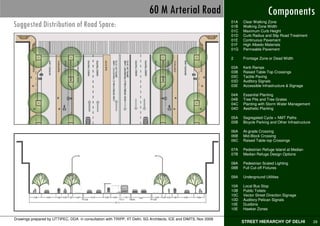
Suggested Distribution of Road Space:                                                                              01A
                                                                                                                   01B
                                                                                                                         Clear Walking Zone
                                                                                                                         Walking Zone Width
                                                                                                                   01C   Maximum Curb Height
                                                                                                                   01D   Curb Radius and Slip Road Treatment
                                                                                                                   01E   Continuous Pavement
                                                                                                                   01F   High Albedo Materials
                                                                                                                   01G   Permeable Pavement

                                                                                                                   2     Frontage Zone or Dead Width

                                                                                                                   03A   Kerb Ramps
                                                                                                                   03B   Raised Table-Top Crossings
                                                                                                                   03C   Tactile Paving
                               Typical Streetscape Plan (60 M)                                                     03D   Auditory Signals
                                                                                                                   03E   Accessible Infrastructure & Signage

                                                                                                                   04A   Essential Planting
                                                                                                                   04B   Tree Pits and Tree Grates
                                                                                                                   04C   Planting with Storm Water Management
                                                                                                                   04D   Aesthetic Planting

                                                                                                                   05A   Segregated Cycle + NMT Paths
                                                                                                                   05B   Bicycle Parking and Other Infrastructure

                                                                                                                   06A   At-grade Crossing
                                                                                                                   06B   Mid-Block Crossing
                                                                                                                   06C   Raised Table-top Crossings

                                                                                                                   07A   Pedestrian Refuge Island at Median
                                                                                                                   07B   Median Refuge Design Options

                                                                                                                   08A   Pedestrian Scaled Lighting
                                                                                                                   08B   Full Cut-off Fixtures

                                                                                                                   09A   Underground Utilities

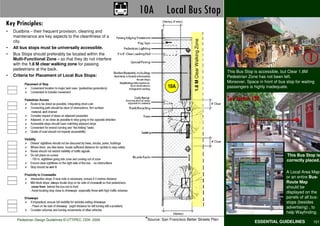
                                                                                                                   10A   Local Bus Stop
                                                                                                                   10B   Public Toilets
                                                                                                                   10C   Vector Street Direction Signage
                                                                                                                   10D   Auditory Pelican Signals
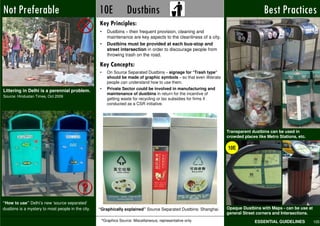
                                                                                                                   10E   Dustbins
                                                                                                                   10E   Hawker Zones

Drawings preparedGuidelines © UTTIPEC, DDA 2009
 Pedestrian Design by UTTIPEC, DDA in consultation with TRIPP, IIT Delhi, SG Architects, ICE and DIMTS, Nov 2009
                                                                                                                         STREET HIERARCHY OF DELHI                  29
Components:                                          45 M Arterial Road – with Service Lane
     01A   Clear Walking Zone
     01B
     01C
           Walking Zone Width
           Maximum Curb Height
                                                      Suggested Distribution of Road Space:
     01D   Curb Radius and Slip Road Treatment
     01E   Continuous Pavement
     01F   High Albedo Materials
     01G   Permeable Pavement

     2     Frontage Zone or Dead Width

     03A   Kerb Ramps
     03B   Raised Table-Top Crossings
     03C   Tactile Paving
     03D   Auditory Signals
     03E   Accessible Infrastructure & Signage

     04A   Essential Planting
     04B   Tree Pits and Tree Grates
     04C   Planting with Storm Water Management
     04D   Aesthetic Planting

     05A   Segregated Cycle + NMT Paths
     05B   Bicycle Parking and Other Infrastructure

     06A   At-grade Crossing
     06B   Mid-Block Crossing
     06C   Raised Table-top Crossings

     07A   Pedestrian Refuge Island at Median
     07B   Median Refuge Design Options

     08A   Pedestrian Scaled Lighting
     08B   Full Cut-off Fixtures

     09A   Underground Utilities

     10A   Local Bus Stop
     10B   Public Toilets
     10C   Vector Street Direction Signage
     10D   Auditory Pelican Signals
     10E   Dustbins
     10E   Hawker Zones


                                                      Drawings prepared by UTTIPEC, DDA in consultation with TRIPP, IIT Delhi, SG Architects, ICE and UTTIPEC, DDA 2009
                                                                                                                        Pedestrian Design Guidelines © DIMTS, Nov 2009
30       STREET HIERARCHY OF DELHI
45 M Arterial Road – without Service Lane                                                                      Components
                                                                                                                   01A   Clear Walking Zone
Suggested Distribution of Road Space:                                                                              01B
                                                                                                                   01C
                                                                                                                         Walking Zone Width
                                                                                                                         Maximum Curb Height
                                                                                                                   01D   Curb Radius and Slip Road Treatment
                                                                                                                   01E   Continuous Pavement
                                                                                                                   01F   High Albedo Materials
                                                                                                                   01G   Permeable Pavement

                                                                                                                   2     Frontage Zone or Dead Width

                                                                                                                   03A   Kerb Ramps
                                                                                                                   03B   Raised Table-Top Crossings
                                                                                                                   03C   Tactile Paving
                                                                                                                   03D   Auditory Signals
                                                                                                                   03E   Accessible Infrastructure & Signage

                                                                                                                   04A   Essential Planting
                                                                                                                   04B   Tree Pits and Tree Grates
                                                                                                                   04C   Planting with Storm Water Management
                                                                                                                   04D   Aesthetic Planting

                                                                                                                   05A   Segregated Cycle + NMT Paths
                                                                                                                   05B   Bicycle Parking and Other Infrastructure

                                                                                                                   06A   At-grade Crossing
                                                                                                                   06B   Mid-Block Crossing
                                                                                                                   06C   Raised Table-top Crossings

                                                                                                                   07A   Pedestrian Refuge Island at Median
                                                                                                                   07B   Median Refuge Design Options

                                                                                                                   08A   Pedestrian Scaled Lighting
                                                                                                                   08B   Full Cut-off Fixtures

                                                                                                                   09A   Underground Utilities

                                                                                                                   10A   Local Bus Stop
                                                                                                                   10B   Public Toilets
                                                                                                                   10C   Vector Street Direction Signage
                                                                                                                   10D   Auditory Pelican Signals
                                                                                                                   10E   Dustbins
                                                                                                                   10E   Hawker Zones


Drawings preparedGuidelines © UTTIPEC, DDA 2009
 Pedestrian Design by UTTIPEC, DDA in consultation with TRIPP, IIT Delhi, SG Architects, ICE and DIMTS, Nov 2009
                                                                                                                         STREET HIERARCHY OF DELHI                  31
Components:                                 40 M Collector Street
                   Suggested Distribution of Road Space:


     All Except 06D and 06E are applicable


                                                                                                               Graphic Source: © INTACH, Delhi Chapter

                                             Drawings prepared by UTTIPEC, DDA in consultation with TRIPP, IIT Delhi, SG Architects, ICE and UTTIPEC, DDA 2009
                                                                                                               Pedestrian Design Guidelines © DIMTS, Nov 2009
32   STREET HIERARCHY OF DELHI
30 M Collector Street                                      Components
                                                                                                    Suggested Distribution of Road Space:


                                                                                                                 All Except 06D and 06E are applicable


Graphic Source: © INTACH, Delhi Chapter

Drawings prepared by UTTIPEC,UTTIPEC,consultation with TRIPP, NovDelhi, SG Architects, ICE and DIMTS, Nov 2009
 Drawings prepared Guidelines © DDA in DDA 2009
   Pedestrian Design in consultation with TRIPP, IIT Delhi and ICE, IIT 2009
                                                                                                                     STREET HIERARCHY OF DELHI           33
Components                              20 M Local Street
 All Except 06D and 06E are applicable
                                                                                                Suggested Distribution of Road Space:


                                         Graphic Source: © INTACH, Delhi Chapter

                                         Drawings prepared by UTTIPEC, DDA in consultation with TRIPP, IIT Delhi, SG Architects, ICE and© UTTIPEC, DDA 2009
                                          Drawings prepared in consultation with Sandeep Gandhi Architects and Pedestrian Design Guidelines DIMTS, Nov 2009
                                                                                                               DIMTS
34   STREET HIERARCHY OF DELHI
12 M Local Street                                      Components
                                                                                                                   All Except 05A, 06D and 06E are applicable


Graphic Source: © INTACH, Delhi Chapter

Drawings preparedGuidelines © UTTIPEC, DDA 2009
 Pedestrian Design by UTTIPEC, DDA in consultation with TRIPP, IIT Delhi, SG Architects, ICE and DIMTS, Nov 2009
                                                                                                                          STREET HIERARCHY OF DELHI        35
This page is intentionally left blank.
Design Toolkit:
Mandatory Components
Not Preferable


                                Delhi

NO clear walkway = Confusion Zone       Commercial:                Confusion Zone –
                                                              Severe car-pedestrian conflict


                                Delhi

     Tree branches on walkway                          Tree planted in
                                        Residential:   walking zone!

                                                                                 Pedestrian Design Guidelines © UTTIPEC, DDA 2009
38   ESSENTIAL GUIDELINES
The Three Pavement Zones
                                                                                                                             02   09


                                                                                                                             01   03


                                                                                                                             04   08   09


                                                                                                                             10


                                                                                                       2.4 M min.


                                                                                                                      0.15
                                                        1.8 m
                                                                   ~ 1.8 M
                                                        min.
                                     daeD
                                     daeD
                                     daeD
                                     daeD
                                     htdiW
i Roy, UTTIPEC DDA UTTIPEC
                             *Base Graphic Source: Streetscape Design Guidelines for City of Lancaster Pennsylvania
Not Preferable
Best Practices


                                  New Delhi
 Frontage       Pedestrian Zone     Planting/
    Zone                            Furniture                                                                    Commercial:
                                    Zone
                                                Frontage    Pedestrian Zone       Planting/
                                                   Zone       (min. 1.8 M)        Furniture Zone
                                                                                  (min. 1.8 M)


                                  Vancouver
     Frontage     Pedestrian      Planting/                                                                       Residential:
        Zone        Zone          Furniture     Frontage Pedestrian   Planting/
                                  Zone             Zone    Zone       Furniture
                                                                      Zone

                                                                                       Pedestrian Design Guidelines © UTTIPEC, DDA 2009
40   ESSENTIAL GUIDELINES
01   Pedestrian Only Zone
      01A Clear Walking Zone
      01B Walking Zone Width
      01C Maximum Kerb Height
      01D Kerb Radius and Slip Road
          Treatment
      01E Continuous Pavement
      01F = See 12 C
          High Albedo Materials
      01G = See 12D
          Permeable Pavement
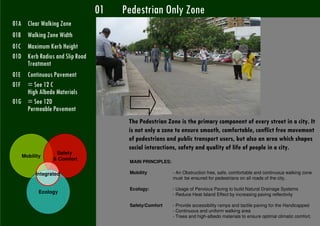
                                               The Pedestrian Zone is the primary component of every street in a city. It
                                               is not only a zone to ensure smooth, comfortable, conflict free movement
                                               of pedestrians and public transport users, but also an area which shapes
                                               social interactions, safety and quality of life of people in a city.
                              Safety
            Mobility
                             & Comfort
                                               MAIN PRINCIPLES:

                   Integrated                  Mobility           - An Obstruction free, safe, comfortable and continuous walking zone
                                                                  must be ensured for pedestrians on all roads of the city.

                                               Ecology:           - Usage of Pervious Paving to build Natural Drainage Systems
                    Ecology                                       - Reduce Heat Island Effect by increasing paving reflectivity

                                               Safety/Comfort     - Provide accessibility ramps and tactile paving for the Handicapped
                                                                  - Continuous and uniform walking area
                                                                  - Trees and high-albedo materials to ensure optimal climatic comfort.
i Roy, UTTIPEC DDA UTTIPEC
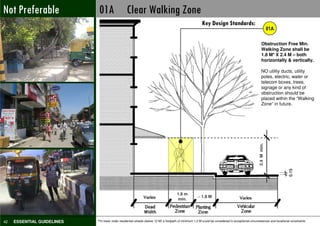
Not Preferable              01A Clear Walking Zone
                                                                                                     Key Design Standards:
                                                                                                                                                            01A

                                                                                                                                                   Obstruction Free Min.
                                                                                                                                                   Walking Zone shall be
                                                                                                                                                   1.8 M* X 2.4 M – both
                                                                                                                                                   horizontally & vertically.

                                                                                                                                                   NO utility ducts, utility
                                                                                                                                                   poles, electric, water or
                                                                                                                                                   telecom boxes, trees,
                                                                                                                                                   signage or any kind of
                                                                                                                                                   obstruction should be
                                                                                                                                                   placed within the “Walking
                                                                                                                                                   Zone” in future.


                                                                                                                                               2.4 M min.


                                                                                                                                                                    0.15
                                                                                    1.8 m
                                                                                                  ~ 1.8 M
                                                                                    min.
                                                            daeD
                                                            daeD
                                                            daeD
                                                            daeD
                                                            htd W
                                                            htd W
                                                            htdiiiiW
                                                            htd W
42   ESSENTIAL GUIDELINES   *In lower order residential streets (below 12 M) a footpath of minimum 1.2 M could be considered in exceptionalGuidelines © UTTIPEC, DDA 2009
                                                                                                                     Pedestrian Design circumstances and locational constraints.
01B - Walking Zone Width                                    01C - Maximum Kerb* Height                                                       Best Practices

                                                                                    Top of Sidewalk

                                                             Top of Road/ NMV Lane


                                                                     mm (6”)
 1.5 M                    1.8 M or More                                                                                                                             Portland
Not enough       Minimum width for two people                                                                                Extra walkway space        Effective       Dead
                 to cross each other comfortably                                                                             through tree grates        walkway         Width


01B                                                                     01C

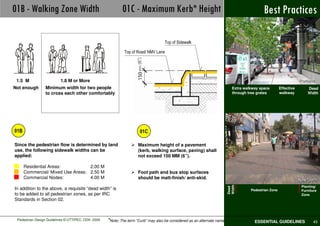
Since the pedestrian flow is determined by land                      Maximum height of a pavement
use, the following sidewalk widths can be                            (kerb, walking surface, paving) shall
applied:                                                             not exceed 150 MM (6”).

      Residential Areas:           2.00 M
      Commercial/ Mixed Use Areas: 2.50 M                            Foot path and bus stop surfaces
      Commercial Nodes:            4.00 M                            should be matt-finish/ anti-skid.                                                              New Delhi


                                                                                                                          Width
                                                                                                                                                                     Planting/


                                                                                                                          Dead
In addition to the above, a requisite “dead width” is                                                                                 Pedestrian Zone                Furniture
to be added to all pedestrian zones, as per IRC                                                                                                                      Zone
Standards in Section 02.


 Pedestrian Design Guidelines © UTTIPEC, DDA 2009   *Note: The term “Curb” may also be considered as an alternate name.                 ESSENTIAL GUIDELINES                43
Not Preferable                                  01D Kerb Radius and Slip Road Treatment
                                                Corner Kerb Radii
                                                The length of a corner kerb radius, greatly affects the overall operation and safety of users at an
                                                intersection.
                                                Smaller turning radii increase pedestrian safety by:
                                                  •   Shortening crossing distances
                                                  •   Increasing pedestrian visibility for drivers
Non-Signalized Slip Roads i.e. “Free Left         •   Decreasing vehicle turning speed; and making drivers look out for pedestrians while taking the turn.
Turns” have made navigating the city a
nightmare for pedestrians and cyclists.         Essential Guidelines:
                                                         Kerb radii should be as follows:   *
                                                                      1.5 M or less for roads less than 30 M width
                                                                      3.0 M for most intersections
                                                                      4.5 M for industrial streets with a lot of truck traffic.


                                                Slip Roads
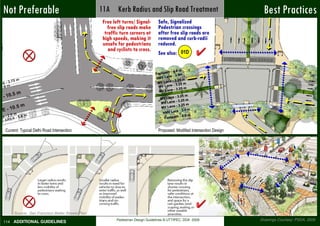
                                                Slip roads on Delhi roads are meant for the “signal free” movement of traffic, and to spare the left turning
                                                traffic from having to wait at traffic lights for taking a turn.
                                                While such car-oriented design features has not really helped reduce congestion on city roads, this design
                                                feature makes “crossing the street safely” for pedestrians, cyclists, aged and physically challenged
                                                people an impossible task.
                                                  Making street-crossing unsafe for these road users further discourages walking and use of public transport,
 A Typical Slip road encourages speedy left turns and therefore induces people to use private vehicles.
 and eliminates safety for pedestrians.           Therefore, from a pedestrian and cyclist safety standpoint, Slip roads are un-advisable.

44   ESSENTIAL GUIDELINES                      *Source: San Francisco Better Streets Plan – Policies and Guidelines for the Pedestrian Realm, JuneDDA 2009
                                                                                                               Pedestrian Design Guidelines © UTTIPEC, 2008
01D Kerb Radius and Slip Road Treatment                                                                       Best Practices
Street Kerb Corners and Slip Roads: Recommendations
Slip roads or Free Left Turns should be avoided. In cases where they already exist, the
following strategies may be employed:
     Reduce the kerb radius at the corner to calm traffic, and signalize the Slip road crossing
     (full or pelican signal), in order to make them safe for all users.
     Introduce raised table top crossings at slip roads – to allow pedestrians, cyclists and
     physically challenged people to cross the road comfortably at the same level, while the raised level
     acts as a traffic calming device to slow down vehicles at the junction. (This is a highly effective         Signalized Slip Road Pedestrian Crossing
     device that has been applied to all slip roads along the BRT corridor and are working very well.)


         01D


                                                                                             01D


Source: Pradeep Sachdeva Design Associates           Source: TRIPP, IIT Delhi, BRT Design Specifications, 2009    Table Top Treatment at Slip Road, ITO Crossing

  Pedestrian Design Guidelines © UTTIPEC, DDA 2009
                                                                                                                               ESSENTIAL GUIDELINES            45
Not Preferable                            01E             Continuous Pavement
                                          Sidewalks and Cycle Lanes should be regarded as a
                                          transportation system which is connected and continuous,
                                          just like roadways and railways.

                                          Key Design Guidelines:
                                            •   Avoid sidewalk interruptions by minimizing kerb cuts i.e.
                                                Minimize the number of driveways that cross the sidewalk –
                                                in order to support pedestrian safety and a continuous
Obstructions that interrupt the walkway         sidewalk.
                                            •   Maintain an even surface and elevation of the pavement at
                                                150 MM from surrounding road level.
                                            •   Remove all obstructions from the sidewalks.
                                            •   Consistency of design elements, color and texture, help
                                                provide visual continuity and calm traffic, even at
                                                crossings.
                                            •   Foot path and bus stop surfaces should be matt-finish/
                                                anti-skid.
Uneven pavement surface due to lack of
proper setting in a concrete sub-base.


Dramatic changes of elevation             Source: FHWA Course on Bicycle and Pedestrian Transportation,, 2006

                                                                                                                Pedestrian Design Guidelines © UTTIPEC, DDA 2009
46   ESSENTIAL GUIDELINES
01E      Continuous Pavement                            Best Practices
Key Design Guidelines:
 •   At entry points of properties – introduce “raised driveway” details – where pedestrian and cycle lanes
     continue at their same level, but the motorized vehicles have to move over a gentle ramp to enter the
     property.


                                                                                                                   BRT Corridor, New Delhi


                                                                    01E


      Typical Detail of Raised Driveway at Building Entries.
      Source: TRIPP, IIT Delhi, BRT Design Specifications, 2009

      Pedestrian Design Guidelines © UTTIPEC, DDA 2009
                                                                                                              ESSENTIAL GUIDELINES      47
This page is intentionally left blank.


48
02         ‘Dead Width’* or Frontage Zone


                              Safety
                                                        Attractive windows and hawkers in shopping districts, or entries and
           Mobility
                             & Comfort                  steps leading up to buildings - create momentary stoppages of curious
                                                        pedestrians or users of the buildings.
                   Integrated
                                                        This is a desired element of a successful and active street.
                    Ecology
                                                        These window watchers take up about 0.5 to 1.0 m of additional space,
                                                        which must be provided in order to ensure conflict free movement of all
                                                        pedestrians.
i Roy, UTTIPEC DDA UTTIPEC               *Source: IRC: 103 - 1988
Not Preferable                          02           Dead Width                                                         Best Practices
                                                                                                                                          New Delhi
                                                                 Key Design Standards*:
                                                                                                    02

                                                           –     For sidewalks in shopping areas,
                                                                 an extra 1M should be added to the
                                                                 stipulated 4.00 M width. This extra
                                                                 width is called “Dead Width”.

                                                           –     In other situations where sidewalks
                                                                 pass next to buildings and fences, a


                                                                                                                                                Furniture Zone
                                                                 dead width of 0.5 M can be added.


                                                                                                                                                Planting/
                                                           –     In busy areas like bus stops, railway
                                                                                                           Dead Width   Pedestrian Zone
                                                                 stations, recreational areas, the width
                                                                 of sidewalk should be suitably
                                                                 increased to account for accumulation
                                                                 of pedestrians.                                                          New Delhi


Above: No extra space allowed for
pedestrians interested in stopping at
attractions. Therefore stopping
pedestrian disrupts moving pedestrian
flow on sidewalk.
                                                                                   1.8 m
                                                                                            ~ 1.8 M
                                                                                   min.
                                                           Frontage
                                                               daeD
                                                               daeD
                                                               daeD
                                                               daeD                                        Dead         Pedestrian Zone
                                                               htd W
                                                               htdiiiiW
                                                               htd W
                                                               htd W                                       Width

50   ESSENTIAL GUIDELINES               *Source: IRC: 103 - 1988
03   Universal Accessibility
03A   Kerb Ramps
03B   Raised Table-Top Crossings
03C   Tactile Paving
03D   Auditory Signals
03E   Accessible Signage


                                                                      San Francisco                  Photo Source: San Francisco Better Streets Plan


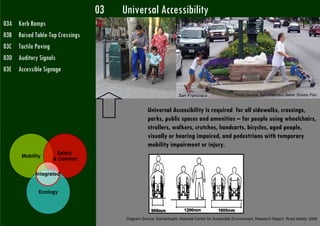
                                                    Universal Accessibility is required for all sidewalks, crossings,
                                                    parks, public spaces and amenities – for people using wheelchairs,
                                                    strollers, walkers, crutches, handcarts, bicycles, aged people,
                                                    visually or hearing impaired, and pedestrians with temporary
                                                    mobility impairment or injury.
                     Safety
       Mobility
                    & Comfort


             Integrated


              Ecology


                                         Diagram Source: Samarthyam, National Center for Accessible Environment, Research Report- Road Safety, 2008
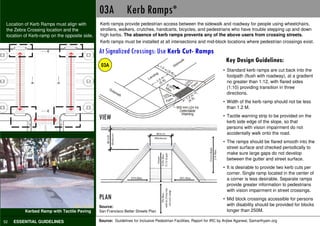
03A Kerb Ramps*
 Location of Kerb Ramps must align with        Kerb ramps provide pedestrian access between the sidewalk and roadway for people using wheelchairs,
 the Zebra Crossing location and the           strollers, walkers, crutches, handcarts, bicycles, and pedestrians who have trouble stepping up and down
 location of Kerb-ramp on the opposite side.   high kerbs. The absence of kerb ramps prevents any of the above users from crossing streets.
                                               Kerb ramps must be installed at all intersections and mid-block locations where pedestrian crossings exist.

                                               At Signalized Crossings: Use Kerb Cut- Ramps
                                                                                                                         Key Design Guidelines:
                                                03A
                                                                                                                        • Standard kerb ramps are cut back into the
                                                                                                                          footpath (flush with roadway), at a gradient
                                                                                                                          no greater than 1:12, with flared sides
                                                                                                                          (1:10) providing transition in three
                                                                                                                          directions.
                                                                                                                        • Width of the kerb ramp should not be less
                                                                                                                          than 1.2 M.

                                               VIEW                                                                     • Tactile warning strip to be provided on the
                                                                                                                          kerb side edge of the slope, so that
                                                                                                                          persons with vision impairment do not
                                                                                                                          accidentally walk onto the road.
                                                                                                                        • The ramps should be flared smooth into the
                                                                                                                          street surface and checked periodically to
                                                                                                                          make sure large gaps do not develop
                                                                                                                          between the gutter and street surface.
                                                                                                                        • It is desirable to provide two kerb cuts per
                                                                                                                          corner. Single ramp located in the center of
                                                                                                                          a corner is less desirable. Separate ramps
                                                                                                                          provide greater information to pedestrians
                                                                                                                          with vision impairment in street crossings.
                                               PLAN                                                                     • Mid block crossings accessible for persons
                                               Source:                                                                    with disability should be provided for blocks
          Kerbed Ramp with Tactile Paving      San Francisco Better Streets Plan                                          longer than 250M.
                                               *Prepared in Consultatio with Anjlee Agarwal, Samarthyam.Org
                                               Source: Guidelines for Inclusive Pedestrian Facilities, Report for IRC byPedestrian Design Samarthyam.org
                                                                                                                         Anjlee Agarwal, Guidelines © UTTIPEC, DDA 2009
52   ESSENTIAL GUIDELINES
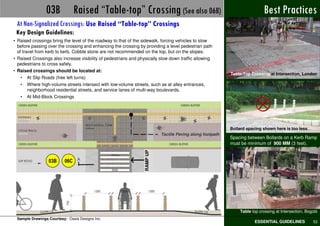
03B              Raised “Table-top” Crossing (See also 06B)                                                Best Practices
 At Non-Signalized Crossings: Use Raised “Table-top” Crossings
 Key Design Guidelines:
• Raised crossings bring the level of the roadway to that of the sidewalk, forcing vehicles to slow
  before passing over the crossing and enhancing the crossing by providing a level pedestrian path
  of travel from kerb to kerb. Cobble stone are not recommended on the top, but on the slopes.
• Raised Crossings also increase visibility of pedestrians and physically slow down traffic allowing
  pedestrians to cross safely.
• Raised crossings should be located at:
                                                                                                            Table-Top Crossing at Intersection, London
    • At Slip Roads (free left turns)
   •   Where high-volume streets intersect with low-volume streets, such as at alley entrances,
       neighborhood residential streets, and service lanes of multi-way boulevards.
   •   At Mid-Block Crossings


                                                                                                            Bollard spacing shown here is too less…
                                                                            Tactile Paving along footpath
                                                                                                            Spacing between Bollards on a Kerb Ramp
                                                                                                            must be minimum of 900 MM (3 feet).
                                                                  RAMP UP


                   03B      06C


                                                                                                                Table top crossing at Intersection, Bogotá
 Sample Drawings Courtesy:UTTIPEC, DDA 2009
 Pedestrian Design Guidelines © Oasis Designs Inc.
                                                                                                                       ESSENTIAL GUIDELINES            53
03C             Tactile Paving                    (See also 07A)
                                        Persons with vision impairment need guidance in using a pedestrianised area, especially if the
                                        footway crosses larger open spaces where the usual guidance given by the edge of the
                                        footway or building base is not available, or when pedestrians need guidance around
                                        obstacles.
                                        A continuous tactile guide (guiding & warning tile) in the direction of pedestrian travel, which
                                        has a different texture to the rest of the footway, can provide this guidance.


                                        Key Design Guidelines:
                                        • A distance of 600-800mm to be maintained from the edge of footpath/ boundary wall/ any
Tactile paving marking top &
                                          obstruction.
bottom of steps.
                                        • A height of about 5mm for the raised part of the surface is sufficient for almost all persons with vision
                                          impairment to detect, without causing too much discomfort for other pedestrians.
                                        • Tactile paving must be maintained to ensure that the profile does not erode away.
                                          Vitrified non-glazed tactile pavers are preferable.
                                        • Tactile tiles should have a colour (preferably canary yellow), which contrasts with the surrounding
                                          surface.
                                        • Tactile Paving should be minimum 300mm wide so that someone can’t miss it by stepping over it.

Accessible Bus Stop, Delhi


                                                                                                                        03C

Tactile paving on footpath leading to                                                                        Engineering configuration of floor
                                             “Go” - Guiding Tile           “Stop” - Warning Tile
ramp and crossing, BRT Corridor Delhi                                                                        tactile tiles
                                        Source: Guidelines for Inclusive Pedestrian Facilities, Report for IRC byPedestrian Design Samarthyam.org
                                                                                                                  Anjlee Agarwal, Guidelines © UTTIPEC, DDA 2009
54   ESSENTIAL GUIDELINES
03C             Tactile Paving                    (See also 07A)                      Best Practices
Tactile pavers (Guiding
and warning path)
should be provided:
 • To lead persons with
   vision impairments to
   the lifts, crossings,
   toilets, bus stops, i.e.
   all public and road
   facilities.
 • In front of an area
   where traffic is
   present.
                                                                                                                    Tactile paving on footpath
 • In front of an
                                                                                                                    leading to ramp and crossing: BRT Corridor
   entrance/exit to a
   facility like
   subway/FOB/ public
   utility.                                                                                                         Design specifications:
 • To and from a
                                                            03C
                                                                                                                    Ramp slope              8% maximum
   staircase or multi-level
                                                                                                                    Gutter slope            5% maximum
   crossing facility.
 • In open space to                                                                                                 Flare slope             10% maximum
   orient persons with                                                                                              Lip at roadway          6mm maximum, flush
   vision impairment.                                                                                                                       surface
                                                                                                                    Ramp width              1200mm minimum,
                                                                                                                                            width of crossing
                                                                                                                    Landing width           1500mm
                                                                                                                    Cross fall on landing   2% maximum
                                                                                                                    and approach
                    Source: CPWD Guidelines and Space Standards for Barrier Free Built Environment for              Width of tactile        610mm
                                    Disabled and Elderly Persons 1998, Ministry of Urban Development                warning surface

 Source: Guidelines for Inclusive Pedestrian Facilities, Report for IRC by Anjlee Agarwal, Samarthyam.org
  Pedestrian Design Guidelines © UTTIPEC, DDA 2009
                                                                                                                                   ESSENTIAL GUIDELINES          55
Not Preferable
Best Practices                             03D Auditory Signals
                                           Key Design Guidelines:
                                           •   Audible crossing signals (pelican crossings) help everyone, as well as being essential
                                               for persons with vision impairments.
                                                   •   Pedestrian traffic lights should be provided with clearly audible signals to facilitate
                                                       safe and independent crossing of pedestrians with low vision and vision impairment.
                                                   •   Acoustic devices should be installed on a pole at the point of origin of crossing and
                                                       not at the point of destination.
                             03D           •   Tactile paving should be provided in the line of travel avoiding obstructions such as
                                               manholes/ tree guards/lamp posts etc.


Audible signals which beep when light is
green (BRT Corridor, Delhi)


                                                                   Tactile lay out for manhole and raised crossing
Accessible Bus Stop, Delhi

                                           Source: Guidelines for Inclusive Pedestrian Facilities, Report for IRC byPedestrian Design Samarthyam.org
                                                                                                                     Anjlee Agarwal, Guidelines © UTTIPEC, DDA 2009
56   ESSENTIAL GUIDELINES
03E             Accessible Infrastructure (See also Section 10)                                                 Best Practices
 Key Design Guidelines:*
 • A slope of 8% (1 in 12) on footbridge ramps, while a slope of 5% (1 in 20) with appropriate resting
   places/landings is preferable .                                                                                  Parking                        Lift
 • Within the underpass, a handrail set 850mm-900mm (Figure 32 & 33) above the walking surface should
   be provided.
 • To assist visually impaired people, tactile paving/ tiles and a colour contrast should be provided at the top
   and bottom of the flight of steps and these areas should be well lit.
 • Elevator/lift should be provide on both the entrances/exits and should have minimum internal dimensions
   of 1400mm x 1400mm.
 • All Lifts to have Braille buttons and audio announcement systems.


      03E


                                                                                                                   Cycle Lift must be minimum 2000 x 1400
                                                                                                                   and provided at every 1 km on a highway
                                                                                                                   FOB, and at all public buildings.


                                                                                                 Braille Letters


                                                                                                                   Accessible Crossing Lift, Shanghai
*Source: Access for All, Guidelines for TOT forDDA 2009 of Universal Design, 2008, Samarthyam
       Pedestrian Design Guidelines © UTTIPEC, promotion
                                                                                                                                ESSENTIAL GUIDELINES         57
This page is intentionally left blank.


58
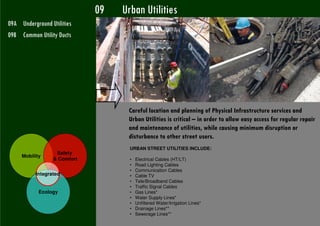
04   Multi-Functional Zone with Planting
04A Essential Planting
04B Tree Pits and Tree Grates
04C Planting with Storm Water
    Management
04D Aesthetic Planting


                                     Multifunctional Planting zones with native Street Trees and Plantation –
                                     are Essential on every Delhi pavement to provide shade and climatic
                                     comfort. Planting zones can also double as Natural Storm Water catchments
                                     and filtration systems - aiding in ground water recharge, preventing
                                     seasonal flooding and reducing the pressure on piped stormwater
   Mobility
                 Safety              infrastructure.
                & Comfort
                                     MAIN PRINCIPLES:
         Integrated
                                     Mobility           - Avenue tree plantation is a must on all streets of Delhi in order to
                                                          provide shade and comfort to pedestrians.
          Ecology                    Ecology:           - Integrated Natural Drainage Systems
                                                        - Native plantation for resistance and water conservation.
                                     Safety/Comfort     - Tree planting zones with native street trees and plantation – are
                                                           essential for shade, lowering HIE and giving comfort to pedestrians.
                                                        - Tree planting zone should be CLEAR of the pedestrian walking zone
04                                         04           Multi-Functional Zone with Planting, Etc.
 Multi-Functional Zones on a Street should
                                                                                                                       Hawker Zone
 be a minimum of 1.8 M Wide, and may
 locate any or all of the following functions
 within them:
      Tree Planting
      Planting for Storm Water
      Management
      Auto-rickshaw Stands
      Cycle-rickshaw Stands
      Hawker Zones
      Paid Car Parking
      Street Furniture                                                                                                 Bus Stop
      Bus Stops
      Traffic Police Booths, MTNL boxes,
      fire hydrants, junction boxes, etc.


                                                                                                                       Auto-Rickshaw Stand


     Due to absence of
     designated space for
     various road users,
     essential functions
     spill-over into the
     carriageway or
     pedestrian walkway
     – creating chaos!

                                                Drawings Courtesy: Pradeep Sachdeva Design Associates, 2009   Pedestrian Design Guidelines © UTTIPEC, DDA 2009
60     ESSENTIAL GUIDELINES
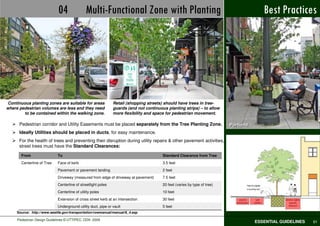
04               Multi-Functional Zone with Planting                                                       Best Practices


Continuous planting zones are suitable for areas              Retail (shopping streets) should have trees in tree-
where pedestrian volumes are less and they need               guards (and not continuous planting strips) – to allow
        to be contained within the walking zone.              more flexibility and space for pedestrian movement.

      Pedestrian corridor and Utility Easements must be placed separately from the Tree Planting Zone.                    Portland
      Ideally Utilities should be placed in ducts, for easy maintenance.
      For the health of trees and preventing their disruption during utility repairs & other pavement activities,
      street trees must have the Standard Clearances:

       From                 To                                                         Standard Clearance from Tree
       Centerline of Tree   Face of kerb                                               3.5 feet
                            Pavement or pavement landing                               2 feet
                            Driveway (measured from edge of driveway at pavement)      7.5 feet
                            Centerline of streetlight poles                            20 feet (varies by type of tree)
                            Centerline of utility poles                                10 feet
                            Extension of cross street kerb at an intersection          30 feet
                            Underground utility duct, pipe or vault                    5 feet
     Source: http://www.seattle.gov/transportation/rowmanual/manual/6_4.asp

     Pedestrian Design Guidelines © UTTIPEC, DDA 2009
                                                                                                                                     ESSENTIAL GUIDELINES   61
Not Preferable                               04A Essential Street Tree Planting
                                             Street Trees are an essential on all Delhi Streets to provide the following:
                                              •   Provide shade to pedestrians and cyclists.
                                              •   Reduce local ambient heat through shading of surfaces and evaporative cooling - making the
                                                  street more comfortable for all users.
                                              •   Absorb pollutants and improve local air quality.
                                              •   Increase local humidity so help absorb dust.
                                              •   Help create a sense of enclosure and placemaking on streets by creating relaxation spaces.

                                    Delhi     •   Flowering or deciduous trees create a changing seasonal urban experience on streets.

Street Trees in same line as Utility Zone;
and with low growing branches – thus         Key Design Guidelines:
obstructing walking zone.                     •   Trees are NOT to be placed on a sidewalk as an “afterthought” or in an ad-hoc manner in left-
                                                  over spaces.
                                              •   Space for Trees on the street must be designated. Since trees are indispensible in Delhi’s
                                                  harsh weather, space must compulsorily be carved out for them within the existing RoW,
                                                  except for ROWs below 6 M.
                                              •   The Clear Pedestrian Zone (minimum 1.8 M Wide) and Utility Easements must be placed
                                                  separately from the Tree Planting Zone.
                                              •   Trees must be placed such that they do not obstruct street lighting as well as visibility of
                                                  traffic signals. Therefore the Tree Planting Plan must be prepared in conjunction with the
                                                  Street Lighting Plan.

Trees occupying walking zone, so              •   Trees must be pruned from the bottom such that all safety devices, signage and traffic signals
pedestrian are displaced.                         are clearly visible to all road users.
                                              •   Before the start of every project, all existing trees must be identified, numbered and marked
                                                  on a Survey Plan and kept intact as much as possible.


                                                                                                          Pedestrian Design Guidelines © UTTIPEC, DDA 2009
62   ESSENTIAL GUIDELINES
04A             Essential Street Tree Planting                                                              Best Practices
                                                                                       Narrow “columnar” trees to be used
                                                                                       where pavement space is limited.

                                                                                       Use trees that can be “pruned
                                                                                       bottom-up” to allow vision clearance.

                                                                                       Use deciduous trees to allow sunlight
                                                                                       access to street in winter.


                                                                                                                                  Ideally, provide “wide spread” but high
                                                                                                                                  canopied trees for shade in summers.


                                                           10’ Tree canopy clearance


                                                                                                                                  Utilizing deciduous trees is advisable on
                                                                                                                                  busy streets where sunlight is desirable
                                                                                                                                  in winter.
Dead Width         Min. 1.8 M x 2.4 M   Planting Zone                                     Tree planting plan and Lighting plans
                 Clear Pedestrian Zone                                                    must be prepared in conjunction – so
              with no Visual Obstructions     04A                                           that tree canopies do not obstruct
                                                                                                   lighting for road users.

    Pedestrian Design Guidelines © UTTIPEC, DDA 2009
                                                                                                                                               ESSENTIAL GUIDELINES         63
Current Situation
Not Preferable                                          04B         Tree Pits and Tree Grates
                                                          A clear width of 1800 x 1800 M is to be left free of concrete, in order to allow access of
                                                          nutrients to the roots of trees.
                                                          Tree Grates allow pedestrians to walk close to trees, without discomfort to either.


 Suffocated Tree pits
                                                                                                          04B
     Delhi High Court, the city government said on
     28 Oct 2009 it would ensure ‘‘breathing
     space’’ for every tree in the Capital — by
     keeping a circumference of 6 feet around it
     concrete-free.
     The assurance came in reply to an HC
     Petitioner who tells HC that concrete
     pavements are weakening tree roots, cutting                         Option 1                                                Option 2
     off their water supply. This leads to ‘slightest
     of storms’ uprooting several trees, leading to                                                                                        1800
     traffic jams.


                                                                                                                         1800
Open Tree pits are acceptable but they are               Sample Detail of Precast Cement Concrete Tree Grating.
difficult for pedestrians to walk over.                  Source: Pradeep Sachdeva Design Associates, Nov 2009

                                                                                                                Pedestrian Design Guidelines © UTTIPEC, DDA 2009
64      ESSENTIAL GUIDELINES
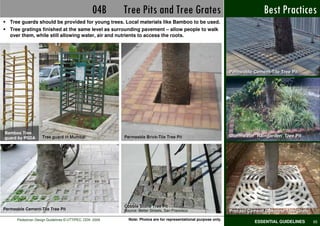
04B     Tree Pits and Tree Grates                                              Best Practices
   Tree guards should be provided for young trees. Local materials like Bamboo to be used.
   Tree gratings finished at the same level as surrounding pavement – allow people to walk
   over them, while still allowing water, air and nutrients to access the roots.


                                                                                                                 Permeable Cement-Tile Tree Pit


Bamboo Tree
guard by PSDA       Tree guard in Mumbai                 Permeable Brick-Tile Tree Pit                           Stormwater ‘Raingarden’ Tree Pit


                                                         Cobble Stone Tree Pit
Permeable Cement-Tile Tree Pit                           Source: Better Streets, San Francisco                   Precast Cement Concrete Tree Grate
      Pedestrian Design Guidelines © UTTIPEC, DDA 2009     Note: Photos are for representational purpose only.
                                                                                                                            ESSENTIAL GUIDELINES      65
Current Situation
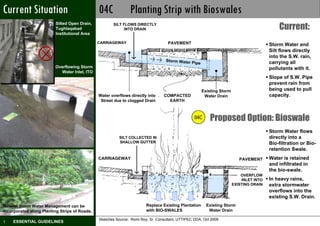
Not Preferable                                 04C             Planting Strip with Bioswales                                             Best Practices
                                                                                                                                              Current:
                          Silted Open Drain,          SILT FLOWS DIRECTLY
                          Tughlaqabad                      INTO DRAIN
                          Institutional Area

                                               CARRIAGEWAY                         PAVEMENT                                               Storm Water and
                                                                                                                                          Silt flows directly
                                                                                                                                          into the S.W. rain,
                                                                                  Storm Water
                                                                                                Pipe                                      carrying all
                         Overflowing Storm                                                                                                pollutants with it.
                            Water Inlet, ITO
                                                                                                                                          Slope of S.W. Pipe
                                                                                                                                          prevent rain from
                                                                                                       Existing Storm                     being used to pull
                                               Water overflows directly into     COMPACTED              Water Drain                       capacity.
                                                Street due to clogged Drain        EARTH


                                                                                                  04C      Proposed Option: Bioswale
                                                                                                                                          Storm Water flows
                                                         SILT COLLECTED IN                                                                directly into a
                                                         SHALLOW GUTTER                                                                   Bio-filtration or Bio-
                                                                                                                                          retention Swale.
                                               CARRIAGEWAY                                                                 PAVEMENT       Water is retained
                                                                                                                                          and infiltrated in
                                                                                                                                          the bio-swale.
                                                                                                                            OVERFLOW
                                                                                                                            INLET INTO    In heavy rains,
                                                                                                                        EXISTING DRAIN    extra stormwater
                                                                                                                                          overflows into the
                                                                                                                                          existing S.W. Drain.
Natural Storm Water Management can be                                   Replace Existing Plantation      Existing Storm
incorporated along Planting Strips of Roads.                            with BIO-SWALES                   Water Drain

                                               Sketches Source: Romi Roy, Sr. Consultant, UTTIPEC DDA, Oct 2009
1   ESSENTIAL GUIDELINES
04C             Planting Strip with Bioswales                                           Best Practices
                                                                                                         “Green Streets”,
How the Science works:                                       Bioswales can connect to the Main
                                                                                                         Portland.
                                                             Storm Water Drain – either in Series
Filtration:                                                  (connected only at the end); or in          Photos: Seattle
Sediments suspended in                                       parallel – i.e. each bioswale bed           Department of
stormwater runoff settle out                                 overflows directly into the Storm Water     Transportation.
and are deposited on                                         drain, in case of heavy rainfall.
planter soil.
                                                             The Parellel Connection option is
Adsorption:
                                                             preferable.
Pollutants in water attach to
the surface of plants and                                    Adding organic compost or mulch
soil particles where roots                                   to soil improves its ability to support
and bacteria can use them.                                   plants and absorb stormwater. Healthy
Storage:                                                     soil is the backbone of natural
Roots, insects, and worms                                    drainage systems.
break up soil, making more                                   The following Plants may be suitable
room for stormwater runoff                                   for Delhi’s soil and climate conditions:*
Plant Uptake:                                                       Scirpus
Water, nitrogen,                                                    Cyprus
phosphorous and trace                                               Canna
elements are used for plant                                         Typha
function.                                                           Phragmites


         MULTI-UTILITY ZONE


                               Bio-Swale within the            Intermediate Storm
                        04C
                               Multi-Functional Zone        water ‘Percolation Pits’

 Pedestrian Design Guidelines © UTTIPEC, DDA 2009            *Plant species are suggested by NEERI
                                                                                                                      ESSENTIAL GUIDELINES   67
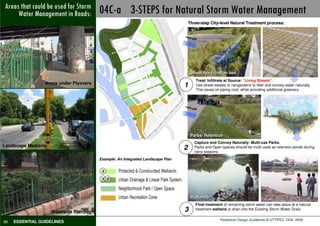
Not Watercould be used forRoads: 04C-a 3-STEPS for Natural Storm Water Management
Areas that
     Preferable in Storm
           Management
                                                                                    Three-step City-level Natural Treatment process:


                                                                                                                         w
                                                                                run-


                                                                                                                      flo
                                                                                    off


                                                                                                                     ed
                                                                                                                   rb
                                                                                                                 so
                                                                                                               ab
                                                                                                            d
                                                                                                          an
                                                                                                           d
                                                                                                        re
                                                                                                     lte
                                                                                                   Fi
                                                                                     Street bio-filtration bed
                                                                                       Treat/ Infiltrate at Source: “Living Streets”.
                 Areas under Flyovers
                                                                                1      Use street-swales or raingardens to filter and convey water naturally.
                                                                                       This saves on piping cost, while providing additional greenery.


                                                                                run-
                                                                                    off


                                                                                     Parks/ Retention
                                                                                       Capture and Convey Naturally: Multi-use Parks.
Landscape Medians
                                                                                2      Parks and Open spaces should be multi-used as retention ponds during
                                                                                       rainy seasons.
                                        Example: An Integrated Landscape Plan


                                         3

                                         1 2


                                                                                     Wetlands**
                                                                                       Final treatment of remaining storm water can take place at a natural
                    Roadside Planting                                           3      treatment wetland or drain into the Existing Storm Water Drain.

                                                                                                      Pedestrian Design Guidelines © UTTIPEC, DDA 2009
68   ESSENTIAL GUIDELINES
04D                Aesthetic Street Tree Planting Best PracticesPractices
                                                                                                  Best
Only Native trees should be planted on streets in order to minimize irrigation requirements and prolong tree life.
Trees like Eucalyptus, Australian Acacia, Lantana, Lucena, Mast tree (False Ashoka) should be avoided.

                                                                                                            04D


Kachnar
Kachnar

                                                                                                                                              “Lutyens New Delhi


Tesu
Tesu


                                       Local Trees planted on Avenues of
Kanak Champa
Kanak Champa                           Lutyens Delhi. Source: “Trees of Delhi”                                       Shown above: Imli (Tamarind) Trees on Akbar Road
                                                                                                                     in April (top) and February in autumn (bottom).
Street Tree Typologies                 Avenue Trees:                      Accent Trees:                               Streets could be “themed” based on the
proposed by © PSDA for                   Arjun, Terminalia arjuna           Kachnar, Bauhinia variegata               seasonal colour of foliage, flowers and
                                         Kusum, Schleichera oleosa          Barna, Crataeva adansonii                 fruits – in order to give a unique and
Streetscaping of Streets for
                                         Imli, Tamarindus indica            Tesu, Butea monosperma
                                                                                                                      beautiful urban experience to Delhiites.
Commonwealth Games:                                                                                                   Deciduous trees provide shade in
                                         Kanak Champa, Pterospermum         Tota, Erythrina variegata
                                                                                                                      summer; change colour of their leaves in
                                         Chikrassy, Chukrasia tabularis     Tabebuia, Tabebuia aurea                  autumn; and shed leaves and let the sun
                                         Mahua, Madhuca indica              Jacaranda, Jacaranda mimosifolia          through in winter.

       Pedestrian Design Guidelines © UTTIPEC, DDA 2009
                                                                                                                                  ESSENTIAL GUIDELINES            69
This page is intentionally left blank.


70
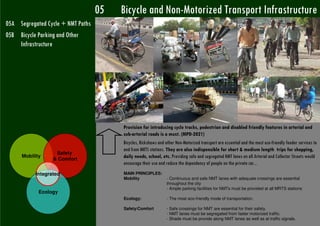
05   Bicycle and Non-Motorized Transport Infrastructure
05A Segregated Cycle + NMT Paths
05B Bicycle Parking and Other
    Infrastructure


                                        Provision for introducing cycle tracks, pedestrian and disabled friendly features in arterial and
                                        sub-arterial roads is a must. (MPD-2021)
                                        Bicycles, Rickshaws and other Non-Motorized transport are essential and the most eco-friendly feeder services to
                                        and from MRTS stations. They are also indispensible for short & medium length trips for shopping,
                   Safety
      Mobility
                  & Comfort
                                        daily needs, school, etc. Providing safe and segregated NMT lanes on all Arterial and Collector Streets would
                                        encourage their use and reduce the dependency of people on the private car...
           Integrated                   MAIN PRINCIPLES:
                                        Mobility                - Continuous and safe NMT lanes with adequate crossings are essential
                                                                throughout the city
                                                                - Ample parking facilities for NMTs must be provided at all MRTS stations
             Ecology
                                        Ecology:                - The most eco-friendly mode of transportation.

                                        Safety/Comfort          - Safe crossings for NMT are essential for their safety.
                                                                - NMT lanes must be segregated from faster motorized traffic.
                                                                - Shade must be provide along NMT lanes as well as at traffic signals.
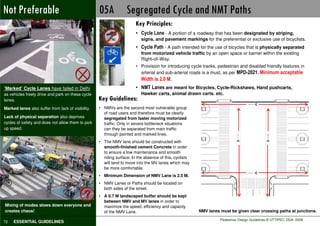
Not Preferable                                      05A Segregated Cycle and NMT Paths
                                                                        Key Principles:
                                                                        • Cycle Lane - A portion of a roadway that has been designated by striping,
                                                                           signs, and pavement markings for the preferential or exclusive use of bicyclists.
                                                                        • Cycle Path - A path intended for the use of bicycles that is physically separated
                                                                           from motorized vehicle traffic by an open space or barrier within the existing
                                                                           Right–of–Way.
                                                                        • Provision for introducing cycle tracks, pedestrian and disabled friendly features in
                                                                          arterial and sub-arterial roads is a must, as per MPD-2021. Minimum acceptable
                                                                           Width is 2.0 M.
‘Marked’ Cycle Lanes have failed in Delhi                               • NMT Lanes are meant for Bicycles, Cycle-Rickshaws, Hand pushcarts,
as vehicles freely drive and park on these cycle                           Hawker carts, animal drawn carts, etc.
lanes.                                              Key Guidelines:
Marked lanes also suffer from lack of visibility.   • NMVs are the second most vulnerable group
                                                      of road users and therefore must be clearly
Lack of physical separation also deprives             segregated from faster moving motorized
cycles of safety and does not allow them to pick      traffic. Only in severe bottleneck situations
up speed.                                             can they be separated from main traffic
                                                      through painted and marked lines.
                                                    • The NMV lane should be constructed with
                                                      smooth-finished cement Concrete in order
                                                      to ensure a low maintenance and smooth
                                                      riding surface. In the absence of this, cyclists
                                                      will tend to move into the MV lanes which may
                                                      be more comfortable.
                                                    • Minimum Dimension of NMV Lane is 2.5 M.
                                                    • NMV Lanes or Paths should be located on
                                                      both sides of the street.
                                             ?      • A 0.7 M landscaped buffer should be kept
                                                      between NMV and MV lanes in order to
Mixing of modes slows down everyone and               maximize the speed, efficiency and capacity
creates chaos!                                        of the NMV Lane.                                   NMV lanes must be given clear crossing paths at junctions.
                                                                                                         NMV lanes must be given clear crossing paths at junctions.
                                                                                                                   Pedestrian Design Guidelines © UTTIPEC, DDA 2009
72   ESSENTIAL GUIDELINES
05A Bicycle and NMT Paths                                        Best Practices
                                       05A


Relative Levels of NMV Paths and Foothpaths.
Source: TRIPP, IIT Delhi, BRT Design Specifications, 2009


                                                                                                              Segregated Cycle-NMV Path,
                                                                                                                  BRT Corridor, Delhi


                                                                      Cycle track on Public Staircase,
                                                                                  Europe

                                                                                                           Segregated TWO-WAY Cycle Path,
                                                                                                                Canal Street, Manhattan


 2.5 M is the Optimum Cycle Path Width. 1.5 M Width is required       Shaded Waiting Area for Cycles at   Segregated Cycle Path on 20 M Road,
 for Cycle Rickshaw Parking.      Detail Source: Oasis Designs Inc.    Road Junction, Hangzhou, China                 Manhattan
 Pedestrian Design Guidelines © UTTIPEC, DDA 2009
                                                                                                                   ESSENTIAL GUIDELINES         73
Not Preferable                                      05B             Bicycle Parking and Other Infrastructure
                                                    Key Principles:
                                                      •   Cycles are a very desirable and affordable private feeder service to MRTS/ BRTS Stations.
                                                                                                                                                      Best Practices
                                                      •   To encourage their usage therefore - safe and secure cycle parking options must be provided.
                                                      •   Secure Cycle Parking must be provided at all MRTS/ BRTS Stations.

                                                    Key Guidelines:
                                                      • Long-Stay Parking – Cycle parking lots must be enclosed, ticketed (like car-parking lots) and
                                                          shaded from weather. Cycle parking lots can be combined with ticket counter booths, local police
                                                          booths, cycle service stations or shared areas within private building complexes.

 80% of Cycles under the Paris Cycle Share
                                                      • Short-stay parking –        should be open to view and close to entrances of destinations.
     Program are stolen or damaged.
Source: Samuel Bollendorff for The New York Times


                                                    The stands should allow at least the frame and ideally both wheels, to be secured to them.
Open lockable parking bays like above may
                                                    A typical Cycle Stand is shown above.
not succeed in Delhi – due to fear of theft or
                                                    Source: http://www.norwich.gov.uk/local_plan/images/figures/diag1a.jpg
 vandalism. However, they may work as a
  short term (10-minute) parking option.            http://www.bolsover.gov.uk/localplan/ws_pics/image005.jpg

                                                                                                                             Pedestrian Design Guidelines © UTTIPEC, DDA 2009
74   ESSENTIAL GUIDELINES
05B             Bicycle Parking and Other Infrastructure                                                               Best Practices


                                                                                                                 Public Cycle Parking in a Private Compound
   2.1 or 2.5 M x 5.0 M Parking Bays


                             Graphic Source:
                          http://www.hackney-
       cyclists.org.uk/parking/on_street_x.jpg

  SAMPLE CYCLE PARKING PLAN                        A Cycle-repair stall next to a Cycle Path, Shanghai


                                                                                                                 Stacked Cycle Parking, China


                                                       05B


 Cycle Rickshaw Parking, Cycle Parking Stands, Cycle repair Stalls, etc. can all be
 accommodated within the Flexible “Multi-Functional Zone” (Section 04)
                                                                                                                 Shaded and Ticketed cycle Parking, Beijing
Pedestrian Design Guidelines © UTTIPEC, DDA 2009             Sample Drawing: Pradeep Sacheva Design Associates
                                                                                                                              ESSENTIAL GUIDELINES            75
This page is intentionally left blank.


76
06         Crossings
06A At-grade Crossing
06B Mid-Block Crossing
06C Raised Crossings - (see 03B)
06D Grade Separate Crossing
    (Foot Over Bridge)
06E Grade Separate Crossing
    (Humped Crossing)


                                                Marked and designated crossings are an essential part of the pedestrian
                                                realm that enable safe, convenient pedestrian travel across roadways.

                                   Key Principles:
                     Safety
       Mobility                     •   Since Pedestrians must be given the shortest possible direct route to cross the street, the most
                    & Comfort
                                        preferred Crossing for them is “at-grade”.
                                    •   Mid Block Crossings must be provided for people to cross the street safely between building entries
             Integrated
                                        or bus stop locations or active landuses on opposite sides of the street. Mid-block crossings may be
                                        provided with pedestrian operate signals and table top crossings.

              Ecology               •   At-grade Pedestrian crossings must be provided at all T-junctions.
                                    •   Grade separated crossings could be provided on highways.
Best Practices
Not Preferable                             06A At-grade Signalized Crossings                                               (See also Section 10)
                                           Key Principles:*
                                           • Crossings should be at least as wide as the sidewalk, and
                                             wider in locations with high pedestrian demand or narrow
                                             sidewalks.
                                                  • Crossings should be no less than 3 M in width. A more
                                                    desirable width is 5 M.
                                                  • Crossings must be outfitted with kerb ramps and tactile
                                                    warning strips per accessibility guidelines in Section 03.

         Warning or Yield Lines or                • All light signals are to have ‘auditory’ mechanism.
         Textured paving before At-grade   • Advance stop and yield lines should be considered at
         Signalized Intersections.           stop- or signal-controlled marked crossings with limited
                                             crossing visibility, poor driver compliance, or non-standard
                                             geometrics.
                                                  • Stop and yield lines can be used from 1 to 15 M in advance
                                                                                                                     Traffic Light Mounted Street Name Plate, with
                                                    of crossings, depending upon location, roadway                   Address Range and Other Directional Signage.
                                                    configuration, vehicle speeds, and traffic control.
                                                                                                                     See Section 10C: Signage
                                           • Wayfinding Signage for Pedestrian orientation and
                                             directional guidance must be provided at street
                                             intersections. Amenities like dustbins are also needed.
                                             (Section 10)

                                            06A


                                              Driver’s view of crossing markings. Source: ITE Professional
                                              Development Complete Streets Webinar, 2008

78   ESSENTIAL GUIDELINES                  *Source: San Francisco Better Streets Plan                        Pedestrian Design Guidelines © UTTIPEC, DDA 2009
06B            Mid-Block Crossing (See also 03B)                                                        Best Practices
Key Design Guidelines:                                                                                                      ** Extended Footway at Crossings
                                                                                                                            provides better visibility of pedestrians
Mid-block crossings should be                                                                                               and reduces the crossing distance.
considered at:*


                                                                         PARKING


                                                                                                                  PARKING
 •    Key civic and commercial locations
 •    Areas with pedestrian attractors with mid-
      block entries like shopping areas, schools
      and community centers.
 •    Mid-block transit/ bus stop locations.
 •    Long blocks (generally >150M)
New mid-block crossings should be                                                                                                   Photo Courtesy: Dr. C.G.B. Mitchell, UK
provided if ALL the following are
true:*
 •    Length of the block is more than 250 M
                                                                                   06B


                                                                                                                  PARKING
 •    Crossing is not less than 60 M from


                                                                         PARKING
      the intersection
 •    All non-signalized mid-block
      crossings are to have auditory
      pelican signals and table top
      provisions with flat paving/stone on          Mid-block Pedestrian Crossing
      the top and cobble stone may be               Signage is Essential –
      provided on the slopes (on the road           to discourage Jaywalking                                                  Signalized Mid-Block Crossing, Barcelona
      sides) for controlling vehicular speeds.

     Mid-block crossings must be provided at regular intervals as per the following standards:
     Residential Areas:                                Spacing Range: Every 80 – 250m
                                                       Coordinated with entry points of complexes;
                                                       location of bus/ train stops, public facilities, etc.
     Commercial/ Mixed Use Areas:                      Spacing Range: Every 80 – 150m
     High Intensity Commercial Areas:                  Pedestrianize if possible.


                                      06C           Raised Crossing                       (See 03B)                     .
                                                                                                                                    Non-Signalized Table Top Crossing
*Source: San Francisco Better UTTIPEC, DDA 2009 **Source: "American Association of State Highway and Transportation
 Pedestrian Design Guidelines © Streets Plan
                                               Officials”, Pedestrian and Bicycle Safety, Lesson 12 Midblock Crossings                  ESSENTIAL GUIDELINES            79
Not Preferable              06D Foot Over-Bridges (Only on Highways)
                            Key Principles and Guidelines:*
                            • Foot Over Bridges may be necessary for streets with high speed transit corridors (like BRT) for people to cross
                              safely and conveniently at mid-block locations. They may also be needed on Highways (Roads of 90 M with or
                              more with traffic speeds greater than 50 km/hr)
                            • All Foot Over Bridges must be universally accessible. Escalators are NOT an inclusive measure. All
                              Subways and Foot-overbridges must have a combination of either “Staircase + Ramp” or “StairCase +
                              Elevator” for universal accessibility.

                            Key Design Guidelines:*
                            • Minimum size for Elevator is 1400 x 1400 MM. Cycle Elevators should be provided at every alternate
                              Foot Overbridge and should be 1400 x 2000 MM
                            • A slope of 8% (1 in 12) on footbridge ramps, while a slope of 5% (1 in 20)
                              with appropriate resting places/landings is preferable .
                            • Tactile paving/ tiles and a colour contrast should be provided at the top and
                              bottom of the flight of steps and these areas should be well lit.


                             06D                                                                                                                          Lift
                                                                                                                                         Advertising
                            Suggested FOB design
                            Sketch Courtesy: Ran Chen & Romi Roy, UTTIPEC DDA                                                  Cycle Track

80   ESSENTIAL GUIDELINES   *Source:                                                                   Pedestrian Design Guidelines © UTTIPEC, DDA 2009
                                       Guidelines for Inclusive Pedestrian Facilities, Report for IRC by Anjlee Aggarwal, Samarthyam
06E             Humped Pedestrian Crossings (Only on Highways)                                   Best Practices

                                                                                                                  Humped road
                                                                                                                over pedestrian
                                                                                                                      crossing


SECTION


                                                                           Accessibility Ramp Down


PLAN
 06E
Sample Detail of a Humped Crossing (only for highways)                                                            Slightly sunk
Source: EIL, Developments Consultant & Creative Arc Architects and Transport Planners                       pedestrian crossing
Pedestrian Design Guidelines © UTTIPEC, DDA 2009
                                                                                                     ESSENTIAL GUIDELINES    81
This page is intentionally left blank.


82
07          Medians and Refuge Islands
07A Pedestrian Refuge Island at
    Median
07B Median Refuge Design Options


                                                                                                                     London

                                                                    A median is the portion of the roadway separating opposing directions
                                                                    of the traveled way, or local lanes from through travel lanes. At a
                                                                    pedestrian crossing, the median acts as a ‘pedestrian refuge island’.
                   Safety          Functions and Benefits:*
      Mobility
                  & Comfort
                                   Raised medians and islands provide space to locate pedestrian safety features and traffic control
                                   devices, amenities, landscaping and stormwater management.
           Integrated
                                   Pedestrian refuge islands are protected areas where people may safely pause or wait while crossing a
                                   street. Pedestrian refuge islands are particularly helpful as resting areas for seniors, persons with
                                   disabilities, children and others who may be less able to cross the street in one stage.
             Ecology
                                   At signalized intersections, they allow slow moving pedestrians to cross in two phases.
                                   At non-signalized locations, they simplify the act of finding a gap in traffic to cross since vehicles from only
                                   one direction must be reckoned with at a time.
Not Preferable                                      07A Landscaped Median
                                                                                                 Key Design Guidelines:*
                                                                                                   Maximum height of Median curb is about 220 MM.
                                                                                                   Instead of fences, Medians should be landscaped and
                                                                                                   used for stormwater management wherever possible.
                                                                                                        Plantings should use drought-tolerant, low maintenance
                                                                                                        species, and preferably capable of storm water filtration
                                                                                                        as well.
                                                                                                   When street trees are desired, a median should be min.
                                                                                                   1.5 M wide, including kerbs, to provide sufficient space for
Median fences totally inappropriate, especially     No Refuge Island, So pedestrians wait          healthy root growth.
on a residential, mixed-use, slow traffic street.   dangerously on the carriageway.                     Trees in medians can provide a fuller canopy and
                                                                                                        provide a highly cooling effect on immediate
                                                                                                        surroundings, thus reducing Urban Heat Island Effect.
                                                                                                        Clear width of a median ‘refuge island’ should be
                                                                                                  07A
                                                                                                        1.2 M.


                                                                                                                            Refuge Island
                                                      Medians are pedestrian                                               for Pedestrians
                                                      refuges (to be shaded by
                                                      trees) , NOT for shrubs and
                                                      fences!
                                                                                                                                  Planted
                                                                                                                                  Median
 ?
Inadequate, unusable refuge island at a             Zebra Crossing Hits Obstructed Median!
signalized intersection in ITO

84    ESSENTIAL GUIDELINES                          *Source: San Francisco Better Streets Plan                    Pedestrian Design Guidelines © UTTIPEC, DDA 2009
07B             Pedestrian Refuge Island at Median                                                            Best Practices


                                                                                           • Kerb Ramp at
                                                                                             Raised Median          Lodhi Road, Delhi Refuge*
                                                                                                                     At-grade Median
                                                                                           • 1200 MM clear
                                                                                                                    Fences are futile if placed on the median.
                                                                                             waiting area
                                                                                                                    The best use of medians is planting of trees and
                                                                                                                    bioswales: reducing Heat Island effect and
                                                                     Raised Median more than 4 M Wide*              ambient temperature for the street & increasing
                                                                                                                    its ecological value by treating and filtering
                                       07B                                                                          stormwater on site.
                                                                                                                    Medians can be designed to retain, cleanse, and
                                                                                                                    infiltrate stormwater runoff from the roadway,
                                                                                                                    replenishing groundwater and decreasing the
                                                                                                                    peak flow burden on stormwater infrastructure.
                                                                                                                    At-grade Median Refuges allow pedestrians to
 Kerb cuts at Median:                                                                                               wait safely for crossing wide streets with long
 Tactile Paving required…                                                                                           signal rotations.


                                         Median


                                     Typical Pedestrian Refuge at Median
Landscaped Median, Lodhi Rd.         (Drawing Courtesy: ICE and SG Architects)                                       At-grade Median Refuge*
   Pedestrian Design Guidelines © UTTIPEC, DDA 2009                    *Source: San Francisco Better Streets Plan                  ESSENTIAL GUIDELINES               85
This page is intentionally left blank.


86
08      Street Lighting
08A Pedestrian Scale Low-Mast
    Street Lighting
08B Full Cut-off Fixtures


                                                                                                 Dublin, Ireland

                                     Lighting needs of pedestrians are different from those of vehicular traffic
                                     and therefore need to be designed and integrated within the overall
                                     lighting strategy for the street. This would aid the safety of pedestrians
                 Safety
                                     on pavements after dark.
    Mobility
                & Comfort
                                     MAIN PRINCIPLES:

                                     Mobility           - Optimal lighting for pedestrians to provide safety and security..
         Integrated
                                                        - Light poles must be CLEAR of the pedestrian walking zone.

                                     Safety/Comfort     - Provide optimal lighting for pedestrians.
           Ecology                                      - Pedestrian lights should be placed lower and focusing on the pavement.

                                     Ecology            - Provide FULL cut-off lighting fixtures to prevent spillage of light and
                                                          wastage of energy, and also prevent night sky light pollution.
Not Preferable                                       08A Pedestrian Scale Street Lighting
                                                     Intent:
                                                      •    Safety of the most vulnerable road user - pedestrians.
                                                      •    Increase sense of security and help keep streets active after dark.
                                                      •    Provide comfortable and attractive night time visual environment.
                                                      •    Reduce night-time accidents.

                                                     Key Design Guidelines:
                                                      1.     Height of Light Pole and Luminaire Type are a function of Street Width:
                                                              •     High Mast Lighting (30 M tall) – are inefficient as too much light is dispersed into the night
                                                                    sky (causing light pollution) and not much light reaches the ground level.
                                                              •     Mid-Mast Lighting (10-12 M tall) – are appropriate for most Arterial and Sub-Arterial Streets.
                                                                    For Wide Streets with high pedestrian/ commerical activity, Mid-Mast lighting may be
                                                                    combined with Pedestrian Scale lighting to create additional security and comfort.
                                                              •     Low-Mast or Pedestrian Scale Lighting (3-5 M Tall) – illuminate pedestrian-only walkways
                                                                    and provide supplemental light for the sidewalk.
                                                      2.     Different Types of Street require Different Types of Street Lighting. Approx. 30 lux level is
High Mast Lighting is inefficient and ineffective,           suitable for non-shopping areas and 20-25 lux-level for shopping areas.
especially in this narrow mixed-use street.           3.     Key aspects of planning for Optimum Street Lighting are:
                                                              •     Evaluation of adjacent landuses.
                                                              •     Evaluation of activities (especially night-time activities) on the street. For example,
                                                                    lighting requirement outside Old Delhi Railway Station would be very different from that
                                                                    outside Millennium Park.
                                                              •     Street Lighting must not pollute the environment, i.e. no night sky light pollution. See
                                                                    08B
                                                              •     Energy Efficient fixtures should be utilized that give good value for money, i.e are
                                                                    durable, rugged and inexpensive.
                                                              •     Concentrated lighting is required at all road Intersections and junctions, as well as bus
                                                                    stops, Metro exits, near crosswalks, street furniture, public amenities and important
                                                                    signage.
 Light poles placed on the walkway so                         •     While placing street lights, ensure adequate gaps and spacing from the tree canopies to
 pedestrians are forced on to the road.                             ensure that performance of lighting is not compromised.
                                                                                                                   Pedestrian Design Guidelines © UTTIPEC, DDA 2009
88   ESSENTIAL GUIDELINES
08A Pedestrian Scale Street Lighting                                                                  Best Practices
                                 Height of Light Pole is a function of Street Width.
                                 Narrower the Street Width, lower can be the Lamp Height.
                                 Expert advise should be taken from lighting engineer for design calculations
                                 including for pole height, type of luminarie, etc. for achieving appropriate
                                 lighting levels at all parts of the street.


                                                                                                                       Street Lighting Fixtures also help define the unique
                                                                                                                       character of an area.
  High/ Mid-Mast Lighting     Additional Low-Mast                  30 M or narrower streets like local access lanes,   Above: A historical neighborhood
  may not provide sufficient Pedestrian Scale Lighting is           alleys and pedestrian pathways can possibly be     Below: A modern area – both in San Francisco
High Mast Lightinglevel.
  light at pavement is inefficient and ineffective,
                              advisable on all Streets.         adequately illuminated with Low-mast fixtures alone.
especially in this narrow mixed-use street.

                                                                     08A


    Tree planting plan and Lighting plans (See also 04A)                               3 - 4 M. Max.
    must be prepared in conjunction – so that tree
    canopies do not obstruct lighting for road users.

    Under NO CIRCUMSTANCES should the Light-pole
    placement interfere with the clearance of the main
    pedestrian walkway of the pavement. Light pole may
    preferably be located within the tree-planting zone.
                                                                                                                        Source: San Francisco Better Streets Plan
       Pedestrian Design Guidelines © UTTIPEC, DDA 2009
                                                                                                                                      ESSENTIAL GUIDELINES             89
Not Preferable                                   08B            Full Cut-off Light Fixtures
                                                 Intent:
                                                 • Provide Ambient Street lighting for pedestrians without causing glare, over brightness or light pollution.

                                                 Key Design Guidelines:
                                                 • Full cut off fixtures which focus light downwards and allow no
                                                   light towards the night sky, and also do not cause glare – are
                                                   required for all public streets.
                                                 • Lighting shall be directed downward at all times (up-lighting
                                                   would be prohibited)
                                                 • Over-lighting an outdoor area at night is NOT the best solution
                                                   for security or safety. Instead, exterior lighting that provides low
                                                   contrast on critical areas improves visual acuity and safety.
                                                 • The light color of lamps also affects safety: illuminating objects
                                                   with products that have high Color Rendering Indexes (CRI)
                                                   improves visual recognition at night.
                                                 • All exterior lighting shall have shielding as per table below.

Non-cutoff Street Lights often cause glare and
night pollution.


                                                 *Source: Cornfield Arroyo Seco Specific Plan                   Pedestrian Design Guidelines © UTTIPEC, DDA 2009
90   ESSENTIAL GUIDELINES
08B      Full Cut-off Light Fixtures                                                      Best Practices
A variety of Full Cutoff light fixtures can
meet required site-specific standards:

 08B


                                                              10 - 12 M. Max.
               3 - 4 M. Max.


                                                                                •For Wide Streets with high
                                                                                 •For Wide Streets with high
Solar LED                                                                       pedestrian/ commercial
lights
                                                                                 pedestrian/ commercial
                                                                                activity, Mid-Mast lighting
                                                                                 activity, Mid-Mast lighting
                                                                                may be combined with
                                                                                 may be combined with
                                                                                Pedestrian Scale lighting
                                                                                 Pedestrian Scale lighting
                                                                                to create adequate sense
                                                                                 to create adequate sense      A poor quality light fixture   Uniform low ambient levels
                                                                                                               causing glare and night        of lighting provides better
                                                                                of security and comfort.
                                                                                 of security and comfort.      pollution.                     visibility for pedestrians.


                                                                                                               Source: San Francisco Better Streets Plan
Graphic Source:                                                                                                Downward-facing lighting prevents excess light from
www.winslowwaystreetscape.org/WinslowWayStreetscape/Final_Design_files/Lighting_finalDesign.pdf                trespassing into adjacent buildings
Pedestrian Design Guidelines © UTTIPEC, DDA 2009
                                                                                                                                 ESSENTIAL GUIDELINES                91
This page is intentionally left blank.


92
09   Urban Utilities
 09A Underground Utilities
 09B Common Utility Ducts


                                            Careful location and planning of Physical Infrastructure services and
                                            Urban Utilities is critical – in order to allow easy access for regular repair
                                            and maintenance of utilities, while causing minimum disruption or
                                            disturbance to other street users.
                                             URBAN STREET UTILITIES INCLUDE:
                           Safety
        Mobility
                          & Comfort          •   Electrical Cables (HT/LT)
                                             •   Road Lighting Cables
                                             •   Communication Cables
                   Integrated                •   Cable TV
                                             •   Tele/Broadband Cables
                                             •   Traffic Signal Cables
                    Ecology                  •   Gas Lines*
                                             •   Water Supply Lines*
                                             •   Unfiltered Water/Irrigation Lines*
                                             •   Drainage Lines**
                                             •   Sewerage Lines**
Romi Roy UTTIPEC
Not Preferable                             09A Underground Utilities
                                           Careful location and planning of services is important in order to cause minimum
                                           disturbance to street users during repairs and maintenance of utilities.
                                            •   The street is also a carrier of urban utilities such as water lines, sewer, electrical and telecom
                                                distribution cables , gas pipes, etc. these must be located underground and in some cases over
                                                ground in a proper manner.

                                           Key Design Guidelines:
                                            •   Placement of services which require access covers should not be done under the NMV lane as
                                                the covers tend to disturb the cyclists ride quality.
          Utilities on Footpath             •   Indian and international standards are available for spacing between the various services.
                                                These should be followed.
                                            •   Locations should be decided after accounting for all the different utilities to be placed in the street.
                                                Individual utility providers should get the locations and routes approved.
                                            •   Dense urban areas such as Shahjahanabad could consider providing Common Utility Ducts for
                                                carrying the services. This will prevent periodic digging up of roads for maintenance.
                                            •   Utilities must be placed in a neat and tidy manner. Poorly installed services make the city look ugly.
                                            •   It would be prudent to leave pipes under the footpath to provide cabling and services in the
                                                future. This will help avoid unnecessary digging and damage to the pavement and road surfaces.
      Open Manholes on footpath
                                            Typical drawings are shown on the following page.


                                                    Split Ducts can be used to accommodate
                                                    existing services during repairs and add
 Dug up footpath during Utilities Repair                future ducts for gradual upgradation.
                                                                                                          Pedestrian Design Guidelines © UTTIPEC, DDA 2009
94   ESSENTIAL GUIDELINES
09A Underground Utilities                                               Best Practices

                                                                                                 Natural
                                                                                                 Storm Water
                                                                                                 Management


         0.5 - 1 M                                                       Multi-Functional Zone
          Dead       Minimum Clear 1.8 M
                                                 Suggested Location of
09        Width
                                                 Underground Utilities
                                                                                                               Utilities along the 0.7 M Buffer Zone between
                                                                                                               Cycle Path and MV Lane, BRT corridor, Delhi.


     Sample Underground Cabling Plan                                            British Services
     Drawing Courtesy: Pradeep Sachdeva Design Associates                     Layout Guideline:
     Pedestrian Design Guidelines © UTTIPEC, DDA 2009
                                                                                                                            ESSENTIAL GUIDELINES         95
Not Preferable
Best Practices                                     09B            Common Utility Duct (“CUD”)
Common Utility Ducts must be integrated            A Common Utility Duct (CUD) is a form of structure, above or under ground, which contains more than
with future MRTS (Metro/BRT) projects.
 - This will help optimize construction costs      two types of public utilities, and includes its own drainage, ventilation, lighting, communication, power,
    and time for provision of future utilities.    monitoring systems, and so on. The advantages of such facility are the reduction of maintenance manholes,
 - It will allow for planned future                accurate positioning of manholes, one-time relocation, and less excavation and repair. It helps keep roads
    redevelopment, densification or new            smoother. The set up of common utility ducts will significantly raise the quality of life and reduce social costs.*
    development along MRTS corridors.
                                                   Advantages of a CUD:
                                                     • Maximum efficiency of underground space usage.
                                                     • Decreasing above ground construction that can disrupt traffic; Keeps road/sidewalks Smoother.
                                                     • One time relocation and less future excavation and repairs.
                                                     • Allow rapid access to all utilities without having to dig access trenches due to confused and often
                                                       inaccurate utility maps.
                                                     • Easy and quick access to utilities after major natural disasters like earthquake etc.
                                                     • Public safety & increase the quality of life and reduces social cost.
                                                     • New services can be laid economically, i.e. after repairs/augmentation, new services can also be laid
                                                       in duct banks.
                                                   Limitations of a CUD:
   Xinyi and Songshan MRT lines in Taipei,           • In old/ already built-up areas, cost of shifting/ relocating Existing Services is huge. However, huge
  Taiwan, have incorporated common utility             savings can be made annually on road/ pavement resurfacing after utility repairs.
           ducts into their designs.
 *Source: Dept. of Rapid Transit Systems, Taipei
                                                   Sewer/Drainage lines not laid in CUD because:
                                                     • Sewer / drainage lines run by gravity so cannot be controlled.
                                                     • To control the flow into the main sewer / drain lines large numbers of valves are required, which need
                                                       heavy maintenance. Other services provided in the corridor can be controlled by main control centre
                                                       and can be switched off in emergency.
                                                     • Leakage in sewer line may lead to foul smell inside the service corridor
                                                     • Size of duct would be much bigger.
                                                   Key Design Guidelines:
                                                     • Indian and international standards are available for spacing between the various services.
                                                       These should be followed.
                                                     • Use of cement concrete should be kept to the minimum requirement. Gravel, Sand, soil etc. is
                                                       preferable as filling material.

96    ESSENTIAL GUIDELINES                         Guidelines Source: “Common Utility Ducts in NDMC Area”, Presentation Pedestrian Design Guidelines © UTTIPEC, DDA 2009
                                                                                                                        by NDMC to UTTIPEC and Hon’ble LG in June, 2009
09B             Common Utility Duct (“CUD”)                                        Best Practices
Types of Common Utility Ducts:
1)      Rectangular Duct with or without partition
        (accessible through Manholes):
          •      Communication cables
          •      Electrical cables
          •      Water/Gas lines

2)      Duct Bank: Pipes encased gravel or soil, often placed over a Concrete Bed.
                                                                                                                                         “Chairs” maintain
                                                                                                                                         spacing between
                                                                                                                                          electrical ducts.


      For power cables


                                                       Above:
      For Telecom cables                               Sample Detail of a Gravel encased Duct Bank

     Pedestrian Design Guidelines © UTTIPEC, DDA in NDMC Area”, Report by NDMC to UTTIPEC and Hon’ble LG in June, 2009
       Guidelines Source: “Common Utility Ducts 2009                                                                     ESSENTIAL GUIDELINES         97
Not Preferable
Best Practices                               09B              Common Utility Duct (“CUD”)
                                             3) Fully Accessible Duct (accessible through Entrance Chambers)
                                                                                                                                                   AC
                                                     FUTURE
                                                    EXPANSION


                                                TELECOM


GAS DUCT
                                                FUTURE
     Section through Service Tunnel of CUD    EXPANSION LT
     proposed in Connaught Place by NDMC


                                                         LT


                                                FUTURE
                                              EXPANSION HT
                                                                                                                                                         FIRE
                                                                                                                                        IRRIGATION
                                                                                                                            WATER
                                                    HT                                               6.3 M X 6.9 M
                                                                                                     0.3 M BELOW THE ROAD LEVEL

                                              View of fully accessible CUD proposed in Connaught Place by NDMC, June 2009

                                              Placement Norms for all 3 Types of CUDs:
     Sketch of a Fully accessible CUD with      •   Complete primary & secondary voltage can be laid in u/g duct system.
          respect to the Street above.          •   Manholes aligned parallel to street to facilitate conduit installation.
                                                •   Duct bank straight & should drain into manholes.
                                                •   Duct banks to contain pull cords
                                                •   Plugged with tapered plastic plugs to prevent entry of debris.
                                                •   Diameter of duct pipe                  : 1.5 x od of cable            : 2 x od of gas pipe

98     ESSENTIAL GUIDELINES                  Guidelines Source: “Common Utility Ducts in NDMC Area”, Report by NDMC to UTTIPEC Guidelines © UTTIPEC, DDA 2009
                                                                                                                 Pedestrian Design and Hon’ble LG in June, 2009
10   Public Amenities, Hawker Zones, Signage
10A    Local Bus Stop
10B    Public Toilets
10C    Street-Direction Signage
10D    Pelican Signals
10E    Dustbins
10F    Hawker Zones


                                           Sulabh Shauchalaya      Maps at Bus Stops      Hawkers


                                        Streets must accommodate all amenities and facilities needed day to day
                                        by pedestrians, cyclists or transit users on Delhi’s streets; as well as
                                        general Delhi citizens.
                                        In addition, streets are portals for other city level outreach, advertising
                    Safety
      Mobility
                   & Comfort
                                        and public service initiatives that can be provided for citizens with
                                        minimal effort…
           Integrated


             Ecology
Not Preferable           10           Public Amenities, Hawker Zones, Signage
       The Kit of Parts:         Designated Hawker Zones (10G) must be allowed to
                                  locate in areas where pedestrians tend to wait or
                              congregate i.e street intersections and near bus stops
                                      or major civic destinations, public offices, etc.

                                        X.     Public Toilets (10A) should be located
                            near every alternate bus-stop and definitely located at
                             each Rapid Transit Station (Metro/BRT). Frequency of                    X.
                                  location of toilets should be every ~500 - 800 M.

                                  Y.      Bus Stops with Route Maps (10B) must be                    Y.
                           universally accessible, and located every ~800-1000 M.

                           Z.    Auditory Pelican signals (10C) and raised table-top                 Z.
                           crossings at all mid-block or T-junctions, in absence of a
                                                                   full traffic signal.


                                                                                                                ~ 200 M max
                           Auto and Cycle-Rickshaw Stands (04) should be provided
                                 near bus-stops, within the Multi-Functional Zone.

                              “Set of 3” at every intersection must be provided for                  1.
                                                            Pedestrian Way-finding:
                                                                            finding
                                                     1.     - Dustbin with map (10E)                 2.
                                              2. - Street directional signage (10D)
                                        3. - Universal accessibility features (03B)                  3.
                                                                                     Pedestrian Design Guidelines © UTTIPEC, DDA 2009
100 ESSENTIAL GUIDELINES
10A Local Bus Stop                                                          Best Practices
Key Principles:
•   Dustbins – their frequent provision, cleaning and
    maintenance are key aspects to the cleanliness of a


                                                                                         1.8 M Clear Walking Zone
    city.
•   All bus stops must be universally accessible.
•   Bus Stops should preferably be located within the
    Multi-Functional Zone – so that they do not interfere
    with the 1.8 M clear walking zone for passing
                                                                                                                                                                !
    pedestrians at the back.
                                                                                                                    This Bus Stop is accessible, but Clear 1.8M
•   Criteria for Placement of Local Bus Stops:                                                                      Pedestrian Zone has not been left.
                                                                                                                    Moreover, Space in front of bus stop for waiting
                                                                         10A                                        passengers is highly inadequate.

                                                                                                                    See Section 13B


                                                                                                                                                    This Bus Stop is
                                                                                                                                                    correctly placed.

                                                                                                                                                    A Local Area Map
                                                                                                                                                    or an entire Bus-
                                                                                                                                                    Route Map
                                                                                                                                                    should be
                                                                                                                                                    displayed on the
                                                                                                                                                    panels of all bus-
                                                                                                                                                    stops (besides
                                                                                                                                                    advertising) , to
                                                                                                                                                    help Wayfinding.
      Pedestrian Design Guidelines © UTTIPEC, DDA 2009       *Source: San Francisco Better Streets Plan                            ESSENTIAL GUIDELINES             101
Not Preferable                               10B          Public Toilets
                                             Key Guidelines:
                                              Provide public toilets at a distance of every 500 – 800 M
                                              (5-8 minute walk) from each other and from any destination.
                                              Toilets should be located near every alternate bus-stop and at each Rapid Transit Station (Metro/BRT)
                                              Public toilets should be provided as combination of general toilets and accessible toilet, where accessible
Lack of adequate clean and frequent public    toilet to be marked as Multi-use toilet to be used by senior citizens, families with young children and
toilets and abundance of unwatched            disabled persons.
boundary walls makes Delhi’s public           Environmental friendly Sulabh Shauchalayas should be built as public toilets as they have the following
spaces an open public toilet.                 advantages:
                                                 They do not smell
                                                 They consume very little water and are easy to clean and maintain (in contrast to conventional toilets that require
                                                 a minimum of 10 litres.)
                                                 They have potential to tie up with other community based environmental technologies such as biogas
                                                 production, etc. for heating, cooking, and generating electricity.
                                                 They provide new employment opportunities for many.
                                                 Environmentally balanced wastewater treatment based on a duckweed and fish raising (pisciculture) ecosystem
                                                 that provides economic opportunities for the urban poor.


                                                                                            10B


                                             (Above) Sulabh Shauchalayas

                                             (Right) A public toilet system that
                                             incorporates local treatment and
                                             water recycling system – providing
                                             much needed water for horticulture.
                                             Source: Pradeep Sachdeva Design
                                             Associates, 2009

                                                                                                              Pedestrian Design Guidelines © UTTIPEC, DDA 2009
102 ESSENTIAL GUIDELINES
Not Preferable                10C Street-Direction Signage                                                           Best Practices
                            Key Principles:
                            Signage for Wayfinding and
                            Information of Pedestrians and
                            Cyclists are essential for creating a
                            public transport friendly city.
                            Signage provides help to pedestrians
                            to navigate the city with ease and
                            safety, and have the following
                            functions:*
                                Orientation – Way finding
                                (Street Signs)
                                Availability of Public Transit
Obscure Street Signage…..       nearby (Transit Signs)
                                Guiding Street Flow (Traffic                                         10C
                                Signs)
                                Announcing about City’s                                             Vector Signage is Essential for Wayfinding.
                                specific features or attractions
                                (Information Signs)
                                Conveniences (Toilet, dustbin,
                                hawker signs).

                              Signs should reinforce the overall
                              character of the specific district
                              and be consistent throughout the
                              City.
                                                                      Pleasing Signage Pallette
                              Posts and poles should be
                                                                         above. But Non-Vector
                              arranged to minimize the number
                                                                       Signage is ineffective for
                              and avoid clutter.
                                                                                    Wayfinding.


                            Visual Signage is preferable for Amenities and General Information

                            *Source: San Francisco Better Streets Plan                                          ESSENTIAL GUIDELINES          103
Not Preferable                               10D Pelican Crossings
Delhi has very large block sizes. This
provides limited permeability for
                                              Key Principles:
pedestrians and makes them difficult to       •   Pedestrian initiated traffic lights may be installed at mid-block crossings to make traffic stop
easily reach Destinations on the opposite         for pedestrians, cyclists and the physically handicapped.
side of the street after alighting from a
bus or train… thus forcing them to
jaywalk and risk their lives.


At the same time, aggressive Delhi drivers
do not stop at designated pedestrian
priority STOP signs, unless it is a
signalized intersection…
                                             Auitory Pelican Signal
                                                                                         How to Use a Pelican Crossing? – A Road Safety Education
                                                                           10D           Feature on the Northern Ireland Road Safety Website.
                                                                                         Source: http://www.roadsafetyni.gov.uk/


                                                                                          See Also:
                                                                                          03B          Raised Table-Top Crossings
                                                                                          06B          Mid-Block Crossing

104 ESSENTIAL GUIDELINES                     *Source: UK Government Road Safety Websites                    Pedestrian Design Guidelines © UTTIPEC, DDA 2009
Not Preferable                                      10E               Dustbins                                                             Best Practices
                                                    Key Principles:
                                                    •      Dustbins – their frequent provision, cleaning and
                                                           maintenance are key aspects to the cleanliness of a city.
                                                    •      Dustbins must be provided at each bus-stop and
                                                           street intersection in order to discourage people from
                                                           throwing trash on the road.

                                                    Key Concepts:
                                                    •      On Source Separated Dustbins – signage for “Trash type”
                                                           should be made of graphic symbols – so that even illiterate
                                                           people can understand how to use them.
                                                    •      Private Sector could be involved in manufacturing and
Littering in Delhi is a perennial problem.
                                                           maintenance of dustbins in return for the incentive of
Source: Hindustan Times, Oct 2009
                                                           getting waste for recycling or tax subsidies for firms if
                                                           conducted as a CSR initiative.


                                                                                                                         Transparent dustbins can be used in
                                                                                                                         crowded places like Metro Stations, etc.

                                                                                                                         10E


                                            ?
“How to use” Delhi’s new ‘source separated’
dustbins is a mystery to most people in the city.   “Graphically explained” Source Separated Dustbins: Shanghai.         Opaque Dustbins with Maps - can be use at
                                                                                                                         general Street corners and Intersections.
                                                        *Graphics Source: Miscellaneous, representative only.                          ESSENTIAL GUIDELINES          105
Not Preferable                                10F       Designated Hawker Zones
                                              Importance and Types of Hawking Activities in Delhi:
                                               Hawkers or “micro-entrepreneurs” provide a wide variety of services and amenities to people,
                                               at convenient locations – with negligible investment and infrastructural costs.
                                               They keep streets clean, busy, vibrant and safe.
                                               They provide a variety of cheaper food and retail options.
                                               They express our unique culture and culture.
                                               They generate self-employment for a large number of people.


    ?


                                                 Chai and Anda Wala                           Paani Wala


                                    ?
Hawkers must be given designated space
       within the road Right-of-Way,
so that they don’t occupy the Minimum Clear
      1.8 M Pedestrian Walking Zone.             Fruit Wala                                   Shoe-Repair Wala
                                                                                                     Pedestrian Design Guidelines © UTTIPEC, DDA 2009
106 ESSENTIAL GUIDELINES
10F       Designated Hawker Zones                                                    Best Practices
Hawker activity is predictable and can be provided
for in the design of the street.
Types of Hawkers in Delhi:*
     1. Semi Permanent
         • Dhaba Wallas
         • Food Kiosk (Chips, Coke,etc.)
     2. Stationary
         • Clothes / Shoes / Accessories
         • Boot Polish
         • Barbers                                                                                              Organized Food Stalls, China
         • Temple Offerings
         • Cycle Repair
         • Chai Wallas
         • Anda Wallas
         • Paan Wallas
     3. Semi-Mobile
         • Tripod Stand Hawkers
         • Fruit Carts
         • Drinking Water Carts                         Organized Hawkers
                                                                                                                Organized Food Stalls, Beijing


                              Organized Food Hawking    Organized Hawking, London                               Organized Hawking, Mumbai

 Pedestrian Design Guidelines © UTTIPEC, DDA 2009      *Typologies Source: Pradeep Sachdeva Design Associates
                                                                                                                             ESSENTIAL GUIDELINES   107
Not Preferable
Best Practices                                10F          Designated Hawker Zones
                                              Designated spaces will make enforcement easier which has not been possible so far.

                                              Key Principles:
                                              1. Hawkers MUST be accommodated within the Road RoW – approximately every 500-1000 M
                                                 on a public street.
                                              2. They are needed at all commercial centers and must be at walking distance from offices, homes and
                                                 retail areas.
                                              3. Flexible Hawking Zones can be accommodated within the Multi-Functional Zone described in
                                                 Section 04.
                                              4. Essential Utilities also must be provided as
                                                 outlined in the NATIONAL POLICY FOR
                                                 URBAN STREET VENDORS:
Connaught Place, New Delhi                          a) Provide provisions for solid waste
                                                       disposal
                                                    b) Public toilets to maintain cleanliness.
                                                    c) Aesthetic design of mobile stalls/ push
                                                       carts
                                                    d) Provision for electricity
                                                    e) Provision for drinking water
                                                    f) Provision for protective covers to protect
                                                       their wares as well as themselves from
                                                       heat, rain, dust etc.
                                                    g) Storage facilities including cold storage.


Fashion Street, Mumbai
                                                                                                          10F

Hawkers must be given designated space
       within the road Right-of-Way,
so that they don’t occupy the Minimum Clear
      1.8 M Pedestrian Walking Zone.


108 ESSENTIAL GUIDELINES                       *Source: BRT Corridor Design Summary, TRIPP              Pedestrian Design Guidelines © UTTIPEC, DDA 2009
10F        Designated Hawker Zones                             Best Practices


                                                                                                                       In Columbia


                                                       New Market, Kolkata
San Diego
                                                   A                                         B
                            Hawker zones at                 1.8 M clearance for moving      Hawkers
                         Street Intersections                       pedestrians             fronting
                                                                                            Shops


                                                                                                                         In Beijing


                                                            CP, Delhi
                                                                                     C
 10F      See Also:        04                                 1.8 M CLEAR                Hawker zone
                                                              Walking Zone               on pavements                  In New York
Pedestrian Design Guidelines © UTTIPEC, DDA 2009
                                                                                                        ESSENTIAL GUIDELINES     109
This page is intentionally left blank.


110
Design Toolkit:
Additional Components
This page is intentionally left blank.


112
11   Traffic Calming Measures
11A = See 01D Kerb Radius and
    Slip Road Treatment
11B = See 03B Raised Table-Top
    Crossings and Driveways
11C Paving Variations at Crossings,
    Stop Signs, Intersections
11D Pedestrian Dominated
    “Kerbless” Streets
11E Chicanes
11F Mini Traffic Calming Circles
11G Full Closures                           Traffic Calming is the management of traffic – through a combination of
                                            Education, Enforcement and Engineering devices – so that its negative
                                            impacts on residents, pedestrians and schools is minimized.
        Mobility
                           Safety           The goal of traffic calming is to reduce vehicle speeds, improve pedestrian
                          & Comfort
                                            and cyclist safety, and enhance quality of life.
                   Integrated               Signal free and fast movement of motorized vehicles within city limits
                                            (other than Mass Rapid Transit Systems) is to be minimized, as this
                    Ecology                 makes the city extremely unsafe for pedestrians and public transport
                                            users and causes fatal accidents.

Romi Roy UTTIPEC
Not Preferable                                   11A Kerb Radius and Slip Road Treatment                                   Best Practices
                                                  Free left turns/ Signal-       Safe, Signalized
                                                    free slip roads make         Pedestrian crossings
                                                   traffic turn corners at       after free slip roads are
                                                  high speeds, making it         removed and curb-radii
                                                  unsafe for pedestrians         reduced.
                                                     and cyclists to cross.
                                                                                 See also: 01D


Current: Typical Delhi Road Intersection                                         Proposed: Modified Intersection Design


     Source: San Francisco Better Streets Plan
                                                         Pedestrian Design Guidelines © UTTIPEC, DDA 2009                 Drawings Courtesy: PSDA, 2009
114 ADDITIONAL GUIDELINES
11B = See 03B Raised Table-Top Crossings & Driveways                                                                    Best Practices


                                                                                                      Only Anti-Skid, uniform materials to be used
                                                                                                         on Tabletop Crossings – for comfortable
                                                                                                          access by people with reduced mobility.


                                                                                                                         www.pedcycleimages.org
                                                                          See also:                  Table-top Crossings slow down traffic at
                                                                                                     Intersections and Mid-block Crossings –
                                                                                    03B     06C      allowing pedestrians & cyclists to cross safely

Pedestrian Design Guidelines © UTTIPEC, DDA 2009   Drawing Courtesy: TRIPP and SG Architects, 2009
                                                                                                                  ADDITIONAL GUIDELINES          115
Best Practices
Not Preferable                               11C          Paving Variations at Crossings, Stop Signs, Intersections


                                                      Minimum 1%
                                                       slope in all
                                                      directions for
                                                        Drainage

Raised Paved Intersections


                                             Raised or Paved Plazas (or “Chowks”) at Intersections induce traffic
                                             to slow down while turning – making them watch out for crossing
                                             pedestrians and cyclists at the intersection.


                                                                                                                    Use of continuous Paving Materials
Paving change before Tabletop Crossing
                                                                                                                    or Colors at Crossings – provides
                                                                                                                    visual continuity to Pedestrians and
                                                                                                                    also makes crossings clearly visible
                                                                                                                    to drivers from a distance.


Paving change before normal Zebra Crossing
                                                                                                        Pedestrian Design Guidelines © UTTIPEC, DDA 2009
116 ADDITIONAL GUIDELINES
11D Pedestrian Dominated: Kerb-less Streets                                                                           Best Practices
                                                                                            Rough Textured Paving
                                                                                            Change at regular intervals
                                                                                            can help keep MV speeds
                                                                                            under acceptable limits.


 TABLE-TOP PAVED
                                                                                            SHARED “CARRAIGEWAY”
  INTERSECTION
                                                                                            PERMEABLE PAVING along
                                                                                            “ TREE PLANTING ZONE”

                                                                                            “WALK ONLY ZONE”

                                          Any Street with heavy mixed-use activity, and streets narrower than 12 M         Kerbless Paved Streets, Mumbai
                                          in Residential and University Areas may be considered “Pedestrian
                                          Dominated Streets” with the following features:
These streets can be made “Kerbless” and paved over in different Materials to give the impression of being
slow-speed and pedestrian dominated.
Paving along the main carriageway helps create friction, making motorized vehicles move slower, thus
increasing safety. Safe jaywalking is desirable on such streets.
Bollards and/or Tree Buffers may be used to keep cars from entering the “Walk Only Zone” along the edges of
the Street.


                                                                                                                                             Kerbless Street
Kerbless Street with Bollards, Montmartre Paris Kerbless Street, Soho, London                                             with Bollards, Brick Lane, London
 Pedestrian Design Guidelines © UTTIPEC, DDA 2009
                                                                                                                            ADDITIONAL GUIDELINES        117
Best Practices
Not Preferable               11E              Chicanes
                                                                                              A chicane is a series of alternating mid-block
                                                                                                    curb extensions or islands that narrow the
                                                                                                    roadway and require vehicles to follow a
                                                                                                    curving, Serpentine path – thus reducing
                                                                                                    vehicular speeds and increasing safety for
                                                                                                    pedestrians and NMVs.
                                                                                              Chicanes can be used on one-way or two-way
                                                                                                   streets and can be single lane or two-lane
Chicane: Vancouver, Canada                                                                         configurations.
(Credit: Richard Drdul)
                                                                                              Key Guidelines:
                                                                                              1.    Chicanes can be created by modulating the
                                                                                                    “Multi Functional (Tree Planting) Zone in order to
                                                                                                    created the curved geometry. (See also: Section 04)
                                                                                              2.    Chicanes must maintain the required clearances
                                                                                                    for emergency vehicle access.
                                                                                              3.    Locate trees and planting (06C) within Chicane
                                                                                                    curb extensions to capture and filter storm water,
                                                                                                    and add greenery to street.
                                                                                              4.    Integration with Street Storm Water management
                                                                                                    plan is a must, as gutters may have to be
                                                                                                    incorporated in Chicane Design.


                             Source: Draft Canadian Guide to Neighbourhood Traffic Calming, 1998,     Pedestrian Design Guidelines © UTTIPEC, DDA 2009
118 ADDITIONAL GUIDELINES    Copyright Transportation Association of Canada.
11F           Mini Traffic Calming Circles                                                                     Best Practices
A Mini- Traffic Calming Circle is a raised island located in the center of an intersection
   around which traffic must circulate.
   They are ideal for all Streets below the Hierarchy of Primary Collector (30-40 M or lower) where
   Design Speeds are to be kept below 30 km/hr for safety of all road users.

Key Guidelines:                                                                                 Regulatory Signage
1. Mini traffic circles should be large enough to        Local planting and Soil treatment for Storm
   force cars to slow down to go around them;               Water Capture and Infiltration. See also: 06C
   but the outer two feet or so of the circles
   should have a concrete apron, with a low                            Mountable Kerb with Permeable Paving
   four-inch curb such that emergency vehicles
   can go over easily when necessary. Typical                                                                                            Mini Traffic Circle in Vancouver, Canada
   Design speeds for movement around the                                                                                                            (Credit: Richard Drdul)
   circle should be 10 to 15 mph; exit speeds
   should be limited to 15 mph through the
   circle’s design wherever possible.
2. Centres of mini traffic circles should be
   attractively landscaped. Planting of local,          Conflict points at traffic c calming circles (and roundabouts). Source:
   drought-tolerant and low-maintenance plants         Stidger, Ruth “Can America Handle Roundabouts,” Better Roads, 2003
   is encouraged. Local community participation
   should be sought in planting and maintaining
   of these circles.

 Advantages:
 • Reduces speeds and accident rates,
   particularly when applied consistently to an
   area.
 • Can green and beautify the streetscape with                                                                                          (Credit: San Jose Department of Transportation)
   trees and/or vegetation, improving                                                                                             Mini Traffic Calming circles should not be confused with
   environmental quality.                                                                                                         Full Roundabouts, which handle much higher traffic
 • Rain gardens and local planting in traffic circle                                                                              volumes and encourage free flowing, faster movement
   can provide Stormwater treatment and reduce                                                                                    of motor vehicles, thus making intersections less safe for
   run-off, seasonal flooding and pressure on                                                                                     pedestrians.
   existing stormwater infrastructure.                                                                                            Full Roundabouts are NOT RECOMMENDED, unless
                                                                                   Source: San Francisco Better Streets Plan      necessary for handling 5 or 6-arm road intersections.
   Pedestrian Design Guidelines © UTTIPEC, DDA 2009
                                                                                                                                                  ADDITIONAL GUIDELINES                   119
Best Practices
Not Preferable                                          11G Full Closures
                                                        Full Closure is a a physical barrier at an intersection to fully close a street segment to motor
                                                        vehicle access at one end.
                                                          • The barrier can be a fence or bollards, a basic sidewalk, or an elaborate landscaped space or plaza.
                                                          • The affected street segment becomes a cul–de–sac for motor vehicles, while pedestrian and bicycle
                                                            access can be maintained through the use of a dedicated bicycle channel or other design elements.
                                                          • Emergency vehicle access can be maintained by using mountable curbs and a clear path.

                                                        Key Benefits:
                                                        1.      Speeding through traffic is completely eliminated, limiting street access to only local residents/ users.
                                                                Permeability to pedestrians and NMVs is maintained, ensuring easy shortcuts for these users.
                                                        2.      Pedestrian and NMV safety is enhanced by eliminating vehicular crossing at the closure.
                                                        3.      Larger closures can create a sizeable public spaces with community facilities such as seating,
Full Closure in Residential colony: Vancouver, Canada
                (Credit: Richard Drdul)
                                                                plantings, etc.


     Full Closure in a Mixed Use District: London


                                                        Drawings Courtesy: City of San Jose: Traffic Calming Toolkit (2001)   Pedestrian Design Guidelines © UTTIPEC, DDA 2009
120 ADDITIONAL GUIDELINES
12   Material Selection
12A Material Selection Guidelines                                  Anti-skid, non slip,
12B Sustainable/“Green” Material                                   unglazed material.
    Options
                                                                                                    Permeable Pavement:
       - Concrete with Cement Substitutes                                                           Zero Runoff or Bio-swale
       - Clay Substituted: Fly-Ash Bricks
       - Recycled Asphalt                                                                                                High-albedo coatings
       - Recycled Rubber Pavement
12C    High-Albedo Materials
12D    Permeable Pavement
12E    Paving Sub-grade
12F    Edge Courses
12G    Accent Materials


                           Safety
        Mobility                                    Appropriate Selection of Materials in design impacts the aesthetics, usability and
                          & Comfort
                                                    comfort of the street for all its users – and in the long run has a huge impact
                   Integrated                       towards endearing these places to the people of the city.
                                                                  Materials selected should have minimal impact on the environment in terms of
                    Ecology                                       carbon emissions, embodied energy, life-cycle costs, quarrying, transporting and
                                                                  top-soil preservation. Materials selected should reduce storm water runoff and
                                                                  urban heat island effect, as much as possible.


Romi Roy UTTIPEC
Not Preferable                                    12A Material Selection Guidelines
                                                  Recommended Materials for Exterior Use:*
                                                              Areas                                  Do’s                                        Don’ts
                                                     1   Footpath           Anti skid / matt finish tiles, interlocking paving          Polished Stone
                                                                            tiles, sandblasted Stone, unpolished Stone,                 finishes
                                                                            checkered tiles
                                                     2   Kerb ramps         Anti skid / matt finish tiles; Flared sides with tactile    Polished Stone
                                                                            paving, exposed Cement Concrete                             finishes
                                                     3   Tactile paving     Vitrified unglazed pavers in bright colour contrast         Stainless steel or
                                                                            to the flooring surface (preferably canary yellow)          metal pavers in dull
                                                                                                                                        /slippery finish
                                                     4   Signage            Bright colour contrast big font signages on non-            Glass, stainless steel,
                                                                            glare surface- acrylic, metal (fully painted) with          aluminum
                                                                            retro reflective paints
                                                     5   Bus Stops          Anti skid / matt finish tiles with vitrified unglazed       Glazed vitrified tiles,
                                                         flooring           tactile pavers in bright colour contrast to the             Granite, polished Kota
                                                                            flooring surface                                            stone
                                                     6   Streetlights       White color, mercury lights- full cutoff fixtures           Yellow lights

                                                     7   Handrails          Stainless steel 304/316, OD- 40-45mm, scotch-
Polished Stone finishes are highly undesirable.                             brite or matt finish
                                                     8   Light signals      Audio signals with time display                             Normal light signals
                                                     9   Table top          Any load bearing anti-skid pavers, tiles                    Cobble stone
                                                   10    Table top          Cobble stone may be provided                                Polished granite or
                                                         slopes (on                                                                     any other Slippery
                                                         road side)                                                                     Surface
                                                   11    Median             Any load bearing anti-skid pavers, tiles                    Cobble stone
                                                         refuges
                                                   12    Cycle tracks       Preferred Pavement Quality Cement Concrete                  CC Paver Tiles and
                                                                                                                                        Polished Finishes
      Glazed Tile finishes are not desirable.

122 ADDITIONAL GUIDELINES
                                                  *Prepared in consultation with Samarthyam, TRIPP and SGA          Pedestrian Design Guidelines © UTTIPEC, DDA 2009
12B              Suggested Sustainable/“Green” Materials                                                Best Practices
All paving materials, as a rule – should be finished as anti-skid, non slip, unglazed material.
Key Guidelines:
1. Locally Available Materials should be preferred i.e. majority of the materials should be available within
   250 km of site.
2. Since most road projects are redevelopment projects – Reuse/ recycling existing road construction
   materials is preferable and advisable.
3. Materials which have some recycled content or that can be recycled after use should be preferred. E.g:
      •      Recycled Asphalt
      •      Recycle Rubber
      •      Flyash
      •      Recycled stone or other existing construction materials.
4. Long life, durability and ease of repair of materials must be factored in during material selection and
   project cost calculations.
5. Use and depletion of finite raw materials should be reduced - by replacing them with rapidly renewable
   materials. (Rapidly renewable materials are ones that are typically harvested within a 10 year cycle, eg,
   bamboo products, corn products, wheat based products, strawboards etc.).
6. Materials with low cement content and low embodied energy should be given preference.


Recommended Options:
Materials which have some recycled content or that can be recycled after use should be preferred. E.g:
      •     Recycled Asphalt
      •     Recycled Rubber
      •     Flyash
      •     Recycled stone or other existing construction materials.
      •     Recycle components in Concrete


   Pedestrian Design Guidelines © UTTIPEC, DDA 2009
                                                                                                               ADDITIONAL GUIDELINES   123
Not Preferable                                 12B-i Recycled Asphalt
                                              Asphalt pavement is commonly composed of 5 percent asphalt (a petroleum derivative) and 95 percent
Why is traditional Asphalt                    Coarse (stone, gravel), and Fine (sand) aggregates - laid down in layers and compacted.
environmentally unsustainable          !        Asphalt Pavements are highly recommended if the following substitutes are incorporated:
             Excessive use of stone             1. Aggregate Substitutes for Asphalt Pavement:*
             Aggregate component of
                                                                                      • Substitutes for Coarse Aggregate = Crushed concrete,
             Asphalt – leads to                                                         foundry sands, hydrated coal fly ash and slag. Air cooled blast furnace
             excessive mining/                                                           slag and steel slag in particular provide good rutting resistance and superior
             quarrying which implies:                                                    friction properties, making it a choice aggregate for the surface course.
              • Use of water and fuel for      Nonferrous Slag                        • Substitutes for Fine Aggregate = Addition of about 35 volume %
                mining (= CO2 emissions)                                                Coal Fly Ash to the aggregate component of hot-mix asphalt (HMA)
              • Quarries abruptly interrupt                                              enhances the resistance of the asphalt to cracks and potholes. This new type
                the continuity of open                                                   of hot-mix asphalt should last at least five times longer than the normal
                space, ruining habitats for                                              hot-mix asphalt.
                                              Low-carbon content Fly Ash
                flora and fauna alike.                                                • Asphalt Binder Modifier = Ground Recycled Rubber, if added to the
              • Stone quarrying causes                                                   HMA prior to mixing with the aggregates, allows it to chemically react with the
                air pollution, most notably                                              mixture. Asphalt concrete pavements made with rubber modified asphalt
                dust.                                                                    cement tend to have less cracking, and wear better than regular pavements.
                                               Scrap Rubber Tyres                        They also significantly reduces traffic noise when used on carriageways.

                                                                                                           2. Asphalt pavement could potentially be 100% recyclable
                                                                                                              and be reused as a Subgrade [See 12D] for new streets.
                                                                                                           3. High-Albedo Coatings along with color pigments may be applied
                                                                                                              to Asphalt –to reduce Urban Heat Island Effect [See 12C]
                                                                                                           Functional and Cost Benefits:
                                                                                                              • The hydrophobic nature of fly ash gives pavements better
                                                                                                                resistance to cracking & potholes, making them safer and more
                                                                                                                durable, with a longer Pavement life.
                                                                                                              • Cost saving by decreasing the need for asphalt binder.
                                                                 Recycled                                     • Less expense and frequency of required maintenance treatments
                                                                  Asphalt                                       to keep the pavement in good functioning condition.
                                                                 Pavement                                     • Reusing materials reduces the need for mining virgin aggregate
                                              www.pwri.go.jp/team/pavement/english/subject/projects.html        and the associated environmental impacts. (See left)
                                              *Source and Copyright 2008: by The Industrial Resources Council               Pedestrian Design Guidelines © UTTIPEC, DDA 2009
124 ADDITIONAL GUIDELINES                     http://www.industrialresourcescouncil.org/Applications/HotMixAsphaltPavement/tabid/378/Default.aspx
12B-i Recycled Asphalt                                             Best Practices


    La-Bisbal,Spain                                    Manhattan, New York                             Padova-Italy


a) Imprinted Asphalt:                                  b) Hexagonal Asphalt Pavers:                     c) Thermoplastic Imprinting:
    Machine-heated asphalt, imprinted with a               Asphalt pre–cast into hexagonally-shaped         Thermoplastics applied into grooves
    pattern template and colored with                      pavers.                                          created by heating and imprinting the
    protective coating.                                                                                     asphalt.

Application:                                           Application:                                     Application:
•   Pedestrian Dominated Streets with                  •   High wear and tear Sidewalks                 •   Crosswalks/ Road Markings
    restricted vehicular traffic [See 11D],
                                                       Benefits:                                        •   Public Art on Streets
    Pedestrian only streets, Plazas

Benefits:                                              •   Hexagonal pavers are relatively easy to      Benefits:
                                                           reset or replace, especially for utility
                                                                                                        •   Because the thermoplastics are imprinted
•   Can be installed on existing asphalt that is           access.
                                                                                                            below the level of the road surface, the
    in good condition.
                                                       •   Easy to replace and/or recycle.                  application will not begin to wear until about
•   More cost–effective and easier to maintain                                                              ¼ inch of the asphalt has been worn away,
    than unit pavers.                                                                                       resulting in a longer lifespan than typical
                                                                                                            thermoplastic crosswalks markings.
    Pedestrian Design Guidelines © UTTIPEC, DDA 2009       Source: New York Street Design Manual
                                                           Photo Credits: Integrated Paving Concepts                      ADDITIONAL GUIDELINES              125
Not Preferable                                 12B-ii Concrete with Cement & Aggregate Substitutes
Why is Concrete the most                       Cement – an integral component of Concrete – is the single biggest material source of carbon
                                               emissions in the world. The use of Concrete for roads and pavements is NOT recommended unless the following
environmentally unsustainable           !      components of traditional concrete are substituted:

               a) Extremely high GHG                                          1. Cement Substitutes in Concrete = Class F Fly-Ash*
                  Emissions:                                                      Owing to its pozzolanic properties, Class F Fly ash can be used to replace
                  The cement industry                                             30-70% by mass of Portland cement. This has been successfully
                  produces 5% of global                                           implemented in various projects around India.
                  man-made CO2
                  emissions, of which 50%                                         Benefits:
                  is from the chemical                                        •   The setting time of Flyash concrete is slower BUT the final concrete’s strength,
                  process of heating                                              chemical resistance and durability is substantially higher.
                  Calcium Carbonate, and       Coal Fly Ash
                  40% from the burning fuel.                                  •   Due to the fineness and spherical shape of fly ash particles, the fluidity and workability
                                                                                  of fresh concrete is much higher, thus reducing water demand during mixing.
b) High Embodied Energy:
   The process of cement manufacture uses                                     2. Aggregate Substitutes = Recycled glass cullet; Crushed recycled
   large amounts of Energy.
                                               Recycled crushed concrete
                                                                                 concrete itself*
c) Mining of Virgin Aggregates:                                               •   Concrete made with recycled concrete aggregate has at least two-thirds the
   The coarse and fine aggregate                                                  compressive strength and modulus of elasticity as natural aggregate concret
   components of concrete lead to excessive
   mining and quarrying with its associate                                    •   Crushed and screened waste glass may be used as a Fine Aggregate i.e. Sand
   negative impacts like fuel and water                                           substitute in concrete, e.g. "non-recyclable" clear window glass and fluorescent bulbs.
   consumption, habitat destruction and CO2                                       Possible applications for such waste-glass concrete are bike paths, footpaths, gutters
                                               Recycled Glass Cullet              and similar non-structural work.
   emissions.


                                               Application:
                                               Bike Paths, Footpaths,
                                               Gutters and any non-
                                               structural concrete works.
                                               *Source: Toolbase Services                                              Pedestrian Design Guidelines © UTTIPEC, DDA 2009
126 ADDITIONAL GUIDELINES                      http://www.toolbase.org/TechInventory/
12B-iii Clay Substituted: Fly-Ash Bricks                                                                           Not Preferable
                                                                                                                                                            Best Practices
         Bricks are one of the most long lasting an beautiful materials that can be used for pedestrian paved                             Why are Clay Bricks
          areas. However, they are recommended only of the following substitutes to Clay are incorporated:                                environmentally unsustainable                !
                   Fly-Ash Bricks (FAB) are the most desirable alternative to traditional Clay-fired                                      a) Top Soil Depletion:
                                                                                                                                              The Clay used for Brick
                                 a) Composition:                                            Bricks:*                                          manufacture generally
                                                FABs comprise of Class C Fly ash –a waste product of the coal-power                           comprises of the
                                                industry, sand and other additives. Pulverized Class C Fly Ash is a self-
                                                cementing material which gradually hardens on contact with water.
                                                                                                                                              fertile top-soil which
                                                                                                                                              is ideal for agriculture.
                                                If not used for bricks, fly-ask is a waste product that pollutes the environment              Depletion of this fertile top
                                                further by landing up in landfills.                                                           soil is highly undesirable.

                                        b)      Manufacture:                                                                              b) High Embodied Energy and GHG
                                                Fly Ask bricks require no burning and are manufactured by a steam bath and
                                                compression process and then toughened with an air entrainment agent.
                                                                                                                                             Emissions:
                                                                                                                                             The process of burning bricks in a kiln
                                        c)      Benefit:                                                                                      during manufacture consumes large
                                                Beautiful material achieved at 20% less cost and a fraction of the Energy                     amounts of Energy and causes huge
                                                Consumption and Carbon Emissions of a traditional clay brick.                                 Green House Gas Emissions.

                                                                                     Application: Plazas, Seating and Accent Areas.


Flyash Bricks and Pavers are widely available with various Manufacturers in India.
Pictures Source: Alibaba.Com, Global Trade Portal
                                         *Source: The Building Brick of Sustainability: Construction Specifications Institute Magazine
         Pedestrian Design Guidelines © UTTIPEC, DDA 2009
                                                  http://calstarproducts.com/wp-content/themes/default/pdf/BldgBrick_Sustainability.pdf               ADDITIONAL GUIDELINES            127
Best Practices
 Not Preferable                               12B-iv Recycled Rubber Pavement
                                                                                                   Rubber Sidewalks – are an interlocking modular open-
                                                                                                   grid pedestrian paving systems – which are potentially the
                                                                                                   most sustainable alternative to concrete paving.
                                                                                                       Composite Rubber Sidewalks are being developed by the
                                                                                                       Shriram Institute for Industrial Research. Samples and Test
                                                                                                       sites are yet to be seen.

 Recycled Rubber Sidewalks in Vancouver, CN
                                                                                                  Advantages & Cost Benefits:
                                                                                                    Rubber sidewalks allow periodic tree root inspection, access to
                                                                                                    utilities, without costly concrete repair and replacement. Modular
                                                                                                    system allows pavers to be periodically opened for inspection
                                                                                                    and immediately ‘reinstalled’
                                                                                                    Rubber sidewalks are unbreakable. They can also easily be cut
                                                                                                    to fit corners and different shapes on pavements.
                                                                                                    Unlike Rubber sidewalks, concrete cannot be “maintained” and
                                                                                                    must be demolished, off-hauled, and replaced when damaged.

                                                                                                  Environmental Benefits:
                                                                                                    Directs water into soil (Permeable) thus reducing water run-off
 Easy to mould around trees, ramps, etc.                                                            into storm drain.
                                                                                                    Resilient though firm, more comfortable and healthy to walk on.
                                                                                                    Absorbs sound, reduces decibel level of foot and wheeled traffic
                                                                                                    Safe, non-toxic and flame resistant
                                                                                                    Can be used in tree wells as well as sidewalks
                                                                                                    Excellent for use in temporary sidewalk situations, e.g. events or
                                                                                                    construction sites.
                                                                                                    One-square-foot of Rubbersidewalks recycles waste rubber from
                                                                                                    one passenger tyre
                                                                                                    Rubbersidewalks can be recollected and recycled at the end of
                                                                                                    their life cycle and the material used again.

                                                                                                  Application: All sidewalks.
Extremely easy to apply and repair.
                                              Source: Rubber Sidewalks, Inc.                                      Pedestrian Design Guidelines © UTTIPEC, DDA 2009
 128 ADDITIONAL GUIDELINES                    http://www.rubbersidewalks.com/pdf/Fact_Sheet.pdf
Not Preferable                                           12C/01F High Albedo Materials                                                              Best Practices
                                                         High Albedo/ ‘Reflectivity’ Materials reflect more of the
                                                           sun’s rays and absorb less heat than traditional black
                                                           asphalt pavement or darker paving materials, thus
                                                           mitigating the urban heat island effect.
                                                         • Most cool pavements use materials such as lighter colored
                                                           aggregate, sand, and cement products.
                                                                                                                               Light-colored paving;
                                                         • High Albedo Materials can reduce pavement surface
                                                                                                                               Carter Road Promenade, Mumbai
                                                           temperatures by 11°C-22° and this may increase
                                                                                   C,
                                                           pavement life.

                                                         Key Design Guidelines/ Application:               01F
  Dark colors of some materials such as asphalt,
  tremendously increases the urban heat.                    Choose light-colored pavers (Light gray, beige and tan
                                                            colors), aggregates or top coats, preferably with a
                                                            reflectivity of 0.29 or higher.
                                                            Parking lots, pavements, roads, driveways and other surfaces
                                                            can have coatings or integral colorants added to increase          Highway showing left side paved with high-
                                                            reflectivity.                                                      albedo asphalt and the right side paved with
                                                                                                                               conventional asphalt.
                                                            If paving with asphalt, applying a white aggregate as a chip
                                                            seal layer, or a light-colored surface coating such as a zinc-
                                                            oxide slurry mix.

                                                                                                                    *


 Darker paving absorbs more sun-rays and radiates it                                                                          By reflecting more sunlight, lighter–colored paving
back as infra-red, increasing ambient air temperature.                                                                        reduces the urban heat island effect

                                                         *Heat Island Reduction Initiative, U.S. © UTTIPEC, DDA 2009 Agency
                                                                    Pedestrian Design Guidelines Environmental Protection
                                                                                                                                               ESSENTIAL GUIDELINES                 129
Not Preferable                           12D/01G Permeable Pavement                                                             Best Practices
                                         Permeable pavement is a paving system which allows the
                                         rainfall to percolate into an underlying soil or aggregate storage
                                         reservoir, where stormwater is stored and infiltrated to
                                         underlying subgrade, or removed by an overflow drainage
                                         system.
                                         Permeable pavements provide ground water recharge and
                                         reduce pollutants in stormwater runoff into rivers and
                                         Nallahs.                                                             Parking Lot in Sydney, Australia
                                         Application:
After 2 hours of rain….
                                           • Permeable paving is most suitable for large paved areas
                                             without heavy foot traffic or any fast vehicle movement.
                                             Therefore, all areas within the Multi-Functional Zone
                                             [Section 04], parking lots, driveway curb-cuts, large
                                             plazas, hawker zones, pedestrian only streets, etc. are
                                             most suitable for permeable pavements.
                                           • The sub-grade of porous paving surfaces must be
                                             porous to a minimum depth of 150 MM well – in order to
                                             achieve the desired level of permeability.                       Hawker Zone in Shanghai, China


                                                                         6” POROUS PAVEMENT LAYER
                                                                 01G


After 4 hours of rain…
The increase of impervious surfaces in
Delhi has led to serious flood issues.                                                                        Permeable Rubber Sidewalk in Vancouver
                                         http://www.mapc.org/regional_planning/LID/permeable_paving.html
130 ESSENTIAL GUIDELINES
12D/01G Permeable Pavement                                                                        Best Practices
                                                                                                                                                               Types


  A                                     B                                   C                                      D                                    E
Permeable Asphalt                   Permeable Concrete                   Interlocking Concrete                  Open-Celled Paving Grid              Open-Celled Paving
                                                                         Pavers                                 with Vegetation                      Grid with Gravel

Fundamentally the same as           This is a variation of traditionalThemselves are not always                 Open-celled paving grids consist     The same open-celled grid
regular asphalt, but it does not    concrete, but without the fine    permeable, but they are typically         of a rigid grid composed of          structure is employed but the
contain the fine particles that     particles in the mix.             installed with gaps between               concrete or a durable plastic that   voids in the rings are filled with
asphalt does, hence, creating                                         them to allow infiltration into the       is filled with a mix of sand,        a mix of gravel.
                                    •Installation is quite different
porosity.
                                    from the traditional method, and subsurface. The gaps, typically            gravel, and topsoil for planting
                                                                                                                                                     •With the gravel in place this
                                    requires experienced              10% of the surface area, are              vegetation.
•Need to be cleaned 2 to 4                                                                                                                           grid system does provide
times a year to avoid build-        installers both in the mixing and filled with a permeable material,  •The plastic grid pavers are also           additional structural
                                    laying of the product.            usually small clean stone.
up of debris. But some                                                                                   flexible, allowing them to be               support. And since most grid-
research has found that even                                             •They have a long useable life, used on uneven sites.                       cell material is plastic, hence
                                    •Proper maintenance includes
with 99% clogging the                                                    are relatively easy to install                                              flexible, it can adapt well to
                                    periodic vacuuming of the                                            •They do not require another
infiltration rate can be up to 10                                        and provide good infiltration.                                              shrink/swell and freeze/thaw
                                    surface to prevent clogging                                          drainage facility and are
inches/hr.                                                                                                                                           conditions.
                                    with sediment or organic             •However, they are sensitive to competitively priced to
•It does not require special        material. With proper                deformation in the base and do asphalt and concrete paving,                 •Most commercially available
training and can easily be          maintenance it can last a            require a thick base to prevent when their required drainage                geocell material is made from
supplied by conventional            minimum of 20 years.                 "heaving."                      costs are factored in.                      recycled material, an added
asphalt batch plants                                                                                                                                 environmental plus.


        Pedestrian Design Guidelines © UTTIPEC, DDA 2009   Source: Seattle Right of Way Improvement Manual and UC Davis Research
                                                                                                                                                ADDITIONAL GUIDELINES                131
Maintenance
Not Preferable                                      12D/01G Permeable Pavement
    Paving Sub-grade: The sub-grade of porous paving surfaces must be designed and executed porous as well – in order to achieve the desired level of permeability:


    PERMEABLE PAVEMENT SIDEWALK ADJACENT TO SWALE OR DITCH                                                 PERMEABLE PAVEMENT SIDEWALK ADJACENT TO CURB


 Application and Design Considerations:
 In general, sites where pervious pavement will be installed needs to meet the following criteria:
   • Soils need to have a permeability of at least 0.5 inches per hour. An acceptable alternative design for soils with low porosity would be the installation of a
     discharge pipe from a storage area or “Percolation Pit”.
   • Areas that have high potential for contamination such as transfer stations, gas stations, or highly industrial areas may not be suitable for permeable pavements
     due to the increased risk of groundwater contamination.
   • The bottom of the stone reservoir should be flat, so that runoff can infiltrate through the entire surface.
   • The seasonal high water table should be at least 1M below grade.
   • It should be installed at least 30 M away from drinking water wells.
   • Pervious pavements should not be used in areas with a slope > 15%, as erosion of the fill material may occur.

 Maintenance for All Permeable Pavements is critical to their performance:
 Permeable pavements and pavers require some additional maintenance to keep them functioning properly:
   • Inspect for surface material that may clog the pavement: Inspect the project upon completion to remove any fine material that has accumulated on the surface.
     Conduct periodic visual inspections to determine if surfaces are clogged with vegetation or fine soils. Clogged surfaces should be corrected immediately.
   • Periodic vacuum sweeping or pressure washing: Permeable concrete and permeable asphalt surfaces should be swept with a high-efficiency or vacuum sweeper
     at least once every month. High pressure hosing could substitute for sweeping or supplement sweeping if material appears clogged. For gravel pave or unit
     pavers, replace gravel if clogging occurs.
   • Replenish aggregate: Replenish paver aggregate material as needed.

                                                     Source: US EPA National Pollutant Discharge Elimination Systems   Pedestrian Design Guidelines © UTTIPEC, DDA 2009
132 ADDITIONAL GUIDELINES
12E           Sub-Grades and Sub-Bases                                                                      Best Practices
        [12 B] Paving as per design - over mortar                                            Pavement        Virgin Soil
                   or appropriate binding material                                   After Construction      Before Construction


                         Mortar 4:1 = Sand: Cement                  Paving
                                                                  + Mortar
                                                                  Bedding

                                                                 Sub-Base
   Bedding layer carries the final surface layer.
    This is usually a coarse grit sand, with a low            Geo-Textile
clay content and with good drainage properties.
                                                                Sub-Grade

Sub-Base layer is often the main load-bearing
                          layer of a pavement.
                                                           Sub-Grade . is the lowest point of the pavement structure - the underground level at which excavation ceases and construction starts.
                                                           Sub-grade mostly comprises of compacted earth, except for Permeable Pavements where it must be kept uncompacted.


                                                                            Geo-textile Fabrics – like GeoJute, etc. These are often non-woven, permeable sheets applied between
                                                                            pavement layers to prevent the various layers of the pavement mixing or disappearing into lower layers.
  Unbound Materials        Bound materials use a                            They thus prevent premature cracking of the surface pavement layers, especially Asphalt.
     rely on natural        binder like cement or
        interlock.              bitumen (tar).                              Functions: Separation between base layers where required; Filtration (liquids and gases); Reinforcement of
                                                                            pavement layers.
They are Permeable;        They are Impermeable.
                                                                            Applications:
May comprise:              May comprise:
• Generally a mixture of   •100-150 MM thick
  coarse (gravel) and      cement concrete slab
  fine (sand) aggregate.   •Recycle granular
• Could also comprise      materials like blast-
  of crushed stone,        furnace slag, mixed with
  crushed slag, crushed    cement and water and
  concrete or non-         compacted.
  plastic well-burnt       Application: Only                                                        In case of clayey soil, geo-textiles help keep the       Root Barrier Geo-textiles protect
  shale.                   pavements where heavy                                                    overlying sub-base material from sinking into a          drainage and foundations
                                                                                                    clayey or softish sub-grade.
Application: Universal     loads or bad grounds
                           are expected.                   Between Bedding & Sub-Grade                       Between Sub-base & Sub-Grade                     Around utilities & foundations


      Pedestrian Design Guidelines © UTTIPEC, DDA 2009                  Source: PavingExperts.Com; Jmdcindia.com
                                                                                                                                                          ADDITIONAL GUIDELINES                    133
Not Preferable                                   12F             Edge Courses
Edge Courses – Functions and Applications:
Edge courses provide a number of functions in a properly constructed block pavement. These functions can be divided into three categories:
Structural:                                     Functional:                                                                    Aesthetic:
They form the restraining edges for a           They eliminate the need for cut blocks at the edge of a                        They form a frame to the pavement that
pavement.                                       pavement.                                                                      gives it definition and shape.
                                                They can be used as level guides for preparation of the
                                                screeded bed.
                                                They facilitate cutting-in procedures.
                                                They can act as drainage channels, directing surface water to a
                                                suitable disposal point.


Edge Course functionally important at a
 Free Edges (e.g. parks, soft edges, etc)


Where a kerb is present, the edge course
     may be purely functional/aesthetic.


    Edge Courses at building edges can help         Brick Drainage           Fluted Drainage   Concrete Drainage Channel
direct water away from building foundations.      Channel in Walkway        Channel in Walkway    in Asphalt Pavement
                                                Source: PavingExperts.Com                                         Pedestrian Design Guidelines © UTTIPEC, DDA 2009
134 ADDITIONAL GUIDELINES
12G             Accent Materials
Public Art engraved Stone Tiles with brick tile paving.    Paving in Rough Kotah stone. Seats in stone masonry.         Red tinted PCC Tiles and concrete bollards with
                                                           Kiosk columns clad in ceramic mosaic. (Vikas Sadan, Delhi)   glaze Ceramic tile highlights. (BRT Delhi)


Different colors and textures of Brick and Red Sandstone     Permeable grass pavers use in sloped seating area with     Ceramic Tiles use on vertical surfaces an risers
use to create this warm and well scaled Plaza.               walkway in rough finished stone pavers. (Shanghai)         of steps to add color (Bikaji Cama Place, Delhi)

      Pedestrian Design Guidelines © UTTIPEC, DDA 2009
                                                                                                                                     ADDITIONAL GUIDELINES             135
This page is intentionally left blank.


136
- This Chapter is Suggestive Only -   13           Public Art, Street Furniture, Educative Signage


Paving Patterns                       Public Awareness Campaigns                                      Manhole cover art, Chandigarh

                                           Public Art in Delhi must be integrated with regular street furniture, Signage or Education and Awareness
                                           Messages, etc. in order to play a dual role – “utility” as well as “aesthetics”. It can be a powerful tool
                                           for education and outreach. Carefully designed art could have a significant impact on the behavioral
                                           patterns of people.
                                           Public Art also helps build civic pride and a sense of ownership amongst citizens, especially if local
                           Safety          communities can be involved in their installation, renewal and maintenance.
        Mobility
                          & Comfort
                                           Street Furniture is an important component of streets as it helps create resting or “pause” spaces along
                                           the daily paths of people and makes streets more enjoyable. All Street Furniture should be located
                   Integrated              within the Multi Functional Zone and kept CLEAR of the designated Walking and NMT zones of the street.
                                           ELEMENTS OF THE URBAN INFRASTRUCTURE POSSIBLY USABLE AS PUBLIC ART
                    Ecology                (Suggestive Only):

                                            •   Pavements             •   Boundary Walls              • Tree Trunks
                                            •   Manhole Covers        •   Fences and Handrails        • Street Furniture
                                            •   Dustbins              •   Public Toilets
                                            •   Bus Stops             •   Pavements
Romi Roy UTTIPEC
Not Preferable                                     13A            Boundary Wall Art!                                                        Best Practices
                                                   The long-term solution to walls and footpaths being used for public
                                                   urination and spitting - is the removal of boundary walls and
                                                   creating “eyes on the street” – which would also make
                                                   the city safe for women. See page 21.
                                                   In the short-term – the abundant boundary walls around the
                                                   city could be used for educative public art.

                                         !

When there is no feeling of belonging, pavements
are not maintained and littering is common


                                                                                                                         Educative Public Art on boundary walls is used
                                                                                                                         as a “Signature Statement” throughout the
                                                                                                                         Streets of Philadelphia, US


                                         !
A Common Site in Delhi due to the abundance of      A Boundary Wall in Kalbadevi, Mumbai used for ‘Environmental
unwatched boundary walls.                           Education’ Art – created by children through NGO cooperation.
                                                            Pedestrian Design Guidelines © UTTIPEC, DDA 2009
138 ADDITIONAL GUIDELINES
13B          Art on Dustbins, Bollards                                                    Best Practices
             Innovative, clean, well maintained and well loved Dustbins are the key to a “Clean” City.


An Artistic way (graphics, cartoons) could convey –   In Philadelphia, Art on Dustbins    Maps on dustbins showing        “How to use” Delhi’s new ‘source separated’
why and what kind of waste should go into which bin   strongly convey the Environmental   location of nearest             dustbins is a mystery to most people in the city.
– even to illiterate users.                           Philosophy of the City.             landmarks and public toilets.

Bollards play a huge role in segregating areas for “pedestrian use only” and help increase safety and
                               usability of public spaces and footpaths.
                                                                                               Bollards could be
                                                                                               designed as
                                                                                               expressions of
                                                                                               public art (through
                                                                                               city level design
                                                                                               competitions or
                                                                                               design festivals).
                                                                                               This would help
                                                                                               generate civic pride
                                                                                               and a sense of
                                                                                               ownership amongst
                                                                                               Delhi citizens.

                           Full Cutoff Bollard Lights enhance visibility without Glare.
Pedestrian Design Guidelines © UTTIPEC, DDA 2009
                                                                                                                                       ADDITIONAL GUIDELINES             139
Not Preferable              13C              Social Art at Bus and BRT Stops, Metro Stations.
                             Art for Conveying……. Important SOCIAL MESSAGES:
                             Bus stops can be used as canvases of public art conveying messages about
                             anti-eve teasing, anti-molestation of women, anti sexual abuse etc....


                             Example of Social abuse Signage at a Bus Stop in New York.

                            Safety Data of Delhi shows that most women find buses and bus-stops the MOST UNSAFE places in Delhi.
                            “The most unsafe time out - 40% felt unsafe between 8 and 10 am and 5 and 7 pm. 31% felt unsafe in mid-afternoon.
                            Most unsafe places - 45% identified buses as the most unsafe; 25% the roadside; 6.7% found bus stops...”
                            – A Delhi Police survey on women’s safety, 05 March 2006.
                            Source: http://southasia.oneworld.net/article/view/127142/1/

                                                                                           Pedestrian Design Guidelines © UTTIPEC, DDA 2009
140 ADDITIONAL GUIDELINES
13C               Maps at Bus and BRT Stops, Metro Stations.                                                               Best Practices
Adequate Wayfinding Signage and well-designed, artistic and bi-lingual “Local Area Maps” should be displayed at all
                        Metro Station Exits and at Bus Stops – showing local roads and important civic destinations.
                                   Bus Stops and Metro Stations should also display an Overall System Route Map.
 Information about bus routes and timing must also be displayed in static signage (even if intelligent signage exists).


 Local Area Map & Info: at a Metro Station Exit in Shanghai.


Map © SFTMA.COM                                                Local area map at a bus stop, Shanghai                     Advertising and Signage at a bus stop, Delhi

      Pedestrian Design Guidelines © UTTIPEC, DDA 2009
                                                                                                                                      ADDITIONAL GUIDELINES              141
Not Preferable                               13D          Street Furniture: Seating Areas, Pause Spaces…
                                              Seating is an essential piece of Street Furniture which provides pedestrians and especially
                                              public transport users an opportunity to rest or pause, in the mist of their daily schedules…
                                                • Seating provided must be easy to clean, located in
                                                  areas that are well watched, busy, and well shaded by
                                                  trees or artificial canopies - to protect people from the
                                                  harsh Delhi heat.
                                                • Ideally low maintenance seating should be located
                                                  under deciduous trees and designed for easy cleaning
                                                  and maintenance.
                                                                  Functional Public Art: SHADED SEATING….
                                                            Chair extensions hold up the roof over your head, while
                                                                        providing a seating place at the same time.
                                                                    (Street furniture: Hudson Riverfront, New York)


   Lack of Adequate Seating Facilities in
the City, especially near Transit Stations         Well shaded, easy-to-maintain Seating, Beijing
                                                                                                                Pedestrian Design Guidelines © UTTIPEC, DDA 2009
142 ADDITIONAL GUIDELINES
13E Art & Awareness: Trees, Planting, Public Involvement.                                                                          Best Practices
                  The Delhi Tree Plantation Drive could be more
                  streamlined towards planting new trees along
                  streets and in specific urban areas where
                  aforestation has taken place or areas where
                  green areas are scarce.
                  School children should be involved in not only
                  planting but also monitoring the growth of
                  saplings so that they develop a sense of
                  ownership to their work and in turn the city.
                  An online or tele-volunteering program could be
                  launched, once areas for planting are identified
                  and designated.
                                                                                                                  Trees as simple Public Art…adding color!


 Green Streets, Portland                             Wetland Centre, Hong Kong
As per Guideline 04C, when Natural Storm Water       Wetland Centres could be set up near the neglected and
Management Systems are implemented in the city       dilapidated natural lakes and wetlands of Delhi (e.g.
- Generating public awareness about these            Sanjay Lake, Mayapuri Wetland, etc.) to make people
                                                                                                                  Mayapuri Wetland (above)
“living streets” will be very important for the      aware of natural storm water systems in the city and the
                                                                                                                  and Sanjay Lake.
maintenance and success of these projects.           importance of maintaining the Nallahs, street-swales, etc.
                                                                                                                  Photos: Hindustan Times
  Pedestrian Design Guidelines © UTTIPEC, DDA 2009
                                                                                                                             ADDITIONAL GUIDELINES           143
13        Public Art, Street Furniture, Educative Signage


    Public Art: Cycle Parking at Powell Books,         Pedestrian & cycle subways under Railway Tracks, etc should be well lit and         Recycled bicycle
    Portland                                          incorporate local public art - to give a sense of ownership with the community.     parts - for seating


    Street banners would give a sense of place and identity to unique neighborhoods and destinations of the city.
    They are easy to install – banner supports can be clamped on the existing streetlamps or other street poles.
                                                                                                                   Pedestrian Design Guidelines © UTTIPEC, DDA 2009
144 ADDITIONAL GUIDELINES
Annexure - I
References:
1.    Ministry of Urban Development; National Urban Transport Policy (2006)
2.    Delhi Development Authority; Master Plan for Delhi -2021 (2001)
3.    IRC:103-1988 Guidelines for Pedestrian Facilities (1988)
4.    IRC:11-1962 Recommended Practice for the Design and Layout of Cycle Tracks (1962)
5.    Ministry of Housing and Urban Poverty Alleviation, National Policy For Urban Street Vendors (2009)
6.    Gandhi, S., Arora, A., Varma, R., Sheth, Y., Sharma, S., Jawed, F., Interface for Cycling Expertise, Manual for Cycling Inclusive
      Urban Infrastructure Design in the Indian Subcontinent (2009)
7.    Aggarwal, A., Samarthayam; Guidelines for Inclusive Pedestrian Facilities, Report for IRC (2009), TRIPP, IIT Delhi, BRT Design
      Specifications (2009)
8.    Centre for Science and Environment, Footfalls: Obstacle Course to Livable Cities, Right to Clean Air Campaign, (2009)
9.    San Francisco Planning Department, Mayor’s Office on Disability, SFMTA; San Francisco Better Streets Plan - Policies and
      Guidelines for the Pedestrian Realm (2008)
10.   City of Seattle, Seattle Right of Way Improvement Manual (2007)
11.   New York City Department of Transportation; Street Design Manual (2009)
12.   Federal Highway Administration (FHWA) University Course on Bicycle and Pedestrian Transportation (2006)
13.   U.S. Environmental Protection Agency, Heat Island Reduction Initiative (2009)
14.   Pradip Krishen, Trees of Delhi : A Field Guide, Penguin (2006)
15.   American Association of State Highway and Transportation Officials, Pedestrian and Bicycle Safety (2008)
16.   City of Los Angeles, Department of City Planning, Cornfields/Arroyo Seco Specific Plan (2008)
17.   City of San Jose: Department of Transportation, Traffic Calming Toolkit (2001)
18.   New Delhi Municipal Council, Report on Common Utility Ducts in NDMC Area, submitted to UTTIPEC and Hon’ble LG (2009)
19.   Transportation Association of Canada, Draft Canadian Guide to Neighbourhood Traffic Calming, (1998)
20.   The Industrial Resources Council, Promoting Sustainable Use of Industrial Materials in Hot Mix Asphalt (2008)
21.   Partnership for Advancing Technology in Housing, Technology Inventory: Accelerating Awareness of Housing Innovations (2008)
22.   Toolbase Services, The Home Building Industry's Technical Information Resource (2009)
23.   Construction Specifications Institute Magazine, The Building Brick of Sustainability (June, 2009)
24.   Rubber Sidewalks, Inc., Rubber Sidewalk Fact Sheet (2008)
25.   Government of Seattle, Seattle Right of Way Improvement Manual (2008)
26.   US Environmental Protection Agency, National Pollutant Discharge Elimination Systems (2009)
27.   AJ McCormack & Son, Paving and Hardscape Advice, PavingExpert.com (2009)

                             Abbreviations:
NMT : Non Motorized Transport             DDA : Delhi Development Authority
NMV : Non Motorized Vehicle               MOUD : Ministry of Urban Development
MV : Motorized Vehicles                   ICE: Interface for Cycling Expertise
MRTS : Mass Rapid Transport System        TRIPP: Transport Research and Injury Prevention Programme
BRTS : Bus Rapid Transit System           GHG: Green House Gas
IRC : Indian Road Congress                Note: The term “Kerb” used in the document could also be referred to as “Curb”.
Annexure - II
                                  Members of WORKING GROUP I-A (DEVELOPMENT OF PLANNING GUIDELINES)
  S.No. List of officers                           Designation/Office Address
  1.    Sh. Sanjiv Sahai                           MD (DIMTS), Chairman
  2.    Sh. Ashok Kumar                            Commr.(Plg.) DDA, Co-Chairman
  3.    Sh. A.K. Jain                              Advisor, UTTIPEC, Nodal Officer (till july‘09)
  4.    Sh. Ashok Bhattacharjee                    Jt. Director (Plg.)-I UTTIPEC, Convener
  5.    Sh. J.B. Kshirsagar                        Chief Planner- Town & Country Planning Organization (TCPO),
                                                   Member.
  6.    Sh. V.K. Bugga                             Chief Town Planner, MCD, Member
  7.    Sh. R P Indoria                            Secretary General, Indian Roads Congress (IRC), Member

  8.    Mr. S. Gangopadhaya                        Head (T&T)- Central Road Research Institute (CRRI), Member
  9.    Sh. Vijay Anand                            Director (Projects)- Delhi Metro Rail Corporation (DMRC), Member

  10.   Dr. S.K. Lohiya                            Director (Urban Transport), MOUD, Member

  11.                                              Ministry of Shipping, Road Transport and Highways, Govt. of India, Member
  12.   Sh. R.K. Verma                             Chairperson – Delhi Transport Corporation(DTC), Member
  13.   Sh. A.K. Sinha, CE                         (Nominee of Engineer-in-Chief)– Public Works Department(PWD) , Zone F-1.Member
  14.   Sh. Ravi Dass                              Engineer-in-Chief –Municipal Corporation of Delhi (MCD), Member
  15.   Sh. Ramesh Raina                           Chief Engineer – New Delhi Municipal Council (NDMC), For Engineer in Chief, Member
  16.   Sh. S K Puri                               Member (Technical), National Highway Authority of India, (NHAI)Member
  17.   Mr. A.K. Lahoti                            Chief Engineer – Northern Railway, Member
  18.   Sh. S.N. Srivastava                        Jt. Commr. Of Police (Traffic)-GNCTD, Member
  19.   Sh. Rohit Baluja                           President – Institute of Road Training Education(IRTE), Member
  20.   Sh. Pavan Gupta                            Consultant – Institutional System Planning Centre,(ISPC) Member
  21.   Smt. Sunita Narain                         Director – Centre for Science and Environment(CSE), Member
  22.   Sh. S.S. Mathur                            Ex. Secretary General (Nominee of Secretary – Institute of Town Planner of India), (ITPI)
                                                   Member

  23                                              Secretary – Institute of Urban Transport Member(IUT)

146
Annexure - II
Planning for Pedestrians – Design Guidelines: Sub Group Members:
1.    Sh Sharad Varshney, Addl. (Dir.) Technical, IRC (Nominated)
2.    Sh. R.Shri Niwas Associate Town & Country Planner (TCPO) (Nominated)
3.    Sh. P.S. Uttarwar, Dir.(Plg.)UC, DDA
4.    Ms M.Z. Bawa, Director(Plg.) MPPR,DDA
5.    Sh. Simon Bishop, Consultant, DIMTS
6.    Sh. Pradeep Sachdeva, Architect, Consultant
7.    Ms. Anjlee Aggarwal, Executive Director, Samarthyam
8.    Ms. Romi Roy, Sr. Consultant, UTTIPEC
9.    Sh. Ashok Bhattacharjee, Jt. Dir.(Plg.)-I, UTTIPEC – Convener
10.   Nominated members of MCD, PWD, NDMC, Traffic Police


Special Invitees : (Contributors)
1.    Dr. S.P.Bansal, A.C. (Plg)-III UTTIPEC DDA
2.    Sh. Vinod Sakle, Dir. (Plg), UTTIPEC DDA
3.    Sh. Sandeep Gandhi, SG Architects, Consultant
4.    Sh. Akash Hingorani, Oasis Designs, Consultant
5.    Ms Anumita Roy Choudhary, Associate Director, CSE

Others:
1.    Sh. A.K. Saini, A.D.(Plg.)UTTIPEC
2.    Sh. Jeevan Babu, Planning Assistant, UTTIPEC


                                                                             147
Best Practices


              In case of all the pedestrian facilities, the issue of regular upkeep and maintenance is
                    vital. Road owning agencies may need to formulate a regime to ensure regular
                              upkeep of footpath surfaces, lighting, signage, amenities, etc.

           To involve the local community in the maintenance and upkeep, innovative approaches of
                        financing the upkeep and maintenance of roads need to be explored.


                                                                   © UTTIPEC, Delhi Development Authority, New Delhi
                                                                                                    November 2009
Pedestrian Design Guidelines © UTTIPEC, DDA 2009
                                                                                              ESSENTIAL GUIDELINES   148

Pedestrian Guidelines 20 Nov09

  • 1.
    Pedestrian Design Guidelines “D o n ’t d r i v e… W a l k !” © UTTIPEC, Delhi Development Authority, New Delhi November 2009
  • 2.
    The Governing Bodyof Unified Traffic and Transportation Infrastructure (Plg. & Engg.) Centre (UTTIPEC) under the Chairmanship of Sh. Tejendra Khanna, Hon’ble Lt. Governor has approved the “Pedestrian Design Guidelines” on 20.11.09 as per the recommendation of the Working Group for immediate implementation, enforcement and uniform adoption by all the road owning agencies. Working Group had made deliberations in its various meetings with the members, experts and resource persons in the field of Urban Planning and Design, who have contributed towards formation and finalization of this document. The document contains graphics, sketches, photographs on each aspect apart from brief write ups, to make it more user-friendly. Any part of this report if used or reproduced must be duly acknowledged. 2
  • 3.
    Streets are valuablepublic spaces as well as movement corridors. Design of Streets is a function of the Street Hierarchy and Adjacent Landuses. Certain Street Design Components are non-negotiable. These components and additional guidelines for world class streets – have been outlined in this document.
  • 4.
    Acknowledgements The preparation ofDraft Pedestrian Design Guidelines was initiated after a detailed presentation on “Great Pavements for Delhi” was made by Ms. Romi Roy, Sr. Consultant, UTTIPEC in the Governing Body meeting on 24.4.2009. The presentation was appreciated and road owning agencies were requested to adopt some of the best practices on pilot project basis. As a follow up, Ms. Romi Roy, has compiled these set of guidelines based on best practices available around the world and customized them to ground conditions and challenges in India, particularly in Delhi. In this, she was helped immensely by the advise, time and material provided by several experienced and respected experts in the field, mentioned below: Sachdeva, Pradeep, Architect, Pradeep Sachdeva Design Associates Gandhi, S., Arora, A., Varma, R., Sheth, Y., Sharma, S., Jawed, F., Interface for Cycling Expertise (ICE), Manual for Cycling Inclusive Urban Infrastructure Design in the Indian Subcontinent, 2009 Aggarwal, Anjlee, Executive Director, Samarthayam, Guidelines for Inclusive Pedestrian Facilities, Report for IRC, 2009 Transport Research And Injury Prevention Programme (TRIPP), IIT Delhi, BRT Design Specifications, 2009 Choudhury, Anumita R., Associate Director, Centre for Science and Environment, Footfalls: Obstacle Course to Livable Cities, Right to Clean Air Campaign, 2009 Hingorani, Akash, Oasis Designs, Inc. INTACH, Delhi Chapter Sh. S.N. Sahai, Chairman of WG-1A and Sh. Ashok Kumar, Commissioner (Plg.) DDA, Co- Chairman of WG-1A have given their complete support with timely advise for the taking up and completion of this guideline document within a time frame. Dr. S. P. Bansal, A.C.(Plg)-III, DDA and Sh. Vinod Sakle, Director (Plg.) UTTIPEC, have provided necessary guidance/advise, which has helped completing the process of preparing the guidelines. Several external consultants have also voluntarily helped in the preparation of drawings and sketches incorporated in the guidelines including Ms. Ran Chen, UI2 International, Mr. Nishant Lall, NilaA Architecture & Urban Design, and Ms. Mitali Ganguly. All the other Sub-group members and special invitees who have attended various meetings of Working Group I-A and the Sub-group have provided necessary inputs for formulating and finalizing the draft guidelines. List of references is placed at Annexure-I. List of Working Group members, sub-group members and other participants and special invitees is placed at Annexure-II. Shri Ashok Bhattacharjee, Joint Director (Plg.) UTTIPEC, Convenor, Working Group WG 1-A 4
  • 5.
    Contents Chapter 1. Need for Pedestrian Design Guidelines Chapter 2 Existing Frameworks. Chapter 3 Essential Goals for Street Design Chapter 4 Street Hierarchy of Delhi Chapter 5 Design Toolkit: Mandatory Components 1. Minimum Walking (Pedestrian only) Zone 2. Frontage Zone or “Dead Width” 3. Universal Accessibility Features/ Barrier Free Design 4. Multi-Functional Zone with Planting 5. Bicycle and Non-Motorized Transport (NMT) Infrastructure 6. Crossings 7. Medians, Refuge Islands 8. Street Lighting 9. Urban Utilities 10. Public Amenities (Toilets, Bus stops, Dustbins), Hawker Zones, Signage Chapter 6 Design Toolkit: Additional Requirements (Work in progress) 11. Traffic Calming Measures 12. Material Selection 13. Public Art, Street Furniture and Educative Signage Annexure I References Annexure II Working Group 1-A Members, Experts, Special Invitees and others. 5
  • 6.
    This page isintentionally left blank.
  • 7.
    Need for PedestrianDesign Guidelines
  • 8.
    Need and prospectiveBenefits of Pedestrian Design Inadequate space for pedestrians Inappropriate kerb heights Missing sidewalks! Missing sidewalks Inadequate space for pedestrians Encroached space by trees, utilities Inadequate Amenities. Pedestrian Design Guidelines © UTTIPEC, DDA 2009 8 BACKGROUND
  • 9.
    Need and prospectiveBenefits of Pedestrian Design Increased Pedestrian Design consideration in Streets would provide: o Increase in comfort for current walking population. o Comfortable last mile connectivity from MRTS Stations – therefore increased ridership of buses and Metro. o Reduced dependency on the car, if shorter trips can be made comfortably by foot. o More exercise, so better health for people walking. o Prioritization of public transport and non-motorized private modes in street design o Reduced car use leading to reduced congestion and pollution. o More equity in the provision of comfortable public spaces and amenities to all sections of society. Source: www.siliconeer.com Pedestrian Design Guidelines © UTTIPEC, DDA 2009 BACKGROUND 9
  • 10.
    Consequences: Current Facts: How many people walk in Delhi? Only 14% of the city drives, yet most of the road space is occupied by them. Roads in Delhi have been primarily designed to increase the speed and ease of movement of car users. Car-oriented design priority and discouragement of walking through inadequate design – has discouraged people from walking and in turn encouraged car-dependency. The following are the consequences: Delhi has more cars than the total cars in Maharashtra, Tamil Nadu, Gujarat & West Bengal. Pollution levels in Delhi are almost double of Mumbai, a city more populated than Delhi. Source: Anon 2008, Transport Demand Forecast Study: study and development of an Integrated cum Multi Modal Public Transport Network for NCT of Delhi, RITES, MVA Asia Ltd, TERI, May 2008 34% of the population engages in” Walk-only” trips for their daily travels, needs or errands. Only 14% population of Delhi rives private cars. 40% of the total Road Length of Delhi has NO 40% Sidewalks! * And the ones having sidewalks, lack in quality in terms of surface, width and geometrics.* 10 BACKGROUND *Source: RITES Transport Demand Forecast Study: May 2008 Pedestrian Design Guidelines © UTTIPEC, DDA 2009
  • 11.
    Who walks inDelhi? Walking for work, education and services….. Of all education trips – 58% walk trips Service and business trips – 31% walk trips (RITES 2001) Walking and urban poor……. About 60% of people live in low income localities. An earlier estimate shows 22% of people with less than Rs 2000/month income walk in Delhi. Moving slums out to periphery had sharply reduced women employment as accessibility became a problem Disability and walking…… Samarthyam survey: 58% of the disabled found steps, ramps, difficult to negotiate; 45% of elderly found steps and ramps daunting; 20%found uneven, narrow sidewalks difficult. Engineering guidelines for persons with disabilities are not implemented. Urbanity and life style Correlation between active transportation (walking and cycling) and obesity: China – 1.8kg weight gain after and twice as likely to get obese for a Chinese who acquired a car. King County, US – people weigh 7 pounds less on an average in walkable neighbourhoods Unacceptably high accident rates…….. Total number of road accidents are very high in Delhi – 2.5 times higher than that of Kolkata, 2.1 times higher than Chennai – personal vehicles cause most of these accidents... Nearly half of fatal accidents in Delhi involve – pedestrians. Source: Walkability Roundtable, Centre for Science and Environment, July 2009 Road deaths of pedestrians Pedestrian Design Guidelines © UTTIPEC, DDA 2009 BACKGROUND 11
  • 12.
    This page isintentionally left blank.
  • 13.
  • 14.
    Existing Frameworks andLegislation Current Laws and Guidelines that legislate “right to walk” and “right to road space” of Pedestrians: A. Current IRC Guidelines for Pedestrian and Cycle track design provide basis standards for pedestrian and cycle oriented design but need more augmentation. B. National Urban Transport Policy 2006 recommends: i. Integrated land use and transport policy ii. Equitable distribution of road space between all road users iii. Priority to the use of public transport iv. Priority to non-motorized modes C. Masterplan of Delhi 2021 specifies: i. All roads should be made pedestrian, disabled and bicycle friendly. ii. Provision of adequate pedestrian facilities. iii. Removal of encroachments from sidewalks. iv. Provision for introducing cycle tracks, pedestrian and disabled friendly features in arterial and sub-arterial roads. v. In urban extension, cycle tracks should be provided at the sub-arterial and local level roads and streets. vi. In specific areas, like the Walled City / Chandni Chowk / Sadar Bazar / Karol Bagh / Lajpat Nagar and Trans Yamuna Area, the use of cycles/rickshaw as a non-motorised mode of transport should be consciously planned along with pedestrianisation. vii. On all roads with ROW greater than 30 m exclusive bus lanes will be planned to implement the Bus Rapid Transit System (BRTS) in a phased manner to cover the whole city. D. EPCA, Supreme Court directive on increased use of Public Transport in Delhi. “Over the years, it has become clear that each city is fighting a losing battle against air pollution and growing congestion — because of the growing numbers of vehicles. Economic progress of our cities will depend on their environmental health. A turnaround is only possible when cities recognize the need for a transition to public transport and adopt it.” The following UTTIPEC, DDA Guidelines will work towards augmenting and strengthening the above city level targets and frameworks. Pedestrian Design Guidelines © UTTIPEC, DDA 2009 14 BACKGROUND
  • 15.
    Existing Frameworks andLegislation Many City level Laws converge to safeguard the safety of pedestrians:* • Central Motor Vehicles rules (CMVR) 1989 Safety Rules provide passive protection for pedestrians, stating that motorists cannot enter pedestrian way and are liable to penalty. Cars parked on pavements are liable to penalty • Indian Penal Code (sec 283), sec 34 of Delhi Police Act -- Obstruction in public space punishable. • Urban street vendor policy, 2007, to protect livelihood rights – recommend Guidelines for proper vending zones, as they are service providers on sidewalks… • The National Policy on Urban Street Vendors, 2009, approved by the Central government, recognizes street vendors (or micro-entrepreneurs) as “an integral and legitimate part of the urban retail trade and distribution system.” The national policy gives street vendors a legal status and aims at providing legitimate vending/hawking zones in city/town master or development plans. Adéquate & fréquent crosswalks are needed • Police Act provides for penalty for jaywalking. • Design and engineering guidelines by Indian Road Congress (IRC) are currently being revised and updated. • Persons with Disabilities Act 1995 (Sec 44) recommends guidelines for the disabled persons. The following UTTIPEC, DDA guidelines will work towards augmenting and strengthening the above city level targets and frameworks. *Source: Walkability Roundtable, Centre for Science and Environment Hawkers are legal Pedestrian Design Guidelines © UTTIPEC, DDA 2009 BACKGROUND 15
  • 16.
    This page isintentionally left blank.
  • 17.
  • 18.
    GOALS FOR “INTEGRATED”STREETS FOR DELHI: GOAL 1: MOBILITY AND ACCCESSIBILITY – Maximum number of people should be able to move fast, safely and conveniently through the city. Safety GOAL 2: Mobility & Comfort SAFETY AND Integrated COMFORT – Make streets safe clean and walkable, create climate Ecology sensitive design. GOAL 3: ECOLOGY – Reduce impact on the natural environment; and Reduce pressure on built infrastructure. Pedestrian Design Guidelines © UTTIPEC, DDA 2009 18 GOALS
  • 19.
    Essential Components ofall Streets (Preferable; based on landuses) Crossings @ 70-250 M Pedestrian sidewalks & crossings Non motorized vehicles Utilities Physically challenged Motorized private vehicles Public Toilets Trees Rainwater harvesting Shaded Bus stops Pedestrian Design Guidelines © UTTIPEC, DDA 2009 GOALS 19
  • 20.
    Mobility Goals: Ensure preferred public transport use 1 To ensure preferable public transport use: Car-dominated street, uncomfortable for pedestrians. Street with equal priority & comfort for all users. 1. To Retrofit Streets for equal or higher priority for Public Transit 2 and Pedestrians. 2. Provide transit-oriented mixed landuse patterns and redensify city within 10 minutes walk of MRTS stops. Segregated Uses, Random density Mixed Uses, Transit-Density Pyramid 3. Provide dedicated lanes for HOVs (high occupancy vehicles) and carpool during peak hours. 3 4 Pedestrian Design Guidelines © UTTIPEC, DDA 2009 20 GOALS
  • 21.
    Provide safety, comfortand amenities to all users Safety, Comfort Goals: 4 5 6 7 To ensure pedestrian safety: 4. Create “eyes on the street” – by removing setbacks and boundary walls and building to the edge of the street ROW. This would allow people from inside to look out on to the pavement, thus discouraging misbehaviour, shady corners, peeing, etc.) 5. Require commercial facades to have minimum 30% transparency. 6. Provide adequate Street Lighting for pedestrians and bicycles. 7. Create commercial/ hawking zones at Eyes on the street regular intervals (10 minute walk from every home in the city) to encourage walkability, increase street activity and provide safety. (e.g. Mumbai, Shanghai) Pedestrian Design Guidelines © UTTIPEC, DDA 2009 GOALS 21
  • 22.
    Safety, Comfort Goals:Provide climatic comfort 8 For climatic comfort: 8. Trees are an essential component for all streets – to provide shade to pedestrians and reduce solar gain. 9. High albedo (diffuse reflectivity) materials for paving reduces urban heat island effect. 10. Built to Pavement edge buildings with 9 overhangs and arcades provide excellent protection to pedestrians. 10 Pedestrian Design Guidelines © UTTIPEC, DDA 2009 22 GOALS
  • 23.
    Provide universal accessibilityand civic amenities Safety, Comfort Goals: 11 12 To ensure universal accessibility and amenities for all street users: 11. Provide at-grade crosswalks (and overpasses on highways) at maximum intervals of ~70-250 M, aligning with location of transit stops, type of street / landuse activities and neighboring building entries and destinations. Signage Pedestrians Street furniture/ Utilities 12. Provide Dustbins, postboxes, signage and other public amenities 13 14 at street corners for high usability. 13. Provide Accessible Public Toilets at every 500 -800 M distance – preferably located close to bus stops for easy access by pedestrians and public transport users. 14. Follow universal accessibility design standards to make public streets & crosswalks fully navigable by the Handicapped Ramps, physically handicapped. Tactile Paving Pedestrian Design Guidelines © UTTIPEC, DDA 2009 GOALS 23
  • 24.
    Ecological Goals: Reduce heat island effect & aid storm water management. 15 16 To reduce urban Heat Island Effect and aid natural storm water management: 15. Decrease impervious surfaces through permeable paving, tree planting zones, etc. to increase Permeable Paving Infiltration beds ground water infiltration & prevent seasonal flooding. 17 16. Integrate Natural Storm Water filtration and absorption into street design through bio-filtration beds, swales and detention ponds. 17. Decrease Heat Island Effect (HIE) by increasing greenery, planting trees, using reflective paving, etc. Bio-filtration beds Pedestrian Design Guidelines © UTTIPEC, DDA 2009 24 GOALS
  • 25.
  • 26.
    Road Network Hierarchyof Delhi: National Urban Transport Policy 2006 recommends: i. Equitable distribution of road space between all road users ii. Priority to the use of public transport iii. Priority to non-motorized modes Masterplan of Delhi 2021 specifies: i. All roads should be made pedestrian, disabled and bicycle friendly. ii. Provision of adequate pedestrian facilities. iii. Provision for introducing cycle tracks, pedestrian and disabled friendly features in arterial and sub-arterial roads. iv. In urban extension, cycle tracks should be provided at the sub- arterial and local level roads and streets. v. On all roads with ROW greater than 30 m exclusive bus lanes will be planned to implement the Bus Rapid Transit System (BRTS) in a phased manner to cover the whole city. Drawing prepared by UTTIPEC WG-IA, DDA, Nov 2009 Pedestrian Design Guidelines © UTTIPEC, DDA 2009 26 STREET HIERARCHY OF DELHI
  • 27.
    Masterplan-2021 Road Hierarchy: 1.National Highways. The recommended minimum right of way (ROW) is 90 meters, wherever possible. However, within the city it shall not be less than 60meters. All the National Highways within the NCTD shall be access controlled upto the Delhi Border. 2. Arterial Roads. These include primary roads with access control and other primary roads. i) Primary Roads: Vehicular routes carrying heavy volumes of traffic will generally have free / stable flow conditions with controlled access. The recommended ROW in existing urban area is 60-80 m. and minimum 80 m. in the proposed urban extension. While designing roads with 30m. ROW and above, provision should also be made for public mass rapid transport system, which may include BRT. Present ring road and outer ring road to be converted to access controlled arterial roads. Cycle tracks should also be constructed along all arterial roads wherever possible. ii) Other Primary roads: Vehicular routes carrying heavy volumes of traffic, BRT route may also be allowed on these roads. The recommended ROW in existing urban area is 45-60 M. and minimum 60 m. in the proposed urban extension. Cycle tracks should also be constructed along all other primary roads wherever possible. 3. Sub Arterial (Collector) Streets. These include primary and secondary collector streets. (i) Primary Collector: These roads will connect major arterial roads and inter residential district collectors. The recommended ROW in existing urban area is 30-40 M. and minimum 45 M. in the proposed urban extension. In addition to this, a separate cycle track should be provided wherever possible. (ii) Secondary Collector: These roads are intended to collect traffic from local streets within one residential district. The recommended R/W in existing urban area is 18-24 M. and minimum 30 M. in the proposed Urban extension. 4. Local Streets. These are intended for neighbourhood (or local) use on which through traffic is to be discouraged. The suggested ROW is 12 to 20 m. in the existing and proposed urban area. These roads should be made pedestrian and bicycle friendly by using modern traffic calming designs to keep the speeds within limits as per design. Exclusive Pedestrian Only Streets (6 M and less) as per the provisions in MPD 2021 be identified area by area, by the local bodies/ road owning agencies. Pedestrian Design Guidelines © UTTIPEC, DDA 2009 STREET HIERARCHY OF DELHI 27
  • 28.
    Masterplan-2021 Road Hierarchy:Possible Categorization* Primary Arterial Other Primary Arterial Primary Collector Secondary Collector Local Streets 60-80 M 45-60 M 30-40 M 18-24 M 12-20 M 50 km/hr. 40 km/hr. 30km/hr 20 km/hr 20 km/hr Enforcement required Enforcement required Traffic calming required Traffic calming required Traffic calming required Segregated bus and HOV Segregated bus and HOV Segregated bus and HOV lanes Segregated bus and HOV No segregated bus lanes or lanes required lanes required required lane optional. bus operations required. 2 to 4 vehicular lanes, 2 to 4 vehicular lanes, 3.1m 2 nos., 2.75m lanes per dir. 2 nos., 2.75m lanes per dir. 1 no., 2.75m wide lane per 3.1m wide (min. 3.3 for wide (min. 3.3 for buses) (min. 3.1 for buses) (min. 3.1 for buses) direction buses) Segregated cycle tracks Segregated cycle tracks Cycle lanes can work, Cycle lanes can work, No special feature for required required segregated tracks required segregated tracks required cyclists where friction & encroachment where friction & expected encroachment expected Service lane required Service lane may or may not No service lane required No service lane required No service lane required be required Continuous median – all Continuous median – all Intermittent or no median - Intermittent or no median - No medians, traffic calmed intersections controlled intersections controlled opening accompanied by traffic opening accompanied by crossings, or mini (signalized or roundabout, (signalized or roundabout, calming. Roundabout or traffic traffic calming. Roundabout roundabouts no grade separators within no grade separators within calmed crossing. or traffic calmed crossing. city) city) * Guidelines prepared by UTTIPEC, DDA in consultation with TRIPP, IIT Delhi and ICE and DIMTS, Nov 2009 Pedestrian Design Guidelines © UTTIPEC, DDA 2009 28 STREET HIERARCHY OF DELHI
  • 29.
    60 M ArterialRoad Components Suggested Distribution of Road Space: 01A 01B Clear Walking Zone Walking Zone Width 01C Maximum Curb Height 01D Curb Radius and Slip Road Treatment 01E Continuous Pavement 01F High Albedo Materials 01G Permeable Pavement 2 Frontage Zone or Dead Width 03A Kerb Ramps 03B Raised Table-Top Crossings 03C Tactile Paving Typical Streetscape Plan (60 M) 03D Auditory Signals 03E Accessible Infrastructure & Signage 04A Essential Planting 04B Tree Pits and Tree Grates 04C Planting with Storm Water Management 04D Aesthetic Planting 05A Segregated Cycle + NMT Paths 05B Bicycle Parking and Other Infrastructure 06A At-grade Crossing 06B Mid-Block Crossing 06C Raised Table-top Crossings 07A Pedestrian Refuge Island at Median 07B Median Refuge Design Options 08A Pedestrian Scaled Lighting 08B Full Cut-off Fixtures 09A Underground Utilities 10A Local Bus Stop 10B Public Toilets 10C Vector Street Direction Signage 10D Auditory Pelican Signals 10E Dustbins 10E Hawker Zones Drawings preparedGuidelines © UTTIPEC, DDA 2009 Pedestrian Design by UTTIPEC, DDA in consultation with TRIPP, IIT Delhi, SG Architects, ICE and DIMTS, Nov 2009 STREET HIERARCHY OF DELHI 29
  • 30.
    Components: 45 M Arterial Road – with Service Lane 01A Clear Walking Zone 01B 01C Walking Zone Width Maximum Curb Height Suggested Distribution of Road Space: 01D Curb Radius and Slip Road Treatment 01E Continuous Pavement 01F High Albedo Materials 01G Permeable Pavement 2 Frontage Zone or Dead Width 03A Kerb Ramps 03B Raised Table-Top Crossings 03C Tactile Paving 03D Auditory Signals 03E Accessible Infrastructure & Signage 04A Essential Planting 04B Tree Pits and Tree Grates 04C Planting with Storm Water Management 04D Aesthetic Planting 05A Segregated Cycle + NMT Paths 05B Bicycle Parking and Other Infrastructure 06A At-grade Crossing 06B Mid-Block Crossing 06C Raised Table-top Crossings 07A Pedestrian Refuge Island at Median 07B Median Refuge Design Options 08A Pedestrian Scaled Lighting 08B Full Cut-off Fixtures 09A Underground Utilities 10A Local Bus Stop 10B Public Toilets 10C Vector Street Direction Signage 10D Auditory Pelican Signals 10E Dustbins 10E Hawker Zones Drawings prepared by UTTIPEC, DDA in consultation with TRIPP, IIT Delhi, SG Architects, ICE and UTTIPEC, DDA 2009 Pedestrian Design Guidelines © DIMTS, Nov 2009 30 STREET HIERARCHY OF DELHI
  • 31.
    45 M ArterialRoad – without Service Lane Components 01A Clear Walking Zone Suggested Distribution of Road Space: 01B 01C Walking Zone Width Maximum Curb Height 01D Curb Radius and Slip Road Treatment 01E Continuous Pavement 01F High Albedo Materials 01G Permeable Pavement 2 Frontage Zone or Dead Width 03A Kerb Ramps 03B Raised Table-Top Crossings 03C Tactile Paving 03D Auditory Signals 03E Accessible Infrastructure & Signage 04A Essential Planting 04B Tree Pits and Tree Grates 04C Planting with Storm Water Management 04D Aesthetic Planting 05A Segregated Cycle + NMT Paths 05B Bicycle Parking and Other Infrastructure 06A At-grade Crossing 06B Mid-Block Crossing 06C Raised Table-top Crossings 07A Pedestrian Refuge Island at Median 07B Median Refuge Design Options 08A Pedestrian Scaled Lighting 08B Full Cut-off Fixtures 09A Underground Utilities 10A Local Bus Stop 10B Public Toilets 10C Vector Street Direction Signage 10D Auditory Pelican Signals 10E Dustbins 10E Hawker Zones Drawings preparedGuidelines © UTTIPEC, DDA 2009 Pedestrian Design by UTTIPEC, DDA in consultation with TRIPP, IIT Delhi, SG Architects, ICE and DIMTS, Nov 2009 STREET HIERARCHY OF DELHI 31
  • 32.
    Components: 40 M Collector Street Suggested Distribution of Road Space: All Except 06D and 06E are applicable Graphic Source: © INTACH, Delhi Chapter Drawings prepared by UTTIPEC, DDA in consultation with TRIPP, IIT Delhi, SG Architects, ICE and UTTIPEC, DDA 2009 Pedestrian Design Guidelines © DIMTS, Nov 2009 32 STREET HIERARCHY OF DELHI
  • 33.
    30 M CollectorStreet Components Suggested Distribution of Road Space: All Except 06D and 06E are applicable Graphic Source: © INTACH, Delhi Chapter Drawings prepared by UTTIPEC,UTTIPEC,consultation with TRIPP, NovDelhi, SG Architects, ICE and DIMTS, Nov 2009 Drawings prepared Guidelines © DDA in DDA 2009 Pedestrian Design in consultation with TRIPP, IIT Delhi and ICE, IIT 2009 STREET HIERARCHY OF DELHI 33
  • 34.
    Components 20 M Local Street All Except 06D and 06E are applicable Suggested Distribution of Road Space: Graphic Source: © INTACH, Delhi Chapter Drawings prepared by UTTIPEC, DDA in consultation with TRIPP, IIT Delhi, SG Architects, ICE and© UTTIPEC, DDA 2009 Drawings prepared in consultation with Sandeep Gandhi Architects and Pedestrian Design Guidelines DIMTS, Nov 2009 DIMTS 34 STREET HIERARCHY OF DELHI
  • 35.
    12 M LocalStreet Components All Except 05A, 06D and 06E are applicable Graphic Source: © INTACH, Delhi Chapter Drawings preparedGuidelines © UTTIPEC, DDA 2009 Pedestrian Design by UTTIPEC, DDA in consultation with TRIPP, IIT Delhi, SG Architects, ICE and DIMTS, Nov 2009 STREET HIERARCHY OF DELHI 35
  • 36.
    This page isintentionally left blank.
  • 37.
  • 38.
    Not Preferable Delhi NO clear walkway = Confusion Zone Commercial: Confusion Zone – Severe car-pedestrian conflict Delhi Tree branches on walkway Tree planted in Residential: walking zone! Pedestrian Design Guidelines © UTTIPEC, DDA 2009 38 ESSENTIAL GUIDELINES
  • 39.
    The Three PavementZones 02 09 01 03 04 08 09 10 2.4 M min. 0.15 1.8 m ~ 1.8 M min. daeD daeD daeD daeD htdiW i Roy, UTTIPEC DDA UTTIPEC *Base Graphic Source: Streetscape Design Guidelines for City of Lancaster Pennsylvania
  • 40.
    Not Preferable Best Practices New Delhi Frontage Pedestrian Zone Planting/ Zone Furniture Commercial: Zone Frontage Pedestrian Zone Planting/ Zone (min. 1.8 M) Furniture Zone (min. 1.8 M) Vancouver Frontage Pedestrian Planting/ Residential: Zone Zone Furniture Frontage Pedestrian Planting/ Zone Zone Zone Furniture Zone Pedestrian Design Guidelines © UTTIPEC, DDA 2009 40 ESSENTIAL GUIDELINES
  • 41.
    01 Pedestrian Only Zone 01A Clear Walking Zone 01B Walking Zone Width 01C Maximum Kerb Height 01D Kerb Radius and Slip Road Treatment 01E Continuous Pavement 01F = See 12 C High Albedo Materials 01G = See 12D Permeable Pavement The Pedestrian Zone is the primary component of every street in a city. It is not only a zone to ensure smooth, comfortable, conflict free movement of pedestrians and public transport users, but also an area which shapes social interactions, safety and quality of life of people in a city. Safety Mobility & Comfort MAIN PRINCIPLES: Integrated Mobility - An Obstruction free, safe, comfortable and continuous walking zone must be ensured for pedestrians on all roads of the city. Ecology: - Usage of Pervious Paving to build Natural Drainage Systems Ecology - Reduce Heat Island Effect by increasing paving reflectivity Safety/Comfort - Provide accessibility ramps and tactile paving for the Handicapped - Continuous and uniform walking area - Trees and high-albedo materials to ensure optimal climatic comfort. i Roy, UTTIPEC DDA UTTIPEC
  • 42.
    Not Preferable 01A Clear Walking Zone Key Design Standards: 01A Obstruction Free Min. Walking Zone shall be 1.8 M* X 2.4 M – both horizontally & vertically. NO utility ducts, utility poles, electric, water or telecom boxes, trees, signage or any kind of obstruction should be placed within the “Walking Zone” in future. 2.4 M min. 0.15 1.8 m ~ 1.8 M min. daeD daeD daeD daeD htd W htd W htdiiiiW htd W 42 ESSENTIAL GUIDELINES *In lower order residential streets (below 12 M) a footpath of minimum 1.2 M could be considered in exceptionalGuidelines © UTTIPEC, DDA 2009 Pedestrian Design circumstances and locational constraints.
  • 43.
    01B - WalkingZone Width 01C - Maximum Kerb* Height Best Practices Top of Sidewalk Top of Road/ NMV Lane mm (6”) 1.5 M 1.8 M or More Portland Not enough Minimum width for two people Extra walkway space Effective Dead to cross each other comfortably through tree grates walkway Width 01B 01C Since the pedestrian flow is determined by land Maximum height of a pavement use, the following sidewalk widths can be (kerb, walking surface, paving) shall applied: not exceed 150 MM (6”). Residential Areas: 2.00 M Commercial/ Mixed Use Areas: 2.50 M Foot path and bus stop surfaces Commercial Nodes: 4.00 M should be matt-finish/ anti-skid. New Delhi Width Planting/ Dead In addition to the above, a requisite “dead width” is Pedestrian Zone Furniture to be added to all pedestrian zones, as per IRC Zone Standards in Section 02. Pedestrian Design Guidelines © UTTIPEC, DDA 2009 *Note: The term “Curb” may also be considered as an alternate name. ESSENTIAL GUIDELINES 43
  • 44.
    Not Preferable 01D Kerb Radius and Slip Road Treatment Corner Kerb Radii The length of a corner kerb radius, greatly affects the overall operation and safety of users at an intersection. Smaller turning radii increase pedestrian safety by: • Shortening crossing distances • Increasing pedestrian visibility for drivers Non-Signalized Slip Roads i.e. “Free Left • Decreasing vehicle turning speed; and making drivers look out for pedestrians while taking the turn. Turns” have made navigating the city a nightmare for pedestrians and cyclists. Essential Guidelines: Kerb radii should be as follows: * 1.5 M or less for roads less than 30 M width 3.0 M for most intersections 4.5 M for industrial streets with a lot of truck traffic. Slip Roads Slip roads on Delhi roads are meant for the “signal free” movement of traffic, and to spare the left turning traffic from having to wait at traffic lights for taking a turn. While such car-oriented design features has not really helped reduce congestion on city roads, this design feature makes “crossing the street safely” for pedestrians, cyclists, aged and physically challenged people an impossible task. Making street-crossing unsafe for these road users further discourages walking and use of public transport, A Typical Slip road encourages speedy left turns and therefore induces people to use private vehicles. and eliminates safety for pedestrians. Therefore, from a pedestrian and cyclist safety standpoint, Slip roads are un-advisable. 44 ESSENTIAL GUIDELINES *Source: San Francisco Better Streets Plan – Policies and Guidelines for the Pedestrian Realm, JuneDDA 2009 Pedestrian Design Guidelines © UTTIPEC, 2008
  • 45.
    01D Kerb Radiusand Slip Road Treatment Best Practices Street Kerb Corners and Slip Roads: Recommendations Slip roads or Free Left Turns should be avoided. In cases where they already exist, the following strategies may be employed: Reduce the kerb radius at the corner to calm traffic, and signalize the Slip road crossing (full or pelican signal), in order to make them safe for all users. Introduce raised table top crossings at slip roads – to allow pedestrians, cyclists and physically challenged people to cross the road comfortably at the same level, while the raised level acts as a traffic calming device to slow down vehicles at the junction. (This is a highly effective Signalized Slip Road Pedestrian Crossing device that has been applied to all slip roads along the BRT corridor and are working very well.) 01D 01D Source: Pradeep Sachdeva Design Associates Source: TRIPP, IIT Delhi, BRT Design Specifications, 2009 Table Top Treatment at Slip Road, ITO Crossing Pedestrian Design Guidelines © UTTIPEC, DDA 2009 ESSENTIAL GUIDELINES 45
  • 46.
    Not Preferable 01E Continuous Pavement Sidewalks and Cycle Lanes should be regarded as a transportation system which is connected and continuous, just like roadways and railways. Key Design Guidelines: • Avoid sidewalk interruptions by minimizing kerb cuts i.e. Minimize the number of driveways that cross the sidewalk – in order to support pedestrian safety and a continuous Obstructions that interrupt the walkway sidewalk. • Maintain an even surface and elevation of the pavement at 150 MM from surrounding road level. • Remove all obstructions from the sidewalks. • Consistency of design elements, color and texture, help provide visual continuity and calm traffic, even at crossings. • Foot path and bus stop surfaces should be matt-finish/ anti-skid. Uneven pavement surface due to lack of proper setting in a concrete sub-base. Dramatic changes of elevation Source: FHWA Course on Bicycle and Pedestrian Transportation,, 2006 Pedestrian Design Guidelines © UTTIPEC, DDA 2009 46 ESSENTIAL GUIDELINES
  • 47.
    01E Continuous Pavement Best Practices Key Design Guidelines: • At entry points of properties – introduce “raised driveway” details – where pedestrian and cycle lanes continue at their same level, but the motorized vehicles have to move over a gentle ramp to enter the property. BRT Corridor, New Delhi 01E Typical Detail of Raised Driveway at Building Entries. Source: TRIPP, IIT Delhi, BRT Design Specifications, 2009 Pedestrian Design Guidelines © UTTIPEC, DDA 2009 ESSENTIAL GUIDELINES 47
  • 48.
    This page isintentionally left blank. 48
  • 49.
    02 ‘Dead Width’* or Frontage Zone Safety Attractive windows and hawkers in shopping districts, or entries and Mobility & Comfort steps leading up to buildings - create momentary stoppages of curious pedestrians or users of the buildings. Integrated This is a desired element of a successful and active street. Ecology These window watchers take up about 0.5 to 1.0 m of additional space, which must be provided in order to ensure conflict free movement of all pedestrians. i Roy, UTTIPEC DDA UTTIPEC *Source: IRC: 103 - 1988
  • 50.
    Not Preferable 02 Dead Width Best Practices New Delhi Key Design Standards*: 02 – For sidewalks in shopping areas, an extra 1M should be added to the stipulated 4.00 M width. This extra width is called “Dead Width”. – In other situations where sidewalks pass next to buildings and fences, a Furniture Zone dead width of 0.5 M can be added. Planting/ – In busy areas like bus stops, railway Dead Width Pedestrian Zone stations, recreational areas, the width of sidewalk should be suitably increased to account for accumulation of pedestrians. New Delhi Above: No extra space allowed for pedestrians interested in stopping at attractions. Therefore stopping pedestrian disrupts moving pedestrian flow on sidewalk. 1.8 m ~ 1.8 M min. Frontage daeD daeD daeD daeD Dead Pedestrian Zone htd W htdiiiiW htd W htd W Width 50 ESSENTIAL GUIDELINES *Source: IRC: 103 - 1988
  • 51.
    03 Universal Accessibility 03A Kerb Ramps 03B Raised Table-Top Crossings 03C Tactile Paving 03D Auditory Signals 03E Accessible Signage San Francisco Photo Source: San Francisco Better Streets Plan Universal Accessibility is required for all sidewalks, crossings, parks, public spaces and amenities – for people using wheelchairs, strollers, walkers, crutches, handcarts, bicycles, aged people, visually or hearing impaired, and pedestrians with temporary mobility impairment or injury. Safety Mobility & Comfort Integrated Ecology Diagram Source: Samarthyam, National Center for Accessible Environment, Research Report- Road Safety, 2008
  • 52.
    03A Kerb Ramps* Location of Kerb Ramps must align with Kerb ramps provide pedestrian access between the sidewalk and roadway for people using wheelchairs, the Zebra Crossing location and the strollers, walkers, crutches, handcarts, bicycles, and pedestrians who have trouble stepping up and down location of Kerb-ramp on the opposite side. high kerbs. The absence of kerb ramps prevents any of the above users from crossing streets. Kerb ramps must be installed at all intersections and mid-block locations where pedestrian crossings exist. At Signalized Crossings: Use Kerb Cut- Ramps Key Design Guidelines: 03A • Standard kerb ramps are cut back into the footpath (flush with roadway), at a gradient no greater than 1:12, with flared sides (1:10) providing transition in three directions. • Width of the kerb ramp should not be less than 1.2 M. VIEW • Tactile warning strip to be provided on the kerb side edge of the slope, so that persons with vision impairment do not accidentally walk onto the road. • The ramps should be flared smooth into the street surface and checked periodically to make sure large gaps do not develop between the gutter and street surface. • It is desirable to provide two kerb cuts per corner. Single ramp located in the center of a corner is less desirable. Separate ramps provide greater information to pedestrians with vision impairment in street crossings. PLAN • Mid block crossings accessible for persons Source: with disability should be provided for blocks Kerbed Ramp with Tactile Paving San Francisco Better Streets Plan longer than 250M. *Prepared in Consultatio with Anjlee Agarwal, Samarthyam.Org Source: Guidelines for Inclusive Pedestrian Facilities, Report for IRC byPedestrian Design Samarthyam.org Anjlee Agarwal, Guidelines © UTTIPEC, DDA 2009 52 ESSENTIAL GUIDELINES
  • 53.
    03B Raised “Table-top” Crossing (See also 06B) Best Practices At Non-Signalized Crossings: Use Raised “Table-top” Crossings Key Design Guidelines: • Raised crossings bring the level of the roadway to that of the sidewalk, forcing vehicles to slow before passing over the crossing and enhancing the crossing by providing a level pedestrian path of travel from kerb to kerb. Cobble stone are not recommended on the top, but on the slopes. • Raised Crossings also increase visibility of pedestrians and physically slow down traffic allowing pedestrians to cross safely. • Raised crossings should be located at: Table-Top Crossing at Intersection, London • At Slip Roads (free left turns) • Where high-volume streets intersect with low-volume streets, such as at alley entrances, neighborhood residential streets, and service lanes of multi-way boulevards. • At Mid-Block Crossings Bollard spacing shown here is too less… Tactile Paving along footpath Spacing between Bollards on a Kerb Ramp must be minimum of 900 MM (3 feet). RAMP UP 03B 06C Table top crossing at Intersection, Bogotá Sample Drawings Courtesy:UTTIPEC, DDA 2009 Pedestrian Design Guidelines © Oasis Designs Inc. ESSENTIAL GUIDELINES 53
  • 54.
    03C Tactile Paving (See also 07A) Persons with vision impairment need guidance in using a pedestrianised area, especially if the footway crosses larger open spaces where the usual guidance given by the edge of the footway or building base is not available, or when pedestrians need guidance around obstacles. A continuous tactile guide (guiding & warning tile) in the direction of pedestrian travel, which has a different texture to the rest of the footway, can provide this guidance. Key Design Guidelines: • A distance of 600-800mm to be maintained from the edge of footpath/ boundary wall/ any Tactile paving marking top & obstruction. bottom of steps. • A height of about 5mm for the raised part of the surface is sufficient for almost all persons with vision impairment to detect, without causing too much discomfort for other pedestrians. • Tactile paving must be maintained to ensure that the profile does not erode away. Vitrified non-glazed tactile pavers are preferable. • Tactile tiles should have a colour (preferably canary yellow), which contrasts with the surrounding surface. • Tactile Paving should be minimum 300mm wide so that someone can’t miss it by stepping over it. Accessible Bus Stop, Delhi 03C Tactile paving on footpath leading to Engineering configuration of floor “Go” - Guiding Tile “Stop” - Warning Tile ramp and crossing, BRT Corridor Delhi tactile tiles Source: Guidelines for Inclusive Pedestrian Facilities, Report for IRC byPedestrian Design Samarthyam.org Anjlee Agarwal, Guidelines © UTTIPEC, DDA 2009 54 ESSENTIAL GUIDELINES
  • 55.
    03C Tactile Paving (See also 07A) Best Practices Tactile pavers (Guiding and warning path) should be provided: • To lead persons with vision impairments to the lifts, crossings, toilets, bus stops, i.e. all public and road facilities. • In front of an area where traffic is present. Tactile paving on footpath • In front of an leading to ramp and crossing: BRT Corridor entrance/exit to a facility like subway/FOB/ public utility. Design specifications: • To and from a 03C Ramp slope 8% maximum staircase or multi-level Gutter slope 5% maximum crossing facility. • In open space to Flare slope 10% maximum orient persons with Lip at roadway 6mm maximum, flush vision impairment. surface Ramp width 1200mm minimum, width of crossing Landing width 1500mm Cross fall on landing 2% maximum and approach Source: CPWD Guidelines and Space Standards for Barrier Free Built Environment for Width of tactile 610mm Disabled and Elderly Persons 1998, Ministry of Urban Development warning surface Source: Guidelines for Inclusive Pedestrian Facilities, Report for IRC by Anjlee Agarwal, Samarthyam.org Pedestrian Design Guidelines © UTTIPEC, DDA 2009 ESSENTIAL GUIDELINES 55
  • 56.
    Not Preferable Best Practices 03D Auditory Signals Key Design Guidelines: • Audible crossing signals (pelican crossings) help everyone, as well as being essential for persons with vision impairments. • Pedestrian traffic lights should be provided with clearly audible signals to facilitate safe and independent crossing of pedestrians with low vision and vision impairment. • Acoustic devices should be installed on a pole at the point of origin of crossing and not at the point of destination. 03D • Tactile paving should be provided in the line of travel avoiding obstructions such as manholes/ tree guards/lamp posts etc. Audible signals which beep when light is green (BRT Corridor, Delhi) Tactile lay out for manhole and raised crossing Accessible Bus Stop, Delhi Source: Guidelines for Inclusive Pedestrian Facilities, Report for IRC byPedestrian Design Samarthyam.org Anjlee Agarwal, Guidelines © UTTIPEC, DDA 2009 56 ESSENTIAL GUIDELINES
  • 57.
    03E Accessible Infrastructure (See also Section 10) Best Practices Key Design Guidelines:* • A slope of 8% (1 in 12) on footbridge ramps, while a slope of 5% (1 in 20) with appropriate resting places/landings is preferable . Parking Lift • Within the underpass, a handrail set 850mm-900mm (Figure 32 & 33) above the walking surface should be provided. • To assist visually impaired people, tactile paving/ tiles and a colour contrast should be provided at the top and bottom of the flight of steps and these areas should be well lit. • Elevator/lift should be provide on both the entrances/exits and should have minimum internal dimensions of 1400mm x 1400mm. • All Lifts to have Braille buttons and audio announcement systems. 03E Cycle Lift must be minimum 2000 x 1400 and provided at every 1 km on a highway FOB, and at all public buildings. Braille Letters Accessible Crossing Lift, Shanghai *Source: Access for All, Guidelines for TOT forDDA 2009 of Universal Design, 2008, Samarthyam Pedestrian Design Guidelines © UTTIPEC, promotion ESSENTIAL GUIDELINES 57
  • 58.
    This page isintentionally left blank. 58
  • 59.
    04 Multi-Functional Zone with Planting 04A Essential Planting 04B Tree Pits and Tree Grates 04C Planting with Storm Water Management 04D Aesthetic Planting Multifunctional Planting zones with native Street Trees and Plantation – are Essential on every Delhi pavement to provide shade and climatic comfort. Planting zones can also double as Natural Storm Water catchments and filtration systems - aiding in ground water recharge, preventing seasonal flooding and reducing the pressure on piped stormwater Mobility Safety infrastructure. & Comfort MAIN PRINCIPLES: Integrated Mobility - Avenue tree plantation is a must on all streets of Delhi in order to provide shade and comfort to pedestrians. Ecology Ecology: - Integrated Natural Drainage Systems - Native plantation for resistance and water conservation. Safety/Comfort - Tree planting zones with native street trees and plantation – are essential for shade, lowering HIE and giving comfort to pedestrians. - Tree planting zone should be CLEAR of the pedestrian walking zone
  • 60.
    04 04 Multi-Functional Zone with Planting, Etc. Multi-Functional Zones on a Street should Hawker Zone be a minimum of 1.8 M Wide, and may locate any or all of the following functions within them: Tree Planting Planting for Storm Water Management Auto-rickshaw Stands Cycle-rickshaw Stands Hawker Zones Paid Car Parking Street Furniture Bus Stop Bus Stops Traffic Police Booths, MTNL boxes, fire hydrants, junction boxes, etc. Auto-Rickshaw Stand Due to absence of designated space for various road users, essential functions spill-over into the carriageway or pedestrian walkway – creating chaos! Drawings Courtesy: Pradeep Sachdeva Design Associates, 2009 Pedestrian Design Guidelines © UTTIPEC, DDA 2009 60 ESSENTIAL GUIDELINES
  • 61.
    04 Multi-Functional Zone with Planting Best Practices Continuous planting zones are suitable for areas Retail (shopping streets) should have trees in tree- where pedestrian volumes are less and they need guards (and not continuous planting strips) – to allow to be contained within the walking zone. more flexibility and space for pedestrian movement. Pedestrian corridor and Utility Easements must be placed separately from the Tree Planting Zone. Portland Ideally Utilities should be placed in ducts, for easy maintenance. For the health of trees and preventing their disruption during utility repairs & other pavement activities, street trees must have the Standard Clearances: From To Standard Clearance from Tree Centerline of Tree Face of kerb 3.5 feet Pavement or pavement landing 2 feet Driveway (measured from edge of driveway at pavement) 7.5 feet Centerline of streetlight poles 20 feet (varies by type of tree) Centerline of utility poles 10 feet Extension of cross street kerb at an intersection 30 feet Underground utility duct, pipe or vault 5 feet Source: http://www.seattle.gov/transportation/rowmanual/manual/6_4.asp Pedestrian Design Guidelines © UTTIPEC, DDA 2009 ESSENTIAL GUIDELINES 61
  • 62.
    Not Preferable 04A Essential Street Tree Planting Street Trees are an essential on all Delhi Streets to provide the following: • Provide shade to pedestrians and cyclists. • Reduce local ambient heat through shading of surfaces and evaporative cooling - making the street more comfortable for all users. • Absorb pollutants and improve local air quality. • Increase local humidity so help absorb dust. • Help create a sense of enclosure and placemaking on streets by creating relaxation spaces. Delhi • Flowering or deciduous trees create a changing seasonal urban experience on streets. Street Trees in same line as Utility Zone; and with low growing branches – thus Key Design Guidelines: obstructing walking zone. • Trees are NOT to be placed on a sidewalk as an “afterthought” or in an ad-hoc manner in left- over spaces. • Space for Trees on the street must be designated. Since trees are indispensible in Delhi’s harsh weather, space must compulsorily be carved out for them within the existing RoW, except for ROWs below 6 M. • The Clear Pedestrian Zone (minimum 1.8 M Wide) and Utility Easements must be placed separately from the Tree Planting Zone. • Trees must be placed such that they do not obstruct street lighting as well as visibility of traffic signals. Therefore the Tree Planting Plan must be prepared in conjunction with the Street Lighting Plan. Trees occupying walking zone, so • Trees must be pruned from the bottom such that all safety devices, signage and traffic signals pedestrian are displaced. are clearly visible to all road users. • Before the start of every project, all existing trees must be identified, numbered and marked on a Survey Plan and kept intact as much as possible. Pedestrian Design Guidelines © UTTIPEC, DDA 2009 62 ESSENTIAL GUIDELINES
  • 63.
    04A Essential Street Tree Planting Best Practices Narrow “columnar” trees to be used where pavement space is limited. Use trees that can be “pruned bottom-up” to allow vision clearance. Use deciduous trees to allow sunlight access to street in winter. Ideally, provide “wide spread” but high canopied trees for shade in summers. 10’ Tree canopy clearance Utilizing deciduous trees is advisable on busy streets where sunlight is desirable in winter. Dead Width Min. 1.8 M x 2.4 M Planting Zone Tree planting plan and Lighting plans Clear Pedestrian Zone must be prepared in conjunction – so with no Visual Obstructions 04A that tree canopies do not obstruct lighting for road users. Pedestrian Design Guidelines © UTTIPEC, DDA 2009 ESSENTIAL GUIDELINES 63
  • 64.
    Current Situation Not Preferable 04B Tree Pits and Tree Grates A clear width of 1800 x 1800 M is to be left free of concrete, in order to allow access of nutrients to the roots of trees. Tree Grates allow pedestrians to walk close to trees, without discomfort to either. Suffocated Tree pits 04B Delhi High Court, the city government said on 28 Oct 2009 it would ensure ‘‘breathing space’’ for every tree in the Capital — by keeping a circumference of 6 feet around it concrete-free. The assurance came in reply to an HC Petitioner who tells HC that concrete pavements are weakening tree roots, cutting Option 1 Option 2 off their water supply. This leads to ‘slightest of storms’ uprooting several trees, leading to 1800 traffic jams. 1800 Open Tree pits are acceptable but they are Sample Detail of Precast Cement Concrete Tree Grating. difficult for pedestrians to walk over. Source: Pradeep Sachdeva Design Associates, Nov 2009 Pedestrian Design Guidelines © UTTIPEC, DDA 2009 64 ESSENTIAL GUIDELINES
  • 65.
    04B Tree Pits and Tree Grates Best Practices Tree guards should be provided for young trees. Local materials like Bamboo to be used. Tree gratings finished at the same level as surrounding pavement – allow people to walk over them, while still allowing water, air and nutrients to access the roots. Permeable Cement-Tile Tree Pit Bamboo Tree guard by PSDA Tree guard in Mumbai Permeable Brick-Tile Tree Pit Stormwater ‘Raingarden’ Tree Pit Cobble Stone Tree Pit Permeable Cement-Tile Tree Pit Source: Better Streets, San Francisco Precast Cement Concrete Tree Grate Pedestrian Design Guidelines © UTTIPEC, DDA 2009 Note: Photos are for representational purpose only. ESSENTIAL GUIDELINES 65
  • 66.
    Current Situation Not Preferable 04C Planting Strip with Bioswales Best Practices Current: Silted Open Drain, SILT FLOWS DIRECTLY Tughlaqabad INTO DRAIN Institutional Area CARRIAGEWAY PAVEMENT Storm Water and Silt flows directly into the S.W. rain, Storm Water Pipe carrying all Overflowing Storm pollutants with it. Water Inlet, ITO Slope of S.W. Pipe prevent rain from Existing Storm being used to pull Water overflows directly into COMPACTED Water Drain capacity. Street due to clogged Drain EARTH 04C Proposed Option: Bioswale Storm Water flows SILT COLLECTED IN directly into a SHALLOW GUTTER Bio-filtration or Bio- retention Swale. CARRIAGEWAY PAVEMENT Water is retained and infiltrated in the bio-swale. OVERFLOW INLET INTO In heavy rains, EXISTING DRAIN extra stormwater overflows into the existing S.W. Drain. Natural Storm Water Management can be Replace Existing Plantation Existing Storm incorporated along Planting Strips of Roads. with BIO-SWALES Water Drain Sketches Source: Romi Roy, Sr. Consultant, UTTIPEC DDA, Oct 2009 1 ESSENTIAL GUIDELINES
  • 67.
    04C Planting Strip with Bioswales Best Practices “Green Streets”, How the Science works: Bioswales can connect to the Main Portland. Storm Water Drain – either in Series Filtration: (connected only at the end); or in Photos: Seattle Sediments suspended in parallel – i.e. each bioswale bed Department of stormwater runoff settle out overflows directly into the Storm Water Transportation. and are deposited on drain, in case of heavy rainfall. planter soil. The Parellel Connection option is Adsorption: preferable. Pollutants in water attach to the surface of plants and Adding organic compost or mulch soil particles where roots to soil improves its ability to support and bacteria can use them. plants and absorb stormwater. Healthy Storage: soil is the backbone of natural Roots, insects, and worms drainage systems. break up soil, making more The following Plants may be suitable room for stormwater runoff for Delhi’s soil and climate conditions:* Plant Uptake: Scirpus Water, nitrogen, Cyprus phosphorous and trace Canna elements are used for plant Typha function. Phragmites MULTI-UTILITY ZONE Bio-Swale within the Intermediate Storm 04C Multi-Functional Zone water ‘Percolation Pits’ Pedestrian Design Guidelines © UTTIPEC, DDA 2009 *Plant species are suggested by NEERI ESSENTIAL GUIDELINES 67
  • 68.
    Not Watercould beused forRoads: 04C-a 3-STEPS for Natural Storm Water Management Areas that Preferable in Storm Management Three-step City-level Natural Treatment process: w run- flo off ed rb so ab d an d re lte Fi Street bio-filtration bed Treat/ Infiltrate at Source: “Living Streets”. Areas under Flyovers 1 Use street-swales or raingardens to filter and convey water naturally. This saves on piping cost, while providing additional greenery. run- off Parks/ Retention Capture and Convey Naturally: Multi-use Parks. Landscape Medians 2 Parks and Open spaces should be multi-used as retention ponds during rainy seasons. Example: An Integrated Landscape Plan 3 1 2 Wetlands** Final treatment of remaining storm water can take place at a natural Roadside Planting 3 treatment wetland or drain into the Existing Storm Water Drain. Pedestrian Design Guidelines © UTTIPEC, DDA 2009 68 ESSENTIAL GUIDELINES
  • 69.
    04D Aesthetic Street Tree Planting Best PracticesPractices Best Only Native trees should be planted on streets in order to minimize irrigation requirements and prolong tree life. Trees like Eucalyptus, Australian Acacia, Lantana, Lucena, Mast tree (False Ashoka) should be avoided. 04D Kachnar Kachnar “Lutyens New Delhi Tesu Tesu Local Trees planted on Avenues of Kanak Champa Kanak Champa Lutyens Delhi. Source: “Trees of Delhi” Shown above: Imli (Tamarind) Trees on Akbar Road in April (top) and February in autumn (bottom). Street Tree Typologies Avenue Trees: Accent Trees: Streets could be “themed” based on the proposed by © PSDA for Arjun, Terminalia arjuna Kachnar, Bauhinia variegata seasonal colour of foliage, flowers and Kusum, Schleichera oleosa Barna, Crataeva adansonii fruits – in order to give a unique and Streetscaping of Streets for Imli, Tamarindus indica Tesu, Butea monosperma beautiful urban experience to Delhiites. Commonwealth Games: Deciduous trees provide shade in Kanak Champa, Pterospermum Tota, Erythrina variegata summer; change colour of their leaves in Chikrassy, Chukrasia tabularis Tabebuia, Tabebuia aurea autumn; and shed leaves and let the sun Mahua, Madhuca indica Jacaranda, Jacaranda mimosifolia through in winter. Pedestrian Design Guidelines © UTTIPEC, DDA 2009 ESSENTIAL GUIDELINES 69
  • 70.
    This page isintentionally left blank. 70
  • 71.
    05 Bicycle and Non-Motorized Transport Infrastructure 05A Segregated Cycle + NMT Paths 05B Bicycle Parking and Other Infrastructure Provision for introducing cycle tracks, pedestrian and disabled friendly features in arterial and sub-arterial roads is a must. (MPD-2021) Bicycles, Rickshaws and other Non-Motorized transport are essential and the most eco-friendly feeder services to and from MRTS stations. They are also indispensible for short & medium length trips for shopping, Safety Mobility & Comfort daily needs, school, etc. Providing safe and segregated NMT lanes on all Arterial and Collector Streets would encourage their use and reduce the dependency of people on the private car... Integrated MAIN PRINCIPLES: Mobility - Continuous and safe NMT lanes with adequate crossings are essential throughout the city - Ample parking facilities for NMTs must be provided at all MRTS stations Ecology Ecology: - The most eco-friendly mode of transportation. Safety/Comfort - Safe crossings for NMT are essential for their safety. - NMT lanes must be segregated from faster motorized traffic. - Shade must be provide along NMT lanes as well as at traffic signals.
  • 72.
    Not Preferable 05A Segregated Cycle and NMT Paths Key Principles: • Cycle Lane - A portion of a roadway that has been designated by striping, signs, and pavement markings for the preferential or exclusive use of bicyclists. • Cycle Path - A path intended for the use of bicycles that is physically separated from motorized vehicle traffic by an open space or barrier within the existing Right–of–Way. • Provision for introducing cycle tracks, pedestrian and disabled friendly features in arterial and sub-arterial roads is a must, as per MPD-2021. Minimum acceptable Width is 2.0 M. ‘Marked’ Cycle Lanes have failed in Delhi • NMT Lanes are meant for Bicycles, Cycle-Rickshaws, Hand pushcarts, as vehicles freely drive and park on these cycle Hawker carts, animal drawn carts, etc. lanes. Key Guidelines: Marked lanes also suffer from lack of visibility. • NMVs are the second most vulnerable group of road users and therefore must be clearly Lack of physical separation also deprives segregated from faster moving motorized cycles of safety and does not allow them to pick traffic. Only in severe bottleneck situations up speed. can they be separated from main traffic through painted and marked lines. • The NMV lane should be constructed with smooth-finished cement Concrete in order to ensure a low maintenance and smooth riding surface. In the absence of this, cyclists will tend to move into the MV lanes which may be more comfortable. • Minimum Dimension of NMV Lane is 2.5 M. • NMV Lanes or Paths should be located on both sides of the street. ? • A 0.7 M landscaped buffer should be kept between NMV and MV lanes in order to Mixing of modes slows down everyone and maximize the speed, efficiency and capacity creates chaos! of the NMV Lane. NMV lanes must be given clear crossing paths at junctions. NMV lanes must be given clear crossing paths at junctions. Pedestrian Design Guidelines © UTTIPEC, DDA 2009 72 ESSENTIAL GUIDELINES
  • 73.
    05A Bicycle andNMT Paths Best Practices 05A Relative Levels of NMV Paths and Foothpaths. Source: TRIPP, IIT Delhi, BRT Design Specifications, 2009 Segregated Cycle-NMV Path, BRT Corridor, Delhi Cycle track on Public Staircase, Europe Segregated TWO-WAY Cycle Path, Canal Street, Manhattan 2.5 M is the Optimum Cycle Path Width. 1.5 M Width is required Shaded Waiting Area for Cycles at Segregated Cycle Path on 20 M Road, for Cycle Rickshaw Parking. Detail Source: Oasis Designs Inc. Road Junction, Hangzhou, China Manhattan Pedestrian Design Guidelines © UTTIPEC, DDA 2009 ESSENTIAL GUIDELINES 73
  • 74.
    Not Preferable 05B Bicycle Parking and Other Infrastructure Key Principles: • Cycles are a very desirable and affordable private feeder service to MRTS/ BRTS Stations. Best Practices • To encourage their usage therefore - safe and secure cycle parking options must be provided. • Secure Cycle Parking must be provided at all MRTS/ BRTS Stations. Key Guidelines: • Long-Stay Parking – Cycle parking lots must be enclosed, ticketed (like car-parking lots) and shaded from weather. Cycle parking lots can be combined with ticket counter booths, local police booths, cycle service stations or shared areas within private building complexes. 80% of Cycles under the Paris Cycle Share • Short-stay parking – should be open to view and close to entrances of destinations. Program are stolen or damaged. Source: Samuel Bollendorff for The New York Times The stands should allow at least the frame and ideally both wheels, to be secured to them. Open lockable parking bays like above may A typical Cycle Stand is shown above. not succeed in Delhi – due to fear of theft or Source: http://www.norwich.gov.uk/local_plan/images/figures/diag1a.jpg vandalism. However, they may work as a short term (10-minute) parking option. http://www.bolsover.gov.uk/localplan/ws_pics/image005.jpg Pedestrian Design Guidelines © UTTIPEC, DDA 2009 74 ESSENTIAL GUIDELINES
  • 75.
    05B Bicycle Parking and Other Infrastructure Best Practices Public Cycle Parking in a Private Compound 2.1 or 2.5 M x 5.0 M Parking Bays Graphic Source: http://www.hackney- cyclists.org.uk/parking/on_street_x.jpg SAMPLE CYCLE PARKING PLAN A Cycle-repair stall next to a Cycle Path, Shanghai Stacked Cycle Parking, China 05B Cycle Rickshaw Parking, Cycle Parking Stands, Cycle repair Stalls, etc. can all be accommodated within the Flexible “Multi-Functional Zone” (Section 04) Shaded and Ticketed cycle Parking, Beijing Pedestrian Design Guidelines © UTTIPEC, DDA 2009 Sample Drawing: Pradeep Sacheva Design Associates ESSENTIAL GUIDELINES 75
  • 76.
    This page isintentionally left blank. 76
  • 77.
    06 Crossings 06A At-grade Crossing 06B Mid-Block Crossing 06C Raised Crossings - (see 03B) 06D Grade Separate Crossing (Foot Over Bridge) 06E Grade Separate Crossing (Humped Crossing) Marked and designated crossings are an essential part of the pedestrian realm that enable safe, convenient pedestrian travel across roadways. Key Principles: Safety Mobility • Since Pedestrians must be given the shortest possible direct route to cross the street, the most & Comfort preferred Crossing for them is “at-grade”. • Mid Block Crossings must be provided for people to cross the street safely between building entries Integrated or bus stop locations or active landuses on opposite sides of the street. Mid-block crossings may be provided with pedestrian operate signals and table top crossings. Ecology • At-grade Pedestrian crossings must be provided at all T-junctions. • Grade separated crossings could be provided on highways.
  • 78.
    Best Practices Not Preferable 06A At-grade Signalized Crossings (See also Section 10) Key Principles:* • Crossings should be at least as wide as the sidewalk, and wider in locations with high pedestrian demand or narrow sidewalks. • Crossings should be no less than 3 M in width. A more desirable width is 5 M. • Crossings must be outfitted with kerb ramps and tactile warning strips per accessibility guidelines in Section 03. Warning or Yield Lines or • All light signals are to have ‘auditory’ mechanism. Textured paving before At-grade • Advance stop and yield lines should be considered at Signalized Intersections. stop- or signal-controlled marked crossings with limited crossing visibility, poor driver compliance, or non-standard geometrics. • Stop and yield lines can be used from 1 to 15 M in advance Traffic Light Mounted Street Name Plate, with of crossings, depending upon location, roadway Address Range and Other Directional Signage. configuration, vehicle speeds, and traffic control. See Section 10C: Signage • Wayfinding Signage for Pedestrian orientation and directional guidance must be provided at street intersections. Amenities like dustbins are also needed. (Section 10) 06A Driver’s view of crossing markings. Source: ITE Professional Development Complete Streets Webinar, 2008 78 ESSENTIAL GUIDELINES *Source: San Francisco Better Streets Plan Pedestrian Design Guidelines © UTTIPEC, DDA 2009
  • 79.
    06B Mid-Block Crossing (See also 03B) Best Practices Key Design Guidelines: ** Extended Footway at Crossings provides better visibility of pedestrians Mid-block crossings should be and reduces the crossing distance. considered at:* PARKING PARKING • Key civic and commercial locations • Areas with pedestrian attractors with mid- block entries like shopping areas, schools and community centers. • Mid-block transit/ bus stop locations. • Long blocks (generally >150M) New mid-block crossings should be Photo Courtesy: Dr. C.G.B. Mitchell, UK provided if ALL the following are true:* • Length of the block is more than 250 M 06B PARKING • Crossing is not less than 60 M from PARKING the intersection • All non-signalized mid-block crossings are to have auditory pelican signals and table top provisions with flat paving/stone on Mid-block Pedestrian Crossing the top and cobble stone may be Signage is Essential – provided on the slopes (on the road to discourage Jaywalking Signalized Mid-Block Crossing, Barcelona sides) for controlling vehicular speeds. Mid-block crossings must be provided at regular intervals as per the following standards: Residential Areas: Spacing Range: Every 80 – 250m Coordinated with entry points of complexes; location of bus/ train stops, public facilities, etc. Commercial/ Mixed Use Areas: Spacing Range: Every 80 – 150m High Intensity Commercial Areas: Pedestrianize if possible. 06C Raised Crossing (See 03B) . Non-Signalized Table Top Crossing *Source: San Francisco Better UTTIPEC, DDA 2009 **Source: "American Association of State Highway and Transportation Pedestrian Design Guidelines © Streets Plan Officials”, Pedestrian and Bicycle Safety, Lesson 12 Midblock Crossings ESSENTIAL GUIDELINES 79
  • 80.
    Not Preferable 06D Foot Over-Bridges (Only on Highways) Key Principles and Guidelines:* • Foot Over Bridges may be necessary for streets with high speed transit corridors (like BRT) for people to cross safely and conveniently at mid-block locations. They may also be needed on Highways (Roads of 90 M with or more with traffic speeds greater than 50 km/hr) • All Foot Over Bridges must be universally accessible. Escalators are NOT an inclusive measure. All Subways and Foot-overbridges must have a combination of either “Staircase + Ramp” or “StairCase + Elevator” for universal accessibility. Key Design Guidelines:* • Minimum size for Elevator is 1400 x 1400 MM. Cycle Elevators should be provided at every alternate Foot Overbridge and should be 1400 x 2000 MM • A slope of 8% (1 in 12) on footbridge ramps, while a slope of 5% (1 in 20) with appropriate resting places/landings is preferable . • Tactile paving/ tiles and a colour contrast should be provided at the top and bottom of the flight of steps and these areas should be well lit. 06D Lift Advertising Suggested FOB design Sketch Courtesy: Ran Chen & Romi Roy, UTTIPEC DDA Cycle Track 80 ESSENTIAL GUIDELINES *Source: Pedestrian Design Guidelines © UTTIPEC, DDA 2009 Guidelines for Inclusive Pedestrian Facilities, Report for IRC by Anjlee Aggarwal, Samarthyam
  • 81.
    06E Humped Pedestrian Crossings (Only on Highways) Best Practices Humped road over pedestrian crossing SECTION Accessibility Ramp Down PLAN 06E Sample Detail of a Humped Crossing (only for highways) Slightly sunk Source: EIL, Developments Consultant & Creative Arc Architects and Transport Planners pedestrian crossing Pedestrian Design Guidelines © UTTIPEC, DDA 2009 ESSENTIAL GUIDELINES 81
  • 82.
    This page isintentionally left blank. 82
  • 83.
    07 Medians and Refuge Islands 07A Pedestrian Refuge Island at Median 07B Median Refuge Design Options London A median is the portion of the roadway separating opposing directions of the traveled way, or local lanes from through travel lanes. At a pedestrian crossing, the median acts as a ‘pedestrian refuge island’. Safety Functions and Benefits:* Mobility & Comfort Raised medians and islands provide space to locate pedestrian safety features and traffic control devices, amenities, landscaping and stormwater management. Integrated Pedestrian refuge islands are protected areas where people may safely pause or wait while crossing a street. Pedestrian refuge islands are particularly helpful as resting areas for seniors, persons with disabilities, children and others who may be less able to cross the street in one stage. Ecology At signalized intersections, they allow slow moving pedestrians to cross in two phases. At non-signalized locations, they simplify the act of finding a gap in traffic to cross since vehicles from only one direction must be reckoned with at a time.
  • 84.
    Not Preferable 07A Landscaped Median Key Design Guidelines:* Maximum height of Median curb is about 220 MM. Instead of fences, Medians should be landscaped and used for stormwater management wherever possible. Plantings should use drought-tolerant, low maintenance species, and preferably capable of storm water filtration as well. When street trees are desired, a median should be min. 1.5 M wide, including kerbs, to provide sufficient space for Median fences totally inappropriate, especially No Refuge Island, So pedestrians wait healthy root growth. on a residential, mixed-use, slow traffic street. dangerously on the carriageway. Trees in medians can provide a fuller canopy and provide a highly cooling effect on immediate surroundings, thus reducing Urban Heat Island Effect. Clear width of a median ‘refuge island’ should be 07A 1.2 M. Refuge Island Medians are pedestrian for Pedestrians refuges (to be shaded by trees) , NOT for shrubs and fences! Planted Median ? Inadequate, unusable refuge island at a Zebra Crossing Hits Obstructed Median! signalized intersection in ITO 84 ESSENTIAL GUIDELINES *Source: San Francisco Better Streets Plan Pedestrian Design Guidelines © UTTIPEC, DDA 2009
  • 85.
    07B Pedestrian Refuge Island at Median Best Practices • Kerb Ramp at Raised Median Lodhi Road, Delhi Refuge* At-grade Median • 1200 MM clear Fences are futile if placed on the median. waiting area The best use of medians is planting of trees and bioswales: reducing Heat Island effect and Raised Median more than 4 M Wide* ambient temperature for the street & increasing its ecological value by treating and filtering 07B stormwater on site. Medians can be designed to retain, cleanse, and infiltrate stormwater runoff from the roadway, replenishing groundwater and decreasing the peak flow burden on stormwater infrastructure. At-grade Median Refuges allow pedestrians to Kerb cuts at Median: wait safely for crossing wide streets with long Tactile Paving required… signal rotations. Median Typical Pedestrian Refuge at Median Landscaped Median, Lodhi Rd. (Drawing Courtesy: ICE and SG Architects) At-grade Median Refuge* Pedestrian Design Guidelines © UTTIPEC, DDA 2009 *Source: San Francisco Better Streets Plan ESSENTIAL GUIDELINES 85
  • 86.
    This page isintentionally left blank. 86
  • 87.
    08 Street Lighting 08A Pedestrian Scale Low-Mast Street Lighting 08B Full Cut-off Fixtures Dublin, Ireland Lighting needs of pedestrians are different from those of vehicular traffic and therefore need to be designed and integrated within the overall lighting strategy for the street. This would aid the safety of pedestrians Safety on pavements after dark. Mobility & Comfort MAIN PRINCIPLES: Mobility - Optimal lighting for pedestrians to provide safety and security.. Integrated - Light poles must be CLEAR of the pedestrian walking zone. Safety/Comfort - Provide optimal lighting for pedestrians. Ecology - Pedestrian lights should be placed lower and focusing on the pavement. Ecology - Provide FULL cut-off lighting fixtures to prevent spillage of light and wastage of energy, and also prevent night sky light pollution.
  • 88.
    Not Preferable 08A Pedestrian Scale Street Lighting Intent: • Safety of the most vulnerable road user - pedestrians. • Increase sense of security and help keep streets active after dark. • Provide comfortable and attractive night time visual environment. • Reduce night-time accidents. Key Design Guidelines: 1. Height of Light Pole and Luminaire Type are a function of Street Width: • High Mast Lighting (30 M tall) – are inefficient as too much light is dispersed into the night sky (causing light pollution) and not much light reaches the ground level. • Mid-Mast Lighting (10-12 M tall) – are appropriate for most Arterial and Sub-Arterial Streets. For Wide Streets with high pedestrian/ commerical activity, Mid-Mast lighting may be combined with Pedestrian Scale lighting to create additional security and comfort. • Low-Mast or Pedestrian Scale Lighting (3-5 M Tall) – illuminate pedestrian-only walkways and provide supplemental light for the sidewalk. 2. Different Types of Street require Different Types of Street Lighting. Approx. 30 lux level is High Mast Lighting is inefficient and ineffective, suitable for non-shopping areas and 20-25 lux-level for shopping areas. especially in this narrow mixed-use street. 3. Key aspects of planning for Optimum Street Lighting are: • Evaluation of adjacent landuses. • Evaluation of activities (especially night-time activities) on the street. For example, lighting requirement outside Old Delhi Railway Station would be very different from that outside Millennium Park. • Street Lighting must not pollute the environment, i.e. no night sky light pollution. See 08B • Energy Efficient fixtures should be utilized that give good value for money, i.e are durable, rugged and inexpensive. • Concentrated lighting is required at all road Intersections and junctions, as well as bus stops, Metro exits, near crosswalks, street furniture, public amenities and important signage. Light poles placed on the walkway so • While placing street lights, ensure adequate gaps and spacing from the tree canopies to pedestrians are forced on to the road. ensure that performance of lighting is not compromised. Pedestrian Design Guidelines © UTTIPEC, DDA 2009 88 ESSENTIAL GUIDELINES
  • 89.
    08A Pedestrian ScaleStreet Lighting Best Practices Height of Light Pole is a function of Street Width. Narrower the Street Width, lower can be the Lamp Height. Expert advise should be taken from lighting engineer for design calculations including for pole height, type of luminarie, etc. for achieving appropriate lighting levels at all parts of the street. Street Lighting Fixtures also help define the unique character of an area. High/ Mid-Mast Lighting Additional Low-Mast 30 M or narrower streets like local access lanes, Above: A historical neighborhood may not provide sufficient Pedestrian Scale Lighting is alleys and pedestrian pathways can possibly be Below: A modern area – both in San Francisco High Mast Lightinglevel. light at pavement is inefficient and ineffective, advisable on all Streets. adequately illuminated with Low-mast fixtures alone. especially in this narrow mixed-use street. 08A Tree planting plan and Lighting plans (See also 04A) 3 - 4 M. Max. must be prepared in conjunction – so that tree canopies do not obstruct lighting for road users. Under NO CIRCUMSTANCES should the Light-pole placement interfere with the clearance of the main pedestrian walkway of the pavement. Light pole may preferably be located within the tree-planting zone. Source: San Francisco Better Streets Plan Pedestrian Design Guidelines © UTTIPEC, DDA 2009 ESSENTIAL GUIDELINES 89
  • 90.
    Not Preferable 08B Full Cut-off Light Fixtures Intent: • Provide Ambient Street lighting for pedestrians without causing glare, over brightness or light pollution. Key Design Guidelines: • Full cut off fixtures which focus light downwards and allow no light towards the night sky, and also do not cause glare – are required for all public streets. • Lighting shall be directed downward at all times (up-lighting would be prohibited) • Over-lighting an outdoor area at night is NOT the best solution for security or safety. Instead, exterior lighting that provides low contrast on critical areas improves visual acuity and safety. • The light color of lamps also affects safety: illuminating objects with products that have high Color Rendering Indexes (CRI) improves visual recognition at night. • All exterior lighting shall have shielding as per table below. Non-cutoff Street Lights often cause glare and night pollution. *Source: Cornfield Arroyo Seco Specific Plan Pedestrian Design Guidelines © UTTIPEC, DDA 2009 90 ESSENTIAL GUIDELINES
  • 91.
    08B Full Cut-off Light Fixtures Best Practices A variety of Full Cutoff light fixtures can meet required site-specific standards: 08B 10 - 12 M. Max. 3 - 4 M. Max. •For Wide Streets with high •For Wide Streets with high Solar LED pedestrian/ commercial lights pedestrian/ commercial activity, Mid-Mast lighting activity, Mid-Mast lighting may be combined with may be combined with Pedestrian Scale lighting Pedestrian Scale lighting to create adequate sense to create adequate sense A poor quality light fixture Uniform low ambient levels causing glare and night of lighting provides better of security and comfort. of security and comfort. pollution. visibility for pedestrians. Source: San Francisco Better Streets Plan Graphic Source: Downward-facing lighting prevents excess light from www.winslowwaystreetscape.org/WinslowWayStreetscape/Final_Design_files/Lighting_finalDesign.pdf trespassing into adjacent buildings Pedestrian Design Guidelines © UTTIPEC, DDA 2009 ESSENTIAL GUIDELINES 91
  • 92.
    This page isintentionally left blank. 92
  • 93.
    09 Urban Utilities 09A Underground Utilities 09B Common Utility Ducts Careful location and planning of Physical Infrastructure services and Urban Utilities is critical – in order to allow easy access for regular repair and maintenance of utilities, while causing minimum disruption or disturbance to other street users. URBAN STREET UTILITIES INCLUDE: Safety Mobility & Comfort • Electrical Cables (HT/LT) • Road Lighting Cables • Communication Cables Integrated • Cable TV • Tele/Broadband Cables • Traffic Signal Cables Ecology • Gas Lines* • Water Supply Lines* • Unfiltered Water/Irrigation Lines* • Drainage Lines** • Sewerage Lines** Romi Roy UTTIPEC
  • 94.
    Not Preferable 09A Underground Utilities Careful location and planning of services is important in order to cause minimum disturbance to street users during repairs and maintenance of utilities. • The street is also a carrier of urban utilities such as water lines, sewer, electrical and telecom distribution cables , gas pipes, etc. these must be located underground and in some cases over ground in a proper manner. Key Design Guidelines: • Placement of services which require access covers should not be done under the NMV lane as the covers tend to disturb the cyclists ride quality. Utilities on Footpath • Indian and international standards are available for spacing between the various services. These should be followed. • Locations should be decided after accounting for all the different utilities to be placed in the street. Individual utility providers should get the locations and routes approved. • Dense urban areas such as Shahjahanabad could consider providing Common Utility Ducts for carrying the services. This will prevent periodic digging up of roads for maintenance. • Utilities must be placed in a neat and tidy manner. Poorly installed services make the city look ugly. • It would be prudent to leave pipes under the footpath to provide cabling and services in the future. This will help avoid unnecessary digging and damage to the pavement and road surfaces. Open Manholes on footpath Typical drawings are shown on the following page. Split Ducts can be used to accommodate existing services during repairs and add Dug up footpath during Utilities Repair future ducts for gradual upgradation. Pedestrian Design Guidelines © UTTIPEC, DDA 2009 94 ESSENTIAL GUIDELINES

  • 95.
    09A Underground Utilities Best Practices Natural Storm Water Management 0.5 - 1 M Multi-Functional Zone Dead Minimum Clear 1.8 M Suggested Location of 09 Width Underground Utilities Utilities along the 0.7 M Buffer Zone between Cycle Path and MV Lane, BRT corridor, Delhi. Sample Underground Cabling Plan British Services Drawing Courtesy: Pradeep Sachdeva Design Associates Layout Guideline: Pedestrian Design Guidelines © UTTIPEC, DDA 2009 ESSENTIAL GUIDELINES 95
  • 96.
    Not Preferable Best Practices 09B Common Utility Duct (“CUD”) Common Utility Ducts must be integrated A Common Utility Duct (CUD) is a form of structure, above or under ground, which contains more than with future MRTS (Metro/BRT) projects. - This will help optimize construction costs two types of public utilities, and includes its own drainage, ventilation, lighting, communication, power, and time for provision of future utilities. monitoring systems, and so on. The advantages of such facility are the reduction of maintenance manholes, - It will allow for planned future accurate positioning of manholes, one-time relocation, and less excavation and repair. It helps keep roads redevelopment, densification or new smoother. The set up of common utility ducts will significantly raise the quality of life and reduce social costs.* development along MRTS corridors. Advantages of a CUD: • Maximum efficiency of underground space usage. • Decreasing above ground construction that can disrupt traffic; Keeps road/sidewalks Smoother. • One time relocation and less future excavation and repairs. • Allow rapid access to all utilities without having to dig access trenches due to confused and often inaccurate utility maps. • Easy and quick access to utilities after major natural disasters like earthquake etc. • Public safety & increase the quality of life and reduces social cost. • New services can be laid economically, i.e. after repairs/augmentation, new services can also be laid in duct banks. Limitations of a CUD: Xinyi and Songshan MRT lines in Taipei, • In old/ already built-up areas, cost of shifting/ relocating Existing Services is huge. However, huge Taiwan, have incorporated common utility savings can be made annually on road/ pavement resurfacing after utility repairs. ducts into their designs. *Source: Dept. of Rapid Transit Systems, Taipei Sewer/Drainage lines not laid in CUD because: • Sewer / drainage lines run by gravity so cannot be controlled. • To control the flow into the main sewer / drain lines large numbers of valves are required, which need heavy maintenance. Other services provided in the corridor can be controlled by main control centre and can be switched off in emergency. • Leakage in sewer line may lead to foul smell inside the service corridor • Size of duct would be much bigger. Key Design Guidelines: • Indian and international standards are available for spacing between the various services. These should be followed. • Use of cement concrete should be kept to the minimum requirement. Gravel, Sand, soil etc. is preferable as filling material. 96 ESSENTIAL GUIDELINES Guidelines Source: “Common Utility Ducts in NDMC Area”, Presentation Pedestrian Design Guidelines © UTTIPEC, DDA 2009 by NDMC to UTTIPEC and Hon’ble LG in June, 2009
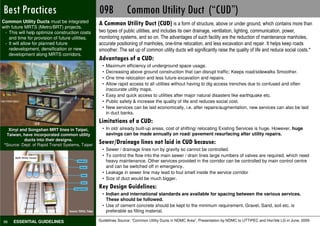
  • 97.
    09B Common Utility Duct (“CUD”) Best Practices Types of Common Utility Ducts: 1) Rectangular Duct with or without partition (accessible through Manholes): • Communication cables • Electrical cables • Water/Gas lines 2) Duct Bank: Pipes encased gravel or soil, often placed over a Concrete Bed. “Chairs” maintain spacing between electrical ducts. For power cables Above: For Telecom cables Sample Detail of a Gravel encased Duct Bank Pedestrian Design Guidelines © UTTIPEC, DDA in NDMC Area”, Report by NDMC to UTTIPEC and Hon’ble LG in June, 2009 Guidelines Source: “Common Utility Ducts 2009 ESSENTIAL GUIDELINES 97
  • 98.
    Not Preferable Best Practices 09B Common Utility Duct (“CUD”) 3) Fully Accessible Duct (accessible through Entrance Chambers) AC FUTURE EXPANSION TELECOM GAS DUCT FUTURE Section through Service Tunnel of CUD EXPANSION LT proposed in Connaught Place by NDMC LT FUTURE EXPANSION HT FIRE IRRIGATION WATER HT 6.3 M X 6.9 M 0.3 M BELOW THE ROAD LEVEL View of fully accessible CUD proposed in Connaught Place by NDMC, June 2009 Placement Norms for all 3 Types of CUDs: Sketch of a Fully accessible CUD with • Complete primary & secondary voltage can be laid in u/g duct system. respect to the Street above. • Manholes aligned parallel to street to facilitate conduit installation. • Duct bank straight & should drain into manholes. • Duct banks to contain pull cords • Plugged with tapered plastic plugs to prevent entry of debris. • Diameter of duct pipe : 1.5 x od of cable : 2 x od of gas pipe 98 ESSENTIAL GUIDELINES Guidelines Source: “Common Utility Ducts in NDMC Area”, Report by NDMC to UTTIPEC Guidelines © UTTIPEC, DDA 2009 Pedestrian Design and Hon’ble LG in June, 2009
  • 99.
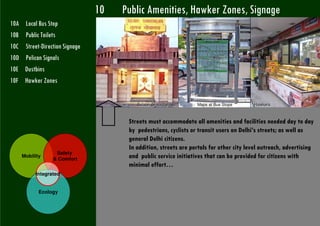
    10 Public Amenities, Hawker Zones, Signage 10A Local Bus Stop 10B Public Toilets 10C Street-Direction Signage 10D Pelican Signals 10E Dustbins 10F Hawker Zones Sulabh Shauchalaya Maps at Bus Stops Hawkers Streets must accommodate all amenities and facilities needed day to day by pedestrians, cyclists or transit users on Delhi’s streets; as well as general Delhi citizens. In addition, streets are portals for other city level outreach, advertising Safety Mobility & Comfort and public service initiatives that can be provided for citizens with minimal effort… Integrated Ecology
  • 100.
    Not Preferable 10 Public Amenities, Hawker Zones, Signage The Kit of Parts: Designated Hawker Zones (10G) must be allowed to locate in areas where pedestrians tend to wait or congregate i.e street intersections and near bus stops or major civic destinations, public offices, etc. X. Public Toilets (10A) should be located near every alternate bus-stop and definitely located at each Rapid Transit Station (Metro/BRT). Frequency of X. location of toilets should be every ~500 - 800 M. Y. Bus Stops with Route Maps (10B) must be Y. universally accessible, and located every ~800-1000 M. Z. Auditory Pelican signals (10C) and raised table-top Z. crossings at all mid-block or T-junctions, in absence of a full traffic signal. ~ 200 M max Auto and Cycle-Rickshaw Stands (04) should be provided near bus-stops, within the Multi-Functional Zone. “Set of 3” at every intersection must be provided for 1. Pedestrian Way-finding: finding 1. - Dustbin with map (10E) 2. 2. - Street directional signage (10D) 3. - Universal accessibility features (03B) 3. Pedestrian Design Guidelines © UTTIPEC, DDA 2009 100 ESSENTIAL GUIDELINES
  • 101.
    10A Local BusStop Best Practices Key Principles: • Dustbins – their frequent provision, cleaning and maintenance are key aspects to the cleanliness of a 1.8 M Clear Walking Zone city. • All bus stops must be universally accessible. • Bus Stops should preferably be located within the Multi-Functional Zone – so that they do not interfere with the 1.8 M clear walking zone for passing ! pedestrians at the back. This Bus Stop is accessible, but Clear 1.8M • Criteria for Placement of Local Bus Stops: Pedestrian Zone has not been left. Moreover, Space in front of bus stop for waiting 10A passengers is highly inadequate. See Section 13B This Bus Stop is correctly placed. A Local Area Map or an entire Bus- Route Map should be displayed on the panels of all bus- stops (besides advertising) , to help Wayfinding. Pedestrian Design Guidelines © UTTIPEC, DDA 2009 *Source: San Francisco Better Streets Plan ESSENTIAL GUIDELINES 101
  • 102.
    Not Preferable 10B Public Toilets Key Guidelines: Provide public toilets at a distance of every 500 – 800 M (5-8 minute walk) from each other and from any destination. Toilets should be located near every alternate bus-stop and at each Rapid Transit Station (Metro/BRT) Public toilets should be provided as combination of general toilets and accessible toilet, where accessible Lack of adequate clean and frequent public toilet to be marked as Multi-use toilet to be used by senior citizens, families with young children and toilets and abundance of unwatched disabled persons. boundary walls makes Delhi’s public Environmental friendly Sulabh Shauchalayas should be built as public toilets as they have the following spaces an open public toilet. advantages: They do not smell They consume very little water and are easy to clean and maintain (in contrast to conventional toilets that require a minimum of 10 litres.) They have potential to tie up with other community based environmental technologies such as biogas production, etc. for heating, cooking, and generating electricity. They provide new employment opportunities for many. Environmentally balanced wastewater treatment based on a duckweed and fish raising (pisciculture) ecosystem that provides economic opportunities for the urban poor. 10B (Above) Sulabh Shauchalayas (Right) A public toilet system that incorporates local treatment and water recycling system – providing much needed water for horticulture. Source: Pradeep Sachdeva Design Associates, 2009 Pedestrian Design Guidelines © UTTIPEC, DDA 2009 102 ESSENTIAL GUIDELINES
  • 103.
    Not Preferable 10C Street-Direction Signage Best Practices Key Principles: Signage for Wayfinding and Information of Pedestrians and Cyclists are essential for creating a public transport friendly city. Signage provides help to pedestrians to navigate the city with ease and safety, and have the following functions:* Orientation – Way finding (Street Signs) Availability of Public Transit Obscure Street Signage….. nearby (Transit Signs) Guiding Street Flow (Traffic 10C Signs) Announcing about City’s Vector Signage is Essential for Wayfinding. specific features or attractions (Information Signs) Conveniences (Toilet, dustbin, hawker signs). Signs should reinforce the overall character of the specific district and be consistent throughout the City. Pleasing Signage Pallette Posts and poles should be above. But Non-Vector arranged to minimize the number Signage is ineffective for and avoid clutter. Wayfinding. Visual Signage is preferable for Amenities and General Information *Source: San Francisco Better Streets Plan ESSENTIAL GUIDELINES 103
  • 104.
    Not Preferable 10D Pelican Crossings Delhi has very large block sizes. This provides limited permeability for Key Principles: pedestrians and makes them difficult to • Pedestrian initiated traffic lights may be installed at mid-block crossings to make traffic stop easily reach Destinations on the opposite for pedestrians, cyclists and the physically handicapped. side of the street after alighting from a bus or train… thus forcing them to jaywalk and risk their lives. At the same time, aggressive Delhi drivers do not stop at designated pedestrian priority STOP signs, unless it is a signalized intersection… Auitory Pelican Signal How to Use a Pelican Crossing? – A Road Safety Education 10D Feature on the Northern Ireland Road Safety Website. Source: http://www.roadsafetyni.gov.uk/ See Also: 03B Raised Table-Top Crossings 06B Mid-Block Crossing 104 ESSENTIAL GUIDELINES *Source: UK Government Road Safety Websites Pedestrian Design Guidelines © UTTIPEC, DDA 2009
  • 105.
    Not Preferable 10E Dustbins Best Practices Key Principles: • Dustbins – their frequent provision, cleaning and maintenance are key aspects to the cleanliness of a city. • Dustbins must be provided at each bus-stop and street intersection in order to discourage people from throwing trash on the road. Key Concepts: • On Source Separated Dustbins – signage for “Trash type” should be made of graphic symbols – so that even illiterate people can understand how to use them. • Private Sector could be involved in manufacturing and Littering in Delhi is a perennial problem. maintenance of dustbins in return for the incentive of Source: Hindustan Times, Oct 2009 getting waste for recycling or tax subsidies for firms if conducted as a CSR initiative. Transparent dustbins can be used in crowded places like Metro Stations, etc. 10E ? “How to use” Delhi’s new ‘source separated’ dustbins is a mystery to most people in the city. “Graphically explained” Source Separated Dustbins: Shanghai. Opaque Dustbins with Maps - can be use at general Street corners and Intersections. *Graphics Source: Miscellaneous, representative only. ESSENTIAL GUIDELINES 105
  • 106.
    Not Preferable 10F Designated Hawker Zones Importance and Types of Hawking Activities in Delhi: Hawkers or “micro-entrepreneurs” provide a wide variety of services and amenities to people, at convenient locations – with negligible investment and infrastructural costs. They keep streets clean, busy, vibrant and safe. They provide a variety of cheaper food and retail options. They express our unique culture and culture. They generate self-employment for a large number of people. ? Chai and Anda Wala Paani Wala ? Hawkers must be given designated space within the road Right-of-Way, so that they don’t occupy the Minimum Clear 1.8 M Pedestrian Walking Zone. Fruit Wala Shoe-Repair Wala Pedestrian Design Guidelines © UTTIPEC, DDA 2009 106 ESSENTIAL GUIDELINES
  • 107.
    10F Designated Hawker Zones Best Practices Hawker activity is predictable and can be provided for in the design of the street. Types of Hawkers in Delhi:* 1. Semi Permanent • Dhaba Wallas • Food Kiosk (Chips, Coke,etc.) 2. Stationary • Clothes / Shoes / Accessories • Boot Polish • Barbers Organized Food Stalls, China • Temple Offerings • Cycle Repair • Chai Wallas • Anda Wallas • Paan Wallas 3. Semi-Mobile • Tripod Stand Hawkers • Fruit Carts • Drinking Water Carts Organized Hawkers Organized Food Stalls, Beijing Organized Food Hawking Organized Hawking, London Organized Hawking, Mumbai Pedestrian Design Guidelines © UTTIPEC, DDA 2009 *Typologies Source: Pradeep Sachdeva Design Associates ESSENTIAL GUIDELINES 107
  • 108.
    Not Preferable Best Practices 10F Designated Hawker Zones Designated spaces will make enforcement easier which has not been possible so far. Key Principles: 1. Hawkers MUST be accommodated within the Road RoW – approximately every 500-1000 M on a public street. 2. They are needed at all commercial centers and must be at walking distance from offices, homes and retail areas. 3. Flexible Hawking Zones can be accommodated within the Multi-Functional Zone described in Section 04. 4. Essential Utilities also must be provided as outlined in the NATIONAL POLICY FOR URBAN STREET VENDORS: Connaught Place, New Delhi a) Provide provisions for solid waste disposal b) Public toilets to maintain cleanliness. c) Aesthetic design of mobile stalls/ push carts d) Provision for electricity e) Provision for drinking water f) Provision for protective covers to protect their wares as well as themselves from heat, rain, dust etc. g) Storage facilities including cold storage. Fashion Street, Mumbai 10F Hawkers must be given designated space within the road Right-of-Way, so that they don’t occupy the Minimum Clear 1.8 M Pedestrian Walking Zone. 108 ESSENTIAL GUIDELINES *Source: BRT Corridor Design Summary, TRIPP Pedestrian Design Guidelines © UTTIPEC, DDA 2009
  • 109.
    10F Designated Hawker Zones Best Practices In Columbia New Market, Kolkata San Diego A B Hawker zones at 1.8 M clearance for moving Hawkers Street Intersections pedestrians fronting Shops In Beijing CP, Delhi C 10F See Also: 04 1.8 M CLEAR Hawker zone Walking Zone on pavements In New York Pedestrian Design Guidelines © UTTIPEC, DDA 2009 ESSENTIAL GUIDELINES 109
  • 110.
    This page isintentionally left blank. 110
  • 111.
  • 112.
    This page isintentionally left blank. 112
  • 113.
    11 Traffic Calming Measures 11A = See 01D Kerb Radius and Slip Road Treatment 11B = See 03B Raised Table-Top Crossings and Driveways 11C Paving Variations at Crossings, Stop Signs, Intersections 11D Pedestrian Dominated “Kerbless” Streets 11E Chicanes 11F Mini Traffic Calming Circles 11G Full Closures Traffic Calming is the management of traffic – through a combination of Education, Enforcement and Engineering devices – so that its negative impacts on residents, pedestrians and schools is minimized. Mobility Safety The goal of traffic calming is to reduce vehicle speeds, improve pedestrian & Comfort and cyclist safety, and enhance quality of life. Integrated Signal free and fast movement of motorized vehicles within city limits (other than Mass Rapid Transit Systems) is to be minimized, as this Ecology makes the city extremely unsafe for pedestrians and public transport users and causes fatal accidents. Romi Roy UTTIPEC
  • 114.
    Not Preferable 11A Kerb Radius and Slip Road Treatment Best Practices Free left turns/ Signal- Safe, Signalized free slip roads make Pedestrian crossings traffic turn corners at after free slip roads are high speeds, making it removed and curb-radii unsafe for pedestrians reduced. and cyclists to cross. See also: 01D Current: Typical Delhi Road Intersection Proposed: Modified Intersection Design Source: San Francisco Better Streets Plan Pedestrian Design Guidelines © UTTIPEC, DDA 2009 Drawings Courtesy: PSDA, 2009 114 ADDITIONAL GUIDELINES
  • 115.
    11B = See03B Raised Table-Top Crossings & Driveways Best Practices Only Anti-Skid, uniform materials to be used on Tabletop Crossings – for comfortable access by people with reduced mobility. www.pedcycleimages.org See also: Table-top Crossings slow down traffic at Intersections and Mid-block Crossings – 03B 06C allowing pedestrians & cyclists to cross safely Pedestrian Design Guidelines © UTTIPEC, DDA 2009 Drawing Courtesy: TRIPP and SG Architects, 2009 ADDITIONAL GUIDELINES 115
  • 116.
    Best Practices Not Preferable 11C Paving Variations at Crossings, Stop Signs, Intersections Minimum 1% slope in all directions for Drainage Raised Paved Intersections Raised or Paved Plazas (or “Chowks”) at Intersections induce traffic to slow down while turning – making them watch out for crossing pedestrians and cyclists at the intersection. Use of continuous Paving Materials Paving change before Tabletop Crossing or Colors at Crossings – provides visual continuity to Pedestrians and also makes crossings clearly visible to drivers from a distance. Paving change before normal Zebra Crossing Pedestrian Design Guidelines © UTTIPEC, DDA 2009 116 ADDITIONAL GUIDELINES
  • 117.
    11D Pedestrian Dominated:Kerb-less Streets Best Practices Rough Textured Paving Change at regular intervals can help keep MV speeds under acceptable limits. TABLE-TOP PAVED SHARED “CARRAIGEWAY” INTERSECTION PERMEABLE PAVING along “ TREE PLANTING ZONE” “WALK ONLY ZONE” Any Street with heavy mixed-use activity, and streets narrower than 12 M Kerbless Paved Streets, Mumbai in Residential and University Areas may be considered “Pedestrian Dominated Streets” with the following features: These streets can be made “Kerbless” and paved over in different Materials to give the impression of being slow-speed and pedestrian dominated. Paving along the main carriageway helps create friction, making motorized vehicles move slower, thus increasing safety. Safe jaywalking is desirable on such streets. Bollards and/or Tree Buffers may be used to keep cars from entering the “Walk Only Zone” along the edges of the Street. Kerbless Street Kerbless Street with Bollards, Montmartre Paris Kerbless Street, Soho, London with Bollards, Brick Lane, London Pedestrian Design Guidelines © UTTIPEC, DDA 2009 ADDITIONAL GUIDELINES 117
  • 118.
    Best Practices Not Preferable 11E Chicanes A chicane is a series of alternating mid-block curb extensions or islands that narrow the roadway and require vehicles to follow a curving, Serpentine path – thus reducing vehicular speeds and increasing safety for pedestrians and NMVs. Chicanes can be used on one-way or two-way streets and can be single lane or two-lane Chicane: Vancouver, Canada configurations. (Credit: Richard Drdul) Key Guidelines: 1. Chicanes can be created by modulating the “Multi Functional (Tree Planting) Zone in order to created the curved geometry. (See also: Section 04) 2. Chicanes must maintain the required clearances for emergency vehicle access. 3. Locate trees and planting (06C) within Chicane curb extensions to capture and filter storm water, and add greenery to street. 4. Integration with Street Storm Water management plan is a must, as gutters may have to be incorporated in Chicane Design. Source: Draft Canadian Guide to Neighbourhood Traffic Calming, 1998, Pedestrian Design Guidelines © UTTIPEC, DDA 2009 118 ADDITIONAL GUIDELINES Copyright Transportation Association of Canada.
  • 119.
    11F Mini Traffic Calming Circles Best Practices A Mini- Traffic Calming Circle is a raised island located in the center of an intersection around which traffic must circulate. They are ideal for all Streets below the Hierarchy of Primary Collector (30-40 M or lower) where Design Speeds are to be kept below 30 km/hr for safety of all road users. Key Guidelines: Regulatory Signage 1. Mini traffic circles should be large enough to Local planting and Soil treatment for Storm force cars to slow down to go around them; Water Capture and Infiltration. See also: 06C but the outer two feet or so of the circles should have a concrete apron, with a low Mountable Kerb with Permeable Paving four-inch curb such that emergency vehicles can go over easily when necessary. Typical Mini Traffic Circle in Vancouver, Canada Design speeds for movement around the (Credit: Richard Drdul) circle should be 10 to 15 mph; exit speeds should be limited to 15 mph through the circle’s design wherever possible. 2. Centres of mini traffic circles should be attractively landscaped. Planting of local, Conflict points at traffic c calming circles (and roundabouts). Source: drought-tolerant and low-maintenance plants Stidger, Ruth “Can America Handle Roundabouts,” Better Roads, 2003 is encouraged. Local community participation should be sought in planting and maintaining of these circles. Advantages: • Reduces speeds and accident rates, particularly when applied consistently to an area. • Can green and beautify the streetscape with (Credit: San Jose Department of Transportation) trees and/or vegetation, improving Mini Traffic Calming circles should not be confused with environmental quality. Full Roundabouts, which handle much higher traffic • Rain gardens and local planting in traffic circle volumes and encourage free flowing, faster movement can provide Stormwater treatment and reduce of motor vehicles, thus making intersections less safe for run-off, seasonal flooding and pressure on pedestrians. existing stormwater infrastructure. Full Roundabouts are NOT RECOMMENDED, unless Source: San Francisco Better Streets Plan necessary for handling 5 or 6-arm road intersections. Pedestrian Design Guidelines © UTTIPEC, DDA 2009 ADDITIONAL GUIDELINES 119
  • 120.
    Best Practices Not Preferable 11G Full Closures Full Closure is a a physical barrier at an intersection to fully close a street segment to motor vehicle access at one end. • The barrier can be a fence or bollards, a basic sidewalk, or an elaborate landscaped space or plaza. • The affected street segment becomes a cul–de–sac for motor vehicles, while pedestrian and bicycle access can be maintained through the use of a dedicated bicycle channel or other design elements. • Emergency vehicle access can be maintained by using mountable curbs and a clear path. Key Benefits: 1. Speeding through traffic is completely eliminated, limiting street access to only local residents/ users. Permeability to pedestrians and NMVs is maintained, ensuring easy shortcuts for these users. 2. Pedestrian and NMV safety is enhanced by eliminating vehicular crossing at the closure. 3. Larger closures can create a sizeable public spaces with community facilities such as seating, Full Closure in Residential colony: Vancouver, Canada (Credit: Richard Drdul) plantings, etc. Full Closure in a Mixed Use District: London Drawings Courtesy: City of San Jose: Traffic Calming Toolkit (2001) Pedestrian Design Guidelines © UTTIPEC, DDA 2009 120 ADDITIONAL GUIDELINES
  • 121.
    12 Material Selection 12A Material Selection Guidelines Anti-skid, non slip, 12B Sustainable/“Green” Material unglazed material. Options Permeable Pavement: - Concrete with Cement Substitutes Zero Runoff or Bio-swale - Clay Substituted: Fly-Ash Bricks - Recycled Asphalt High-albedo coatings - Recycled Rubber Pavement 12C High-Albedo Materials 12D Permeable Pavement 12E Paving Sub-grade 12F Edge Courses 12G Accent Materials Safety Mobility Appropriate Selection of Materials in design impacts the aesthetics, usability and & Comfort comfort of the street for all its users – and in the long run has a huge impact Integrated towards endearing these places to the people of the city. Materials selected should have minimal impact on the environment in terms of Ecology carbon emissions, embodied energy, life-cycle costs, quarrying, transporting and top-soil preservation. Materials selected should reduce storm water runoff and urban heat island effect, as much as possible. Romi Roy UTTIPEC
  • 122.
    Not Preferable 12A Material Selection Guidelines Recommended Materials for Exterior Use:* Areas Do’s Don’ts 1 Footpath Anti skid / matt finish tiles, interlocking paving Polished Stone tiles, sandblasted Stone, unpolished Stone, finishes checkered tiles 2 Kerb ramps Anti skid / matt finish tiles; Flared sides with tactile Polished Stone paving, exposed Cement Concrete finishes 3 Tactile paving Vitrified unglazed pavers in bright colour contrast Stainless steel or to the flooring surface (preferably canary yellow) metal pavers in dull /slippery finish 4 Signage Bright colour contrast big font signages on non- Glass, stainless steel, glare surface- acrylic, metal (fully painted) with aluminum retro reflective paints 5 Bus Stops Anti skid / matt finish tiles with vitrified unglazed Glazed vitrified tiles, flooring tactile pavers in bright colour contrast to the Granite, polished Kota flooring surface stone 6 Streetlights White color, mercury lights- full cutoff fixtures Yellow lights 7 Handrails Stainless steel 304/316, OD- 40-45mm, scotch- Polished Stone finishes are highly undesirable. brite or matt finish 8 Light signals Audio signals with time display Normal light signals 9 Table top Any load bearing anti-skid pavers, tiles Cobble stone 10 Table top Cobble stone may be provided Polished granite or slopes (on any other Slippery road side) Surface 11 Median Any load bearing anti-skid pavers, tiles Cobble stone refuges 12 Cycle tracks Preferred Pavement Quality Cement Concrete CC Paver Tiles and Polished Finishes Glazed Tile finishes are not desirable. 122 ADDITIONAL GUIDELINES *Prepared in consultation with Samarthyam, TRIPP and SGA Pedestrian Design Guidelines © UTTIPEC, DDA 2009
  • 123.
    12B Suggested Sustainable/“Green” Materials Best Practices All paving materials, as a rule – should be finished as anti-skid, non slip, unglazed material. Key Guidelines: 1. Locally Available Materials should be preferred i.e. majority of the materials should be available within 250 km of site. 2. Since most road projects are redevelopment projects – Reuse/ recycling existing road construction materials is preferable and advisable. 3. Materials which have some recycled content or that can be recycled after use should be preferred. E.g: • Recycled Asphalt • Recycle Rubber • Flyash • Recycled stone or other existing construction materials. 4. Long life, durability and ease of repair of materials must be factored in during material selection and project cost calculations. 5. Use and depletion of finite raw materials should be reduced - by replacing them with rapidly renewable materials. (Rapidly renewable materials are ones that are typically harvested within a 10 year cycle, eg, bamboo products, corn products, wheat based products, strawboards etc.). 6. Materials with low cement content and low embodied energy should be given preference. Recommended Options: Materials which have some recycled content or that can be recycled after use should be preferred. E.g: • Recycled Asphalt • Recycled Rubber • Flyash • Recycled stone or other existing construction materials. • Recycle components in Concrete Pedestrian Design Guidelines © UTTIPEC, DDA 2009 ADDITIONAL GUIDELINES 123
  • 124.
    Not Preferable 12B-i Recycled Asphalt Asphalt pavement is commonly composed of 5 percent asphalt (a petroleum derivative) and 95 percent Why is traditional Asphalt Coarse (stone, gravel), and Fine (sand) aggregates - laid down in layers and compacted. environmentally unsustainable ! Asphalt Pavements are highly recommended if the following substitutes are incorporated: Excessive use of stone 1. Aggregate Substitutes for Asphalt Pavement:* Aggregate component of • Substitutes for Coarse Aggregate = Crushed concrete, Asphalt – leads to foundry sands, hydrated coal fly ash and slag. Air cooled blast furnace excessive mining/ slag and steel slag in particular provide good rutting resistance and superior quarrying which implies: friction properties, making it a choice aggregate for the surface course. • Use of water and fuel for Nonferrous Slag • Substitutes for Fine Aggregate = Addition of about 35 volume % mining (= CO2 emissions) Coal Fly Ash to the aggregate component of hot-mix asphalt (HMA) • Quarries abruptly interrupt enhances the resistance of the asphalt to cracks and potholes. This new type the continuity of open of hot-mix asphalt should last at least five times longer than the normal space, ruining habitats for hot-mix asphalt. Low-carbon content Fly Ash flora and fauna alike. • Asphalt Binder Modifier = Ground Recycled Rubber, if added to the • Stone quarrying causes HMA prior to mixing with the aggregates, allows it to chemically react with the air pollution, most notably mixture. Asphalt concrete pavements made with rubber modified asphalt dust. cement tend to have less cracking, and wear better than regular pavements. Scrap Rubber Tyres They also significantly reduces traffic noise when used on carriageways. 2. Asphalt pavement could potentially be 100% recyclable and be reused as a Subgrade [See 12D] for new streets. 3. High-Albedo Coatings along with color pigments may be applied to Asphalt –to reduce Urban Heat Island Effect [See 12C] Functional and Cost Benefits: • The hydrophobic nature of fly ash gives pavements better resistance to cracking & potholes, making them safer and more durable, with a longer Pavement life. • Cost saving by decreasing the need for asphalt binder. Recycled • Less expense and frequency of required maintenance treatments Asphalt to keep the pavement in good functioning condition. Pavement • Reusing materials reduces the need for mining virgin aggregate www.pwri.go.jp/team/pavement/english/subject/projects.html and the associated environmental impacts. (See left) *Source and Copyright 2008: by The Industrial Resources Council Pedestrian Design Guidelines © UTTIPEC, DDA 2009 124 ADDITIONAL GUIDELINES http://www.industrialresourcescouncil.org/Applications/HotMixAsphaltPavement/tabid/378/Default.aspx
  • 125.
    12B-i Recycled Asphalt Best Practices La-Bisbal,Spain Manhattan, New York Padova-Italy a) Imprinted Asphalt: b) Hexagonal Asphalt Pavers: c) Thermoplastic Imprinting: Machine-heated asphalt, imprinted with a Asphalt pre–cast into hexagonally-shaped Thermoplastics applied into grooves pattern template and colored with pavers. created by heating and imprinting the protective coating. asphalt. Application: Application: Application: • Pedestrian Dominated Streets with • High wear and tear Sidewalks • Crosswalks/ Road Markings restricted vehicular traffic [See 11D], Benefits: • Public Art on Streets Pedestrian only streets, Plazas Benefits: • Hexagonal pavers are relatively easy to Benefits: reset or replace, especially for utility • Because the thermoplastics are imprinted • Can be installed on existing asphalt that is access. below the level of the road surface, the in good condition. • Easy to replace and/or recycle. application will not begin to wear until about • More cost–effective and easier to maintain ¼ inch of the asphalt has been worn away, than unit pavers. resulting in a longer lifespan than typical thermoplastic crosswalks markings. Pedestrian Design Guidelines © UTTIPEC, DDA 2009 Source: New York Street Design Manual Photo Credits: Integrated Paving Concepts ADDITIONAL GUIDELINES 125
  • 126.
    Not Preferable 12B-ii Concrete with Cement & Aggregate Substitutes Why is Concrete the most Cement – an integral component of Concrete – is the single biggest material source of carbon emissions in the world. The use of Concrete for roads and pavements is NOT recommended unless the following environmentally unsustainable ! components of traditional concrete are substituted: a) Extremely high GHG 1. Cement Substitutes in Concrete = Class F Fly-Ash* Emissions: Owing to its pozzolanic properties, Class F Fly ash can be used to replace The cement industry 30-70% by mass of Portland cement. This has been successfully produces 5% of global implemented in various projects around India. man-made CO2 emissions, of which 50% Benefits: is from the chemical • The setting time of Flyash concrete is slower BUT the final concrete’s strength, process of heating chemical resistance and durability is substantially higher. Calcium Carbonate, and Coal Fly Ash 40% from the burning fuel. • Due to the fineness and spherical shape of fly ash particles, the fluidity and workability of fresh concrete is much higher, thus reducing water demand during mixing. b) High Embodied Energy: The process of cement manufacture uses 2. Aggregate Substitutes = Recycled glass cullet; Crushed recycled large amounts of Energy. Recycled crushed concrete concrete itself* c) Mining of Virgin Aggregates: • Concrete made with recycled concrete aggregate has at least two-thirds the The coarse and fine aggregate compressive strength and modulus of elasticity as natural aggregate concret components of concrete lead to excessive mining and quarrying with its associate • Crushed and screened waste glass may be used as a Fine Aggregate i.e. Sand negative impacts like fuel and water substitute in concrete, e.g. "non-recyclable" clear window glass and fluorescent bulbs. consumption, habitat destruction and CO2 Possible applications for such waste-glass concrete are bike paths, footpaths, gutters Recycled Glass Cullet and similar non-structural work. emissions. Application: Bike Paths, Footpaths, Gutters and any non- structural concrete works. *Source: Toolbase Services Pedestrian Design Guidelines © UTTIPEC, DDA 2009 126 ADDITIONAL GUIDELINES http://www.toolbase.org/TechInventory/
  • 127.
    12B-iii Clay Substituted:Fly-Ash Bricks Not Preferable Best Practices Bricks are one of the most long lasting an beautiful materials that can be used for pedestrian paved Why are Clay Bricks areas. However, they are recommended only of the following substitutes to Clay are incorporated: environmentally unsustainable ! Fly-Ash Bricks (FAB) are the most desirable alternative to traditional Clay-fired a) Top Soil Depletion: The Clay used for Brick a) Composition: Bricks:* manufacture generally FABs comprise of Class C Fly ash –a waste product of the coal-power comprises of the industry, sand and other additives. Pulverized Class C Fly Ash is a self- cementing material which gradually hardens on contact with water. fertile top-soil which is ideal for agriculture. If not used for bricks, fly-ask is a waste product that pollutes the environment Depletion of this fertile top further by landing up in landfills. soil is highly undesirable. b) Manufacture: b) High Embodied Energy and GHG Fly Ask bricks require no burning and are manufactured by a steam bath and compression process and then toughened with an air entrainment agent. Emissions: The process of burning bricks in a kiln c) Benefit: during manufacture consumes large Beautiful material achieved at 20% less cost and a fraction of the Energy amounts of Energy and causes huge Consumption and Carbon Emissions of a traditional clay brick. Green House Gas Emissions. Application: Plazas, Seating and Accent Areas. Flyash Bricks and Pavers are widely available with various Manufacturers in India. Pictures Source: Alibaba.Com, Global Trade Portal *Source: The Building Brick of Sustainability: Construction Specifications Institute Magazine Pedestrian Design Guidelines © UTTIPEC, DDA 2009 http://calstarproducts.com/wp-content/themes/default/pdf/BldgBrick_Sustainability.pdf ADDITIONAL GUIDELINES 127
  • 128.
    Best Practices NotPreferable 12B-iv Recycled Rubber Pavement Rubber Sidewalks – are an interlocking modular open- grid pedestrian paving systems – which are potentially the most sustainable alternative to concrete paving. Composite Rubber Sidewalks are being developed by the Shriram Institute for Industrial Research. Samples and Test sites are yet to be seen. Recycled Rubber Sidewalks in Vancouver, CN Advantages & Cost Benefits: Rubber sidewalks allow periodic tree root inspection, access to utilities, without costly concrete repair and replacement. Modular system allows pavers to be periodically opened for inspection and immediately ‘reinstalled’ Rubber sidewalks are unbreakable. They can also easily be cut to fit corners and different shapes on pavements. Unlike Rubber sidewalks, concrete cannot be “maintained” and must be demolished, off-hauled, and replaced when damaged. Environmental Benefits: Directs water into soil (Permeable) thus reducing water run-off Easy to mould around trees, ramps, etc. into storm drain. Resilient though firm, more comfortable and healthy to walk on. Absorbs sound, reduces decibel level of foot and wheeled traffic Safe, non-toxic and flame resistant Can be used in tree wells as well as sidewalks Excellent for use in temporary sidewalk situations, e.g. events or construction sites. One-square-foot of Rubbersidewalks recycles waste rubber from one passenger tyre Rubbersidewalks can be recollected and recycled at the end of their life cycle and the material used again. Application: All sidewalks. Extremely easy to apply and repair. Source: Rubber Sidewalks, Inc. Pedestrian Design Guidelines © UTTIPEC, DDA 2009 128 ADDITIONAL GUIDELINES http://www.rubbersidewalks.com/pdf/Fact_Sheet.pdf
  • 129.
    Not Preferable 12C/01F High Albedo Materials Best Practices High Albedo/ ‘Reflectivity’ Materials reflect more of the sun’s rays and absorb less heat than traditional black asphalt pavement or darker paving materials, thus mitigating the urban heat island effect. • Most cool pavements use materials such as lighter colored aggregate, sand, and cement products. Light-colored paving; • High Albedo Materials can reduce pavement surface Carter Road Promenade, Mumbai temperatures by 11°C-22° and this may increase C, pavement life. Key Design Guidelines/ Application: 01F Dark colors of some materials such as asphalt, tremendously increases the urban heat. Choose light-colored pavers (Light gray, beige and tan colors), aggregates or top coats, preferably with a reflectivity of 0.29 or higher. Parking lots, pavements, roads, driveways and other surfaces can have coatings or integral colorants added to increase Highway showing left side paved with high- reflectivity. albedo asphalt and the right side paved with conventional asphalt. If paving with asphalt, applying a white aggregate as a chip seal layer, or a light-colored surface coating such as a zinc- oxide slurry mix. * Darker paving absorbs more sun-rays and radiates it By reflecting more sunlight, lighter–colored paving back as infra-red, increasing ambient air temperature. reduces the urban heat island effect *Heat Island Reduction Initiative, U.S. © UTTIPEC, DDA 2009 Agency Pedestrian Design Guidelines Environmental Protection ESSENTIAL GUIDELINES 129
  • 130.
    Not Preferable 12D/01G Permeable Pavement Best Practices Permeable pavement is a paving system which allows the rainfall to percolate into an underlying soil or aggregate storage reservoir, where stormwater is stored and infiltrated to underlying subgrade, or removed by an overflow drainage system. Permeable pavements provide ground water recharge and reduce pollutants in stormwater runoff into rivers and Nallahs. Parking Lot in Sydney, Australia Application: After 2 hours of rain…. • Permeable paving is most suitable for large paved areas without heavy foot traffic or any fast vehicle movement. Therefore, all areas within the Multi-Functional Zone [Section 04], parking lots, driveway curb-cuts, large plazas, hawker zones, pedestrian only streets, etc. are most suitable for permeable pavements. • The sub-grade of porous paving surfaces must be porous to a minimum depth of 150 MM well – in order to achieve the desired level of permeability. Hawker Zone in Shanghai, China 6” POROUS PAVEMENT LAYER 01G After 4 hours of rain… The increase of impervious surfaces in Delhi has led to serious flood issues. Permeable Rubber Sidewalk in Vancouver http://www.mapc.org/regional_planning/LID/permeable_paving.html 130 ESSENTIAL GUIDELINES
  • 131.
    12D/01G Permeable Pavement Best Practices Types A B C D E Permeable Asphalt Permeable Concrete Interlocking Concrete Open-Celled Paving Grid Open-Celled Paving Pavers with Vegetation Grid with Gravel Fundamentally the same as This is a variation of traditionalThemselves are not always Open-celled paving grids consist The same open-celled grid regular asphalt, but it does not concrete, but without the fine permeable, but they are typically of a rigid grid composed of structure is employed but the contain the fine particles that particles in the mix. installed with gaps between concrete or a durable plastic that voids in the rings are filled with asphalt does, hence, creating them to allow infiltration into the is filled with a mix of sand, a mix of gravel. •Installation is quite different porosity. from the traditional method, and subsurface. The gaps, typically gravel, and topsoil for planting •With the gravel in place this requires experienced 10% of the surface area, are vegetation. •Need to be cleaned 2 to 4 grid system does provide times a year to avoid build- installers both in the mixing and filled with a permeable material, •The plastic grid pavers are also additional structural laying of the product. usually small clean stone. up of debris. But some flexible, allowing them to be support. And since most grid- research has found that even •They have a long useable life, used on uneven sites. cell material is plastic, hence •Proper maintenance includes with 99% clogging the are relatively easy to install flexible, it can adapt well to periodic vacuuming of the •They do not require another infiltration rate can be up to 10 and provide good infiltration. shrink/swell and freeze/thaw surface to prevent clogging drainage facility and are inches/hr. conditions. with sediment or organic •However, they are sensitive to competitively priced to •It does not require special material. With proper deformation in the base and do asphalt and concrete paving, •Most commercially available training and can easily be maintenance it can last a require a thick base to prevent when their required drainage geocell material is made from supplied by conventional minimum of 20 years. "heaving." costs are factored in. recycled material, an added asphalt batch plants environmental plus. Pedestrian Design Guidelines © UTTIPEC, DDA 2009 Source: Seattle Right of Way Improvement Manual and UC Davis Research ADDITIONAL GUIDELINES 131
  • 132.
    Maintenance Not Preferable 12D/01G Permeable Pavement Paving Sub-grade: The sub-grade of porous paving surfaces must be designed and executed porous as well – in order to achieve the desired level of permeability: PERMEABLE PAVEMENT SIDEWALK ADJACENT TO SWALE OR DITCH PERMEABLE PAVEMENT SIDEWALK ADJACENT TO CURB Application and Design Considerations: In general, sites where pervious pavement will be installed needs to meet the following criteria: • Soils need to have a permeability of at least 0.5 inches per hour. An acceptable alternative design for soils with low porosity would be the installation of a discharge pipe from a storage area or “Percolation Pit”. • Areas that have high potential for contamination such as transfer stations, gas stations, or highly industrial areas may not be suitable for permeable pavements due to the increased risk of groundwater contamination. • The bottom of the stone reservoir should be flat, so that runoff can infiltrate through the entire surface. • The seasonal high water table should be at least 1M below grade. • It should be installed at least 30 M away from drinking water wells. • Pervious pavements should not be used in areas with a slope > 15%, as erosion of the fill material may occur. Maintenance for All Permeable Pavements is critical to their performance: Permeable pavements and pavers require some additional maintenance to keep them functioning properly: • Inspect for surface material that may clog the pavement: Inspect the project upon completion to remove any fine material that has accumulated on the surface. Conduct periodic visual inspections to determine if surfaces are clogged with vegetation or fine soils. Clogged surfaces should be corrected immediately. • Periodic vacuum sweeping or pressure washing: Permeable concrete and permeable asphalt surfaces should be swept with a high-efficiency or vacuum sweeper at least once every month. High pressure hosing could substitute for sweeping or supplement sweeping if material appears clogged. For gravel pave or unit pavers, replace gravel if clogging occurs. • Replenish aggregate: Replenish paver aggregate material as needed. Source: US EPA National Pollutant Discharge Elimination Systems Pedestrian Design Guidelines © UTTIPEC, DDA 2009 132 ADDITIONAL GUIDELINES
  • 133.
    12E Sub-Grades and Sub-Bases Best Practices [12 B] Paving as per design - over mortar Pavement Virgin Soil or appropriate binding material After Construction Before Construction Mortar 4:1 = Sand: Cement Paving + Mortar Bedding Sub-Base Bedding layer carries the final surface layer. This is usually a coarse grit sand, with a low Geo-Textile clay content and with good drainage properties. Sub-Grade Sub-Base layer is often the main load-bearing layer of a pavement. Sub-Grade . is the lowest point of the pavement structure - the underground level at which excavation ceases and construction starts. Sub-grade mostly comprises of compacted earth, except for Permeable Pavements where it must be kept uncompacted. Geo-textile Fabrics – like GeoJute, etc. These are often non-woven, permeable sheets applied between pavement layers to prevent the various layers of the pavement mixing or disappearing into lower layers. Unbound Materials Bound materials use a They thus prevent premature cracking of the surface pavement layers, especially Asphalt. rely on natural binder like cement or interlock. bitumen (tar). Functions: Separation between base layers where required; Filtration (liquids and gases); Reinforcement of pavement layers. They are Permeable; They are Impermeable. Applications: May comprise: May comprise: • Generally a mixture of •100-150 MM thick coarse (gravel) and cement concrete slab fine (sand) aggregate. •Recycle granular • Could also comprise materials like blast- of crushed stone, furnace slag, mixed with crushed slag, crushed cement and water and concrete or non- compacted. plastic well-burnt Application: Only In case of clayey soil, geo-textiles help keep the Root Barrier Geo-textiles protect shale. pavements where heavy overlying sub-base material from sinking into a drainage and foundations clayey or softish sub-grade. Application: Universal loads or bad grounds are expected. Between Bedding & Sub-Grade Between Sub-base & Sub-Grade Around utilities & foundations Pedestrian Design Guidelines © UTTIPEC, DDA 2009 Source: PavingExperts.Com; Jmdcindia.com ADDITIONAL GUIDELINES 133
  • 134.
    Not Preferable 12F Edge Courses Edge Courses – Functions and Applications: Edge courses provide a number of functions in a properly constructed block pavement. These functions can be divided into three categories: Structural: Functional: Aesthetic: They form the restraining edges for a They eliminate the need for cut blocks at the edge of a They form a frame to the pavement that pavement. pavement. gives it definition and shape. They can be used as level guides for preparation of the screeded bed. They facilitate cutting-in procedures. They can act as drainage channels, directing surface water to a suitable disposal point. Edge Course functionally important at a Free Edges (e.g. parks, soft edges, etc) Where a kerb is present, the edge course may be purely functional/aesthetic. Edge Courses at building edges can help Brick Drainage Fluted Drainage Concrete Drainage Channel direct water away from building foundations. Channel in Walkway Channel in Walkway in Asphalt Pavement Source: PavingExperts.Com Pedestrian Design Guidelines © UTTIPEC, DDA 2009 134 ADDITIONAL GUIDELINES
  • 135.
    12G Accent Materials Public Art engraved Stone Tiles with brick tile paving. Paving in Rough Kotah stone. Seats in stone masonry. Red tinted PCC Tiles and concrete bollards with Kiosk columns clad in ceramic mosaic. (Vikas Sadan, Delhi) glaze Ceramic tile highlights. (BRT Delhi) Different colors and textures of Brick and Red Sandstone Permeable grass pavers use in sloped seating area with Ceramic Tiles use on vertical surfaces an risers use to create this warm and well scaled Plaza. walkway in rough finished stone pavers. (Shanghai) of steps to add color (Bikaji Cama Place, Delhi) Pedestrian Design Guidelines © UTTIPEC, DDA 2009 ADDITIONAL GUIDELINES 135
  • 136.
    This page isintentionally left blank. 136
  • 137.
    - This Chapteris Suggestive Only - 13 Public Art, Street Furniture, Educative Signage Paving Patterns Public Awareness Campaigns Manhole cover art, Chandigarh Public Art in Delhi must be integrated with regular street furniture, Signage or Education and Awareness Messages, etc. in order to play a dual role – “utility” as well as “aesthetics”. It can be a powerful tool for education and outreach. Carefully designed art could have a significant impact on the behavioral patterns of people. Public Art also helps build civic pride and a sense of ownership amongst citizens, especially if local Safety communities can be involved in their installation, renewal and maintenance. Mobility & Comfort Street Furniture is an important component of streets as it helps create resting or “pause” spaces along the daily paths of people and makes streets more enjoyable. All Street Furniture should be located Integrated within the Multi Functional Zone and kept CLEAR of the designated Walking and NMT zones of the street. ELEMENTS OF THE URBAN INFRASTRUCTURE POSSIBLY USABLE AS PUBLIC ART Ecology (Suggestive Only): • Pavements • Boundary Walls • Tree Trunks • Manhole Covers • Fences and Handrails • Street Furniture • Dustbins • Public Toilets • Bus Stops • Pavements Romi Roy UTTIPEC
  • 138.
    Not Preferable 13A Boundary Wall Art! Best Practices The long-term solution to walls and footpaths being used for public urination and spitting - is the removal of boundary walls and creating “eyes on the street” – which would also make the city safe for women. See page 21. In the short-term – the abundant boundary walls around the city could be used for educative public art. ! When there is no feeling of belonging, pavements are not maintained and littering is common Educative Public Art on boundary walls is used as a “Signature Statement” throughout the Streets of Philadelphia, US ! A Common Site in Delhi due to the abundance of A Boundary Wall in Kalbadevi, Mumbai used for ‘Environmental unwatched boundary walls. Education’ Art – created by children through NGO cooperation. Pedestrian Design Guidelines © UTTIPEC, DDA 2009 138 ADDITIONAL GUIDELINES
  • 139.
    13B Art on Dustbins, Bollards Best Practices Innovative, clean, well maintained and well loved Dustbins are the key to a “Clean” City. An Artistic way (graphics, cartoons) could convey – In Philadelphia, Art on Dustbins Maps on dustbins showing “How to use” Delhi’s new ‘source separated’ why and what kind of waste should go into which bin strongly convey the Environmental location of nearest dustbins is a mystery to most people in the city. – even to illiterate users. Philosophy of the City. landmarks and public toilets. Bollards play a huge role in segregating areas for “pedestrian use only” and help increase safety and usability of public spaces and footpaths. Bollards could be designed as expressions of public art (through city level design competitions or design festivals). This would help generate civic pride and a sense of ownership amongst Delhi citizens. Full Cutoff Bollard Lights enhance visibility without Glare. Pedestrian Design Guidelines © UTTIPEC, DDA 2009 ADDITIONAL GUIDELINES 139
  • 140.
    Not Preferable 13C Social Art at Bus and BRT Stops, Metro Stations. Art for Conveying……. Important SOCIAL MESSAGES: Bus stops can be used as canvases of public art conveying messages about anti-eve teasing, anti-molestation of women, anti sexual abuse etc.... Example of Social abuse Signage at a Bus Stop in New York. Safety Data of Delhi shows that most women find buses and bus-stops the MOST UNSAFE places in Delhi. “The most unsafe time out - 40% felt unsafe between 8 and 10 am and 5 and 7 pm. 31% felt unsafe in mid-afternoon. Most unsafe places - 45% identified buses as the most unsafe; 25% the roadside; 6.7% found bus stops...” – A Delhi Police survey on women’s safety, 05 March 2006. Source: http://southasia.oneworld.net/article/view/127142/1/ Pedestrian Design Guidelines © UTTIPEC, DDA 2009 140 ADDITIONAL GUIDELINES
  • 141.
    13C Maps at Bus and BRT Stops, Metro Stations. Best Practices Adequate Wayfinding Signage and well-designed, artistic and bi-lingual “Local Area Maps” should be displayed at all Metro Station Exits and at Bus Stops – showing local roads and important civic destinations. Bus Stops and Metro Stations should also display an Overall System Route Map. Information about bus routes and timing must also be displayed in static signage (even if intelligent signage exists). Local Area Map & Info: at a Metro Station Exit in Shanghai. Map © SFTMA.COM Local area map at a bus stop, Shanghai Advertising and Signage at a bus stop, Delhi Pedestrian Design Guidelines © UTTIPEC, DDA 2009 ADDITIONAL GUIDELINES 141
  • 142.
    Not Preferable 13D Street Furniture: Seating Areas, Pause Spaces… Seating is an essential piece of Street Furniture which provides pedestrians and especially public transport users an opportunity to rest or pause, in the mist of their daily schedules… • Seating provided must be easy to clean, located in areas that are well watched, busy, and well shaded by trees or artificial canopies - to protect people from the harsh Delhi heat. • Ideally low maintenance seating should be located under deciduous trees and designed for easy cleaning and maintenance. Functional Public Art: SHADED SEATING…. Chair extensions hold up the roof over your head, while providing a seating place at the same time. (Street furniture: Hudson Riverfront, New York) Lack of Adequate Seating Facilities in the City, especially near Transit Stations Well shaded, easy-to-maintain Seating, Beijing Pedestrian Design Guidelines © UTTIPEC, DDA 2009 142 ADDITIONAL GUIDELINES
  • 143.
    13E Art &Awareness: Trees, Planting, Public Involvement. Best Practices The Delhi Tree Plantation Drive could be more streamlined towards planting new trees along streets and in specific urban areas where aforestation has taken place or areas where green areas are scarce. School children should be involved in not only planting but also monitoring the growth of saplings so that they develop a sense of ownership to their work and in turn the city. An online or tele-volunteering program could be launched, once areas for planting are identified and designated. Trees as simple Public Art…adding color! Green Streets, Portland Wetland Centre, Hong Kong As per Guideline 04C, when Natural Storm Water Wetland Centres could be set up near the neglected and Management Systems are implemented in the city dilapidated natural lakes and wetlands of Delhi (e.g. - Generating public awareness about these Sanjay Lake, Mayapuri Wetland, etc.) to make people Mayapuri Wetland (above) “living streets” will be very important for the aware of natural storm water systems in the city and the and Sanjay Lake. maintenance and success of these projects. importance of maintaining the Nallahs, street-swales, etc. Photos: Hindustan Times Pedestrian Design Guidelines © UTTIPEC, DDA 2009 ADDITIONAL GUIDELINES 143
  • 144.
    13 Public Art, Street Furniture, Educative Signage Public Art: Cycle Parking at Powell Books, Pedestrian & cycle subways under Railway Tracks, etc should be well lit and Recycled bicycle Portland incorporate local public art - to give a sense of ownership with the community. parts - for seating Street banners would give a sense of place and identity to unique neighborhoods and destinations of the city. They are easy to install – banner supports can be clamped on the existing streetlamps or other street poles. Pedestrian Design Guidelines © UTTIPEC, DDA 2009 144 ADDITIONAL GUIDELINES
  • 145.
    Annexure - I References: 1. Ministry of Urban Development; National Urban Transport Policy (2006) 2. Delhi Development Authority; Master Plan for Delhi -2021 (2001) 3. IRC:103-1988 Guidelines for Pedestrian Facilities (1988) 4. IRC:11-1962 Recommended Practice for the Design and Layout of Cycle Tracks (1962) 5. Ministry of Housing and Urban Poverty Alleviation, National Policy For Urban Street Vendors (2009) 6. Gandhi, S., Arora, A., Varma, R., Sheth, Y., Sharma, S., Jawed, F., Interface for Cycling Expertise, Manual for Cycling Inclusive Urban Infrastructure Design in the Indian Subcontinent (2009) 7. Aggarwal, A., Samarthayam; Guidelines for Inclusive Pedestrian Facilities, Report for IRC (2009), TRIPP, IIT Delhi, BRT Design Specifications (2009) 8. Centre for Science and Environment, Footfalls: Obstacle Course to Livable Cities, Right to Clean Air Campaign, (2009) 9. San Francisco Planning Department, Mayor’s Office on Disability, SFMTA; San Francisco Better Streets Plan - Policies and Guidelines for the Pedestrian Realm (2008) 10. City of Seattle, Seattle Right of Way Improvement Manual (2007) 11. New York City Department of Transportation; Street Design Manual (2009) 12. Federal Highway Administration (FHWA) University Course on Bicycle and Pedestrian Transportation (2006) 13. U.S. Environmental Protection Agency, Heat Island Reduction Initiative (2009) 14. Pradip Krishen, Trees of Delhi : A Field Guide, Penguin (2006) 15. American Association of State Highway and Transportation Officials, Pedestrian and Bicycle Safety (2008) 16. City of Los Angeles, Department of City Planning, Cornfields/Arroyo Seco Specific Plan (2008) 17. City of San Jose: Department of Transportation, Traffic Calming Toolkit (2001) 18. New Delhi Municipal Council, Report on Common Utility Ducts in NDMC Area, submitted to UTTIPEC and Hon’ble LG (2009) 19. Transportation Association of Canada, Draft Canadian Guide to Neighbourhood Traffic Calming, (1998) 20. The Industrial Resources Council, Promoting Sustainable Use of Industrial Materials in Hot Mix Asphalt (2008) 21. Partnership for Advancing Technology in Housing, Technology Inventory: Accelerating Awareness of Housing Innovations (2008) 22. Toolbase Services, The Home Building Industry's Technical Information Resource (2009) 23. Construction Specifications Institute Magazine, The Building Brick of Sustainability (June, 2009) 24. Rubber Sidewalks, Inc., Rubber Sidewalk Fact Sheet (2008) 25. Government of Seattle, Seattle Right of Way Improvement Manual (2008) 26. US Environmental Protection Agency, National Pollutant Discharge Elimination Systems (2009) 27. AJ McCormack & Son, Paving and Hardscape Advice, PavingExpert.com (2009) Abbreviations: NMT : Non Motorized Transport DDA : Delhi Development Authority NMV : Non Motorized Vehicle MOUD : Ministry of Urban Development MV : Motorized Vehicles ICE: Interface for Cycling Expertise MRTS : Mass Rapid Transport System TRIPP: Transport Research and Injury Prevention Programme BRTS : Bus Rapid Transit System GHG: Green House Gas IRC : Indian Road Congress Note: The term “Kerb” used in the document could also be referred to as “Curb”.
  • 146.
    Annexure - II Members of WORKING GROUP I-A (DEVELOPMENT OF PLANNING GUIDELINES) S.No. List of officers Designation/Office Address 1. Sh. Sanjiv Sahai MD (DIMTS), Chairman 2. Sh. Ashok Kumar Commr.(Plg.) DDA, Co-Chairman 3. Sh. A.K. Jain Advisor, UTTIPEC, Nodal Officer (till july‘09) 4. Sh. Ashok Bhattacharjee Jt. Director (Plg.)-I UTTIPEC, Convener 5. Sh. J.B. Kshirsagar Chief Planner- Town & Country Planning Organization (TCPO), Member. 6. Sh. V.K. Bugga Chief Town Planner, MCD, Member 7. Sh. R P Indoria Secretary General, Indian Roads Congress (IRC), Member 8. Mr. S. Gangopadhaya Head (T&T)- Central Road Research Institute (CRRI), Member 9. Sh. Vijay Anand Director (Projects)- Delhi Metro Rail Corporation (DMRC), Member 10. Dr. S.K. Lohiya Director (Urban Transport), MOUD, Member 11. Ministry of Shipping, Road Transport and Highways, Govt. of India, Member 12. Sh. R.K. Verma Chairperson – Delhi Transport Corporation(DTC), Member 13. Sh. A.K. Sinha, CE (Nominee of Engineer-in-Chief)– Public Works Department(PWD) , Zone F-1.Member 14. Sh. Ravi Dass Engineer-in-Chief –Municipal Corporation of Delhi (MCD), Member 15. Sh. Ramesh Raina Chief Engineer – New Delhi Municipal Council (NDMC), For Engineer in Chief, Member 16. Sh. S K Puri Member (Technical), National Highway Authority of India, (NHAI)Member 17. Mr. A.K. Lahoti Chief Engineer – Northern Railway, Member 18. Sh. S.N. Srivastava Jt. Commr. Of Police (Traffic)-GNCTD, Member 19. Sh. Rohit Baluja President – Institute of Road Training Education(IRTE), Member 20. Sh. Pavan Gupta Consultant – Institutional System Planning Centre,(ISPC) Member 21. Smt. Sunita Narain Director – Centre for Science and Environment(CSE), Member 22. Sh. S.S. Mathur Ex. Secretary General (Nominee of Secretary – Institute of Town Planner of India), (ITPI) Member 23 Secretary – Institute of Urban Transport Member(IUT) 146
  • 147.
    Annexure - II Planningfor Pedestrians – Design Guidelines: Sub Group Members: 1. Sh Sharad Varshney, Addl. (Dir.) Technical, IRC (Nominated) 2. Sh. R.Shri Niwas Associate Town & Country Planner (TCPO) (Nominated) 3. Sh. P.S. Uttarwar, Dir.(Plg.)UC, DDA 4. Ms M.Z. Bawa, Director(Plg.) MPPR,DDA 5. Sh. Simon Bishop, Consultant, DIMTS 6. Sh. Pradeep Sachdeva, Architect, Consultant 7. Ms. Anjlee Aggarwal, Executive Director, Samarthyam 8. Ms. Romi Roy, Sr. Consultant, UTTIPEC 9. Sh. Ashok Bhattacharjee, Jt. Dir.(Plg.)-I, UTTIPEC – Convener 10. Nominated members of MCD, PWD, NDMC, Traffic Police Special Invitees : (Contributors) 1. Dr. S.P.Bansal, A.C. (Plg)-III UTTIPEC DDA 2. Sh. Vinod Sakle, Dir. (Plg), UTTIPEC DDA 3. Sh. Sandeep Gandhi, SG Architects, Consultant 4. Sh. Akash Hingorani, Oasis Designs, Consultant 5. Ms Anumita Roy Choudhary, Associate Director, CSE Others: 1. Sh. A.K. Saini, A.D.(Plg.)UTTIPEC 2. Sh. Jeevan Babu, Planning Assistant, UTTIPEC 147
  • 148.
    Best Practices In case of all the pedestrian facilities, the issue of regular upkeep and maintenance is vital. Road owning agencies may need to formulate a regime to ensure regular upkeep of footpath surfaces, lighting, signage, amenities, etc. To involve the local community in the maintenance and upkeep, innovative approaches of financing the upkeep and maintenance of roads need to be explored. © UTTIPEC, Delhi Development Authority, New Delhi November 2009 Pedestrian Design Guidelines © UTTIPEC, DDA 2009 ESSENTIAL GUIDELINES 148