COMMON-Sense Net Wireless Sensor Networks for Marginal Farming in India Jacques Panchard  PhD Private Defense Advisor: Prof. Jean-Pierre Hubaux Jun 5, 2009
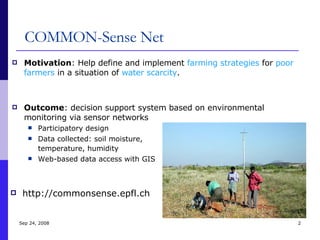
COMMON-Sense Net Motivation : Help define and implement  farming strategies  for  poor farmers  in a situation of  water scarcity . Outcome : decision support system based on environmental monitoring via sensor networks Participatory design Data collected: soil moisture,  temperature, humidity   Web-based data access with GIS Jun 5, 2009 http://commonsense.epfl.ch
Outline  of the presentation Field State-of-the-Art Project description Summary of Results Sensor-Tunes Conclusion Jun 5, 2009
Environment and Development? There is a growing tension between economic development and environmental sustainability. Millennium Development Goals and the Environment: Ensure environmental sustainability Eradicate extreme poverty and hunger Reduce child mortality Enhanced environmental monitoring: Explore Environment-to-Person Information Systems. New technological window: wireless sensor networks Jun 5, 2009 Field State of the Art CSN Results Sensor-Tune Conclusion
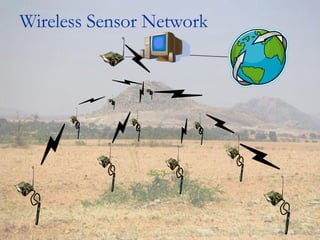
Wireless Sensor Network Jun 5, 2009
ICT4D ICT4D: Information and Communication Technologies for Development ICT as an enabler for development [Heeks 2002, 2008], [Walsham 2001], [Negroponte 1998] Empowerment Fight against exclusion Prevention of corruption Common pitfalls of ICT4D projects [Heeks 2002, 2008] Design/actuality gaps Sustainability Scalability Design guidelines [Surana et al. 2008], [Heeks 2002, 2008] Use Hybrids Optimization of existing systems Financial self-sufficiency Operational self-sufficiency Jun 5, 2009 Field State of the Art CSN Results Sensor-Tune Conclusion
Test-Case: India India is a country with two faces Extreme Poverty Cutting Edge Technology and Excellent higher education system Jun 5, 2009 Field State of the Art CSN Results Sensor-Tune Conclusion
India Agriculture Agriculture in India : 67% of employment Small land-holding: More than 80% farms are less than 4 ha 39% farms are less than 1 ha (Karnataka) Green revolution: from subsistence to market agriculture Difficulties for small farmers: Cannot invest in intensive agriculture practices Institutional crisis: From collectively managed infrastructure to individual management Early impacts of climate change Semi-arid areas characterized by low-rain fall and high climatic variability Jun 5, 2009 Field State of the Art CSN Results Sensor-Tune Conclusion
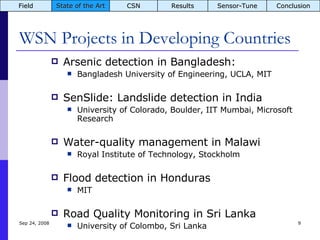
WSN Projects in Developing Countries Arsenic detection in Bangladesh:  Bangladesh University of Engineering, UCLA, MIT SenSlide: Landslide detection in India University of Colorado, Boulder, IIT Mumbai, Microsoft Research Water-quality management in Malawi Royal Institute of Technology, Stockholm Flood detection in Honduras MIT Road Quality Monitoring in Sri Lanka University of Colombo, Sri Lanka Jun 5, 2009 Field State of the Art CSN Results Sensor-Tune Conclusion
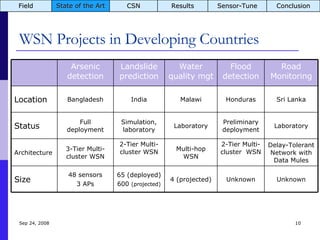
WSN Projects in Developing Countries Jun 5, 2009 Field State of the Art CSN Results Sensor-Tune Conclusion Arsenic detection Landslide prediction Water quality mgt Flood detection Road Monitoring Location Bangladesh India Malawi Honduras Sri Lanka Status Full deployment Simulation, laboratory Laboratory Preliminary deployment Laboratory Architecture 3-Tier Multi-cluster WSN 2-Tier Multi-cluster WSN Multi-hop WSN 2-Tier Multi-cluster  WSN Delay-Tolerant Network with Data Mules Size 48 sensors 3 APs 65 (deployed) 600  (projected) 4 (projected) Unknown Unknown
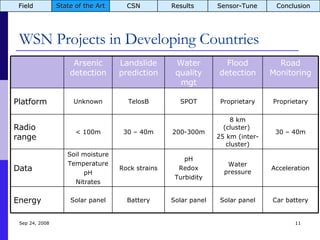
WSN Projects in Developing Countries Jun 5, 2009 Field State of the Art CSN Results Sensor-Tune Conclusion Arsenic detection Landslide prediction Water quality mgt Flood detection Road Monitoring Platform Unknown TelosB SPOT Proprietary Proprietary Radio range < 100m 30 – 40m 200-300m 8 km (cluster)  25 km (inter-cluster) 30 – 40m Data Soil moisture Temperature pH Nitrates Rock strains pH Redox Turbidity Water pressure Acceleration Energy Solar panel Battery Solar panel Solar panel Car battery
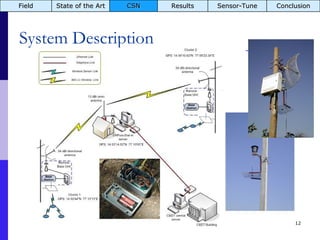
System Description Jun 5, 2009 Field State of the Art CSN Results Sensor-Tune Conclusion
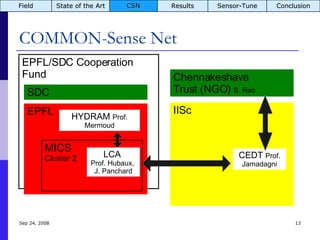
COMMON-Sense Net Jun 5, 2009 IISc CEDT  Prof. Jamadagni EPFL/SDC Cooperation Fund EPFL SDC HYDRAM  Prof. Mermoud MICS Cluster 2 Chennakeshava Trust (NGO)  S. Rao LCA  Prof. Hubaux,  J. Panchard Field State of the Art CSN Results Sensor-Tune Conclusion
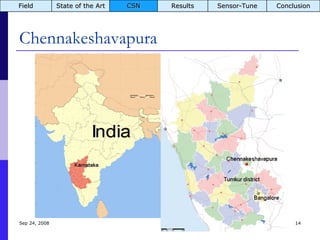
Chennakeshavapura Jun 5, 2009 Field State of the Art CSN Results Sensor-Tune Conclusion
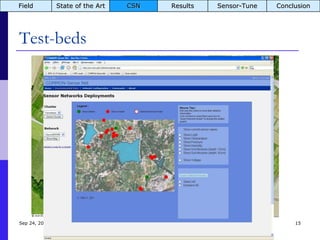
Test-beds Jun 5, 2009 Field State of the Art CSN Results Sensor-Tune Conclusion
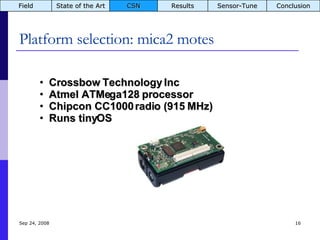
Platform selection: mica2 motes Jun 5, 2009 Crossbow Technology Inc Atmel ATMega128 processor Chipcon CC1000 radio (915 MHz) Runs tinyOS Field State of the Art CSN Results Sensor-Tune Conclusion
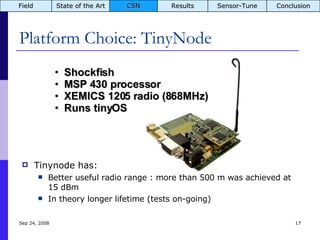
Platform Choice: TinyNode Tinynode has: Better useful radio range : more than 500 m was achieved at 15 dBm In theory longer lifetime (tests on-going) Jun 5, 2009 Shockfish MSP 430 processor XEMICS 1205 radio (868MHz) Runs tinyOS Field State of the Art CSN Results Sensor-Tune Conclusion
Lessons Learned Jun 5, 2009 Environmental monitoring is useful for small farmers (User survey 2004) Impossibility to identify precise use cases for marginal farmers at this point Specialists are needed to deploy and maintain the network Relationship with farmers : estrangement towards technology Consequence: Necessity to develop tools to put wireless sensors in the hands of non-specialists Target scientists rather than farmers.  Find precise use cases, design experiments, carry them out in a controlled environment  Field State of the Art CSN Results Sensor-Tune Conclusion
Survey of agriculture scientists Qualitative and quantitative 20 participants: Indian agriculture scientists Briefing meeting 2 weeks Logging of web application queries Scenario-based detailed questionnaire Debriefing interviews Jun 5, 2009 Field State of the Art Contribution Results Sensor-Tune Conclusion
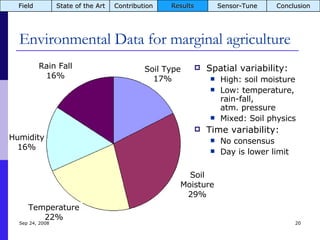
Environmental Data for marginal agriculture Jun 5, 2009 Rain Fall 16% Soil Type 17% Temperature 22% Soil Moisture 29% Humidity 16% Spatial variability: High: soil moisture Low: temperature, rain-fall,  atm. pressure Mixed: Soil physics Time variability: No consensus Day is lower limit Field State of the Art Contribution Results Sensor-Tune Conclusion
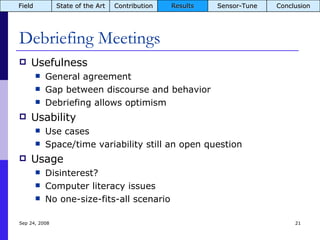
Debriefing Meetings Usefulness General agreement Gap between discourse and behavior Debriefing allows optimism Usability Use cases Space/time variability still an open question Usage Disinterest? Computer literacy issues No one-size-fits-all scenario Jun 5, 2009 Field State of the Art Contribution Results Sensor-Tune Conclusion
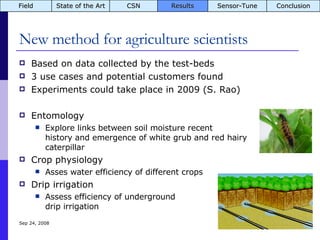
New method for agriculture scientists Based on data collected by the test-beds 3 use cases and potential customers found Experiments could take place in 2009 (S. Rao) Entomology Explore links between soil moisture recent  history and emergence of white grub and red hairy  caterpillar Crop physiology Asses water efficiency of different crops Drip irrigation Assess efficiency of underground  drip irrigation Jun 5, 2009 Field State of the Art CSN Results Sensor-Tune Conclusion
Sensor-Tune Jun 5, 2009 Field State of the Art Contribution Results Sensor-Tune Conclusion
Deployment Technical Issues Jun 5, 2009 Challenging physical environment Connectivity depends on fluctuating radio channel Network topology is highly unpredictable Difficulty to know link-quality over time Ergonomic problem LCD displays are ill-adapted to outdoor conditions Wireless sensors have very limited interfacing capabilities Task at hand requires attention and disponibility Field State of the Art Contribution Results Sensor-Tune Conclusion
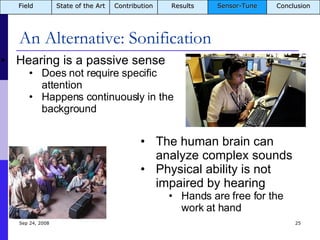
An Alternative: Sonification Jun 5, 2009 Hearing is a passive sense Does not require specific attention Happens continuously in the background The human brain can analyze complex sounds Physical ability is not impaired by hearing Hands are free for the work at hand Field State of the Art Contribution Results Sensor-Tune Conclusion
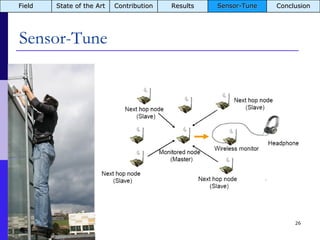
Sensor-Tune Jun 5, 2009 Field State of the Art Contribution Results Sensor-Tune Conclusion
Use Cases Jun 5, 2009 Non-expert users WSN deployment/maintenance staff Live connectivity to the Base Station As deployment goes on Monitor radio link Monitor distance to one base station Connectivity history over the last 24 hours Nodes with a PER below a threshold replay their history User can select and tag nodes Field State of the Art Contribution Results Sensor-Tune Conclusion
Parameters and Mapping Jun 5, 2009 Monitor  Packet delivery rate Distance to the base station Model ideal state with a repetitive pleasant sound:   Music Voice Natural sound (bird songs) The noise metaphor: Degrade the sound when the quality drops. Field State of the Art Contribution Results Sensor-Tune Conclusion
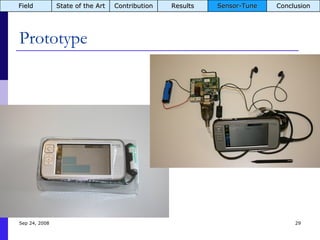
Prototype Jun 5, 2009 Field State of the Art Contribution Results Sensor-Tune Conclusion
User experiment Jun 5, 2009 Performed indoor Simple deployment task  Non-specialists Comparison between audio and visual Indoor, audio interface performs as well as visual Audio advantages in a challenging environment (hands free, vision free), come at no performance price Field State of the Art Contribution Results Sensor-Tune Conclusion
Contributions Participatory design the first WSN toolkit for  resource-poor agriculture First reported WSN deployment in an ICT4D project Identified precise applications with agriculture scientists Developed a WSN interface targeted at non-specialists, using sonification Jun 5, 2009 Field State of the Art Contribution Results Sensor-Tune Conclusion
Future Work Jun 5, 2009 Extended laboratory deployments with identified scientific partners Extensive tests of sonification interface in the field  Field State of the Art Contribution Results Sensor-Tune Conclusion
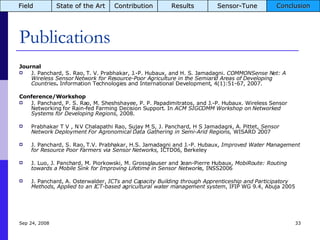
Publications Journal J. Panchard, S. Rao, T. V. Prabhakar, J.-P. Hubaux, and H. S. Jamadagni.  COMMONSense Net: A Wireless Sensor Network for Resource-Poor Agriculture in the Semiarid Areas of Developing Countries .  Information Technologies and International Development, 4(1):51-67, 2007.  Conference/Workshop J. Panchard, P. S. Rao, M. Sheshshayee, P. P. Papadimitratos, and J.-P. Hubaux. Wireless Sensor Networking for Rain-fed Farming Decision Support. In  ACM SIGCOMM Workshop on Networked Systems for Developing Regions , 2008.  Prabhakar T V , N V Chalapathi Rao, Sujay M S, J. Panchard, H S Jamadagni, A. Pittet,  Sensor Network Deployment For Agronomical Data Gathering in Semi-Arid Regions,  WISARD 2007 J. Panchard, S. Rao, T.V. Prabhakar, H.S. Jamadagni and J.-P. Hubaux,  Improved Water Management for Resource Poor Farmers via Sensor Networks,  ICTD06, Berkeley J. Luo, J. Panchard, M. Piorkowski, M. Grossglauser and Jean-Pierre Hubaux,  MobiRoute: Routing towards a Mobile Sink for Improving Lifetime in Sensor Networks,  INSS2006 J. Panchard,  A. Osterwalder,  ICTs and Capacity Building through Apprenticeship and Participatory Methods, Applied to an ICT-based agricultural water management system , IFIP WG 9.4, Abuja 2005 Jun 5, 2009 Field State of the Art Contribution Results Sensor-Tune Conclusion
Thank you. Jun 5, 2009
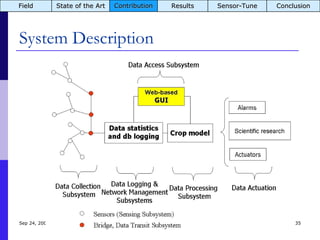
System Description Jun 5, 2009 Field State of the Art Contribution Results Sensor-Tune Conclusion
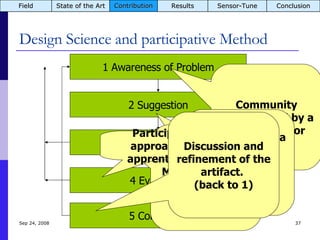
Design Science and participative Method Jun 5, 2009 3 Development 2 Suggestion 1 Awareness of Problem 4 Evaluation 5 Conclusion Community meetings led by a local faclitator Translation into a technical language: local facilitator and scientists Multidisciplinary development Participatory approach and apprenticeship Discussion and refinement of the artifact.  (back to 1) Field State of the Art Contribution Results Sensor-Tune Conclusion
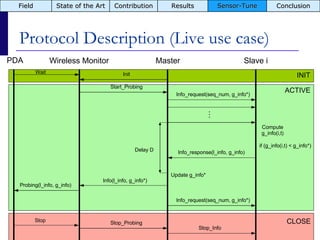
Protocol Description (Live use case) Jun 5, 2009 PDA Master Wireless Monitor Slave i Wait Init Start_Probing Info_request(seq_num, g_info*) … Compute g_info(i,t) if (g_info(i,t) < g_info*) Info_response(l_info, g_info) Info(l_info, g_info*) Probing(l_info, g_info) Delay D INIT ACTIVE CLOSE Info_request(seq_num, g_info*) Update g_info* Stop Stop_Probing Stop_Info Field State of the Art Contribution Results Sensor-Tune Conclusion
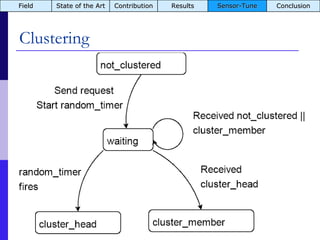
Clustering Jun 5, 2009 Field State of the Art Contribution Results Sensor-Tune Conclusion
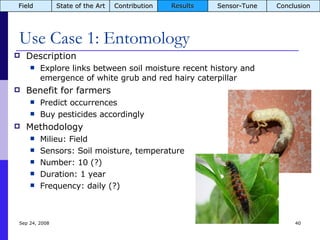
Use Case 1: Entomology Description Explore links between soil moisture recent history and emergence of white grub and red hairy caterpillar Benefit for farmers Predict occurrences Buy pesticides accordingly Methodology Milieu: Field Sensors: Soil moisture, temperature Number: 10 (?) Duration: 1 year Frequency: daily (?) Jun 5, 2009 Field State of the Art Contribution Results Sensor-Tune Conclusion
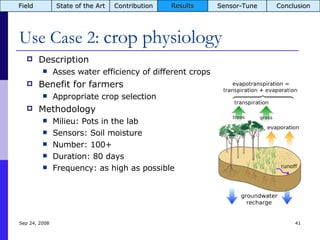
Use Case 2:  crop physiology Jun 5, 2009 Description Asses water efficiency of different crops Benefit for farmers Appropriate crop selection Methodology Milieu: Pots in the lab Sensors: Soil moisture Number: 100+ Duration: 80 days Frequency: as high as possible Field State of the Art Contribution Results Sensor-Tune Conclusion
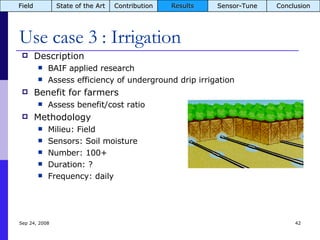
Use case 3 : Irrigation Jun 5, 2009 Description BAIF applied research Assess efficiency of underground drip irrigation Benefit for farmers Assess benefit/cost ratio Methodology Milieu: Field Sensors: Soil moisture Number: 100+ Duration: ? Frequency: daily Field State of the Art Contribution Results Sensor-Tune Conclusion

Thesis Slides

  • 1.
    COMMON-Sense Net WirelessSensor Networks for Marginal Farming in India Jacques Panchard PhD Private Defense Advisor: Prof. Jean-Pierre Hubaux Jun 5, 2009
  • 2.
    COMMON-Sense Net Motivation: Help define and implement farming strategies for poor farmers in a situation of water scarcity . Outcome : decision support system based on environmental monitoring via sensor networks Participatory design Data collected: soil moisture, temperature, humidity Web-based data access with GIS Jun 5, 2009 http://commonsense.epfl.ch
  • 3.
    Outline ofthe presentation Field State-of-the-Art Project description Summary of Results Sensor-Tunes Conclusion Jun 5, 2009
  • 4.
    Environment and Development?There is a growing tension between economic development and environmental sustainability. Millennium Development Goals and the Environment: Ensure environmental sustainability Eradicate extreme poverty and hunger Reduce child mortality Enhanced environmental monitoring: Explore Environment-to-Person Information Systems. New technological window: wireless sensor networks Jun 5, 2009 Field State of the Art CSN Results Sensor-Tune Conclusion
  • 5.
  • 6.
    ICT4D ICT4D: Informationand Communication Technologies for Development ICT as an enabler for development [Heeks 2002, 2008], [Walsham 2001], [Negroponte 1998] Empowerment Fight against exclusion Prevention of corruption Common pitfalls of ICT4D projects [Heeks 2002, 2008] Design/actuality gaps Sustainability Scalability Design guidelines [Surana et al. 2008], [Heeks 2002, 2008] Use Hybrids Optimization of existing systems Financial self-sufficiency Operational self-sufficiency Jun 5, 2009 Field State of the Art CSN Results Sensor-Tune Conclusion
  • 7.
    Test-Case: India Indiais a country with two faces Extreme Poverty Cutting Edge Technology and Excellent higher education system Jun 5, 2009 Field State of the Art CSN Results Sensor-Tune Conclusion
  • 8.
    India Agriculture Agriculturein India : 67% of employment Small land-holding: More than 80% farms are less than 4 ha 39% farms are less than 1 ha (Karnataka) Green revolution: from subsistence to market agriculture Difficulties for small farmers: Cannot invest in intensive agriculture practices Institutional crisis: From collectively managed infrastructure to individual management Early impacts of climate change Semi-arid areas characterized by low-rain fall and high climatic variability Jun 5, 2009 Field State of the Art CSN Results Sensor-Tune Conclusion
  • 9.
    WSN Projects inDeveloping Countries Arsenic detection in Bangladesh: Bangladesh University of Engineering, UCLA, MIT SenSlide: Landslide detection in India University of Colorado, Boulder, IIT Mumbai, Microsoft Research Water-quality management in Malawi Royal Institute of Technology, Stockholm Flood detection in Honduras MIT Road Quality Monitoring in Sri Lanka University of Colombo, Sri Lanka Jun 5, 2009 Field State of the Art CSN Results Sensor-Tune Conclusion
  • 10.
    WSN Projects inDeveloping Countries Jun 5, 2009 Field State of the Art CSN Results Sensor-Tune Conclusion Arsenic detection Landslide prediction Water quality mgt Flood detection Road Monitoring Location Bangladesh India Malawi Honduras Sri Lanka Status Full deployment Simulation, laboratory Laboratory Preliminary deployment Laboratory Architecture 3-Tier Multi-cluster WSN 2-Tier Multi-cluster WSN Multi-hop WSN 2-Tier Multi-cluster WSN Delay-Tolerant Network with Data Mules Size 48 sensors 3 APs 65 (deployed) 600 (projected) 4 (projected) Unknown Unknown
  • 11.
    WSN Projects inDeveloping Countries Jun 5, 2009 Field State of the Art CSN Results Sensor-Tune Conclusion Arsenic detection Landslide prediction Water quality mgt Flood detection Road Monitoring Platform Unknown TelosB SPOT Proprietary Proprietary Radio range < 100m 30 – 40m 200-300m 8 km (cluster) 25 km (inter-cluster) 30 – 40m Data Soil moisture Temperature pH Nitrates Rock strains pH Redox Turbidity Water pressure Acceleration Energy Solar panel Battery Solar panel Solar panel Car battery
  • 12.
    System Description Jun5, 2009 Field State of the Art CSN Results Sensor-Tune Conclusion
  • 13.
    COMMON-Sense Net Jun5, 2009 IISc CEDT Prof. Jamadagni EPFL/SDC Cooperation Fund EPFL SDC HYDRAM Prof. Mermoud MICS Cluster 2 Chennakeshava Trust (NGO) S. Rao LCA Prof. Hubaux, J. Panchard Field State of the Art CSN Results Sensor-Tune Conclusion
  • 14.
    Chennakeshavapura Jun 5,2009 Field State of the Art CSN Results Sensor-Tune Conclusion
  • 15.
    Test-beds Jun 5,2009 Field State of the Art CSN Results Sensor-Tune Conclusion
  • 16.
    Platform selection: mica2motes Jun 5, 2009 Crossbow Technology Inc Atmel ATMega128 processor Chipcon CC1000 radio (915 MHz) Runs tinyOS Field State of the Art CSN Results Sensor-Tune Conclusion
  • 17.
    Platform Choice: TinyNodeTinynode has: Better useful radio range : more than 500 m was achieved at 15 dBm In theory longer lifetime (tests on-going) Jun 5, 2009 Shockfish MSP 430 processor XEMICS 1205 radio (868MHz) Runs tinyOS Field State of the Art CSN Results Sensor-Tune Conclusion
  • 18.
    Lessons Learned Jun5, 2009 Environmental monitoring is useful for small farmers (User survey 2004) Impossibility to identify precise use cases for marginal farmers at this point Specialists are needed to deploy and maintain the network Relationship with farmers : estrangement towards technology Consequence: Necessity to develop tools to put wireless sensors in the hands of non-specialists Target scientists rather than farmers. Find precise use cases, design experiments, carry them out in a controlled environment Field State of the Art CSN Results Sensor-Tune Conclusion
  • 19.
    Survey of agriculturescientists Qualitative and quantitative 20 participants: Indian agriculture scientists Briefing meeting 2 weeks Logging of web application queries Scenario-based detailed questionnaire Debriefing interviews Jun 5, 2009 Field State of the Art Contribution Results Sensor-Tune Conclusion
  • 20.
    Environmental Data formarginal agriculture Jun 5, 2009 Rain Fall 16% Soil Type 17% Temperature 22% Soil Moisture 29% Humidity 16% Spatial variability: High: soil moisture Low: temperature, rain-fall, atm. pressure Mixed: Soil physics Time variability: No consensus Day is lower limit Field State of the Art Contribution Results Sensor-Tune Conclusion
  • 21.
    Debriefing Meetings UsefulnessGeneral agreement Gap between discourse and behavior Debriefing allows optimism Usability Use cases Space/time variability still an open question Usage Disinterest? Computer literacy issues No one-size-fits-all scenario Jun 5, 2009 Field State of the Art Contribution Results Sensor-Tune Conclusion
  • 22.
    New method foragriculture scientists Based on data collected by the test-beds 3 use cases and potential customers found Experiments could take place in 2009 (S. Rao) Entomology Explore links between soil moisture recent history and emergence of white grub and red hairy caterpillar Crop physiology Asses water efficiency of different crops Drip irrigation Assess efficiency of underground drip irrigation Jun 5, 2009 Field State of the Art CSN Results Sensor-Tune Conclusion
  • 23.
    Sensor-Tune Jun 5,2009 Field State of the Art Contribution Results Sensor-Tune Conclusion
  • 24.
    Deployment Technical IssuesJun 5, 2009 Challenging physical environment Connectivity depends on fluctuating radio channel Network topology is highly unpredictable Difficulty to know link-quality over time Ergonomic problem LCD displays are ill-adapted to outdoor conditions Wireless sensors have very limited interfacing capabilities Task at hand requires attention and disponibility Field State of the Art Contribution Results Sensor-Tune Conclusion
  • 25.
    An Alternative: SonificationJun 5, 2009 Hearing is a passive sense Does not require specific attention Happens continuously in the background The human brain can analyze complex sounds Physical ability is not impaired by hearing Hands are free for the work at hand Field State of the Art Contribution Results Sensor-Tune Conclusion
  • 26.
    Sensor-Tune Jun 5,2009 Field State of the Art Contribution Results Sensor-Tune Conclusion
  • 27.
    Use Cases Jun5, 2009 Non-expert users WSN deployment/maintenance staff Live connectivity to the Base Station As deployment goes on Monitor radio link Monitor distance to one base station Connectivity history over the last 24 hours Nodes with a PER below a threshold replay their history User can select and tag nodes Field State of the Art Contribution Results Sensor-Tune Conclusion
  • 28.
    Parameters and MappingJun 5, 2009 Monitor Packet delivery rate Distance to the base station Model ideal state with a repetitive pleasant sound: Music Voice Natural sound (bird songs) The noise metaphor: Degrade the sound when the quality drops. Field State of the Art Contribution Results Sensor-Tune Conclusion
  • 29.
    Prototype Jun 5,2009 Field State of the Art Contribution Results Sensor-Tune Conclusion
  • 30.
    User experiment Jun5, 2009 Performed indoor Simple deployment task Non-specialists Comparison between audio and visual Indoor, audio interface performs as well as visual Audio advantages in a challenging environment (hands free, vision free), come at no performance price Field State of the Art Contribution Results Sensor-Tune Conclusion
  • 31.
    Contributions Participatory designthe first WSN toolkit for resource-poor agriculture First reported WSN deployment in an ICT4D project Identified precise applications with agriculture scientists Developed a WSN interface targeted at non-specialists, using sonification Jun 5, 2009 Field State of the Art Contribution Results Sensor-Tune Conclusion
  • 32.
    Future Work Jun5, 2009 Extended laboratory deployments with identified scientific partners Extensive tests of sonification interface in the field Field State of the Art Contribution Results Sensor-Tune Conclusion
  • 33.
    Publications Journal J. Panchard,S. Rao, T. V. Prabhakar, J.-P. Hubaux, and H. S. Jamadagni. COMMONSense Net: A Wireless Sensor Network for Resource-Poor Agriculture in the Semiarid Areas of Developing Countries . Information Technologies and International Development, 4(1):51-67, 2007. Conference/Workshop J. Panchard, P. S. Rao, M. Sheshshayee, P. P. Papadimitratos, and J.-P. Hubaux. Wireless Sensor Networking for Rain-fed Farming Decision Support. In ACM SIGCOMM Workshop on Networked Systems for Developing Regions , 2008. Prabhakar T V , N V Chalapathi Rao, Sujay M S, J. Panchard, H S Jamadagni, A. Pittet, Sensor Network Deployment For Agronomical Data Gathering in Semi-Arid Regions, WISARD 2007 J. Panchard, S. Rao, T.V. Prabhakar, H.S. Jamadagni and J.-P. Hubaux, Improved Water Management for Resource Poor Farmers via Sensor Networks, ICTD06, Berkeley J. Luo, J. Panchard, M. Piorkowski, M. Grossglauser and Jean-Pierre Hubaux, MobiRoute: Routing towards a Mobile Sink for Improving Lifetime in Sensor Networks, INSS2006 J. Panchard, A. Osterwalder, ICTs and Capacity Building through Apprenticeship and Participatory Methods, Applied to an ICT-based agricultural water management system , IFIP WG 9.4, Abuja 2005 Jun 5, 2009 Field State of the Art Contribution Results Sensor-Tune Conclusion
  • 34.
  • 35.
    System Description Jun5, 2009 Field State of the Art Contribution Results Sensor-Tune Conclusion
  • 36.
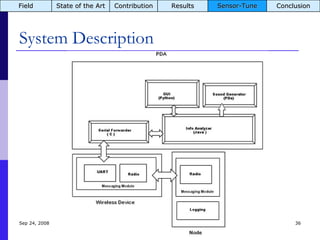
    System Description Jun5, 2009 Field State of the Art Contribution Results Sensor-Tune Conclusion
  • 37.
    Design Science andparticipative Method Jun 5, 2009 3 Development 2 Suggestion 1 Awareness of Problem 4 Evaluation 5 Conclusion Community meetings led by a local faclitator Translation into a technical language: local facilitator and scientists Multidisciplinary development Participatory approach and apprenticeship Discussion and refinement of the artifact. (back to 1) Field State of the Art Contribution Results Sensor-Tune Conclusion
  • 38.
    Protocol Description (Liveuse case) Jun 5, 2009 PDA Master Wireless Monitor Slave i Wait Init Start_Probing Info_request(seq_num, g_info*) … Compute g_info(i,t) if (g_info(i,t) < g_info*) Info_response(l_info, g_info) Info(l_info, g_info*) Probing(l_info, g_info) Delay D INIT ACTIVE CLOSE Info_request(seq_num, g_info*) Update g_info* Stop Stop_Probing Stop_Info Field State of the Art Contribution Results Sensor-Tune Conclusion
  • 39.
    Clustering Jun 5,2009 Field State of the Art Contribution Results Sensor-Tune Conclusion
  • 40.
    Use Case 1:Entomology Description Explore links between soil moisture recent history and emergence of white grub and red hairy caterpillar Benefit for farmers Predict occurrences Buy pesticides accordingly Methodology Milieu: Field Sensors: Soil moisture, temperature Number: 10 (?) Duration: 1 year Frequency: daily (?) Jun 5, 2009 Field State of the Art Contribution Results Sensor-Tune Conclusion
  • 41.
    Use Case 2: crop physiology Jun 5, 2009 Description Asses water efficiency of different crops Benefit for farmers Appropriate crop selection Methodology Milieu: Pots in the lab Sensors: Soil moisture Number: 100+ Duration: 80 days Frequency: as high as possible Field State of the Art Contribution Results Sensor-Tune Conclusion
  • 42.
    Use case 3: Irrigation Jun 5, 2009 Description BAIF applied research Assess efficiency of underground drip irrigation Benefit for farmers Assess benefit/cost ratio Methodology Milieu: Field Sensors: Soil moisture Number: 100+ Duration: ? Frequency: daily Field State of the Art Contribution Results Sensor-Tune Conclusion

Editor's Notes

  • #2 Good afternoon and welcome to my thesis defense. During the next 45 minutes, I will present the core of my work for the last 4 years: the COMMON-Sense Net project. The essence of this work is the application of emerging technologies for rural development in Developing Countries. In order to address this problem in a concrete and meaningful way, I focused on the design, implementation and assessment of wireless sensor networks to tackle some of the problems faced by marginal farmers in India, more precisely in Karnataka.