CHAPTER 1
Introduction to
Electrical
Installation
Design
EAT 105-Fundamental of Electrical Engineering
ELECTRICAL
INSTALLATION DESIGN
Design of Power Distribution System in
Buildings
The best distribution system is one that will,
cost effectively and safely, supply adequate
electric service to both present and future
probable loads
Function of the electric power
distribution system
To receive power at one or more supply
points and deliver it to the individual lamps,
motors, and all other electrically operated
devices.
ELECTRICAL
INSTALLATION DESIGN
Basic Principles or Factor Requiring
Consideration During Design
• Functions of structure, present and future.
• Life and flexibility of structure.
• Locations of service entrance and
distribution equipment, locations and
characteristics of loads, locations of unit
substations.
• Demand and diversity factors of loads.
• Sources of power; including normal,
standby and emergency.
• Continuity and quality of power available
and required.
• Energy efficiency and management.
• Distribution and utilization voltages.
• Bus and/or cable feeders.
• Distribution equipment and motor control.
• Power and lighting distribution boards and
motor control centers.
• Types of lighting systems.
• Installation methods.
• Power monitoring systems.
• Electric utility requirements.
ELECTRICAL
INSTALLATION DESIGN
Goals of System Design
1) Safety
To design the power system which will not
present any electrical hazard to the people
who utilize the facility, and/or the
utilization equipment fed from the electrical
system
2) Minimum Initial Investment
The owner’s overall budget for first cost
purchase and installation of the electrical
distribution system and electrical utilization
equipment will be a key factor in
determining which of various alternate
system designs are to be selected. When
trying to minimize initial investment for
electrical equipment, consideration should
be given to the cost of installation, floor
space requirements and possible extra
cooling requirements as well as the initial
purchase price
ELECTRICAL
INSTALLATION DESIGN
Goals of System Design (Cont…)
3) Maximum Service Continuity
The degree of service continuity and reliability needed will vary
depending on the type and use of the facility as well as the
loads or process being supplied by the electrical distribution
system.
Typically, service continuity and reliability can be increased by:
Supplying multiple utility power sources or services
Supplying multiple connection paths to loads served
Using short time rated power circuit breakers
Providing alternate customers owned power sources
such as generators or batteries supplying uninterruptible
power supplies
Selecting the highest quality electrical equipment and
conductors
Using the best installation methods
Designing appropriate systems alarms, monitoring and
diagnostics
Selecting preventative maintenance systems or
equipment to alarm before an outage occurs
ELECTRICAL
INSTALLATION DESIGN
Goals of System Design (Cont…)
4) Maximum Flexibility & Expendability
In many industrial manufacturing plants, electrical utilization
loads are periodically relocated or changed requiring changes in
the electrical distribution system. Consideration of the layout
and design of the electrical distribution system to accommodate
these changes must be considered
5) Maximum Electrical Efficiency (Minimum Operating
Costs)
Electrical efficiency can generally be maximized by designing
systems that minimize the losses in conductors, transformers
and utilization equipment. Proper voltage level selection plays a
key factor in this area and will be discussed later. Selecting
equipment, such as transformers, with lower operating losses,
generally means higher first cost and increased floor space
requirements; thus, there is a balance to be considered
between the owner’s utility energy change for the losses in the
transformer or other equipment versus the owner’s first cost
budget and cost of money.
ELECTRICAL
INSTALLATION DESIGN
Goals of System Design (Cont…)
6) Minimum Maintenance Cost
Usually the simpler the electrical system design and the simpler
the electrical equipment, the less the associated maintenance
costs and operator errors. As electrical systems and equipment
become more complicated to provide greater service continuity
or flexibility, the maintenance costs and chance for operator
error increases. The systems should be designed with an
alternate power circuit to take electrical equipment (requiring
periodic maintenance) out of service without dropping essential
loads. Use of drawout type protective devices such as breakers
and combination starters can also minimize maintenance cost
and out-of-service time.
7) Maximum Power Quality
The power input requirements of all utilization equipment has
to be considered including the acceptable operating range of
the equipment and the electrical distribution system has to be
designed to meet these needs
ELECTRICAL
INSTALLATION DESIGN
Low Voltage Distribution System
(Principles)
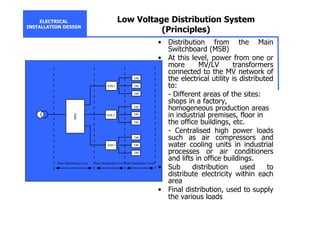
MSB
SSB 1
Main Distribution Level Sub Distribution Level Sub Distribution Level
SSB 2
SSB 3
DB
DB
DB
DB
DB
DB
DB
DB
DB
• Distribution from the Main
Switchboard (MSB)
• At this level, power from one or
more MV/LV transformers
connected to the MV network of
the electrical utility is distributed
to:
- Different areas of the sites:
shops in a factory,
homogeneous production areas
in industrial premises, floor in
the office buildings, etc.
- Centralised high power loads
such as air compressors and
water cooling units in industrial
processes or air conditioners
and lifts in office buildings.
• Sub distribution used to
distribute electricity within each
area
• Final distribution, used to supply
the various loads
ELECTRICAL
INSTALLATION DESIGN
Low Voltage Distribution System
(Principles)
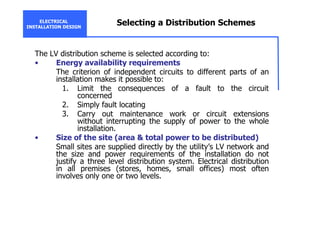
Basic Topologies
All distribution systems are combinations of two basic topologies:
1. Star topologies: Radial or centralized distribution
2. Bus topologies: Distribution using busduct / busways (also
referred to as busbar trunking system)
Star Topologies Bus Topologies
ELECTRICAL
INSTALLATION DESIGN
Selecting a Distribution Schemes
The LV distribution scheme is selected according to:
• Energy availability requirements
The criterion of independent circuits to different parts of an
installation makes it possible to:
1. Limit the consequences of a fault to the circuit
concerned
2. Simply fault locating
3. Carry out maintenance work or circuit extensions
without interrupting the supply of power to the whole
installation.
• Size of the site (area & total power to be distributed)
Small sites are supplied directly by the utility’s LV network and
the size and power requirements of the installation do not
justify a three level distribution system. Electrical distribution
in all premises (stores, homes, small offices) most often
involves only one or two levels.
ELECTRICAL
INSTALLATION DESIGN
Selecting a Distribution Schemes
• Load layout (equipment and power density)
Two types of loads, depending on their layout on the site,
must be taken in account:
• Concentrated load, generally corresponding to building
utilities used for the entire site and requiring high power
(e.g. centralized air conditioning units, lifts, refrigeration
units in supermarket)
• Distributed loads that can be dealt with in groups
corresponding to a homogeneous area (floor, factory
shop, production line) and characterized by two
parameters: power density (in VA/m2) and equipment
density (in number of devices per 10 or 100m2)
• Installation flexibility requirements
Installation flexibility is an increasingly important requirement,
in particular for commercial and industrial premises.
ELECTRICAL
INSTALLATION DESIGN
Rules and Statutory Regulations
Low-voltage installations are governed by a number of regulatory
and advisory texts, which may be classified as follows:
1. Statutory regulations (decrees, factory acts, etc.),
2. Codes of practice, regulations issued by professional institutions,
job specifications,
3. National and international standards for installations,
4. National and international standards for products.
The electricity supply and installation practice in Peninsular
Malaysia are governed by the following:
1. Electricity Supply Act 1990 – Act 447
2. Licensee Supply Regulation 1990
3. Electricity Regulation 1994
4. OSHA 1994 – Occupational, Safety & Health Act
5. Malaysia Standard MS IEC 60364 Electrical Installation of
Buildings
6. The current edition of the IEE Wiring Regulations for Electrical
Installations, where necessary (IEE Wiring Regulation 16th
Edition)
7. Electricity Supply (Successor Company) Act 1990 – Act 448
ELECTRICAL
INSTALLATION DESIGN
Definitions of Voltage Ranges
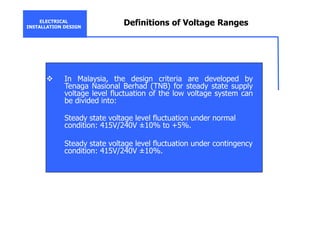
In Malaysia, the design criteria are developed by
Tenaga Nasional Berhad (TNB) for steady state supply
voltage level fluctuation of the low voltage system can
be divided into:
Steady state voltage level fluctuation under normal
condition: 415V/240V ±10% to +5%.
Steady state voltage level fluctuation under contingency
condition: 415V/240V ±10%.
ELECTRICAL
INSTALLATION DESIGN
TNB Supply Schemes and Maximum
Demand Level for Low Voltage System
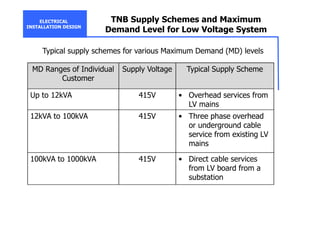
MD Ranges of Individual
Customer
Supply Voltage Typical Supply Scheme
Up to 12kVA 415V • Overhead services from
LV mains
12kVA to 100kVA 415V • Three phase overhead
or underground cable
service from existing LV
mains
100kVA to 1000kVA 415V • Direct cable services
from LV board from a
substation
Typical supply schemes for various Maximum Demand (MD) levels
ELECTRICAL
INSTALLATION DESIGN
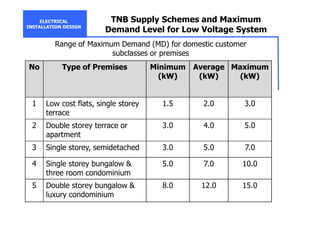
No Type of Premises Minimum
(kW)
Average
(kW)
Maximum
(kW)
1 Low cost flats, single storey
terrace
1.5 2.0 3.0
2 Double storey terrace or
apartment
3.0 4.0 5.0
3 Single storey, semidetached 3.0 5.0 7.0
4 Single storey bungalow &
three room condominium
5.0 7.0 10.0
5 Double storey bungalow &
luxury condominium
8.0 12.0 15.0
Range of Maximum Demand (MD) for domestic customer
subclasses or premises
TNB Supply Schemes and Maximum
Demand Level for Low Voltage System
ELECTRICAL
INSTALLATION DESIGN
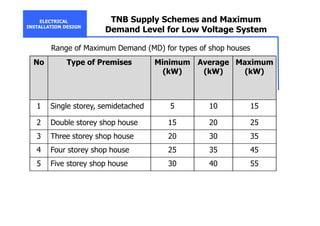
Range of Maximum Demand (MD) for types of shop houses
TNB Supply Schemes and Maximum
Demand Level for Low Voltage System
No Type of Premises Minimum
(kW)
Average
(kW)
Maximum
(kW)
1 Single storey, semidetached 5 10 15
2 Double storey shop house 15 20 25
3 Three storey shop house 20 30 35
4 Four storey shop house 25 35 45
5 Five storey shop house 30 40 55
ELECTRICAL
INSTALLATION DESIGN
Rules and Statutory Regulations
Types of supply applications are provided by TNB can
be classified into three types:
• Supply application for load up to 100kVA
Supply usually from existing supply mains
Submission of applications to TNBD by Electrical
Contractor registered with Suruhanjaya Tenaga (ST)
Processing period for supply will take a maximum of 3
weeks upon approval from the local authorities.
• Supply application for load exceeding 100kVA
Supply may require establishment of new substation
Submission of applications to TNBD by Consultant
Engineer
Processing period for supply may take between 6
months to 3 years depending on the extent of electrical
infrastructure required.
• Supply application for streetlight
Application made by the local authority/government
department
Application by developer
Application by individual

Eat105 Chapter 1

  • 1.
    CHAPTER 1 Introduction to Electrical Installation Design EAT105-Fundamental of Electrical Engineering
  • 2.
    ELECTRICAL INSTALLATION DESIGN Design ofPower Distribution System in Buildings The best distribution system is one that will, cost effectively and safely, supply adequate electric service to both present and future probable loads Function of the electric power distribution system To receive power at one or more supply points and deliver it to the individual lamps, motors, and all other electrically operated devices.
  • 3.
    ELECTRICAL INSTALLATION DESIGN Basic Principlesor Factor Requiring Consideration During Design • Functions of structure, present and future. • Life and flexibility of structure. • Locations of service entrance and distribution equipment, locations and characteristics of loads, locations of unit substations. • Demand and diversity factors of loads. • Sources of power; including normal, standby and emergency. • Continuity and quality of power available and required. • Energy efficiency and management. • Distribution and utilization voltages. • Bus and/or cable feeders. • Distribution equipment and motor control. • Power and lighting distribution boards and motor control centers. • Types of lighting systems. • Installation methods. • Power monitoring systems. • Electric utility requirements.
  • 4.
    ELECTRICAL INSTALLATION DESIGN Goals ofSystem Design 1) Safety To design the power system which will not present any electrical hazard to the people who utilize the facility, and/or the utilization equipment fed from the electrical system 2) Minimum Initial Investment The owner’s overall budget for first cost purchase and installation of the electrical distribution system and electrical utilization equipment will be a key factor in determining which of various alternate system designs are to be selected. When trying to minimize initial investment for electrical equipment, consideration should be given to the cost of installation, floor space requirements and possible extra cooling requirements as well as the initial purchase price
  • 5.
    ELECTRICAL INSTALLATION DESIGN Goals ofSystem Design (Cont…) 3) Maximum Service Continuity The degree of service continuity and reliability needed will vary depending on the type and use of the facility as well as the loads or process being supplied by the electrical distribution system. Typically, service continuity and reliability can be increased by: Supplying multiple utility power sources or services Supplying multiple connection paths to loads served Using short time rated power circuit breakers Providing alternate customers owned power sources such as generators or batteries supplying uninterruptible power supplies Selecting the highest quality electrical equipment and conductors Using the best installation methods Designing appropriate systems alarms, monitoring and diagnostics Selecting preventative maintenance systems or equipment to alarm before an outage occurs
  • 6.
    ELECTRICAL INSTALLATION DESIGN Goals ofSystem Design (Cont…) 4) Maximum Flexibility & Expendability In many industrial manufacturing plants, electrical utilization loads are periodically relocated or changed requiring changes in the electrical distribution system. Consideration of the layout and design of the electrical distribution system to accommodate these changes must be considered 5) Maximum Electrical Efficiency (Minimum Operating Costs) Electrical efficiency can generally be maximized by designing systems that minimize the losses in conductors, transformers and utilization equipment. Proper voltage level selection plays a key factor in this area and will be discussed later. Selecting equipment, such as transformers, with lower operating losses, generally means higher first cost and increased floor space requirements; thus, there is a balance to be considered between the owner’s utility energy change for the losses in the transformer or other equipment versus the owner’s first cost budget and cost of money.
  • 7.
    ELECTRICAL INSTALLATION DESIGN Goals ofSystem Design (Cont…) 6) Minimum Maintenance Cost Usually the simpler the electrical system design and the simpler the electrical equipment, the less the associated maintenance costs and operator errors. As electrical systems and equipment become more complicated to provide greater service continuity or flexibility, the maintenance costs and chance for operator error increases. The systems should be designed with an alternate power circuit to take electrical equipment (requiring periodic maintenance) out of service without dropping essential loads. Use of drawout type protective devices such as breakers and combination starters can also minimize maintenance cost and out-of-service time. 7) Maximum Power Quality The power input requirements of all utilization equipment has to be considered including the acceptable operating range of the equipment and the electrical distribution system has to be designed to meet these needs
  • 8.
    ELECTRICAL INSTALLATION DESIGN Low VoltageDistribution System (Principles) MSB SSB 1 Main Distribution Level Sub Distribution Level Sub Distribution Level SSB 2 SSB 3 DB DB DB DB DB DB DB DB DB • Distribution from the Main Switchboard (MSB) • At this level, power from one or more MV/LV transformers connected to the MV network of the electrical utility is distributed to: - Different areas of the sites: shops in a factory, homogeneous production areas in industrial premises, floor in the office buildings, etc. - Centralised high power loads such as air compressors and water cooling units in industrial processes or air conditioners and lifts in office buildings. • Sub distribution used to distribute electricity within each area • Final distribution, used to supply the various loads
  • 9.
    ELECTRICAL INSTALLATION DESIGN Low VoltageDistribution System (Principles) Basic Topologies All distribution systems are combinations of two basic topologies: 1. Star topologies: Radial or centralized distribution 2. Bus topologies: Distribution using busduct / busways (also referred to as busbar trunking system) Star Topologies Bus Topologies
  • 10.
    ELECTRICAL INSTALLATION DESIGN Selecting aDistribution Schemes The LV distribution scheme is selected according to: • Energy availability requirements The criterion of independent circuits to different parts of an installation makes it possible to: 1. Limit the consequences of a fault to the circuit concerned 2. Simply fault locating 3. Carry out maintenance work or circuit extensions without interrupting the supply of power to the whole installation. • Size of the site (area & total power to be distributed) Small sites are supplied directly by the utility’s LV network and the size and power requirements of the installation do not justify a three level distribution system. Electrical distribution in all premises (stores, homes, small offices) most often involves only one or two levels.
  • 11.
    ELECTRICAL INSTALLATION DESIGN Selecting aDistribution Schemes • Load layout (equipment and power density) Two types of loads, depending on their layout on the site, must be taken in account: • Concentrated load, generally corresponding to building utilities used for the entire site and requiring high power (e.g. centralized air conditioning units, lifts, refrigeration units in supermarket) • Distributed loads that can be dealt with in groups corresponding to a homogeneous area (floor, factory shop, production line) and characterized by two parameters: power density (in VA/m2) and equipment density (in number of devices per 10 or 100m2) • Installation flexibility requirements Installation flexibility is an increasingly important requirement, in particular for commercial and industrial premises.
  • 12.
    ELECTRICAL INSTALLATION DESIGN Rules andStatutory Regulations Low-voltage installations are governed by a number of regulatory and advisory texts, which may be classified as follows: 1. Statutory regulations (decrees, factory acts, etc.), 2. Codes of practice, regulations issued by professional institutions, job specifications, 3. National and international standards for installations, 4. National and international standards for products. The electricity supply and installation practice in Peninsular Malaysia are governed by the following: 1. Electricity Supply Act 1990 – Act 447 2. Licensee Supply Regulation 1990 3. Electricity Regulation 1994 4. OSHA 1994 – Occupational, Safety & Health Act 5. Malaysia Standard MS IEC 60364 Electrical Installation of Buildings 6. The current edition of the IEE Wiring Regulations for Electrical Installations, where necessary (IEE Wiring Regulation 16th Edition) 7. Electricity Supply (Successor Company) Act 1990 – Act 448
  • 13.
    ELECTRICAL INSTALLATION DESIGN Definitions ofVoltage Ranges In Malaysia, the design criteria are developed by Tenaga Nasional Berhad (TNB) for steady state supply voltage level fluctuation of the low voltage system can be divided into: Steady state voltage level fluctuation under normal condition: 415V/240V ±10% to +5%. Steady state voltage level fluctuation under contingency condition: 415V/240V ±10%.
  • 14.
    ELECTRICAL INSTALLATION DESIGN TNB SupplySchemes and Maximum Demand Level for Low Voltage System MD Ranges of Individual Customer Supply Voltage Typical Supply Scheme Up to 12kVA 415V • Overhead services from LV mains 12kVA to 100kVA 415V • Three phase overhead or underground cable service from existing LV mains 100kVA to 1000kVA 415V • Direct cable services from LV board from a substation Typical supply schemes for various Maximum Demand (MD) levels
  • 15.
    ELECTRICAL INSTALLATION DESIGN No Typeof Premises Minimum (kW) Average (kW) Maximum (kW) 1 Low cost flats, single storey terrace 1.5 2.0 3.0 2 Double storey terrace or apartment 3.0 4.0 5.0 3 Single storey, semidetached 3.0 5.0 7.0 4 Single storey bungalow & three room condominium 5.0 7.0 10.0 5 Double storey bungalow & luxury condominium 8.0 12.0 15.0 Range of Maximum Demand (MD) for domestic customer subclasses or premises TNB Supply Schemes and Maximum Demand Level for Low Voltage System
  • 16.
    ELECTRICAL INSTALLATION DESIGN Range ofMaximum Demand (MD) for types of shop houses TNB Supply Schemes and Maximum Demand Level for Low Voltage System No Type of Premises Minimum (kW) Average (kW) Maximum (kW) 1 Single storey, semidetached 5 10 15 2 Double storey shop house 15 20 25 3 Three storey shop house 20 30 35 4 Four storey shop house 25 35 45 5 Five storey shop house 30 40 55
  • 17.
    ELECTRICAL INSTALLATION DESIGN Rules andStatutory Regulations Types of supply applications are provided by TNB can be classified into three types: • Supply application for load up to 100kVA Supply usually from existing supply mains Submission of applications to TNBD by Electrical Contractor registered with Suruhanjaya Tenaga (ST) Processing period for supply will take a maximum of 3 weeks upon approval from the local authorities. • Supply application for load exceeding 100kVA Supply may require establishment of new substation Submission of applications to TNBD by Consultant Engineer Processing period for supply may take between 6 months to 3 years depending on the extent of electrical infrastructure required. • Supply application for streetlight Application made by the local authority/government department Application by developer Application by individual