Talk on “ProfessionalTalk on “Professional
Competency Examination”Competency Examination”
Dato’ Paduka Ir Hj Keizrul Abdullah
Past President, Institution of Engineers Malaysia
6th
March 2015
Institution of EngineersInstitution of Engineers
MalaysiaMalaysia
REGISTRATION OF
ENGINEERS ACT 1967
Act of Parliament
First enacted as Act 66 (of 1967)
Regulations Governing the Engineering
Profession, Practice & Services
Enabling Legislation
Institution of EngineersInstitution of Engineers
MalaysiaMalaysia
Intent of Legislation
Preamble  Registration of Engineers Act
1967 (Revised 2007) - REA
An Act to provide for the registration of
engineers, and sole proprietorships,
partnerships and bodies corporate providing
professional engineering services and for
purposes connected therewith
Institution of EngineersInstitution of Engineers
MalaysiaMalaysia
1967 The REGISTRATION OF ENGINEERS ACT 1967
was enacted (Act No. 66 of 1967)
1987 Revised to be REGISTRATION OF ENGINEERS
ACT 1967 (Revised 1987)
(Act 662 - 16.1.1987)
2002 Revised to be REGISTRATION OF ENGINEERS
ACT 1967 (Revised 2002)
(Act 1158 - 1.12.2002)
2007 Further amended to become REGISTRATION OF
ENGINEERS ACT 1967 (Revised 2007)
(ACT A1288 - 1.4.2007)
History of the Act
1972 Amendments (Act 138 - Operationalised in 1972)
1973 Amendments (Act 173)
1974 Amendments (Act 218)
Institution of EngineersInstitution of Engineers
MalaysiaMalaysia
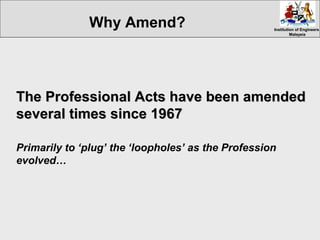
The Professional Acts have been amendedThe Professional Acts have been amended
several times since 1967several times since 1967
Primarily to ‘plug’ the ‘loopholes’ as the Profession
evolved…
Why Amend?
Institution of EngineersInstitution of Engineers
MalaysiaMalaysia
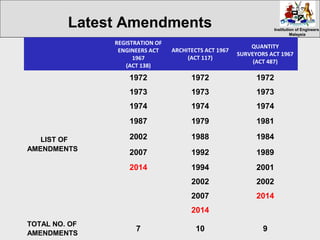
REGISTRATION OF
ENGINEERS ACT
1967
(ACT 138)
ARCHITECTS ACT 1967
(ACT 117)
QUANTITY
SURVEYORS ACT 1967
(ACT 487)
LIST OF
AMENDMENTS
1972 1972 1972
1973 1973 1973
1974 1974 1974
1987 1979 1981
2002 1988 1984
2007 1992 1989
2014 1994 2001
2002 2002
2007 2014
2014
TOTAL NO. OF
AMENDMENTS
7 10 9
Latest Amendments
Institution of EngineersInstitution of Engineers
MalaysiaMalaysia
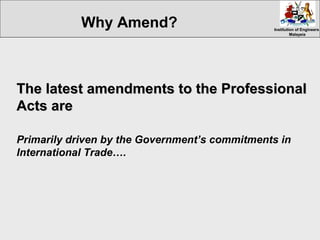
The latest amendments to the ProfessionalThe latest amendments to the Professional
Acts areActs are
Primarily driven by the Government’s commitments in
International Trade….
Why Amend?
Malaysia as a Trading Nation has BenefittedMalaysia as a Trading Nation has Benefitted
Greatly from Trade LiberalisationGreatly from Trade Liberalisation
Institution of EngineersInstitution of Engineers
MalaysiaMalaysia
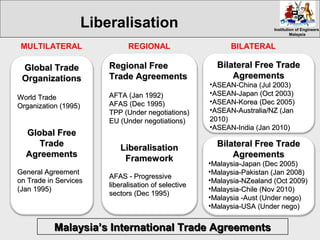
MULTILATERAL REGIONAL BILATERAL
Global TradeGlobal Trade
OrganizationsOrganizations
World TradeWorld Trade
Organization (1995)Organization (1995)
Global FreeGlobal Free
TradeTrade
AgreementsAgreements
General AgreementGeneral Agreement
on Trade in Serviceson Trade in Services
(Jan 1995)(Jan 1995)
Regional FreeRegional Free
Trade AgreementsTrade Agreements
AFTA (Jan 1992)AFTA (Jan 1992)
AFAS (Dec 1995)AFAS (Dec 1995)
TPP (Under negotiations)TPP (Under negotiations)
EU (Under negotiations)EU (Under negotiations)
LiberalisationLiberalisation
FrameworkFramework
AFAS - ProgressiveAFAS - Progressive
liberalisation of selectiveliberalisation of selective
sectors (Dec 1995)sectors (Dec 1995)
Bilateral Free TradeBilateral Free Trade
AgreementsAgreements
•ASEAN-China (Jul 2003)ASEAN-China (Jul 2003)
•ASEAN-Japan (Oct 2003)ASEAN-Japan (Oct 2003)
•ASEAN-Korea (Dec 2005)ASEAN-Korea (Dec 2005)
•ASEAN-Australia/NZ (JanASEAN-Australia/NZ (Jan
2010)2010)
•ASEAN-India (Jan 2010)ASEAN-India (Jan 2010)
Bilateral Free TradeBilateral Free Trade
AgreementsAgreements
•Malaysia-Japan (Dec 2005)Malaysia-Japan (Dec 2005)
•Malaysia-Pakistan (Jan 2008)Malaysia-Pakistan (Jan 2008)
•Malaysia-NZealand (Oct 2009)Malaysia-NZealand (Oct 2009)
•Malaysia-Chile (Nov 2010)Malaysia-Chile (Nov 2010)
•Malaysia -Aust (Under nego)Malaysia -Aust (Under nego)
•Malaysia-USA (Under nego)Malaysia-USA (Under nego)
Liberalisation
Malaysia’s International Trade AgreementsMalaysia’s International Trade Agreements
Institution of EngineersInstitution of Engineers
MalaysiaMalaysia
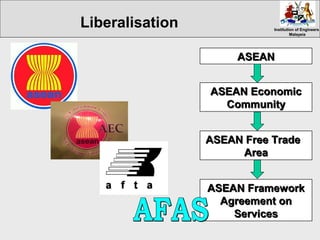
Liberalisation
ASEANASEAN
ASEAN EconomicASEAN Economic
CommunityCommunity
ASEAN Free TradeASEAN Free Trade
AreaArea
ASEAN FrameworkASEAN Framework
Agreement onAgreement on
ServicesServices
Institution of EngineersInstitution of Engineers
MalaysiaMalaysia
Developed Nation Status
Institution of EngineersInstitution of Engineers
MalaysiaMalaysia
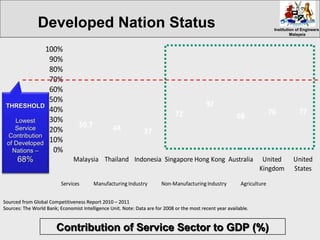
Sourced from Global Competitiveness Report 2010 – 2011Sourced from Global Competitiveness Report 2010 – 2011
Sources: The World Bank; Economist Intelligence Unit. Note: Data are for 2008 or the most recent year available.Sources: The World Bank; Economist Intelligence Unit. Note: Data are for 2008 or the most recent year available.
50.7 44 37
72
92
68 76 77
0%
10%
20%
30%
40%
50%
60%
70%
80%
90%
100%
Malaysia Thailand Indonesia Singapore Hong Kong Australia United
Kingdom
United
States
Services Manufacturing Industry Non-Manufacturing Industry Agriculture
THRESHOLDTHRESHOLD
LowestLowest
ServiceService
ContributionContribution
of Developedof Developed
Nations –Nations –
68%68%
Contribution of Service Sector to GDP (%)Contribution of Service Sector to GDP (%)
Developed Nation Status
Institution of EngineersInstitution of Engineers
MalaysiaMalaysia
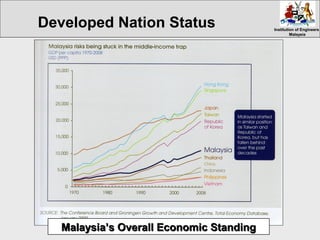
Malaysia’s Overall Economic StandingMalaysia’s Overall Economic Standing
Developed Nation Status
Institution of EngineersInstitution of Engineers
MalaysiaMalaysia
How Do We Get Back on TrackHow Do We Get Back on Track
To transform the Malaysian Economy…
Institution of EngineersInstitution of Engineers
MalaysiaMalaysia
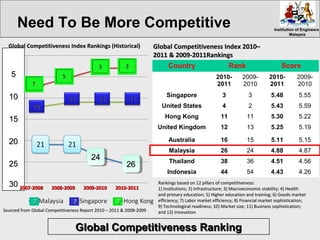
Country Rank Score
2010-
2011
2009-
2010
2010-
2011
2009-
2010
Singapore 3 3 5.48 5.55
United States 4 2 5.43 5.59
Hong Kong 11 11 5.30 5.22
United Kingdom 12 13 5.25 5.19
Australia 16 15 5.11 5.15
Malaysia 26 24 4.88 4.87
Thailand 38 36 4.51 4.56
Indonesia 44 54 4.43 4.26
Sourced from Global Competitiveness Report 2010 – 2011 & 2008-2009Sourced from Global Competitiveness Report 2010 – 2011 & 2008-2009
Global Competitiveness Index 2010–Global Competitiveness Index 2010–
2011 & 2009-2011Rankings2011 & 2009-2011Rankings
55
1010
1515
2020
2525
3030 2007-2008 2008-2009 2009-2010 2010-20112007-2008 2008-2009 2009-2010 2010-2011
24242424
26262626
Global Competitiveness Index Rankings (Historical)Global Competitiveness Index Rankings (Historical)
1212
1111 1111 1111
77
55
33
Rankings based on 12 pillars of competitiveness:Rankings based on 12 pillars of competitiveness:
1) Institutions; 2) Infrastructure; 3) Macroeconomic stability; 4) Health1) Institutions; 2) Infrastructure; 3) Macroeconomic stability; 4) Health
and primary education; 5) Higher education and training; 6) Goods marketand primary education; 5) Higher education and training; 6) Goods market
efficiency; 7) Labor market efficiency; 8) Financial market sophistication;efficiency; 7) Labor market efficiency; 8) Financial market sophistication;
9) Technological readiness; 10) Market size; 11) Business sophistication;9) Technological readiness; 10) Market size; 11) Business sophistication;
and 12) Innovationand 12) Innovation
33
777777
Global Competitiveness RankingGlobal Competitiveness Ranking
Need To Be More Competitive
Institution of EngineersInstitution of Engineers
MalaysiaMalaysia
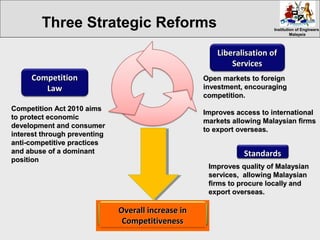
Competition Act 2010 aimsCompetition Act 2010 aims
to protect economicto protect economic
development and consumerdevelopment and consumer
interest through preventinginterest through preventing
anti-competitive practicesanti-competitive practices
and abuse of a dominantand abuse of a dominant
positionposition
Open markets to foreignOpen markets to foreign
investment, encouraginginvestment, encouraging
competition.competition.
Improves access to internationalImproves access to international
markets allowing Malaysian firmsmarkets allowing Malaysian firms
to export overseas.to export overseas.
ImprovesImproves quality of Malaysianquality of Malaysian
services, allowing Malaysianservices, allowing Malaysian
firms to procure locally andfirms to procure locally and
export overseas.export overseas.
Liberalisation ofLiberalisation of
ServicesServices
StandardsStandards
Overall increase inOverall increase in
CompetitivenessCompetitiveness
Three Strategic Reforms
CompetitionCompetition
LawLaw
Institution of EngineersInstitution of Engineers
MalaysiaMalaysia
For amendments to the ProfessionalFor amendments to the Professional
Acts the following Issues to beActs the following Issues to be
considered …..considered …..
Issues To Consider
Institution of EngineersInstitution of Engineers
MalaysiaMalaysia
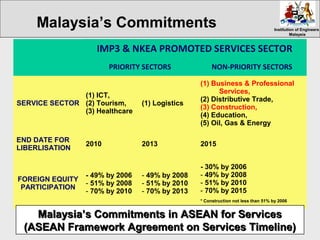
IMP3 & NKEA PROMOTED SERVICES SECTOR
PRIORITY SECTORS NON-PRIORITY SECTORS
SERVICE SECTOR
(1) ICT,
(2) Tourism,
(3) Healthcare
(1) Logistics
(1) Business & Professional
Services,
(2) Distributive Trade,
(3) Construction,
(4) Education,
(5) Oil, Gas & Energy
END DATE FOR
LIBERLISATION
2010 2013 2015
FOREIGN EQUITY
PARTICIPATION
- 49% by 2006
- 51% by 2008
- 70% by 2010
- 49% by 2008
- 51% by 2010
- 70% by 2013
- 30% by 2006
- 49% by 2008
- 51% by 2010
- 70% by 2015
* Construction not less than 51% by 2006
Malaysia’s Commitments in ASEAN for ServicesMalaysia’s Commitments in ASEAN for Services
(ASEAN Framework Agreement on Services Timeline)(ASEAN Framework Agreement on Services Timeline)
Malaysia’s Commitments
Institution of EngineersInstitution of Engineers
MalaysiaMalaysia
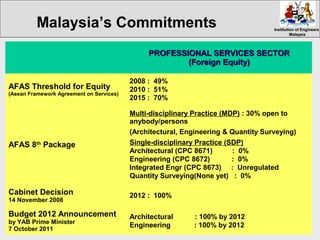
PROFESSIONAL SERVICES SECTORPROFESSIONAL SERVICES SECTOR
(Foreign Equity)(Foreign Equity)
AFAS Threshold for Equity
(Asean Framework Agreement on Services)
2008 : 49%
2010 : 51%
2015 : 70%
AFAS 8th
Package
Multi-disciplinary Practice (MDP) : 30% open to
anybody/persons
(Architectural, Engineering & Quantity Surveying)
Single-disciplinary Practice (SDP)
Architectural (CPC 8671) : 0%
Engineering (CPC 8672) : 0%
Integrated Engr (CPC 8673) : Unregulated
Quantity Surveying(None yet) : 0%
Cabinet Decision
14 November 2008
2012 : 100%
Budget 2012 Announcement
by YAB Prime Minister
7 October 2011
Architectural : 100% by 2012
Engineering : 100% by 2012
Malaysia’s Commitments
Institution of EngineersInstitution of Engineers
MalaysiaMalaysia
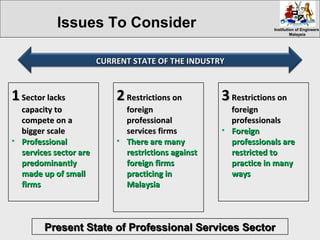
11 Sector lacksSector lacks
capacity tocapacity to
compete on acompete on a
bigger scalebigger scale
• ProfessionalProfessional
services sector areservices sector are
predominantlypredominantly
made up of smallmade up of small
firmsfirms
22 Restrictions onRestrictions on
foreignforeign
professionalprofessional
services firmsservices firms
• There are manyThere are many
restrictions againstrestrictions against
foreign firmsforeign firms
practicing inpracticing in
MalaysiaMalaysia
33 Restrictions onRestrictions on
foreignforeign
professionalsprofessionals
• ForeignForeign
professionals areprofessionals are
restricted torestricted to
practice in manypractice in many
waysways
CURRENT STATE OF THE INDUSTRYCURRENT STATE OF THE INDUSTRY
Issues To Consider
Present State of Professional Services SectorPresent State of Professional Services Sector
Institution of EngineersInstitution of Engineers
MalaysiaMalaysia
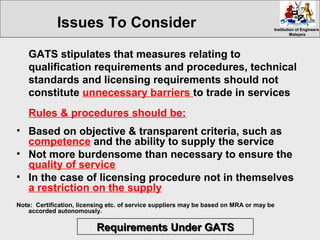
GATS stipulates that measures relating to
qualification requirements and procedures, technical
standards and licensing requirements should not
constitute unnecessary barriers to trade in services
Rules & procedures should be:
• Based on objective & transparent criteria, such as
competence and the ability to supply the service
• Not more burdensome than necessary to ensure the
quality of service
• In the case of licensing procedure not in themselves
a restriction on the supply
Note: Certification, licensing etc. of service suppliers may be based on MRA or may be
accorded autonomously.
Issues To Consider
Requirements Under GATSRequirements Under GATS
Institution of EngineersInstitution of Engineers
MalaysiaMalaysia
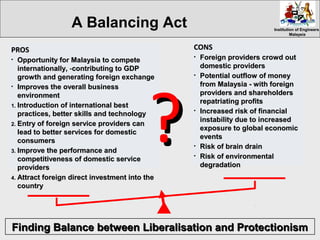
CONSCONS
• Foreign providers crowd outForeign providers crowd out
domestic providersdomestic providers
• Potential outflow of moneyPotential outflow of money
from Malaysia -from Malaysia - with foreignwith foreign
providers and shareholdersproviders and shareholders
repatriating profitsrepatriating profits
• Increased risk of financialIncreased risk of financial
instability due to increasedinstability due to increased
exposure to global economicexposure to global economic
eventsevents
• Risk of brain drainRisk of brain drain
• Risk of environmentalRisk of environmental
degradationdegradation
PROSPROS
• Opportunity for Malaysia to competeOpportunity for Malaysia to compete
internationally,internationally, --contributing to GDPcontributing to GDP
growth and generating foreign exchangegrowth and generating foreign exchange
• Improves the overall businessImproves the overall business
environmentenvironment
1.1. Introduction of international bestIntroduction of international best
practices, better skills and technologypractices, better skills and technology
2.2. Entry of foreign service providers canEntry of foreign service providers can
lead to better services for domesticlead to better services for domestic
consumersconsumers
3.3. Improve the performance andImprove the performance and
competitiveness of domestic servicecompetitiveness of domestic service
providersproviders
4.4. Attract foreign direct investment into theAttract foreign direct investment into the
countrycountry
??
A Balancing Act
Finding Balance between Liberalisation and ProtectionismFinding Balance between Liberalisation and Protectionism
Institution of EngineersInstitution of Engineers
MalaysiaMalaysia
What needs to be done for theWhat needs to be done for the
Professional ActsProfessional Acts
Taking the next step…
Latest Amendments
Institution of EngineersInstitution of Engineers
MalaysiaMalaysia
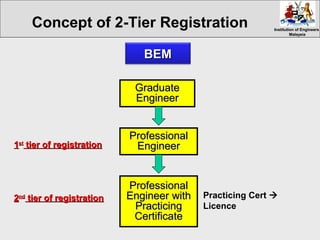
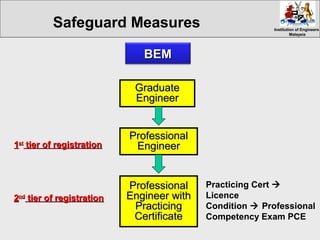
BEMBEM
GraduateGraduate
EngineerEngineer
ProfessionalProfessional
EngineerEngineer
ProfessionalProfessional
Engineer withEngineer with
PracticingPracticing
CertificateCertificate
11stst
tier of registrationtier of registration
22ndnd
tier of registrationtier of registration Practicing Cert 
Licence
Concept of 2-Tier Registration
Institution of EngineersInstitution of Engineers
MalaysiaMalaysia
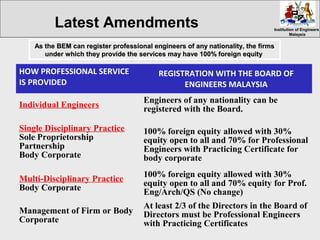
As the BEM can register professional engineers of any nationality, the firmsAs the BEM can register professional engineers of any nationality, the firms
under which they provide the services may have 100% foreign equityunder which they provide the services may have 100% foreign equity
HOW PROFESSIONAL SERVICE
IS PROVIDED
REGISTRATION WITH THE BOARD OF
ENGINEERS MALAYSIA
Individual Engineers
Engineers of any nationality can be
registered with the Board.
Single Disciplinary Practice
Sole Proprietorship
Partnership
Body Corporate
100% foreign equity allowed with 30%
equity open to all and 70% for Professional
Engineers with Practicing Certificate for
body corporate
Multi-Disciplinary Practice
Body Corporate
100% foreign equity allowed with 30%
equity open to all and 70% equity for Prof.
Eng/Arch/QS (No change)
Management of Firm or Body
Corporate
At least 2/3 of the Directors in the Board of
Directors must be Professional Engineers
with Practicing Certificates
Latest Amendments
Institution of EngineersInstitution of Engineers
MalaysiaMalaysia
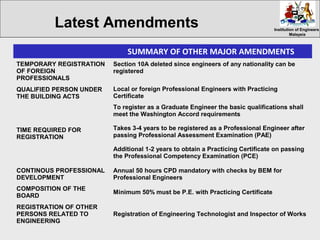
SUMMARY OF OTHER MAJOR AMENDMENTS
TEMPORARY REGISTRATION
OF FOREIGN
PROFESSIONALS
Section 10A deleted since engineers of any nationality can be
registered
QUALIFIED PERSON UNDER
THE BUILDING ACTS
Local or foreign Professional Engineers with Practicing
Certificate
TIME REQUIRED FOR
REGISTRATION
To register as a Graduate Engineer the basic qualifications shall
meet the Washington Accord requirements
Takes 3-4 years to be registered as a Professional Engineer after
passing Professional Assessment Examination (PAE)
Additional 1-2 years to obtain a Practicing Certificate on passing
the Professional Competency Examination (PCE)
CONTINOUS PROFESSIONAL
DEVELOPMENT
Annual 50 hours CPD mandatory with checks by BEM for
Professional Engineers
COMPOSITION OF THE
BOARD
Minimum 50% must be P.E. with Practicing Certificate
REGISTRATION OF OTHER
PERSONS RELATED TO
ENGINEERING
Registration of Engineering Technologist and Inspector of Works
Latest Amendments
Institution of EngineersInstitution of Engineers
MalaysiaMalaysia
Liberalisation does not mean deregulationLiberalisation does not mean deregulation
That is why safeguard measures are …That is why safeguard measures are …
Safeguard Measures
Institution of EngineersInstitution of Engineers
MalaysiaMalaysia
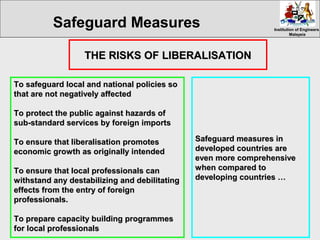
To safeguard local and national policies soTo safeguard local and national policies so
that are not negatively affectedthat are not negatively affected
To protect the public against hazards ofTo protect the public against hazards of
sub-standard services by foreign importssub-standard services by foreign imports
To ensure that liberalisation promotesTo ensure that liberalisation promotes
economic growth as originally intendedeconomic growth as originally intended
To ensure that local professionals canTo ensure that local professionals can
withstand any destabilizing and debilitatingwithstand any destabilizing and debilitating
effects from the entry of foreigneffects from the entry of foreign
professionals.professionals.
To prepare cTo prepare capacity building programmesapacity building programmes
for local professionalsfor local professionals
THE RISKS OF LIBERALISATIONTHE RISKS OF LIBERALISATION
Safeguard measures inSafeguard measures in
developed countries aredeveloped countries are
even more comprehensiveeven more comprehensive
when compared towhen compared to
developing countries …developing countries …
Safeguard Measures
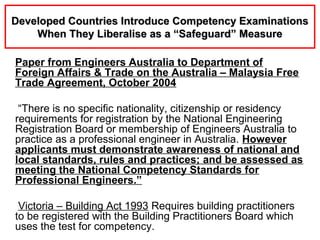
Paper from Engineers Australia to Department of
Foreign Affairs & Trade on the Australia – Malaysia Free
Trade Agreement, October 2004
“There is no specific nationality, citizenship or residency
requirements for registration by the National Engineering
Registration Board or membership of Engineers Australia to
practice as a professional engineer in Australia. However
applicants must demonstrate awareness of national and
local standards, rules and practices; and be assessed as
meeting the National Competency Standards for
Professional Engineers.”
Victoria – Building Act 1993 Requires building practitioners
to be registered with the Building Practitioners Board which
uses the test for competency.
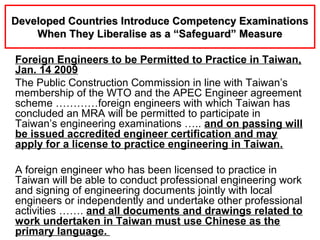
Developed Countries Introduce Competency ExaminationsDeveloped Countries Introduce Competency Examinations
When They Liberalise as a “Safeguard” MeasureWhen They Liberalise as a “Safeguard” Measure
Foreign Engineers to be Permitted to Practice in Taiwan,
Jan. 14 2009
The Public Construction Commission in line with Taiwan’s
membership of the WTO and the APEC Engineer agreement
scheme …………foreign engineers with which Taiwan has
concluded an MRA will be permitted to participate in
Taiwan’s engineering examinations ….. and on passing will
be issued accredited engineer certification and may
apply for a license to practice engineering in Taiwan.
A foreign engineer who has been licensed to practice in
Taiwan will be able to conduct professional engineering work
and signing of engineering documents jointly with local
engineers or independently and undertake other professional
activities ……. and all documents and drawings related to
work undertaken in Taiwan must use Chinese as the
primary language.
Developed Countries Introduce Competency ExaminationsDeveloped Countries Introduce Competency Examinations
When They Liberalise as a “Safeguard” MeasureWhen They Liberalise as a “Safeguard” Measure
Institution of EngineersInstitution of Engineers
MalaysiaMalaysia
BEMBEM
GraduateGraduate
EngineerEngineer
ProfessionalProfessional
EngineerEngineer
ProfessionalProfessional
Engineer withEngineer with
PracticingPracticing
CertificateCertificate
11stst
tier of registrationtier of registration
22ndnd
tier of registrationtier of registration
Practicing Cert 
Licence
Condition  Professional
Competency Exam PCE
Safeguard Measures
Institution of EngineersInstitution of Engineers
MalaysiaMalaysia
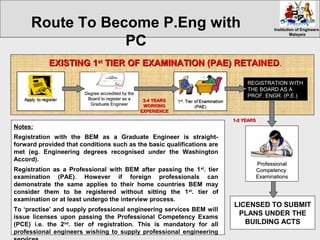
Notes:
Registration with the BEM as a Graduate Engineer is straight-
forward provided that conditions such as the basic qualifications are
met (eg. Engineering degrees recognised under the Washington
Accord).
Registration as a Professional with BEM after passing the 1st
. tier
examination (PAE). However if foreign professionals can
demonstrate the same applies to their home countries BEM may
consider them to be registered without sitting the 1st
. tier of
examination or at least undergo the interview process.
To ‘practise’ and supply professional engineering services BEM will
issue licenses upon passing the Professional Competency Exams
(PCE) i.e. the 2nd
. tier of registration. This is mandatory for all
professional engineers wishing to supply professional engineering
REGISTRATION WITHREGISTRATION WITH
THE BOARD AS ATHE BOARD AS A
PROF. ENGR. (P.E.)PROF. ENGR. (P.E.)Degree accredited by theDegree accredited by the
Board to register as aBoard to register as a
Graduate EngineerGraduate Engineer
3-4 YEARS3-4 YEARS
WORKINGWORKING
EXPERIENCEEXPERIENCE
EXISTING 1EXISTING 1stst
TIER OF EXAMINATION (PAE) RETAINEDTIER OF EXAMINATION (PAE) RETAINED..
LICENSED TO SUBMIT
PLANS UNDER THE
BUILDING ACTS
ProfessionalProfessional
CompetencyCompetency
ExaminationsExaminations
1-2 YEARS1-2 YEARS
Route To Become P.Eng with
PC
Institution of EngineersInstitution of Engineers
MalaysiaMalaysia
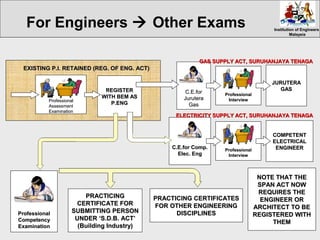
ProfessionalProfessional
AssessmentAssessment
ExaminationExamination
REGISTERREGISTER
WITH BEM ASWITH BEM AS
P.ENGP.ENG
EXISTING P.I. RETAINED (REG. OF ENG. ACT)EXISTING P.I. RETAINED (REG. OF ENG. ACT)
C.E.forC.E.for
JuruteraJurutera
GasGas
ProfessionalProfessional
InterviewInterview
JURUTERAJURUTERA
GASGAS
GAS SUPPLY ACT, SURUHANJAYA TENAGAGAS SUPPLY ACT, SURUHANJAYA TENAGA
C.E.for Comp.C.E.for Comp.
Elec. EngElec. Eng
ProfessionalProfessional
InterviewInterview
COMPETENTCOMPETENT
ELECTRICALELECTRICAL
ENGINEERENGINEER
ELECTRICITY SUPPLY ACT, SURUHANJAYA TENAGAELECTRICITY SUPPLY ACT, SURUHANJAYA TENAGA
PRACTICING CERTIFICATESPRACTICING CERTIFICATES
FOR OTHER ENGINEERINGFOR OTHER ENGINEERING
DISCIPLINESDISCIPLINESProfessionalProfessional
CompetencyCompetency
ExaminationExamination
PRACTICINGPRACTICING
CERTIFICATE FORCERTIFICATE FOR
SUBMITTING PERSONSUBMITTING PERSON
UNDER ‘S.D.B. ACT’UNDER ‘S.D.B. ACT’
(Building Industry)(Building Industry)
NOTE THAT THENOTE THAT THE
SPAN ACT NOWSPAN ACT NOW
REQUIRES THEREQUIRES THE
ENGINEER ORENGINEER OR
ARCHITECT TO BEARCHITECT TO BE
REGISTERED WITHREGISTERED WITH
THEMTHEM
For Engineers  Other Exams
Institution of EngineersInstitution of Engineers
MalaysiaMalaysia
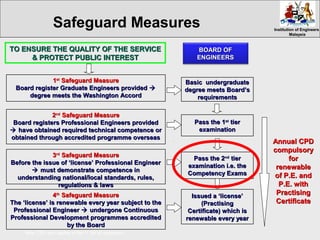
BOARD OFBOARD OF
ENGINEERSENGINEERS
Basic undergraduateBasic undergraduate
degree meets Board’sdegree meets Board’s
requirementsrequirements
Pass the 1Pass the 1stst
tiertier
examinationexamination
Pass the 2Pass the 2ndnd
tiertier
examination i.e. theexamination i.e. the
Competency ExamsCompetency Exams
Issued a ‘license’Issued a ‘license’
(Practising(Practising
Certificate) which isCertificate) which is
renewable every yearrenewable every year
11stst
Safeguard MeasureSafeguard Measure
Board register Graduate Engineers providedBoard register Graduate Engineers provided 
degree meets the Washington Accorddegree meets the Washington Accord
22ndnd
Safeguard MeasureSafeguard Measure
Board registers Professional Engineers providedBoard registers Professional Engineers provided
 have obtained required technical competence orhave obtained required technical competence or
obtained through accredited programme overseasobtained through accredited programme overseas
33rdrd
Safeguard MeasureSafeguard Measure
Before the issue of ‘license’ Professional EngineerBefore the issue of ‘license’ Professional Engineer
 must demonstrate competence inmust demonstrate competence in
understanding national/local standards, rules,understanding national/local standards, rules,
regulations & lawsregulations & laws
44thth
Safeguard MeasureSafeguard Measure
The ‘license’ is renewable every year subject to theThe ‘license’ is renewable every year subject to the
Professional EngineerProfessional Engineer  undergone Continuousundergone Continuous
Professional Development programmes accreditedProfessional Development programmes accredited
by the Boardby the Board
Annual CPDAnnual CPD
compulsorycompulsory
forfor
renewablerenewable
of P.E. andof P.E. and
P.E. withP.E. with
PractisingPractising
CertificateCertificate
TO ENSURE THE QUALITY OF THE SERVICETO ENSURE THE QUALITY OF THE SERVICE
& PROTECT PUBLIC INTEREST& PROTECT PUBLIC INTEREST
Note: CPD also applies at the 1st
. tier of registration
Safeguard Measures
Institution of EngineersInstitution of Engineers
MalaysiaMalaysia
ProfessionalProfessional
CompetencyCompetency
ExaminationExamination
ProfessionalProfessional
CompetencyCompetency
ExaminationExamination
Institution of EngineersInstitution of Engineers
MalaysiaMalaysia
PART 1 Enabling Legislation
Amendments to REA 1967
PART 2 What is the Purpose of the PCE
To ensure Competency
PART 3 Format of the PCE
The Structure and Format
PART 4 The Common Paper – Sample Questions
For all Engineers in the Building/Construction Industry
PART 5 The Civil & Structural, Mechanical & Electrical Papers
Sample Questions
PART 6 Trial Examination
To test the Examination
PART 7 Candidates Feedback & Results of the PCE
To gauge the Difficulty & Level of Understanding
PART 8 BEM’s Operations for the PCE
Information for Candidates
Professional Competency Exam
Institution of EngineersInstitution of Engineers
MalaysiaMalaysia
Part 1
Enabling Legislation
Amendments to REA 1967 ….
Institution of EngineersInstitution of Engineers
MalaysiaMalaysia
(1) Amendment to Section 4 (Functions of the Board)
Section 4(1) The functions of the Board shall be –
(ee)(ed)(ii) to appoint a committee consisting of
persons to be determined by the Board, to conduct
the Professional Competency Examination for the
purpose of issuing a Practising Certificate to
Professional Engineers.
Latest Amendments to REA
Institution of EngineersInstitution of Engineers
MalaysiaMalaysia
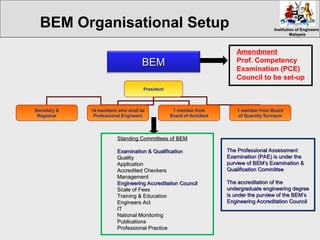
BEMBEM
Standing Committees of BEMStanding Committees of BEM
Examination & QualificationExamination & Qualification
QualityQuality
ApplicationApplication
Accredited CheckersAccredited Checkers
ManagementManagement
Engineering Accreditation CouncilEngineering Accreditation Council
Scale of FeesScale of Fees
Training & EducationTraining & Education
Engineers ActEngineers Act
ITIT
National MonitoringNational Monitoring
PublicationsPublications
Professional PracticeProfessional Practice
President
Secretary &
Registrar
14 members who shall be
Professional Engineers
1 member from
Board of Architect
1 member from Board
of Quantity Surveyor
The Professional AssessmentThe Professional Assessment
Examination (PAE) is under theExamination (PAE) is under the
purview of BEM’s Examination &purview of BEM’s Examination &
Qualification CommitteeQualification Committee
The accreditation of theThe accreditation of the
undergraduate engineering degreeundergraduate engineering degree
is under the purview of the BEM’sis under the purview of the BEM’s
Engineering Accreditation CouncilEngineering Accreditation Council
BEM Organisational Setup
Amendment
Prof. Competency
Examination (PCE)
Council to be set-up
Institution of EngineersInstitution of Engineers
MalaysiaMalaysia
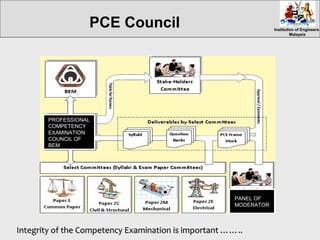
PROFESSIONALPROFESSIONAL
COMPETENCYCOMPETENCY
EXAMINATIONEXAMINATION
COUNCIL OFCOUNCIL OF
BEMBEM
PANEL OFPANEL OF
MODERATORMODERATOR
Integrity of the Competency Examination is important ……..Integrity of the Competency Examination is important ……..
PCE Council
Institution of EngineersInstitution of Engineers
MalaysiaMalaysia
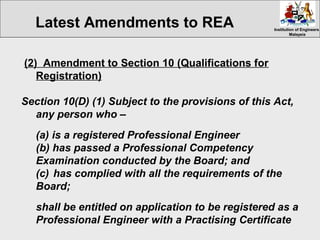
(2) Amendment to Section 10 (Qualifications for
Registration)
Section 10(D) (1) Subject to the provisions of this Act,
any person who –
(a) is a registered Professional Engineer
(b) has passed a Professional Competency
Examination conducted by the Board; and
(c) has complied with all the requirements of the
Board;
shall be entitled on application to be registered as a
Professional Engineer with a Practising Certificate
Latest Amendments to REA
Institution of EngineersInstitution of Engineers
MalaysiaMalaysia
Part 2
What is the purpose of the PCE?
To ensure competency ..….
Institution of EngineersInstitution of Engineers
MalaysiaMalaysia
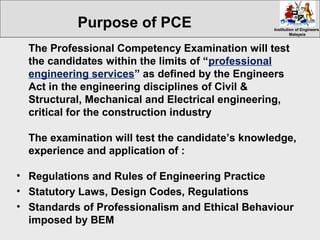
The Professional Competency Examination will test
the candidates within the limits of “professional
engineering services” as defined by the Engineers
Act in the engineering disciplines of Civil &
Structural, Mechanical and Electrical engineering,
critical for the construction industry
The examination will test the candidate’s knowledge,
experience and application of :
• Regulations and Rules of Engineering Practice
• Statutory Laws, Design Codes, Regulations
• Standards of Professionalism and Ethical Behaviour
imposed by BEM
Purpose of PCE
Institution of EngineersInstitution of Engineers
MalaysiaMalaysia
BEM is developing PCE for other engineering
disciplines
The following organisations were commissioned to
prepare the criteria/requirement, syllabus and exam
questions :
•Marine MISC BHD
•Chemical iChemE Malaysia Chapter
•Environmental Dept of Chem Engrg UM
•Oil and Gas Petronas
Future Applications of PCE
Institution of EngineersInstitution of Engineers
MalaysiaMalaysia
Part 3
Format of the Professional
Competency Examination (PCE)
The structure & format ..….
Institution of EngineersInstitution of Engineers
MalaysiaMalaysia
• Professional engineers wishing to sit for the PCE shall
apply to the Board by completion of a prescribed form
and payment of the prescribed fees
• Eligible candidates for the examination must be a
Professional Engineer registered with the Board in the
appropriate discipline
• Candidates seeking registration as a licensing
submitting engineer in the construction industry must
have the relevant working experience in the field of
engineering which he wishes to practice
• On approval of the candidate’s application by the
Board, the candidate is allowed to sit for the
examination.
Eligibility to sit for PCE
Institution of EngineersInstitution of Engineers
MalaysiaMalaysia
• The Examination is conducted by BEM pursuant to
Section 4 of the amended REA
• BEM appoints an Examination Panel, consisting of such
members from amongst registered Professional
Engineers to assist in conducting the Examination
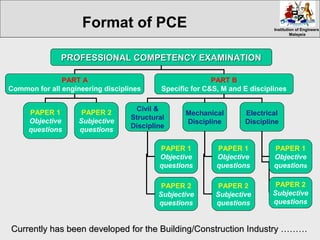
• The PCE comprises :
• PART A {Common}  Paper 1 (Objective) and Paper
2 (Subjective)
• PART B {Each discipline}  Paper 1 (Objective) and
Paper 2 (Subjective)
• Candidates can sit for PART A and B together or
separately
• Must pass both papers for both PARTs at one sitting
• The exam is an open book exam
Format of PCE
Institution of EngineersInstitution of Engineers
MalaysiaMalaysia
PROFESSIONAL COMPETENCY EXAMINATIONPROFESSIONAL COMPETENCY EXAMINATION
PART A
Common for all engineering disciplines
PART B
Specific for C&S, M and E disciplines
Civil &
Structural
Discipline
Mechanical
Discipline
Electrical
Discipline
PAPER 1
Objective
questions
PAPER 2
Subjective
questions
PAPER 1
Objective
questions
PAPER 2
Subjective
questions
PAPER 1
Objective
questions
PAPER 2
Subjective
questions
PAPER 1
Objective
questions
PAPER 2
Subjective
questions
Currently has been developed for the Building/Construction Industry ………Currently has been developed for the Building/Construction Industry ………
Format of PCE
Institution of EngineersInstitution of Engineers
MalaysiaMalaysia
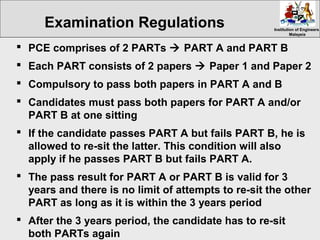
 PCE comprises of 2 PARTs  PART A and PART B
 Each PART consists of 2 papers  Paper 1 and Paper 2
 Compulsory to pass both papers in PART A and B
 Candidates must pass both papers for PART A and/or
PART B at one sitting
 If the candidate passes PART A but fails PART B, he is
allowed to re-sit the latter. This condition will also
apply if he passes PART B but fails PART A.
 The pass result for PART A or PART B is valid for 3
years and there is no limit of attempts to re-sit the other
PART as long as it is within the 3 years period
 After the 3 years period, the candidate has to re-sit
both PARTs again
Examination Regulations
Institution of EngineersInstitution of Engineers
MalaysiaMalaysia
• To be taken by all candidates
• Non-technical in nature
• To test candidates’ knowledge of laws governing the
profession, the responsibility of the professional
towards the general public and standards of
professionalism and ethical behaviour
There are two papers for this PART  Paper 1 and Paper 2
PART A - Common PaperPART A - Common Paper
PCE : PART A
Institution of EngineersInstitution of Engineers
MalaysiaMalaysia
• To be taken by candidates in the relevant discipline
which they wish to practice
• Technical in nature
• Test candidate’s competency within his respective field
of practice on :
Regulations and rules of practice by BEM
Statutory laws, codes, regulations etc.
There are two papers for this PART  Paper 1 and Paper 2
PART B - Paper on each DisciplinePART B - Paper on each Discipline
PCE : PART B
Institution of EngineersInstitution of Engineers
MalaysiaMalaysia
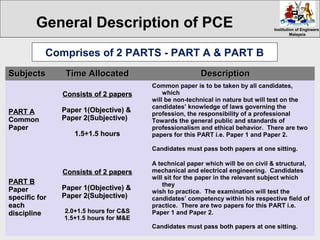
Comprises of 2 PARTS - PART A & PART B
SubjectsSubjects Time AllocatedTime Allocated DescriptionDescription
PART APART A
CommonCommon
PaperPaper
Consists of 2 papersConsists of 2 papers
Paper 1(Objective) &Paper 1(Objective) &
Paper 2(Subjective)Paper 2(Subjective)
1.5+1.5 hours1.5+1.5 hours
Common paper is to be taken by all candidates,
which
will be non-technical in nature but will test on the
candidates’ knowledge of laws governing the
profession, the responsibility of a professional
Towards the general public and standards of
professionalism and ethical behavior. There are two
papers for this PART i.e. Paper 1 and Paper 2.
Candidates must pass both papers at one sitting.
PART BPART B
PaperPaper
specific forspecific for
eacheach
disciplinediscipline
Consists of 2 papersConsists of 2 papers
Paper 1(Objective) &Paper 1(Objective) &
Paper 2(Subjective)Paper 2(Subjective)
2.0+1.5 hours for C&S2.0+1.5 hours for C&S
1.5+1.5 hours for M&E1.5+1.5 hours for M&E
A technical paper which will be on civil & structural,
mechanical and electrical engineering. Candidates
will sit for the paper in the relevant subject which
they
wish to practice. The examination will test the
candidates’ competency within his respective field of
practice. There are two papers for this PART i.e.
Paper 1 and Paper 2.
Candidates must pass both papers at one sitting.
General Description of PCE
Institution of EngineersInstitution of Engineers
MalaysiaMalaysia
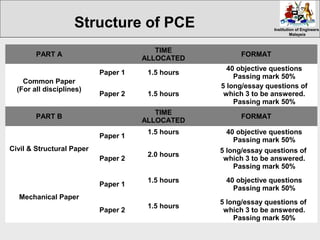
PART A
TIME
ALLOCATED
FORMAT
Common Paper
(For all disciplines)
Paper 1 1.5 hours
40 objective questions
Passing mark 50%
Paper 2 1.5 hours
5 long/essay questions of
which 3 to be answered.
Passing mark 50%
PART B
TIME
ALLOCATED
FORMAT
Civil & Structural Paper
Paper 1
1.5 hours 40 objective questions
Passing mark 50%
Paper 2
2.0 hours
5 long/essay questions of
which 3 to be answered.
Passing mark 50%
Mechanical Paper
Paper 1
1.5 hours 40 objective questions
Passing mark 50%
Paper 2
1.5 hours
5 long/essay questions of
which 3 to be answered.
Passing mark 50%
Structure of PCE
Institution of EngineersInstitution of Engineers
MalaysiaMalaysia
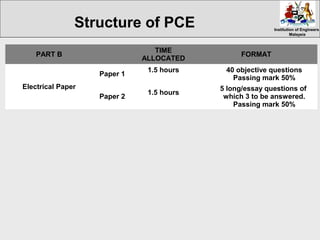
PART B
TIME
ALLOCATED
FORMAT
Electrical Paper
Paper 1
1.5 hours 40 objective questions
Passing mark 50%
Paper 2
1.5 hours
5 long/essay questions of
which 3 to be answered.
Passing mark 50%
Structure of PCE
Institution of EngineersInstitution of Engineers
MalaysiaMalaysia
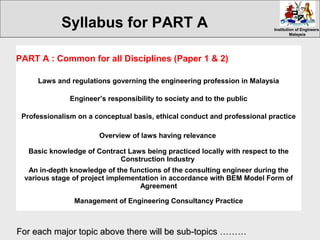
PART A : Common for all Disciplines (Paper 1 & 2)
Laws and regulations governing the engineering profession in Malaysia
Engineer’s responsibility to society and to the public
Professionalism on a conceptual basis, ethical conduct and professional practice
Overview of laws having relevance
Basic knowledge of Contract Laws being practiced locally with respect to the
Construction Industry
An in-depth knowledge of the functions of the consulting engineer during the
various stage of project implementation in accordance with BEM Model Form of
Agreement
Management of Engineering Consultancy Practice
For each major topic above there will be sub-topics ………For each major topic above there will be sub-topics ………
Syllabus for PART A
Institution of EngineersInstitution of Engineers
MalaysiaMalaysia
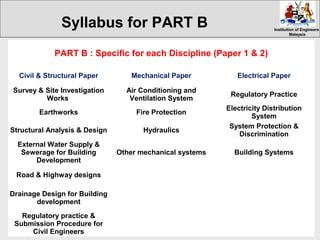
PART B : Specific for each Discipline (Paper 1 & 2)
Civil & Structural Paper Mechanical Paper Electrical Paper
Survey & Site Investigation
Works
Air Conditioning and
Ventilation System
Regulatory Practice
Earthworks Fire Protection
Electricity Distribution
System
Structural Analysis & Design Hydraulics
System Protection &
Discrimination
External Water Supply &
Sewerage for Building
Development
Other mechanical systems Building Systems
Road & Highway designs
Drainage Design for Building
development
Regulatory practice &
Submission Procedure for
Civil Engineers
Syllabus for PART B
Institution of EngineersInstitution of Engineers
MalaysiaMalaysia
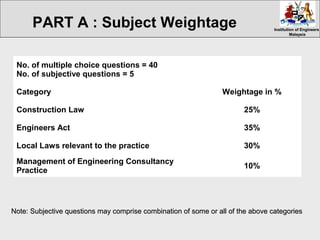
Note: Subjective questions may comprise combination of some or all of the above categoriesNote: Subjective questions may comprise combination of some or all of the above categories
No. of multiple choice questions = 40
No. of subjective questions = 5
Category Weightage in %
Construction Law 25%
Engineers Act 35%
Local Laws relevant to the practice 30%
Management of Engineering Consultancy
Practice
10%
PART A : Subject Weightage
Institution of EngineersInstitution of Engineers
MalaysiaMalaysia
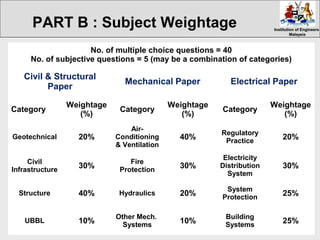
No. of multiple choice questions = 40
No. of subjective questions = 5 (may be a combination of categories)
Civil & Structural
Paper
Mechanical Paper Electrical Paper
Category
Weightage
(%)
Category
Weightage
(%)
Category
Weightage
(%)
Geotechnical 20%
Air-
Conditioning
& Ventilation
40%
Regulatory
Practice
20%
Civil
Infrastructure
30%
Fire
Protection
30%
Electricity
Distribution
System
30%
Structure 40% Hydraulics 20%
System
Protection
25%
UBBL 10%
Other Mech.
Systems
10%
Building
Systems
25%
PART B : Subject Weightage
Institution of EngineersInstitution of Engineers
MalaysiaMalaysia
Part 4
Sample Questions :
The Common Paper
For all Engineers in the Building/Construction
Industry …..
Institution of EngineersInstitution of Engineers
MalaysiaMalaysia
Q1. A local Consultant (A) enters into an agreement
with a foreign Contractor (B) to carry out
engineering consultancy services for a Turnkey
Contract in that country. Mid-way through the
project, war breaks out in that country. What is
the effect?
A. The Contract is valid and enforceable
B. The Contract is frustrated
C. The Contract is suspended
D. The Contract is discharged
E. The Contract is void
[Test on Contract law]
Sample Question : PART A Paper 1
Institution of EngineersInstitution of Engineers
MalaysiaMalaysia
Q2. Which of the following statement is/are true?
a) Only Mechanical Professional Engineers can submit
active fire protection plans
b) Only Civil or Mechanical Professional Engineers
can submit passive fire protection plans for
industrial buildings
c) Professional Engineers of any discipline can submit
active fire protection plans
d) Only Electrical Professional Engineers can submit
electrical plans
A. a) only D. c) only
B. a) and b) only E. b), c) and d) only
C. a), b) and d) only
[Test on UBBL and Regulations]
Sample Question : PART A Paper 1
Institution of EngineersInstitution of Engineers
MalaysiaMalaysia
Q3. Which of the following statement is false?
A) The BEM Scale of Fees is mandatory.
B) A Sole Proprietorship practising as an ECP
must be registered with BEM
C) All ECPs must be registered with BEM
D) Professional Fees based on man months do
not contravene the BEM Scale of Fees
E) For a private project, a consultant may
exclude provision of supervision and hence
need not charge the corresponding
professional fees
[Test on Engineers Act]
Sample Question : PART A Paper 1
Institution of EngineersInstitution of Engineers
MalaysiaMalaysia
Q1. The contractor applies for Extension of Time (EOT)
before his contract completion period expires. The
Contract Administrator does not respond and the
original contract completion date is passed. One
month later, the Contract Administrator issues a
V.O. for additional works to the Contractor. The
Contractor refuses to carry out the V.O. works.
What can the Contract Administrator do in this
situation?
[Test on Contract law and the Engineers Act]
Sample Question : PART A Paper 2
Institution of EngineersInstitution of Engineers
MalaysiaMalaysia
Q2. A Consultant has carried out substantial works on
a project and the Employer encounters financial
difficulties. He suspends the project. On
resumption, he terminates the Consultant's
employment citing use of in-house consultants to
complete the works due to financial constraints.
What is the legal effect of the termination and what
financial compensation can the consultant seek?
[Test on Contract law and the Engineers Act]
Sample Question : PART A Paper 2
Institution of EngineersInstitution of Engineers
MalaysiaMalaysia
Part 5 (a)
Sample Questions :
The Civil & Structural Paper
For civil engineers …..
Institution of EngineersInstitution of Engineers
MalaysiaMalaysia
Q1. Which of the following statements are true for
circular column?
A. Minimum no. of bars is 8, size of bar is not less
than 10 mm
B. Minimum no. of bars is 8, size of bar is not less
than 12 mm
C. Minimum no. of bars is 6, size of bar is not less
than 10 mm
D. Minimum no. of bars is 6, size of bar is not less
than 12 mm
E. None of the above
[Test on understanding of the Code of Practice]
Sample Question : C&S Paper 1
Institution of EngineersInstitution of Engineers
MalaysiaMalaysia
Q2. What is the minimum residual pressure head for
an external hydrant system required by Bomba
A. 3.0m
B. 7.5m
C. 12.5m
D. 10.0m
E. 9.0m
[Understanding of Bomba requirements]
Sample Question : C&S Paper 1
Institution of EngineersInstitution of Engineers
MalaysiaMalaysia
Q1. You are the infrastructure engineer for a housing
developing scheme for a 500 acres project. What is
your advice to the Developer, Planners and
Architects in terms of requirements for drainage
for the whole development?
Note:
Question can be answered in ½ hr provided that
the answer is descriptive in nature. However if a
layout plan of the housing scheme with contours
are provided and it is expected that the drainage
reserve be sized-up, this question will take 1 hr. to
answer.
[Understanding of MASMA]
Sample Question : C&S Paper 2
Institution of EngineersInstitution of Engineers
MalaysiaMalaysia
Part 5 (b)
Sample Questions :
The Mechanical Paper
For mechanical engineers …..
Institution of EngineersInstitution of Engineers
MalaysiaMalaysia
Q1. Which of the following is not applicable for active
fire designs?
A. MS 1472
B. MS 1780
C. MS 1910
D. MS 1525
E. Guide to Fire Protection in Malaysia
[Understanding of design codes for fire protection]
Sample Question : Mech. Paper 1
Institution of EngineersInstitution of Engineers
MalaysiaMalaysia
Q2. Fire lifts are required for buildings where the
top most occupied floor is
A. Over 30.5m
B. Over 18.5m
C. Over 1,000m2
D. Over 18.5m and 1,000m2
E. Over 30.5m and 1,000m2
[Understanding of Bomba requirements]
Sample Question : Mech. Paper 1
Institution of EngineersInstitution of Engineers
MalaysiaMalaysia
Q1. The following complaints have been received from
building occupants. Briefly describe what you think are
the likely causes of these problems and the solutions you
would propose.
a) Office occupants seating next to window complain of
unsatisfactory air conditioning. Your on-site
measurement shows the design temperature of 24ºC DB
and 55% RH is achieved.
b) Hotel guests complain it takes a long time to get hot
water from their toilet showers and the water temperature
fluctuates during their showers.
c) The contractor was unable to achieve specified
background noise level of NC 25 for the auditorium even
though he has followed manufacturer’s recommendation
of internal duct lining as well as installed silencers.
[Understanding of Building Services requirements]
Sample Question : Mech. Paper 2
Institution of EngineersInstitution of Engineers
MalaysiaMalaysia
Part 5 (c)
Sample Questions :
The Electrical Paper
For electrical engineers …..
Institution of EngineersInstitution of Engineers
MalaysiaMalaysia
Q1. Which is the best installation method to minimize
eddy current losses in single core cable sheaths ?
A. Flat formation
B. Trefoil formation
C. Alternate formation
D. Cross bonding of sheaths
E. Bundle in air
[Understanding of Electrical Distribution Network]
Sample Question : Elect. Paper 1
Institution of EngineersInstitution of Engineers
MalaysiaMalaysia
Q2. What is expected short circuit current at 400V if a
1000 kVA transformer of 11/0.4 kV with an
impedance of 5 % is connected to a 11 kV infinite
bus ?
A. 8,000 Amps
B. 1,250 Amps
C. 50,000 Amps
D. 2,886 Amps
E. 28,868 Amps
[Understanding of System Protection]
Sample Question : Elect. Paper 1
Institution of EngineersInstitution of Engineers
MalaysiaMalaysia
Q1. Answer completely the following two questions:
(a) As a electrical consulting engineer, describe
clearly the general procedures which would be
established for acceptance of works under your
supervision
(b) Describe the role of SIRIM certification in the
work acceptance procedure
[Understanding of Building Systems]
Sample Question : Elect. Paper 2
Institution of EngineersInstitution of Engineers
MalaysiaMalaysia
Part 6
Trial Examination
To test out the PCE …..….
Institution of EngineersInstitution of Engineers
MalaysiaMalaysia
The Trial Examination was organized for the following
disciplines of engineering in the Building/Construction
industry :
 Civil & Structural engineering
 Mechanical engineering
 Electrical engineering
Format of Trial PCE
Institution of EngineersInstitution of Engineers
MalaysiaMalaysia
The Trial Examination was conducted in two parts:
 PART A : The Common paper was to be taken by all
candidates. This paper was non-technical in nature
but would test on the candidates’ knowledge of laws
governing the profession, the responsibility of a
professional towards the general public and
standards of professionalism and ethical behavior.
There were two papers for this PART i.e. Paper 1 and
Paper 2. Candidates must pass both papers at one
sitting.
Format of Trial PCE
Institution of EngineersInstitution of Engineers
MalaysiaMalaysia
The Trial Examination was conducted in two parts:
 PART B : This was the technical paper which was
on Civil & Structural, Mechanical and Electrical
engineering. Candidates will sit for the paper in the
relevant discipline which they wish to practice. The
Examination will test the candidates’ competency
within his respective field of practice. There were
two papers for this PART i.e. Paper 1 and Paper 2.
Candidates must pass both papers at one sitting.
Format of Trial PCE
Institution of EngineersInstitution of Engineers
MalaysiaMalaysia
A total of 47 candidates sat for the trial PCE on 24
April 2010 at the Women’s Institute of Management,
Kuala Lumpur
Breakdown of disciplines :
Civil and Structural = 25 candidates
Mechanical = 12 candidates
Electrical = 10 candidates
Candidates from consultant firms : 40 pax
Candidates from govt. bodies/organization : 7 pax
All the Candidates were Professional Engineers (P.E.)
Breakdown of Candidates
Institution of EngineersInstitution of Engineers
MalaysiaMalaysia
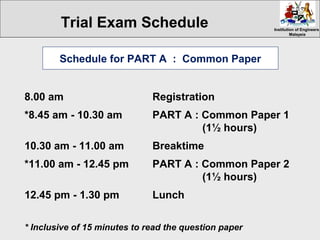
8.00 am Registration
*8.45 am - 10.30 am PART A : Common Paper 1
(1½ hours)
10.30 am - 11.00 am Breaktime
*11.00 am - 12.45 pm PART A : Common Paper 2
(1½ hours)
12.45 pm - 1.30 pm Lunch
Schedule for PART A : Common Paper
* Inclusive of 15 minutes to read the question paper
Trial Exam Schedule
Institution of EngineersInstitution of Engineers
MalaysiaMalaysia
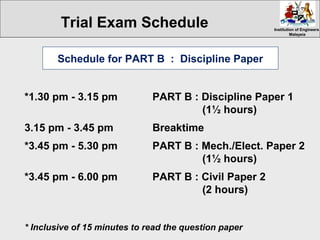
*1.30 pm - 3.15 pm PART B : Discipline Paper 1
(1½ hours)
3.15 pm - 3.45 pm Breaktime
*3.45 pm - 5.30 pm PART B : Mech./Elect. Paper 2
(1½ hours)
*3.45 pm - 6.00 pm PART B : Civil Paper 2
(2 hours)
Schedule for PART B : Discipline Paper
* Inclusive of 15 minutes to read the question paper
Trial Exam Schedule
Institution of EngineersInstitution of Engineers
MalaysiaMalaysia
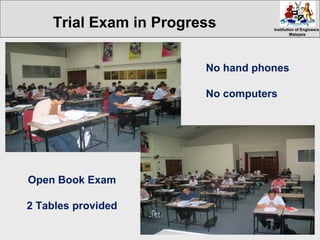
No hand phones
No computers
Open Book Exam
2 Tables provided
Trial Exam in Progress
Institution of EngineersInstitution of Engineers
MalaysiaMalaysia
Part 7 (a)
Candidates’ Feedback on Trial
Examination
To gauge the level of difficulty …..….
Institution of EngineersInstitution of Engineers
MalaysiaMalaysia
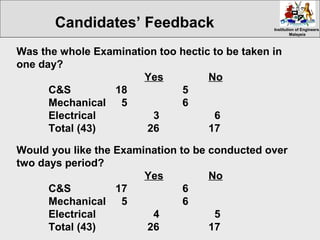
a) Part A Common Paper 1 Difficult: 14 Reasonable: 29
b) Part A Common Paper 2 Difficult: 13 Reasonable: 30
c) Part B C&S Paper 1 Difficult: 8 Reasonable: 15
d) Part B C&S Paper 2 Difficult: 8 Reasonable: 15
e) Part B Mech. Paper 1 Difficult: 1 Reasonable: 10
f) Part B Mech. Paper 2 Difficult: 1 Reasonable: 10
g) Part B Elect. Paper 1 Difficult: 2 Reasonable: 7
h) Part B Elect. Paper 2 Difficult: 1 Reasonable: 8
Majority of candidates find it reasonable ………
Candidates’ Feedback
Institution of EngineersInstitution of Engineers
MalaysiaMalaysia
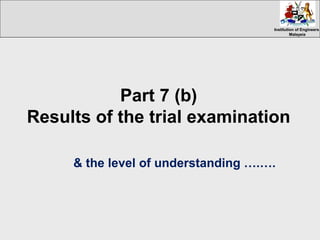
Was the whole Examination too hectic to be taken in
one day?
Yes No
C&S 18 5
Mechanical 5 6
Electrical 3 6
Total (43) 26 17
Would you like the Examination to be conducted over
two days period?
Yes No
C&S 17 6
Mechanical 5 6
Electrical 4 5
Total (43) 26 17
Candidates’ Feedback
Institution of EngineersInstitution of Engineers
MalaysiaMalaysia
Part 7 (b)
Results of the trial examination
& the level of understanding ….….
Institution of EngineersInstitution of Engineers
MalaysiaMalaysia
a) Candidates must satisfy the examiners in all the
papers in PART A and PART B of the examination
b) No marks will be revealed to the candidates. The
results will be notified to the candidates as either a
“pass” or “fail”
c) The marks are to be used as an internal tool to
gauge the “difficulty” level of the exam for the
examination committee. They are being kept as
“confidential”
d) To obtain an overall pass in the exam, candidates
must pass both PART A and PART B
Marking Scheme
Institution of EngineersInstitution of Engineers
MalaysiaMalaysia
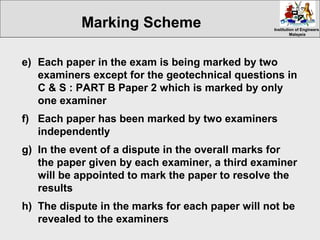
e) Each paper in the exam is being marked by two
examiners except for the geotechnical questions in
C & S : PART B Paper 2 which is marked by only
one examiner
f) Each paper has been marked by two examiners
independently
g) In the event of a dispute in the overall marks for
the paper given by each examiner, a third examiner
will be appointed to mark the paper to resolve the
results
h) The dispute in the marks for each paper will not be
revealed to the examiners
Marking Scheme
Institution of EngineersInstitution of Engineers
MalaysiaMalaysia
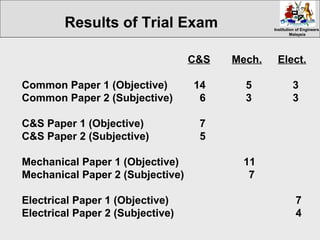
C&S Mech. Elect.
Common Paper 1 (Objective) 14 5 3
Common Paper 2 (Subjective) 6 3 3
C&S Paper 1 (Objective) 7
C&S Paper 2 (Subjective) 5
Mechanical Paper 1 (Objective) 11
Mechanical Paper 2 (Subjective) 7
Electrical Paper 1 (Objective) 7
Electrical Paper 2 (Subjective) 4
Results of Trial Exam
Institution of EngineersInstitution of Engineers
MalaysiaMalaysia
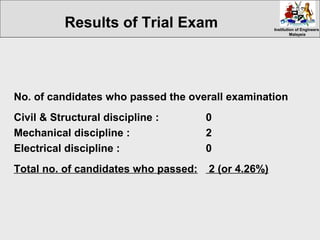
No. of candidates who passed the overall examination
Civil & Structural discipline : 0
Mechanical discipline : 2
Electrical discipline : 0
Total no. of candidates who passed: 2 (or 4.26%)
Results of Trial Exam
Institution of EngineersInstitution of Engineers
MalaysiaMalaysia
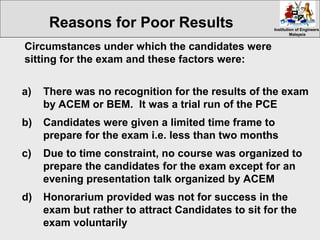
a) There was no recognition for the results of the exam
by ACEM or BEM. It was a trial run of the PCE
b) Candidates were given a limited time frame to
prepare for the exam i.e. less than two months
c) Due to time constraint, no course was organized to
prepare the candidates for the exam except for an
evening presentation talk organized by ACEM
d) Honorarium provided was not for success in the
exam but rather to attract Candidates to sit for the
exam voluntarily
Circumstances under which the candidates were
sitting for the exam and these factors were:
Reasons for Poor Results
Institution of EngineersInstitution of Engineers
MalaysiaMalaysia
Part 8
BEM’s Operations for the PCE
Information for the Candidates ….….
Institution of EngineersInstitution of Engineers
MalaysiaMalaysia
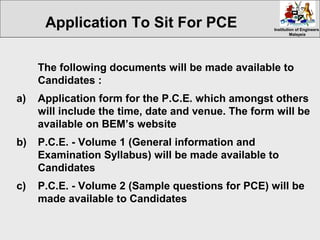
The following documents will be made available to
Candidates :
a) Application form for the P.C.E. which amongst others
will include the time, date and venue. The form will be
available on BEM’s website
b) P.C.E. - Volume 1 (General information and
Examination Syllabus) will be made available to
Candidates
c) P.C.E. - Volume 2 (Sample questions for PCE) will be
made available to Candidates
Application To Sit For PCE
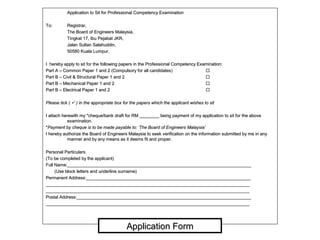
Application to Sit for Professional Competency ExaminationApplication to Sit for Professional Competency Examination
To:To: Registrar,Registrar,
The Board of Engineers Malaysia,The Board of Engineers Malaysia,
Tingkat 17, Ibu Pejabat JKR,Tingkat 17, Ibu Pejabat JKR,
Jalan Sultan Salahuddin,Jalan Sultan Salahuddin,
50580 Kuala Lumpur.50580 Kuala Lumpur.
I hereby apply to sit for the following papers in the Professional Competency Examination:I hereby apply to sit for the following papers in the Professional Competency Examination:
Part A – Common Paper 1 and 2 (Compulsory for all candidates)Part A – Common Paper 1 and 2 (Compulsory for all candidates) 
Part B – Civil & Structural Paper 1 and 2Part B – Civil & Structural Paper 1 and 2 
Part B – Mechanical Paper 1 and 2Part B – Mechanical Paper 1 and 2 
Part B – Electrical Paper 1 and 2Part B – Electrical Paper 1 and 2 
Please tick (Please tick (  ) in the appropriate box for the papers which the applicant wishes to sit) in the appropriate box for the papers which the applicant wishes to sit
I attach herewith my *cheque/bank draft for RM ________ being payment of my application to sit for the aboveI attach herewith my *cheque/bank draft for RM ________ being payment of my application to sit for the above
examination.examination.
**Payment by cheque is to be made payable to: ‘The Board of Engineers Malaysia’Payment by cheque is to be made payable to: ‘The Board of Engineers Malaysia’
I hereby authorize the Board of Engineers Malaysia to seek verification on the information submitted by me in anyI hereby authorize the Board of Engineers Malaysia to seek verification on the information submitted by me in any
manner and by any means as it deems fit and proper.manner and by any means as it deems fit and proper.
Personal ParticularsPersonal Particulars
(To be completed by the applicant)(To be completed by the applicant)
Full Name:___________________________________________________________________________Full Name:___________________________________________________________________________
(Use block letters and underline surname)(Use block letters and underline surname)
Permanent Address:___________________________________________________________________Permanent Address:___________________________________________________________________
______________________________________________________________________________________________________________________________________________________________________
______________________________________________________________________________________________________________________________________________________________________
Postal Address:_______________________________________________________________________Postal Address:_______________________________________________________________________
______________________________________________________________________________________________________________________________________________________________________
Application FormApplication Form
Institution of EngineersInstitution of Engineers
MalaysiaMalaysia
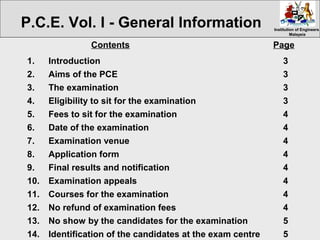
Contents Page
1. Introduction 3
2. Aims of the PCE 3
3. The examination 3
4. Eligibility to sit for the examination 3
5. Fees to sit for the examination 4
6. Date of the examination 4
7. Examination venue 4
8. Application form 4
9. Final results and notification 4
10. Examination appeals 4
11. Courses for the examination 4
12. No refund of examination fees 4
13. No show by the candidates for the examination 5
14. Identification of the candidates at the exam centre 5
P.C.E. Vol. I - General Information
Institution of EngineersInstitution of Engineers
MalaysiaMalaysia
Contents Page
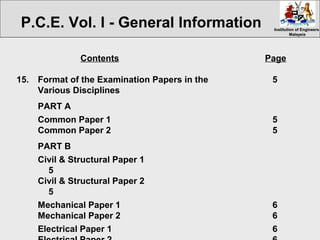
15. Format of the Examination Papers in the 5
Various Disciplines
PART A
Common Paper 1 5
Common Paper 2 5
PART B
Civil & Structural Paper 1
5
Civil & Structural Paper 2
5
Mechanical Paper 1 6
Mechanical Paper 2 6
Electrical Paper 1 6
P.C.E. Vol. I - General Information
Institution of EngineersInstitution of Engineers
MalaysiaMalaysia
Contents Page
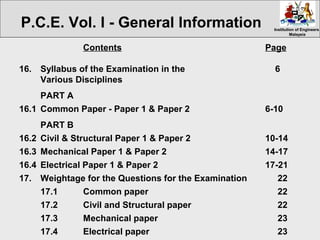
16. Syllabus of the Examination in the 6
Various Disciplines
PART A
16.1 Common Paper - Paper 1 & Paper 2 6-10
PART B
16.2 Civil & Structural Paper 1 & Paper 2 10-14
16.3 Mechanical Paper 1 & Paper 2 14-17
16.4 Electrical Paper 1 & Paper 2 17-21
17. Weightage for the Questions for the Examination 22
17.1 Common paper 22
17.2 Civil and Structural paper 22
17.3 Mechanical paper 23
17.4 Electrical paper 23
P.C.E. Vol. I - General Information
Institution of EngineersInstitution of Engineers
MalaysiaMalaysia
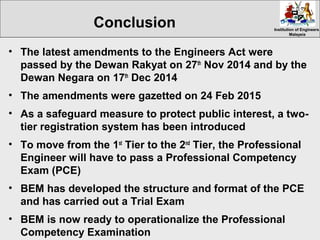
• The latest amendments to the Engineers Act were
passed by the Dewan Rakyat on 27th
Nov 2014 and by the
Dewan Negara on 17th
Dec 2014
• The amendments were gazetted on 24 Feb 2015
• As a safeguard measure to protect public interest, a two-
tier registration system has been introduced
• To move from the 1st
Tier to the 2nd
Tier, the Professional
Engineer will have to pass a Professional Competency
Exam (PCE)
• BEM has developed the structure and format of the PCE
and has carried out a Trial Exam
• BEM is now ready to operationalize the Professional
Competency Examination
Conclusion

IEM on PCE Slideshow

  • 1.
    Talk on “ProfessionalTalkon “Professional Competency Examination”Competency Examination” Dato’ Paduka Ir Hj Keizrul Abdullah Past President, Institution of Engineers Malaysia 6th March 2015
  • 2.
    Institution of EngineersInstitutionof Engineers MalaysiaMalaysia REGISTRATION OF ENGINEERS ACT 1967 Act of Parliament First enacted as Act 66 (of 1967) Regulations Governing the Engineering Profession, Practice & Services Enabling Legislation
  • 3.
    Institution of EngineersInstitutionof Engineers MalaysiaMalaysia Intent of Legislation Preamble  Registration of Engineers Act 1967 (Revised 2007) - REA An Act to provide for the registration of engineers, and sole proprietorships, partnerships and bodies corporate providing professional engineering services and for purposes connected therewith
  • 4.
    Institution of EngineersInstitutionof Engineers MalaysiaMalaysia 1967 The REGISTRATION OF ENGINEERS ACT 1967 was enacted (Act No. 66 of 1967) 1987 Revised to be REGISTRATION OF ENGINEERS ACT 1967 (Revised 1987) (Act 662 - 16.1.1987) 2002 Revised to be REGISTRATION OF ENGINEERS ACT 1967 (Revised 2002) (Act 1158 - 1.12.2002) 2007 Further amended to become REGISTRATION OF ENGINEERS ACT 1967 (Revised 2007) (ACT A1288 - 1.4.2007) History of the Act 1972 Amendments (Act 138 - Operationalised in 1972) 1973 Amendments (Act 173) 1974 Amendments (Act 218)
  • 5.
    Institution of EngineersInstitutionof Engineers MalaysiaMalaysia The Professional Acts have been amendedThe Professional Acts have been amended several times since 1967several times since 1967 Primarily to ‘plug’ the ‘loopholes’ as the Profession evolved… Why Amend?
  • 6.
    Institution of EngineersInstitutionof Engineers MalaysiaMalaysia REGISTRATION OF ENGINEERS ACT 1967 (ACT 138) ARCHITECTS ACT 1967 (ACT 117) QUANTITY SURVEYORS ACT 1967 (ACT 487) LIST OF AMENDMENTS 1972 1972 1972 1973 1973 1973 1974 1974 1974 1987 1979 1981 2002 1988 1984 2007 1992 1989 2014 1994 2001 2002 2002 2007 2014 2014 TOTAL NO. OF AMENDMENTS 7 10 9 Latest Amendments
  • 7.
    Institution of EngineersInstitutionof Engineers MalaysiaMalaysia The latest amendments to the ProfessionalThe latest amendments to the Professional Acts areActs are Primarily driven by the Government’s commitments in International Trade…. Why Amend?
  • 8.
    Malaysia as aTrading Nation has BenefittedMalaysia as a Trading Nation has Benefitted Greatly from Trade LiberalisationGreatly from Trade Liberalisation
  • 9.
    Institution of EngineersInstitutionof Engineers MalaysiaMalaysia MULTILATERAL REGIONAL BILATERAL Global TradeGlobal Trade OrganizationsOrganizations World TradeWorld Trade Organization (1995)Organization (1995) Global FreeGlobal Free TradeTrade AgreementsAgreements General AgreementGeneral Agreement on Trade in Serviceson Trade in Services (Jan 1995)(Jan 1995) Regional FreeRegional Free Trade AgreementsTrade Agreements AFTA (Jan 1992)AFTA (Jan 1992) AFAS (Dec 1995)AFAS (Dec 1995) TPP (Under negotiations)TPP (Under negotiations) EU (Under negotiations)EU (Under negotiations) LiberalisationLiberalisation FrameworkFramework AFAS - ProgressiveAFAS - Progressive liberalisation of selectiveliberalisation of selective sectors (Dec 1995)sectors (Dec 1995) Bilateral Free TradeBilateral Free Trade AgreementsAgreements •ASEAN-China (Jul 2003)ASEAN-China (Jul 2003) •ASEAN-Japan (Oct 2003)ASEAN-Japan (Oct 2003) •ASEAN-Korea (Dec 2005)ASEAN-Korea (Dec 2005) •ASEAN-Australia/NZ (JanASEAN-Australia/NZ (Jan 2010)2010) •ASEAN-India (Jan 2010)ASEAN-India (Jan 2010) Bilateral Free TradeBilateral Free Trade AgreementsAgreements •Malaysia-Japan (Dec 2005)Malaysia-Japan (Dec 2005) •Malaysia-Pakistan (Jan 2008)Malaysia-Pakistan (Jan 2008) •Malaysia-NZealand (Oct 2009)Malaysia-NZealand (Oct 2009) •Malaysia-Chile (Nov 2010)Malaysia-Chile (Nov 2010) •Malaysia -Aust (Under nego)Malaysia -Aust (Under nego) •Malaysia-USA (Under nego)Malaysia-USA (Under nego) Liberalisation Malaysia’s International Trade AgreementsMalaysia’s International Trade Agreements
  • 10.
    Institution of EngineersInstitutionof Engineers MalaysiaMalaysia Liberalisation ASEANASEAN ASEAN EconomicASEAN Economic CommunityCommunity ASEAN Free TradeASEAN Free Trade AreaArea ASEAN FrameworkASEAN Framework Agreement onAgreement on ServicesServices
  • 11.
    Institution of EngineersInstitutionof Engineers MalaysiaMalaysia Developed Nation Status
  • 12.
    Institution of EngineersInstitutionof Engineers MalaysiaMalaysia Sourced from Global Competitiveness Report 2010 – 2011Sourced from Global Competitiveness Report 2010 – 2011 Sources: The World Bank; Economist Intelligence Unit. Note: Data are for 2008 or the most recent year available.Sources: The World Bank; Economist Intelligence Unit. Note: Data are for 2008 or the most recent year available. 50.7 44 37 72 92 68 76 77 0% 10% 20% 30% 40% 50% 60% 70% 80% 90% 100% Malaysia Thailand Indonesia Singapore Hong Kong Australia United Kingdom United States Services Manufacturing Industry Non-Manufacturing Industry Agriculture THRESHOLDTHRESHOLD LowestLowest ServiceService ContributionContribution of Developedof Developed Nations –Nations – 68%68% Contribution of Service Sector to GDP (%)Contribution of Service Sector to GDP (%) Developed Nation Status
  • 13.
    Institution of EngineersInstitutionof Engineers MalaysiaMalaysia Malaysia’s Overall Economic StandingMalaysia’s Overall Economic Standing Developed Nation Status
  • 14.
    Institution of EngineersInstitutionof Engineers MalaysiaMalaysia How Do We Get Back on TrackHow Do We Get Back on Track To transform the Malaysian Economy…
  • 15.
    Institution of EngineersInstitutionof Engineers MalaysiaMalaysia Country Rank Score 2010- 2011 2009- 2010 2010- 2011 2009- 2010 Singapore 3 3 5.48 5.55 United States 4 2 5.43 5.59 Hong Kong 11 11 5.30 5.22 United Kingdom 12 13 5.25 5.19 Australia 16 15 5.11 5.15 Malaysia 26 24 4.88 4.87 Thailand 38 36 4.51 4.56 Indonesia 44 54 4.43 4.26 Sourced from Global Competitiveness Report 2010 – 2011 & 2008-2009Sourced from Global Competitiveness Report 2010 – 2011 & 2008-2009 Global Competitiveness Index 2010–Global Competitiveness Index 2010– 2011 & 2009-2011Rankings2011 & 2009-2011Rankings 55 1010 1515 2020 2525 3030 2007-2008 2008-2009 2009-2010 2010-20112007-2008 2008-2009 2009-2010 2010-2011 24242424 26262626 Global Competitiveness Index Rankings (Historical)Global Competitiveness Index Rankings (Historical) 1212 1111 1111 1111 77 55 33 Rankings based on 12 pillars of competitiveness:Rankings based on 12 pillars of competitiveness: 1) Institutions; 2) Infrastructure; 3) Macroeconomic stability; 4) Health1) Institutions; 2) Infrastructure; 3) Macroeconomic stability; 4) Health and primary education; 5) Higher education and training; 6) Goods marketand primary education; 5) Higher education and training; 6) Goods market efficiency; 7) Labor market efficiency; 8) Financial market sophistication;efficiency; 7) Labor market efficiency; 8) Financial market sophistication; 9) Technological readiness; 10) Market size; 11) Business sophistication;9) Technological readiness; 10) Market size; 11) Business sophistication; and 12) Innovationand 12) Innovation 33 777777 Global Competitiveness RankingGlobal Competitiveness Ranking Need To Be More Competitive
  • 16.
    Institution of EngineersInstitutionof Engineers MalaysiaMalaysia Competition Act 2010 aimsCompetition Act 2010 aims to protect economicto protect economic development and consumerdevelopment and consumer interest through preventinginterest through preventing anti-competitive practicesanti-competitive practices and abuse of a dominantand abuse of a dominant positionposition Open markets to foreignOpen markets to foreign investment, encouraginginvestment, encouraging competition.competition. Improves access to internationalImproves access to international markets allowing Malaysian firmsmarkets allowing Malaysian firms to export overseas.to export overseas. ImprovesImproves quality of Malaysianquality of Malaysian services, allowing Malaysianservices, allowing Malaysian firms to procure locally andfirms to procure locally and export overseas.export overseas. Liberalisation ofLiberalisation of ServicesServices StandardsStandards Overall increase inOverall increase in CompetitivenessCompetitiveness Three Strategic Reforms CompetitionCompetition LawLaw
  • 17.
    Institution of EngineersInstitutionof Engineers MalaysiaMalaysia For amendments to the ProfessionalFor amendments to the Professional Acts the following Issues to beActs the following Issues to be considered …..considered ….. Issues To Consider
  • 18.
    Institution of EngineersInstitutionof Engineers MalaysiaMalaysia IMP3 & NKEA PROMOTED SERVICES SECTOR PRIORITY SECTORS NON-PRIORITY SECTORS SERVICE SECTOR (1) ICT, (2) Tourism, (3) Healthcare (1) Logistics (1) Business & Professional Services, (2) Distributive Trade, (3) Construction, (4) Education, (5) Oil, Gas & Energy END DATE FOR LIBERLISATION 2010 2013 2015 FOREIGN EQUITY PARTICIPATION - 49% by 2006 - 51% by 2008 - 70% by 2010 - 49% by 2008 - 51% by 2010 - 70% by 2013 - 30% by 2006 - 49% by 2008 - 51% by 2010 - 70% by 2015 * Construction not less than 51% by 2006 Malaysia’s Commitments in ASEAN for ServicesMalaysia’s Commitments in ASEAN for Services (ASEAN Framework Agreement on Services Timeline)(ASEAN Framework Agreement on Services Timeline) Malaysia’s Commitments
  • 19.
    Institution of EngineersInstitutionof Engineers MalaysiaMalaysia PROFESSIONAL SERVICES SECTORPROFESSIONAL SERVICES SECTOR (Foreign Equity)(Foreign Equity) AFAS Threshold for Equity (Asean Framework Agreement on Services) 2008 : 49% 2010 : 51% 2015 : 70% AFAS 8th Package Multi-disciplinary Practice (MDP) : 30% open to anybody/persons (Architectural, Engineering & Quantity Surveying) Single-disciplinary Practice (SDP) Architectural (CPC 8671) : 0% Engineering (CPC 8672) : 0% Integrated Engr (CPC 8673) : Unregulated Quantity Surveying(None yet) : 0% Cabinet Decision 14 November 2008 2012 : 100% Budget 2012 Announcement by YAB Prime Minister 7 October 2011 Architectural : 100% by 2012 Engineering : 100% by 2012 Malaysia’s Commitments
  • 20.
    Institution of EngineersInstitutionof Engineers MalaysiaMalaysia 11 Sector lacksSector lacks capacity tocapacity to compete on acompete on a bigger scalebigger scale • ProfessionalProfessional services sector areservices sector are predominantlypredominantly made up of smallmade up of small firmsfirms 22 Restrictions onRestrictions on foreignforeign professionalprofessional services firmsservices firms • There are manyThere are many restrictions againstrestrictions against foreign firmsforeign firms practicing inpracticing in MalaysiaMalaysia 33 Restrictions onRestrictions on foreignforeign professionalsprofessionals • ForeignForeign professionals areprofessionals are restricted torestricted to practice in manypractice in many waysways CURRENT STATE OF THE INDUSTRYCURRENT STATE OF THE INDUSTRY Issues To Consider Present State of Professional Services SectorPresent State of Professional Services Sector
  • 21.
    Institution of EngineersInstitutionof Engineers MalaysiaMalaysia GATS stipulates that measures relating to qualification requirements and procedures, technical standards and licensing requirements should not constitute unnecessary barriers to trade in services Rules & procedures should be: • Based on objective & transparent criteria, such as competence and the ability to supply the service • Not more burdensome than necessary to ensure the quality of service • In the case of licensing procedure not in themselves a restriction on the supply Note: Certification, licensing etc. of service suppliers may be based on MRA or may be accorded autonomously. Issues To Consider Requirements Under GATSRequirements Under GATS
  • 22.
    Institution of EngineersInstitutionof Engineers MalaysiaMalaysia CONSCONS • Foreign providers crowd outForeign providers crowd out domestic providersdomestic providers • Potential outflow of moneyPotential outflow of money from Malaysia -from Malaysia - with foreignwith foreign providers and shareholdersproviders and shareholders repatriating profitsrepatriating profits • Increased risk of financialIncreased risk of financial instability due to increasedinstability due to increased exposure to global economicexposure to global economic eventsevents • Risk of brain drainRisk of brain drain • Risk of environmentalRisk of environmental degradationdegradation PROSPROS • Opportunity for Malaysia to competeOpportunity for Malaysia to compete internationally,internationally, --contributing to GDPcontributing to GDP growth and generating foreign exchangegrowth and generating foreign exchange • Improves the overall businessImproves the overall business environmentenvironment 1.1. Introduction of international bestIntroduction of international best practices, better skills and technologypractices, better skills and technology 2.2. Entry of foreign service providers canEntry of foreign service providers can lead to better services for domesticlead to better services for domestic consumersconsumers 3.3. Improve the performance andImprove the performance and competitiveness of domestic servicecompetitiveness of domestic service providersproviders 4.4. Attract foreign direct investment into theAttract foreign direct investment into the countrycountry ?? A Balancing Act Finding Balance between Liberalisation and ProtectionismFinding Balance between Liberalisation and Protectionism
  • 23.
    Institution of EngineersInstitutionof Engineers MalaysiaMalaysia What needs to be done for theWhat needs to be done for the Professional ActsProfessional Acts Taking the next step… Latest Amendments
  • 24.
    Institution of EngineersInstitutionof Engineers MalaysiaMalaysia BEMBEM GraduateGraduate EngineerEngineer ProfessionalProfessional EngineerEngineer ProfessionalProfessional Engineer withEngineer with PracticingPracticing CertificateCertificate 11stst tier of registrationtier of registration 22ndnd tier of registrationtier of registration Practicing Cert  Licence Concept of 2-Tier Registration
  • 25.
    Institution of EngineersInstitutionof Engineers MalaysiaMalaysia As the BEM can register professional engineers of any nationality, the firmsAs the BEM can register professional engineers of any nationality, the firms under which they provide the services may have 100% foreign equityunder which they provide the services may have 100% foreign equity HOW PROFESSIONAL SERVICE IS PROVIDED REGISTRATION WITH THE BOARD OF ENGINEERS MALAYSIA Individual Engineers Engineers of any nationality can be registered with the Board. Single Disciplinary Practice Sole Proprietorship Partnership Body Corporate 100% foreign equity allowed with 30% equity open to all and 70% for Professional Engineers with Practicing Certificate for body corporate Multi-Disciplinary Practice Body Corporate 100% foreign equity allowed with 30% equity open to all and 70% equity for Prof. Eng/Arch/QS (No change) Management of Firm or Body Corporate At least 2/3 of the Directors in the Board of Directors must be Professional Engineers with Practicing Certificates Latest Amendments
  • 26.
    Institution of EngineersInstitutionof Engineers MalaysiaMalaysia SUMMARY OF OTHER MAJOR AMENDMENTS TEMPORARY REGISTRATION OF FOREIGN PROFESSIONALS Section 10A deleted since engineers of any nationality can be registered QUALIFIED PERSON UNDER THE BUILDING ACTS Local or foreign Professional Engineers with Practicing Certificate TIME REQUIRED FOR REGISTRATION To register as a Graduate Engineer the basic qualifications shall meet the Washington Accord requirements Takes 3-4 years to be registered as a Professional Engineer after passing Professional Assessment Examination (PAE) Additional 1-2 years to obtain a Practicing Certificate on passing the Professional Competency Examination (PCE) CONTINOUS PROFESSIONAL DEVELOPMENT Annual 50 hours CPD mandatory with checks by BEM for Professional Engineers COMPOSITION OF THE BOARD Minimum 50% must be P.E. with Practicing Certificate REGISTRATION OF OTHER PERSONS RELATED TO ENGINEERING Registration of Engineering Technologist and Inspector of Works Latest Amendments
  • 27.
    Institution of EngineersInstitutionof Engineers MalaysiaMalaysia Liberalisation does not mean deregulationLiberalisation does not mean deregulation That is why safeguard measures are …That is why safeguard measures are … Safeguard Measures
  • 28.
    Institution of EngineersInstitutionof Engineers MalaysiaMalaysia To safeguard local and national policies soTo safeguard local and national policies so that are not negatively affectedthat are not negatively affected To protect the public against hazards ofTo protect the public against hazards of sub-standard services by foreign importssub-standard services by foreign imports To ensure that liberalisation promotesTo ensure that liberalisation promotes economic growth as originally intendedeconomic growth as originally intended To ensure that local professionals canTo ensure that local professionals can withstand any destabilizing and debilitatingwithstand any destabilizing and debilitating effects from the entry of foreigneffects from the entry of foreign professionals.professionals. To prepare cTo prepare capacity building programmesapacity building programmes for local professionalsfor local professionals THE RISKS OF LIBERALISATIONTHE RISKS OF LIBERALISATION Safeguard measures inSafeguard measures in developed countries aredeveloped countries are even more comprehensiveeven more comprehensive when compared towhen compared to developing countries …developing countries … Safeguard Measures
  • 29.
    Paper from EngineersAustralia to Department of Foreign Affairs & Trade on the Australia – Malaysia Free Trade Agreement, October 2004 “There is no specific nationality, citizenship or residency requirements for registration by the National Engineering Registration Board or membership of Engineers Australia to practice as a professional engineer in Australia. However applicants must demonstrate awareness of national and local standards, rules and practices; and be assessed as meeting the National Competency Standards for Professional Engineers.” Victoria – Building Act 1993 Requires building practitioners to be registered with the Building Practitioners Board which uses the test for competency. Developed Countries Introduce Competency ExaminationsDeveloped Countries Introduce Competency Examinations When They Liberalise as a “Safeguard” MeasureWhen They Liberalise as a “Safeguard” Measure
  • 30.
    Foreign Engineers tobe Permitted to Practice in Taiwan, Jan. 14 2009 The Public Construction Commission in line with Taiwan’s membership of the WTO and the APEC Engineer agreement scheme …………foreign engineers with which Taiwan has concluded an MRA will be permitted to participate in Taiwan’s engineering examinations ….. and on passing will be issued accredited engineer certification and may apply for a license to practice engineering in Taiwan. A foreign engineer who has been licensed to practice in Taiwan will be able to conduct professional engineering work and signing of engineering documents jointly with local engineers or independently and undertake other professional activities ……. and all documents and drawings related to work undertaken in Taiwan must use Chinese as the primary language. Developed Countries Introduce Competency ExaminationsDeveloped Countries Introduce Competency Examinations When They Liberalise as a “Safeguard” MeasureWhen They Liberalise as a “Safeguard” Measure
  • 31.
    Institution of EngineersInstitutionof Engineers MalaysiaMalaysia BEMBEM GraduateGraduate EngineerEngineer ProfessionalProfessional EngineerEngineer ProfessionalProfessional Engineer withEngineer with PracticingPracticing CertificateCertificate 11stst tier of registrationtier of registration 22ndnd tier of registrationtier of registration Practicing Cert  Licence Condition  Professional Competency Exam PCE Safeguard Measures
  • 32.
    Institution of EngineersInstitutionof Engineers MalaysiaMalaysia Notes: Registration with the BEM as a Graduate Engineer is straight- forward provided that conditions such as the basic qualifications are met (eg. Engineering degrees recognised under the Washington Accord). Registration as a Professional with BEM after passing the 1st . tier examination (PAE). However if foreign professionals can demonstrate the same applies to their home countries BEM may consider them to be registered without sitting the 1st . tier of examination or at least undergo the interview process. To ‘practise’ and supply professional engineering services BEM will issue licenses upon passing the Professional Competency Exams (PCE) i.e. the 2nd . tier of registration. This is mandatory for all professional engineers wishing to supply professional engineering REGISTRATION WITHREGISTRATION WITH THE BOARD AS ATHE BOARD AS A PROF. ENGR. (P.E.)PROF. ENGR. (P.E.)Degree accredited by theDegree accredited by the Board to register as aBoard to register as a Graduate EngineerGraduate Engineer 3-4 YEARS3-4 YEARS WORKINGWORKING EXPERIENCEEXPERIENCE EXISTING 1EXISTING 1stst TIER OF EXAMINATION (PAE) RETAINEDTIER OF EXAMINATION (PAE) RETAINED.. LICENSED TO SUBMIT PLANS UNDER THE BUILDING ACTS ProfessionalProfessional CompetencyCompetency ExaminationsExaminations 1-2 YEARS1-2 YEARS Route To Become P.Eng with PC
  • 33.
    Institution of EngineersInstitutionof Engineers MalaysiaMalaysia ProfessionalProfessional AssessmentAssessment ExaminationExamination REGISTERREGISTER WITH BEM ASWITH BEM AS P.ENGP.ENG EXISTING P.I. RETAINED (REG. OF ENG. ACT)EXISTING P.I. RETAINED (REG. OF ENG. ACT) C.E.forC.E.for JuruteraJurutera GasGas ProfessionalProfessional InterviewInterview JURUTERAJURUTERA GASGAS GAS SUPPLY ACT, SURUHANJAYA TENAGAGAS SUPPLY ACT, SURUHANJAYA TENAGA C.E.for Comp.C.E.for Comp. Elec. EngElec. Eng ProfessionalProfessional InterviewInterview COMPETENTCOMPETENT ELECTRICALELECTRICAL ENGINEERENGINEER ELECTRICITY SUPPLY ACT, SURUHANJAYA TENAGAELECTRICITY SUPPLY ACT, SURUHANJAYA TENAGA PRACTICING CERTIFICATESPRACTICING CERTIFICATES FOR OTHER ENGINEERINGFOR OTHER ENGINEERING DISCIPLINESDISCIPLINESProfessionalProfessional CompetencyCompetency ExaminationExamination PRACTICINGPRACTICING CERTIFICATE FORCERTIFICATE FOR SUBMITTING PERSONSUBMITTING PERSON UNDER ‘S.D.B. ACT’UNDER ‘S.D.B. ACT’ (Building Industry)(Building Industry) NOTE THAT THENOTE THAT THE SPAN ACT NOWSPAN ACT NOW REQUIRES THEREQUIRES THE ENGINEER ORENGINEER OR ARCHITECT TO BEARCHITECT TO BE REGISTERED WITHREGISTERED WITH THEMTHEM For Engineers  Other Exams
  • 34.
    Institution of EngineersInstitutionof Engineers MalaysiaMalaysia BOARD OFBOARD OF ENGINEERSENGINEERS Basic undergraduateBasic undergraduate degree meets Board’sdegree meets Board’s requirementsrequirements Pass the 1Pass the 1stst tiertier examinationexamination Pass the 2Pass the 2ndnd tiertier examination i.e. theexamination i.e. the Competency ExamsCompetency Exams Issued a ‘license’Issued a ‘license’ (Practising(Practising Certificate) which isCertificate) which is renewable every yearrenewable every year 11stst Safeguard MeasureSafeguard Measure Board register Graduate Engineers providedBoard register Graduate Engineers provided  degree meets the Washington Accorddegree meets the Washington Accord 22ndnd Safeguard MeasureSafeguard Measure Board registers Professional Engineers providedBoard registers Professional Engineers provided  have obtained required technical competence orhave obtained required technical competence or obtained through accredited programme overseasobtained through accredited programme overseas 33rdrd Safeguard MeasureSafeguard Measure Before the issue of ‘license’ Professional EngineerBefore the issue of ‘license’ Professional Engineer  must demonstrate competence inmust demonstrate competence in understanding national/local standards, rules,understanding national/local standards, rules, regulations & lawsregulations & laws 44thth Safeguard MeasureSafeguard Measure The ‘license’ is renewable every year subject to theThe ‘license’ is renewable every year subject to the Professional EngineerProfessional Engineer  undergone Continuousundergone Continuous Professional Development programmes accreditedProfessional Development programmes accredited by the Boardby the Board Annual CPDAnnual CPD compulsorycompulsory forfor renewablerenewable of P.E. andof P.E. and P.E. withP.E. with PractisingPractising CertificateCertificate TO ENSURE THE QUALITY OF THE SERVICETO ENSURE THE QUALITY OF THE SERVICE & PROTECT PUBLIC INTEREST& PROTECT PUBLIC INTEREST Note: CPD also applies at the 1st . tier of registration Safeguard Measures
  • 35.
    Institution of EngineersInstitutionof Engineers MalaysiaMalaysia ProfessionalProfessional CompetencyCompetency ExaminationExamination ProfessionalProfessional CompetencyCompetency ExaminationExamination
  • 36.
    Institution of EngineersInstitutionof Engineers MalaysiaMalaysia PART 1 Enabling Legislation Amendments to REA 1967 PART 2 What is the Purpose of the PCE To ensure Competency PART 3 Format of the PCE The Structure and Format PART 4 The Common Paper – Sample Questions For all Engineers in the Building/Construction Industry PART 5 The Civil & Structural, Mechanical & Electrical Papers Sample Questions PART 6 Trial Examination To test the Examination PART 7 Candidates Feedback & Results of the PCE To gauge the Difficulty & Level of Understanding PART 8 BEM’s Operations for the PCE Information for Candidates Professional Competency Exam
  • 37.
    Institution of EngineersInstitutionof Engineers MalaysiaMalaysia Part 1 Enabling Legislation Amendments to REA 1967 ….
  • 38.
    Institution of EngineersInstitutionof Engineers MalaysiaMalaysia (1) Amendment to Section 4 (Functions of the Board) Section 4(1) The functions of the Board shall be – (ee)(ed)(ii) to appoint a committee consisting of persons to be determined by the Board, to conduct the Professional Competency Examination for the purpose of issuing a Practising Certificate to Professional Engineers. Latest Amendments to REA
  • 39.
    Institution of EngineersInstitutionof Engineers MalaysiaMalaysia BEMBEM Standing Committees of BEMStanding Committees of BEM Examination & QualificationExamination & Qualification QualityQuality ApplicationApplication Accredited CheckersAccredited Checkers ManagementManagement Engineering Accreditation CouncilEngineering Accreditation Council Scale of FeesScale of Fees Training & EducationTraining & Education Engineers ActEngineers Act ITIT National MonitoringNational Monitoring PublicationsPublications Professional PracticeProfessional Practice President Secretary & Registrar 14 members who shall be Professional Engineers 1 member from Board of Architect 1 member from Board of Quantity Surveyor The Professional AssessmentThe Professional Assessment Examination (PAE) is under theExamination (PAE) is under the purview of BEM’s Examination &purview of BEM’s Examination & Qualification CommitteeQualification Committee The accreditation of theThe accreditation of the undergraduate engineering degreeundergraduate engineering degree is under the purview of the BEM’sis under the purview of the BEM’s Engineering Accreditation CouncilEngineering Accreditation Council BEM Organisational Setup Amendment Prof. Competency Examination (PCE) Council to be set-up
  • 40.
    Institution of EngineersInstitutionof Engineers MalaysiaMalaysia PROFESSIONALPROFESSIONAL COMPETENCYCOMPETENCY EXAMINATIONEXAMINATION COUNCIL OFCOUNCIL OF BEMBEM PANEL OFPANEL OF MODERATORMODERATOR Integrity of the Competency Examination is important ……..Integrity of the Competency Examination is important …….. PCE Council
  • 41.
    Institution of EngineersInstitutionof Engineers MalaysiaMalaysia (2) Amendment to Section 10 (Qualifications for Registration) Section 10(D) (1) Subject to the provisions of this Act, any person who – (a) is a registered Professional Engineer (b) has passed a Professional Competency Examination conducted by the Board; and (c) has complied with all the requirements of the Board; shall be entitled on application to be registered as a Professional Engineer with a Practising Certificate Latest Amendments to REA
  • 42.
    Institution of EngineersInstitutionof Engineers MalaysiaMalaysia Part 2 What is the purpose of the PCE? To ensure competency ..….
  • 43.
    Institution of EngineersInstitutionof Engineers MalaysiaMalaysia The Professional Competency Examination will test the candidates within the limits of “professional engineering services” as defined by the Engineers Act in the engineering disciplines of Civil & Structural, Mechanical and Electrical engineering, critical for the construction industry The examination will test the candidate’s knowledge, experience and application of : • Regulations and Rules of Engineering Practice • Statutory Laws, Design Codes, Regulations • Standards of Professionalism and Ethical Behaviour imposed by BEM Purpose of PCE
  • 44.
    Institution of EngineersInstitutionof Engineers MalaysiaMalaysia BEM is developing PCE for other engineering disciplines The following organisations were commissioned to prepare the criteria/requirement, syllabus and exam questions : •Marine MISC BHD •Chemical iChemE Malaysia Chapter •Environmental Dept of Chem Engrg UM •Oil and Gas Petronas Future Applications of PCE
  • 45.
    Institution of EngineersInstitutionof Engineers MalaysiaMalaysia Part 3 Format of the Professional Competency Examination (PCE) The structure & format ..….
  • 46.
    Institution of EngineersInstitutionof Engineers MalaysiaMalaysia • Professional engineers wishing to sit for the PCE shall apply to the Board by completion of a prescribed form and payment of the prescribed fees • Eligible candidates for the examination must be a Professional Engineer registered with the Board in the appropriate discipline • Candidates seeking registration as a licensing submitting engineer in the construction industry must have the relevant working experience in the field of engineering which he wishes to practice • On approval of the candidate’s application by the Board, the candidate is allowed to sit for the examination. Eligibility to sit for PCE
  • 47.
    Institution of EngineersInstitutionof Engineers MalaysiaMalaysia • The Examination is conducted by BEM pursuant to Section 4 of the amended REA • BEM appoints an Examination Panel, consisting of such members from amongst registered Professional Engineers to assist in conducting the Examination • The PCE comprises : • PART A {Common}  Paper 1 (Objective) and Paper 2 (Subjective) • PART B {Each discipline}  Paper 1 (Objective) and Paper 2 (Subjective) • Candidates can sit for PART A and B together or separately • Must pass both papers for both PARTs at one sitting • The exam is an open book exam Format of PCE
  • 48.
    Institution of EngineersInstitutionof Engineers MalaysiaMalaysia PROFESSIONAL COMPETENCY EXAMINATIONPROFESSIONAL COMPETENCY EXAMINATION PART A Common for all engineering disciplines PART B Specific for C&S, M and E disciplines Civil & Structural Discipline Mechanical Discipline Electrical Discipline PAPER 1 Objective questions PAPER 2 Subjective questions PAPER 1 Objective questions PAPER 2 Subjective questions PAPER 1 Objective questions PAPER 2 Subjective questions PAPER 1 Objective questions PAPER 2 Subjective questions Currently has been developed for the Building/Construction Industry ………Currently has been developed for the Building/Construction Industry ……… Format of PCE
  • 49.
    Institution of EngineersInstitutionof Engineers MalaysiaMalaysia  PCE comprises of 2 PARTs  PART A and PART B  Each PART consists of 2 papers  Paper 1 and Paper 2  Compulsory to pass both papers in PART A and B  Candidates must pass both papers for PART A and/or PART B at one sitting  If the candidate passes PART A but fails PART B, he is allowed to re-sit the latter. This condition will also apply if he passes PART B but fails PART A.  The pass result for PART A or PART B is valid for 3 years and there is no limit of attempts to re-sit the other PART as long as it is within the 3 years period  After the 3 years period, the candidate has to re-sit both PARTs again Examination Regulations
  • 50.
    Institution of EngineersInstitutionof Engineers MalaysiaMalaysia • To be taken by all candidates • Non-technical in nature • To test candidates’ knowledge of laws governing the profession, the responsibility of the professional towards the general public and standards of professionalism and ethical behaviour There are two papers for this PART  Paper 1 and Paper 2 PART A - Common PaperPART A - Common Paper PCE : PART A
  • 51.
    Institution of EngineersInstitutionof Engineers MalaysiaMalaysia • To be taken by candidates in the relevant discipline which they wish to practice • Technical in nature • Test candidate’s competency within his respective field of practice on : Regulations and rules of practice by BEM Statutory laws, codes, regulations etc. There are two papers for this PART  Paper 1 and Paper 2 PART B - Paper on each DisciplinePART B - Paper on each Discipline PCE : PART B
  • 52.
    Institution of EngineersInstitutionof Engineers MalaysiaMalaysia Comprises of 2 PARTS - PART A & PART B SubjectsSubjects Time AllocatedTime Allocated DescriptionDescription PART APART A CommonCommon PaperPaper Consists of 2 papersConsists of 2 papers Paper 1(Objective) &Paper 1(Objective) & Paper 2(Subjective)Paper 2(Subjective) 1.5+1.5 hours1.5+1.5 hours Common paper is to be taken by all candidates, which will be non-technical in nature but will test on the candidates’ knowledge of laws governing the profession, the responsibility of a professional Towards the general public and standards of professionalism and ethical behavior. There are two papers for this PART i.e. Paper 1 and Paper 2. Candidates must pass both papers at one sitting. PART BPART B PaperPaper specific forspecific for eacheach disciplinediscipline Consists of 2 papersConsists of 2 papers Paper 1(Objective) &Paper 1(Objective) & Paper 2(Subjective)Paper 2(Subjective) 2.0+1.5 hours for C&S2.0+1.5 hours for C&S 1.5+1.5 hours for M&E1.5+1.5 hours for M&E A technical paper which will be on civil & structural, mechanical and electrical engineering. Candidates will sit for the paper in the relevant subject which they wish to practice. The examination will test the candidates’ competency within his respective field of practice. There are two papers for this PART i.e. Paper 1 and Paper 2. Candidates must pass both papers at one sitting. General Description of PCE
  • 53.
    Institution of EngineersInstitutionof Engineers MalaysiaMalaysia PART A TIME ALLOCATED FORMAT Common Paper (For all disciplines) Paper 1 1.5 hours 40 objective questions Passing mark 50% Paper 2 1.5 hours 5 long/essay questions of which 3 to be answered. Passing mark 50% PART B TIME ALLOCATED FORMAT Civil & Structural Paper Paper 1 1.5 hours 40 objective questions Passing mark 50% Paper 2 2.0 hours 5 long/essay questions of which 3 to be answered. Passing mark 50% Mechanical Paper Paper 1 1.5 hours 40 objective questions Passing mark 50% Paper 2 1.5 hours 5 long/essay questions of which 3 to be answered. Passing mark 50% Structure of PCE
  • 54.
    Institution of EngineersInstitutionof Engineers MalaysiaMalaysia PART B TIME ALLOCATED FORMAT Electrical Paper Paper 1 1.5 hours 40 objective questions Passing mark 50% Paper 2 1.5 hours 5 long/essay questions of which 3 to be answered. Passing mark 50% Structure of PCE
  • 55.
    Institution of EngineersInstitutionof Engineers MalaysiaMalaysia PART A : Common for all Disciplines (Paper 1 & 2) Laws and regulations governing the engineering profession in Malaysia Engineer’s responsibility to society and to the public Professionalism on a conceptual basis, ethical conduct and professional practice Overview of laws having relevance Basic knowledge of Contract Laws being practiced locally with respect to the Construction Industry An in-depth knowledge of the functions of the consulting engineer during the various stage of project implementation in accordance with BEM Model Form of Agreement Management of Engineering Consultancy Practice For each major topic above there will be sub-topics ………For each major topic above there will be sub-topics ……… Syllabus for PART A
  • 56.
    Institution of EngineersInstitutionof Engineers MalaysiaMalaysia PART B : Specific for each Discipline (Paper 1 & 2) Civil & Structural Paper Mechanical Paper Electrical Paper Survey & Site Investigation Works Air Conditioning and Ventilation System Regulatory Practice Earthworks Fire Protection Electricity Distribution System Structural Analysis & Design Hydraulics System Protection & Discrimination External Water Supply & Sewerage for Building Development Other mechanical systems Building Systems Road & Highway designs Drainage Design for Building development Regulatory practice & Submission Procedure for Civil Engineers Syllabus for PART B
  • 57.
    Institution of EngineersInstitutionof Engineers MalaysiaMalaysia Note: Subjective questions may comprise combination of some or all of the above categoriesNote: Subjective questions may comprise combination of some or all of the above categories No. of multiple choice questions = 40 No. of subjective questions = 5 Category Weightage in % Construction Law 25% Engineers Act 35% Local Laws relevant to the practice 30% Management of Engineering Consultancy Practice 10% PART A : Subject Weightage
  • 58.
    Institution of EngineersInstitutionof Engineers MalaysiaMalaysia No. of multiple choice questions = 40 No. of subjective questions = 5 (may be a combination of categories) Civil & Structural Paper Mechanical Paper Electrical Paper Category Weightage (%) Category Weightage (%) Category Weightage (%) Geotechnical 20% Air- Conditioning & Ventilation 40% Regulatory Practice 20% Civil Infrastructure 30% Fire Protection 30% Electricity Distribution System 30% Structure 40% Hydraulics 20% System Protection 25% UBBL 10% Other Mech. Systems 10% Building Systems 25% PART B : Subject Weightage
  • 59.
    Institution of EngineersInstitutionof Engineers MalaysiaMalaysia Part 4 Sample Questions : The Common Paper For all Engineers in the Building/Construction Industry …..
  • 60.
    Institution of EngineersInstitutionof Engineers MalaysiaMalaysia Q1. A local Consultant (A) enters into an agreement with a foreign Contractor (B) to carry out engineering consultancy services for a Turnkey Contract in that country. Mid-way through the project, war breaks out in that country. What is the effect? A. The Contract is valid and enforceable B. The Contract is frustrated C. The Contract is suspended D. The Contract is discharged E. The Contract is void [Test on Contract law] Sample Question : PART A Paper 1
  • 61.
    Institution of EngineersInstitutionof Engineers MalaysiaMalaysia Q2. Which of the following statement is/are true? a) Only Mechanical Professional Engineers can submit active fire protection plans b) Only Civil or Mechanical Professional Engineers can submit passive fire protection plans for industrial buildings c) Professional Engineers of any discipline can submit active fire protection plans d) Only Electrical Professional Engineers can submit electrical plans A. a) only D. c) only B. a) and b) only E. b), c) and d) only C. a), b) and d) only [Test on UBBL and Regulations] Sample Question : PART A Paper 1
  • 62.
    Institution of EngineersInstitutionof Engineers MalaysiaMalaysia Q3. Which of the following statement is false? A) The BEM Scale of Fees is mandatory. B) A Sole Proprietorship practising as an ECP must be registered with BEM C) All ECPs must be registered with BEM D) Professional Fees based on man months do not contravene the BEM Scale of Fees E) For a private project, a consultant may exclude provision of supervision and hence need not charge the corresponding professional fees [Test on Engineers Act] Sample Question : PART A Paper 1
  • 63.
    Institution of EngineersInstitutionof Engineers MalaysiaMalaysia Q1. The contractor applies for Extension of Time (EOT) before his contract completion period expires. The Contract Administrator does not respond and the original contract completion date is passed. One month later, the Contract Administrator issues a V.O. for additional works to the Contractor. The Contractor refuses to carry out the V.O. works. What can the Contract Administrator do in this situation? [Test on Contract law and the Engineers Act] Sample Question : PART A Paper 2
  • 64.
    Institution of EngineersInstitutionof Engineers MalaysiaMalaysia Q2. A Consultant has carried out substantial works on a project and the Employer encounters financial difficulties. He suspends the project. On resumption, he terminates the Consultant's employment citing use of in-house consultants to complete the works due to financial constraints. What is the legal effect of the termination and what financial compensation can the consultant seek? [Test on Contract law and the Engineers Act] Sample Question : PART A Paper 2
  • 65.
    Institution of EngineersInstitutionof Engineers MalaysiaMalaysia Part 5 (a) Sample Questions : The Civil & Structural Paper For civil engineers …..
  • 66.
    Institution of EngineersInstitutionof Engineers MalaysiaMalaysia Q1. Which of the following statements are true for circular column? A. Minimum no. of bars is 8, size of bar is not less than 10 mm B. Minimum no. of bars is 8, size of bar is not less than 12 mm C. Minimum no. of bars is 6, size of bar is not less than 10 mm D. Minimum no. of bars is 6, size of bar is not less than 12 mm E. None of the above [Test on understanding of the Code of Practice] Sample Question : C&S Paper 1
  • 67.
    Institution of EngineersInstitutionof Engineers MalaysiaMalaysia Q2. What is the minimum residual pressure head for an external hydrant system required by Bomba A. 3.0m B. 7.5m C. 12.5m D. 10.0m E. 9.0m [Understanding of Bomba requirements] Sample Question : C&S Paper 1
  • 68.
    Institution of EngineersInstitutionof Engineers MalaysiaMalaysia Q1. You are the infrastructure engineer for a housing developing scheme for a 500 acres project. What is your advice to the Developer, Planners and Architects in terms of requirements for drainage for the whole development? Note: Question can be answered in ½ hr provided that the answer is descriptive in nature. However if a layout plan of the housing scheme with contours are provided and it is expected that the drainage reserve be sized-up, this question will take 1 hr. to answer. [Understanding of MASMA] Sample Question : C&S Paper 2
  • 69.
    Institution of EngineersInstitutionof Engineers MalaysiaMalaysia Part 5 (b) Sample Questions : The Mechanical Paper For mechanical engineers …..
  • 70.
    Institution of EngineersInstitutionof Engineers MalaysiaMalaysia Q1. Which of the following is not applicable for active fire designs? A. MS 1472 B. MS 1780 C. MS 1910 D. MS 1525 E. Guide to Fire Protection in Malaysia [Understanding of design codes for fire protection] Sample Question : Mech. Paper 1
  • 71.
    Institution of EngineersInstitutionof Engineers MalaysiaMalaysia Q2. Fire lifts are required for buildings where the top most occupied floor is A. Over 30.5m B. Over 18.5m C. Over 1,000m2 D. Over 18.5m and 1,000m2 E. Over 30.5m and 1,000m2 [Understanding of Bomba requirements] Sample Question : Mech. Paper 1
  • 72.
    Institution of EngineersInstitutionof Engineers MalaysiaMalaysia Q1. The following complaints have been received from building occupants. Briefly describe what you think are the likely causes of these problems and the solutions you would propose. a) Office occupants seating next to window complain of unsatisfactory air conditioning. Your on-site measurement shows the design temperature of 24ºC DB and 55% RH is achieved. b) Hotel guests complain it takes a long time to get hot water from their toilet showers and the water temperature fluctuates during their showers. c) The contractor was unable to achieve specified background noise level of NC 25 for the auditorium even though he has followed manufacturer’s recommendation of internal duct lining as well as installed silencers. [Understanding of Building Services requirements] Sample Question : Mech. Paper 2
  • 73.
    Institution of EngineersInstitutionof Engineers MalaysiaMalaysia Part 5 (c) Sample Questions : The Electrical Paper For electrical engineers …..
  • 74.
    Institution of EngineersInstitutionof Engineers MalaysiaMalaysia Q1. Which is the best installation method to minimize eddy current losses in single core cable sheaths ? A. Flat formation B. Trefoil formation C. Alternate formation D. Cross bonding of sheaths E. Bundle in air [Understanding of Electrical Distribution Network] Sample Question : Elect. Paper 1
  • 75.
    Institution of EngineersInstitutionof Engineers MalaysiaMalaysia Q2. What is expected short circuit current at 400V if a 1000 kVA transformer of 11/0.4 kV with an impedance of 5 % is connected to a 11 kV infinite bus ? A. 8,000 Amps B. 1,250 Amps C. 50,000 Amps D. 2,886 Amps E. 28,868 Amps [Understanding of System Protection] Sample Question : Elect. Paper 1
  • 76.
    Institution of EngineersInstitutionof Engineers MalaysiaMalaysia Q1. Answer completely the following two questions: (a) As a electrical consulting engineer, describe clearly the general procedures which would be established for acceptance of works under your supervision (b) Describe the role of SIRIM certification in the work acceptance procedure [Understanding of Building Systems] Sample Question : Elect. Paper 2
  • 77.
    Institution of EngineersInstitutionof Engineers MalaysiaMalaysia Part 6 Trial Examination To test out the PCE …..….
  • 78.
    Institution of EngineersInstitutionof Engineers MalaysiaMalaysia The Trial Examination was organized for the following disciplines of engineering in the Building/Construction industry :  Civil & Structural engineering  Mechanical engineering  Electrical engineering Format of Trial PCE
  • 79.
    Institution of EngineersInstitutionof Engineers MalaysiaMalaysia The Trial Examination was conducted in two parts:  PART A : The Common paper was to be taken by all candidates. This paper was non-technical in nature but would test on the candidates’ knowledge of laws governing the profession, the responsibility of a professional towards the general public and standards of professionalism and ethical behavior. There were two papers for this PART i.e. Paper 1 and Paper 2. Candidates must pass both papers at one sitting. Format of Trial PCE
  • 80.
    Institution of EngineersInstitutionof Engineers MalaysiaMalaysia The Trial Examination was conducted in two parts:  PART B : This was the technical paper which was on Civil & Structural, Mechanical and Electrical engineering. Candidates will sit for the paper in the relevant discipline which they wish to practice. The Examination will test the candidates’ competency within his respective field of practice. There were two papers for this PART i.e. Paper 1 and Paper 2. Candidates must pass both papers at one sitting. Format of Trial PCE
  • 81.
    Institution of EngineersInstitutionof Engineers MalaysiaMalaysia A total of 47 candidates sat for the trial PCE on 24 April 2010 at the Women’s Institute of Management, Kuala Lumpur Breakdown of disciplines : Civil and Structural = 25 candidates Mechanical = 12 candidates Electrical = 10 candidates Candidates from consultant firms : 40 pax Candidates from govt. bodies/organization : 7 pax All the Candidates were Professional Engineers (P.E.) Breakdown of Candidates
  • 82.
    Institution of EngineersInstitutionof Engineers MalaysiaMalaysia 8.00 am Registration *8.45 am - 10.30 am PART A : Common Paper 1 (1½ hours) 10.30 am - 11.00 am Breaktime *11.00 am - 12.45 pm PART A : Common Paper 2 (1½ hours) 12.45 pm - 1.30 pm Lunch Schedule for PART A : Common Paper * Inclusive of 15 minutes to read the question paper Trial Exam Schedule
  • 83.
    Institution of EngineersInstitutionof Engineers MalaysiaMalaysia *1.30 pm - 3.15 pm PART B : Discipline Paper 1 (1½ hours) 3.15 pm - 3.45 pm Breaktime *3.45 pm - 5.30 pm PART B : Mech./Elect. Paper 2 (1½ hours) *3.45 pm - 6.00 pm PART B : Civil Paper 2 (2 hours) Schedule for PART B : Discipline Paper * Inclusive of 15 minutes to read the question paper Trial Exam Schedule
  • 84.
    Institution of EngineersInstitutionof Engineers MalaysiaMalaysia No hand phones No computers Open Book Exam 2 Tables provided Trial Exam in Progress
  • 85.
    Institution of EngineersInstitutionof Engineers MalaysiaMalaysia Part 7 (a) Candidates’ Feedback on Trial Examination To gauge the level of difficulty …..….
  • 86.
    Institution of EngineersInstitutionof Engineers MalaysiaMalaysia a) Part A Common Paper 1 Difficult: 14 Reasonable: 29 b) Part A Common Paper 2 Difficult: 13 Reasonable: 30 c) Part B C&S Paper 1 Difficult: 8 Reasonable: 15 d) Part B C&S Paper 2 Difficult: 8 Reasonable: 15 e) Part B Mech. Paper 1 Difficult: 1 Reasonable: 10 f) Part B Mech. Paper 2 Difficult: 1 Reasonable: 10 g) Part B Elect. Paper 1 Difficult: 2 Reasonable: 7 h) Part B Elect. Paper 2 Difficult: 1 Reasonable: 8 Majority of candidates find it reasonable ……… Candidates’ Feedback
  • 87.
    Institution of EngineersInstitutionof Engineers MalaysiaMalaysia Was the whole Examination too hectic to be taken in one day? Yes No C&S 18 5 Mechanical 5 6 Electrical 3 6 Total (43) 26 17 Would you like the Examination to be conducted over two days period? Yes No C&S 17 6 Mechanical 5 6 Electrical 4 5 Total (43) 26 17 Candidates’ Feedback
  • 88.
    Institution of EngineersInstitutionof Engineers MalaysiaMalaysia Part 7 (b) Results of the trial examination & the level of understanding ….….
  • 89.
    Institution of EngineersInstitutionof Engineers MalaysiaMalaysia a) Candidates must satisfy the examiners in all the papers in PART A and PART B of the examination b) No marks will be revealed to the candidates. The results will be notified to the candidates as either a “pass” or “fail” c) The marks are to be used as an internal tool to gauge the “difficulty” level of the exam for the examination committee. They are being kept as “confidential” d) To obtain an overall pass in the exam, candidates must pass both PART A and PART B Marking Scheme
  • 90.
    Institution of EngineersInstitutionof Engineers MalaysiaMalaysia e) Each paper in the exam is being marked by two examiners except for the geotechnical questions in C & S : PART B Paper 2 which is marked by only one examiner f) Each paper has been marked by two examiners independently g) In the event of a dispute in the overall marks for the paper given by each examiner, a third examiner will be appointed to mark the paper to resolve the results h) The dispute in the marks for each paper will not be revealed to the examiners Marking Scheme
  • 91.
    Institution of EngineersInstitutionof Engineers MalaysiaMalaysia C&S Mech. Elect. Common Paper 1 (Objective) 14 5 3 Common Paper 2 (Subjective) 6 3 3 C&S Paper 1 (Objective) 7 C&S Paper 2 (Subjective) 5 Mechanical Paper 1 (Objective) 11 Mechanical Paper 2 (Subjective) 7 Electrical Paper 1 (Objective) 7 Electrical Paper 2 (Subjective) 4 Results of Trial Exam
  • 92.
    Institution of EngineersInstitutionof Engineers MalaysiaMalaysia No. of candidates who passed the overall examination Civil & Structural discipline : 0 Mechanical discipline : 2 Electrical discipline : 0 Total no. of candidates who passed: 2 (or 4.26%) Results of Trial Exam
  • 93.
    Institution of EngineersInstitutionof Engineers MalaysiaMalaysia a) There was no recognition for the results of the exam by ACEM or BEM. It was a trial run of the PCE b) Candidates were given a limited time frame to prepare for the exam i.e. less than two months c) Due to time constraint, no course was organized to prepare the candidates for the exam except for an evening presentation talk organized by ACEM d) Honorarium provided was not for success in the exam but rather to attract Candidates to sit for the exam voluntarily Circumstances under which the candidates were sitting for the exam and these factors were: Reasons for Poor Results
  • 94.
    Institution of EngineersInstitutionof Engineers MalaysiaMalaysia Part 8 BEM’s Operations for the PCE Information for the Candidates ….….
  • 95.
    Institution of EngineersInstitutionof Engineers MalaysiaMalaysia The following documents will be made available to Candidates : a) Application form for the P.C.E. which amongst others will include the time, date and venue. The form will be available on BEM’s website b) P.C.E. - Volume 1 (General information and Examination Syllabus) will be made available to Candidates c) P.C.E. - Volume 2 (Sample questions for PCE) will be made available to Candidates Application To Sit For PCE
  • 96.
    Application to Sitfor Professional Competency ExaminationApplication to Sit for Professional Competency Examination To:To: Registrar,Registrar, The Board of Engineers Malaysia,The Board of Engineers Malaysia, Tingkat 17, Ibu Pejabat JKR,Tingkat 17, Ibu Pejabat JKR, Jalan Sultan Salahuddin,Jalan Sultan Salahuddin, 50580 Kuala Lumpur.50580 Kuala Lumpur. I hereby apply to sit for the following papers in the Professional Competency Examination:I hereby apply to sit for the following papers in the Professional Competency Examination: Part A – Common Paper 1 and 2 (Compulsory for all candidates)Part A – Common Paper 1 and 2 (Compulsory for all candidates)  Part B – Civil & Structural Paper 1 and 2Part B – Civil & Structural Paper 1 and 2  Part B – Mechanical Paper 1 and 2Part B – Mechanical Paper 1 and 2  Part B – Electrical Paper 1 and 2Part B – Electrical Paper 1 and 2  Please tick (Please tick (  ) in the appropriate box for the papers which the applicant wishes to sit) in the appropriate box for the papers which the applicant wishes to sit I attach herewith my *cheque/bank draft for RM ________ being payment of my application to sit for the aboveI attach herewith my *cheque/bank draft for RM ________ being payment of my application to sit for the above examination.examination. **Payment by cheque is to be made payable to: ‘The Board of Engineers Malaysia’Payment by cheque is to be made payable to: ‘The Board of Engineers Malaysia’ I hereby authorize the Board of Engineers Malaysia to seek verification on the information submitted by me in anyI hereby authorize the Board of Engineers Malaysia to seek verification on the information submitted by me in any manner and by any means as it deems fit and proper.manner and by any means as it deems fit and proper. Personal ParticularsPersonal Particulars (To be completed by the applicant)(To be completed by the applicant) Full Name:___________________________________________________________________________Full Name:___________________________________________________________________________ (Use block letters and underline surname)(Use block letters and underline surname) Permanent Address:___________________________________________________________________Permanent Address:___________________________________________________________________ ______________________________________________________________________________________________________________________________________________________________________ ______________________________________________________________________________________________________________________________________________________________________ Postal Address:_______________________________________________________________________Postal Address:_______________________________________________________________________ ______________________________________________________________________________________________________________________________________________________________________ Application FormApplication Form
  • 97.
    Institution of EngineersInstitutionof Engineers MalaysiaMalaysia Contents Page 1. Introduction 3 2. Aims of the PCE 3 3. The examination 3 4. Eligibility to sit for the examination 3 5. Fees to sit for the examination 4 6. Date of the examination 4 7. Examination venue 4 8. Application form 4 9. Final results and notification 4 10. Examination appeals 4 11. Courses for the examination 4 12. No refund of examination fees 4 13. No show by the candidates for the examination 5 14. Identification of the candidates at the exam centre 5 P.C.E. Vol. I - General Information
  • 98.
    Institution of EngineersInstitutionof Engineers MalaysiaMalaysia Contents Page 15. Format of the Examination Papers in the 5 Various Disciplines PART A Common Paper 1 5 Common Paper 2 5 PART B Civil & Structural Paper 1 5 Civil & Structural Paper 2 5 Mechanical Paper 1 6 Mechanical Paper 2 6 Electrical Paper 1 6 P.C.E. Vol. I - General Information
  • 99.
    Institution of EngineersInstitutionof Engineers MalaysiaMalaysia Contents Page 16. Syllabus of the Examination in the 6 Various Disciplines PART A 16.1 Common Paper - Paper 1 & Paper 2 6-10 PART B 16.2 Civil & Structural Paper 1 & Paper 2 10-14 16.3 Mechanical Paper 1 & Paper 2 14-17 16.4 Electrical Paper 1 & Paper 2 17-21 17. Weightage for the Questions for the Examination 22 17.1 Common paper 22 17.2 Civil and Structural paper 22 17.3 Mechanical paper 23 17.4 Electrical paper 23 P.C.E. Vol. I - General Information
  • 100.
    Institution of EngineersInstitutionof Engineers MalaysiaMalaysia • The latest amendments to the Engineers Act were passed by the Dewan Rakyat on 27th Nov 2014 and by the Dewan Negara on 17th Dec 2014 • The amendments were gazetted on 24 Feb 2015 • As a safeguard measure to protect public interest, a two- tier registration system has been introduced • To move from the 1st Tier to the 2nd Tier, the Professional Engineer will have to pass a Professional Competency Exam (PCE) • BEM has developed the structure and format of the PCE and has carried out a Trial Exam • BEM is now ready to operationalize the Professional Competency Examination Conclusion

Editor's Notes

  • #20 The latest status for the Liberalisation commitments of the Professional Services Sector as provided by the AFAS Threshold for Equity is to reach 51% foreign equity holdings by 2010. This has been agreed to by the other ASEAN countries as well. The current offers under the 8th AFAS Package are as follows: Architectural Services (CPC 8671); Engineering Services (CPC 8672); Integrated Engineering Services (CPC 8673); and Subsurface Surveying Services (CPC 86753) that covers Quantity surveying (Cost Engineering) Specialist Services in the provision of Arbitration/litigation, Tax Depreciation, Pre/Post Contract Audits, Technical Due Diligence, Resource Analysis, construct Ability Analysis These services are all limited to 30% foreign equity holdings for Multi-Disciplinary Practices due to the act restrictions. Therefore, aligned with the Cabinet Decision on 14 November 2008 to achieve 100% foreign equity holdings for the professional services sector, KKR and its agencies have mobilised and started the process of amending the sections within the acts to enable the implementation of full liberalisation by 2012.
  • #77 Duty of care