

Click to edit Master title style
1
Types of Joints in
Rigid Pavement
P a v e m e n t D e s i g n
Bhavya S. Jaiswal
Btech civil, Mtech Transportation
Engineering
Click to edit Master title style
2
Introduction
2
• Load transfer is done by slab action.
• Rigid pavement has a significant
flexural strength because it behaves
like a slab.
• Presence of various joint is observed.
• Design is based on elastic theory.
• High initial cost and low maintenance
cost.
• IRC-58:2012
CC pavement
Base Course
Sub Grade
Prepared by: Bhavya S. Jaiswal
Click to edit Master title style
3
Types of joints in rigid pavement
3
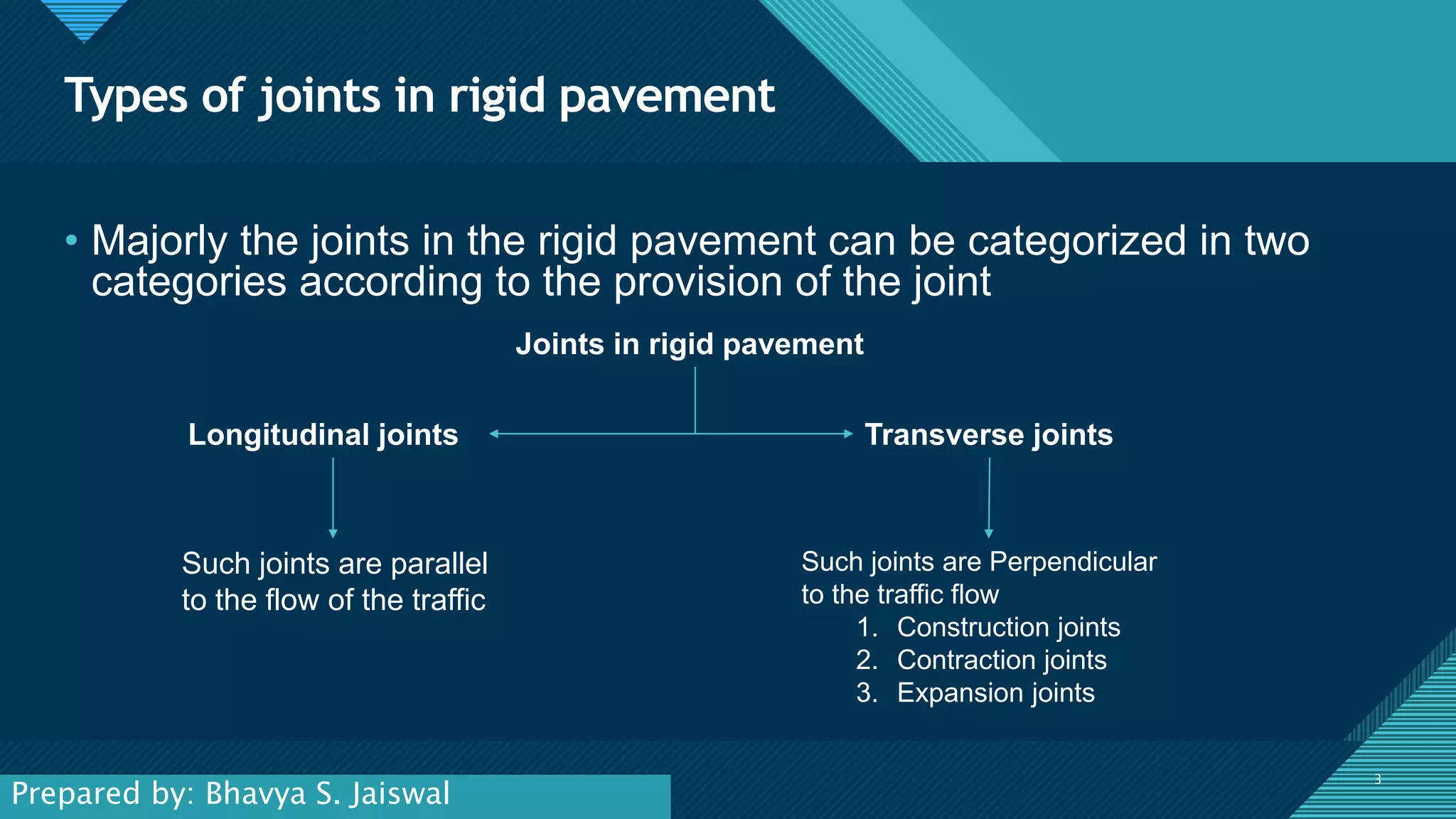
• Majorly the joints in the rigid pavement can be categorized in two
categories according to the provision of the joint
Joints in rigid pavement
Longitudinal joints Transverse joints
Such joints are parallel
to the flow of the traffic
Such joints are Perpendicular
to the traffic flow
1. Construction joints
2. Contraction joints
3. Expansion joints
Prepared by: Bhavya S. Jaiswal
Click to edit Master title style
4
Longitudinal joints
4
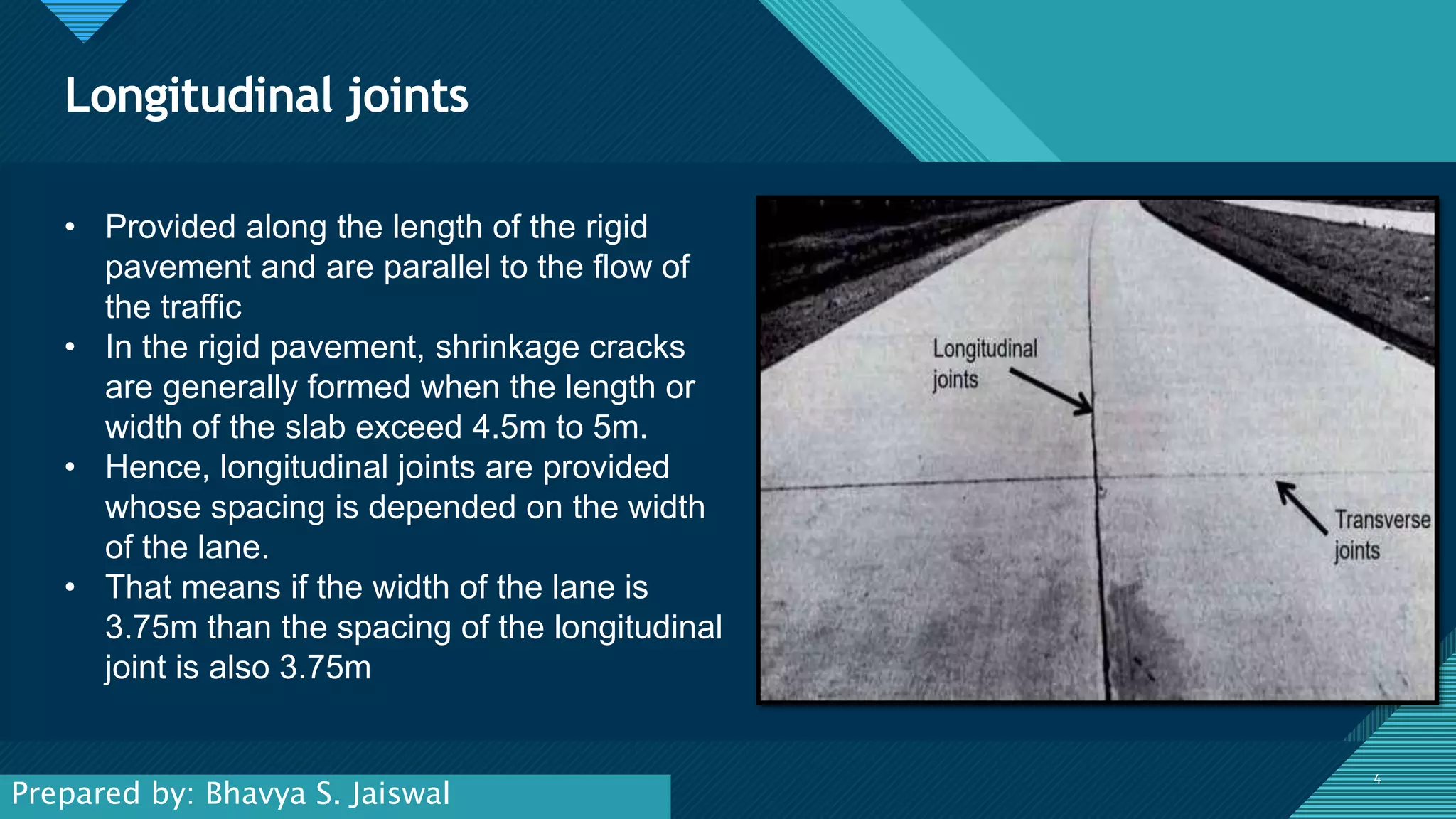
• Provided along the length of the rigid
pavement and are parallel to the flow of
the traffic
• In the rigid pavement, shrinkage cracks
are generally formed when the length or
width of the slab exceed 4.5m to 5m.
• Hence, longitudinal joints are provided
whose spacing is depended on the width
of the lane.
• That means if the width of the lane is
3.75m than the spacing of the longitudinal
joint is also 3.75m
Prepared by: Bhavya S. Jaiswal
Click to edit Master title style
5
Transverse joints
5
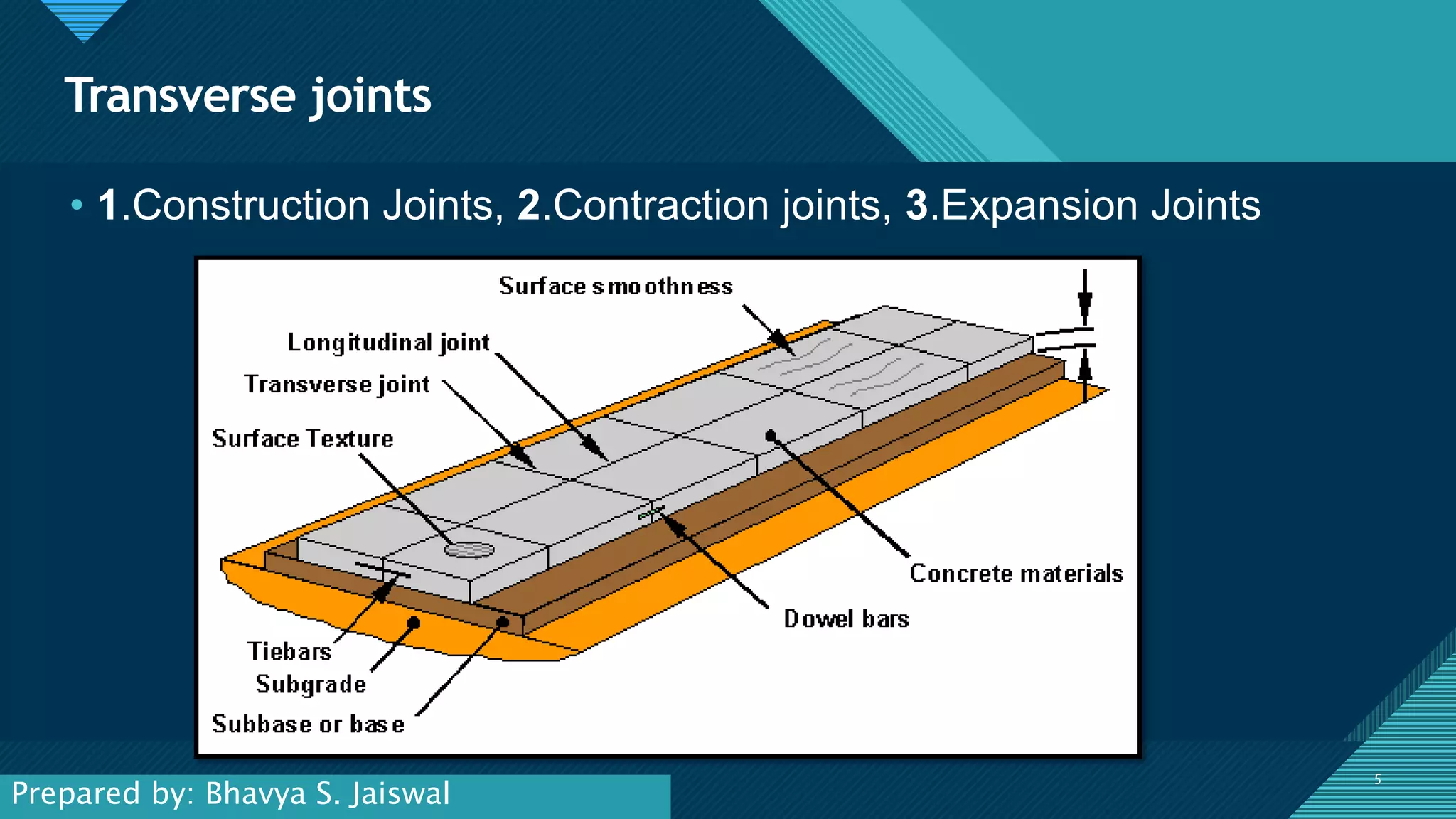
• 1.Construction Joints, 2.Contraction joints, 3.Expansion Joints
Prepared by: Bhavya S. Jaiswal
Click to edit Master title style
6
1.Construction Joints
6
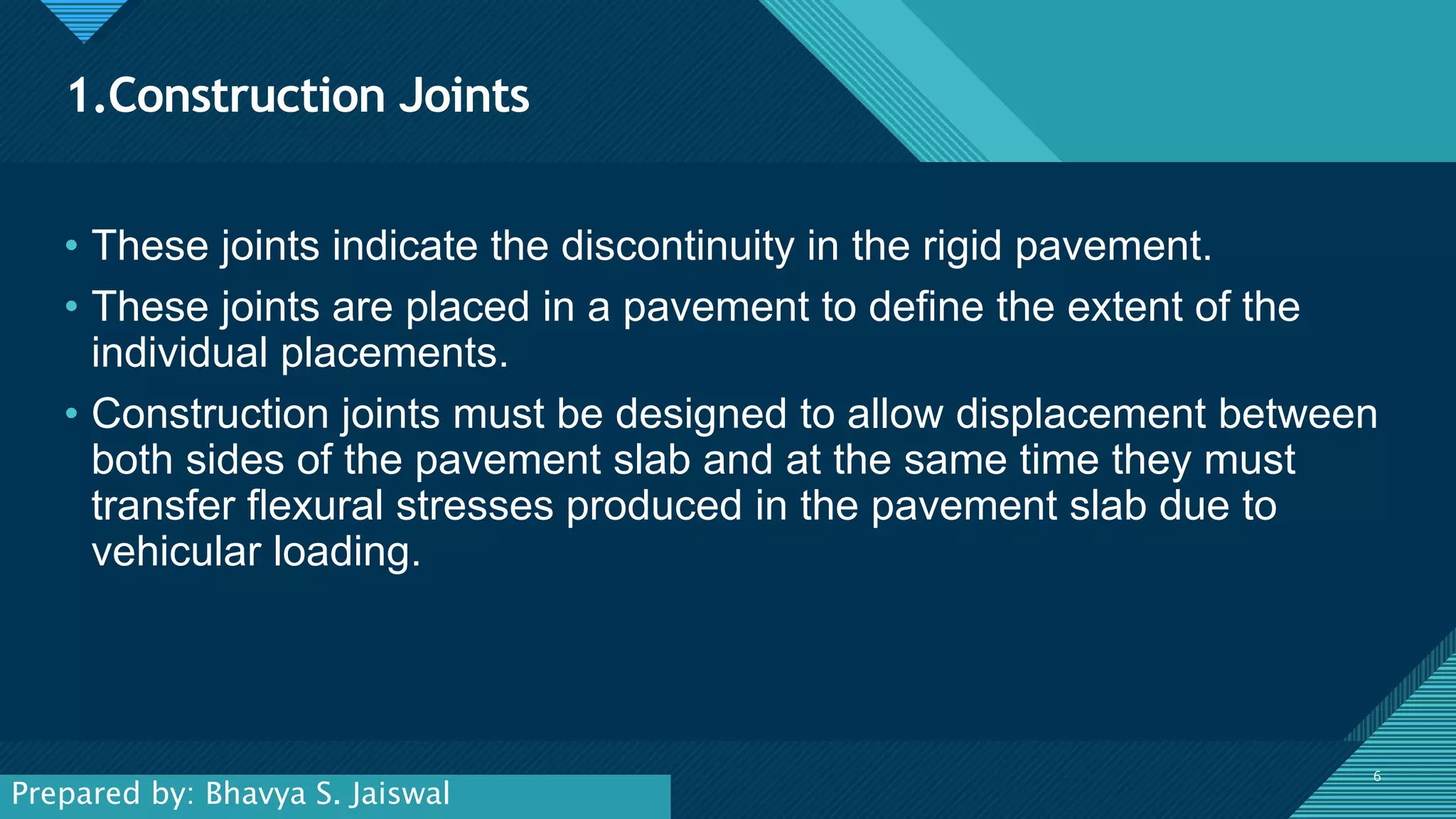
• These joints indicate the discontinuity in the rigid pavement.
• These joints are placed in a pavement to define the extent of the
individual placements.
• Construction joints must be designed to allow displacement between
both sides of the pavement slab and at the same time they must
transfer flexural stresses produced in the pavement slab due to
vehicular loading.
Prepared by: Bhavya S. Jaiswal
Click to edit Master title style
7
2.Contraction joints
7
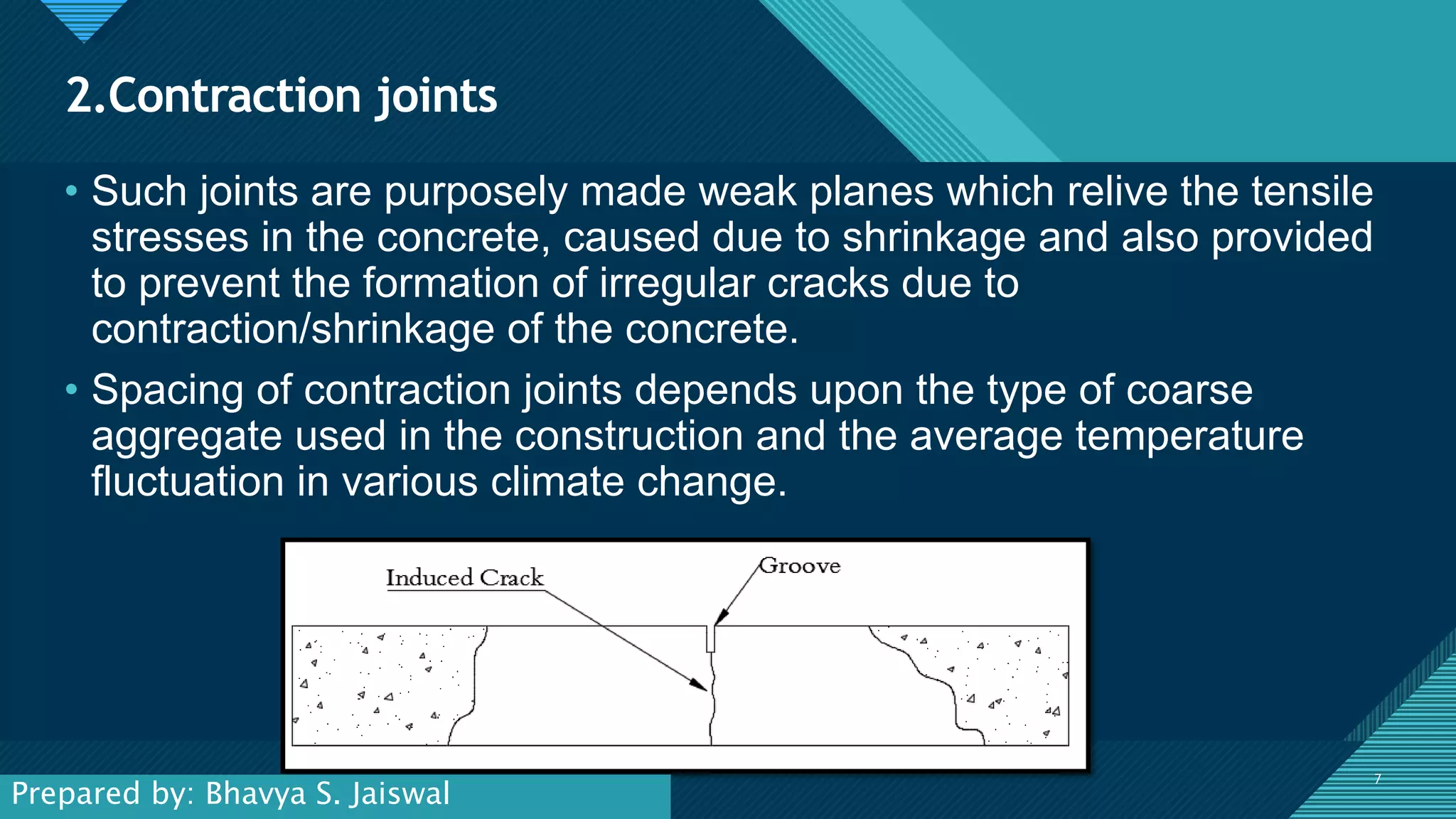
• Such joints are purposely made weak planes which relive the tensile
stresses in the concrete, caused due to shrinkage and also provided
to prevent the formation of irregular cracks due to
contraction/shrinkage of the concrete.
• Spacing of contraction joints depends upon the type of coarse
aggregate used in the construction and the average temperature
fluctuation in various climate change.
Prepared by: Bhavya S. Jaiswal
Click to edit Master title style
8
3.Expansion Joints
8
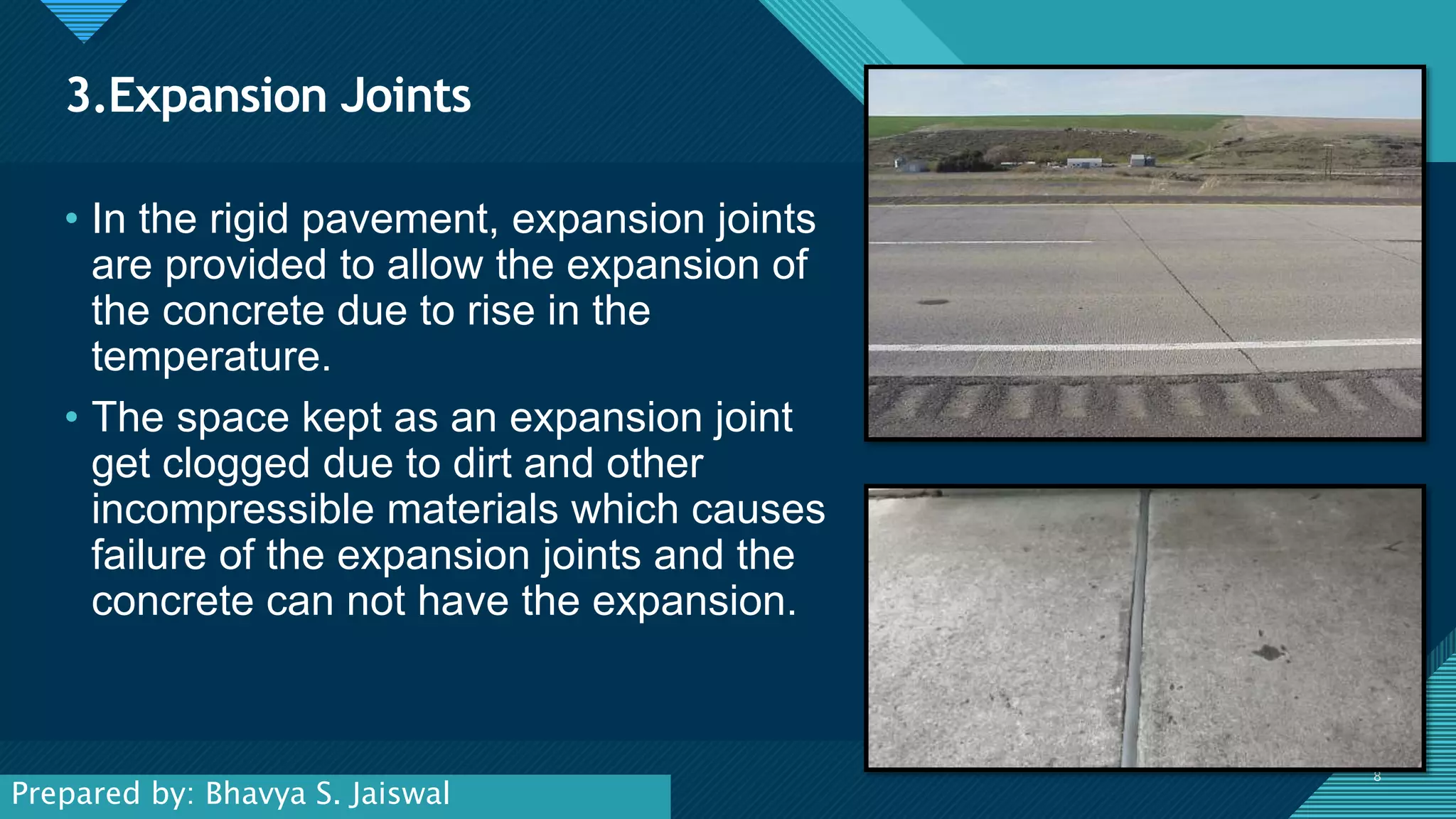
• In the rigid pavement, expansion joints
are provided to allow the expansion of
the concrete due to rise in the
temperature.
• The space kept as an expansion joint
get clogged due to dirt and other
incompressible materials which causes
failure of the expansion joints and the
concrete can not have the expansion.
Prepared by: Bhavya S. Jaiswal

Types of joints in rigid pavement

  • 1.
    Click to editMaster title style 1 Types of Joints in Rigid Pavement P a v e m e n t D e s i g n Bhavya S. Jaiswal Btech civil, Mtech Transportation Engineering
  • 2.
    Click to editMaster title style 2 Introduction 2 • Load transfer is done by slab action. • Rigid pavement has a significant flexural strength because it behaves like a slab. • Presence of various joint is observed. • Design is based on elastic theory. • High initial cost and low maintenance cost. • IRC-58:2012 CC pavement Base Course Sub Grade Prepared by: Bhavya S. Jaiswal
  • 3.
    Click to editMaster title style 3 Types of joints in rigid pavement 3 • Majorly the joints in the rigid pavement can be categorized in two categories according to the provision of the joint Joints in rigid pavement Longitudinal joints Transverse joints Such joints are parallel to the flow of the traffic Such joints are Perpendicular to the traffic flow 1. Construction joints 2. Contraction joints 3. Expansion joints Prepared by: Bhavya S. Jaiswal
  • 4.
    Click to editMaster title style 4 Longitudinal joints 4 • Provided along the length of the rigid pavement and are parallel to the flow of the traffic • In the rigid pavement, shrinkage cracks are generally formed when the length or width of the slab exceed 4.5m to 5m. • Hence, longitudinal joints are provided whose spacing is depended on the width of the lane. • That means if the width of the lane is 3.75m than the spacing of the longitudinal joint is also 3.75m Prepared by: Bhavya S. Jaiswal
  • 5.
    Click to editMaster title style 5 Transverse joints 5 • 1.Construction Joints, 2.Contraction joints, 3.Expansion Joints Prepared by: Bhavya S. Jaiswal
  • 6.
    Click to editMaster title style 6 1.Construction Joints 6 • These joints indicate the discontinuity in the rigid pavement. • These joints are placed in a pavement to define the extent of the individual placements. • Construction joints must be designed to allow displacement between both sides of the pavement slab and at the same time they must transfer flexural stresses produced in the pavement slab due to vehicular loading. Prepared by: Bhavya S. Jaiswal
  • 7.
    Click to editMaster title style 7 2.Contraction joints 7 • Such joints are purposely made weak planes which relive the tensile stresses in the concrete, caused due to shrinkage and also provided to prevent the formation of irregular cracks due to contraction/shrinkage of the concrete. • Spacing of contraction joints depends upon the type of coarse aggregate used in the construction and the average temperature fluctuation in various climate change. Prepared by: Bhavya S. Jaiswal
  • 8.
    Click to editMaster title style 8 3.Expansion Joints 8 • In the rigid pavement, expansion joints are provided to allow the expansion of the concrete due to rise in the temperature. • The space kept as an expansion joint get clogged due to dirt and other incompressible materials which causes failure of the expansion joints and the concrete can not have the expansion. Prepared by: Bhavya S. Jaiswal