

Embed presentation
Downloaded 86 times


The document discusses patterns and sequences in mathematics. It explains that a sequence is the proper term for a pattern of numbers, with each number in the sequence having a term name (first term, second term, etc.). It provides examples of number sequences and instructs readers to look for the relationship between each term to predict the next number in the sequence. Several practice sequences are presented for readers to identify the patterns.
The slide introduces the concept of 'Patterns' as a fundamental idea in mathematics.
Defines sequences as patterns of numbers; first term and second term noted as key elements.
Emphasizes the importance of observing multiple numbers (4-5) to understand a pattern before predicting.
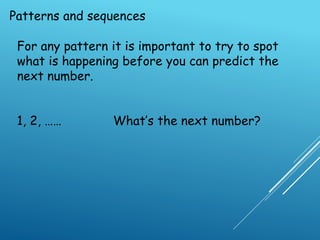
Provides an example (1, 2, ...) emphasizing the need to identify the pattern for prediction.
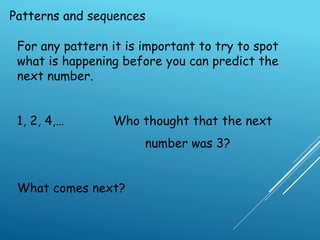
Another example (1, 2, 4, ...) highlights the common misconception and encourages pattern identification.
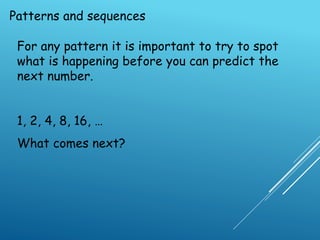
Illustrates progression in the sequence (1, 2, 4, 8, 16, ...) and challenges participation in predicting the next number.
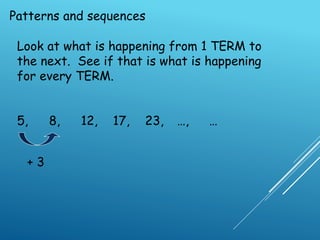
Introduces a sequence-based cue; showing differences (+3) between terms helps in prediction.
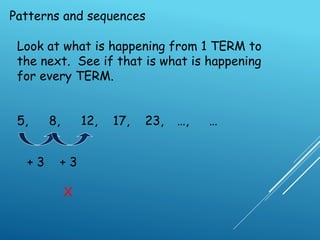
Continues pattern discussion, emphasizing consistent differences (+3 +3) across terms.
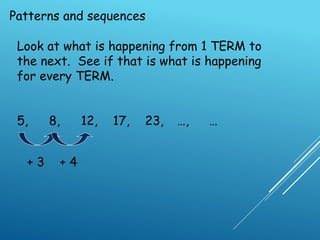
Explores the variation in differences with an updated example (+3 +4), prompting deeper analysis.
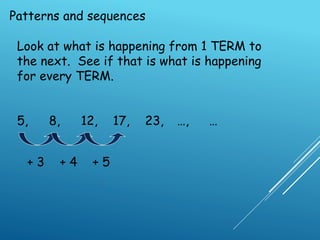
Introduces cumulative differences (+3 +4 +5) in terms to identify trends in sequence development.
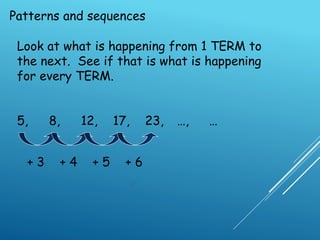
Continues the identification of increasingly complex differences in terms (+3 +4 +5 +6).
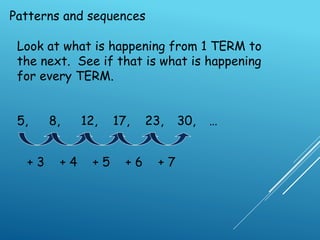
Shows a complete sequence and how cumulative differences (+3 +4 +5 +6 +7) lead to the next prediction.
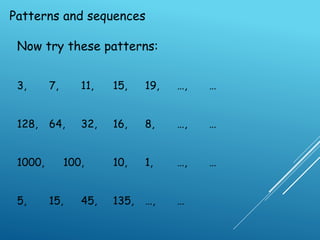
Presents multiple patterns for practice, testing the ability to spot and predict numerical sequences.


