Generating Patterns
MOST ESSENTIAL LEARNING COMPETENCY:
THE LEARNERS CAN GENERATE PATTERNS
(M10AL-IA-1).
At the end of the lesson, you are
expected to:
1. generate pattern from a given
succession of objects, numbers,
letters, or symbols;
2. find the nth term of a sequence;
and
3. write the rule for the nth term of a
sequence.
2,4,6,8,10,12,…
a, b, c, d, e
For any pattern it is important to
try to spot what is happening
before you can predict the next
number.
1, 2, …… What’s the next
number?
.
1, 2, 4,…
What comes next?
1, 2, 4, 8, 16, …
What comes next?
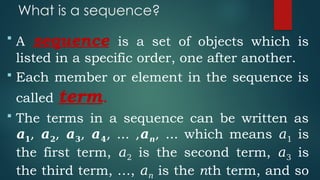
What is a sequence?
 A sequence is a set of objects which is
listed in a specific order, one after another.
 Each member or element in the sequence is
called term.
 The terms in a sequence can be written as
𝒂𝟏, 𝒂𝟐, 𝒂𝟑, 𝒂𝟒, ... ,𝒂𝒏, ... which means 𝑎1 is
the first term, 𝑎2 is the second term, 𝑎3 is
the third term, …, 𝑎𝑛 is the nth term, and so
1st
Term
nth term (a term's position
in the sequence)
a1
Position or order
of the terms
n
an
Sequences can be classified as either
finite sequence or infinite sequence.
Finite Infinite
• has limited
number of terms
• it has an end or
last term
• has countless
number of terms
• it continues
without stopping
1. The first five natural number.
2. The set of even whole numbers.
3. The multiples of 4 up to the 40.
4. The sequence of the multiples of three
FINITE
INFINITE
INFINITE
FINITE
3, 6, 9, 12, 15, 18,…
2, 4, 6, 8, 10, 12, 14, 16, …
4, 8, 12, 16, 20, 24, 28, 32, 36, 40
1, 2, 3, 4, 5
Finding terms of a sequence
 A term in a sequence can be
identified using a general
term.
 A general term or the nth
term is usually expressed as
an equation.
How to find a term of a sequence
using a general term?
Consider the following steps:
1. Substitute the value of n.
2. Perform the operations.
3. Simplify.
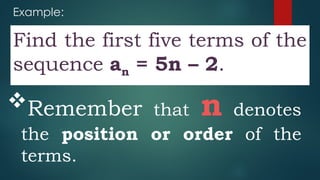
Example:
Find the first five terms of the
sequence an = 5n – 2.
Remember that n denotes
the position or order of the
terms.
Solution: Find the first five terms of the
sequence an = 5n – 2.
an = 5n – 2
For the first term, n = 1
an = 5n – 2
a1 = 5(1) – 2
a1 = 5 – 2
a1 = 3
Solution: Find the first five terms of the
sequence an = 5n – 2.
For the second term,
n = 2
an = 5n – 2
a2 = 5(2) – 2
a2 = 10 – 2
a2 = 8
For the third term,
n = 3
an = 5n – 2
a3 = 5(3) – 2
a3 = 15 – 2
a3 = 13
Solution: Find the first five terms of the
sequence an = 5n – 2.
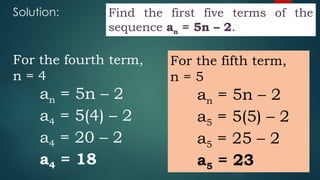
For the fourth term,
n = 4
an = 5n – 2
a4 = 5(4) – 2
a4 = 20 – 2
a4 = 18
For the fifth term,
n = 5
an = 5n – 2
a5 = 5(5) – 2
a5 = 25 – 2
a5 = 23
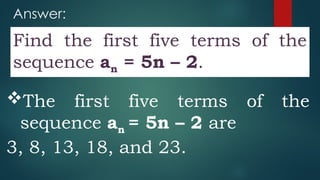
Answer:
Find the first five terms of the
sequence an = 5n – 2.
The first five terms of the
sequence an = 5n – 2 are
3, 8, 13, 18, and 23.

Generating patterns Lesson_ in Math.pptx

  • 1.
    Generating Patterns MOST ESSENTIALLEARNING COMPETENCY: THE LEARNERS CAN GENERATE PATTERNS (M10AL-IA-1).
  • 2.
    At the endof the lesson, you are expected to: 1. generate pattern from a given succession of objects, numbers, letters, or symbols; 2. find the nth term of a sequence; and 3. write the rule for the nth term of a sequence.
  • 3.
  • 6.
    For any patternit is important to try to spot what is happening before you can predict the next number. 1, 2, …… What’s the next number?
  • 7.
    . 1, 2, 4,… Whatcomes next?
  • 8.
    1, 2, 4,8, 16, … What comes next?
  • 14.
    What is asequence?  A sequence is a set of objects which is listed in a specific order, one after another.  Each member or element in the sequence is called term.  The terms in a sequence can be written as 𝒂𝟏, 𝒂𝟐, 𝒂𝟑, 𝒂𝟒, ... ,𝒂𝒏, ... which means 𝑎1 is the first term, 𝑎2 is the second term, 𝑎3 is the third term, …, 𝑎𝑛 is the nth term, and so
  • 15.
    1st Term nth term (aterm's position in the sequence) a1 Position or order of the terms n an
  • 16.
    Sequences can beclassified as either finite sequence or infinite sequence. Finite Infinite • has limited number of terms • it has an end or last term • has countless number of terms • it continues without stopping
  • 17.
    1. The firstfive natural number. 2. The set of even whole numbers. 3. The multiples of 4 up to the 40. 4. The sequence of the multiples of three FINITE INFINITE INFINITE FINITE 3, 6, 9, 12, 15, 18,… 2, 4, 6, 8, 10, 12, 14, 16, … 4, 8, 12, 16, 20, 24, 28, 32, 36, 40 1, 2, 3, 4, 5
  • 18.
    Finding terms ofa sequence  A term in a sequence can be identified using a general term.  A general term or the nth term is usually expressed as an equation.
  • 19.
    How to finda term of a sequence using a general term? Consider the following steps: 1. Substitute the value of n. 2. Perform the operations. 3. Simplify.
  • 20.
    Example: Find the firstfive terms of the sequence an = 5n – 2. Remember that n denotes the position or order of the terms.
  • 21.
    Solution: Find thefirst five terms of the sequence an = 5n – 2. an = 5n – 2 For the first term, n = 1 an = 5n – 2 a1 = 5(1) – 2 a1 = 5 – 2 a1 = 3
  • 22.
    Solution: Find thefirst five terms of the sequence an = 5n – 2. For the second term, n = 2 an = 5n – 2 a2 = 5(2) – 2 a2 = 10 – 2 a2 = 8 For the third term, n = 3 an = 5n – 2 a3 = 5(3) – 2 a3 = 15 – 2 a3 = 13
  • 23.
    Solution: Find thefirst five terms of the sequence an = 5n – 2. For the fourth term, n = 4 an = 5n – 2 a4 = 5(4) – 2 a4 = 20 – 2 a4 = 18 For the fifth term, n = 5 an = 5n – 2 a5 = 5(5) – 2 a5 = 25 – 2 a5 = 23
  • 24.
    Answer: Find the firstfive terms of the sequence an = 5n – 2. The first five terms of the sequence an = 5n – 2 are 3, 8, 13, 18, and 23.