



August 8, 2013
For live audio, you must use your phone and dial (866) 513-4976; passcode: 6875187
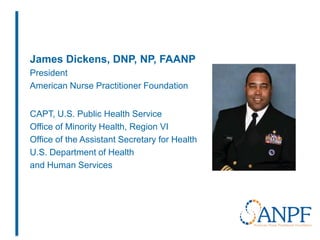
James Dickens, DNP, NP, FAANP
President
American Nurse Practitioner Foundation
CAPT, U.S. Public Health Service
Office of Minority Health, Region VI
Office of the Assistant Secretary for Health
U.S. Department of Health
and Human Services
American Nurse Practitioner Foundation
• Formed in 1998
• First National NP Foundation in the US
• Focus on solutions to costly healthcare outcomes
related to unmanaged Chronic Disease
– Resources and Tools through Simply Health in Practice
Over $1 million given in Scholarships and vital research grants
to help overcome the impending shortage of Primary Care
Providers and assist research efforts to improve patient care.
American Nurse Practitioner Foundation
• Network NPs on domestic and global Humanitarian
efforts.
• Connect NPs and Corporations for communication
leading to better healthcare.
• Provide Global Care, starting locally.
The goal of the webinar is to link important advocacy
messages to patient messaging and focus.
Webinar Objectives
By the end of the webinar, participants will:
• Understand patient’s rights and provider relationships
• Identify ways healthcare providers and patients can
collaborate to create legislative change
• Understanding the role of the family caregiver
• Establish ways to focus on patient centered
messaging while utilizing the healthcare provider
Speakers
• Regina Holliday, caregiver, patient advocate and
artist
• Susan Hassmiller, PhD, RN, FAAN,
Robert Wood Johnson Foundation’s Senior Advisor
for Nursing & Director for the Future of Nursing:
Campaign for Action
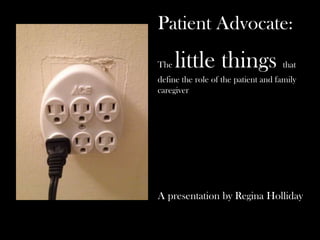
Patient Advocate:
The little things that
define the role of the patient and family
caregiver
A presentation by Regina Holliday
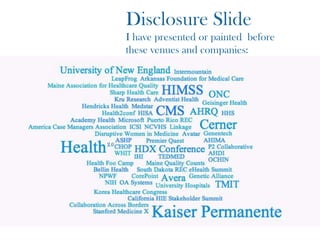
Disclosure Slide
I have presented or painted before
these venues and companies:
2.0
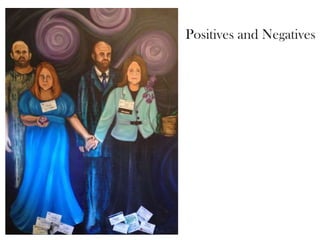
Positives and Negatives
Creative Thinking
Is this a clothespin or a bear trap?
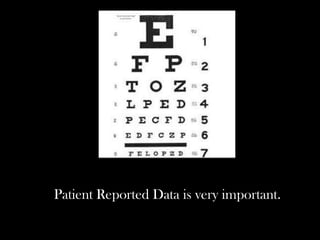
Patient Reported Data is very important.
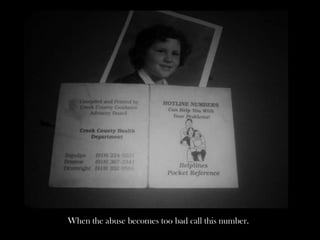
When the abuse becomes too bad call this number.
Fred would meet Regina on a stage
in a scenic painting class at Oklahoma State University.
We would talk of Stephen King’s Dark Tower.
We would fall in love.
Fred got a Masters and then a PhD.
I would paint neighborhood murals.
I would teach art at a local preschool.
I would work in a toy store.
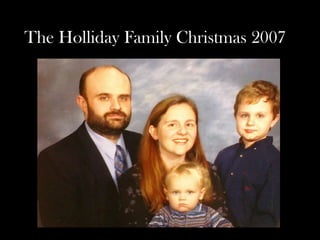
The Holliday Family Christmas 2007
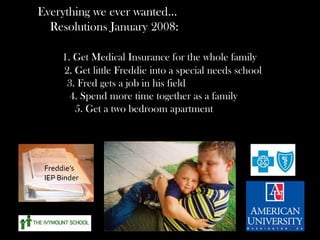
Everything we ever wanted…
Resolutions January 2008:
1. Get Medical Insurance for the whole family
2. Get little Freddie into a special needs school
3. Fred gets a job in his field
4. Spend more time together as a family
5. Get a two bedroom apartment
Freddie’s
IEP Binder
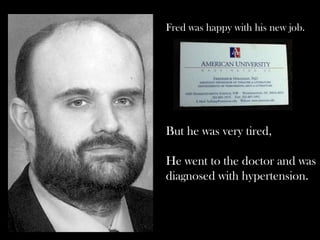
Fred was happy with his new job.
But he was very tired,
He went to the doctor and was
diagnosed with hypertension.
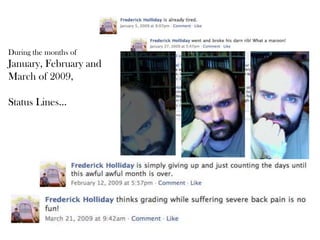
During the months of
January, February and
March of 2009,
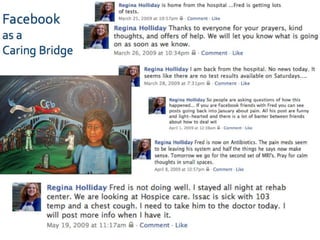
Status Lines…
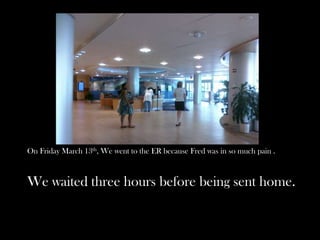
On Friday March 13th, We went to the ER because Fred was in so much pain .
We waited three hours before being sent home.
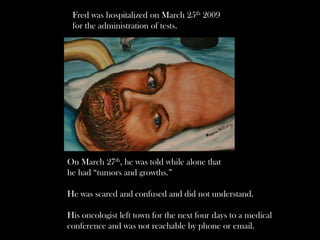
Fred was hospitalized on March 25th 2009
for the administration of tests.
On March 27th, he was told while alone that
he had “tumors and growths.”
He was scared and confused and did not understand.
His oncologist left town for the next four days to a medical
conference and was not reachable by phone or email.
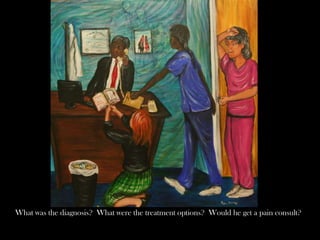
What was the diagnosis? What were the treatment options? Would he get a pain consult?
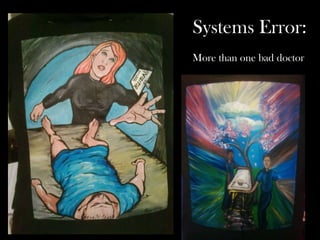
Systems Error:
More than one bad doctor
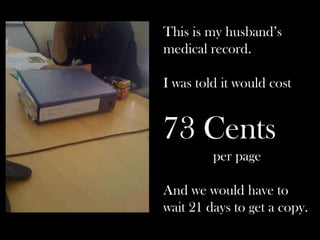
This is my husband’s
medical record.
I was told it would cost
73 Cents
per page
And we would have to
wait 21 days to get a copy.
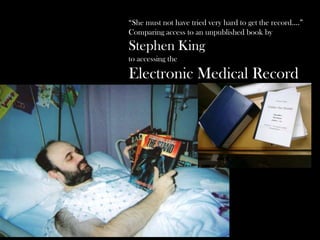
“She must not have tried very hard to get the record….”
Comparing access to an unpublished book by
Stephen King
to accessing the
Electronic Medical Record
while hospitalized.
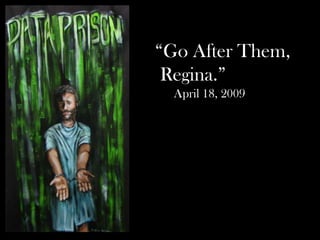
“Go After Them,
Regina.”
April 18, 2009
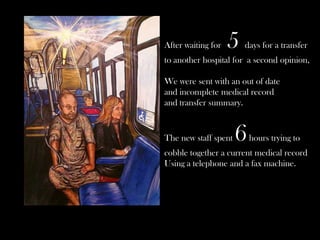
After waiting for 5 days for a transfer
to another hospital for a second opinion,
We were sent with an out of date
and incomplete medical record
and transfer summary.
The new staff spent 6hours trying to
cobble together a current medical record
Using a telephone and a fax machine.
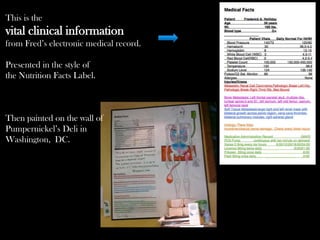
This is the
vital clinical information
from Fred’s electronic medical record.
Presented in the style of
the Nutrition Facts Label.
Then painted on the wall of
Pumpernickel’s Deli in
Washington, DC.
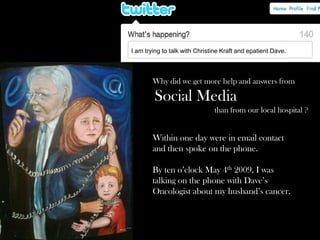
I am trying to talk with Christine Kraft and epatient Dave.
Within one day were in email contact
and then spoke on the phone.
By ten o’clock May 4th 2009, I was
talking on the phone with Dave’s
Oncologist about my husband’s cancer.
Why did we get more help and answers from
Social Media
than from our local hospital ?
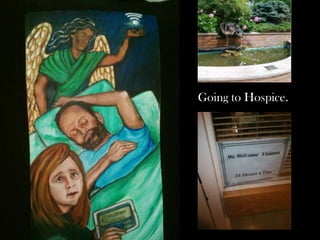
Going to Hospice.
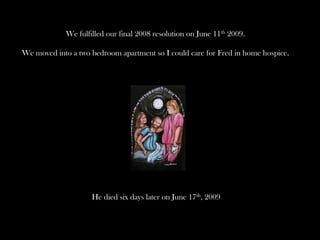
We fulfilled our final 2008 resolution on June 11th 2009.
We moved into a two bedroom apartment so I could care for Fred in home hospice.
He died six days later on June 17th, 2009
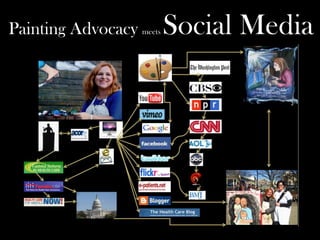
Painting Advocacy meets Social Media
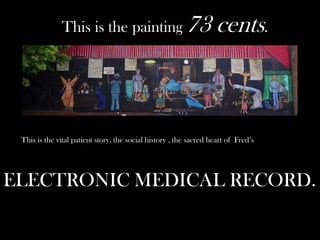
This is the painting 73 cents.
This is the vital patient story, the social history , the sacred heart of Fred’s
ELECTRONIC MEDICAL RECORD.
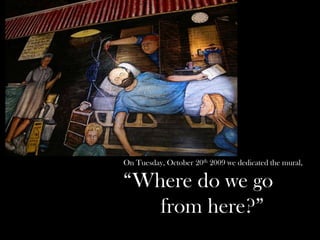
On Tuesday, October 20th 2009 we dedicated the mural,
“Where do we go
from here?”
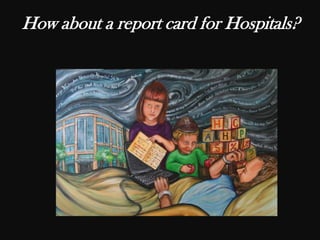
How about a report card for Hospitals?
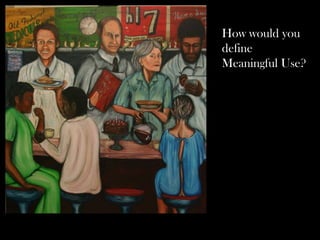
How would you
define
Meaningful Use?
The in HIT
Here is the real meaning of
the “I” in HIT.
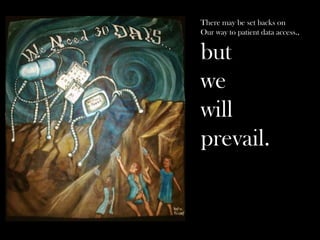
There may be set backs on
Our way to patient data access.,
but
we
will
prevail.
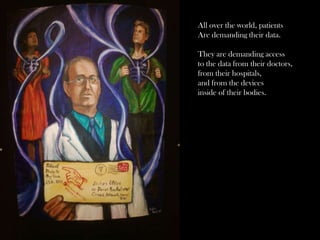
All over the world, patients
Are demanding their data.
They are demanding access
to the data from their doctors,
from their hospitals,
and from the devices
inside of their bodies.
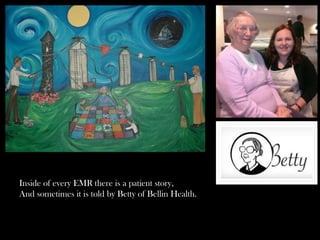
Inside of every EMR there is a patient story,
And sometimes it is told by Betty of Bellin Health.
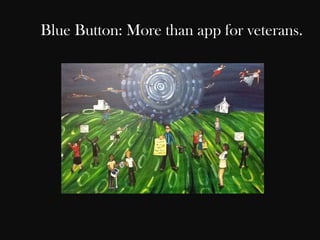
Blue Button: More than app for veterans.
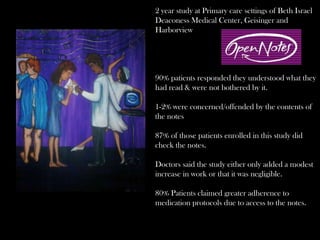
2 year study at Primary care settings of Beth Israel
Deaconess Medical Center, Geisinger and
Harborview
90% patients responded they understood what they
had read & were not bothered by it.
1-2% were concerned/offended by the contents of
the notes
87% of those patients enrolled in this study did
check the notes.
Doctors said the study either only added a modest
increase in work or that it was negligible.
80% Patients claimed greater adherence to
medication protocols due to access to the notes.
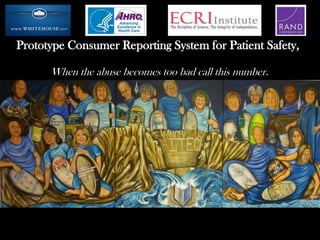
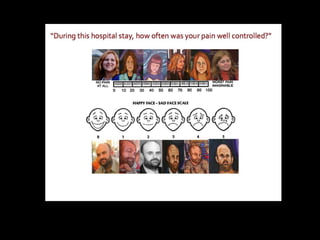
Prototype Consumer Reporting System for Patient Safety,
When the abuse becomes too bad call this number.
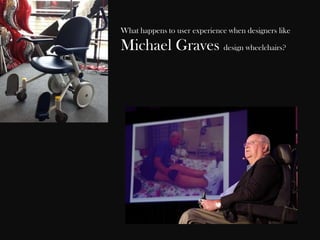
What happens to user experience when designers like
Michael Graves design wheelchairs?
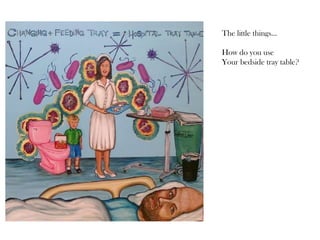
The little things…
How do you use
Your bedside tray table?
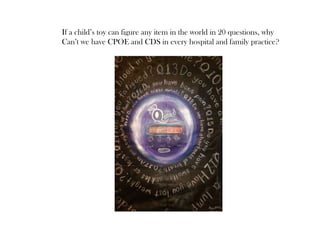
If a child’s toy can figure any item in the world in 20 questions, why
Can’t we have CPOE and CDS in every hospital and family practice?
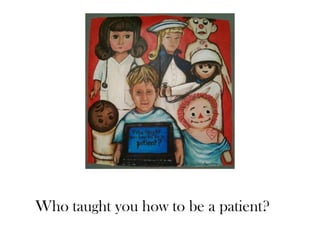
Who taught you how to be a patient?
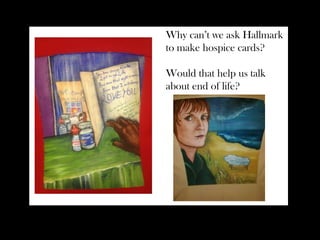
Why can’t we ask Hallmark
to make hospice cards?
Would that help us talk
about end of life?
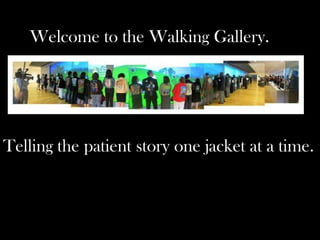
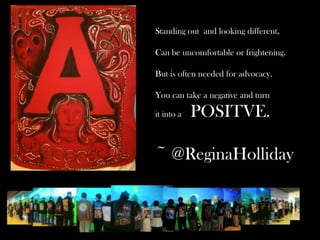
Welcome to the Walking Gallery.
Telling the patient story one jacket at a time.
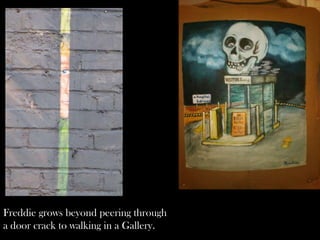
Freddie grows beyond peering through
a door crack to walking in a Gallery.
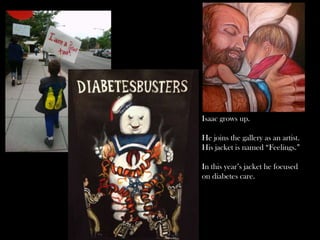
Isaac grows up.
He joins the gallery as an artist.
His jacket is named “Feelings.”
In this year’s jacket he focused
on diabetes care.
Standing out and looking different,
Can be uncomfortable or frightening.
But is often needed for advocacy.
You can take a negative and turn
it into a POSITVE.
~ @ReginaHolliday
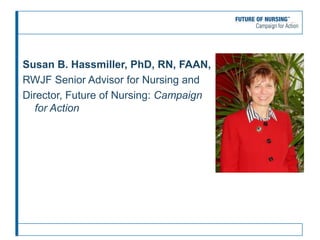
Susan B. Hassmiller, PhD, RN, FAAN,
RWJF Senior Advisor for Nursing and
Director, Future of Nursing: Campaign
for Action
Campaign Vision
All Americans have access to high-quality,
patient-centered care in a health care system
where nurses contribute as essential partners
in achieving success.
Jody’s Patient’s Story
• Bedridden patient who was diagnosed with wound.
• Needed visiting nursing services.
• Took week to receive authorization from physician’s
office.
• Patient’s wound became larger and took longer to
heal.
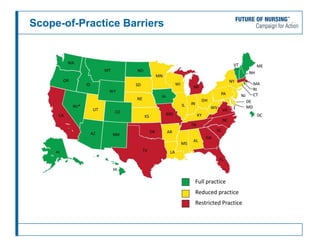
Scope-of-Practice Barriers
Full practice
Reduced practice
Restricted Practice
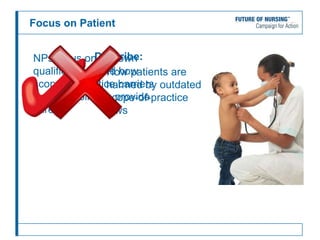
Focus on Patient
NPs focus on our own
qualifications and how
scope-of-practice barriers
hurt our ability to provide
care.
Describe:
• How patients are
harmed by outdated
scope-of-practice
laws
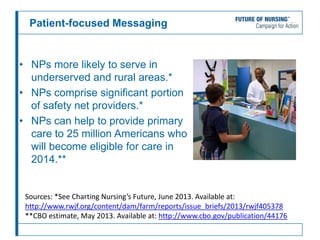
Patient-focused Messaging
• NPs more likely to serve in
underserved and rural areas.*
• NPs comprise significant portion
of safety net providers.*
• NPs can help to provide primary
care to 25 million Americans who
will become eligible for care in
2014.**
Sources: *See Charting Nursing’s Future, June 2013. Available at:
http://www.rwjf.org/content/dam/farm/reports/issue_briefs/2013/rwjf405378
**CBO estimate, May 2013. Available at: http://www.cbo.gov/publication/44176
Patient-focused Messaging
The State Op-Ed: “Nurses Can Help Solve Pending Care
Crisis”
• Describes implications of crisis: longer waits, more ER
crowding and more expensive primary care.
• Explains how NPs can help improve access to care.
• Mentions barriers, despite evidence supporting APRN
practice.
• Calls on policy leaders to remove barriers so South
Carolinians can get care they need.
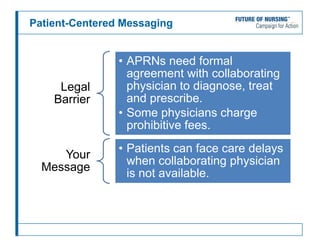
Patient-Centered Messaging
Legal
Barrier
• APRNs need formal
agreement with collaborating
physician to diagnose, treat
and prescribe.
• Some physicians charge
prohibitive fees.
Your
Message
• Patients can face care delays
when collaborating physician
is not available.
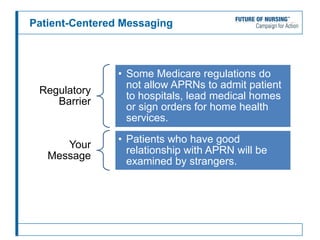
Patient-Centered Messaging
Regulatory
Barrier
• Some Medicare regulations do
not allow APRNs to admit patient
to hospitals, lead medical homes
or sign orders for home health
services.
Your
Message
• Patients who have good
relationship with APRN will be
examined by strangers.
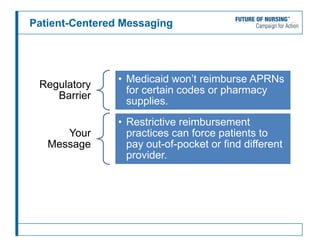
Patient-Centered Messaging
Regulatory
Barrier
• Medicaid won’t reimburse APRNs
for certain codes or pharmacy
supplies.
Your
Message
• Restrictive reimbursement
practices can force patients to
pay out-of-pocket or find different
provider.
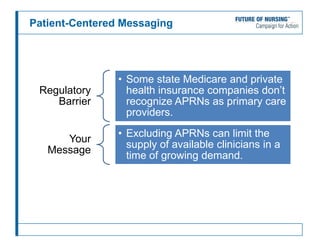
Patient-Centered Messaging
Regulatory
Barrier
• Some state Medicare and private
health insurance companies don’t
recognize APRNs as primary care
providers.
Your
Message
• Excluding APRNs can limit the
supply of available clinicians in a
time of growing demand.
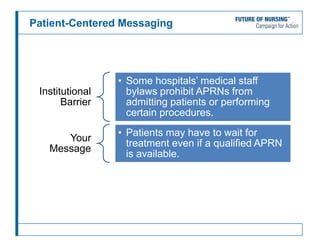
Patient-Centered Messaging
Institutional
Barrier
• Some hospitals’ medical staff
bylaws prohibit APRNs from
admitting patients or performing
certain procedures.
Your
Message
• Patients may have to wait for
treatment even if a qualified APRN
is available.
http://facebook.com/campaignforaction www.twitter.com/campaignforaction
Campaign Resources
Visit us on the web at
www.campaignforaction.org
Press *1 on your telephone key pad to ask a question
OR
Use the “chat” feature to send the host/presenter a question.
Email Questions to foundation@anp-foundation.org
Visit us at www.anp-foundation.org
12600 Hill Country Blvd, Suite R-275
Austin, Texas 78738
512-320-2644

Patient Advocates: A Powerful Nurse Practitioner Resource 2

  • 1.
    August 8, 2013 Forlive audio, you must use your phone and dial (866) 513-4976; passcode: 6875187
  • 2.
    James Dickens, DNP,NP, FAANP President American Nurse Practitioner Foundation CAPT, U.S. Public Health Service Office of Minority Health, Region VI Office of the Assistant Secretary for Health U.S. Department of Health and Human Services
  • 3.
    American Nurse PractitionerFoundation American Nurse Practitioner Foundation • Formed in 1998 • First National NP Foundation in the US • Focus on solutions to costly healthcare outcomes related to unmanaged Chronic Disease – Resources and Tools through Simply Health in Practice Over $1 million given in Scholarships and vital research grants to help overcome the impending shortage of Primary Care Providers and assist research efforts to improve patient care.
  • 4.
    American Nurse PractitionerFoundation • Network NPs on domestic and global Humanitarian efforts. • Connect NPs and Corporations for communication leading to better healthcare. • Provide Global Care, starting locally. The goal of the webinar is to link important advocacy messages to patient messaging and focus.
  • 5.
    Webinar Objectives By theend of the webinar, participants will: • Understand patient’s rights and provider relationships • Identify ways healthcare providers and patients can collaborate to create legislative change • Understanding the role of the family caregiver • Establish ways to focus on patient centered messaging while utilizing the healthcare provider
  • 6.
    Speakers • Regina Holliday,caregiver, patient advocate and artist • Susan Hassmiller, PhD, RN, FAAN, Robert Wood Johnson Foundation’s Senior Advisor for Nursing & Director for the Future of Nursing: Campaign for Action
  • 7.
    Patient Advocate: The littlethings that define the role of the patient and family caregiver A presentation by Regina Holliday
  • 8.
    Disclosure Slide I havepresented or painted before these venues and companies: 2.0
  • 9.
  • 10.
    Creative Thinking Is thisa clothespin or a bear trap?
  • 11.
    Patient Reported Datais very important.
  • 12.
    When the abusebecomes too bad call this number.
  • 13.
    Fred would meetRegina on a stage in a scenic painting class at Oklahoma State University. We would talk of Stephen King’s Dark Tower. We would fall in love.
  • 14.
    Fred got aMasters and then a PhD. I would paint neighborhood murals. I would teach art at a local preschool. I would work in a toy store.
  • 15.
    The Holliday FamilyChristmas 2007
  • 16.
    Everything we everwanted… Resolutions January 2008: 1. Get Medical Insurance for the whole family 2. Get little Freddie into a special needs school 3. Fred gets a job in his field 4. Spend more time together as a family 5. Get a two bedroom apartment Freddie’s IEP Binder
  • 17.
    Fred was happywith his new job. But he was very tired, He went to the doctor and was diagnosed with hypertension.
  • 18.
    During the monthsof January, February and March of 2009, Status Lines…
  • 19.
    On Friday March13th, We went to the ER because Fred was in so much pain . We waited three hours before being sent home.
  • 20.
    Fred was hospitalizedon March 25th 2009 for the administration of tests. On March 27th, he was told while alone that he had “tumors and growths.” He was scared and confused and did not understand. His oncologist left town for the next four days to a medical conference and was not reachable by phone or email.
  • 21.
    What was thediagnosis? What were the treatment options? Would he get a pain consult?
  • 22.
  • 23.
    This is myhusband’s medical record. I was told it would cost 73 Cents per page And we would have to wait 21 days to get a copy.
  • 24.
    “She must nothave tried very hard to get the record….” Comparing access to an unpublished book by Stephen King to accessing the Electronic Medical Record while hospitalized.
  • 25.
  • 26.
    After waiting for5 days for a transfer to another hospital for a second opinion, We were sent with an out of date and incomplete medical record and transfer summary. The new staff spent 6hours trying to cobble together a current medical record Using a telephone and a fax machine.
  • 27.
    This is the vitalclinical information from Fred’s electronic medical record. Presented in the style of the Nutrition Facts Label. Then painted on the wall of Pumpernickel’s Deli in Washington, DC.
  • 29.
    I am tryingto talk with Christine Kraft and epatient Dave. Within one day were in email contact and then spoke on the phone. By ten o’clock May 4th 2009, I was talking on the phone with Dave’s Oncologist about my husband’s cancer. Why did we get more help and answers from Social Media than from our local hospital ?
  • 30.
  • 31.
    We fulfilled ourfinal 2008 resolution on June 11th 2009. We moved into a two bedroom apartment so I could care for Fred in home hospice. He died six days later on June 17th, 2009
  • 32.
  • 33.
    This is thepainting 73 cents. This is the vital patient story, the social history , the sacred heart of Fred’s ELECTRONIC MEDICAL RECORD.
  • 34.
    On Tuesday, October20th 2009 we dedicated the mural, “Where do we go from here?”
  • 35.
    How about areport card for Hospitals?
  • 36.
  • 37.
    The in HIT Hereis the real meaning of the “I” in HIT.
  • 38.
    There may beset backs on Our way to patient data access., but we will prevail.
  • 39.
    All over theworld, patients Are demanding their data. They are demanding access to the data from their doctors, from their hospitals, and from the devices inside of their bodies.
  • 40.
    Inside of everyEMR there is a patient story, And sometimes it is told by Betty of Bellin Health.
  • 41.
    Blue Button: Morethan app for veterans.
  • 42.
    2 year studyat Primary care settings of Beth Israel Deaconess Medical Center, Geisinger and Harborview 90% patients responded they understood what they had read & were not bothered by it. 1-2% were concerned/offended by the contents of the notes 87% of those patients enrolled in this study did check the notes. Doctors said the study either only added a modest increase in work or that it was negligible. 80% Patients claimed greater adherence to medication protocols due to access to the notes.
  • 43.
    Prototype Consumer ReportingSystem for Patient Safety, When the abuse becomes too bad call this number.
  • 44.
    What happens touser experience when designers like Michael Graves design wheelchairs?
  • 45.
    The little things… Howdo you use Your bedside tray table?
  • 46.
    If a child’stoy can figure any item in the world in 20 questions, why Can’t we have CPOE and CDS in every hospital and family practice?
  • 47.
    Who taught youhow to be a patient?
  • 49.
    Why can’t weask Hallmark to make hospice cards? Would that help us talk about end of life?
  • 50.
    Welcome to theWalking Gallery. Telling the patient story one jacket at a time.
  • 51.
    Freddie grows beyondpeering through a door crack to walking in a Gallery.
  • 52.
    Isaac grows up. Hejoins the gallery as an artist. His jacket is named “Feelings.” In this year’s jacket he focused on diabetes care.
  • 53.
    Standing out andlooking different, Can be uncomfortable or frightening. But is often needed for advocacy. You can take a negative and turn it into a POSITVE. ~ @ReginaHolliday
  • 54.
    Susan B. Hassmiller,PhD, RN, FAAN, RWJF Senior Advisor for Nursing and Director, Future of Nursing: Campaign for Action
  • 55.
    Campaign Vision All Americanshave access to high-quality, patient-centered care in a health care system where nurses contribute as essential partners in achieving success.
  • 56.
    Jody’s Patient’s Story •Bedridden patient who was diagnosed with wound. • Needed visiting nursing services. • Took week to receive authorization from physician’s office. • Patient’s wound became larger and took longer to heal.
  • 57.
  • 58.
    Focus on Patient NPsfocus on our own qualifications and how scope-of-practice barriers hurt our ability to provide care. Describe: • How patients are harmed by outdated scope-of-practice laws
  • 59.
    Patient-focused Messaging • NPsmore likely to serve in underserved and rural areas.* • NPs comprise significant portion of safety net providers.* • NPs can help to provide primary care to 25 million Americans who will become eligible for care in 2014.** Sources: *See Charting Nursing’s Future, June 2013. Available at: http://www.rwjf.org/content/dam/farm/reports/issue_briefs/2013/rwjf405378 **CBO estimate, May 2013. Available at: http://www.cbo.gov/publication/44176
  • 60.
    Patient-focused Messaging The StateOp-Ed: “Nurses Can Help Solve Pending Care Crisis” • Describes implications of crisis: longer waits, more ER crowding and more expensive primary care. • Explains how NPs can help improve access to care. • Mentions barriers, despite evidence supporting APRN practice. • Calls on policy leaders to remove barriers so South Carolinians can get care they need.
  • 61.
    Patient-Centered Messaging Legal Barrier • APRNsneed formal agreement with collaborating physician to diagnose, treat and prescribe. • Some physicians charge prohibitive fees. Your Message • Patients can face care delays when collaborating physician is not available.
  • 62.
    Patient-Centered Messaging Regulatory Barrier • SomeMedicare regulations do not allow APRNs to admit patient to hospitals, lead medical homes or sign orders for home health services. Your Message • Patients who have good relationship with APRN will be examined by strangers.
  • 63.
    Patient-Centered Messaging Regulatory Barrier • Medicaidwon’t reimburse APRNs for certain codes or pharmacy supplies. Your Message • Restrictive reimbursement practices can force patients to pay out-of-pocket or find different provider.
  • 64.
    Patient-Centered Messaging Regulatory Barrier • Somestate Medicare and private health insurance companies don’t recognize APRNs as primary care providers. Your Message • Excluding APRNs can limit the supply of available clinicians in a time of growing demand.
  • 65.
    Patient-Centered Messaging Institutional Barrier • Somehospitals’ medical staff bylaws prohibit APRNs from admitting patients or performing certain procedures. Your Message • Patients may have to wait for treatment even if a qualified APRN is available.
  • 66.
  • 67.
    Press *1 onyour telephone key pad to ask a question OR Use the “chat” feature to send the host/presenter a question.
  • 68.
    Email Questions tofoundation@anp-foundation.org Visit us at www.anp-foundation.org 12600 Hill Country Blvd, Suite R-275 Austin, Texas 78738 512-320-2644

Editor's Notes

  • #3 JamesThank you for joining us for today’s webinar: Patient Advocates: A Powerful Nurse Practitioner Resource. I am James Dickens, President of the American Nurse Practitioner Foundation. We are delighted to be sponsoring this webinar and I want to provide a speacial thanks to our sponsor Astra-Zeneca for making this webinar possible. Also a thanks to the Future of Nursing: Campaign for Action for their support. Before we get started, I just want to mention that we arerecording today’s presentation.We plan to take questions over the phone at the end of the presentation.
  • #6 JamesAnd so, I would now like to turn it over to our speakers. First,Regina Holliday, caregiver, patient advocate and artist, she tells a personal story in words and art across the U.S. and globally. She sends a powerful message about patient rights, the healthcare system and needed change. She will change your view of patient relationships.Then, Susan Hassmiller, PhD, RN, FAAN,Robert Woods Johnson Foundation’s Senior Advisor for Nursing and Director for the Future of Nursing Campaign for Action, addressing nurse and faculty shortages in an effort to create a higher quality of patient care in the U.S. She speaks to organizational advocacy for the less fortunate and underserved. Susan will share with healthcare providers how focusing on patient centered messaging can have an impact on changing legislation by addressing: scope of practice, prescriptive authority and reimbursement.
  • #7 Regina
  • #55 Sue HassmillerThank you, Regina, for sharing your story, and thank you for your commitment to improving patient care. Regina’s story underscores that patients and their family members need to be full partners with providers. And both need to work together as a team to achieve high-quality care. 
  • #56 The Robert Wood Johnson Foundation and AARP are committed to ensuring that patients receive high-quality patient-centered care. And that’s why we’re advocating for the removal of outdated scope-of-practice barriers as part of the Future of Nursing: Campaign for Action. We need to stop engaging in turf battles and start putting the patient first. We need to make sure that patients receive timely access to care.As nurses and nurse practitioners, we all too often see the adverse ramifications when our health care system fails to place the patient first.
  • #57 For example, Jody Hoppis is a nurse practitioner who owns a house calls practice in Bellingham, Washington. Although she can generally practice to the full extent of her education and training, a Medicare policy resulted in one of her patients receiving worse care. The patient was bedridden; Jody diagnosed a wound and recommended visiting nurse services. However, it took more than a week for the patient to receive treatment, and as a result, the wound became larger and took longer to heal. Why the delay? Jody must follow a Medicare requirement for physician certification of home health services. That means she needed to find a physician willing to countersign home health orders and set up a contract. Since the physician’s office that she found was located two hours away, Jody spent time and resources faxing authorizations back and forth between her practice, the physician and home health agencies. It took Jody a week to obtain authorization for wound care for this patient and for the home health agency to accept the orders.
  • #58 Fortunately, Jody lives in Washington State, where NPs face few legal barriers to practice -- 31 states that have outdated barriers that prevent nurses from practicing to the full extent of their education and training.
  • #59 We need to remove these barriers to improve patient care. We know that patients will benefit when policy-makers eliminate outdated scope-of-practice barriers.But far too often, nurses and nurse practitioners don’t emphasize the benefits to patients.We focus on our own qualifications and how scope-of-practice barriers hurt our ability to provide care. And quite frankly, policy-makers don’t care about turf battles.We can’t change scope-of-practice laws by focusing on ourselves. But we can convince policy-makers to change laws, regulations and institutional policies by focusing on how patients are harmed by outdated scope-of-practice regulations.We need to use patient-focused messaging when we talk to policy-makers.
  • #60 We need to explain that nurse practitioners are more likely than physicians to practice in underserved remote and rural areas and make up a significant portion of the nation’s safety net providers. Hospitalized patients are more likely to receive care from an advanced practice registered nurse if they live in a rural area.  Up to 25 million people will become eligible for health insurance next year, and nurse practitioners can help to ensure that patients don’t face delays in seeing a primary care practitioner.
  • #61 A recent op-ed published in The State, a South Carolina newspaper, does a fantastic job of emphasizing how patients will benefit if nurse practitioners are able to practice to the full extent of their education and training – starting with the title: “Nurses can help solve pending crisis.” You can find a link to the op-ed in the email you received with the webinar call-in information, and it will also be posted to the Campaign for Action webinar page. The author, Stephanie Burgess, describes the current health care crisis in South Carolina and notes that that state will have to provide primary care to 800,000 new patients. She describes the implications: longer waits for well-care visits, more crowding in ERs and an increase in cost for primary care.She then describes how an “obvious solution” exists: over 2,500 advanced practice nurses already in South Carolina. She states that giving patients the option to select an advanced-practice nurse as their primary care provider could give them access to an additional 3,000 providers.Only then does she mention scope of practice barriers in South Carolina and assert that these barriers mean that “patients struggle to get the care they need in a timely and safe manner.” She provides evidence supporting APRN practice and mentions that 19 states already allow them to practice to the full extent of their education and training.She ends by calling on policy leaders to take swift action to allow advanced practice nurses to “provide the care that so many South Carolinians need before the burden on our health-care system becomes even greater.”  You should adapt this article for your messaging to policy-makers. It’s convincing primarily because it focuses on the benefits to patients.
  • #62 When you speak with policy-makers about legal, regulatory and institutional barriers, always describe the impact on patients and patient care. Here are examples:  Legal/Regulatory Barriers. The majority of states require most APRNs to have a formal agreement, such as New Jersey’s joint protocol with a collaborating physician in order to diagnose, treat and prescribe. Further, some physicians charge fees for their services that APRNs can’t afford.  We need to explain that the risk of delays in care is high when collaborating physicians are not readily available. One of your members shared a story about a boy in Texas who experienced a severe asthma attack. His family took him to his physician’s office for treatment. But the physician had died earlier that week, and the office was closed, even though a nurse practitioner worked there and could have provided care if Texas wasn’t subject to a collaborating physician agreement. Instead, the nurse practitioner was at home because she didn’t have a collaborating physician to work with, and the boy didn’t receive timely care.
  • #63 Some Medicare regulations do not allow APRNs to admit patient to hospitals, lead medical homes or sign orders for home health services.  Your message should be that patients who have a good relationship with an APRN will be examined by strangers.
  • #64 In some states, Medicaid won’t reimburse APRNs for certain codes or pharmacy supplies.  Your message should be that restrictive reimbursement practices can force patients to pay out-of-pocket or find a different provider. Katie Lavery, a certified nurse midwife in Michigan, says that because Medicaid won’t reimburse her office for Depo-Provera, her patients have to go to a pharmacy to pick up the prescription and bring it back to her office for the injection.
  • #65 In some parts of the country, APRNs are not recognized as primary care providers by Medicare or private health insurance companies.  Your message should be that excluding APRNs can limit the supply of available clinicians in a time of growing demand.
  • #66 And at some hospitals, medical staff bylaws prohibit APRNs from admitting patients or performing certain procedures. Only anesthesiologists at some hospitals can perform invasive monitor placements, for example.  Your message should be that at some hospitals, patients may have to wait for treatment even if a qualified APRN is available.
  • #67 So please go to www.campaignforaction.org to sign up and get involved. Join the Campaign for Action and become a force for change to make nurses a valued partner in health care improvements. Together, let’s create a health system that provides accessible, affordable and quality care to every American.  Thank you.  
  • #68 JamesThank you Regina and Sue. now happy to take any questions you might have! At this time, listeners can ask a question over the phone by pressing *1 on your telephone. Operator, we would now like to open the lines for questions. Listeners can also type their questions using the chat function. Be sure to send the question to “everyone”.
  • #69 JamesThank you and good bye.